Rand Is Already Running, Ctd

Last week, Rich Lowry wrote that, while he is “far from a Rand Paul-ite,” anyone “underestimating him in 2016 does so at their peril”:

At least for some stretch of 2015, Rand Paul could well be the Republican front-runner, tapping into grass-roots enthusiasm on the model of Howard Dean in 2003. And it’s not inconceivable that he could go further than that famous representative of “the Democratic wing of the Democratic Party,” although the field will presumably be very crowded on the right.

But Ramesh doubts that voters will warmly receive his economic platform:

Paul’s economic plan includes a 17 percent flat tax to replace the current income tax. The effect of such a policy would be a bigger bill for a lot of middle-class households. The median income for a family of four is $65,000, and under the current tax code — assuming the family takes the standard deduction — its federal income-tax bill would be about $2,700. Under the plan Paul sketches, it would be about $3,500.

A single mother of one making $35,000 a year would see her tax liability rise, too. If she uses the standard deduction, she pays about $1,500 today. She’d probably pay $2,100 if Paul had his way.

The very richest Americans, on the other hand, would see their taxes decrease a lot. The journalists buzzing about Paul have rarely discussed this. They want to talk to him about foreign policy or marijuana. I suspect that if he were a presidential nominee, however, voters would see a lot more Democratic ads about his views on taxes. And he wouldn’t come across as the candidate who wants to keep the government out of their wallets.

Francis Wilkinson focuses instead on “Paul’s ‘crunchy con’ persona”:

At a Reagan library event, he extolled the virtues of composting. This is anything but trivial. Conservatism in recent years has defined itself largely by what it hates: Obama, liberals, government. Environmentalism is high on that list, as a toxic stream of votes in the House of Representatives confirms. Paul’s embrace of composting is brilliant: It suggests a thoughtfulness about the environment (along with an absence of hatred) without in any way challenging Republican petro-donors.

Paul’s fiscal policy, including a flat tax and a grim reaper approach to federal departments and the federal budget, should be enough to keep him penned in on Congress’s end of Pennsylvania Avenue. But a Paul presidential run might begin to liberate his party from other orthodoxies.

Earlier Dish on Rand here.

Bound To Obesity

Is being obese a matter of individual responsibility? David Berreby finds that question far too simplistic:

If you or your parents – or their parents – were undernourished, you’re more likely to become obese in a food-rich environment. Moreover, obese people, when they have children, pass on changes in metabolism that can predispose the next generation to obesity as well. Like the children of underfed people, the children of the overfed have their metabolism set in ways that tend to promote obesity. This means that a past of undernutrition, combined with a present of overnutrition, is an obesity trap.

[Professor of nutrition Jonathan C K] Wells memorably calls this double-bind the ‘metabolic ghetto’, and you can’t escape it just by turning poor people into middle-class consumers: that turn to prosperity is precisely what triggers the trap. ‘Obesity,’ he writes, ‘like undernutrition, is thus fundamentally a state of malnutrition, in each case promoted by powerful profit-led manipulations of the global supply and quality of food.’

The trap is deeper than that, however. … Wells told me via email, ‘We need to understand that we have not yet grasped how to address this situation, but we are increasingly understanding that attributing obesity to personal responsibility is very simplistic.’ Rather than harping on personal responsibility so much, Wells believes, we should be looking at the global economic system, seeking to reform it so that it promotes access to nutritious food for everyone. That is, admittedly, a tall order. But the argument is worth considering, if only as a bracing critique of our individual-responsibility ideology of fatness.

Recent Dish on obesity here, here, and here.

The Things They Couldn’t Carry Home, Ctd

A reader writes:

The news from Afghanistan is hardly the first time the United States has scrapped military hardware on an industrial level. After World War II, a similar (and far more aggressive) scrapping took place. My own grandfather was in the Merchant Marine in August 1945, bound for the Philippines with a ship full of M4 Sherman tanks destined for the invasion of the Japanese home islands. When the ship learned of Hiroshima, Nagasaki and the unconditional surrender, they were ordered to dump the tanks into the ocean and head home. Because it was cheaper than transporting them to the Philippines.

Is the waste we’re seeing stupid and sad and more than a little ridiculous? Yes. But it’s not especially indicative of America’s crumbling power.

Another has a bit of good news:

​I have some knowledge of the logistics of getting some of the equipment back from Afghanistan (is the vague enough for you?). They’ve cancelled lunch at a lot of facilities and forward operating bases. There are so many MREs floating around the country and the best way to get rid of them is in American stomaches. It helps that it saves money on the cafeteria contract.

Another circles back to the Second World War:

It’s interesting that the US is going to the expense of actually destroying the excess equipment.  There are other options.  In WWII, we established a huge base on Santo Island in the New Hebrides (now Vanuatu).  At the end of the war they tried to sell the excess equipment to the British and French colonial authorities for ten cents on the dollar. But they refused, figuring they would get it for free when we left it there. Rather than do that, the US built a jetty and just dropped everything off the end into fairly shallow water.  It’s now a famous scuba site called “Million Dollar Point” that has probably made more money for the locals in tourism than the value of the equipment.  It’s eerie seeing all the jeeps, trucks, etc., rusting away 100’ underwater.

Photos here. Update from a reader:

One of those Google image results was not of military equipment. Well, not standard issue, anyhow.

Thanks for the laugh.

Your Souvenir Barcode

ticket

In 1973, a nine-year-old Paul Lukas went to see a Mets baseball game, keeping the ticket to remember the day – an experience he’s not likely to have again:

I no longer save my tickets like I did when I was a kid. But even if I were still inclined to save such things, the 2013 ticket isn’t a particularly pleasing keepsake. It’s printed on an ordinary sheet of paper, it has no design flourishes other than the Mets logo, and it isn’t very official-seeming. The fact that the Mets felt the need to emblazon it with the words “THIS IS YOUR TICKET” speaks to how un-ticket-like it is. Like every other ticket these days, it’s really just a bar code delivery device. I suppose I might be inclined to save it if something historic had happened at this game — a no-hitter, say, or a single player hitting four home runs—but it still wouldn’t have the satisfying feel of something that could be framed or put in an album.

His broader point – and a counterpoint from a reader:

[T]he real cost of digital ticketing isn’t just the loss of nicely designed physical items. It’s also the loss of documentation, the loss of personal totems that serve as touchstones to past experiences. Of course, digital tickets are documented too, since every ticket purchase and turnstile scan ends up on a hard drive or server as more data to be mined. But that’s not the same as having an envelope full of stubs that you can pull out of the drawer whenever you like.

Update from a reader:

While we no longer have the physical momento of a ticket, we have digital artifacts that can be more powerful. Any photo I take with my phone at a ball game is instantly backed up with date and location information attached. I can instagram the event and pick a filter to match the mood. I can Vine a video or post about it to Google Plus or Facebook. In short, I can curate the moment the way I choose.

(Photo by Jeff Marquis)

The Good, Dirty Book

Jamie Quatro discusses her O. Henry prize-winning short story, “Sinkhole” – which, like much of her work, explores “the intersection of faith and sexuality in Judeo-Christian orthodoxy”:

“Sinkhole” is the only story I’ve ever written that came to me as a grand-scale, amorphous idea: to write a combination loss-of-virginity/exorcism scene in which neither person realized what was happening to the other. That was all I had. No image or character, not even a fragment of dialogue…

Growing up, I was flummoxed by the church’s strictures on sexual behavior on the one hand and the rampant scriptural use of sexual image and metaphor on the other. It seems there’s something inherently erotic about the way we’re supposed to think about God (bridegroom) and the way he thinks about us (the return of Christ as Consummation, the church as his Bride, etc). Many (most?) Christians might say the two are mutually exclusive—that sexual love is tied to flesh, love for God to spirit—but I’m convinced they’re very closely aligned.

This spring, Nina Schuyler reviewed Quatro’s collection, I Want To Show You More, and found these themes in abundance:

One of the most prevalent themes is adultery, which is sprinkled throughout the book through a series of stories. The collection opens with “Caught Up,” in which the narrator reveals her affair to her mother. The narrator has spent ten months talking daily to her lover on the phone. The affair never is consummated, but in her mother’s view, it might as well have: “It’s all the same in God’s eyes,” says her mother.

Throughout, Quatro is not cynical about God or Christian beliefs. The narrators (women) in the adultery string of stories grapple with lust, passion, guilt, and God. The adulterous narrator appears again in “Imperfections,” a two-page story in which the man kisses the narrator’s forehead. The kiss makes her right eye burn, “Like you put a seal on my forehead, I wrote to him later, and hot wax dripped down into my eye.” And she returns again in other short pieces, which begin to feel like the heavy, complicated breathing of two lovers held apart.

Stumbling Towards Success

Reviewing Worldly Philosopher: The Odyssey of Albert O. Hirschman, Malcolm Gladwell spots this arresting passage from one of the thinker’s essays:

While we are rather willing and even eager and relieved to agree with a historian’s finding that we stumbled into the more shameful events of history, such as war, we are correspondingly unwilling to concede—in fact we find it intolerable to imagine—that our more lofty achievements, such as economic, social or political progress, could have come about by stumbling rather than through careful planning. . . . Language itself conspires toward this sort of asymmetry: we fall into error, but do not usually speak of falling into truth.

How his embrace of failure, doubt, and the unexpected, spurred heterodox economic ideas:

Hirschman published his first important book, “The Strategy of Economic Development,” in 1958. He had returned from Colombia by then and was at Yale, and the book was an attempt to make sense of his experience of watching a country try to lift itself out of poverty. At the time, he was reading deeply in the literature of psychology and psychoanalysis, and he became fascinated with the functional uses of negative emotions: frustration, aggression, and, in particular, anxiety. Obstacles led to frustration, and frustration to anxiety. No one wanted to be anxious. But wasn’t anxiety the most powerful motivator—the emotion capable of driving even the most reluctant party toward some kind of solution?

In the field of developmental economics, this was heretical. When people from organizations like the World Bank descended on Third World countries, they always tried to remove obstacles to development, to reduce economic anxiety and uncertainty. They wanted to build bridges and roads and airports and dams to insure that businesses and entrepreneurs encountered as few impediments as possible to growth. But, as Hirschman thought about case studies like the Karnaphuli Paper Mills and the Troy-Greenfield folly, he became convinced that his profession had it backward. His profession ought to embrace anxiety, and not seek to remove it.

Recent Dish coverage of Hirschman here.

A Not So Grim Reaper

religiondeath

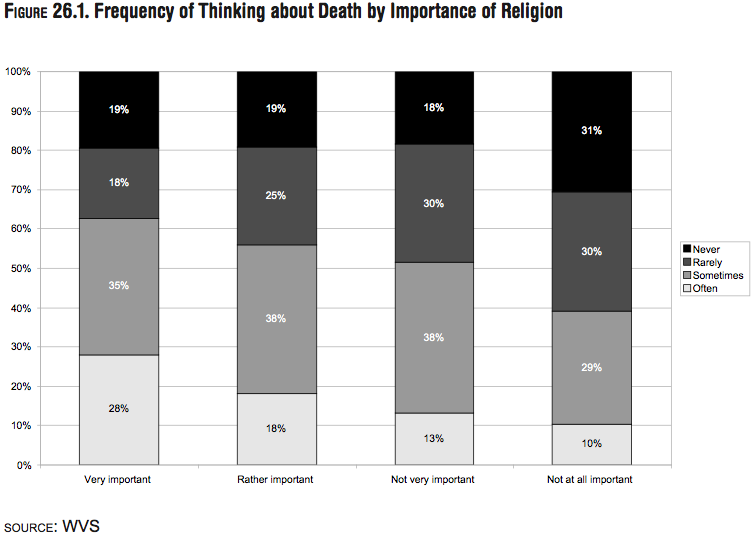
Hemant Mehta, who posts the chart above, turns to an excerpt from sociologist Ryan T. Cragun’s new book, What You Don’t Know about Religion (but Should) to support his case that atheists die “better” than the religious:

A growing body of evidence seems to support the idea that the nonreligious have an easier time coping with death than do the religious, at least with their own mortality. Religious people appear to be more afraid of death than are nonreligious people. Nonreligious people are less likely to use aggressive means to extend their lives and exhibit less anxiety about dying than do religious people. That seems remarkably counterintuitive since the nonreligious are much less likely to believe in an afterlife, which is supposed to help people cope with death. But factor in that religious people are contemplating their eternal fate and it begins to make more sense. Even if they have done everything their religion says they are supposed to do, there is always a bit of uncertainty about where they might end up. As a result, religious people appear to have a greater fear of dying than do nonreligious people.

In a related video post, Mehta answers questions about what atheists believe happens when the fateful day comes:

Related Dish coverage of atheist funerals here.

Fighting Religion With Religion?

Rabbi Jonathan Sacks argues that it will take more than science and atheism to stave off fundamentalism:

In one respect the new atheists are right. The threat to western freedom in the 21st century is not from fascism or communism but from a religious fundamentalism combining hatred of the other, the pursuit of power and contempt for human rights. But the idea that this can be defeated by individualism and relativism is naive almost beyond belief. Humanity has been here before. The precursors of today’s scientific atheists were Epicurus in third-century BCE Greece and Lucretius in first-century Rome. These were two great civilisations on the brink of decline. Having lost their faith, they were no match for what Bertrand Russell calls ‘nations less civilised than themselves but not so destitute of social cohesion’. The barbarians win. They always do.

The new barbarians are the fundamentalists who seek to impose a single truth on a plural world. Though many of them claim to be religious, they are actually devotees of the will to power. Defeating them will take the strongest possible defence of freedom, and strong societies are always moral societies. That does not mean that they need be religious. It is just that, in the words of historian Will Durant, ‘There is no significant example in history, before our time, of a society successfully maintaining moral life without the aid of religion.’

In response, Jerry Coyne calls Sacks an “ignorant fool”:

Here is a partial list of countries that have a very high percentage of nonbelievers. This is all it takes to rebut Sack’s claim that if one loses Judeo-Christian sanctity of life (note that he doesn’t mention Islam) we will descend into evil, barbarism, and perfidy:

  • Sweden
  • Denmark
  • Norway
  • Japan
  • Finland
  • France
  • Germany
  • South Korea

The last time I looked, these countries were remarkably sane, well-behaved, and their inhabitants generally moral.

What Do Women Want To See?

In an interview with Tracy Clark-Flory, former Playgirl editor Jessanne Collins describes where the magazine fell short:

Did you ever witness a Playgirl shoot that you found legitimately sexy?

Honestly, no. I mean, maybe this is another sign that I was very much a fish out of water, but I just did not at all get the aesthetic. I don’t buy the myth that women are “not visual” people whatsoever. I check out dudes. I know we all have specific aesthetic triggers. And yet in all those pages upon pages of photos — none of them did it for me. There was an almost clinical approach to photography — almost as if these bodies were specimens under a microscope, every muscle all waxed and on display — and I think that’s the major thing. It’s this certain type of porn trope that doesn’t translate well for a real female audience.

Which is why the majority of its readership was male, of course:

One can’t help but wonder why it took Playgirl so long to embrace their male demographic, which accounts for 60% of the title’s readership and 65% of online subscribers [in early 2008, shortly before the print magazine’s collapse].

Clark-Flory also asked Collins, “What would it take to publish a successful porn magazine for women?”:

Again, I think it’s very much a myth that women don’t like to look at hot visual content. I think the hard part is that there’s literally no formula for what that is. There’s something about expectedness, in fact, that just kills intrigue immediately. And this is a challenge because porn’s a pretty formulaic thing, most of it, especially what’s produced in a corporate capacity. So a porn magazine for women would have to be out of bounds — it would take a real eye for the particular chemistry that goes into making content that is suggestive and explicit, even, without being cheesy — it takes nuance, subtlety, a kind of storytelling. I think women are visual, but I also think perhaps they’re a different kind of visual than men are, maybe, in that a little can go a long way — there’s something hotter in an insinuation, a possibility, a tease than there is about a straightforward close-up of a giant penis. For many women, anyway. This is why the romance genre is so wildly successful where porn for women, in today’s porn terms, can be a hard sell. Also, smart words! Language can do a lot to turn women on, but it has to be the right language.

High Culture

Reviewing Tao Lin’s new novel Taipei, Audrea Lim surveys a history of drug use in literature:

The scholar Marcus Boon’s The Road to Excess: A History of Writers on Drugs (2002) usefully taxonomizes the different literary and philosophical tendencies associated with different classes of drugs. Narcotics are a transcendental experience, providing access to the sublime. (Antonin Artaud compared them to literature and theater). Amphetamines transform authors into tireless writing machines. (Kerouac cranked out On The Road in two or three weeks on Benzedrine). Cannabis causes the mind to meander, highlighting unnoticed details and revealing connections between seemingly unrelated things, a state that has obvious affinities with the mindset of the flâneur who wanders aimlessly through Paris’ Arcades. (It is telling that the list of books Walter Benjamin regretted never writing included one on hashish.) … Drugs can help us to adapt, to be more productive, and even to excel within our circumstances, to make our lives more bearable, and in some cases, to radically reconfigure our subjectivity, if not the world.

In Taipei, drug use is less about changing the world than it is about adjusting to it.

[The protagonist] Paul, nervous and shy by nature, tries various combinations of drugs to help him cope with ordinary life, but they don’t actually make him any more comfortable. He swallows potent chemical cocktails at parties, but they seem to produce the opposite of the intended effect: “after four more parties, two of which he similarly slept on sofas after walking mutely through rooms without looking at anyone, Paul began attending less social gatherings and ingesting more drugs.” The scene he is part of (twentysomething middle-class white kids who make mostly meaningless art) is hedonistic, yet while he participates, he seems not to derive any pleasure from it. If altered states were once, as the old Aldous Huxley chestnut has it, “doors of perception,” then sometime between Huxley’s era and the one depicted in Taipei, those doors seem to have closed.

(Video: William S. Burroughs talking about his addiction to heroin in 1977)