The Right Goes Silent On Marriage Equality

Barro studies the right-wing media’s response to Murkowski announcing that she supports marriage equality:

Nothing at National Review, the Weekly Standard, Human Events, the Washington Free Beacon, or the American Spectator. Breitbart.com ran two Associated Press stories. WorldNetDaily ran an NBC News story. The Daily Caller and RedState mentioned Murkowski in pieces about immigration reform, but nothing on gay marriage.

The only conservative outlet I found covering Murkowski was the Washington Examiner, which ran a straightforward news story about her announcement.

Four years ago, it was hard to imagine Republican senators supporting gay marriage. It was even harder to imagine conservative media outlets having no reaction at all to them doing so.

He believes that “the national conservative media is done with engaging on the issue.” Timothy Kincaid likewise notes how the debate over marriage has shifted:

[I]t seems to me that we have entered a phase in which one can be “not ready” or “not convinced” or “not yet evolved” on the issue of marriage equality. That’s simply opinion. But to be actively opposed suggests a character flaw, something with a whiff of nastiness and maybe even vile. The public – right and left – seem to have decided that you can support gay marriage or you can not support gay marriage, but you can’t oppose gay marriage any longer.

So more and more, those who can safely be assumed to favor heterosexual superiority simply choose to say nothing. Instead of defending their God-given moral view, they announce their support for states’ rights, defer to the wisdom of the courts, or just change the subject.

Does “British Art” Exist?

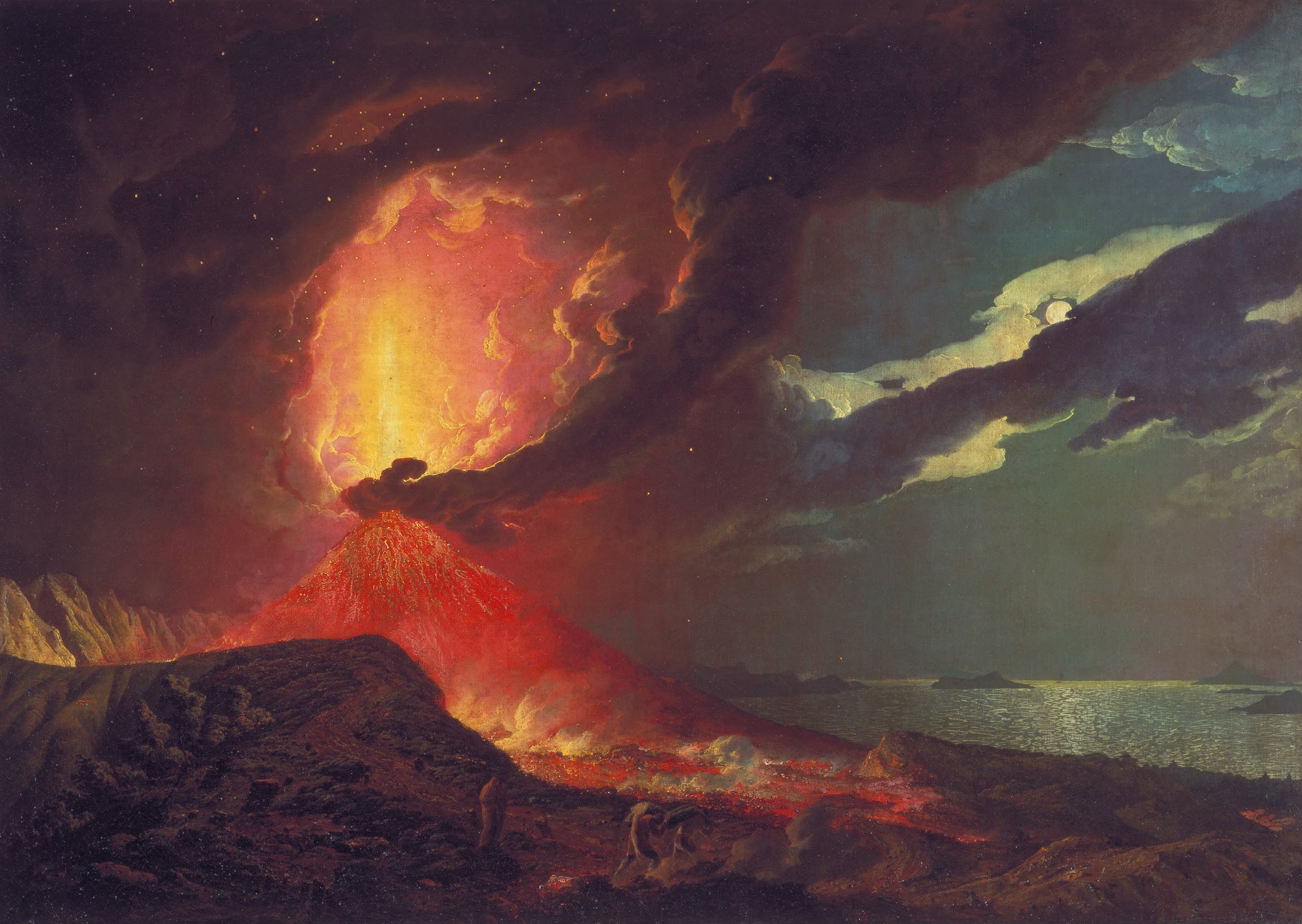
Vesuvius

After walking through the recently reorganized permanent collection at the Tate Britain, which invites visitors to “Meet British Art,” James Polchin isn’t so sure:

What makes this work distinctly British is not so clear. Some of the earliest works are done by artists born outside of Britain. Consider the grand landscape of a newly formed St. James’ Park by the 18th century Venetian painter Giovanni Antonio Canal, known as Canaletto. His early paintings of architecturally precise palazzos of Venice became popular souvenirs for British tourists. In London, he continued his distinctive bird’s-eye view of the landscape with scenes in and around the city. But what makes St. James’ Park distinctively British, I wondered. It cannot be considered as part of “the British School.” The work is much more an import or rather an immigrant into the history of British Art. There are other such immigrant artists here, such as the Dutch born van Dyck, the American Whistler, and Zoffany, a German Romantic painter who, as a short text indicates, “Travelled to paint the Empire” in India in the early 19th century.

I thought perhaps it was subject matter that anchored a definition of British art in this collection, until I arrived at Joseph Wright of Derby’s “Vesuvius in Eruption” (1776-80), an imagined view of the volcano’s burst of brilliant molten light. This was a view of Naples, stuck here in the history of British Art. Or consider the more contemporary David Hockney’s “A Bigger Splash” (1967) offering the flat tones and minimalist forms of a Southern California house and pool, the flutter of a splash in the water breaking the painting’s geometry. These are not British subjects, but composed by British born artists. The term “British Art” remains in quotations throughout these galleries as both artists and subjects confuse any firm idea of what makes this art so British. As so often happens, nationalism is something we just have to believe in here, with little evidence of its meaning or importance. Instead, this collection is an imagined community of British art. But like any imagined community, constructed from fragments and ruins, from alien forces assimilated into a whole, it is fragile idea to hold together.

(Image: Vesuvius in Eruption by Joseph Wright of Derby, 1776, via Wikimedia Commons)

The Marketing Of Obamacare

It’s about to begin in earnest:

The exchanges need roughly 2.7 million healthy 18-t0-35-year-olds to sign up to be solvent. The majority of that group is nonwhite and male, according to Simas’ data, and a third are located in just three states: California, Texas and Florida. If too few choose to enroll because they don’t know about the law, don’t like it, or feel they don’t need insurance, the exchanges will fail. And so will the law.

The Administration has plotted an extensive social-media campaign designed to reach the young and healthy and is soliciting sports teams to help raise awareness. More than 10 staffers in the Office of Public Engagement are marshalling the help of Latino and African American groups and community nonprofits. And [David] Simas has spent countless hours surrounded by maps of media markets and demographic data on the uninsured trying to remind prospective enrollees of the benefits available to them: “It’s that guy in Dallas, it’s the woman in Los Angeles, it’s the family in Miami-Dade,” he says.

Kyle Cheney reports that the “Obama administration has reached out to the NBA about a potential marketing partnership to promote the health law.” Jonathan Cohn comments

[I]f the NBA signs on, a model for the project might be a campaign that the Boston Red Sox undertook in 2007, when Massachusetts was rolling out the health reforms that became a model for Obamacare. The Red Sox ads for health reform in Massachusetts have a certain legendary status in health policy circles—and for good reason. They leveraged the celebrity status of beloved sports heroes, not to promote the reforms themselves but to make two very simple points: Everybody can get sick and, for the first time, everybody can get health insurance.

Sandhya Somashekhar looks at how attaching Obama’s name to the law changes approval of it:

According to the poll, overall favorability of the law jumps from 35 percent to 42 percent when the term “Obamacare” is used. That’s almost entirely due to the enthusiastic reception it gets from Democrats, 58 percent of whom responded favorably to “health reform law,” compared with 73 percent for “Obamacare.”

Independents in the poll reacted about the same to both descriptors (about a third responded favorably while around a half responded unfavorably). Among Republicans, 76 percent responded unfavorably to “the health reform law.” That number jumped to 86 percent when “Obamacare” was used.

The ad above was created by a pro-Obama group:

The ad highlights the ways the Affordable Care Act is already helping some Americans as part of a “major education campaign” by the issue advocacy group Organizing for Action, founded out of Obama’s 2012 campaign. The group is spending seven-figures on a series of ads, which complement White House and administration efforts to build support for the law.


The Purging Of Syria’s Moderate Rebels

Reuters reports that Jihadist rebels are sidelining and even disarming more moderate rebels within Syria. Allahpundit asks how the US plans to address this issue:

If the jihadis are intent on isolating and purging the moderates, what exactly is the strategy for getting them to fight in concert against Assad? The assumption thus far has been, I guess, that once U.S.-armed units start to put a hurt on the regime, the jihadis will leave them alone and will try to multiply the effect by focusing on the regime themselves. But in light of this story, maybe that’s naive. Maybe the jihadis will launch a two-front war, one against Assad and one against the proxy army of their western archenemy, which in turn will make things easier for Assad’s forces by letting them fight a divided enemy. That would be the exact opposite of what the U.S. is out to do here, i.e. help the rebels beat up on the regime and drag out the war until Assad sues for peace.

The British public, by the way, is overwhelmingly against their leaders’ current posture. Only 24 percent back Cameron’s loony idea. My impression among friends in London is that they are terrified that this could lead not just to a regional but global war, if Russia, Britain, France and the US go to war old-school by elbowing their way into Syria’s civil war. Allahpundit continues:

Even in a best-case scenario, in which the CIA somehow builds a small moderate force and turns it into an effective army, what’s the plan for the obviously inevitable civil war after the Assad falls between the U.S.-backed Sunni moderates and the Sunni jihadis? You’re going to have to fight and kill them too, apparently, or else they’ll fight and kill you. That means committing to years of supplying one side here, and maybe doing more than that if/when things don’t go their way. How long, roughly, is all of this going to take?

Nicholas Thompson wishes the US had stayed out of the war altogether:

There were other options. Obama could have continued imposing sanctions and sending non-lethal aid to rebel groups. If the goal is to save lives and give comfort to the victims, we should give further support to the refugee camps. Joining the battle, though, transforms it. Now our weapons will be killing people. We will be tied by blood to one side in a sectarian civil war that seems likely to spread in an unpredictable fashion. We are now part owners of the pain it will cause—in Syria, Lebanon, and elsewhere.

James Gandolfini, RIP

Last night, Gandolfini, the terrifying yet relatable Tony Soprano, passed away. Alyssa eulogizes:

If you write about television, as I do, or watch it frequently, Gandolfini’s performance as Tony Soprano on the titular show that helped remake HBO and prestige television along with it was a major contribution to the world we inhabit together. … [M]ore than anything else, it was Gandolfini, who gave us a man who fascinated us and commanded our sympathy despite the enormity of his crimes, reminding us that people whose only sins are against each other’s hearts deserve our attention, too.

James Poniewozik reflects on how he changed television drama:

James Gandolfini was our usher into that new TV era, by taking a performance that could have been cartoonish (remember Analyze This?) and making it psychologically layered and unshakeable. This was a man who could show us a brute throttling a Mafia turncoat while looking at colleges with his daughter and make us think: I want to know this guy better. He could lead us, mildly contemplating an onion ring, to the finale’s famous cut-to-black, to the tune of “Don’t Stop Believin’,” and leave us wondering whether he lived or died, and what he deserved, and what it all meant. We can only wonder what more Gandolfini would have done with a more fair measure of years.

Suderman nods:

Certainly [the show] was among the most influentual, with its creators and core ideas still reverberating through the so many of the high-quality dramas produced today.

And that influence, and it staying power, has a lot to do with the way Gandolfini payed Tony: powerful but conflcted, angry and often menacingly violent but not wholly heartless, driven and determined yet fundamentally confused about what he wanted out of life. Was he a monster? Or just the man next door? Gandolfini’s performance helped provide the only possible answer to that pair of questions: Yes. It was the perfect role, and he was the perfect actor for it. It’s impossible to imagine The Sopranos without Gandolfini, and nearly as difficult to imagine the modern TV drama landscape — with its emphasis on brooding serials led by aging male antiheroes — without his work on the show.

Marc Tracy wants critics to remember that Gandolfini wasn’t Tony:

I can hear the laptops clacking: obituarists are saying that the [Sopranos]’s obsession with death (“In the midst of death, we are in life. Or is it the other way around?”) has prepared us for Gandolfini’s death as we are prepared for nobody else’s death; that the final scene blah blah blah; that, indeed, “Whaddya gonna do?” No. At least when we ascribe attributes of a fictional character to her author, it is not always a fallacy—the author has created the character, and so it is fair to ask what he has invested her with. Gandolfini’s achievement was different: while Tony may share things with Gandolfini, ultimately what Gandolfini does is completely efface himself, disappearing into the role completely in order to make the entire thing work.

“The Sopranos” likely would have been a pretty good show no matter who was playing Tony (unless it was Steve Van Zandt, who played Silvio and reportedly auditioned for the part). Would it have been the American masterpiece it was with anyone other than Gandolfini? To ask the question, as Christopher Hitchens used to write, is to answer it.

Stop The Force-Feeding At GTMO

DiFi stands up against the Obama administration and in defense of core American values:

Dear Secretary Hagel:

I have given a great deal of thought since visiting the detention facility at Guantanamo Bay on June 7, 2013, about the continued hunger strikes and force-feeding occurring there. I write to express to you my concerns and opposition to the force- feeding of detainees, not for reasons of medical necessity but as a matter of policy that stands in conflict with international norms …

During our visit, more than 60 percent of the 166 detainees held at Guantanamo Bay were categorized by the Department of Defense as “hunger strikers,” with more than 40 of them being force-fed. Four detainees were in the facility’s hospital for problems related to their feeding or hunger strike. During our visit to the prison, we were briefed on the Department of Defense policies regarding force-feedings and I remain concerned that these policies are out of step with international norms, medical ethics and practices of the U.S. Bureau of Prisons.

The International Committee of the Red Cross (ICRC) and the World Medical Association (WMA), as well as numerous international organizations (including the Office of the UN High Commissioner for Human Rights, the Inter-American Commission on Human Rights, the United Nations Working Group on Arbitrary Detention, and three UN Special Rapporteurs) have all criticized or opposed the force- feedings of detainees.

The WMA recently stated that “[f]orcible feeding is never ethically acceptable,” and “that physicians should never be used to break hunger strikes through acts such as force-feeding.” The American Medical Association has supported the WMA’s position on this matter. On May 13, 2013, several human rights and anti-torture organizations—citing the positions of the ICRC and WMA—wrote that the force-feeding of detainees at the Guantanamo Bay facility violates Common Article 3 of the Geneva Conventions prohibiting cruel, humiliating and degrading treatment. Moreover, a recently published bipartisan Task Force on Detainee Treatment—led by former Congressman Asa Hutchinson and former Ambassador Jim Jones—found that the Department of Defense’s force-feeding practices were “contrary to established medical and professional ethical standards” and called on the United States to adopt standards of care, policies, and procedures in keeping with the guidelines developed by the WMA, “including affirmation that force-feeding is prohibited.”

In addition to the allegation that the Department of Defense’s force-feeding practices are out of sync with international norms, they also appear to deviate significantly from U.S. Bureau of Prison practices. Based on a review by Intelligence Committee staff, the significant differences between force-feedings at Guantanamo Bay and within the U.S. Bureau of Prisons relate to the manner in which detainees are force-fed, how often detainees are force-fed, and the safeguards and oversight in place during force-feedings.

Within the Bureau of Prisons, force-feeding is exceedingly rare. The Intelligence Committee staff has been told that no inmate within the Bureau of Prisons has been force-fed in more than six months. When force-feedings do occur within the Bureau of Prisons, we have been told that nearly 95% of the time they are conducted with a fully compliant inmate requiring no restraints. At Guantanamo Bay, on the other hand, all detainees being force-fed—regardless of their level of cooperation—are placed in chairs where they are forcibly restrained. The visual impression is one of restraint: of arms, legs, and body. Further, at Guantanamo Bay, detainees are fed twice a day in this manner, potentially over a substantial period of time. This also is inconsistent with the practice of the U.S. Bureau of Prisons.

Additionally, the U.S. federal prison guidelines for force-feedings include several safeguards and oversight mechanisms that are not in place at Guantanamo Bay. These guidelines require the warden to notify a sentencing judge of the involuntary feeding, with background and an explanation of the reasons for involuntary feeding. Further, the Bureau of Prisons requires an individualized assessment of an inmate’s situation to guide how force-feedings are administered, a practice that I found largely absent at Guantanamo Bay. Finally, all force-feedings must be videotaped within the Bureau of Prisons.

Hunger strikes are a long known form of non-violent protest aimed at bringing attention to a cause, rather than an attempt of suicide. I believe that the current approach raises very important ethical questions and complicates the difficult situation regarding the continued indefinite detention at Guantanamo. I urge you to reevaluate the force-feeding policies at Guantanamo Bay and to put in place the most humane policies possible.

Ask Fareed Zakaria Anything: Misjudging Iraq

In today’s video from Fareed, he reviews how wrong he was about the Iraq War:

In an op-ed yesterday, Fareed restated his opposition to our intervention in Syria, highlighting the United States’ historical tendency to screw up such affairs:

In the mid-1980s, the scholar Samuel Huntington pondered why the United States, the world’s dominant power — which had won two world wars, deterred the Soviet Union and maintained global peace — was so bad at smaller military intervention.

Since World War II, he noted, the United States had engaged militarily in a series of conflicts around the world, and in almost every case the outcome had been inconclusive, muddled or worse. Huntington concluded that we rarely entered conflicts actually trying to win. Instead, he reasoned, U.S. military intervention has usually been sparked by a crisis, which put pressure on Washington to do something. But Americans rarely saw the problem as one that justified getting fully committed. So, we would join the fight in incremental ways and hope that this would change the outcome. It rarely does. (More recent conflicts where we have succeeded — the 1990 Persian Gulf War, Grenada and Panama — were all ones where we did fight to win, used massive force and achieved a quick, early knockout.)

In Syria, we have lofty ends but no one wants to use the means necessary to achieve them. So we are now giving arms to the opposition and hoping this will bring the regime to the negotiating table or force it to strike a deal. But, as Huntington observed, “military forces are not primarily instruments of communication to convey signals to an enemy; they are instead instruments of coercion to compel him to alter his behavior.”

He adds that if Obama is indeed engaging in some kind of clever realpolitik, it is with “Machiavellian rather than humanitarian” intent. Fareed also made an argument against intervening in Syria in a previous AA answer.

If you want to keep track of his other work, Fareed Zakaria GPS airs Sundays on CNN, as well as via podcast, and he is also an Editor-at-Large of TIME Magazine, a Washington Post columnist, and the author of The Post-American WorldThe Future of Freedom, and From Wealth to Power: The Unusual Origins of America’s World Role. Fareed’s previous AA videos are here. Our full AA archive is here.

Twittiquette

Betsy Morais reviews Daniel Post Senning’s Emily Post’s Manners in a Digital World: Living Well Online:

Many have handed down commandments on the rules of Web manners. Etiquette is a public performance, just as it was a century ago—but now “public” has become synonymous with “on the Internet.” Underlying all the prescriptions is the vanishing line between the manners of the analog universe and those of its virtual counterpart, since we move so seamlessly from one to the other.

Senning writes, “In an increasingly connected world, it is up to each individual to set boundaries.” We will be judged, then, by the standard of presence—the courtesy of acknowledging our surroundings. …

What we really need is a guide for those already immersed in the Internet; there is the alphabet, and then there is fluency. A Twitter user may be familiar with the “@” symbol, but it carries its own detailed rules. For instance, “.@” has different implications than “@” on its own. Depending on context, placing the period before the symbol can either be generous—“.@strugglingmusician has a terrific new video on YouTube”—or self-serving. (“.@minorcelebrity thanks for the compliment!”) As in “real life,” these kinds of signals are used as self-conscious indications of relative status.

The Pregnant Workforce, Ctd

A reader writes:

What is the qualification for being “working class“?  I work as support staff in a mid-sized for our city law firm.  In the last month of pregnancy, I developed gestational hypertension, a potential precursor to preeclampsia, high blood pressure, edema in my limbs, etc.  But I couldn’t slow down my work production or take any time off without having it docked when I would need it most, during my maternity leave. In Connecticut, the law requires 6 weeks unpaid leave for a regular delivery and 8 weeks unpaid for a C -section.  You can use your accrued vacation time to soften the blow of losing your income for 6 or 8 weeks, unless of course you had to use it beforehand because you were sick during pregnancy.  It wasn’t until my healthcare provider mandated bed rest (after a night in the hospital being monitored) that my own, self-pay, short-term disability insurance kicked in.  Thank goodness for that money.

This isn’t an issue that just impacts “low income” women.  The Republicans in power put far greater value on the life of an embryo or a fetus than they do a newborn and its mother.  Pop it out, plop it in daycare and get back to work.

Another also shares a personal perspective and then highlights a dilemma for the GOP:

I practice law in a very red state that is getting redder by the election cycle.  My practice focuses on civil litigation of all types.  I typically have full weeks and work a few hours each weekend, unless I’m in trial, in which case I’m usually pulling 15 to 16 hour workdays. My wife is an attorney as well, who has been a member of the State bar association for 12 years, and has had her own practice for 10.  She handles criminal matters of all types in both state and federal courts.  In her office, it is just her and a receptionist/legal assistant.  We are expecting our second child in October.  There will be no maternity leave for her.

She gets no break on her rent from her landlord.  Her clients will still have court dates and trial dates.  About 30% of our local bench is female, and about 50% of them recognize that they may have to continue hearings/trials for my wife.  We have been INCREDIBLY fortunate in that her first pregnancy (though miserable) went smoothly with only a minor complication at delivery.  We have been INCREDIBLY lucky so far in this pregnancy that she has gutted out the Braxton Hicks and early relentless vomiting, and hasn’t had anything more severe. The conundrum arises at delivery.

She is lucky that I am a member of the bar and can appear if necessary to continue matters or advocate for her clients at an uncomplicated hearing or sentencing.  However, she will have clients get arrested, violated on probation and the like, and they will face penalties requiring her special skill set and relationship with the prosecutors.  If I were not an attorney, there is no way she could have a child and keep her business afloat, because to get other attorneys (competitors) to “cover” her for a few weeks requires her to compensate them, making paying her own staff and bills impossible.

As more and more women are entrepreneurs and own their own business, the question arises: should government step in to provide assistance to female small business owners with children to give the equivalent of the maternity leave mandated by the FMLA and other acts?  Should a bar association such as my states’s have something in place to help fund the attorney’s practice to allow maternity leave for solo practitioners?

It’s a fascinating conundrum for those who advocate for women’s rights, as well as for those who champion entrepreneurship.  Many of those (i.e. GOP voices) who advocate for job creators and entrepreneurs and rugged individualism are also the same voices championing the need to support family values and the need to support moms bonding with their newborns.  What do you do when the two are a mutually exclusive?  I do not perceive this problem to be unique to my household or my profession, and I expect as more women become breadwinners and entrepreneurs and business owners, it is a problem that will grow.

As an aside, I was first row above the first base dugout for Mississippi State’s game Monday night versus Indiana.  Those are some scruffy-looking fellas.  But the beards seem to be working, as they are 2-0 in the College World Series and progressing towards a championship game.

Losing Our Seat At The African Table

Zambia's President Michael Sata Pays Official Visit To China

Howard French worries that American misperceptions of the situation in Africa are giving the Chinese a big advantage:

I have spent the last few years working on a book about China’s relationship with the continent, and could not have been more struck by the differences in attitude in the United States and China toward Africa. More than a million Chinese have moved to Africa in the last decade, largely because they see the continent as an arena of almost limitless opportunity. … Americans, meanwhile, despite their far deeper historical associations with the continent, including 13 percent of the population that traces its ancestry to Africa, cling to deeply engrained attitudes toward this part of the world, as a place of war, of misery, of strife, etc.

He lays the blame primarily on the press:

[T]he American media are long overdue for a re-set in terms of the ways they habitually frame African coverage. This should start with a repudiation of the way that African events are denied specificity. Things are routinely said to take place “in Africa,” or “across Africa” instead of in actual countries or places with real names. The eternal pretext is to “make it easier” for the reader, who can’t be bothered with too many unfamiliar names. This kind of factual looseness, though, is not practiced toward any other part of the world, and bespeaks a casual and persistent ghettoization of Africa.

Another example of this is the fact that virtually no American news organization offers business coverage of Africa. Return on investment in Africa is among the highest in the world. Trade with each region of the continent is booming. And recently, big U.S. companies like Walmart, IBM and Google, to name the most prominent examples, have been expanding their presence in Africa. But because the media speaks mainly in terms of conflict and aid, the general public has no perception of the growing opportunities on the continent, unlike the large numbers of Chinese newcomers.

(Photo: Chinese Premier Li Keqiang speaks with Zambia’s President Michael Sata during a meeting at the Great Hall of the People in Beijing, China on April 10, 2013. By Yoshsuke Mizuno – Pool/Getty Images)