What The Hell Is Happening In Brazil? Ctd

IMG_1897 1

Brazilian readers continue to inform us on the situation as good as any blogger:

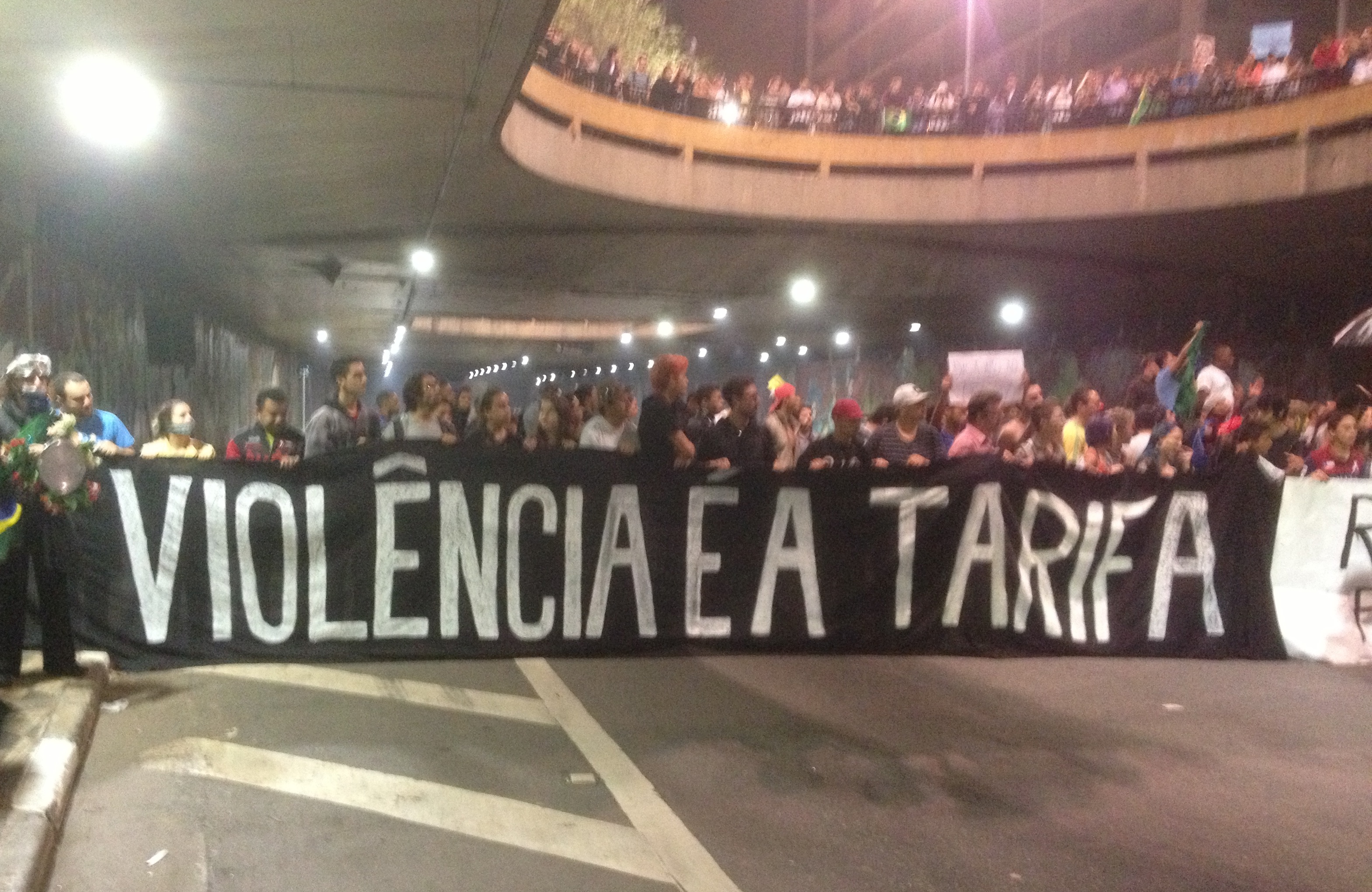
I live in Sao Paulo and here are some photos I took last night. One thing of note for your readers is that, as usual, the media is focusing on the violence of the protests.  The vast, vast majority of the protesters are not violent at all.  In fact, a common chant of the protesters is “Sem Violencia,” or without violence. Take a look at the photo that says “Violência é a tarifa” (violence is the fare). Reuters cropped the photo so it only showed the word “Violência,” and then selected largely photos of protesters doing mischief and burning things.  Oh well, confirming our ideas about “dangerous Latin America” always sells ad space.  Never mind trying to figure out what a place like Brazil is really about.

The protests are more than just calling for a 9 cents (US) fare reduction.  Brazil has a lot of very serious problems that need to be addressed.  But at times during the protests I have been to, I don’t know … while I’m delighted to see everyone out on the streets (especially on Mondaynight), I couldn’t shake the feeling of worry.  Where’s the plan? You can’t just hold up a sign that says “End corruption.”  Who wants corruption? IMG_1905 1Who doesn’t want better schools?  The call for reducing the transport fares is a good start, I suppose, but 9 cents does not really fix the problem.  What about the fact that the system needs to be expanded further?

I guess I am worried that the government will cave on this fare hike and then say, nope, sorry no money to improve schools.  No money to improve health care.  Of course, this response is ridiculous, as they have plenty of money.  It’s just being directed into the politicians’ pockets.

Another:

I may be biased, but this reader is uninformed. They’re right that Dilma herself is not the issue here. Where they’re wrong is that this is just people feeling the economic squeeze. Things have not gotten that bad here economically, at least not yet. And they definitely haven’t tanked on the level that Argentina has recently. No, the point is corruption. The point is that it doesn’t seem to matter who the president is because nothing ever gets done.

There are two long-term problems here that are inspiring most of this.

The first is that despite being the world’s sixth largest economy, and having higher tax rates than most of the developed world, the money simply seems to disappear. Brazil has famously received tons of money to build stadiums and infrastructure for the World Cup next year. The Brazilian government proudly announced renovations of Maracanã stadium in Rio de Janeiro – the largest stadium in the world – as well as plans to build state-of-the-art new stadiums for the event. It’s since been announced that most of these projects will be NOT ready in time. And not only will they not even be ready on time, but the metro line extensions, the highway expansions, and all of the other promised infrastructure to relieve up to four hours of commuting some Brazilians suffer through each day – none of it is getting done any time soon.

Some Brazilian publications have dug into these projects and found – you guessed it – insanely errant spending. Invoices for 500 new gates for a stadium that only needs ten. Paying tens of thousands of Reais for bathroom mirrors that should only cost a few hundred. Somewhere along the way, a lot of money is ending up in someone’s pocket.

The second ongoing issue here is the cash-for-votes corruption that went on under the previous administration, or as it’s called here, mensalão. Back in December, 25 high-ranking politicians and government officials were found guilty by the supreme court of money-laundering, fraud, and using government funds inappropriately.

Well, of course, these 25 officials aren’t actually serving any time. In fact, the government is pushing through PEC 37, a notorious bill that basically removes all investigative powers of the district attorneys and puts it in the hands of the Federal Policia, who are famously corrupt here. This is akin to Nixon getting caught for Watergate and instead of resigning, pushing through a constitutional amendment to remove the impeaching powers of Congress.

As for Bolsa Familia, yes, it has raised many people out of poverty here. But it’s by no means universally celebrated. In fact, in my time here it’s the most contentious and divisive political issue I’ve heard Brazilians speak of. As a gringo, I don’t pretend to come down on one side or the other. Some say it saved millions of lives. Other say that it’s free money to poor people for not working and is pulling the economy down. From what I can tell, it’s probably done a lot of good but it’s not sustainable and is causing as many economic problems as it solves.

Look, I’m no economist, but tell me if this makes any sense. You have a country with a massive poor and unemployed population. You also have a country with a terrible lack of infrastructure. What is the OBVIOUS SOLUTION HERE? Pay the poor people to build the infrastructure. Ta-da! You now have a thriving and functioning economy. Yet, the government gives money to the poor people whether they work or not, they tax the middle class to high heaven and pocket tons of the money while providing no new infrastructure. You would be pissed too.

And finally, for the record, let’s not all trip over each other talking about how important football/the World Cup is for Brazilian pride. Brazilians have known this was going to be a disaster since Day One. I arrived here a year and a half ago, have been all over the country, and everywhere I go, every Brazilian has told me this was a disaster waiting to happen. I’ve honestly met more Brazilians who are considering leaving the country for the World Cup than ones who are going to try to go. They knew this was coming. All of them. From my girlfriend’s CEO all the way down to the janitor at my gym, they all knew this was going to happen, just perhaps not this soon or not on such a scale.

There were more protests in Rio and São Paulo [on Tuesday] night. Monday’s was very peaceful here in São Paulo, but last night the police came out and started exploding tear gas to disperse everyone. There’s another big protest scheduled for Saturday that looks to draw 100k+ here in SP again. I imagine there will be a lot more between now and then as well.

By the way, here is a beautiful video a professional photographer made of the events in Rio:

“Reason, Enriched By Faith, Is Going To Reveal Truth”

This picture taken 21 March 2007 shows a

Michael O’Loughlin tours DePaul, the nation’s largest Catholic university and the first to offer a minor in gay and lesbian studies:

Part of the reason in creating the minor was to explore challenging subjects in an academic setting, explained the Rev. James Halstead, the chair of DePaul’s religious studies department. A priest for more than 36 years, Halstead said that the president’s office asked that the minor include a religious, philosophical, or ethical component.

Halstead believes that Catholic universities are precisely the places where great moral questions should be debated. “The obligation of a teacher is to maintain a classroom ethos and atmosphere in which all points of views can be respectfully heard,” he said. Students may dismiss the bishops’ teaching on homosexuality as erroneous, but his job as a professor, he said, involves offering an explanation of texts, not indoctrinating his students.

When I asked what he thought about the critics who questioned DePaul’s Catholic identity because of the minor and various LGBT student groups, Halstead lamented …. “To measure the Catholic identity of a university by asking if it has a LGBT program or not, Jesus, help us all. Do people really think that’s at the heart of Catholic Christianity? To me, it’s just not.”

Instead, he wishes that Catholic schools were judged on how well students answer the “deep questions” such as where they come from and what it means to be human, all in the search for truth. “Truth really is a process of emerging, in goodness and beauty, friendship and love,” he said. “Rational people can figure this stuff out. Reason, enriched by faith, is going to reveal truth.”

O’Loughlin also gets a great quote from another Catholic academic and priest, Paul Crowley:

What the world really needs to hear, and what we so deeply need to hear, is a message of loving mercy and inclusion, rather than judgment. The language of “objective disorder” has proved to be very problematic, to say the least. On one level, all that LGBT people in the Catholic Church are asking for is an affirmation of who they are as human beings, people whom God loves. If you say anything like this in church, people come up to you and say, ‘Thank you Father for being so courageous!’ Well, it’s not courageous, it’s just the Gospel!

I remember going to Notre Dame for the first ever talk there about homosexuality in its history.

The LGBT group was not allowed to put up posters or publicly advertize the event, and when they did, the group was abolished by the faculty. A broader student body had to sponsor the talk. But it was one of the more riveting evenings of my life: the auditorium so full they had to add another one with a video feed. I spoke about natural law arguments about homosexuality and based my critique on agreement with that church doctrine arguendo. The place jumped at the chance to discuss this; a couple of priests even came out in the question-and-answer session. No one was uncivil; no one was attacking the church. I felt and feel I am defending the church when I point out that its doctrines on homosexuality make no sense on their own terms or are uniquely designed to target one group in society in ways the church would never do with any other. We have ceased to be Christians on this issue. Or rather stopped believing in the core notion best summed up by: “In essential things, unity. In doubtful things, liberty. In all things, charity.”

I believe in dialogue – not yelling – on this. And one of the greatest injuries inflicted on the church by the last Pope was his shutting down of even any discourse on the subject – and several others. The most intellectual of Popes enforced anti-intellectualism with a relentlessness that bordered on hysteria. I hope that’s over now – because reason can help faith and can bring the whole church family closer together. And that combination – of faith and reason – is what keeps Catholicism alive.

(Photo: Frederick Florin/Getty)

Is Obamacare Keeping Costs Down?

Eric Morath calls attention to the first time that the medical cost index has posted a monthly decline since 1975:

The effects of the federal health care overhaul — the Affordable Care Act that passed in 2010 —and constrained government payments to doctors and hospitals seems to be trickling down to consumers, both those directly purchasing insurance plans and those buying drugs and treatments. “The slowing of healthcare inflation right now seems to be driven by onset of new policies,” said Alec Phillips, a Goldman Sachs economist who follows health care trends. “That is probably going to be a temporary factor.” In the coming year, the next phase of the health care overhaul will expand coverage and increase subsidy payments and could, in turn, push medical costs back up, Mr. Phillips said.

Drum throws cold water:

[M]edical inflation has been outrunning overall inflation by about 1.5 percentage points ever since the 1950s, and, roughly speaking, that’s still the case. There’s been a bit of a slowdown over the past decade, but only a bit.

Laurie McGinley examines a report that “concludes that if present trends continue Medicare savings will be $1 trillion more in the next 10 years than the savings projected by the Congressional Budget Office in May”:

The changes, Al Dobson said in an interview, are the result of marketplace pressures and the Affordable Care Act, which set new penalties for hospital readmissions, and included bundled payments and other incentives for hospitals and doctors to find ways to cut costs without hurting patients.

But why assume present trends will continue? For one thing, won’t the aging of the Baby Boomers drive up Medicare spending? The answer Dobson argues, is counter-intuitive: At least for the next several years, Baby Boomers will be the youngest people on Medicare, a positive trend, cost-wise. That gives the nation a “respite,” he contends, to figure out how to handle needed entitlements changes. “We have 10 years to figure this baby out,” he says. “If we don’t, it could be pretty messy.”


Tim Fernholz, meanwhile, profiles a firm that thinks keeping healthcare costs in check could be as simple as a little more transparency:

Castlight [is] a big data firm that launched a service to help big employers, from companies like Safeway to the state of Indiana, cut health insurance costs. Castlight uses each employer’s historical data on insurance claims and payments to develop price and quality comparisons for local health-care providers, from physicians to pharmacists. That data is provided to people on the insurance plan, who use web and mobile apps to find the best combination of cost and quality for their needs. That can mean big savings if the cost of a procedure like a colonoscopy varies by as much as a factor of seven. Right now, 4 million people use Castlight’s service, and the company is set to grow. But it can do better, according to its CEO and co-founder, Dr. Giovanni Colella, if it gets more data from the government.

How We Hear Humor

Richard Restak describes how the brain processes jokes:

All humor involves playing with what linguists call scripts (also referred to as frames). Basically, scripts are hypotheses about the world and how it works based on our previous life experiences. Consider what happens when a friend suggests meeting at a restaurant. Instantaneously our brains configure a scenario involving waiters or waitresses, menus, a sequence of eatables set out in order from appetizer to dessert, followed by a bill and the computation of a tip. This process, highly compressed and applicable to almost any kind of restaurant, works largely outside conscious awareness. And because our scripts are so generalized and compressed, we tend to make unwarranted assumptions based on them. Humor takes advantage of this tendency.

Consider, for example, almost any joke from stand-up comedian Steven Wright, known for his ironic, deadpan delivery:

—I saw a bank that said “24 Hour Banking,” but I didn’t have that much time.
—I bought some batteries, but they weren’t included. So I had to buy them again.
—I washed a sock. Then I put it in the dryer. When I took it out it was gone.
—I went into a store and asked the clerk if there was anything I could put under my coasters. He asked why I wanted to do that. I told him I wanted to make sure my coasters weren’t scratching my table.

In each of these examples, everyday activities are given a different spin by forcing the listener to modify standard scripts about them. Indeed, the process of reacting to and appreciating humor begins with the activation of a script in the brain’s temporal lobes. It is the brain’s frontal lobes that make sense of the discrepancy between the script and the situation described by the joke or illustrated by the cartoon.

This ability is unique to our species. Though apes can engage in play and tease each other by initiating false alarm calls accompanied by laughter, they cannot shift back and forth between multiple mental interpretations of a situation. Only we can do this because—thanks to the larger size of our frontal lobes compared with other species—we are the only creatures that possess a highly evolved working memory, which by creating and storing scripts allows us to appreciate sophisticated and subtle forms of humor. Neuroscientists often compare working memory to mental juggling. To appreciate a cartoon or a joke, you have to keep in mind at least two possible scenarios: your initial assumptions, created and stored over a lifetime in the temporal lobes, along with the alternative explanations that are worked out with the aid of the frontal lobes.

Speaking of standup, Patton Oswalt reflected recently on some of its most contentious aspects:

The comedians I’ve known who joke about rape—and genocide, racism, serial killers, drug addiction, and everything else in the Dark Subjects Suitcase—tend to be, internally and in action, anti-violence, anti-bigotry, and decidedly anti-rape. It’s their way—at least, it’s definitely my way—of dealing with the fact that all of this shittiness exists in the world. It’s one of the ways I try to reduce the power and horror those subjects hold for me. And since I’ve been a comedian longer than any of the people who blogged or wrote essays or argued about this, I was secure in thinking my point of view was right. That “rape culture” was an illusion, that the examples of comedians telling “rape jokes” in which the victim was the punchline were exceptions that proved the rule. I’ve never wanted to rape anyone. No one I know has ever expressed a desire to rape anyone. My viewpoint must be right. Right?

I had that same knee-jerk reaction when the whole Daniel Tosh incident went down. Again, only looking at it from my experience. And my experience, as a comedian, made me instantly defend him. I still do, up to a point. Here’s why: He was at an open mic. Trying out a new joke. A joke about rape. A horrible subject but, like with all horrible subjects, the first thing a comedian will subconsciously think is, “Does a funny approach exist with which to approach this topic?” He tried, and it didn’t go well. I’ve done the same thing, with all sorts of topics. Can I examine something that horrifies me and reduce the horror of it with humor? It’s a foolish reflex and all comedians have it.

What The NSA Can Do

Obama spelled it out in his interview with Charlie Rose:

Michael Crowley thinks the administration has finally found its voice on the surveillance leaks:

Speaking with Charlie Rose, Obama portrayed himself–as he did in his recent address on his drone and detention policies–as copiously working to strike a balance. “[W]e don’t have to sacrifice our freedom in order to achieve security. That’s a false choice,” Obama told Rose. “And so every program that we engage in, what I’ve said is, ‘Let’s examine and make sure that we’re making the right tradeoffs.’” Obama also clarified key points that may be lost on people who only follow the surveillance debate casually–namely that “if you are a U.S. person, the NSA cannot listen to your telephone calls, and the NSA cannot target your emails,” as he put it. A longtime critic of fear-mongering about terrorism, Obama was tonally measured about the threat.

Michael Tomasky found the interview “fascinating” but argues that Obama was too equivocating in his defense of NSA surveillance:

He supports these programs, and he ordered them, and he ought to just come out with a guns-blazing, f–k you ACLU, smackdown defense of the whole thing. Maybe an interview isn’t the place for that, and a speech or address is. He owns the program, so he might as well really own it.

More than that, I’d imagine he has interesting thoughts on national security and civil liberties, and it would be nice if we could hear our president go into some detail on questions like this instead of speaking in guarded and defensive soundbites. Even so, the comments were illuminating in that they show that Obama is of no frame of mind to change the current policy a whit.

Frank James reminds us that as much as Obama would like to make it seem otherwise, this conversation was forced upon him:

From the reasonable, matter-of-fact way the president put it, you would have thought that such a discussion had been part of Obama’s plan for his second term all along. But, of course, it wasn’t. The Obama administration didn’t exactly initiate this discussion. Instead, it was thrust upon him. Indeed, whether you view Edward Snowden, the leaker of the NSA surveillance programs, as a hero or traitor, he’s likely the only reason Obama is now forced to call for such a discussion about NSA surveillance. …

Presidents often see national security as requiring aggressive actions — frequently at odds with civil liberties — which they, of course, would rather not discuss openly. Once leaks force a public debate, presidents are compelled to speak to the nation’s concerns and sometimes to the global public beyond the U.S. But it certainly isn’t part of their plan.

Behind Every Man Of Steel

Matt Zoller Seitz picks up on the “striking and curious” absence of fleshed-out female characters in the new movie:

Lois is an important character, but only for how she furthers Clark/Superman’s attempts to understand himself and claim his destiny; she’s ultimately much less of a fully-realized, freestanding human being than the kooky, narcissistic Lois Lane played by Margot Kidder in the Reeve films, or even Kate Bosworth’s Lois in “Superman Returns,” a melancholy figure defined by her capacity to move on after the hero’s abrupt departure from Earth. Adams’ Lois is tough and smart but has no personality, only drive, and she’s not as integral to the action as she seems to be on first glance … females exist, for the most part, to be saved, or to have things explained to them.

Alyssa confesses she’s had enough of the standard superhero romance:

If we’re going to be clobbered with two or three superhero movies a year into infinity, as seems to be the case, we are desperately in need of new narrative frameworks for stories about these characters. Just as it’s gotten exhausting and poisonous for superheroes and their antagonists to destroy enormous swaths of cities without facing any apparent moral or legal consequences for the mass death and property damage they’re causing, it’s exhausting to see their interactions with women be essentially the same time after time, without any growth or sense of what a settled relationship between a superhero and a human with her own interests might look like. It was what made Tony and Pepper’s argument over the hideous giant rabbit he got her for Christmas in Iron Man 3 simultaneously so appealing and sad: it was an actual conversation about their relationship, and one that revealed that Tony knows precisely nothing about the live-in girlfriend who is running his company.

Recent Dish on Man Of Steel here. Recent Dish on the Hollywood’s problems with female protagonists here, here, and here.

Ask Josh Barro Anything: How Can We Solve Climate Change?

A good question, hence the, well, watch for yourself:

Relatedly, John Kerry writes today that he is committed to keeping climate change in the foreground “because it’s critical to the survival of our civilization, and that means it’s a critical mission for [him] as our country’s top diplomat”:

By keeping the pressure on each other to take ambitious action and replicating this effort around the world, [China and America] will create a virtuous cycle to address the climate challenge the right way: together. In a more collaborative environment, I am absolutely confident we will find the solutions and push the curve of discovery. We can do it without jeopardizing our economies — in fact, we will grow them. And the United States will be working not just with China, but around the globe. Next I will be traveling to India, where once again climate change and energy will be vital to the conversation.

Josh Barro is currently the Politics Editor at Business Insider. He has previously written for Bloomberg View, and before that was a Senior Fellow at the Manhattan Institute. Previous Dish on Chait’s recent profile of Barro here and here. Watch Josh’s previous answers here. Our full Ask Anything archive is here.

What’s A Bisexual Anyway? Ctd

A male reader quotes another:

“(What I haven’t ever encountered was a guy claiming to be bi, but apparently exclusively interested in men.)” Actually, “bi” was often shorthand for something else in the old “men seeking men” section of the Village Voice personals. Guys used “bi” and/or “masc” to differentiate from “fem” men (which had its own large following). “Bi” implied they pass for straight and/or were turned off by femininity in other men and themselves. It was a physical description that didn’t pertain to sexual practices because this personals section was exclusively about dude-on-dude action.

Personally, I liked the idea of dating bi men even if he really wasn’t, and I liked dating married men even if they were a little fem. They just had to be a bear.

Another has a long and dramatic story:

One of your readers in response to the original letter wrote that he has never met a bisexual man who only plays around with men.  I am as close to that as I think anybody is going to find. Growing up, my animal attraction was definitely more directed at other males, but I developed deep crushes on girls and women as well.  At 17, I had my first girlfriend and we were together until I was 21.  Our sex life was satisfying (to me anyway, she had problems achieving orgasm from intercourse out of fear of pregnancy).  However, I also had many male obsessions, any one of which I would have acted on if the situation arose – or more accurately, if the other guy had been extremely aggressive.

To that point, my only sexual encounter had been as a 16-year old at a choral convention of which my high school was one of only two invited.  The rest of the groups were from colleges across the country.  I relentlessly stared at this guy, not because I thought he was so attractive (there were others way more attractive) but because he was obviously gay.  We eventually struck up a conversation and he asked me if I wanted to go to his room “to talk.”  When there, he made a big move, which surprisingly, shocked me.  But we messed around and then I went out to dinner and a show with my class, embarrassed and humiliated.

I continued dating women but developed a crush on a co-worker who prided himself on being the “first” for a lot of straight guys.  I still identified as straight and aside from saying things like “I wouldn’t push Sting out of bed”, I never let on.  We wound up in an extremely unhealthy relationship that lasted for two years on and off.

After it was over and I had recovered my sanity and self-esteem, I embarked on a period of dating women and sleeping around with men.

I told myself I was attracted to men but emotionally I was better off with a woman and I suspected I would never be happy with either completely.  Surprisingly, I subsequently met a woman at the gym with whom I fell deeply in love.  In two months we were married and in two years we had two children.  I was 99% faithful as she seemed to help me put it all together.  She was beautiful and wild and fun and raunchy and more importantly when I told her about my attraction to men and about my ex-boyfriend, her response was, “Cool!” Maybe twice in the first six years I had a little dalliance with a guy when she was out of town but it was nothing she probably wouldn’t have forgiven.

Seven years into my marriage, my wife was diagnosed as clinically depressed (she wasn’t, she was bipolar) and she was put on medication which made her worse and which also amplified the effects of alcohol (up to that point alcohol had no effect on her in any way, she could drink 20 shots and remain as sober as the moment she started) and she started to get drunk regularly.  Our marriage started to fall apart and I started to sleep with men any chance I could get.  The more unhappy we were, the gayer I became.  We resembled a miserable married couple except for my secret.  I still believed however, that emotionally I was meant for women and truthfully, I still loved my wife very much.

At eleven years of marriage, I met a man online and fell madly in love.  Three weeks later I left my wife and he left his boyfriend of 14 years.  A messy divorce followed.  This man and I are still together 13 years later and we have been married for ten (in Ottawa in 2003).  We regularly play outside the relationship together (although much less lately) and it’s always been with other men.  We’ve joked about certain women we could have fun with (he has had his moments with women through the years), but it’s talk and nothing more.  I’m very happy and I’m not tempted by women.  However, I still do find certain women extremely sexually attractive and I would have no problem following through if the situation arose.

If I’m honest with myself I never really stopped being in love with my wife.  I don’t have much to do with her anymore except when it comes to our beautiful children, but she really was and is someone very special to me. But for a number of reasons it wasn’t right.

I identified as bisexual for years after I left her but the truth is despite my obvious ability to have relationships and sex with men and women, I am gay.  And while I’m sure you didn’t realize or expected this to go here, I really don’t believe there are bisexual men (as previously discussed, the fluidity of most women’s sexuality is way more complicated); men who can live life like a blank slate and where ever they wind up is fine with them.  There is a correct choice for each person regardless of what titillates them or what they can do in the moment.

Your initial reader isn’t bisexual if his letter is honest.  He’s a straight man who’s turned on by “dirty”.  Despite 11 years of a mostly happy marriage in which my wife and I had a fulfilling sexual relationship until the day I left her, I could not completely be who I am with her.  With my husband, I can.  While many may disagree with me and that’s fine, I don’t find bisexuals threatening because I don’t believe in them.  However, I’m as close to a bisexual man who only fools around with men as you are likely to find.

Another:

I feel vindicated by my earlier email to you by that fact that every letter you have posted is from a “bisexual” woman. You won’t find any truly bisexual men. Your initial reader is either titillated by the taboo of it all or he is a closeted gay man who is in denial. I know from personal experience, and so does every other gay man who finds women attractive in some way. It isn’t surprising to me that you appear to have very few men who would openly discuss their bisexuality.

Read the whole Dish thread on bisexuality here.

The Anti-Quagmire President, Ctd

Obama acknowledges the danger of getting sucked deeper and deeper into a conflict:

Jeffrey Goldberg also reports that last week John Kerry pushed for US airstrikes on Syrian airfields, only to be rebuked (mercifully) by the Pentagon:

At a principals meeting in the White House situation room, Secretary of State John Kerry began arguing, vociferously, for immediate U.S. airstrikes against airfields under the control of Bashar al-Assad’s Syrian regime — specifically, those fields it has used to launch chemical weapons raids against rebel forces.

It was at this point that the current chairman of the Joint Chiefs of Staff, the usually mild-mannered Army General Martin Dempsey, spoke up, loudly. According to several sources, Dempsey threw a series of brushback pitches at Kerry, demanding to know just exactly what the post-strike plan would be and pointing out that the State Department didn’t fully grasp the complexity of such an operation.

Dempsey informed Kerry that the Air Force could not simply drop a few bombs, or fire a few missiles, at targets inside Syria: To be safe, the U.S. would have to neutralize Syria’s integrated air-defense system, an operation that would require 700 or more sorties. At a time when the U.S. military is exhausted, and when sequestration is ripping into the Pentagon budget, Dempsey is said to have argued that a demand by the State Department for precipitous military action in a murky civil war wasn’t welcome.

If this is true, it reveals again how John Kerry is still trapped in the mindset of his generation. Even Kerry – Vietnam vet – is arguing for exactly the kind of small intervention that metastasized into the Vietnam disaster. And remember he backed the Iraq War as well, however ludicrously he tried to spin it in 2004. Meanwhile, Hussein Ibish objects to the comparison of Syria to the quagmire in Iraq:

The Iraq war was about unilaterally engineered American regime change. The intervention in Syria will be about helping Syrians themselves ensure regime change on their own or come to the point where they can actually negotiate a new post-dictatorship modus vivendi.

Rather than a long-term occupation, as in Iraq, this will involve major aid to specific rebel groups, including arms and other materiel intelligence, command-and-control assistance, no-fly zones, and possibly a real confrontation with the Syrian Air Force and air defenses. But what it will not mean is American “boots on the ground.” As in Libya, the ‘Pottery Barn’ rules (“you break it, you own it”) will and should not apply in Syria. We can help Syrians get out of the mess they are in, but we cannot and should not dictate their future.

Ibish’s arguments – among them, that my opposition to intervention in Syria or Iran is based on some kind of crude non-interventionism – evaporate upon close inspection.

On Iran, I simply don’t believe their nuclear capacity is a real threat to the US. They have more than 200 Israeli nuclear warheads pointed right at them and would benefit much more from keeping their arsenal just on the brink of becoming operational (like Japan) than doing something crazy. More to the point, if our goal is eventual rapprochement with Iran’s people who support the nuclear program, then making this issue the non-negotiable element is to alienate the very future generation we will need. On Syria, whether we have boots on the ground seems largely irrelevant to me. Any attempt seriously to arm the Sunni Jihadists would require exactly what Ibish says – and what he describes is a huge military operation, as the generals told Kerry. We have no idea where that might lead, but if we succeed in changing the dynamic of the civil war, we very much will own the result. And that result could be a massacre of Alawites and Christians in Syria, unpredictable reactions from Iran and Russia, and involvement of the US in the Sunni-Shia regional war.

And please, if we have learned anything at this point it is that the word “Syrians” confuses as much as it clarifies. The reality is a country at war with itself, splintered by sectarian passions and history’s endless grudges and now recent atrocities requiring revenge. I’m with the president in the interview above – and much less worried that we might actually slip into another clusterfuck in the Middle East than I was before I heard him explain the strong limits he has placed on the operation.

More Dish on intervention in Syria here, here, here, and here.

Whither The Weaponry?

Marc Herman wonders how well the US will be able to keep tabs on the weapons it has committed to Syrian rebels. He notes that we’re still trying to figure out how many foreign weapons “ended up in Libya in violation of their original terms of purchase”:

Scholars who study small arms proliferation have looked at the 2011 war in Libya as a guide and found evidence of illegal arms transfers and poor tracking of weapons. More than a year after the war ended, no overall accounting exists of the total amount of lethal material allies like France and Qatar imported to Libya.

The doesn’t mean the same will be true in Syria. And the U.S., which has some of the world’s most stringent weapons tracking rules, was not a key supplier of lethal material to Libyan rebels.

But the parallels worry scholars. In a series of interviews begun last year, several investigators who follow small arms transactions argued that weak international rules for tracking transfers make it nearly impossible to account for weapons sent to non-government actors—like rebel militias in Libya and, now, Syria.