Silver vs Politico

This made me very happy this morning:

It’s striking how preoccupied Harris and VandeHei are with the perception that Politico is too “insidery”. My personal critique of their work cuts a little deeper than that, however. It’s not that they are too “insidery” per se, but that the perceptions of Beltway 447px-Rose_champagne_infinite_bubblesinsiders, which Politico echoes and embraces, are not always very insightful or accurate. In other words, the conventional wisdom is often wrong, especially in Washington.

Now, it would be one thing if Politico were to describe the conventional wisdom and then hold it up to a critical examination. That would be extremely useful and interesting. I thought Ben Smith, back when he wrote for them, had a real knack for that. And they have a few other journalists who I really enjoy reading. But in most of the “Behind the Curtain” pieces, by contrast, there’s a lack of perspective — in particular, a lack of perspective about the role that Politico plays in formulating the conventional wisdom which they then “report” upon.

Furthermore, Harris and VandeHei seem to lack very much curiosity for the world outside of the bubble.

Harris claims it’s not worth his time to read 538, and VandeHei characterizes my work as “trying to use numbers to prove stuff”. Instead, what 538 is really about is providing a critical perspective, and scrutinizing claims on the basis of evidence (statistical or otherwise). In order to do that, you have to believe that there is some sort of truth outside the bubble — what would be called the “objective” world in a scientific or philosophical context. Politico, by contrast, sometimes seems to operate within a “post-truth” worldview. Some people think that is the very essence of savvy, modern journalism, but my bet is that journalism is headed in another direction – toward being more critical and empirical.

I am, of course, with Nate. The distortive effect of Politico actually corrodes democracy, in my view, because it constantly prioritizes the 6-hour news cycle and the higher inside-bullshit to tell us allegedly what is happening in Washington. We can mistake that for what matters in Washington for the 300 million people it’s supposed to represent. That’s an after-thought to these Beltway courtesans.

There’s no perspective, very little history, precious little policy and no perceivable goal except financial success. It feels to me like a modern company which always works for the next earnings report, rather than a long-term strategy for actually contributing to democratic discourse.

We’d be better off if they disappeared into the ether. But, of course, they will continue to thrive.

How Immigration Saves America Money

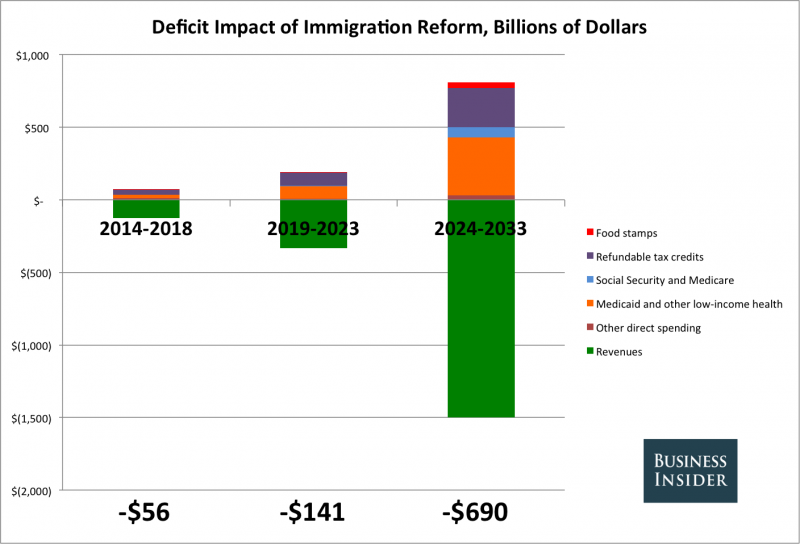
CBO Immigration Chart

A CBO report released yesterday found that the immigration reform bill would lower the deficit. Ezra unpacks the report:

How? In a word, growth. But in two words, population growth. CBO expects that passage of the bill would mean 10.4 million more U.S. residents in the next decade. To be clear, that’s not a measure of newly legal residents. CBO isn’t counting the newly legalized population — which they estimate at 8 million — as new residents. After all, those people are already here. The 10.4 million number only counts people who wouldn’t otherwise physically reside in the United States.

The basic math of the CBO’s report is that those new workers pay more in taxes than they take in benefits. To be precise, the bill increases government spending by $262 billion but increases revenues by $459 billion. And that’s before accounting for economic growth above and beyond the direct effect on population.

Zeke Miller and Alex Rogers have more details:

The bill would increase inflation-adjusted GDP relative by 3.3 percent in 2023 and by 5.4 percent in 2033. It also shows that average wages for the entire labor force would be 0.1 percent lower in 2023 and 0.5 percent higher in 2033, as the amount of capital available to workers would not increase as rapidly as the number of workers and because the new workers would be less skilled and have lower wages, on average, than the labor force under current law.

Allahpundit is unimpressed by the CBO’s numbers:

 If the entitlement regime is unsustainable long-term now, and you’re suddenly adding a huge population that’s likely to vote on balance to preserve that regime and promote the Democrats who protect it, then in 40 years all of this will be a, er, “net benefit for our economy.” I wonder what the average annual rate of GDP growth needs to be between now and, say, 2050 to make Medicare and Social Security able to shoulder that extra load.

Josh Barro, on the other hand, notes that the “CBO report may actually understate the deficit reduction due to immigration reform”:

Normally, CBO evaluates legislation on a “static” basis, meaning they don’t account for economic changes spurred by policy change. Here, they relaxed that practice to account for the rise in population that the bill would cause. They still did not account for broader economic benefits that immigration reform might produce, such as an increase in productivity or innovation.

And Chait puts the CBO report in context, noting that many of “Obama’s growth initiatives are also wrapped together in social goals, which have instigated political controversy and obscured their growth-generating goals”:

Immigration reform is one such example. Its base of support lies with immigrant communities motivated by its humanitarian goals. But immigration reform is also part of a national human capital strategy. The law would not only attempt to rationalize the currently illegal market for undocumented immigrant labor, it would also dramatically shift the composition of future legalimmigration. Most documented immigrants are currently admitted on the basis of family relationships. The law would alter that so that most were admitted on the basis of their labor skills. (The administration has been influenced by an economic paper finding that higher levels of college-educated immigrants boost innovation.)

Chart from Barro.

The Pregnant Workforce

Dwyer Gunn explores the challenges facing pregnant, working-class women:

[W]hile the [Americans with Disabilities Act] provides protections for pregnant women suffering from more severe pregnancy-related “disabilities” like preeclampsia, it doesn’t require employers to provide pregnant women with the kind of small modifications they may need to stay on the job, because pregnancy itself isn’t considered a disability. Technically, women like Yvette and B are supposed to be protected by either the federal Pregnancy Discrimination Act (PDA) or the sex and disability protections of the New York Human Rights law. In practice, it doesn’t work out like that for most low-income women. “There’s a gap in protection under the law,” explained Katharine Bodde, Policy Counsel at the NYCLU. “Courts have not interpreted the federal Pregnancy Discrimination Act to require employers to provide reasonable accommodations.”

E.J. Graff believes this gap could be closed with “a little bit of bipartisan cooperation” by passing the Pregnant Workers’ Fairness Act, which would extend disability protection to pregnant women:

The PWFA doesn’t have any active opposition—not in the Chamber of Commerce or among Republicans; its opponent is inertia and lack of knowledge. [Emily] Martin believes that the PWFA could be like the Americans with Disabilities Act, the beneficiary of a great deal of bipartisan support—if enough people come to understand that this is a problem—today, now—for thousands of women.

A few months, here and there. A stool, a water bottle, a bathroom break, a little help lifting now and then. What’s so hard about that? It’s stunning that we need a law to enforce what is simply considerate: letting people take care of themselves when they don’t feel well. You shouldn’t lose your job for having a family: How simple a rule is that?

Detroit On The Brink?

7436812494_55f1a2bd8d_z

Felix Salmon summarizes some of the stats contained in Detroit’s “unutterably depressing” Proposal for Creditors:

Detroit’s infrastructure is crumbling: 40% of its street lights are out of order, and it has 78,000 abandoned and blighted structures, of which 38,000 are considered dangerous buildings. Those buildings account for a large proportion of the 12,000 fires Detroit has every year. At the moment, firefighters are instructed not to use the hydraulic ladders on their firetrucks unless there is an immediate threat to life, because the ladders have not received safety inspections for years. Detroit also has just 36 ambulances, of which generally no more than 14 are in operation at any given time. And in terms of the city’s IT infrastructure — well, you can probably guess; suffice to say that a recent IRS audit characterized the city’s income tax system as “catastrophic”.

He describes the effect of the city’s emergency manager Kevyn Orr’s plan to “write down some of Detroit’s debt”:

[T]he real pain here is going to be felt by two main groups.

The first is the companies who provide wraps for municipal debt — companies whose muni arms somehow managed to escape the financial crisis largely unscathed, and which had to expect some losses on all the debt they were insuring. It’s hard to feel any sympathy for them. But the second group — Detroit’s municipal retirees — had much less choice about taking on their unsecured exposure to the city’s finances. Looking at the straits Detroit is in, the bond default makes sense. But it’s not being driven by stratospheric pension costs, and the swipe at pensioners does look rather gratuitous.

Walter Russell Mead considers the broader impact if the battle over pensions goes to court:

Michigan’s state constitution specifically protects pensions and retirement benefits, but that clause is in tension with federal bankruptcy law. The unions would likely argue that the 10th Amendment “trumps the notion that federal law is supreme.”

If the Supreme Court rejected that argument, it would deal a major blow to public sector unions across the country. According to bankruptcy lawyer Michael Sweet, “The last thing (union pension funds) may want is for a judge to rule on that….Because if the judge ruled against them, it would open the floodgates.” Every public sector union in the country would then be on notice that underfunded pension programs will ultimately be welshed on by cities and states. If the unions prevailed, though, federal bankruptcy law could be called into question elsewhere. Either way, it’s a major blow to blue model government: either states’ rights get a big boost or public sector unions take it on the chin.

Doug Mataconis wonders if “negotiations are being made more difficult by the fact that the creditors don’t necessarily believe that Detroit will pull the trigger and file a Chapter 9 [bankruptcy] petition”:

[S]uch a filing would constitute the largest Chapter 9 filing in recent history. Even if the city were to emerge from court in something resembling decent financial shape, the filing alone would do immense damage to the city’s credibility with creditors, contractors, and others who have done business with the city in the past. … In general, the city may end up finding that it would not be able to successfully emerge from bankruptcy because of the financial uncertainty the bankruptcy creates. That happens all the time in the corporate world, of course, which is why many companies that emerge from Chapter 11 find themselves on the steps of the Courthouse a few years later. In the case of a municipality, though, the consequences would be far more serious as the financial crisis that led to the Chapter 9 filing reemerged at a later date in a much more painful form. In the meantime, the brain drain that has exacerbated Detroit’s problems over the decades would likely only accelerate.

But at least the art is safe … for now.

(Photo from the interior of Detroit’s Farwell Building by Lotus Carroll)

Why So Furious?

dish_legofaces

A study finds that the faces of LEGO Minifigures “are becoming increasingly angry and less happy”:

[Researcher Christoph] Bartneck obtained images of all 3655 Minifigure types manufactured by LEGO between 1975 and 2010. The 628 different heads on these figures were then shown to 264 adult participants recruited via Amazon’s Mechanical Turk online survey website. The participants’ task was to categorise the emotions on the heads in terms of the six main human emotions, and to rate their intensity.

There was ambiguity in the faces – each received an average of 3.9 emotion labels. Looking at historical trends – there was a massive increase in the variety of emotional expressions from early 1990s onwards, a process that continued up to 2010. The vast majority of figures have happy faces (324), but the next most common is angry (192), followed by sadness (49), disgust (28), surprise (23) and fear (11). And the trend is for an increasing proportion of angry faces, with a concomitant reduction in happy faces.

Rose Eveleth ventures a guess as to why:

This [trend] probably has to do with the increase in themed collections that go along with action movies and video games, many of whom are fighters. The researchers also found an increase in the amount of weaponry LEGO characters come with. Bartneck and his team express concern about how this shift to angry faces might impact children, writing “We cannot help but wonder how the move from only positive faces to an increasing number of negative faces impacts how children play.” Their research, though, didn’t attempt to investigate any links between angry LEGOs and angry kids.

(Photo by Flickr user Sunfox)

What The Hell Is Happening In Brazil? Ctd


Dish readers supplied the initial context for the massive protests in Brasilia, Rio, and Sao Paulo. David Lavin zooms out:

Brazil’s public transportation is often slow, dangerous and crowded, and these fare increases come at a time when Brazil’s decade-long economic success has slowed dramatically. Inflation is on the rise and many basic services are woefully underfunded. For years, the economy grew, the middle class expanded and millions rose from poverty. After the country suffered through crushing hyperinflation in the 1980’s and 1990’s, inflation seemed to be finally under control.

But recently the economy has stalled, much-feared inflation is outside of targets, and rising prices on everything from food to transportation have made life more difficult for the average Brazilian. It is this contrast, between the massive investment in Olympic and World Cup infrastructure, and the lack of investment in the basics Brazilians depend on in their daily lives, that seems to be sparking the unrest.

Roberto Ferdman breaks down how badly the hikes are squeezing average Brazilians:

A fare price that sounds pretty minuscule in dollar terms actually takes up a huge chunk of Brazilian incomes for those at the bottom (and presumably, those who most need to use the bus). The $0.09 hike brought the price of a single bus fare in Sao Paolo up to $1.47. Assuming Brazil’s city dwellers ride the bus twice daily—to and from work during the week, and to and from anywhere during the weekend—that’s $82.46 a month. For Brazilians making the minimum wage of $312.33 a month, that’s a whopping 26% of their income.

A reader quotes another to underscore the severity of the World Cup concerns:

The reporters also are lamenting that this is happening during the Confederate’s Cup, as it’s going to embarrass the country on the international level. It was a HUGE deal for Brazil to land the World Cup and Olympics because it meant tons of money was going to be pumped into the country to build infrastructure.

This is like saying Oakeshott is a good philosopher. Factually true, but greatly understated. The World Cup is, arguably, the largest cultural event on the planet.

Although occurring once every four years (like the Olympics, but not diffused by numerous sports). It appeals to anyone who has kicked a soccer ball, which means billions and billions of people, in every nation (unlike the Olympics, where most countries do not participate in all sports). In many places soccer (henceforth, football) is woven into the fabric of society and culture; it is the leading game for children and the leading subject of interest for adults. More so, it defines public identity.

One of the places where football is so woven is Brazil, home of the “beautiful game.”

Brazil is one of the few non-European nations with consistent football success on the world stage, in fact the most such success amongst those nations. Brazil is one of the leading nations of football, which is to say, one of the leading nations of perhaps the most important activity on Earth outside of producing and consuming economic goods. Only religion, treated collectively, stands higher, and unlike religion football is practiced in the same manner worldwide.

Economically, Brazil has risen to be a notable economic power, the strongest in South America. While any number of third-world countries stopped being “backward” some time ago, symbolically it has taken time for the perception to catch up with the reality. Hosting the World Cup is a chance for Brazil, and by extension South America, to present itself to the world anew.

So your reader further says:

Well, the money came and the infrastructure didn’t. So now you have tens, if not hundreds, of thousands of pissed off people on the streets.

It’s not just a lack of infrastructure. Stadiums are well behind schedule. And yet the world’s eyes are about to descend on Brazil, along with up to a hundred thousand travelers, perhaps to see a country, said to have built a strong economy, without the basics complete. Yes, the lack of infrastructure is pissing off people, but the prospect of humiliation looms. It could be a public relations, economic, cultural, and almost spiritual disaster of biblical proportions.

Update from another reader:

Three thoughts (from another native here in Brazil):

1. Most of the rioting is being done by teens who suffer and are humiliated on a daily basis at the hands of the PM, the Military Police, a very nasty legacy of the Dictatorship years. Young, poor men are routinely slapped, kicked and sometimes even killed for minor offenses, so there is a pretty large amount of latent anger already there. All the rest of the several hundreds of thousands of us that marched yesterday are just having a grand old peaceful time.

2. Some say that protesters want to “take advantage of this moment when we have foreign visitors”. Yep, they sure started out that way, but it has become something way bigger. Something big enough to take Brazil’s attention away from an international soccer competition being played at home. Believe me, that’s *big*!

3. Dilma’s “Workers’ Party” was always seen as both government watchdog and protector of the poor and huddled masses. But after Lula got to power, then Dilma, corruption and government overreach rose to (almost comically) absurd levels. From laws forbidding congressmen to stand trial to public officials being caught with thousands of dollars stuffed in their underwear, people are feeling mighty disenfranchised right around now.

So expect some “The View From Your Protest” pictures tomorrow, ’cause take to the streets again. We are happy, we are hopeful and most of all; we are acting.

#changebrazil

Epistemic Closure Watch

NRA Gathers In Houston For 2013 Annual Meeting

In Politico, Bobby Jindal attempts a rallying cry for Republicans:

At some point, the American public is going to revolt against the nanny state and the leftward march of this president. I don’t know when the tipping point will come, but I believe it will come soon.

Why?

Because the left wants: The government to explode; to pay everyone; to hire everyone; they believe that money grows on trees; the earth is flat; the industrial age, factory-style government is a cool new thing; debts don’t have to be repaid; people of faith are ignorant and uneducated; unborn babies don’t matter; pornography is fine; traditional marriage is discriminatory; 32 oz. sodas are evil; red meat should be rationed; rich people are evil unless they are from Hollywood or are liberal Democrats; the Israelis are unreasonable; trans-fat must be stopped; kids trapped in failing schools should be patient; wild weather is a new thing; moral standards are passé; government run health care is high quality; the IRS should violate our constitutional rights; reporters should be spied on; Benghazi was handled well; the Second Amendment is outdated; and the First one has some problems too.

Barro sighs:

I’ll grant Jindal one thing: He certainly didn’t ration the red meat in that paragraph. This is a big reason the Republican party can’t change. So many of its members have a warped vision of what liberalism is. They think it’s something so mind-bendingly awful that they cannot fathom how voters could willingly choose it. It must be some mistake. And sooner or later, mistakes get fixed.

Ezra piles on:

The upside of this theory is that it frees Jindal and the rest of the Republican Party from having to do the hard work of rethinking and renewing its own governing agenda. The downside of this theory is that it’s utter nonsense. And the most damaging part of this theory is that it’s utter nonsense aimed at Jindal’s own base. … That’s how the GOP becomes the stupid party: Republican Party elites like Jindal convince Republican Party activists of things that aren’t true. And that’s how the GOP becomes the losing party: The activists push the Republican Party to choose candidate decisions and campaign strategies based on those untruths, and they collapse in the light of day.

Larison views it as another step in Jindal’s decline as a serious figure in the party:

Jindal seems to be retreating here from his previous very mild recommendations for Republican reform, and seems to think that there’s nothing ailing the party that can’t be fixed by a redoubling of effort and a more combative attitude. Jindal is right that public opinion can change, and a party’s political fortunes can revive when the public tires of the party in power, but that doesn’t mean that one can simply wish away a party’s political weaknesses. No one would seriously accuse the GOP of having suffered from an “excess of navel-gazing” in the last few months. Most Republican pundits and politicians can’t bring themselves to face up to the bankruptcy of the party’s economic and foreign policy agendas, and they are even less interested in a remedy.

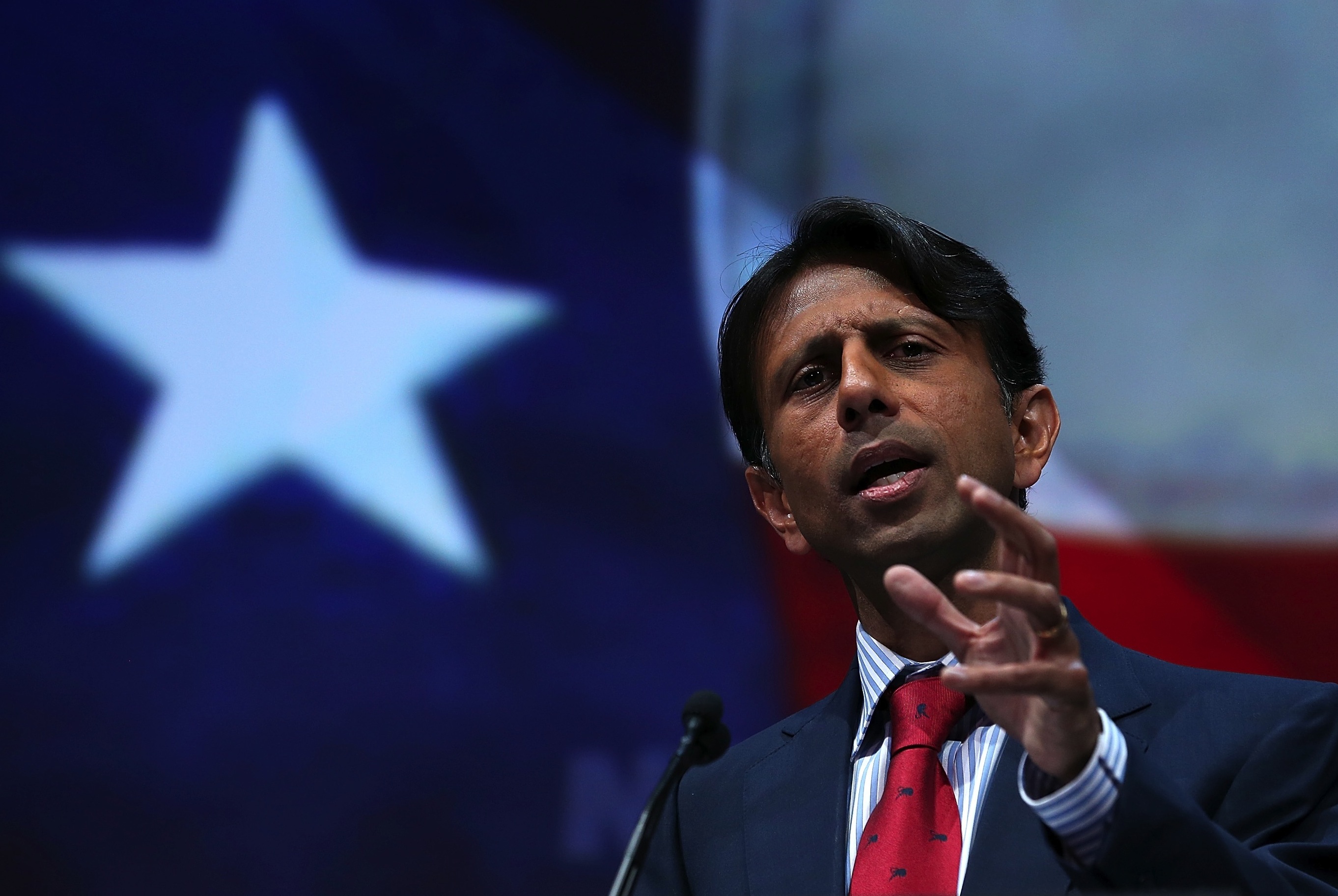
(Photo: Louisiana governor Bobby Jindal speaks during the 2013 NRA Annual Meeting and Exhibits at the George R. Brown Convention Center on May 3, 2013 in Houston, Texas. By Justin Sullivan/Getty Images)

Stylized Suicide For Page-views

https://twitter.com/jetpack/status/347051650537635840

“Maximum trolling” is how Michele Filgate characterizes “Last Words,” Vice‘s June fashion spread depicting models as famous female writers, such as Virginia Woolf and Sylvia Plath, at the time of their suicides. Vice removed the photos from the website today, but not before igniting heated debate. Filgate fumes:

When should art infuriate, and when is something just so offensive that it’s not even art? Art can and at times should be provocative — there’s no doubt about that. Yet this isn’t art. This is an editorial decision to get more pageviews — and perhaps to appear cool and above outrage, while simultaneously stoking it — and it’s more pathetic than anything else. … If we glorify suicide, we’re contributing to the problem. We’re also making light of an incredibly painful subject—one that many people are way too familiar with.

At Jezebel, which republished the photos, Jenna Sauers emphasizes that “suicide is not a fashion statement”:

And while time doesn’t necessarily lessen the grief of suicide, it’s perhaps especially distressing that some of the people Vice depicts died very recently — [Iris] Chang in just 2004 — leaving still-living loved ones behind. These weren’t fictional characters; these were real women, who lived and struggled and died, and to treat their lowest moments as fodder for a silly fashion spread is shameful and sad.

Stacey Goguen provides links for those who would like to learn more about suicide or are personally affected by suicidality. Rebecca Wait elaborates on the danger of trivializing the subject:

Glamourising suicide is deeply irresponsible. As the [British support organization] Samaritans’ website states, “certain types of suicide reporting are particularly harmful and can act as a catalyst to influence the behaviour of people who are already vulnerable”. It points out that over 60 research papers have noted this link between the depiction of suicide in the media and imitative behaviour.

Helen Lewis believes Vice‘s display warrants further condemnation:

As a journalist, covering suicide is always hard because there is a fine line between raising awareness of a vital public health issue and contributing to a spectacle that could harm vulnerable people. Which of those two was the feminist website Jezebel doing when it decided to republish Vice‘s pictures, alongside outraged commentary? And have the thousands of tweets on the subject, not to mention this article, simply told Vice that it has found a tender spot in our collective consciousness, which it can jab to great effect?

I don’t have the answer to that and it is easy to find things to be outraged about these days. But this one is worth being angered by, because tonight, there might be one less Vice reader in the world.

That reader won’t be Ryan Kearney, who thinks critics are “overstat[ing] Vice‘s influence in the real world” and is surprised that editors took down the online photos:

The critics will claim victory, but Vice has won again: “Last Words” got all the pageviews it was going to get, and now the company can appear to care about giving offense. Meanwhile, readers are rushing out to get their hands on a print copy. I hope it doesn’t inspire anyone to hurt themselves, but if it does, I won’t blame Vice.

Be Literary And Multiply?

6908080437_343b8718b6_z

Lauren Sandler suggests that the success of female writers is linked to them having only one child:

It was only when I was working on a book investigating what it means to have, and to be, an only child that I realized how many of the writers I revere had only children themselves. Alongside Sontag: Joan Didion, Mary McCarthy, Elizabeth Hardwick, Margaret Atwood, Ellen Willis, and more. Someone once asked Alice Walker if women (well, female artists) should have children. She replied, “They should have children—assuming this is of interest to them—but only one.” Why? “Because with one you can move,” she said. “With more than one you’re a sitting duck.”

Author Jane Smiley pops up in the comments section to dispute Sandler’s premise:

The key is not having one child, it is living in a place where there is excellent daycare and a social world that allows fathers to have the time and the motivation to fully share in raising kids.

Zadie Smith adds that she could “really go on all day” with her rebuttal:

I have two children. Dickens had ten – I think Tolstoy did, too. Did anyone for one moment worry that those men were becoming too father-ish to be writer-esque? Does the fact that Heidi Julavitz, Nikita Lalwani, Nicole Krauss, Jhumpa Lahiri, Vendela Vida, Curtis Sittenfeld, Marilynne Robinson, Toni Morrison and so on and so forth (i could really go on all day with that list) have multiple children make them lesser writers? Are four children a problem for the writer Michael Chabon – or just for his wife the writer Ayelet Waldman? The idea that motherhood is inherently somehow a threat to creativity is just absurd.

What IS a threat to all women’s freedoms is the issue of time, which is the same problem whether you are a writer, factory worker or nurse. We need decent public daycare services, partners who do their share, affordable childcare and/or a supportive community of friends and family. As for the issue of singles versus multiples verses none at all, each to their own! But as the parent of multiples I can assure Ms Sandler that two kids entertaining each other in one room gives their mother in another room a surprising amount of free time she would not have otherwise.

Earlier Dish on Sandler’s new book on single children here. On the image seen above:

14-year-old Zev from Natick, Massachusetts, has taken the photography world by storm with his surreal photo manipulations. Better known by the nickname of ‘fiddle oak’, Zev presents a highly imaginative portfolio of surreal self-portraits, which he created together with his sister Nellie (aged 17). His work seems to mirror the transition from the fairy-tale childhood worlds into those that are way more complicated and still unknown.

Website: fiddleoak.wordpress.com, flickr

A Temporary Victory For Voting Rights

On Monday the Supreme Court invalidated an Arizona law passed in 2004 that requires people registering to vote to provide proof of citizenship at the time of registration. But, as Lyle Denniston explains, Scalia’s majority opinion suggested a way around the ruling:

On the particular point at issue in this case — Arizona’s requirement of proof of citizenship before one may register to vote or actually vote — the Scalia opinion said that a state was free to ask the federal government for permission to add that requirement.  And, Scalia said, if that doesn’t work — either because the federal agency that would deal with such a request is either not functioning or says no — then a state would be free to go to court and make an argument that it has a constitutional right to insist on proof of citizenship as an absolute qualification for voting, in all elections.

Arizona officials have already begun (pdf) to pursue this suggestion. Emily Bazelon zooms out:

As Jonathan Alter points out in his new book, The Center Holds, voter ID and other impediments led to a backlash against Republicans in 2012, energizing minority voters to go to the polls in the key states of Pennsylvania, Ohio, Virginia, and Florida.

[University of California, Irvine, law professor Rick] Hasen cautions against getting too giddy, however. “It’s a mixed bag,” he says of the current state of make-it-harder-to-vote laws. A lot of the voter ID laws that spruced up versions of the voter ID laws that were on hold in the last election will probably be enforced next time around, including in Pennsylvania, Texas, and Wisconsin. Take a look at this handy map and you’ll see that 11 states require photo ID to vote, and 19 states impose other kinds of requirements. Monday’s Supreme Court ruling doesn’t change any of that. It knocks down four states’ extra requirements for one form of voter registration. But to actually show up and cast a ballot, in a lot of places, you still have to prove who you are.