What’s A Bisexual Anyway? Ctd

A reader writes:

The only thing that surprised me about your reader’s letter (though it shouldn’t have) was that it came from a man. I have always believed, and almost all of my female friends agree, that women are, by their very nature, “bisexual” (unless they are gay), and that it is the rare woman who is 100% heterosexual. Women frequently have very intimate relationships with their female friends, and society generally does not think of those relationships as “sexual” ones. Yet, for most women, as studies generally show, intercourse and orgasm are not the most important aspects of sexual satisfaction. Rather, the emotional aspects of a relationship and the cuddling, holding, spooning aspect of physically intimacy with a partner are as important, if not more so. Couple that with the fact that the distance between a friendly hug and a sexual hug is not far, and the former can easily become the later.

To a large extent, I believe that the only reason that most women do not acknowledge their attractions to their girl friends or act on them is that it would be inconsistent with perceived notions of who we should and should not be attracted to, and a pervasive skepticism at the notion that someone can truly be sexually attracted to members of both genders.

Another:

I recently started using OK Cupid and I (as a 30-year-old straight guy) have been really surprised by the number of women who identify as bisexual. I don’t know what they mean by that, exactly, since it seems to mean different things to different people.

Another:

As a straight man with a bi daughter, it is my experience that both gays and straights are menaced politically by bisexuals. To gays, bisexuality is a threat to the absolutely-true-for-gays “born this way” argument which has been so successful in leveraging moves toward equality.

If there are really many bisexuals out there, many people who are born with a choice and ability to be with either sex, there’s a worry that the forces of oppression will use bisexuals’ ability to choose to cudgel gays and lesbians back into “choosing” to be straight. The activist question that gays ask of straights, “When did you choose to be straight?”, is only effective when straights don’t think they had a choice in how they express their sexuality. If lots of people realize they are partly bisexual, they’ll acknowledge increasingly that they DO have a choice, and maybe the fight for equality becomes harder as a result.

To straights, bisexuality is an even greater threat to the Manichean worldview that there are only two kinds of people in the world. The idea that maybe they could swing both ways is so terrifying that they have oppressed GLBT people for centuries to deny it. Yet the suspicion that maybe they ARE bisexual and CAN choose how they express their sexuality is why so many apparent straights have had a tough time buying the “born this way” argument for all its truth.

But if the Kinsey continuum of sexual orientation is an accurate descriptor of most people’s sexuality as I believe it is, leading to a realization that there are perhaps even MORE bisexuals in society than today’s survey indicates, then your need today to insist (while covering yourself with rhetorical caveats) that a lot of closeted gays and lesbians are only *saying* they’re bisexual will ultimately put you on the wrong side of history.

Another:

Like your reader, I’m sexually interested in both men and women. Though I haven’t a romantic relationship with a man, I wouldn’t rule it out. Unlike your reader, I identify as bisexual to friends, family, and partners. And it can be tough, especially in work or casual contexts, to balance the need for honest self-representation (most people assume I’ straight unless I clarify) with maintaining some level of privacy about my personal life.

I’m constantly asking myself: how close am I with these people? Have I become dishonest yet by not working in a declaration of my sexual orientation into the conversation? Does my boss need to know? My partner’s parents? The employees at the farm I volunteer at? And these are, for the most part, academic questions; I’m from an areligious family on the west coast, and the only person my coming out has ever, in my (blessed) experience, been a big deal to was me. I still struggle with these things, though it honestly feels like wasted energy a lot of the time.

Though I identify as bi (or queer if I’m talking to someone more familiar with the nitty gritty of current terminology), I know several men with sexual experiences similar to mine and your other reader who, looking at the sum of their sexual and romantic life, are quite comfortable identifying as straight. (What I haven’t ever encountered was a guy claiming to be bi, but apparently exclusively interested in men.) “Bisexual,” like most labels for human experience, is subject to interpretation. And like any other label, it is imperfect shorthand for the complexity and detail involved in the human experience.

I’m with your other reader: I just want to do who I want, marry who I want, and not get any shit for it. Fortunately, thanks to the struggles of an earlier generation, more of us have the opportunity to do just that.
Ask Fareed Zakaria Anything: Libya Was The Right Call

In the latest video from Fareed, he explains why he thinks Obama was right to intervene in Libya, and in a follow-up offers a hopeful progress report on the other Arab Spring nations:

Last week in Time, Fareed made his case for why the US should not get involved in Syria, including this distinction regarding the Libya intervention:

[U]nlike Libya, Syria is not a vast country with huge tracts of land where rebels can retreat, hide and be resupplied. Syria is roughly one-tenth the size of Libya but has three times as many people. Partly for this reason, the Syrian rebellion has not been able to take control of any significant part of the country. Nearly half of all Syrians live in or around two cities, Damascus and Aleppo, both of which seem to remain under the regime’s grip. Sporadic night attacks in other places recur, but they don’t expand.

Nor is it clear that the Syrian opposition is capable of unity. Popular opposition to Assad is neither broad-based nor organized. The Syrian National Council, the umbrella group of organized opposition, appears unable to unify behind a leader, agenda or set of goals. Rima Fleihan, a grassroots activist who escaped from Syria to organize the opposition, quit the council, telling the New York Times, “They fight more than they work.”

The geopolitics of military intervention is also unattractive. Whereas in Egypt and even Libya, all the major and regional powers were on the side of intervention or passively accepted it, in Syria that is not the case. Iran and Russia have both maintained strong ties to the Assad regime. Were the Western powers to intervene, it would quickly become a proxy struggle, with great-power-funded militias on both sides. That would likely result in a protracted civil war with civilian casualties that would dwarf the current numbers. To many observers the situation in Syria looks less like Libya and more like Lebanon, where a decades-long civil war resulted in over 150,000 deaths and a million displaced people.

Fareed also made the Lebanon connection in his Ask Anything answer on Syria. Fareed Zakaria GPS airs Sundays on CNN, as well as via podcast.  Zakaria is also an Editor-at-Large of TIME Magazine, a Washington Post columnist, and the author of The Post-American WorldThe Future of Freedom, and From Wealth to Power: The Unusual Origins of America’s World Role. Our AA archive is here.

New Hope For Nuclear?

Michael Specter is coming around on nuclear power:

[L]ife is about choices, and we need to make one. We can let our ideals suffocate us or we can survive. Being opposed to nuclear power, as [Richard] Rhodes points out, means being in favor of burning fossil fuel. It’s that simple. Nuclear energy—now in its fourth generation—is at least as safe as any other form of power. Fukushima was a disaster, but was it worse than the fact that our atmosphere now contains more than four hundred parts per million of carbon dioxide, a figure that many climate scientists believe assures catastrophe? Sadly, we may soon find out.

Razib Khan points to polling data indicating that nuclear is more popular among liberals that you might expect. Meanwhile, David Roberts tries to change the debate:

Nuclear or coal is not the choice that faces us going forward, but were I convinced it was, I’d be a big nuke supporter. I am leery of them for several reasons that I’ll touch on below, but life is about risk, and the risks of coal and climate change are a hell of a lot worse than the risks of nuclear power. … But the reason I and most people I know are not nuke boosters is [economics]: Nuke plants are hellishly expensive to finance, build, insure, and decommission. It’s one of the most expensive ways to reduce carbon emissions and it’s not getting any cheaper. If anything, nuclear has exhibited a negative learning curve.

The response to this from supporters usually amounts to, “Yeah, but you can’t get all the way there on renewables.” This may or not be true. There are credible models of large-scale renewable penetration, but ultimately we won’t know until we try. If we reach a point where nuclear power is cheaper than the next increment of conservation, energy efficiency, demand shifting, renewables, cogeneration, and/or storage, then yay for nukes. But right now there are lots of cheaper options and more on the way. Renewables are plunging in price; nuclear prices are static or rising. You don’t need a weatherman to know which way the wind blows.

Obama Caves On Syria, Ctd

In a post noted yesterday, Marc Lynch predicts that the president’s decision “will have only a marginal impact on the Syrian war — the real risks lie in what steps might follow when it fails”:

The Syrian opposition’s spokesmen and advocates barely paused to say thank you before immediately beginning to push for more and heavier weapons, no-fly zones, air campaigns, and so on.  The arming of the rebels may buy a few months, but when it fails to produce either victory or a breakthrough at the negotiating table the pressure to do more will build. Capitulating to the pressure this time will make it that much harder to resist in a few months when the push builds to escalate.

In response to Lynch, Larison observes that neither hawks nor doves endorse the president’s decision:

It is telling that virtually no one thinks it is worth doing by itself. Most Syria hawks have been demanding this measure only as the first step towards greater U.S. involvement, and everyone else in the debate has been rejecting it as useless or harmful, but there is no one that believes that this is what U.S. Syria policy ought to be. That is why the decision is so disturbing and foolish. The U.S. almost never scales back a foreign commitment and sooner or later opts for increased direct involvement. The administration has put itself in an untenable position of promoting a policy that no one can defend in good faith while ceding the initiative to the hawks that want a much bigger commitment. Syria hawks recognize the capitulation for what it is, and have wasted no time in clamoring for much more.

Rania Abouzeid points out that other countries’ attempts to organize the rebels by supplying arms have failed:

For the past year or so, Saudi Arabia and Qatar have sponsored a structured effort, with U.S. and Turkish backing, to funnel weapons—mainly light armaments like rifles, rocket-propelled grenades, and ammunition—to select rebel groups. The conduits have been the rebel F.S.A.’s various hierarchical structures, including military councils in each of Syria’s fourteen provinces. These were supposed to be the main tap for weapons, and an instrument of control over the men on the ground; they never were. The Saudis and the Qataris had conflicting ideas about which groups should be armed, and sent weapons in different directions. The operation was plagued, too, by claims of favoritism in the distribution process. Instead of being a model, the experience may provide a cautionary tale of what might go wrong with a U.S. effort to arm the rebels.

John Dickerson looks back:

The president has already confronted this complexity in Libya, where he tried to justify intervention to a war-weary nation on the basis of norms. In that instance, the president said that the international community had the responsibility to intervene when a state fails to protect its population from mass atrocities. The president described protecting the innocent in Libya as an American value. And allowing Qaddafi to massacre his people would have “stained the conscience of the world.”

But he added a second variable to the equation—the United States was taking action in Libya because it had the unique military capability to do so. In Syria, it doesn’t look like the president is going to add that second element; his advisers say he has ruled out boots on the ground or a no-fly zone (although that may be slipping, too).

Do Millennials Give A Damn About PRISM? Ctd

A reader writes:

Please no more of the “it’s modernity, get used to it” argument. That kind of argument from apathetic helplessness is lazy and illuminates nothing. Talk about the trade-offs between security and privacy; talk about the pros and cons of using our identity as a product of commerce. But your inability to conceive of a modern Internet that also protects privacy is simply not a justification for programs like PRISM. Just because you can’t imagine it, doesn’t mean it’s not possible. The technology is there to encrypt and protect private communications and to enforce chain of custody and access to data. It’s only a matter of deciding that this is something we value as a citizenry, and then vote with our wallets and at the ballet box, and it will happen.

Maybe people aren’t willing to pay for online services, and would rather commodify their personal information in exchange.  But this is a value judgment and it is incorrect to argue that this is an inherent property of networked society. It’s not a fact of modernity; it’s just the way we’ve allowed corporations and our government to develop the Internet.

The second thing I find problematic is when people invoke the opt-out argument in reference to the Internet as a whole.

When dealing with private institutions, an individual can opt in or opt out on a service-by-service basis, which makes the ability to opt out easier. If you don’t agree with a particular terms of service, you don’t have to use that service. I know plenty of people who are not on Facebook and choose not to share their personal information with that company. But when you think about it, Facebook is really not an essential service and most of us can do without it. This government surveillance program, on the other hand, is an entirely different bargain: there are no terms of service, and if you want to opt out, you’d need to opt out of the whole Internet.

I work with street-engaged youth, and the Internet is one of the basic tools used to help them problem solve things like employment and housing. Lack of access to the Internet is a real barrier, and I think that people who easily dismiss the Internet as a non-essential service do so from a point of stability in their lives where they don’t really need to locate new resources or make new connections to people. You can do it for a time, but eventually you will run into a situation where you will need to interact with the modern world and then you will be stuck. Point is: it’s very difficult to opt out of the Internet entirely, and it’s not fair to say, “well then don’t use the Internet!”

Another:

I’m a 26-year-old who’s been reading your blog daily since your coverage of the Green Revolution in Iran, and who’s been a tech nerd for much longer. I couldn’t possibly disagree more with the comments you posted from other millennials. The idea that we should accept and understand the Internet as a free, open tool that also allows both private entities and governments to collect and monitor all of our data is absurd and contradictory on its face. The Internet really can’t be considered “open” or “free” without complete transparency from governments and private corporations about exactly how/when/why they’re using our data, and without our explicit permission to do so.

Which is exactly why Edward Snowden’s revelations are so profoundly troubling to me (and every other millennial I’ve talked to about this): back when we first started using the internet, we could expect almost complete privacy. Websites that wanted to keep your data would have to ask you about it. You could send emails, place purchases, read blogs, search Google, etc. without the fear of having those actions tracked – either by the sites you used or your own government. But now we no longer have a real choice to opt out of this kind of tracking and monitoring, and both the government and the companies that collect and use our data are unapologetic about doing so.

I mean, I find myself at the same place as your first millennial commenter – if you’re uncomfortable with data collection, you can choose to not use the Internet – but I come to the polar opposite conclusion about that place. The Internet is now so ingrained in my generational cohort’s lives that not using it is not a realistic option. So we must use the knowledge that our every digital move is subject to surveillance (knowledge that we now have thanks to Snowden) to have an actual debate about how far we’re willing to go to protect ourselves from a threat that, even at its worst, pales in comparison to the lethality of more pressing concerns (gun violence, obesity/disease, traffic accidents).

Snowden’s revelations have, in my mind, breathed new life into FDR’s warning that “the only thing we have to fear is fear itself.” This is something this county has been struggling with ever since 9/11: to what extent do we let our fear of the unknown incrementally drive us somewhere horrifying? To the point where we decide it’s fine for the government to collect data on all of our phone calls if we’re assured it’s being used to save us from the all-powerful terrorists? To the point where we let the NSA read all of our emails? Let them listen in on all of our phone calls (because our phone companies allow them to listen in when their own call monitoring programs pick up on patterns of speech that they find threatening)? Let them control who we can and can’t talk to or associate with (people who talk to politically troubling people have a chance of being problematic themselves, of course)? Let them decide which party we support (our Amazon wishlists and Facebook likes should predict that accurately, so why even bother to vote)?

Yes, that’s hyperbolic, but it seems to me that we’re still shamefully quaking in our boots about the threat of terrorism, based on fear and fear itself. We are better than that, and it is fundamentally wrong for us not to be outraged about blatant invasions of our privacy (legal or otherwise).

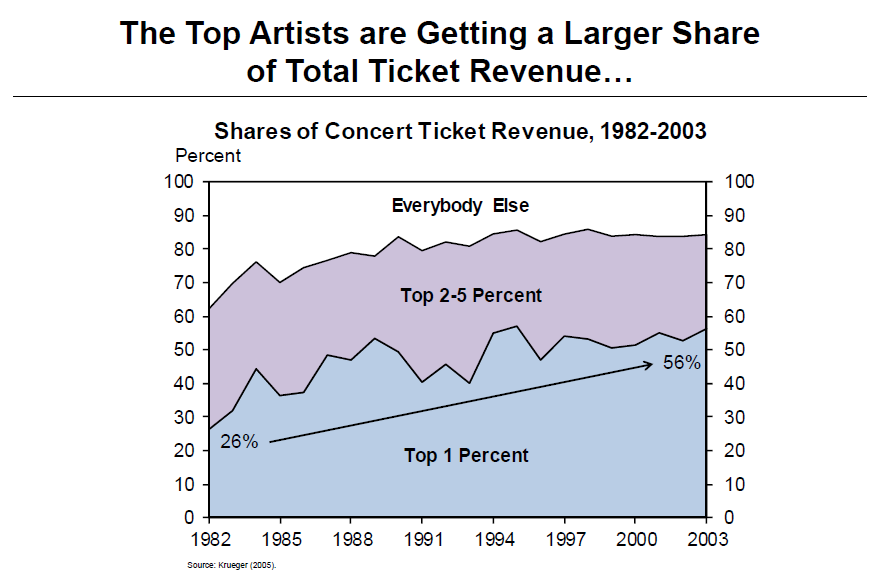
Rock And Roll’s 1%

Top Artists Sales

Neil Irwin recaps an “exceedingly rare” speech on music by White House chief economist Alan Krueger:

“The music industry is a microcosm of what is happening in the U.S. economy at large,” Krueger, chairman of the White House Council of Economic Advisers, says. “We are increasingly becoming a ‘winner-take-all economy,’ a phenomenon that the music industry has long experienced. Over recent decades, technological change, globalization and an erosion of the institutions and practices that support shared prosperity in the U.S. have put the middle class under increasing stress. The lucky and the talented – and it is often hard to tell the difference – have been doing better and better, while the vast majority has struggled to keep up.” …

A century ago, a musical performer could only reach as many people as his or her vocal range and travel schedule would allow. Now, high-quality recordings can be distributed to billions with the flip of a switch. The result: Everybody has access to the very best music, or at least the music that most precisely suits their tastes.

Which would be great if the music industry were a meritocracy. Unfortunately, it isn’t:

Luck plays a shockingly important role in which songs and artists become mega-successes, Krueger shows. He points to research by sociologists Matt Salganik and Duncan Watts. Participants in their study were able to log in to listen to songs and download those that they liked. The researchers played a little trick on them: Some of the participants saw an actual ranking of which songs had been downloaded the most previously. Others saw a random ranking. It turns out that just the appearance that something was popular drove more people to download the song. Rather than a pure meritocracy where the best songs rise to the top, music seems to have strange effects in which popularity breeds greater popularity.

Do Mascots Need Modernizing? Ctd

The popular mascot thread is still kicking:

I grew up in North Dakota, where there is a long history of sports teams with controversial  sports mascots.  Up until the 1970s, the mascot for Dickinson State University was the Savages (the school is 60 miles from an Indian reservation) and every year a white female student and a white male student would be elected homecoming chief and princess and don costumes to dress the part.  The current mascot for the school’s men’s teams is Blue Hawks and the women’s teams are called the Blue Chicks.  Today there is a small amount of controversy about the nickname of the public high school in Dickinson as the mascot for Dickinson High School is the Midgets.

For many years the mascot of Wahpeton High School was the Wops.  That nickname got changed to the Huskies.  I think it lasted as long as it did simply because there are so few people of Italian extraction in the state.

The mascot controversy at the University of North Dakota got a lot of national press.  The Fighting Sioux nickname has been officially retired and the school has no mascot at this time until tempers cool and a new one can be introduced (I think the Fighting Frackers would be a good option).  Things got really ugly in the state and the legislature got involved and it even ended up on a statewide ballot.  Some people felt so strongly about the Fighting Sioux mascot that they wanted to keep it even if it meant the school could not compete in NCAA tournaments.  It also did not help that one of the two Sioux tribes in the state voted to support/approve the use of the Sioux nickname … while the tribal council of the other Sioux tribe never permitted the members to vote.

Unfortunately for UND, the controversy overshadowed and diminished the really good work and huge investment the school has made in Native American higher education.

Another reader:

All this mascot talk got me thinking again about a very tearful, bitter school board meeting I attended with hundreds of my fellow students in 1986 in an effort to keep our principal and a group of evangelical Christian parents from changing our school mascot from The Diablos to The Bulldogs.

When Mission Viejo High School in southern California was founded in 1966, it’s mascot was The Diablo, aka “Pablo the Diablo.” I don’t really remember anyone ever referring to our mascot by its appended Spanish first name, especially since the color guard mascot at the time was always a girl dressed in a devil’s outfit . I definitely don’t remember anyone being offended by the ethnic/cultural association of naming the school’s mascot devil Pablo. But as evangelical Christians began to assert themselves in the local political and educational institutions of Mission Viejo at the time, the Diablo mascot became a primary target of their ire.

The student body was divided as parents and kids took sides in what became a city-wide controversy. I was on the pro-Diablo side, and for me personally it became friend against friend after my best friend started dating a born-again girl and he “converted” to maintain the relationship (she also convinced him to get a perm, but that’s another story). I remember the pro-Diablo student leaders speaking passionately about tradition and history at the school board meeting, but our side was ultimately outvoted. The pro-Diablo forces lost and the school’s mascot was changed to the Bulldogs.

I graduated in 1987 and never looked back and had assumed that the mascot remained the Bulldog ever since. The thread on mascots prompted me to do a little research and I discovered that the battle raged on and still continues today. The student body fought back in 1993 and after a campus-wide vote rechristened the school’s mascot as the Diablo (though the current cartoonish incarnation is a lot different than the illustrations I remember of our Diablo, who sported a Van Dyke and his eyes had a certain sinister gleam). Interestingly enough, the anti-Diablo forces in 1993 cited the separation of church and state as an argument against the mascot:

Bev Stephenson, a former school employee whose daughter graduated from Mission Viejo High last year, opposes the devil logo and fears an uproar from the local Christian community if a devil mascot wins–even a cute, smiling one. “We’re talking about the separation of church and state,” Stephenson said Tuesday. “We don’t put the Ayatollah Khomeini out there. We don’t put Jesus on the flag. We don’t use the devil either. There are many other positive depictions we can use.”

The mascot remains The Diablo at present although this rather lonely blog post suggests there are still those hoping to change it back:

Many parents and students have voiced concern over the mascot as the Diablos; saying that it is the one thing that bothers them about this High School. Today’s society is full of dark and evil messages that bring our children down. Let’s build our kids up and empower them with a Unified Mascot Change.

Almost defiantly, it seems to me now, the school website offers a “A Tour the Campus with Pablo the Diablo” page. I’m glad that subsequent students were able to get the mascot changed back after my classes failure to keep it. For me, the experience marked the first time I had ever encountered the political will of the evangelical Christian community and as I reflect on it now, the battle over the Diablo, as localized as it was, seems a harbinger of the cultural war that’s been waging ever since on a national level. I wonder how many of the Christian fans who oppose changing the mascot of the Cleveland Indians or the Washington Redskins would be in favor of changing either mascot to the Cleveland Satans or the Washington Devils?

Obama’s Worst Foreign Policy Decision

US-POLITICS-OBAMA-LGBT

MoDo today summed up the wisdom of everyone who championed the Iraq war and endorsed those arguments all over again. As if it never happened.

She even cites its two most persuasive proponents, McCain and Clinton. The argument is that something bad is happening in the world and because you are the American president, you need to stop it. If you don’t, you are “a wuss”. Worse, other actors, like Putin and Khamenei are intervening in Syria, so we must too – or appear “weak.” The entire scope of this argument, as with Iraq, is limited to the moral posture of the United States, the existence of an evil, the imperative of acting, and then trying to sell the American public on the action. The argument is actually weaker than for Iraq, because at least Clinton and McCain insisted at the time that Saddam had weapons of mass destruction that he wanted to use against America; at the current moment, no one is saying that about Syria’s chemical arsenal. In fact, the only scenario in which the US might be the target of such weapons is if we do exactly what these “statesmen” are demanding: side with one faction or another. Then at least one side has a reason to hate us.

Does Dowd have any argument as to where such “leadership” would take us? Does she argue that arming Sunni Jihadists against Alawites and Shiites is a good thing because those Jihadists would never use such weapons or be an enemy of the US? No. Who does she want to win the Syrian civil war and why? She doesn’t say. Does she support the theological claims of Sunni Islam against Shiite Islam? I don’t know. In fact, she doesn’t explain at all what the point of her new war is, or what her preferred outcome would be. These are simply to be figured out, or in Clinton’s words, “sold” later. This foreign policy “doctrine”, if it even deserves such a designation, is essentially an endorsement of George W Bush’s presidency. Yes, MoDo hates Obama that much that in this column she has actually gone full circle and endorsed the arguments that gave us the catastrophe in a very similar country, Iraq.

Clinton also accuses the president of taking his previous, coherent and strong position on Syria not because staying out of this conflict is obviously the sanest thing to do; but because Obama is apparently just listening to the polls. The gall of Clinton of all people to accuse anyone of that level of cynicism! And the American people, he assumes, are obviously wrong. The job of a president is not to listen to them on matters of war and peace, especially if they have a collective memory longer than that of a gnat, but to ignore them, forget the lessons of the very recent past, wing it, and hope to “sell” the war later.

I write all of this in acute frustration, of course. Because I thought I understood Barack Obama’s strategy and obviously I don’t, and because I want this president to succeed and I cannot possibly see how this can lead to anything but failure. And I’m frustrated because MoDo is right about the substance and the timing of Thursday’s stomach-churning presser. How dare a sitting president delegate the explanation of such a dangerous, portentous step to anyone but himself? The sheer arrogance of that delegation of a core duty is shocking. Here’s what the president had to do that day that was more important, in his mind, than explaining why he had just committed the US to the folly of another war in another Middle Eastern country:

He spent time at an LGBT Pride Month celebration, a Father’s Day luncheon and a reception for the W.N.B.A. championship Indiana Fever basketball team.

I presumed at first this was another version of the Libya fiasco:

self-righteous hand-wringing followed by removal of a tyrant, leading to more regional destabilization and the murder of an ambassador and other Americans. Only this time, the president didn’t even muster his lame defense of the Libya mess. Or perhaps it was, as Marc Lynch calls it, a version of the Afghan surge – an act that sacrificed American lives for no conceivable end but face-saving for an exit and protecting his right flank at home. The Afghan surge remains, to my mind, morally cold. Sending mother’s sons to their death when you know it won’t work is not something even Niebuhr would endorse. But as Marc notes, at least that surge had an end-date. Not this time. So perhaps this was just a minor concession to the Sunni allies who want to win the war for their version of Islam or the European allies who keep stupidly wanting to pull off another Suez. If so, it’s an insult to them as well as to us. It won’t do anything to change anything, but will mean the US will find it progressively harder and harder to avoid more and more commitment.

So let’s posit “our side” wins. What good could possibly now come of a Sunni Jihadist victory? We’d see a mass slaughter of Alawites at best, and a metastasizing sectarian war across the Middle East in which the US would be entangled. By staying out, on the other hand, we make Putin and Iran the targets for Sunni hatred, we do not add fuel to the sectarian fire, and we do not hurt any of our strategic interests. I thought I had supported Obama over McCain and Clinton in 2008. Why are we now getting boomer-era interventionism?

For a kinder, gentler version of this screed, read Fareed. Or watch this space if and when the president deigns even to explain why he has just done what he promised never to do again.

Chirpings Of The Soul

cicadas

Casey Cep offers a literary primer for the current cicada craze:

Cicadas are a global species and an ancient one. They can be found in “The Tale of Genji,” Plato’s “Phaedrus,” and even “Aesop’s Fables.” Time-lapse photography may have enhanced our understanding of their life cycle, but poets have been cataloguing their summer songs for thousands of years.

Take Robert Hass, who describes in “Between the Wars” how one could hear “the slightly / maniacal cicadas tuning up to tear the fabric / of the silence into tatters.” The poem’s speaker is reading Polish history, but finds himself disturbed by the insects’ furious activity. When male cicadas sing for females, they do, as Hass says, shred and torture silence. The tiny tymbals of the cicada buckle several hundred times a second, like mallets on a kettledrum, already a blast that only amplifies when billions of the males sing simultaneously, each trying to attract a mate. Jorie Graham describes the music of the cicadas as “kindling that won’t take.” Her poem “The Errancy” begins with the tymbals of the male cicadas crackling like wood under flame: “The struck match of some utopia we no longer remember / the terms of.”

One version of the forgotten utopia of cicadas can be found in Plato’s “Phaedrus.” When Socrates runs into one of his students walking outside the Athenian city walls, the two settle by a shaded stream to talk. Socrates notices that their conversation is competing with the shrill sound of cicadas. The eavesdropping insects listen as teacher and student debate the virtues of friendship over erotic love, the blessings of madness, the immortality of the soul, the art of rhetoric, and the superiority of speech to written text.

Alan Burdick, in an essay on the mating rituals of the insects, found cicada researchers David Marshall and John Cooley also waxing poetic about them:

As one gets older, the presentation of youth can begin to feel apocalyptic. It is always rising up, always gaining in number—insistent, heedless, both a memory and a premonition. “Working with seventeen-year cicadas brings the past into a different kind of perspective,” Marshall told me. “The last time this brood was out was seventeen years ago; a lot has happened since then. You’re having those moments with every brood that comes up; it’s always seventeen years ago. Every year, I’m saying, basically, ‘Ah, this is the brood from ’96, we were in this particular place.’ ” It’s like when you hear a song on the radio, he said: “It takes you right back to where you were.” He added, “It certainly makes me think how old I’ll be next time. That’s always where your thoughts go when you think forward from a brood.”

(Photo by Flickr user superbatfish)

Married To Different Gods

Martin Marty ponders the gritty realities of interfaith marriage. He finds Naomi Schaefer Riley’s recent book, Till Faith Do Us Part: How Interfaith Marriage Is Transforming America, a welcome exploration of the issues involved:

Ms. Riley herself and many reviewers are in “interfaith” marriages, and find much to affirm in many of them, but they are also aware of what social scientific data says about the causes of changes in marriage trends. Some data suggests that, among large communities, Mormons and Muslims are the most successful at holding off marriage “across the aisles,” to use The Economist’s terms.

Ask, in polls, which religion “other than your own” you view most positively, and the largest set of respondents lists Mormon and Muslim as problematic. Years ago Jews and Catholics were most feared and despised, but today they are most readily accepted by others! One reason for the change is interfaith marriage, and, alongside it, many other means of getting to know “the other.”

In an interview, Schaefer Riley describes what’s surprised her about her own interfaith marriage:

I told my husband on our first date that I plan to raise my children Jewish. In my survey, though, apparently, about less than half of interfaith couples actually talk about how they’re going to raise their children before they get married. So that wasn’t a big surprise. But I will say one of the interesting things is that I think most people getting into interfaith unions seem to think it’s kind of one discussion happens, somebody wins, and then you sort of move forward from there.

But I think it’s been a much more dynamic process. And, you know, you don’t really realize until you get to these various milestones in life, you know, how you’re going to feel about them. And little things can really affect the compromises that you’ve reached, you know. So you used to go to so-and-so’s for, you know, an Easter egg hunt, and it was completely an, you know, irreligious experience. You know, that person no longer hosted, and then you go to Uncle So-and-So’s, and he’s much more into talking about the real reason behind Easter. And suddenly, I think an interfaith family can get very uncomfortable.