Welcome To Your Unemployment

Speaking to graduates of Columbia University’s School of the Arts, David Byrne dumped a big bucket of cold water on their career prospects. Rachel Aron, who was there, summarizes:

In a slide-show presentation on the auditorium’s projection screen, Byrne showed a series of graphs, based on information compiled by the Strategic National Arts Alumni Project (SNAAP), illustrating that if you chose a career in the arts you are, basically, screwed. A pie chart, based on 2011 data, showed that only three per cent of film and theatre grads, and five per cent of writing and visual-arts grads, end up working in their areas of concentration (forty-three percent work in the arts but outside of their specialties; forty-one per cent work outside of the arts altogether). A subsequent bar graph showed that, according to those stats, fourteen writing and fourteen Columbia visual-arts graduates will go on to careers in their fields, and eight theatre and eight film grads will go on to careers in theirs. “That’s the end of the charts,” Byrne said, after sharing another, which showed the median salaries of people working in the arts (between thirty-five and forty-five thousand dollars across all four sectors). “I’m glad you’re laughing.”

Colin Marshall tries to find the silver lining:

[F]irsthand reports from the ceremony don’t describe a too terribly shaken Columbia graduating class, and even Byrne took pains to emphasize, or at least emphatically imply, that truly worthwhile careers — such as, I would say, his own — lay outside, or in between, or at the intersection of, definable fields. And why would you want to work in the same field you studied, anyway? To paraphrase something Byrne’s friend and collaborator Brian Eno said about technology, once a whole major has built up around a pursuit, it’s probably not the most interesting thing to be doing anymore.

Meanwhile, in a commencement address at McGill University, the philosopher Judith Butler offered a more hopeful appraisal for those studying the humanities, focusing on the non-financial aspects of such an education:

The humanities allow us to learn to read carefully, with appreciation and a critical eye; to find ourselves, unexpectedly, in the middle of the ancient texts we read, but also to find ways of living, thinking, acting, and reflecting that belong to times and spaces we have never known. The humanities give us a chance to read across languages and cultural differences in order to understand the vast range of perspectives in and on this world. How else can we imagine living together without this ability to see beyond where we are, to find ourselves linked with others we have never directly known, and to understand that, in some abiding and urgent sense, we share a world?

She continued:

You will need all of those skills to move forward, affirming this earth, our ethical obligations to live among those who are invariably different from ourselves, to demand recognition for our histories and our struggles at the same time that we lend that to others, to live our passions without causing harm to others, and to know the difference between raw prejudice and distortion, and sound critical judgment. The first step towards nonviolence, which is surely an absolute obligation we all bear, is to begin to think critically, and to ask others to do the same.

Related Dish coverage of Joss Whedon’s commencement address here.
Greater Than The Sum Of Our Neurons?

Reviewing Curtis White’s new book, The Science Delusion, Mark O’Connell summarizes the non-religious case for a more expansive understanding of truth:

White is a nonbeliever, but like a lot of nonbelievers—me included—he’s frustrated with the so-called New Atheism’s refusal to engage with anything but the narrowest and most reductive understanding of religious experience, and its insistence on the scientific method as the only legitimate approach to truth. He starts out here by taking some well-aimed swipes at the Dawkins-Hitchens-Dennett Axis of Reason, but the book’s interest isn’t so much in the New Atheism per se as in the broader ideology of which it is the militant wing: scientism. Science often looks like the only show in town when it comes to considering things like the nature of consciousness and the meaning of human existence, and White is convinced that the demotion of the humanities—of poetic, philosophical, and spiritual approaches to truth—is a demotion of humanity itself. He’s aggravated, in particular, by the mechanistic model of personhood advanced by neuroscience, whereby consciousness is seen as something that can be “mapped,” explained in terms of “wiring” and “connections,” as though the mind were actually (as opposed to just metaphorically) a kind of computer. And so he’s arguing for a return to the spirit of Romanticism, to an intellectual culture that looks to poets and philosophers and artists, rather than scientists, for insight into what used to be called “the human condition.”

Jerry Coyne unloads on O’Connell:

Aren’t these anti-New Atheism pieces getting tiresome? They have three characteristics: 1. The author is an atheist or agnostic; 2. The author takes New Atheists to task for presenting a caricature of religion and not engaging with religion’s “best” arguments (i.e., academic obscurantism that uses big words), and 3. They call out New Atheists for the horrible crime of scientism.

The response goes on to call out the “nuanced” understandings of religion that New Atheists supposedly fail to engage:

Sometimes I wonder if people like O’Connell have really read the purveyors of obscurantist religious bullpucky: people like Karen Armstrong, Alvin Plantinga, Richard Swinburne, or even Tanya Luhrmann.  Their “nonreductive understanding” is either an attempt to evade spelling out what they really believe, or a wordy justification for garden-variety religion.  And O’Connell also neglects that fact that most religious people aren’t theologians, do not read theology, and have a pretty straightforward (and “reductive,” whatever that means) set of beliefs. Jesus existed, was divine, and was crucified to save us from sin; Mohamed was the prophet and his words are not metaphorical; Joseph Smith revealed the visit of Jesus to North America and you can baptize your ancestors post mortem; you can get “clear” by investing thousands of dollars in analysis with the e-meter, and so on. I venture to say that at least 90% of the world’s religious believers fall into the class that Dawkins criticizes.  Why on earth do critics like O’Connell always equate “religion” with “theology”?

Meanwhile, Pat Finn takes the debate in a different direction, emphasizing White’s re-appropriation of Romanticism as an alternate way forward:

Between the scientific rationalism of the neuroscientists and their allies in the New Atheist camp and the religious dogmatism of, among others, the Christian right, White advocates for a third mode of conceptualizing reality that he traces to Romanticism, which swept through Western Europe in the 19th century. What White sees as central to Romanticism is a commitment to the interminable re-imagining of society, and he considers its legacy to be intimately bound up with the various counterculture movements that sprung up in the second half of the 20th century, when millions of people throughout the Western world expressed dissatisfaction with their culture and tried to change it. To protest requires an act of imagination or will, the type that the scientific worldview tends to de-emphasize or even outright deny with its vision of man as an elaborate piece of machinery. This isn’t a new idea. As White points out, Isaiah Berlin made a similar argument in the 1960s when he said that “[s]cience is submission, science is being guided by the nature of things.” Many other secular thinkers throughout the past two centuries have expressed a similar form of dissatisfaction with the constraints science threatens to impose on human potential, both individually and collectively. To leap beyond the given – to see the world not as a collection of bare facts but as material to be transformed – is, for White, the essence of a progressive political culture. Scientism threatens to extinguish this belief in possibility and freedom that has always been at the heart of progressive cultural and political movements.

Climbing A Ladder To The Heavens

Monestary

George Zarkadakis visited a monastery on Mount Athos, known as the “Christian Tibet,” to experience hesychasm – the “mental prayer” of Eastern Orthodox tradition:

In the early 14th century, a Greek theologian named Gregory Palamas produced a synthesis of Orthodox philosophy that has defined the theology of the Eastern church ever since. He founded the contemporary tradition of hesychasm, which focuses on achieving experiential knowledge of God. Palamas believed that human beings could never understand the essence of God by employing reason alone. But humans could experience God’s actions (or ‘manifestations’ as he called them), through a retreat into inner prayer. While the Catholic tradition of mental prayer allows the faithful to use icons as aids and regards apparitions as signs from God, Orthodox mental prayer focuses on mental stillness and abstraction, deliberately keeping the mind free of images or thoughts.

Palamas claimed that such prayer gradually builds an increasingly close relationship with God. One of the common themes in late Byzantine iconography is a ladder, representing hesychastic prayer, which connects the earth to the heavens.

Though no longer sharing the “central beliefs” of the faith, Zarkadakis found himself moved to wonder:

I climbed the steps to the highest spot on the wall, and looked out towards the sea. The sky was steadily lightening and a cool breeze carried the rejuvenating scent of salt towards me. Thyme, pine, jasmine and laurel emanated from the monastery’s garden. My face was warmed by the first rays of the sun. I knew that the light that kissed my face came from a star — a great ball of fire fuelled by thermonuclear reactions. That the laurels, the thyme, the bees and the chanting monks were the results of millions of years of biological evolution that had probably begun with a humble bacterium. That I smelled, saw and listened because of electrochemical signals that passed between neurons. That my limbic system was on overdrive.

But despite my knowledge, a sense of mystery remained. Why was the sun so magnificent? Why was the sea so dear? Why did I feel a sense of profound meaning in everything? Perhaps my epiphany owed to nothing more than a second night of sleep deprivation. Nevertheless, I had arrived at a state of mind, possibly not dissimilar to that of the praying monks, where logic failed and gazing at beauty was all that mattered. If that was true then perhaps to know God was simply to look at a rising star, and feel inexplicably moved.

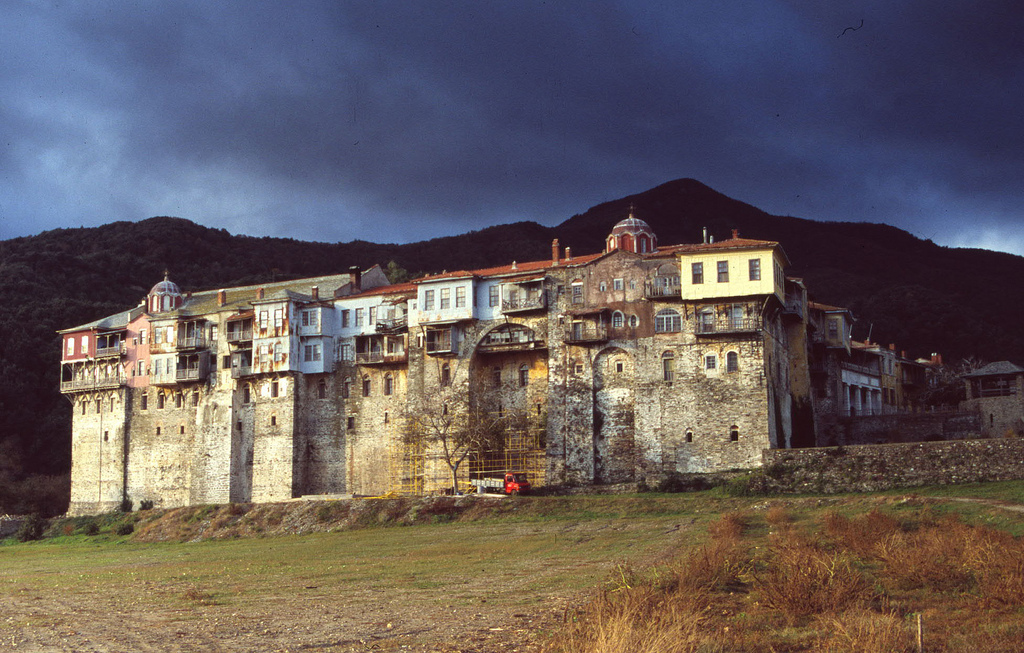
(Photo of the Iviron Monastery, where Zarkadakis stayed, by Leon Hart)

Green To Purple

iranelection-instagramed

More tweets from the celebration in Iran, going into the wee hours:

https://twitter.com/PoliticallyAff/status/346041698872336385

https://twitter.com/thekarami/status/346053260014141440

Iran’s semi-official Fars News Agency has a gallery up here. One from BBC Persia here. Mackey has been rounding up videos and tweets as well. Meanwhile, Thomas Erdbrink steps back (NYT):

[I]f the election, which electrified a nation that had lost faith in its electoral process, was a victory for reformers and the middle class, it also served the goals of the supreme leader, restoring at least a patina of legitimacy to the theocratic state, providing a safety valve for a public distressed by years of economic malaise and isolation, and returning a cleric to the presidency. Mr. Ahmadinejad was the first noncleric to hold the presidency, and often clashed with the religious order and its traditionalist allies.

The question for Western capitals is whether a more conciliatory approach can lead to substantive change in the conflict with Iran over its nuclear program. A willingness to talk does not mean a willingness to concede.

But this was no win for Khamenei either:

The election results put the supreme leader under pressure to allow changes to take place, or allow him to make the kind of changes that might be opposed by hard-liners if they controlled all the levers of power. For the supreme leader, a weak loyal president might be less threatening that Mr. Ahmadinejad, who over time alienated the ayatollah as he spread his own power throughout the bureaucracy. The ayatollah had exhorted Iranians to exercise their right to vote. Analysts are predicting at least some change. “There will be moderation in domestic and foreign policy under Mr. Rowhani,” said Saeed Laylaz, an economist and columnist close to the reformist current of thinking. “First we need to form a centrist and moderate government, reconcile domestic disputes, then he can make changes in our foreign policy,” said Mr. Laylaz, who, in a sign of confidence, agreed to be quoted by name.

Omid Memarian thinks the president-elect now has some debts to pay:

Rowhani could have never found much reception within the different layers of the society if two reformist and popular figures, Akbar Hashemi Rafsanjani and Mohammad Khatami, former Iranian presidents, had not supported him.

The popularity of Hashemi Rafsanjani and Khatami themselves has soared over the past few years, particularly after they put distance between themselves and Iran’s supreme leader, Ali Khamenei, following the intense crackdown on the people in the aftermath of the 2009 elections….

That Rowhani’s 18 million votes were followed by a 12 million-vote margin between him and the next candidate showed that Iran’s silent dissidents and suppressed civil society continues to own a very powerful voice. The urban middle-class vote, as well as the blue-collar vote, were cast in favor of Rowhani following the political and social suppression for which the supreme leader is responsible. Not to mention the public realization that the Iranian nuclear program could have continued without sanctions, and that Saeed Jalili, the supreme leader’s representative, has brought economic sanctions to Iran due to his incompetence.

In fact, the Iranian presidential election became a public referendum on the Iranian nuclear program, which for the past several years has been defined as an issue of national security. As such, the Iranian civil society and media have been unable to address and discuss it in their articles and analysis. The election results indicate that the Iranian people have strongly rejected the way the nuclear negotiations, led by Iran’s supreme leader, Ali Khamenei, have been taking shape.

But as Arash Karami reminds us, if Rouhani pursues reform, success won’t come easy:

Rouhani will be facing a litany of domestic and foreign issues, and on many fronts his efforts will be restrained by [the Supreme Leader], who not only controls foreign policy and the nuclear file but has increasingly interfered in the appointment of key cabinet positions under the administration. …

[S]enior policy analyst at Rand Corporation, Alireza Nader, believes that the cards are stacked against Rouhani in implementing meaningful reform. “It remains to be seen how the ultra-conservatives among the Revolutionary Guards and Basij react to Rouhani. There was a lot of hope that Mohammad Khatami could also solve Iran’s problems when he was elected in 1997. But Khamenei and the Guards managed to constrain him again and again. A key question is whether Khamenei will trust Rouhani … Rouhani is very closely associated with Ayatollah Rafsanjani, who was disqualified from the race [by the Guardian Council which is directly and indirectly appointed by the Supreme Leader]. This may not sit well with many of the Iranian hard-liners.”

Our ongoing coverage of the Iranian election, in reverse chronological order, is here.

(Image: Dish mashup of today’s Instagrams from Iran. Clockwise from the upper left – credits to: sh4hrz4dardalankaashkangiplasihommaa, ashkangiplasipedramveisi)

Rated G Or Rated X?

Hillary Louise Johnson argues that an all-or-nothing approach to sexual expression on the Internet misrepresents how people actually behave:

The rise of the privately-held, terms-of-service-governed internet has cultivated a binary view of sex, in which all content is divided into two categories: porn and not-porn. As a result, I can have a G-rated profile on Facebook, and/or an X rated one on Fetlife. But you will not see overlap between those. No one on Fetlife talks about their kids or their day at work, no more than anyone on Facebook talks about putting on a leather pony costume and playing giddyup in the local dungeon on a Saturday night. On Fetlife, you post pictures of your genitals, but not of your face (lest a cousin or co-worker stumble across your profile, presumably), and on Facebook…well, it’s called Facebook, not Assbook. …

So as much as I love the internet, its rules of engagement do not satisfy my desire as an enlightened and liberal human being … to live on my own terms, which means openly acknowledging that I do, in fact, have a sexual identity that is not separate from other aspects of my identity, and that I may want to express and promote ideas that do not easily fall into the binary porn/not-porn baskets carved out for us by terms of service and content guidelines: I might want to write a review of an erotic art show that isn’t porn, or introduce my followers to my friend’s sex advice column, or publish a short story that includes graphic sex but isn’t porn or erotica—that gray area known in some circles as literature.

Iran Votes For Change: Blog Reax

IRAN-VOTE-ROWHANI-WIN

Among Juan Cole’s initial observations:

Those who believed that Khamenei would try to fix this election for Jalili as he is accused by the Green movement of doing four years ago were mistaken. Either the Leader feels that he has sufficient control of the country to risk a mildly reformist candidate like Hasan Rouhani winning, or the turmoil the country faced in 2009 chastened him and he decided to let the public blow off steam by giving him a president he isn’t entirely happy with.

Suzanne Maloney believes that Rouhani could improve relations with the West:

Today, despite the campaign antics, Rouhani is an ideal candidate to spearhead a new initiative to wrest Iran from its debilitating battle with the international community over the nuclear issue. His credentials for this assignment are clear: as a member of the religious class, he offers the prospect of clerical continuity; as a long-time consigliore of Khamenei, he harbors no intentions of pushing the constraints on the presidency; and as the author of Iran’s previous dabbling in nuclear concessions, he can be the fall guy, yet again, for a deal that the Leader wishes to disavow. Rouhani is tested and nothing if not pragmatic. Though his supporters have crashed the gates of theocratic restrictions on debate, Rouhani has remained mostly cautious in his own statements, his campaign embodying its slogan of prudence as well as hope.

Bob Dreyfuss is optimistic:

[A] former nuclear negotiator for Iran under President Khatami, and as President Rafsanjani’s top national security adviser before that, Rouhani will have a chance to “reset” relations with the United States. Just as important, the emergence of Rouhani as president of Iran gives President Obama a tremendous opportunity to re-start talks with Iran on a new basis, and the fact that Iran’s next president won’t be named Ahmadinejad means that all of the efforts by hawks, neoconservatives and the Israel Lobby to demonize Ahmadinejad are now for naught.

Before the election, NIAC’s Trita Parsi predicted what a Rouhani win would mean:

First, it’s not just about Rouhani; it’s about the personnel that would follow him into government and populate key ministries and institutions and reconfigure the political makeup of the regime’s decision-making table. When Mahmoud Ahmadinejad came to power, within months he fired 80 of Iran’s most experienced ambassadors and foreign policy profiles. Many of these were Iran’s most pragmatic and competent foreign policy hands, often key players in Iran’s more conciliatory decisions, such as the collaboration with the United States in Afghanistan and the suspension of enrichment in 2004. They were replaced by inexperienced ideologues hired not for their capabilities but their loyalty to Mr. Ahmadinejad. A reversal of this trend can prove quite valuable.

Second, Mr. Rouhani and his entourage hold a different world view than those close to Mr. Ahmadinejad and the supreme leader. While still suspicious and distrustful of the West, and while still committed to Iran’s bottom line on the nuclear issue, the elite that associates with Mr. Rouhani does not see the world in Manichean black and white. The outside world may be seen as hostile, but common interests can still be found. Collaboration is still possible. Rather than emphasizing ideology and resistance, they pride themselves on being pragmatic and results-oriented (of course, within the context of the political spectrum of the Islamic republic).

Parsi believes both the West and Iran should now take this opportunity for a reset.

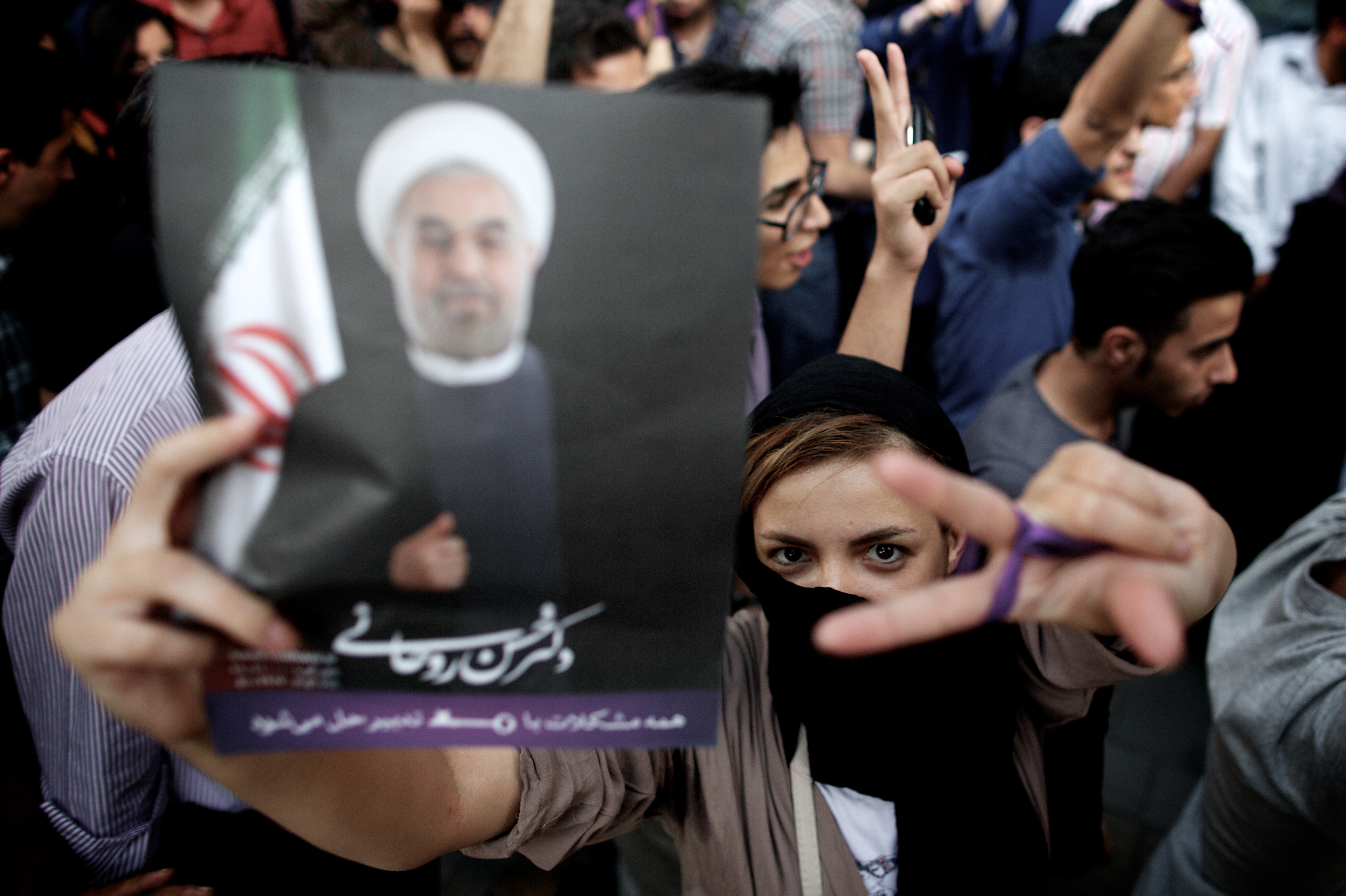
(Photo: An Iranian woman flashes the sign for victory as she holds a portrait of moderate presidential candidate Hassan Rowhani during celebrations for his victory in the Islamic Republic’s presidential elections in downtown Tehran on June 15, 2013. Iranian Interior Minister Mohammad Mostafa Najjar said Rowhani won outright with 18.6 million votes, or 50.68 percent. By Behrouz Mehri/AFP/Getty Images)

Iran’s Election Surprise?

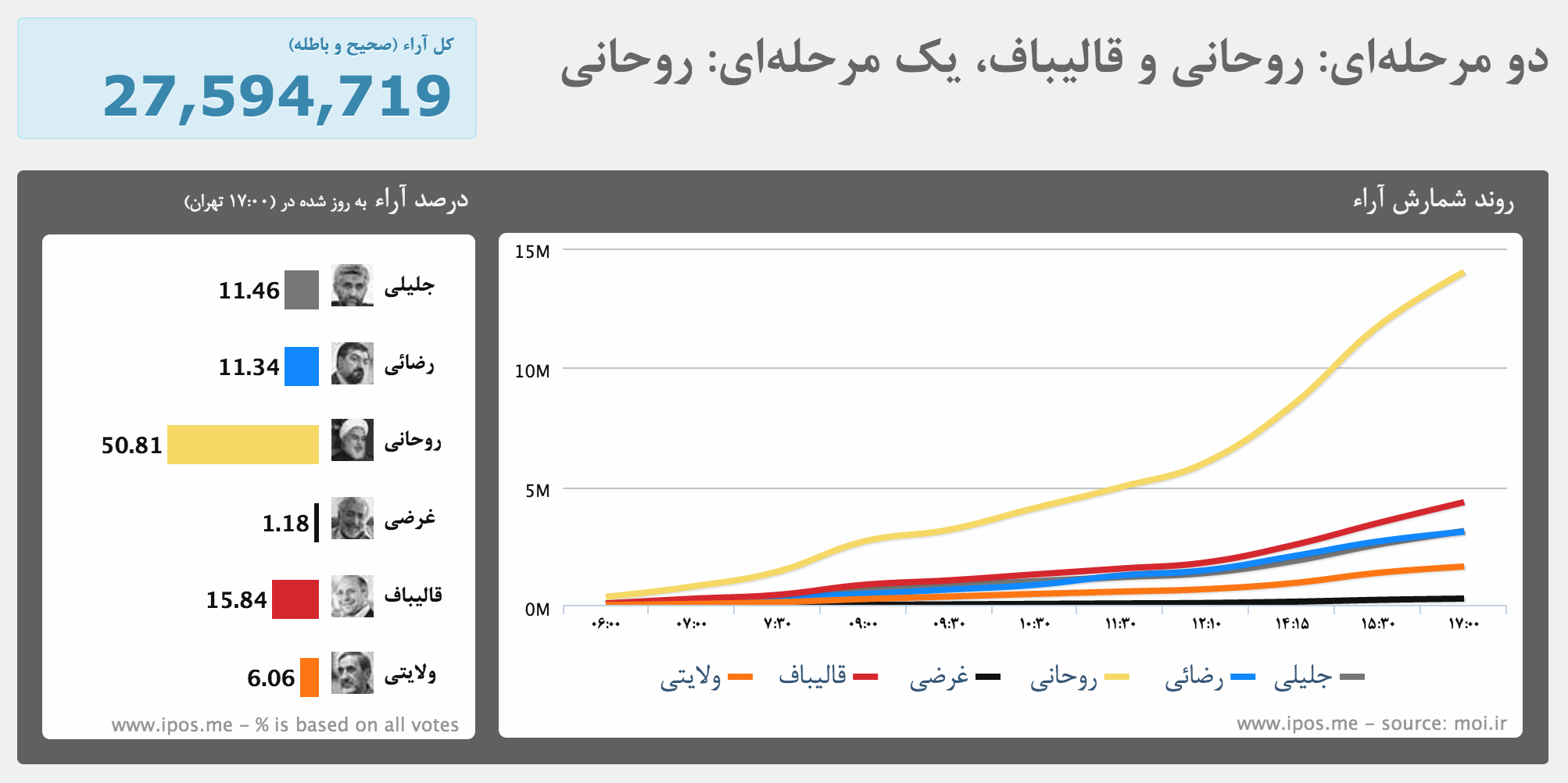
Here are the voting results as of 5 pm Tehran time, as tracked by Ipos.me:

ipos-iranelection-results

With the votes still be counted, reformist-backed candidate Hassan Rouhani is currently winning yesterday’s election in a landslide. We’ll have reax soon but in the meantime here’s a selection of tweets following the news as the results trickled out over the past 12+ hours:

https://twitter.com/thekarami/status/345670534509514752

https://twitter.com/SaeedKD/status/345711846042505217

https://twitter.com/Omid_M/status/345735721799278592

https://twitter.com/IranBlogger/status/345694591137230850

https://twitter.com/ianbremmer/status/346018038782521345

https://twitter.com/Najmeh_Tehran/status/345805085328158720

https://twitter.com/SaeedKD/status/345844909758099456

https://twitter.com/Najmeh_Tehran/status/345845437233762305

https://twitter.com/thekarami/status/345769771641475075

https://twitter.com/Najmeh_Tehran/status/345886784162500609

https://twitter.com/Omid_M/status/345882361784848384

https://twitter.com/thekarami/status/345882338527432705

https://twitter.com/shashj/status/345887742716157952

Web Developers: They Didn’t Build That

James Somers questions the value of his field:

We call ourselves web developers, software engineers, builders, entrepreneurs, innovators. We’re celebrated, we capture a lot of wealth and attention and talent. We’ve become a vortex on a par with Wall Street for precocious college grads.

But we’re not making the self-driving car. We’re not making a smarter pill bottle. Most of what we’re doing, in fact, is putting boxes on a page. Users put words and pictures into one box; we store that stuff in a database; and then out it comes into another box. … I do most of that work with a tool called Ruby on Rails. … And the important thing to understand is that I am merely a user of this thing. I didn’t make it. I just read the instruction manual.

Update from a reader:

I’ve been a web developer since the late ’90s. James Somers is accurately describing a small percentage of the web development world that is unfortunately blown out of proportion by lazy sensationalist writers. While I am sure that there are people burning VC money on lavish salaries for guys to put boxes on pages that’s not how it goes where I work. But hey, Somers is an expert who works in the industry so obviously his take on it must be accurate, right?

As Mr. Somers has observed in response to being called out for his poorly-written screed, there are a lot of companies out there doing real work, making products that perform valuable and necessary services, and without skilled web developers that wouldn’t be possible. Mr. Somers also falsely implies that all it takes to succeed in this field is the ability to read a manual. That’s a bit like saying all it takes for an attorney to be successful is to have the ability to read a law book, or for an accountant to be successful the ability to do math. Where I work the developers have to actually know how to think and solve problems, and they must pass non-trivial coding tests to get hired. It’s damn tough to find qualified applicants for our numerous open engineering roles, where we wade through dozens of resumes from wannabe web devs to find the few who know what they’re doing.

Another:

The thing about programming is if you’re good at it, it’s gonna be really hard to imagine why other people aren’t. There’s this problem that a lot of companies use to test candidates, writing a program that can play FizzBuzz, and a shockingly large number of applicants fail it. As far as I’m concerned you should be able to do that on your very first day programming, but there you have it. I suspect something similar is going on with Somers, along with the all-too-common refrain that if it’s not ground-breaking it must not be worthwhile. Even if he were right, there are still a lot of people in the world who need boxes put on their webpages and clearly not everyone can do it for themselves. (Otherwise, they wouldn’t pay a lot of money to hire web developers to do it for them.) Sometimes these boxes are in the service of something really important and sometimes they aren’t, and that’s completely irrelevant to whether web developers should be making that much money making them. They make that much money because their skills are in demand and supply is scarce. Either programming is harder than we think or other people have mysteriously failed to catch on.

Obama Caves On Syria

US-POLITICS-OBAMA-LGBT

[Re-posted from earlier today]

Well, we don’t yet quite know what’s in the works – but once you start arming one side of a civil war, you become part of that civil war; the other side may target you; and as this sectarian conflict deepens across the region, the US will be seen as a Sunni power fighting Shiites. I cannot think of a worse policy position for this country – to take stand on the sectarian fault-line of the Muslim world and back one side over another. You think the other side won’t notice? You think Americans wouldn’t be targeted for this kind of meddling? Let Putin get bogged down in this hell, if he remains so 19th Century he feels he must. But we should have zero interest in that ancient religious dispute; zero.

And you can say you’re only arming them with anti-tank weapons and the like. Ben Rhodes was very careful not to say too much. But of course he did say far too much. Once you have committed to one side in a civil war, you have committed. The pressure from the neocons and liberal interventionists to expand this war will only increase – because either you fight to win or you shouldn’t fight at all. Yes, it’s the same coalition that gave us the Iraq catastrophe.

My strong view, vented last night as I absorbed this stunning collapse of nerve, is that we shouldn’t fight at all. We are damn lucky to have gotten every GI out of Iraq, and the notion of being sucked back into that region again – and to join sides in a sectarian conflict – is a betrayal of everything this president has said and stood for. It’s a slap in the face for everyone who backed him because he said he wouldn’t be another Bush or McCain or Clinton. If he intervenes in Syria, he will have no credibility left with those of us who have supported his largely sane and prudent foreign policy so far. Libya was bad enough – and look at the consequences. But Syria? And the entire Middle East? Is he out of his mind?

And can you think of a dumber war than this one?

The man who said he would never engage in a dumb war is apparently preparing to join the dumbest war since … well, Iraq. And by the way: who would you rather have in control of chemical weapons – Assad or the al Nusra brigades? Because it will be the al Nusra brigades who would seize the country if Assad falls. And you think those fanatics have the slightest loyalty to us?

One reason I supported Obama so passionately in 2008 and 2012 was because I thought he understood this and had the spine to stand up to drama queens like McCain and armchair generals like William Jefferson Clinton. But it is beginning to appear that this president isn’t actually that strong. We voted for him … and he’s giving us Clinton’s and McCain’s foreign policy. If Cameron and Hollande want to pull another Suez, for Pete’s sake be Eisenhower – not Kennedy.

My cri de coeur is here. Don’t do it, Mr President. And don’t you dare involve us in another war without a full Congressional vote and national debate. That wouldn’t just be a mistake; it would be a betrayal.

(Photo: Saul Loeb/Getty.)

They Don’t Make CEOs Like They Used To

Mitt Romney With HUD Secretary

Chrystia Freeland asks today’s CEOs to take a lesson from Mark Mizruchi’s book The Fracturing of the American Corporate Elite, which tells the story of the Committee for Economic Development, a group of “engaged, moderate businessman from across the country” formed in 1942:

In order to maintain the system from which their privileges derived, they believed it would be necessary to attend to the welfare of the broader population. This meant supporting a high level of employment, the alleviation of poverty, the amelioration of racial disadvantage, and the provision of sufficient purchasing power in the population to consume the goods that American business was so proficient at producing.

This was the creed of the nation’s most influential corporate leaders, a group that supplied Cabinet secretaries to both Republican and Democratic Administrations. Today, with so much of the national economic conversation consumed by the budget deficit and which middle-class entitlements need to be cut to reduce it, that platform would place you on the left wing of the Democratic Party, and no leading business organization would advocate it.

Christopher Flavelle, meanwhile, is bothered by today’s chief executives “squandering their influence” by promoting partisan ideas rather than bridging the gaps:

The Business Roundtable, an association of chief executive officers of the largest U.S. companies, held a lunch for reporters this week on what’s wrong with the economy. A better question might be what’s wrong with the country’s chief executives.

In the face of persistently high unemployment and slow economic growth, the two executives hosting the lunch (the Roundtable insisted they not be identified) didn’t talk about this year’s government spending cuts, the best course for monetary policy or even reducing regulations. Instead, they talked about their plan to cut Social Security and Medicare, which they called a drag on economic growth. …

If business leaders really wanted to shore up Medicare, they could throw their weight behind cost-cutting mechanisms that are already in law but face enormous political opposition, such as the board of experts charged with limiting the rise in Medicare spending to just 1 percent more than gross domestic product growth. If they really wanted to ensure Social Security’s solvency, they could support eliminating the cap on income subject to the Social Security tax, which now stands at $113,700. That the Roundtable chose instead to push ideas that even Republicans seem to have quietly shelved says more about its members than the state of debate. It doesn’t matter whether these proposals are a heartfelt but unpromising attempt to fix the economy, or simply the Roundtable providing a soapbox for its members’ views about the role of government. The effect is the same: It isn’t likely to accomplish much.

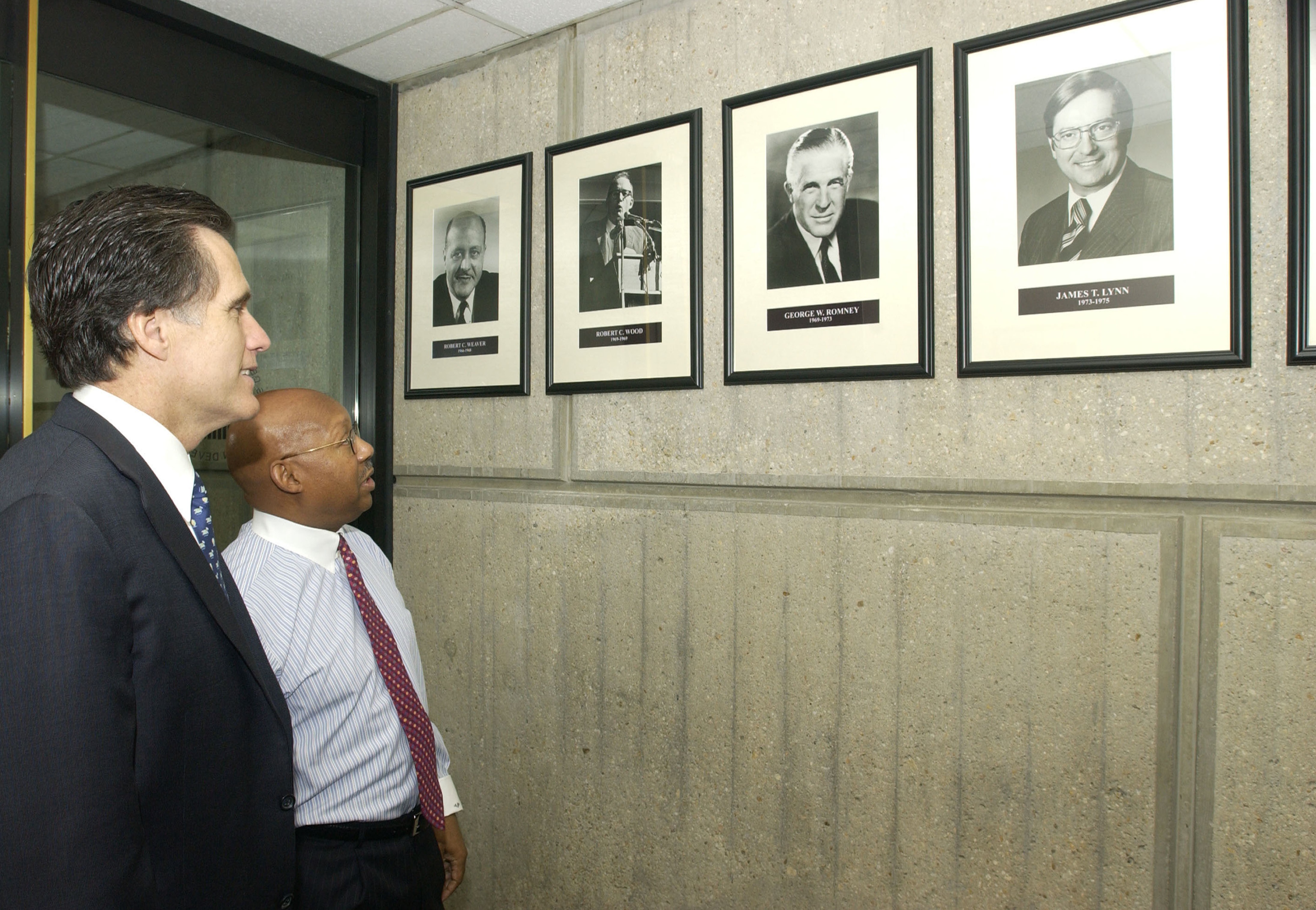
(Photo: American politician (and future Republican Party nominee for the US Presidency) Mitt Romney looks at a portrait of his father, former Michigan Governer and US Secretary of Housing and Urban Development (HUD) George Romney, with then-incumbant HUD Secretary Alphonso Jackson, in Washington DC on May 3, 2004. By PhotoQuest/Getty Images)