Your Brain Has Been Branded

Tom Jacobs explains a recent study that suggests big brand names neurologically “override” consumers’ usual patterns of judgment:

The researchers describe an experiment featuring 15 people ranging in age from 23 to 50. While their brains were scanned using fMRI technology, they were given a series of small drinks of cola. After each swallow, they rated how pleasurable it tasted on a scale of one to eight. They were told they were sampling Coke, Pepsi, River Cola (a generic brand sold in Germany), and a new drink created in a test laboratory, which was labeled T-Cola. In fact, they always received the same mixture of the first three brands. Participants rated the “Coke” and “Pepsi” samples as tastier than either the generic or the test brand. “We did not find a significant difference between Coca-Cola and Pepsi-Cola preference,” the researchers write.

Relatedly, Planet Money describes Coke’s new ad campaign in Burma, where, until recently, sanctions prevented Coke from selling its products. One of the strategies being used to sell “Coke to people who may not remember what it tastes like”:

[Shakir Moin, the head of marketing for Coke in Southeast Asia,] says he started to go back in the Coca-Cola archives. He was looking at how the company marketed its product before the internet, before TV, even before radio. Eventually he found his perfect model for Myanmar, place where nobody knew anything about Coke — Atlanta, 1886.

Back then the hot advertising trend was wall posters. Moin noticed that in the beginning, Coke didn’t use the posters to talk about friends or happiness or style. It talked about what the product tasted like. It simply described it. Moin pulled out two words in particular that would form the core of his Myanmar campaign — “delicious, refreshing.”

Those two words from the 1800s are now on the Myanmar bottle, and on the billboards and fliers that advertise the product.

Diversity Pays Dividends

TNC believes that Republicans suffer from a lack of diversity:

I’ve said this before but conservatives often perceive liberal attachment to diversity as a kind of “everyone’s a winner” cuddle party, where we sit around exchanging rice-cakes and hating on the military. But the great strength of diversity is it forces you into a room with people who have experiences very different from your own. It’s all fine and good to laugh at Sherrod Brown dancing to Jay-Z. But dude is outside his lane and he’s learning something. M.C. Rove should be so lucky.

If you are not around people who will look at you like you are crazy when you make stupid claims about other people’s experiences, then you tend to keep saying stupid things about other people’s experiences.

Dreher objects:

TNC’s point that we benefit from learning perspectives different from ours is perfectly valid, even anodyne. But it’s simply untrue that “diversity” in practice means what liberals say it means. If liberals meant what they said, they would push for “diversity” to include political conservatives, Southern Baptists, and others unlike themselves. How often does that happen? It seems that ”diversity” only applies to racial and sexual minorities. Conservatives understand perfectly well that the concept of diversity is an ideological construct that implicitly marginalizes them. That is the essence of the conservative resistance to “diversity” — that it’s a racket and a sham. TNC’s post prescribes diversity to conservatives to get them to be less “stupid,” and again, I agree that it’s always good to try to understand the perspective of others. But: every conservative has heard liberals say incredibly ignorant, stupid, untrue things about conservatives, but one rarely hears liberals worry about their own epistemic closure resulting from their monocultural liberalism.

A Sunny Future For Veterans?

Tina Casey applauds a new program that is reducing the military’s carbon footprint while providing job training to servicemembers and veterans:

The nonprofit career education organization Solar Energy International (SEI) has taken note of the surging interest in solar jobs among military veterans, and it has come up with a scholarship plan to help both veterans and active duty military jump-start new careers in the solar industry. The program is further evidence that the creation of a culture of energy awareness in the Defense Department is having a direct impact on service members and their home communities…

The need to create an energy awareness platform for deploying new technology effectively is best demonstrated by the Army’s new “The Power Is In Your Hands” energy awareness initiative, which notes that sustaining a Soldier in today’s battlefield takes more than 20 gallons of fuel per day, compared to two or less in World War II. Private sector companies are already taking note that military veterans can serve as powerful “green ambassadors” for introducing renewable energy technology to civilian communities, particularly in the solar industry, and the Army’s Net Zero program was designed in part to serve as a role model and best practices test bed for its host communities.

Jeff Spross agrees:

The new scholarship is a direct response to an uptick in demand, probably driven by the military’s big ongoing push into renewable power and energy efficiency. … [T]he military is pushing ahead with everything from geothermal projects, to electric vehicles, to solar cells that can be stitched into backpacks, clothing, tents, or that can even be rolled up or unfurled like placemats — thus relieving soldiers of the need to cart around much heavier battery packs.

Given all that, it’s little wonder there are more soldiers and veterans looking to carry those skills and experiences into the private sector.

Iranian Election Update

https://twitter.com/thekarami/statuses/345613295564251136

Voting ended at 11 pm in Iran. Saeed Kamali Dehghan reports that a second round seems likely:

Election officials at Iran’s interior ministry were yet to announce final results but a high turnout after a last-minute excitement caused by the reformists’ endorsement of a moderate candidate boosted the chances of a second round next Friday. Hassan Rouhani, the moderate cleric backed by reformists and many opposition figures, and Tehran’s pragmatic mayor, Mohammad-Bagher Ghalibaf, looked likely to emerge on top, with the chief nuclear negotiator Saeed Jalili, thought to be the favourite candidate of the clerical establishment, falling behind.

He also points out:

In a strange paradox, the state is so keen during elections to showcase a country ostensibly united despite it differences that normal stringent rules do not apply. Thus a picture published by a conservative news agency showed a young woman with virtually no head-covering, her headscarf loosely tied at the back of her head. Iranian women voting abroad reported that they were able to vote without wearing the hijab despite normally strict rules imposed by embassies.

The BBC, meanwhile, complained that Iran had launched a new campaign of intimidation against staff working for its Persian service in London. Relatives of 15 journalists have been harassed, summoned for questioning and threatened.

Regardless of which candidate is ultimately declared the winner, Reza Aslan thinks we might end up missing Ahmadinejad and how extensively he took on Iran’s clerical establishment:

In his second term, Ahmadinejad steadily chipped away at the clergy’s religious, economic, and political control. First, he started questioning the mullahs’ self-proclaimed status as the arbiters of Islamic morality — and especially its obsession with proper Islamic dress. He condemned the actions of the country’s dreaded morality police, saying, “it is an insult to ask a man and woman walking on the street about their relation to each other.” Ahmadinejad’s media advisor, Ali Akbar Javanfekr, was even arrested for printing articles criticizing the law forcing women to wear veils.

The president then began repeatedly criticizing the clergy for their enormous wealth, which stood in stark contrast to most Iranians’ economic suffering under international sanctions. In a surprise move, Ahmadinejad curtailed the amount of money that the government pays to religious institutions, which have ballooned over the past three decades into a source of tremendous personal enrichment for many in the clerical elite.

Ahmadinejad also took a number of bold steps to wrest political power away from the mullahs. He ceased attending meetings of the Expediency Council, one of Iran’s many Orwellian committees whose purpose is to protect the political interests of the clergy. When Iran’s oil minister stepped down, Ahmadinejad took over the ministry himself until a permanent replacement could be found, establishing an extremely significant presidential precedent in the process. … But Ahmadinejad’s challenge to the clerical regime goes beyond any single skirmish with the supreme leader. Perhaps more important is his very public questioning of the foundation of the Islamic Republic’s political and religious authority. “Administering the country should not be left to the [supreme] leader, the religious scholars, and other [clerics],” the president said in 2011.

Aslan adds that “the one thing that the top contenders to replace [Ahmadinejad] have in common is their comical obeisance to the supreme leader”. Mackey and Enduring America are still live-blogging. Our earlier coverage from today is here.

Do Republicans Care About Healthcare?

Paul Waldman thinks the Republicans’ biggest challenge in the fight against Obamacare is that “conservatives just don’t care”:

That isn’t to say there are no conservatives who care about health care, because there are a few (like the folks at the Heritage Foundation who came up with the individual mandate!). But they are few and far between on the right. Your typical Republican, on the other hand, cares deeply about issues like taxes and defense policy, and works hard to understand them and come up with ideas for where they should go in the future. But had President Obama not passed health-care reform, they would have been perfectly happy to let the status quo continue indefinitely.

Drum agrees:

I don’t blame Ponnuru and others for trying to get conservatives to embrace some kind of healthcare plan. I think they’re kind of crazy to think their proposed plan would (a) work, (b) be politically attractive, or (c) be popular, but maybe that’s just my liberal bias talking. What’s not my liberal bias talking, however, is the plain fact that conservatives don’t care about expanding access to healthcare. As Waldman says, the evidence on this score is overwhelming. They opposed Medicare. They opposed CHIP. They’ve opposed every expansion of Medicaid ever. Only brutal strongarm tactics got them to support their own president’s prescription drug plan, despite the sure knowledge that killing it would likely lose them the White House the following year. And of course, they’ve opposed every Democratic attempt to pass universal healthcare legislation in the last century.

During that same period, Republicans have never shown any interest in a plan of their own. They periodically put on a show whenever Democrats propose something that looks like it might have legs, but it’s purely defensive. When the threat goes away, so does the show. This has happened like clockwork for decades.

Obama’s Betrayal On Syria: Reax II

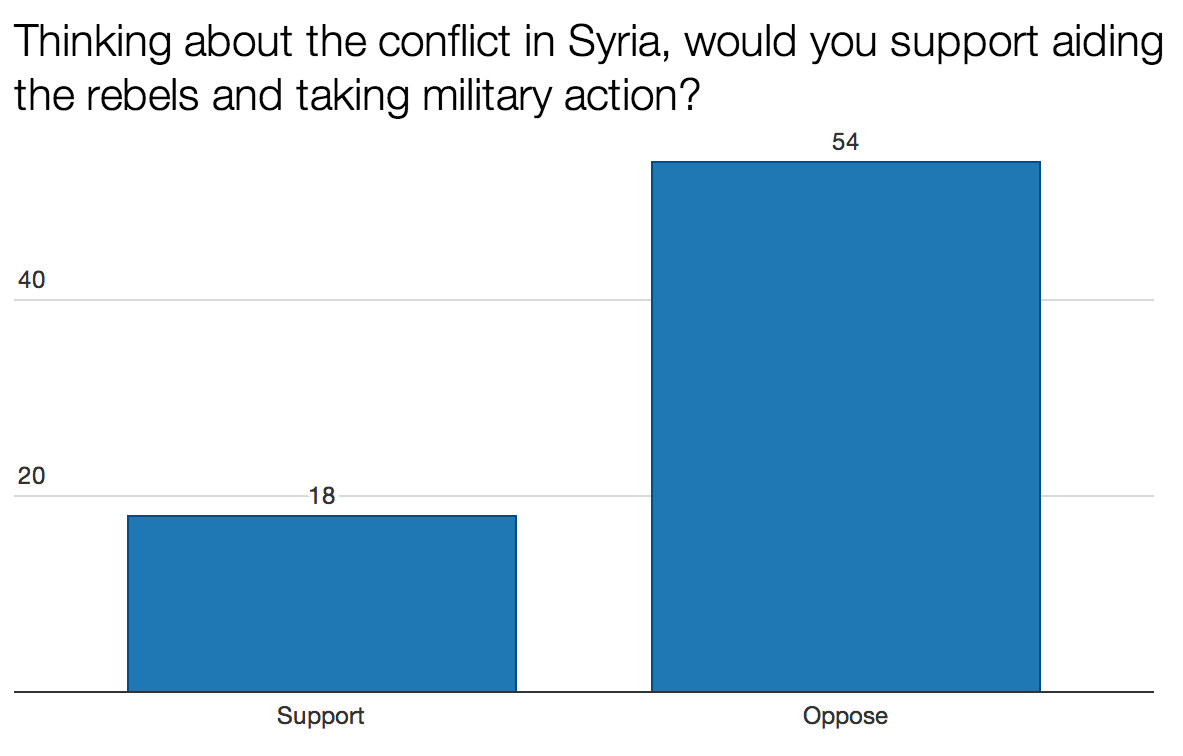
YouGov finds that Americans oppose intervention in Syria:

Syria Public Opinion

Jeffrey Goldberg thinks that Clinton’s remarks forced Obama’s hand:

From the president’s perspective, in fact, it would be best not to get involved at all. But the pressure on him this week became too much to bear. Former President Bill Clinton essentially called Obama a dithering coward because of his unwillingness to enter the Syrian conflict, and the intelligence community found evidence that Assad’s regime has definitively crossed the chemical weapons “red line” the president had spoken of — surely to his everlasting regret — last year.

Obama sees no clean way out, and no clear rationale for deepening U.S. involvement. He also sees a rebel coalition that is both dysfunctional and radicalized, and he knows that there is an outcome to this war that is worse than the continuation of Assad’s rule: the dissolution of the Syrian state and its replacement, in some locations, with al-Qaeda havens. Even an all-in move by Obama to make the rebels’ cause his own probably wouldn’t prevent the country’s collapse (it has, in fact, already collapsed as a unitary state). And he knows that if terrorist groups establish footholds in Syria — geographically close to our crucial allies, Jordan and Israel — he will have to act against them.

Matt Steinglass hopes that Clinton’s comments didn’t play a role:

I dearly hope that the policy documents the State Department is now drawing up regarding American military aid to Syrian rebel groups do not read “Goal: Keep POTUS from looking like a wuss.”

Larison rejects arguments, like Drezner’s, that Obama’s actions qualify as Realpolitik:

As long as the war goes on, the demands for “decisive” action will increase every week, and the administration has just decided to do something that is intended to prolong the war. Meanwhile, containing and limiting the effects of the war on Syria’s neighbors, which is what ought to matter far more to the U.S., will become more difficult as the U.S. directly contributes to regional instability. I suppose one could call this Realpolitik, except that it ignores U.S. interests, the stability and security of allies and clients, and commits us to the losing side in a civil war where we have nothing at stake. I wouldn’t expect this realist policy to please many realists.

Justin Logan agrees that intervention in Syria isn’t realist foreign policy in action:

I don’t think it’s right to read realists as advising Washington to fuel the Syrian civil war in the hopes of bleeding Hezbollah and Iran white. It’s this sort of operationally realist but strategically grandiose foreign policy that has given realism a bad name. Sometimes, in the name of conservatism and defraying the costs of war, realists advise deeply cynical policies that force those costs onto others. But in a similar spirit of conservatism, and indeed ethics, they tend to define the national interest in such a way that a profoundly secure country like the United States doesn’t have to do terrible things across the globe all the time.

Max Fisher doubts that giving the rebels small arms will accomplish much:

Rebel leaders say that small arms will do them little good and that they need heavier weapons. Whether or not greater U.S. involvement is a good idea, two things appear to be true: that the rebels are losing ground against Assad’s forces, backed by Iran and Hezbollah, and that small arms would not turn the tide.

Michael Weiss and Elizabeth O’Bagy are already calling for a no-fly zone:

Any swift and decisive decision to materially aid the Free Syrian Army will necessarily include degrading or destroying the runways and infrastructure of Syria’s military airbases and commercial airports. The fact is, Assad’s warplanes and helicopters aren’t just bombing rebel strongholds, civilian homes and bakeries, they’re also being used for domestic and international resupply efforts. Whenever the regime wants to bolster its conventional military presence in restive areas in the north or northwest of Syria, it dispatches reinforcements of crack troops via air transport. (Ground transport is still dangerous for Damascus given the supply routes now controlled by the rebels).

James Traub claims that Obama won’t commit American troops to Syria:

Obama has now crossed a line that he had hoped not to cross. Those who wish he had not done even that much will say that a slippery slope leads to U.S. boots on Syrian soil. That’s not a serious argument; this is a president who is focused on reducing American troop deployments, not finding new pretexts for combat. The real question is how much the United States and other outside actors can do to stop the killings, to force Assad to reconsider, to stabilize a region now facing the threat of sectarian war. You can’t help feeling that Obama is trying to simultaneously satisfy incompatible moral and strategic calculations. There’s a very real danger that he will fail on both counts.

And Josh Marshall comes out against intervention:

The only thing which gives me some pause are the advantages the US and US allies would gain by severing the Syrian-Iranian alliance. That’s a big thing. But to put it in really surgical terms, I think we’ve learned, at great pain and loss, that the US doing surgery on the Middle East creates scar tissue and complications way out of proportion to the hoped for gains.

Earlier reax here. My thoughts here and here.
Hysteria Repeats Itself

The debate over Obamacare is giving Aaron Carroll déjà vu:

Let’s all take a deep breath and appreciate what’s going on. Health care is expensive, and changing the health care system is scary. But when Medicaid was passed, tons of people panicked. They claimed that it would bankrupt the states. They claimed that the feds would renege on their promises. They claimed that it was a backdoor to socialism. They claimed that doctors would be paid much less. They claimed that doctors would leave the program in droves. They claimed that no one liked the law. They predicted doom. It didn’t happen.

It’s easy to scream that the sky is falling. Remember when Ronald Reagan told us that Medicare was the death of freedom?

At some point, though, you have to look around and realize that things just ain’t that bad. We’ve heard these arguments before. They didn’t come to pass. States have all embraced Medicaid. The feds never broke the bargain. Docs made a fortune in the 80’s. There are more medical school applicants than ever before. At some point, we have to stop giving these arguments so much weight. Obamacare will not be perfect. Neither will the Medicaid expansion. We’ll need to fix them. But neither will bring about the end of the republic, just as no health care reform in any other country resulted in the end of democracy itself.

Will We Ever Be “Majority-Minority”?

Despite the fact that the Census predicts that the white majority in the US will be gone by 2043, Jamelle Bouie expresses skepticism that we’ll ever really be “a country where most Americans have nonwhite heritage”:

The fastest growing group of Americans—by far—fall under the “multiracial category.” If past research is any indication, these Americans are likely the product of intermarriage betweens whites and Hispanics (the most common interracial pairing) or whites and Asians (the next most common one). While we identify them as nonwhite, we don’t know how they’ll identify themselves in the future. My hunch is that—as (certain groups of) Latinos and Asians integrate themselves into American life—a good number will identify themselves as white, with Hispanic or Asian heritage, in the same way that many white Americans point to their Irish or Italian backgrounds. …

While there’s no doubt the United States will become a place where people of Asian and Hispanic heritage are common, that’s not the same as saying it will become a “majority-minority” country. Given our history, and continued assimilation, intermarriage, and upward mobility among Latino and Asian Americans as a whole, there’s a good chance the United States will remain a “white” country, where “white” includes people of Hispanic and Asian heritage.

However, Josh Marshall argues that, with the white vote getting smaller, inciting racial panic has become less and less politically effective:

Let’s just talk about the 1990s or really any other time up to the last few years. It’s not that any of this stuff is new. It’s that until pretty recently we had this stuff and on balance it was successful. That’s the key. And now, though it’s a very close run thing, it tends not to be successful. And by successful I mean in a purely electoral sense. Does it get you more votes than it loses you. And at a certain level that’s all that matters.

Republicans invested heavily in voter suppression for the 2012 cycle. And while it is very important to note that a big reason why it didn’t ‘work’ was that courts struck down a lot of the most egregious laws (and huge kudos to the myriad civil rights and voting rights lawyers who made that possible), it also didn’t work because the attempt itself massively energized the growing non-white electorate. So every time a little Mexican-American kid dares to sing the national anthem at a basketball game wearing a mariachi suit and freaks start telling him on Twitter to go back to Mexico, it’s gross and it’s a bummer, but you also realize that it’s probably marginalizing the white racist freakshow vote more than it’s empowering it.

What’s A Bisexual Anyway?

A reader writes:

Thanks for pointing out that LGBT as an acronym refers to so much that it refers to nothing. And I totally do think that there are a large number of “closeted bisexuals” out there, if you define “bisexuality” as anyone who has had a same-sex experience and enjoyed it. That describes me perfectly. I date women, and am romantically interested only in women. I don’t even like sex with men 1-on-1. But sometimes I do see a guy and think he’d be fun to share a girl with, and sometimes in the heat of an encounter like that, I want to play with him directly as well. And I do. And I like it. And nobody in my life, not my family or closest friends, knows that about me.

Here’s the thing, though: I’m not “closeted”.

At least, not in the way a gay kid in Arkansas with an abusive, redneck father is “closeted”. My family consists of hippie liberals from the Pacific Northwest. They’d probably be thrilled that I was so open and free, especially since I’m probably still going to marry a girl someday. I don’t tell anyone because whom I fuck and how is my own business and nobody else’s. I don’t need support. I don’t want to be part of a sexual community. I just want to do what I want to do and not get any shit about it, which is 100% possible if I just keep it to myself.

I get the sense that there are TONS of people out there like me. Most of the guys I’ve been with are also in relationships with women, and “identify”, so far as they need to, as straight. I messed around with several guys in high school who are married with kids. I also knew TONS of women in college who drunkenly messed around with their friends sometimes, and are now married to guys. Are all of these people bisexual? Or is it more likely that any set of letters and specific categories cannot describe the fluidity of a human’s sexuality over time? I’d vote for the second.

This might make a good thread idea, no? Sort of a sexual “tales from the cannabis closet”. Just a thought. Thanks for airing such a frank discussion.

Obama’s Betrayal On Syria: Reax

Zbigniew Brzezinski struggles to understand the president’s strategy:

Larison analyzes the news:

This move will almost certainly prolong and intensify the conflict, which will mean that even more Syrians on both sides of the war will suffer and die. It’s a serious mistake, and one that will probably lead to even bigger ones in the future. Because it will prove to be ineffective in changing the course of the war, as opponents of this measure have said for years, it will serve as an invitation to further escalation in the coming months and years. The Syria hawks agitating for increased involvement have managed to pressure the administration into this because of Obama’s own unforced errors and because there has been practically no one to stop this from happening. Let this be a lesson that there is no policy measure so ill-conceived or unwise that the constant, repetitive demand for it in public won’t eventually succeed.

Massimo Calabresi thinks prolonging the war may be the point:

The Assad regime is increasingly relying on Hezbollah to fight throughout the country. The rebels for their part are relying on jihadist and al Qaeda allies to fight back. Keeping two of the United States’ most active terrorist enemies fighting each other might be seen in some circles as not such a bad thing.

Drezner agrees:

To your humble blogger, this is simply the next iteration of the unspoken, brutally realpolitik policy towards Syria that’s been going on for the past two years.  To recap, the goal of that policy is to ensnare Iran and Hezbollah into a protracted, resource-draining civil war, with as minimal costs as possible.  This is exactly what the last two years have accomplished…. at an appalling toll in lives lost.

This policy doesn’t require any course correction… so long as rebels are holding their own or winning. A faltering Assad simply forces Iran et al into doubling down and committing even more resources.  A faltering rebel movement, on the other hand, does require some external support, lest the Iranians actually win the conflict.  In a related matter, arming the rebels also prevents relations with U.S. allies in the region from fraying any further.

Dexter Filkins sizes up Assad and his allies:

Now that the moment for American action has come, it is very late in the day. The war in Syria is not just a humanitarian catastrophe—the U.N. said on Thursday that the death toll had reached ninety-three thousand. Worse, the Assad régime appears, after months of stalemate, to have gained the upper hand. This is almost certainly due to a large-scale intervention by Hezbollah, the Lebanese armed group, which has sent as many as two thousand fighters into Syria to save Assad. Hezbollah fighters were decisive in the pro-Assad force’s recent recapture of the city of Qusayr, which, in turn, is central to Hezbollah’s existence. Qusayr sits on the main road leading into Lebanon’s Beqaa Valley, Hezbollah’s stronghold, and serves as the main conduit for Iranian arms and missiles that have made Hezbollah the formidable armed group that it is. Hezbollah’s intervention has been accompanied by a massive, ceaseless airlift from the Iranian government, which regards Assad as its closest friend in the Arab world.

Drum expects that US involvement will only deepen:

The next step, of course, is to cave in to the hawks and send the rebels the antitank and antiaircraft weaponry they want. I figure, what? Another couple of months before Obama decides to do that? Then the no-fly zone. Then….something else.

And Friedersdorf has stopped “trying to figure Obama out”:

[W]hether he is deliberately trying to escalate U.S. involvement, as Sullivan seems to think, or just prolonging the slaughter in Syria, as Drezner believes, his actions will be just the latest disappointment to the anti-war liberals who helped elect him. They’ll also be another example of a president making a decision that would be better debated and voted on by Congress.

My objection to intervention in Syria here.