The Road Finally Taken

Robert Frost’s influence on the generations that followed him seemed limited, but the last several decades have yielded renewed interest:

Narrative was the road not taken for Modernism, and Frost’s powerful examples were ignored by the few poets who did major work in the narrative mode. … Then, in the 1980s, just when it would have been safe to declare the matter of Frost’s narrative influence dead, something unexpected happened. A new generation of American poets began to revive verse narrative, and they chose Frost as their chief model.

Born seventy years after Frost and steeped in Modernism, they felt that he had opened up possibilities for a contemporary style of narrative poetry that had never been exploited. They admired both Frost’s technique (blank verse, conversational tone, understated diction, direct dialogue) and his powerfully psychological characterizations. “The New Narrative” became one of the signature movements of the period, and a significant group of young poets emerged, including David Mason, Andrew Hudgins, Mark Jarman, Marilyn Nelson, Sydney Lea, Robert McDowell, and Christian Wiman. All explored the Frostian narrative tradition—often in strikingly different ways. Some of their poems, set in rural locations, such as Lea’s “The Feud,” McDowell’s “The Pact,” and Wiman’s “The Long Home,” pay deliberate homage to their master. Others set in urban or suburban milieu adopt Frost’s techniques to new subject matter. His approach proved both fresh and flexible—​a rich vein of Modernism that had remained untouched.

Previous Dish on Frost here, here and here.

(Video: Robert Frost reads “Birches“)

Why No Cure For Severe Morning Sickness?

Jessica Grose is disappointed by the lack of interest in treating hyperemesis gravidarum, “otherwise known as unrelenting nausea and vomiting during pregnancy, or the Kate Middleton disease”:

[W]hy is there so little information about a malady that sends around 285,000 women to the hospital every year? Fejzo says that research stalled after the 1950s, when women with severe pregnancy nausea were given thalidomide, which turned out to cause major birth defects. “After that, studies with pregnant women pretty much came to a halt. Drug companies stopped doing research and so did universities.” Even though the thalidomide scandal was more than half a century ago, the research Fejzo does is funded through the Hyperemesis Education Research Foundation, which runs pretty much on donations. She was hoping Kate Middleton’s publicizing of the disease would help the cause, but so far there hasn’t been much movement. “It’s the second leading cause of hospitalization in pregnancy,” Fejzo says, but “it’s just not thought of as a serious problem.”

Could cannabis help?

Dr. Wei-Ni Lin Curry published a first-person account documenting her own use of therapeutic cannabis to alleviate symptoms of hyperemesis gravidarum (HG), a potentially life-threatening condition characterized by severe nausea and vomiting, malnutrition, and weight loss during pregnancy. (While general nausea and vomiting, colloquially known as ‘morning sickness,’ is experienced by an estimate 70 to 80 percent of all expectant mothers, approximately 1 to 2 percent are struck with the persistent vomiting and wasting associated with HG.) Curry recounts:

“Within two weeks of my daughter’s conception, I became desperately nauseated and vomited throughout the day and night. … I vomited bile of every shade, and soon began retching up blood. … I felt so helpless and distraught that I went to the abortion clinic twice, but both times I left without going through the with procedure. … Finally I decide to try medical cannabis. … Just one to two little puffs at night, and if I needed in the morning, resulted in an entire day of wellness. I went from not eating, not drinking, not functioning, and continually vomiting and bleeding from two orifices to being completely cured. … Not only did the cannabis save my [life] during the duration of my hyperemesis, it saved the life of the child within my womb.”

Most recently, survey data collected by the directors of the Vancouver Island Compassion Society (The VICS) and the BC Compassion Club and published in the journal Complementary Therapies in Clinical Practice reported that cannabis is therapeutic in the treatment of both morning sickness and HG. Of the 84 women who responded to the anonymous questionnaire, 36 said that they had used cannabis intermittently during their pregnancy to treat symptoms of vomiting, nausea, and appetite loss. Of these, 92 percent said that cannabis was “extremely effective” or “effective” in combating their symptoms. Investigators noted that although most women chose to self-administer cannabis by smoking, many (31 percent) also reported consuming hempen edibles, and eight percent reported using cannabis-based oils or tinctures.

Repeating Akin’s Mistake?

Congressman Trent Franks said on the Hill today, “The incidence of rape resulting in pregnancy are very low.” Chait steps in to clarify and defends Franks from charges of Akinism:

Franks didn’t say the “rate” of pregnancy from rape is low. He said the “incidence” is low. He didn’t say it’s hard to get pregnant when you’re raped. He said rape-induced pregnancy doesn’t happen very often.

Is that claim, which is different than Akin’s, true? Well, there are about 30,000 pregnancies from rape a year. I’d say that’s a lot. I suppose that if you’re comparing it to the total number of abortions, a figure that’s 20 to 30 times larger, you could argue it isn’t so many. From Franks’s starting point, in which which abortion is murder, the United States allows massive murder of human beings on an unthinkable scale, next to which 30,000 annual pregnancies looms small. If (like me) you don’t share his view of abortion, that 30,000 pregnancies looms large.

In related news, Amanda Marcotte comments on the story of a 13-year-old girl who was impregnated through rape, chose to keep the baby, and has gotten shamed for it:

This sort of thing reveals the inescapable contradiction at the heart of the anti-abortion movement: The very same sexual conservatism that gives rise to anti-abortion sentiment also produces slut-shaming and social ostracism of pregnant young and single women (not to mention rape victims). Avoiding the shame may actually drive a woman to get an abortion—not exactly the end result the anti-choicers want. For single pregnant women who are grown adults, this contradiction is finally collapsing under its own weight, contributing to the rise in single motherhood in red states. But for teenagers, the loving support for “choosing life” promised by the anti-abortion movement remains elusive.

The Right To Be Left Alone?

Jacob Bacharach recently reflected on the way many authority figures construe privacy in the age of the Internet:

Educators and employers are constantly yelling that you young people have an affirmative responsibility not to post anything where a teacher or principal or, worst of all, boss or potential boss might find it, which gets the ethics of the situation precisely backwards. It isn’t your sister’s obligation to hide her diary; it’s yours not to read it. Your boyfriend shouldn’t have to close all his browser windows and hide his cell phone; you ought to refrain from checking his history and reading his texts. But, says the Director of Human Resources and the Career Counselor, social media is public; you’re putting it out there. Yes, well, then I’m sure you won’t mind if I join you guys at happy hour with this flip-cam and a stenographer. Privacy isn’t the responsibility of individuals to squirrel away secrets; it’s the decency of individuals to leave other’s lives alone.

Douthat responds with a more modest understanding of privacy:

A truly moral person, a truly moral corporation, and a truly moral government would not exploit the kind of information that people now share with one another on the internet. But it is not sufficient to simply say, with Bacharach and many others who have come of age with the internet, that privacy is “the decency … to leave other’s lives alone,” and demand that the world and all its powers live up to that ideal. Privacy is also the wisdom to recognize that not all peers and powers are actually decent, and that one’s exposure should perhaps be limited accordingly. And it’s precisely because the ease and convenience of internet communication inclines us all (myself included) to forget or compromise this wisdom — or else pretend to we’re abandoning it out of some higher commitment to honesty and openness — that I expect us to make our peace with the surveillance state, now and for many years to come.

Shut Up And Write

Reviewing a collection of exchanges between Paul Auster and J.M. Coetzee, Terry Eagleton bashes novelists who try to be pundits and pols:

It is a Romantic delusion to suppose that writers are likely to have something of interest to say about race relations, nuclear weapons or economic crisis simply by virtue of being writers. There is no reason to assume that a pair of distinguished novelists such as Paul Auster and J. M. Coetzee should be any wiser about the state of the world than a physicist or a brain surgeon, as this exchange of letters between them depressingly confirms.

In fact, there is no reason why authors should have anything particularly striking to say about writing, let alone about Kashmir or the Continuity IRA. Their comments on their own work can be even more obtuse than those of their critics. If T. S. Eliot really did believe that The Waste Land was merely a piece of rhythmical grumbling, as he once claimed, he should never have been awarded the Order of Merit.

Coetzee’s comments on the current economic crisis are not only wrongheaded but fatuous. Nothing has really happened to the world economy, he writes airily to Auster, other than a change of statistics. It is unlikely that the Bank of England, not to speak of those who have had their homes or livelihoods snatched from them by financial gangsters, would be over-impressed by this argument. Neither, judging from his circumspect reply, is Paul Auster, though he is too respectful of his renowned colleague to say so outright. Mysteriously, Coetzee goes on to suggest that putting this right requires an entirely new economic system, a piece of logic that his correspondent wisely leaves untouched. The truth is that neither man knows anything about economics, and there is no reason why being skilled in handling a metaphor should grant you such insight.

“Open The Doors!” (And The Closets?)

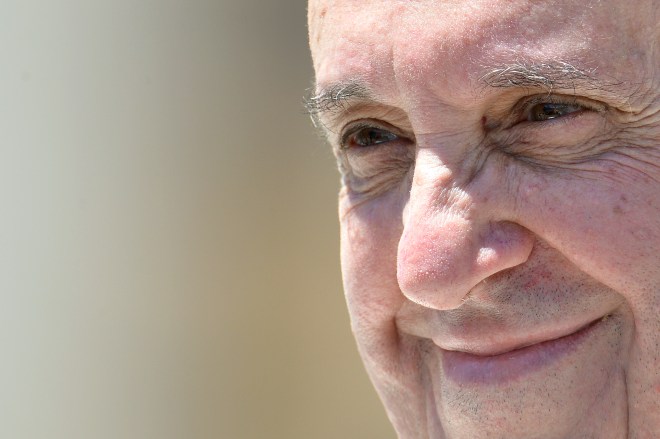
VATICAN-POPE-AUDIENCE

If you want to understand just how vastly different this Pope is from his predecessor, read the full and best translation of his recent impromptu remarks to the Latin American and Caribbean Confederation of Religious Men and Women. They blew me away. Can you ever imagine the anal-retentive doctrine cop, Ratzinger, ever saying this about the body that dictates doctrine that he once headed, the Congregation For The Doctrine Of The Faith:

They will make mistakes, they will make a blunder [meter la pata], this will pass! Perhaps even a letter of the Congregation for the Doctrine (of the Faith) will arrive for you, telling you that you said such or such thing… But do not worry. Explain whatever you have to explain, but move forward… Open the doors, do something there where life calls for it. I would rather have a Church that makes mistakes for doing something than one that gets sick for being closed up…

The heart swells as the voice of Jesus replaces the voice of the Pharisee. Rocco tartly observes that Pope Francis’ “penchant for veering off-text in open company just reached a whole new planet”. You can say that again. I loved this aside in observing how we are often more obsessed with tiny shifts in stock prices than the human being dying of hypothermia down the street:

Computers are not made in the image and likeness of God; they are an instrument, yes, but nothing more. Money is not image and likeness of God. Only the person is image and likeness of God. It is necessary to flip it over. This is the gospel.

And I loved this dismissal both of the uptight traditionalists who cannot see the forest for the rosaries and of those seeking to substitute the core teaching of the incarnation in favor of a vague spirituality:

There are some restorationist groups. I know some, it fell upon me to receive them in Buenos Aires. And one feels as if one goes back 60 years! Before the Council… One feels in 1940… An anecdote, just to illustrate this, it is not to laugh at it, I took it with respect, but it concerns me; when I was elected, I received a letter from one of these groups, and they said: “Your Holiness, we offer you this spiritual treasure: 3,525 rosaries.” Why don’t they say, ‘we pray for you, we ask…’, but this thing of counting… The second [concern] is for a Gnostic current. Those Pantheisms… Both are elite currents, but this one is of a more educated elite… I heard of a superior general that prompted the sisters of her congregation to not pray in the morning, but to spiritually bathe in the cosmos, things like that …

And then a possible clue as to why Benedict XVI decided to break with centuries of tradition and run into hiding after he read a dossier on abuses in the church:

In the Curia, there are also holy people, really, there are holy people. But there also is a stream of corruption, there is that as well, it is true… The “gay lobby” is mentioned, and it is true, it is there… We need to see what we can do…

Was the former Pope subject to blackmail? Were other Cardinals?

If the Vatican’s screwed-up doctrines about gay people have led to genuine threats of blackmail from within the hierarchy, if a faction of benign or malign homosexuals has really been using that leverage for whatever purposes, then we do indeed have a problem, to which the answer must be more transparency – of the kind Francis seems to endorse. The Vatican is refusing to comment on the content of the “private meeting.” But Mary Elizabeth Williams recognizes an emerging pattern:

The pope’s cryptic statement about a “gay lobby” doesn’t do anything to explain what a “gay lobby” actually is, how it’s gay lobbying and what it’s gay lobbying for — or what the Vatican intends to do about what Francis calls the “difficult” work of reforming the genuinely corrupt aspects of the huge worldwide organization he recently became the leader of. But already his actions have revealed a Hillary-like determination to do it his way, protocol be damned. …

Like his institution itself, Francis still got a long, long, lonnnnnng way to go in terms of broadening the definition of love, humility and tolerance. But a guy who’s been tweeting about “the unemployed, often as a result of a self-centered mindset bent on profit at any cost,” is a guy who’s having a good time shaking things up and making splitting headaches for the big shots around him. A guy who remembers that Jesus was a loudmouth and a troublemaker. [Vatican spokesman] Father Lombardi, I hope you’ve got plenty of Advil. Because I have a feeling your boss is just getting warmed up.

Previous Dish on the rumors of a “gay lobby” in the Vatican here and here.

(Photo: Pope Francis smiles after his weekly general audience in St Peter’s square at the Vatican on June 12, 2013. By Alberto Pizzoli/AFP/Getty Images.)

Poseur Alert

“What kind of hand job leaves you cleaner than before? A manicure, of course. Why does this joke work? Because of the tension between the conventional idiomatic sense of ‘hand job’ (a certain type of sex act) and its semantic or compositional meaning (in which it is synonymous with ‘job done by or to the hand’). When you think about it, virtually all jobs are ‘hand jobs’ in the second semantic sense: for all human work is manual work—not just carpentry and brick laying but also cookery and calligraphy. Indeed, without the hand human culture and human economies would not exist. So really ‘hand jobs’ are very respectable and vital to human flourishing. We are a ‘hand job’ species. (Are you now becoming desensitized to the specifically sexual meaning of ‘hand job’? Remember that heart surgeons are giving you a ‘hand job’ when they operate on you; similarly for masseurs and even tax accountants.)

I have in fact written a whole book about the hand, Prehension, in which its ubiquity is noted and celebrated.

I even have a cult centering on the hand, described in this blog. I have given a semester-long seminar discussing the hand and locutions related to it. I now tend to use ‘hand job’ in the capacious sense just outlined, sometimes with humorous intent.

Suppose now a professor P, well conversant in the above points, slyly remarks to his graduate student, who is also thus conversant: ‘I had a hand job yesterday’. The astute student, suitably linguistically primed, responds after a moment by saying: ‘Ah, you had a manicure’. Professor P replies: ‘You are clearly a clever student—I can’t trick you. That is exactly the response I was looking for!’ They then chuckle together in a self-congratulatory academic manner. Academics like riddles and word games,” – Colin McGinn, a philosophy professor who resigned last week from the University of Miami following allegations that he sent sexually explicit emails to a female graduate student. McGinn is a Dish Poseur repeat offender.

Dissents Of The Day, Ctd

This embed is invalid

Readers continue to vent their disapproval of the NSA program:

Add my voice to the throngs who find your shrugs over this week’s news distressing and unlike you.  I would argue that as a society we can’t possibly be protected 100% from persons who have decided to harm others, and that intrusive attempts to do so are neither fruitful nor worthwhile.  Stephen Walt is correct that this “making us safer” argument can and will be used indiscriminately and that the “insecurity industry” has far-reaching consequences. One of the reasons I take you seriously is your capacity to acknowledge when you’ve miscalculated.  I do hope to see such a change of heart on issues like these.  After all, it must be a little distressing to find yourself in agreement with Kristol.  Also, it would be illuminating to see a Dishhead poll, to see how many readers agree with you and how many don’t.

Poll available above. I understand the worries. They’re completely legit. But if they forbid the entire use of Big Data by government, let’s be clear what the consequences are. Those big drops in crime because of more targeted enforcement? Too invasive to allow:

The police say they are tamping down retaliatory shootings between gang factions by using a comprehensive analysis of the city’s tens of thousands of suspected gang members, the turf they claim and their rivalries. The police are also focusing on more than 400 people they have identified as having associations that make them the most likely to be involved in a murder, as a victim or an offender.

And what about the Obama campaign? They are a political organization that used vast amounts of Big Data to find specific likely voters and get them to the polls. Can you imagine the potential for abuse there? So ban it there too, I suppose. And if Big Data is inherently susceptible to abuse, then we also have to end the following:

Baseball teams like Billy Beane’s Oakland A’s (immortalized in Michael Lewis’s best-seller “Moneyball”) have embraced new number-crunching approaches to scouting players with remarkable success… And New York City has used data analytics to find new efficiencies in everything from disaster response, to identifying stores selling bootleg cigarettes, to steering overburdened housing inspectors directly to buildings most in need of their attention.

That’s from a fascinating review today of a new book, Big Data. Again, in every single case, private or public, someone could manage somewhere to abuse it – for a personal vendetta, or political smear campaign, and on and on. And this collapse of what we once called “privacy” is simply going to grow and grow while outraged defenses of the privacy we once enjoyed, while fully understandable, will become, if they are not already, effectively moot. That’s the conundrum, as Ross recently observed. It’s not a totalitarian police state; it’s a soft ubiquitous, private and public surveillance state that we either participate in or withdraw from society altogether. I don’t like this much, but I fail to see how it can be stopped. And it makes something like the Fourth Amendment in desperate need of re-interpretation. I guess what I’m saying is that the data is there and always will be. The question is simply who has access to it. If only private entities do, then we need to stop all the obviously productive and efficient innovations that Big Data has produced to make government better. Yes, we absolutely need to have firmer safeguards, and we need to end the secrecy about this. But the notion that we can somehow protect ourselves from all of this seems utopian to me. Another reader:

In this post you responded to a dissenter who expressed concern about the reach about the PRISM programBos: “As long as you’re clear about what you’re doing and will not complain about the government next time a Tsarnaev sets off a bomb, fine.” That might be a fine argument except you seem to have forgotten that the PRISM program was in effect before the Boston bombing – and the bombing still occurred. So, if we have to make those “hard choices” between security and privacy, what exactly have we gained?  It appears that Boston would have happened even if no one ever thought of PRISM.  The decision wasn’t between security and privacy; it was about privacy and no privacy. But, even if Boston didn’t invalidate the usefulness of PRISM, your argument points to its even greater danger.  Wait until a child is abducted, a drug lord is on the loose, a fraudster is preying upon the elderly.  The cries demanding we stop tying the hands behind the backs of authorities will begin and we’ll hear the same refrain:  If you’ve nothing to hide, what’s the problem?  “As long as you’re clear you won’t complain the next time a kid goes missing, fine.” And finally, I’m not comforted in the fact that Congress approved the program.  I have no doubt that the program fits within the bounds of legality given the collusion of the three branches of government, but given the lack of credibility and trust the American people have in Congress wouldn’t it be the right thing to do (even if not the legally mandated one) to be a bit more explicit in exactly what we as Americans were giving up?

Another:

Let’s think about what’s happened in the past few years. Bradley Manning managed to illegally copy and distribute massive amounts of classified data to a guy who doesn’t exactly seem like a fan of the US. We have the IRS picking out conservative groups for extra attention. We have a federal official leaking information about North Korea to James Rosen. We have the most recent massive leaks. This is not a bureaucracy that exactly has a comforting track record of late. This is who you trust to keep our information private?

Another:

Although I vehemently disagree with the massive-scale data mining being undertaken, that’s not what concerns me about your reaction. What I find especially disturbing is that after all we have now discovered, you still seem to be buying the government line. In March, DNI James Clapper emphatically told Congress that the intelligence community wasn’t data mining domestically. Now we know that was a bald-faced lie (if only he had been under oath…).  Now, however, when President Obama says that the content of our emails is not being read, you believe him … um, why? No matter how many times President Obama or his aides lie, you seem ready to believe their mitigating explanation.

Ending the absurd secrecy around this would avoid those legally mandatory lies. And I favor ending the secrecy.

About That Huge Public Outcry, Ctd

Bouie thinks that the American public’s attitude toward NSA surveillance shows that “there isn’t a large constituency for civil libertarian ideas”:

We have concrete examples of what happens when the federal government doesn’t make anti-terrorism a priority. The United States isn’t a stranger to civil liberties violations, but overwhelmingly, they’ve targeted the more marginal members of our society: Political dissidents, and racial and religious minorities. For the large majority of Americans, the surveillance state is an abstraction, and insofar that it would lead to abuses, they don’t perceive themselves as a target. And, in general, it’s hard to get people motivated when there isn’t a threat. Which is why it’s not a surprise to find that most Americans support the National Security Agency’s program of mass data collection. …

For civil libertarians to make surveillance into a political issue that will move votes, they’ll have to turn the abstract issue into something more concrete, cut through partisanship, and grab the attention of ordinary voters. It’s a tough challenge, which is why—in the short-term at least—I don’t expect much in the way of substantive change.

But what if they cannot? What if it is precisely the sheer scale of anonymous data that makes the surveillance less individually invasive than previous methods?

My hunch is that the biggest headache for the administration will be allies – whose foreign nationals do not have the protections that Americans have, but who are caught up in the same mass data. The Germans are getting very edgy, as are the Brits. Mataconis, meanwhile, analyzes a new poll on the NSA snooping that shows less support than the Pew one, with a 58 percent majority disapproving metadata collection when it is used on ordinary Americans:

When you break the issue down the way the CBS poll does, you find that people are opposed to the idea of the Federal Government monitoring the activity of “ordinary Americans,” but not similarly opposed to using those tactics against “suspected terrorists.” Quite honestly that makes more sense than the Post/Pew poll does, and it shows us how much more insightful a poll can be when the questions are less general and more specific.

Conor argues further that the public debate has really only entered its first phase:

[I]nformed Americans who vehemently dissent haven’t had an opportunity to mount legal challenges on the merits — rather, they’ve been thwarted from having their day in court by arguably illegitimate invocations of the state-secrets privilege. Relatedly, a lawsuit challenging the FISA Amendments Act was thrown out by the Supreme Court because, according to the reasoning in the ruling, none of the plaintiffs could prove they had standing. At the very least, this would suggest the troubling possibility that the national-security state’s behavior could be both unconstitutional and impervious to judicial challenge. To me, that seems like the sort of circumstance in which civil disobedience is defensible, especially if the act of civil disobedience obviates the state secret or standing obstacle.

Greening The Tubes

Kendra Tupper summarizes Google’s recent conference on the environmental impact of the Internet:

[K]eynote speaker and former Vice President of the United States Al Gore frame[d] the importance of the problem: the ICT sector and its associated energy use are growing at an unprecedented rate. Within the next seven years, there will be 50 billion smart devices connected to the Internet. Researchers estimate this could account for around 10 percent of current U.S. electricity consumption. Really, no one knows; not even Google. But the number will be significant. With that staggering energy consumption in mind, Gore stressed the urgency of the climate crisis we are facing, referring to the recent news reports of climate-related weather disasters as “a nature hike through the Book of Revelation.” …

Eric Schmidt, executive director of Google, kicked off the afternoon breakouts with an inspirational talk that really got to the heart of the matter—the growth in this sector is going to continue. And it’s adding immeasurable societal value in ways that we never could have dreamed of. The Internet has provided consumers with information to make more sustainable consumer purchases and enabled telecommuting and teleconferencing as alternatives to carbon-intensive travel. In some societies, the Internet provides people with their only access to medical treatment, politics, education, and socialization outside of their culture. “You think the Internet matters?” he asked. “It matters a lot.” He stressed that the solution shouldn’t be to use the Internet less, and certainly not to limit the global reach of these services. Instead, we must make the system components more efficient; power the sector with clean renewable energy; and leverage the Internet to help solve the climate crisis.