Consider The Octopus

What’s it like to be an octopus? Peter Godfrey-Smith explores the question in pursuit of a philosophy of mind:

Action by an octopus … would mix elements that are usually distinct in animals like us. When we act, the border between self and environment is usually fairly clear. When we move an arm, the arm can be controlled both in its general path and in the details. You can then watch your arm move, but what you are watching are the consequences of choices, or perhaps of habits that are the remnants of earlier choices. Various other things in the environment are not under your direct control at all, though they can be moved indirectly by manipulating them with your limbs. Uncontrolled movement by an object around you is usually a sign that it is not part of you at all (with partial exceptions for knee-jerk reflexes and the like). If you were an octopus, these distinctions would be blurred. Your arms would move in a way that is a mix of the centrally and peripherally controlled. To some extent you would guide them, and to some extent you would just watch them go.

Godfrey-Smith on the worthiness of “what it’s like to be X” thought experiments:

Some philosophers working within a broadly materialist framework are opposed to asking questions about “what it’s like” to have a particular kind of mind. They regard this way of setting up the issues as misguided. I think these questions are good ones, as long as they are asked in a way that does not doom them to unanswerability from the start. The divide between first-person and third-person points of view is real regardless of what minds are made of. Knowing how an animal’s body and brain are put together does not put you into a state that is similar to what is going on inside that animal, so in that sense no description can tell you “what it’s like to be” that animal. Getting a sense of what it feels like to be another animal—bat, octopus, or next-door neighbor—must involve the use of memory and imagination to produce what we think might be faint analogues of that other animal’s experiences. This project can be guided by knowledge of how the animal is put together and how it lives its life. When the animal is as different from us as an octopus, the task is certainly difficult, but it is one worth undertaking.

See also Thomas Nagel’s 1974 essay “What Is It Like to Be a Bat?” here (and a recent takedown of Nagel here). Recent Dish on “what it’s like” thought experiments here.

(Video: Moving Octopus Vulgaris, Wikimedia Commons)

The Price We Pay For Progress?

Ryan Avent puts the NSA’s data collection in historical context:

One of the interesting points in Tyler Cowen’s ebook “The Great Stagnation” is that, historically, technological advance has both created demand for and enabled growth in the reach of the state.

Air travel, for instance, generated interest in and demand for government involvement in everything from direct production of aircraft to construction of airports to management of air traffic to control over passenger security. Those demands broadened the scope of government involvment in our lives—being groped and/or photographed naked is now a standard part of life for the American traveling public—while also directly expanding the government’s reach in other ways. The same technology that allows travelers to flit off for a weekend in the Bahamas gives America the ability to project power across the globe.

Growth in Leviathan’s tentacles therefore amounts to a not-half-bad measure of technological progress in society. It is no coincidence that the period from 1870 to 1950, a remarkable era of human technological achievement, also happened to include a dizzying and unprecedented growth in the state.

Is FISA An Effective Check? Ctd

A reader pushes back against another:

Your reader claims that the FISA Court must be a “kangaroo court” because it never denies applications. I, too, do not like the appearance of a court that grants almost every warrant application.  But this is much more complicated than it looks.

First, the warrant process can be back-and-forth.  I have heard FISA Court judges explain that in reviewing applications they sometimes find some aspect deficient, and tell the DOJ of their concern.  The DOJ then, if possible, tries to improve the application (say, with additional facts) to satisfy the court’s concern.  If they know they cannot, the DOJ may simply withdraw the application.  This means the “granted versus denied” number is much less informative than it first appears.

Second, FISA applications are complex and often lengthy.  The government does not bother with one unless they really want one, and then they put the time in to make the application thorough.

Third, it’s worth looking more carefully at who some of these judges are (and have been).  In many ways the court is secretive, but one thing we do know is the members.  They are all sitting federal judges.  Here are a few who served recently:  Judge James Roberston, of the D.C. district court, was on the FISA court for a number of years until he resigned in 2005 to protest the Bush administration’s warrantless wiretapping program.  He was appointed to the federal bench by President Clinton, and early in his career worked for the Lawyer’s Committee for Civil Rights under Law.  His public judicial work shows that he is anything but a rubber stamp for government police powers.  Yet he (apparently) rejected almost no applications, as there were only 11 rejections out of almost 34,000 from 1979-2012.  Or consider Judge James G. Carr, who served on the FISA Court from 2002-2008.  He was appointed to the federal bench by President Clinton, and is a former law professor who wrote an extensive treatise on wiretapping law.  I have practiced in front of Judge Carr; he, too, is no rubber stamp.

It is definitely worth scrutinizing the FISA Court, but it is not a kangaroo court.

I’m grateful to have this expert perspective; and relieved.

Immigration Reform Passes Its First Test

Chait celebrates the Senate’s lopsided cloture vote on the bill today:

It’s a vote to have a debate on immigration reform, not a vote for a particular bill, which is sure to attract fewer than 82 votes in the end, and probably far fewer. But it gives the general impression that conservative opponents are merely going through the motions and have made their peace with a likely defeat. And that impression is not wrong.

That 82 votes is a signal that Republicans in the Senate are, indeed, not using every tool they have to block a bill. Eighty-two votes to proceed is a way of signaling that the status quo, not the expected outlines of a bill, is what is most unacceptable. This is the opposite of how Republicans have approached the major legislation of the Obama era, beginning with the stimulus, when they did not make any distinction between voting to allow debate and voting on the underlying merits of the final bill. Republican senators today faced a choice to position themselves as fundamentally opposed to the entire process, and most of them decided to stand aside.

Weigel adds:

Only the delegations from Alabama, Idaho, and Wyoming voted fully against proceeding to debate. Less trivially, reformers have stuck to “70” as the number they need to hit in the Senate in order to build momentum for a vote on a House reform bill. They can afford to lose 12 of today’s “aye” votes; Republicans are convinced they can limit those losses if they allow some amendments that allow them to save face on “border security.”

Barro believes that immigration reform is going to pass:

For many, many House Republicans, the ideal situation is for a reform bill to pass over their objections. Business interests will get the bill they want, Democrats will be deprived of a powerful talking point with Hispanic voters, and individual house members will be able to tell conservative primary voters that they tried to “stop amnesty.” Win, win, win.

What Snowden May Achieve

This is encouraging:

Dear Attorney General Holder and Director Mueller,

… Assertions in the press that our compliance with [NSA] requests gives the U.S. government unfettered access to our users’ data are simply untrue. However, government nondisclosure obligations regarding the number of FISA national security requests that Google receives, as well as the number of accounts covered by those requests, fuel that speculation. We therefore ask you to help make it possible for Google to publish in our Transparency Report aggregate numbers of national security requests, including FISA disclosures—in terms of both the number we receive and their scope.

Even better:

Seeking to drag the shadowy world of U.S. national security law into the light, a bipartisan group of senators has proposed a bill that would declassify significant legal opinions reached by the Foreign Intelligence Surveillance Court… The bill is based on Merkley’s past proposal to declassify important FISA court opinions. He is joined by a small bipartisan group of senators that includes Democratic Sens. Patrick Leahy of Vermont, Ron Wyden of Oregon, Jon Tester of Montana, Mark Begich of Alaska, and Al Franken of Minnesota. Republicans joining the effort include Senator Mike Lee of Utah and Dean Heller of Nevada.

A more open and transparent FISA court process would be a big step forward toward ensuring this isn’t abused. So would what Google proposes.

Do You Trust Future Administrations With These Powers?

Drum’s core – and legitimate – worry about the NSA program:

I find it quite likely that NSA isn’t currently abusing the phone surveillance program … but someday there will be a different president in the White House, there will be a different head of NSA, and there will be different professionals running the program. What will they do with all that data the next time something happens that makes America crazy for a few years? I don’t know, but I do know that if they don’t have the data in the first place they can’t abuse it.

But if they don’t have the data, they also cannot use it. Waldman shares Drum’s fear:

They aren’t just looking through people’s records willy-nilly; mostly all this information is just there waiting, and they look at an individual’s records only once they have reason to suspect they might be connected to something fishy. But it isn’t because they can’t, it’s because, they say, they’ve chosen not to.

And that may well be true. But is the next administration, and the one after that, going to do the same? Especially if it’s run by people who not too long ago were torturing prisoners; claiming the president had the right to order the arrest of an American citizen on American soil and throw him in jail for life with no charges, no trial, and no access to legal counsel; asserting that the vice president existed in a legal netherworld between the executive and legislative branches that left him immune to any rules or oversight he found inconvenient; and a hundred other abuses of power that we’ve already almost forgotten by now?

I haven’t forgotten. So this may be a golden opportunity to reform the security state – while we have a president and a potential bipartisan coalition who are sympathetic to the cause. But again, that requires real engagement with public opinion, which by big margins support PRISM – and an acceptance that the program we have has a legitimate purpose. Almost every single thing the government does can be abused. That doesn’t mean the government should be barred from doing anything that could lead to such abuse. It means more accountability.

Do You Trust A Corporation More Than Your Government? Ctd

Several readers express their distrust of the government:

There is a key distinction that has not been raised. As some readers have mentioned, we give up personal data to Internet companies. This is the trade-off we all make for using the Internet. While some companies are able to track and profile your usage, you can somewhat control your tracking preferences.

The government, on the other hand, apparently has access to not only your Internet usage (or metadata) but also other metadata (e.g. phone calls), and the ability to tie it all together – more so than any private company. The government also has the power to investigate, subpoena records, arrest, interrogate and generally make someone’s life pretty miserable. Which is fine by me if there is a high degree of confidence that the government pursues only bad guys.

Without getting into a discussion of slippery slopes and what may happen if low-level bureaucrats start playing with readily available data, my main concerns are regarding:

1) the standard that must be met before a specific individual is targeted and 2) the recourse available to a person who is incorrectly targeted. On #1 it’s not clear how much rigor is applied by FISA judges, and on #2 who knows what one can do.

James Fallows has a series of recent posts about private pilots being harassed because they apparently fit some profile.  And I’m sure you’ve heard (and perhaps even written) of people who have mistakenly been put on the TSA’s do-not-fly list, and have no way of getting off the list.

For me the real issue is about transparency, and knowing the rules. There’s obviously a trade-off between privacy and security imperatives – this is a discussion we should be having in the country. I’m not sure our elected representatives are having it on our behalf. Or if they are, they can’t tell us what they’ve discussed because it’s all secret.

Another is on the same page:

Of course I trust corporations more than my government. Corporations cannot have me followed. Corporations cannot arrest me. Corporations cannot send an armed SWAT team into my home. The US government can do all that. And the US government has an ugly history of doing that. It’s been a few decades since COINTELPRO was shut down, but it seems entirely likely that the FBI would do it again if they could. We should not risk the FBI using PRISM to monitor dissidents by labeling their surveillance targets as terrorists the way they did with occupy protestors. We should not risk police forces like those in New York and Chicago getting access to a system like PRISM for monitoring the local mosques or plot against future Fred Hamptons. Our government has a long history of abusing its powers.

To prevent abuse of PRISM, we need to shut it down now, before it falls into the hands of a government likely to use it for very bad acts. There will be future Lyndon Johnsons and Richard Nixons. We should not make it easier for them to abuse those who elect them.

Another:

The consequences of my information being in the hands of a corporation aren’t that severe. More likely than not, the primary effect on me is that I’m going to be served with targeted marketing. At the very, very worst, some of this data might have some conceivable impact on my credit score. As such, my concerns over the abuse of that data is fairly mild.

If the government misuses my data, however, the consequences could be dire. If I end up as a false positive on an NSA terrorist watch list, my life is now under suspicion and I have very little recourse to address that suspicion. Even if the only consequence is that I end up on a no-fly list, my life can experience serious disruptions and inconveniences. And, of course, we have no way of knowing what the NSA is actually doing with that information, so a certain degree of legitimate paranoia seems warranted.

Another:

With the NSA spying, you cannot opt-out.  You can’t even know you are being targeted, and prior to Snowden’s decision, you can’t even know that a program exists that could target your supposedly secure communications and purchases!  I think most would agree with me that you cannot declare opt-in situations to be the equivalent opt-out.  They simply are not, and American citizens should realize that they are trading away a great deal of their freedoms for precious little security under this program.

Can Modern Men Have It All?

After absorbing the myriad discussions about whether the modern woman can have it all, Richard Dorment flips the question:

According to a study released in March by the Pew Research Center, household setups like ours are increasingly the norm: 60 percent of two-parent homes with kids under the age of eighteen 543716_3767267616092_1491403777_nare made up of dual-earning couples (i.e., two working parents). On any given week in such a home, women put in more time than men doing housework (sixteen hours to nine) and more time with child care (twelve to seven). These statistics provoke outrage among the “fair share” crowd, and there is a sense, even among the most privileged women, that they are getting a raw deal. …

But the complete picture reveals a more complex and equitable reality. Men in dual-income couples work outside the home eleven more hours a week than their working wives or partners do (forty-two to thirty-one), and when you look at the total weekly workload, including paid work outside the home and unpaid work inside the home, men and women are putting in roughly the same number of hours: fifty-eight hours for men and fifty-nine for women.

How you view those numbers depends in large part on your definition of work, but it’s not quite as easy as saying men aren’t pulling their weight around the house. (Spending eleven fewer hours at home and with the kids doesn’t mean working dads are freeloaders any more than spending eleven fewer hours at work makes working moms slackers.) These are practical accommodations that reflect real-time conditions on the ground, and rather than castigate men, one might consider whether those extra hours on the job provide the financial cover the family needs so that women can spend more time with the kids.

He notes a shift in the attitude that men have toward their “home-work balance” over the past 50 years:

“In 1977,” [researcher Ellen Galinsky] says, “there was a Department of Labor study that asked people, ‘How much interference do you feel between your work and your family life?’ and men’s work-family conflict was a lot lower than women’s.” She saw the numbers begin to shift in the late 1990s, and “by 2008, 60 percent of fathers in dual-earning couples were experiencing some or a lot of conflict compared to about 47 percent of women. I would go into meetings with business leaders and report the fact that men’s work-family conflict was higher than women’s, and people in the room — who were so used to being worried about women’s advancement — couldn’t believe it.” What they couldn’t believe was decades of conventional wisdom — men secure and confident in the workplace, women somewhat less so — crumbling away as more and more fathers began to invest more of their time and energy into their home lives.

My “Faith” In Obama

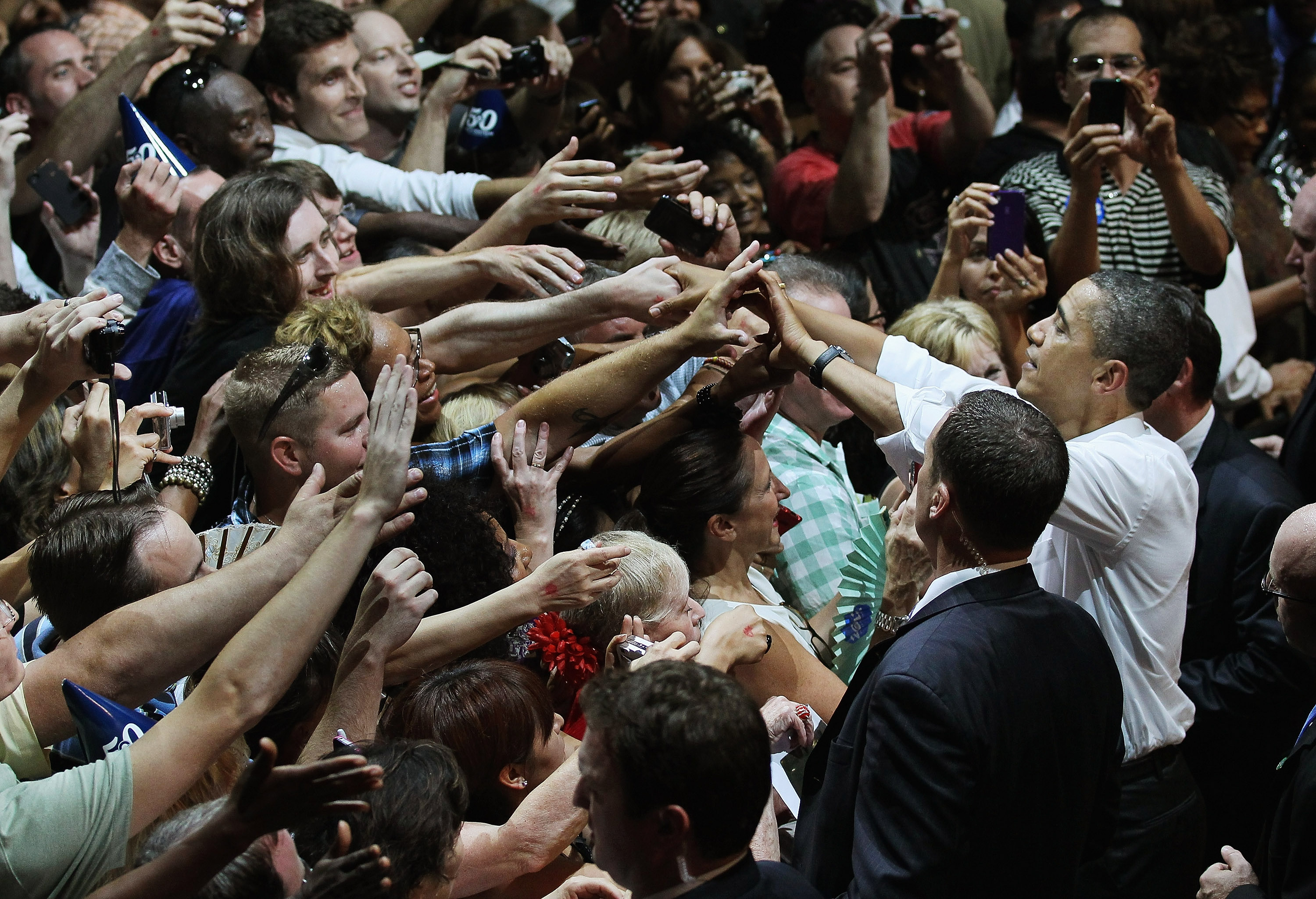
Obama Celebrates His Birthday At DNC Fundraiser In Chicago

Freddie deBoer struggles to reconcile my book with my recent blogging:

If you asked me to define one trait that would be least reconcilable with the conservatism espoused in The Conservative Soul, it would be deference to a particular leader. I cannot square the recognition that all political leadership is subject to corruption and failure with the kind of faith Sullivan regularly shows in Obama. And this becomes a deeper confusion when you see how this trust has filtered down from Obama to the people and programs beneath him.

He asks:

How can a man who admits the elusive nature of prudential judgment trust the judgments of thousands of totally unaccountable government functionaries? How can he believe that a system bent on total secrecy and total denial of oversight or restraint would represent a culture that could instill character? How could he look at this vast, dehumanized and dehumanizing surveillance system and not see a potentially failed solution to a problem that is, in perspective, a fact of life in the modern world? I cannot reconcile the philosophy with the individual commitments. I no longer really know how to read Andrew, at this point.

Well, I am most grateful for Freddie’s deep reading of my book, The Conservative Soul. But I dispute the idea that I have hero-worshiped Obama or failed to apply the same principles against him as I did against Bush, whose offenses were nonetheless immensely greater. The record of my tough criticisms of Obama on various issues is there for all to read. From dragging his feet on gay rights to not prosecuting war criminals to failing to end the war on marijuana to intervening in Libya without Congressional approval to the surge in Afghanistan … it’s a long list.

At the same time, judging political events in real times does require some grip on the character of those in office, and the inevitable compromises that requires, and I remain an admirer of Obama’s temperament, pragmatism and small-c conservatism. And I don’t think that abstract ideological issues can ignore the role of human beings and their prudential judgments over time. A conservative will always recognize that there is no substitute for character in political leaders and that representative government requires some basic form of – sorry – minimal trust if it is to function at all. Skepticism is not anarchism; real conservatives like strong, but limited, government. That’s why, though I have serious libertarian leanings, I still call myself a conservative. That’s why I see more insight in, say, David Brooks’ column today, than many on the libertarian right or civil liberties left.

So, yes, there is a real potential for abuse of a system like PRISM. But are we actually going to prevent government from using Big Data, while Google plumbs its depths even further and Buzzfeed even schedules its content by chasing algorithms? At least there is some minimal check on the government, a judicial court. It almost certainly needs more muscle, as this reader suggests, and that might be a helpful reform. There is also Congressional oversight – another important check. Yes, I remain skeptical and opposed to the state secrets that Obama has maintained which make it impossible for the public even to have a debate about trade-offs or those in Congress to protest publicly. But that doesn’t mean denying the realities of the low-level Jihadist insurgency we and the Muslim world are struggling against. Back to Freddie:

I would like for Sullivan to consider the possibility that he is placing far too much faith in a bureaucratic apparatus that contains a multitude of agendas and all of the potential for mismanagement and bad behavior that engenders… a scary thought, when that apparatus is connected to military power.

These programs are run by people, and people are fallible and frequently immoral. (It’s worth noting that many of the people working in these programs are the same people who worked under the Bush administration that Sullivan has rightfully criticized.) It would take so little for all of this to go wrong.

Yes, I know, and am open to such a debate. In fact, I’d welcome such a debate, as long as we can discuss trade-offs and not absolutes, as so many civil libertarians prefer. And I didn’t criticize Bush for this. So it seems plain weird to say that my position on this kind of meta-data is somehow a function of faith in one leader, rather than a consistent position. And if my position on this is that it may be, in fact, the least worst kind of surveillance, then again, I fail to see where I have gone astray.

From the very beginning of this conflict on 9/11, I argued both for pursuing this lethal fundamentalist insurgency on civilization and for protecting our civil liberties as much as we can in the process. I understood this would require pragmatic judgment and remain very open to the idea that we now may have a chance to seize this moment for a broader and necessary debate. I think Obama has pursued a balance in ways that Bush never fully did until the influence of Cheney receded. Here’s a money quote from the Dish on the very day of the attack:

The one silver lining of this is that we may perhaps be shaken out of our self-indulgent preoccupations and be reminded of what really matters: our freedom, our security, our integrity as a democratic society. This means we must be vigilant not to let our civil liberties collapse under the understandable desire for action. To surrender to that temptation is part of what these killers want… The task in front of us to somehow stay civilized while not shrinking from the face of extinguishing – by sheer force if necessary – the forces that would eclipse us.

I believe that is still the task, that Bush massively over-reached (unforgivably so on torture) and that Obama has improved on Bush immeasurably – no more torture, no more completely unchecked executive power, and a genuine attempt to close Gitmo – and may now be able to lead from behind on civil liberties with cover from parts of the public. At the same time, I’d welcome that. But PRISM? Big Data exists whether we like it or not. Not to use it and use more targeted forms of surveillance would unnerve me more. And yes, of course, there is potential for abuse – which is why I’m delighted it is now out in the open, where it should be. But we may find that the public’s view of the correct balance is not where Rand Paul or Glenn Greenwald or Freddie want it to be. And in the end, it’s their call.

(Photo: Scott Olson/Getty)

Demeaning The Friendships Of Women

In a review of the new film Hannah Arendt, Michelle Dean appraises the subject’s friendship with Mary McCarthy:

McCarthy, played by Janet McTeer, is blowsily silly — and though she could be wicked and subversively funny, McCarthy was far from silly. Nearly every exchange between the two women is about men and love. It is symptomatic of a trend, I think. We are in a moment of unprecedented popular interest in the matter of female friendship, and this has been greeted as a triumph for feminism. But what we get, for all that, is rather flat portraiture: women giggling about crushes before finding real fulfillment in heterosexual romance and the grail of marriage. It’s a shame, because many women hunger for models of intellectual self-confidence, and female friendships can be rich soil for them.

McCarthy and Arendt’s “love affair” — as their friends described it — was a union of ferocious minds, but it was hardly unusual. Women talk about ideas among themselves all the time. It would be nice if the culture could catch up. To give just a sample of the subjects McCarthy and Arendt talked and wrote to each other about: George Eliot, Cartesianism, Eldridge Cleaver, Kant, G. Gordon Liddy, and Sartre. Both women were members of the Partisan Review crowd, who spent much of their time talking about Stalin and Trotsky.

This also requires a better cultural appreciation of the virtue of friendship. A powerful friendship can be as intense as a love-affair and more stable over time. The notion that women cannot and do not have the finest forms of friendship, spanning a whole range of thought and ideas and experiences, is so absurd it’s amazing it survives. But then we live in a world of the Real Housewives of New Jersey. Sometimes, it seems we may be going backward.