After an extensive review of Obama’s speeches to black audiences over the years, TNC spells out his disappointment:
When Barack Obama makes a moral appeal, he is not performing a Sista Souljah tactic. He is speaking sincere beliefs that run deep in his community. I happen to think those beliefs elide some difficult truths about the nature of power. In the case of the president, I think they elide the fact that there are actual policy steps he could be taking and isn’t. I think yesterday’s post on marijuana busts really brings this home. You will not find me among those arguing for deadbeat dads. But putting away the X-Box will not change those incredible arrest numbers. Policy will. As it stands, the president is on the wrong side of that policy. …
My disappointment with how Obama addresses black people originates in the fact that I believe he, quite literally, knows better and could do better. It is not enough to point out that crowds of black people cheer him on. Greatness demands that you not just make people cheer, that you not just grant them “Oh my people” catharsis, but that you make them think. This is about legacy. This is about asking whether “First Black President” will simply be an accidental honorific.
In a later post, he describes his own approach when speaking at predominantly black schools:
What I generally try to do is avoid messages about “hard work” and “homework,” not because I think those things are unimportant, but because I think they put the cart before the horse. The two words I try to use with them are “excitement” and “entrepreneurial.” I try to get them to think of education not as something that pleases their teachers, but as a ticket out into a world so grand and stunning that it defies their imagination. My belief is that, if I can get them to understand the “why?” of education, then the effort and hard work and long study hours will come after. I don’t know how true that is in practice, but given that I am asked to speak from my own experience, that is the lesson I have drawn.
(Video: Obama speaking to the Apostolic Church of God on Chicago’s South Side on Father’s Day, 2008. Full transcript here.)
Tom Ricks sees the actions of Edward Snowden more in line with the Pentagon Papers than Wikileaks:
I opposed what Manning did. I thought his actions were reckless. He did a data dump, making secret information public without knowing what it was or what he was really doing. I remember mentioning, for example, an Ethiopian journalist who wound up in the hot seat because of the WikiLeaks release. Manning’s act was that of a goofball anarchist.
Snowden’s, by contrast, seems to have been one of civil disobedience. That is, he seems to have known exactly what he was doing. Snowden does seem to have some elements of Manning, a mixed-up kid, but on balance seems to me to be more of an Ellsberg — that is, a disillusioned insider who was appalled by what he saw and made a choice to disclose the existence of certain government programs.
Civil disobedience has a cost though:
[D]o I think Snowden should go to jail? Yes, I think he should expect to. Martin Luther King, Jr. did too, when he consciously broke the law in protest. Breaking the law to make a point and then doing some time in consequence fit well within the American tradition. That said, knowing what I know now, I would hope it would be just a few months on a prison farm.
A reader chimes in:
When you “Money Quoted” Jeff Toobin taking Mr. Snowden down a few notches, one aspect of his quote was really nothing but unproven hyperbole, clearly intend to add a touch of smear. Toobin wrote: “The question, of course, is whether the government can function when all of its employees (and contractors) can take it upon themselves to sabotage the programs they don’t like. That’s what Snowden has done.”
Sabotage? Actually no, that’s not what he’s done.
While I’m not going to defend him or everything he’s done, I’m equally not going to go along with smearing him for what he plainly has not done. There is no concrete, definitive evidence that he has sabotaged the NSA’s programs. He simply exposed their existence. I’m sorry but the mere exposure of the programs’ existence is not equal to sabotage (no matter how much the secrecy freaks in the government security-intelligence-complex might cry otherwise).
Let’s be clear: sabotage would have been if he’d done something like inserting a computer virus into the NSA’s systems that shut the whole thing down, or destroyed their collected data, or the like. Exposure of the mere existence of the programs is not in and of itself sabotage. In fact, since this exposure late last week, the NSA has presumably been continuing to actively vacuum up all the same ongoing telephone call data, Facebook posts, Google search data, emails, and the rest without missing a beat … and, I’m sure, are still doing so as I type this. Exposed? Yes. Sabotaged? I don’t quite think so.
A wider debate is brewing. Ed Kilgore kicks it off with an examination of the widening gulf between those labeling Snowden a traitor and others calling him a hero:
While the wind’s blowing pretty hard against Snowden in Washington, he continues to receive widespread tribute as a hero—which is, as you might know, a bit different from being a traitor—among civil libertarians at both ends of the political spectrum. Ron Paul publicly thanked both Snowden and his top journalistic conduit, Glenn Greenwald, for “exposing the truth about what our government is doing in secret.”
This is the polarized terrain on which the president will eventually have to take some sort of stand, recognizing that his past direct and indirect statements defending the kind of activities Snowden exposed, and harshly criticizing leakers, limit his freedom of action, even if he’s inclined to separate himself from the treason-shouters.
Dan Amira notes that the question is gaining steam online and calls it “a bullshit choice”:
[T]here’s also plenty of room for nuance between those two poles. You could say, for example, that Snowden did the wrong thing but with the best of intentions. If Snowden’s goal was to hurt America, there were better ways to do it. He could have sold his secrets to the Chinese. Snowden gave them to reporters. And, if you take his words at face value, his motivation is protecting America’s core values, not opening the country up to terrorism.
Or: Snowden kick-started an important debate, one that we couldn’t have had without him, but some of the information he leaked will make the country less safe. Hero? Eh, not quite. Traitor? Hardly.
Or: Snowden is a true patriot, but it was so mean what he did to his girlfriend.
Meanwhile, Scott McConnell thinks prosecuting Snowden will be hard:
I think the Obama administration will have a very difficult time prosecuting Edward Snowden. They can go after Bradley Manning because they have him, in uniform and in prison, and thus shut off from normal communication. Americans are unable to perceive how normal, probably likeable, and how similar to most of us he probably is. But Snowden comes across like everyone’s ideal of a really smart, techie, individualist kid. No high school degree, yet speaks as eloquently as an assistant Harvard professor. Smart enough to rise rapidly in the world without credentials, reminding us vividly computers really are a new frontier, the one field outside of sports and music where classic American Horatio Alger tropes have any continued relevance.
After John Oliver’s first night hosting, Brett LoGiurato thinks the Daily Show “will be in good hands this summer”:
The John Oliver era started off with a bang, as he was on point in ripping the National Security Agency’s extensive surveillance operations. Oliver said that the NSA is surveilling “vastly more information than even George Orwell wet the bed over,” reassuring his viewers that NSA surveillance only affects people who “make calls or use the Internet.”
There’s an obviousness outsiderness to Oliver which works brilliantly when he’s commenting on America’s foolishness. Or really, anyone’s foolishness. Note for instance how his accent played a role as he called out Jon Stewart for not lampooning Anthony Weiner back in 2011. Even the way he uses his accent is a joke on us: according to The Guardian’s Oliver Burkeman, “most Americans… hear his distinctively Brummie accent as standard Posh English.” Or, as Kevin Fallon wrote in The Daily Beast, “By merely speaking with a British accent, he comes off as a superior know-it-all explaining American politics to us when, in fact, he’s talking out of his ass. Err … arse.”
But aside from the fact that Oliver gets to call America (and Stewart) out, the NSA scandal also fits into Oliver’s Daily Show oeuvre in other ways. Oliver has a knack for tackling complicated stories that deal with America’s role on an international scale. Surely, he if anyone can lend sensible humor to the hunt for Edward Snowden.
Laura Bennett believes that Oliver’s stint will be exactly what the “increasingly insidery, decreasingly funny Daily Show needs”:
[A]t first glance, Oliver seems like a somewhat surprising choice to take over a show that relies on the host’s highly personal outrage at the American political landscape. But as “The Daily Show” has become increasingly rooted in Stewart’s umbrage, it has also become less funny. So Oliver’s outsiderness might be just what the show needs. … In a sense, Oliver may be set to channel “The Daily Show”’s earliest instincts: the old David v. Goliath attitude that targeted large subjects with small-bore satirical marksmanship and a clear sense of fun. Those were the days when Stewart was animated by scrappy underdog enthusiasm, before he started to feel the weight of his own influence.
Meanwhile, Jaime Weinman takes the opportunity to wonder why the show “eliminated virtually all the recurring bits”:
There’s the perennial “Back in Black” for whenever Lewis Black appears, and more recently John Hodgman’s appearances were titled “You’re Welcome” after they hit on the idea of characterizing him as an entitled, bubble-dwelling rich person (which made his appearances much more consistently funny). But otherwise, almost everything is gone. Even “The Toss” between Stewart and Colbert is gone. Instead, the first act is almost always an extended version of what Kilborn and Stewart used to call “Headlines,” and the second act is often the same, unless it’s a pre-taped field piece. Free-form riffing on the day’s news, field pieces and interviews; that’s pretty much all she wrote.
What has emerged in the past few days is a fascinating snapshot of a shifting political landscape. On the one side, we have a libertarian-civil liberties left alliance. On the other, a strange world where Bill Kristol and Joe Klein are on the same page. Personally, I think it’s a shame that this alliance has emerged over PRISM because it seems to me to be one of the less worrisome anti-terrorism policies. My general inclination is to back the liberaltarians on these questions, but I have never been a purist, appreciate the political balances required and wish this debate were not also wrapped in accusations of treason and heroism.
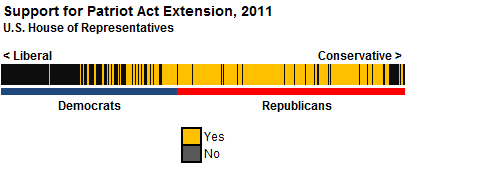
But we have a truly remarkable development here. The president, while defending PRISM, is open to ending it – or debating it more widely. That’s of a piece with his recent speech on terrorism. So he’s inviting more scrutiny of the issue in general – and encouraging, therefore, both Republican and Democratic opposition. Nate Silver gets the strange moment here:
But this is the money graphic:
What we’re seeing here is a two-pronged pincer from the liberal conscience and the libertarian mind against the current center – from two years ago. I wonder what this chart would look like today. What we’ve outed this past week is the potential for a serious alliance, led from behind by the president.
Of course, there are two obvious caveats:
Some of the Republican opposition is so brazenly partisan its cynicism almost blows you away. But since they seem only to care about wounding Obama, it’s still a politically potent force, susceptible only to the possibility that Obama might at some point agree. The second caveat is that the public backs the security-over-surveillance center by a hefty margin – for the moment – and so it may not be a propitious moment for this emergent potential realignment to bear fruit.
But it may be the start of something, no? Nate looks at party primaries, where cross currents will shake up both parties from within. And you can imagine this alliance becoming more cohesive if we continue success in foiling terror attacks, withdraw from Afghanistan and ease back to a more conventional pre-9/11 mindset. It is not beyond Obama to be dragged toward this liberaltarian axis, and it is almost certain that Rand Paul may inject this theme very powerfully in the GOP presidential primaries.
I’m not shocked by PRISM. But if the president began to argue that he thinks it may be time to retire such and similar programs – and he already has – then he could leave a civil liberties legacy much better than the one that now seems likely. So while defending his past practice as justifiable, I have two words for those on the right and the left who want to unwind our overweening security state: Make him.
This afternoon, the full U.S. Senate holds its first vote on the bipartisan immigration legislation, which seeks to bolster border security and establish a pathway to citizenship for the nation’s millions of undocumented immigrants. This vote on the motion to proceed requires 60 votes, and it’s expected to cross that threshold. But the question is whether there are potentially as many as 70 senators who support the final legislation, which would give the legislation lots of momentum, putting pressure on the GOP-controlled House of Representatives to take up the Senate version. Today’s vote COULD give us a hint. A reminder: This is just the first full Senate vote; the vote for final passage won’t take place until before the July 4 holiday.
Brett LoGiurato passes along a good sign regarding the bill’s chances in the House:
In an interview with ABC’s George Stephanopoulous that aired Tuesday morning, House Speaker John Boehner hinted that he would clear a significant hurdle to immigration reform passing through the House of Representatives. During the interview, Stephanopoulous asked Boehner if he would let the bill in the House come to a vote, even if it means he has to break the so-called “Hastert Rule” — meaning that he would let it come to the floor even if he wasn’t sure it would have support form a majority of Republicans.
There is no doubt that conservatives will revolt against the bill. The major question is whether John Boehner really wants to kill reform, whether he wants to cast a symbolic vote against reform while letting Democrats pass it for him, or whether conservative opponents will force him to keep a bill from coming up. The back-from-the-brink signals sent out by Establishment Republicans suggest Boehner and the party’s Establishment don’t want to kill it.
Allahpundit is unhappy about Rubio’s refusal to “demand border security before legalization”:
I think he’s calculating, unfortunately quite rationally, that conservatives are far more likely to forgive him for selling out their core interest in the name of winning over Latinos than general-election voters are if he becomes known as The Man Who Killed Reform. So he’ll give the Dems “legalization first” and focus instead on making the border security in step two as tight as he can. That’s the best way to balance general-election voters and Republican primary voters. It’s also why, I assume, Rubio would never agree to Mickey Kaus’s idea to give up on a big comprehensive bill and start small with a confidence-building compromise that would institute E-Verify in exchange for DREAM amnesty for younger illegals. Anything short of a big bill at this point will be used against him by Democrats eager to frame him as in thrall to conservatives and therefore “too radical” to get things done in Washington as president. For Rubio it’s comprehensive reform or bust, even if that means selling out on the key legalization provision.
The calculation now, for Rubio, is a bit complicated. If it looks like something close to the Senate bill can pass the House with Republican support, Rubio is no longer the sole conservative responsible for it happening. He escapes blame. If the Senate bill passes with Rubio’s support and then Boehner decides to get the bill through the House with Democratic votes, Rubio will be branded a traitor to the conservative cause for the rest of eternity. If it passes the Senate and dies in the House, Rubio stuck his neck out for nothing.
I, like you, am underwhelmed by the NSA revelations. Frankly, this is confirmation of what I’ve always thought since the Patriot Act was passed, and I personally believe anyone who thought otherwise is incredibly naive or fatally misinformed. Or both.
But here’s what I don’t get: the sudden consternation over this from libertarians. Really? You’re shocked – shocked! – to find that there’s data mining going on here? You have no problem voluntarily posting your life’s narrative and personal information on Facebook, Twitter, Amazon, eBay, PayPal, etc., and you’re ticked at the federal government, which cannot get out of its own way?
Devil’s Advocate: We hand over our names, checking accounts, credit card numbers, social security numbers, birth dates, photos, interests, political leanings, browsing histories, etc. to hundreds – if not thousands – of private companies without batting an eye. We’ve been doing it for upwards of 20 years now. And now we suddenly get angry that the government can see that information? What about the companies themselves? It’s not like they have the best track record of “protecting” their customers over the past five to ten years. Where has the anger been over that?
Since when did we as a society place absolute trust in private companies, whose lone basic motivation is monetary profit, to handle our information better than the government?
I can do nothing to oust the CEOs of Facebook or Google. But I can change (or at least have a hand in changing) the CEO of the Federal Government once every four years, and the board members once every two years. A government’s overarching motivation, in my opinion, is to protect its citizens from threats internal and external. If a government fails to do that, it ceases to be a government.
I realize there’s a bunch of Revolutionary 1760s Bostonian types that will scream “Give me liberty or give me death” back at me, but on the face of it, it makes no sense to me. Maybe that’s because it’s 2013, I’m a millennial, and we have the Internet now and whatnot. But I actively participate in the workings of my government at the very least by voting. I cannot participate in the workings of ANY company I interact with. (And don’t tell me I can just stop buying stuff from them. I’m not going off the grid any time soon.)
So I’m supposed to trust them with my information more than the government? Am I missing something here, or am I just as naive?
Another is more succinct:
The outrage over potential abuse of the system is actually pretty funny when it comes from a population that tweets every breath it takes and posts the most private facts (with pictures) on Facebook for total strangers to view and comment. Twitter gives others access to every aspect of our lives as we live it and Facebook lets the whole world be your intimate friend to know your thoughts, actions, and mood. Every time I order online, some company tracks my data so they can custom tailor my advertising. Every class I take or research on a subject I am interested in becomes information for someone. Why get all bent out of shape over the government jumping on the band wagon? As for abuse, I’ll take the government over Amazon or Google. Less chance of my information being used for evil purposes, quite frankly.
The government isn’t spying on us; Google is spying on us, and the government is asking Google for certain results. We need to think coherently about what we find scary here. The problem isn’t so much that we haven’t set up a legal architecture to preserve our online privacy from the government; it’s that we haven’t set up a legal architecture to preserve our online privacy from anyone at all. If we don’t have laws and regulations that create meaningful zones of online privacy from corporations, the attempt to create online privacy from the government will be an absurdity.
How another reader boils it down:
What a strange, pathetic country we live in that private companies, whose sole goal is profit, are more trusted than the government, whose main goal (at least, in this instance) is to prevent the killing of Americans.
Another differs:
You’ve mentioned multiple times something to the effect of “We entrust our data to private companies, so why shouldn’t we entrust it to the government?” I think this line of reasoning is mistaken for two main reasons:
1) Consumers are making an informed decision to let companies like Apple view their location data from their phone. Part of that tradeoff is that Apple’s motivation is to provide them with better products with that data. If people want to make the decision to allow the government access to this information, let them make it with the full knowledge that’s what they’re doing.
2) From a technical standpoint (and I’ll try not to get too technical), data, including the contents of phone calls, can be encrypted from the starting point (a person’s PC) to the end point (a server at Microsoft’s datacenter). Nobody can have access to that data unless they have encryption information from one of the two endpoints. If a terrorist wanted to have secure communication, all they would need to do is to use a service from outside the U.S. That would require the NSA to have physical access to the person’s PC to get the encryption keys, which may not still exist by the time they search the apartment. This could all be done with inexpensive technology that would have been the dream of 1950s Soviet spies. The only “terrorists” that would be caught by this kind of program are the ones who are naive enough to believe that entrusting an American-based company with their sensitive communication doesn’t pose a security threat to their operation.
Overall, this kind of program may scare up a few arrests from idiot would-be terrorists, but it would do very little to disrupt well-planned and well-coordinated attacks like 9/11, and at a cost of a massive secret database that, as other readers have pointed out, is ripe for abuse.
I’m open to arguments for the abolition of PRISM, if my reader’s claims about it are true, and the balance of evidence suggests it does far more harm than good. Heck, I’m open to arguments about getting rid of the CIA altogether. But a general fear of Big Data – when it comes to protection from terrorism as opposed to when it comes to protection of your porn watching habits – is not something that terrifies me. Unless you’re terrified by modernity itself. I don’t like it and would probably have been happier when all information was on paper and tied to a physical object that can be protected by the Fourth Amendment. But this is our world. We want our smartphones; we have to deal with Big Data. If we have Big Data, it’s crazy not to use it for reasonable ends.
Malcolm Harris remains unsatisfied by the administration’s latest effort to address the rising student debt crisis:
President Obama, Senator Warren (D-MA), and Congressional Republicans have offered different plans that tinker with rates and/or tie them to the Treasury’s borrowing costs. These solutions might depress the embarrassing government profit and save borrowers a few here or there, but none of them even begin to address the root causes of the student debt crisis. They’re Band-Aids on broken limbs, and any answer that includes former students—it’s important to remember not everyone who takes out debt graduates with a degree—paying back the entire trillion-dollar outstanding total is downright cruel. And until policymakers start talking about forgiving existing debt and actively reducing higher education costs, anything else is simply a distraction.
David Dayen emphasizes that student loans aren’t even loans in the traditional sense:
Students currently paying high interest rates should be able to refinance, and reap the rewards of the Federal Reserve’s quantitative easing that asset-holders have enjoyed for so long. Sen. Kirsten Gillibrand’s bill would mandate refinancing on all federal student loans into fixed 4 percent loans, which would benefit 90 percent of all current loans, and save 37 million borrowers around $14.5 billion in the first year alone. The Consumer Financial Protection Bureau has proposed a similar refinancing scheme for private student loans, which the government backstops anyway. The president constantly talks up the glories of refinancing for homeowners to reduce payments; students deserve the same lifeline.
My generation got a cheap college education when we were young, and we’re getting good retirement benefits now that we’re old. Pretty nice. But now we’re turning around and telling today’s 20-somethings that they should pay through the nose for college, keep paying taxes for our retirements, and oh by the way, when it comes time for you to retire your benefits are going to have to be cut. So sorry. And all this despite the fact that the country is richer than it was 50 years ago.
Howard Gleckman believes that the federal government should reconsider their taxation of medical marijuana, given its widespread legality:
Firms can legally sell medical marijuana in 19 states and the District of Columbia and recreational weed in two. They must pay federal income taxes, but unlike all other businesses they are prohibited from reducing their taxable income by deducting business expenses. It is, to say the least, an odd state of affairs. Almost all firms are taxed on their income, that is, revenues minus expenses. But not businesses that sell drugs such as marijuana. In effect, they must pay a gross receipts tax, not an income tax. The loss of those deductions is a big deal.
How this came about:
Congress passed the law explicitly barring deductions for drug sellers back in 1982. According to a nice summary by Stephen Fishman at nolo.com, this happened after the Tax Court ruled that a cocaine dealer could reduce his taxable income by subtracting the wholesale cost of the drugs he peddled. It even let him take a home office deduction for his illicit activities. Curiously, the law (Sec. 280E, if you are keeping score) applies only to firms that sell illegal drugs. As Fishman notes, a professional hit man can deduct his cost of doing business. So can a prostitute. But a drug seller cannot.
Women want sex, and in particular, they want sex with people who really want them. But socially, many straight men still find it a turnoff when women are sexual aggressors. Which means that, for women, aggressively pursuing the thing they want actually leads to them not getting it. I suspect this is the source of much sexual dissatisfaction of the modern single lady, who’s so horny she’s running across the street to Walgreens to buy more batteries twice a week, but is unable to pick up men despite social conventions that men are “easy” to bed and women have to be coaxed into casual sex. The thing women are told they can access any time is, maddeningly, often just out of reach.
Lately, whenever I write about social stigma against women who sleep around—from social media shaming in the wake of Steubenville to the science on the social barriers that hold women back from pursuing casual sex—I hear from men who tell me, “Men don’t slut-shame women. We’d love for women to have more casual sex with us.” But liking the fact that a woman wants to have sex doesn’t translate to actually liking the woman herself—especially if she’s mostly interested in doing it with another guy …
In an interview, Bergner addresses other aspects of his book on female desire:
For a long time, we have as a society told ourselves a kind of fairytale about male and female desire, that males are programmed for spreading cheap seed around, for promiscuity, and females desire relationships, with some exceptions. We’re speaking in generalities here, but on average, we’re told that women are sexually programmed to seek out one good man and thus more suited to monogamy. That seems so convenient and comforting to men and so soothing to society, that we can rely on women as a kind of social glue.
That is one of many things we need to look beyond because the evidence for that is thin at best.
Relatedly, Ronnie Koenig, a former Playgirl editor, talks about female desire:
Whether it’s Daniel Craig emerging from the ocean in a cock-revealing bathing suit, Brad Pitt in Fight Club or Adam from Girls with his shirt off (yes, please) women desire visual stimulation just as much as the next guy. Women may not be turned on by a full-page picture of a penis the way men might like to look at close-ups of vaginas in porn, but what we’re discovering is that male and female sexual desire is more alike than different.

![types of debt[1]](https://dish.andrewsullivan.com/wp-content/uploads/2013/06/student-loans.jpg)
 The Dish