Who Is Afraid Of Big Brother?

When you hear lots of rhetoric about Orwell’s Nineteen-Eighty-Four, it’s worth reminding oneself that its themes are infinitely more dire than our current situation. The danger of the abuse of power is omni-present, but as Matthew Steinglass explains, the Orwellian metaphor is too drastic to explain our present unease:

It’s not the totalitarian fear that an agency that knows exactly where we are and who we’re talking to at all times would find it easier to round us up; we’re not a totalitarian state, and in any case, in modern America, if the police want to arrest you, they’ll be able to find you. The legitimate fear boils down to two things. The first is the possibility of illegitimate pressure based on information we didn’t intend to be made public. Everyone has secrets; everyone has things they’d prefer not be publicly known. … This problem is exacerbated by the fact that when we say “the government”, we are actually referring to huge numbers of different agencies and individuals, each of which have their own interests and will use whatever information resources they get their hands on to pursue those interests.

The second is the fear that a pattern of circumstantial activity will lead us to be falsely incriminated, or to suffer administrative penalties that don’t even require any actual indictment.

In the era of the no-fly list, it’s not clear what set of activities are enough to get you to pop up on somebody’s computer screen at DHS and turn your life into a Kafkaesque hassle-dome. Did you visit Qatar, then Pakistan, then Qatar again? Did you spray-paint artistic graffiti on a sidewalk that turned out to be too close to Dick Cheney’s daughter’s house? We don’t know; our security agencies will never tell us. Giving the NSA a vast database of phone calls, and inviting them to search for correlations that might be predictive of terrorist activity, is likely to generate a massive number of false positives.

John Sides notes that “most Americans do not express much anxiety about domestic surveillance”:

 In a recent article (gated), political scientists Samuel J. Best, Brian S. Krueger, and Shanna Pearson-Merkowitz reported the results of a 2007 survey in which they explicitly asked whether Americans were anxious, worried, or scared about “the government monitoring the activities of people like you.”  Only about 30% of Americans said that they were “somewhat” or “very” anxious, worried, or scared.  Best and colleagues note that this is more than some commentators and scholars have suggested.  The question, though, is whether it is “enough” to engender a backlash.  I have not seen comparable questions asked in more recent surveys, but my guess is that there is not a great deal more anxiety.

Many people I admire – from Conor to the Pet Shop Boys – find all this horrifying. I still don’t. Maybe it’s because what’s left of my own privacy was destroyed long ago; maybe it’s because I lived under government surveillance as a non-permanent resident for almost two decades. I had to constantly report where I lived, make sure my visa was always in good standing, and go before all-powerful immigration officials at least every three years. I’m now routinely taken aside for extra interviews whenever I enter the US (I’m told my name is on an Irish terrorist-suspect list, but who knows?) and I had to give the government a sample of my own blood in order to stay here. So apart from my blood, my address, my salary, and almost every detail of my professional and private life, I’ve been a free man. After that, maybe meta-data is never going to terrify me.

Barack and Xi

Anticipating the summit between the two presidents, Osnos predicts “the chances of success this week are high”:

The comparison to Kennedy and Khrushchev can sound melodramatic; the stakes this time are lower in the short term. But they are just as high in the long term. I am optimistic about the chances for success. Both sides know they cannot afford to insult or bully—and neither man is known for it. More importantly, they know that history has been unkind to great powers who fail to come to an accommodation. Neither side wants conflict, but, as of today, neither can exclude the possibility. That is a powerful motivator. “The ultimate question,” Reynolds wrote, “is whether a leader feels that in the last resort he can afford to walk away empty-handed.” The summit in the desert will be the rare case in which neither side can afford to leave empty-handed—or to run the table.

I worry about the Thucydides trap. Stephen Walt is, in contrast, a refreshing glass of iced water:

Neither Obama nor Xi can alter the core interests of the two countries, or wish away the various issues where those interests already conflict or are likely to do so in the future. The best they can achieve is a better understanding of each other’s red lines and resolve and some agreement on those issues where national interests overlap. In this way, each can hope to keep things from getting worse and at the margin make relations a bit warmer. In this sense, personal summitry of the sort being practiced this weekend is the only card either can play.

But even if Obama is successful this weekend, this effort is unlikely to prevent Sino-American rivalry from intensifying in the future. The basic problem is that the two states’ core grand strategies are at odds, and good rapport between these two particular leaders won’t prevent those tensions from re-emerging down the road.

John Cassidy’s perspective:

In the long run … accommodation is the only practical option. China is too big and it’s growing too fast to be contained. By 2016, according to a recent report from the Organization for Economic Coöperation and Development, it will be the world’s biggest economy, and that is only the beginning. Despite a slight slowdown in recent months, China continues to invest heavily in the future. During the next couple of years alone, it is planning to build more than a hundred thousand miles of highways, fifty new airports, and more than five thousand miles of high-speed rail track.

What, then, should Obama do? Despite all the uproar about corporate espionage and hacking, the first thing on his to-do list should be reassuring the Chinese government, and the Chinese people, that the United States seeks coöperation rather than confrontation. As Ross wrote: “The right China policy would assuage, not exploit, Beijing’s anxieties, while protecting U.S. interests in the region.” That doesn’t mean ignoring examples of egregious behavior by Chinese, but it means dealing with them in the right setting. For example, complaints about intellectual property theft can be pursued through the World Trade Organization, which China joined more than a decade ago.

On Being “Conservative”

FRANCE-FISHING-ENVIRONMENT-TOURISM-FEATURE

Barro, despite my arguing otherwise, insists that he isn’t a conservative:

I’ve never quite understood Sullivan’s attachment to the term “conservative.” It seems to me that conservatism is whatever ideology is shared by most of the people who call themselves conservatives — roughly, that taxes should be low and non-progressive; that the safety net should be strictly limited and particularly should not include a universal health care guarantee; that more financial risk should be shifted away from the government and toward individuals; that the government should promote some concept of “traditional morality.”

I don’t believe those things and neither does Sullivan, so I’m not a conservative and neither is he. What members of the Whig party favored in England in the 1700s doesn’t enter into the question. I’ve had a lot of similar conversations over the years with libertarians who are upset that the left somehow got control of the term “liberal.” They need to let it go, too.

Here’s why I cling to that word as still meaningful:

I’m a utilitarian, so my first principle is “make people better off.” You could have some alternative set of first principles, perhaps based around protecting a concept of natural rights or a set of religious beliefs. But the justifications we most often hear for conservative economic policies are utilitarian ones — that they foster economic growth, create jobs, and make people wealthier.

Those are empirical claims, and Republicans ought to change their policy prescriptions if they turn out to be false. And my finding is that they have.

But I’m not a neo-liberal utilitarian like Josh (and I use ‘liberal’ there in the classical sense). I totally take his point about the quixotic nature of using that word in America today for anything other than what conservatives call themselves – and his matter-of-factness about that is refreshing. But the tradition I have long studied and thought about is not a conservatism finding solutions to problems. It is about finding solutions to problems you suspect may not be solutions at all, and may be moot once you’ve done your best; it’s about the elusive nature of prudential judgment; the creation of character through culture; the love of what is and what is one’s own; and a non-rational grasp of the times any statesman lives through. It is about a view of the whole that keeps politics in its place. It is, in the end, a way of being contingently in the world.

I could go on – or you can read my best attempt at explaining; (the longer, original version is here). Or you can try this classic [PDF] from the master.

(Photo: A fisherman practices fly fishing in the river Loue near Chenecey-Buillon, eastern France on July 16, 2012.  By Sebastien Bozon/AFP/Getty Images.)

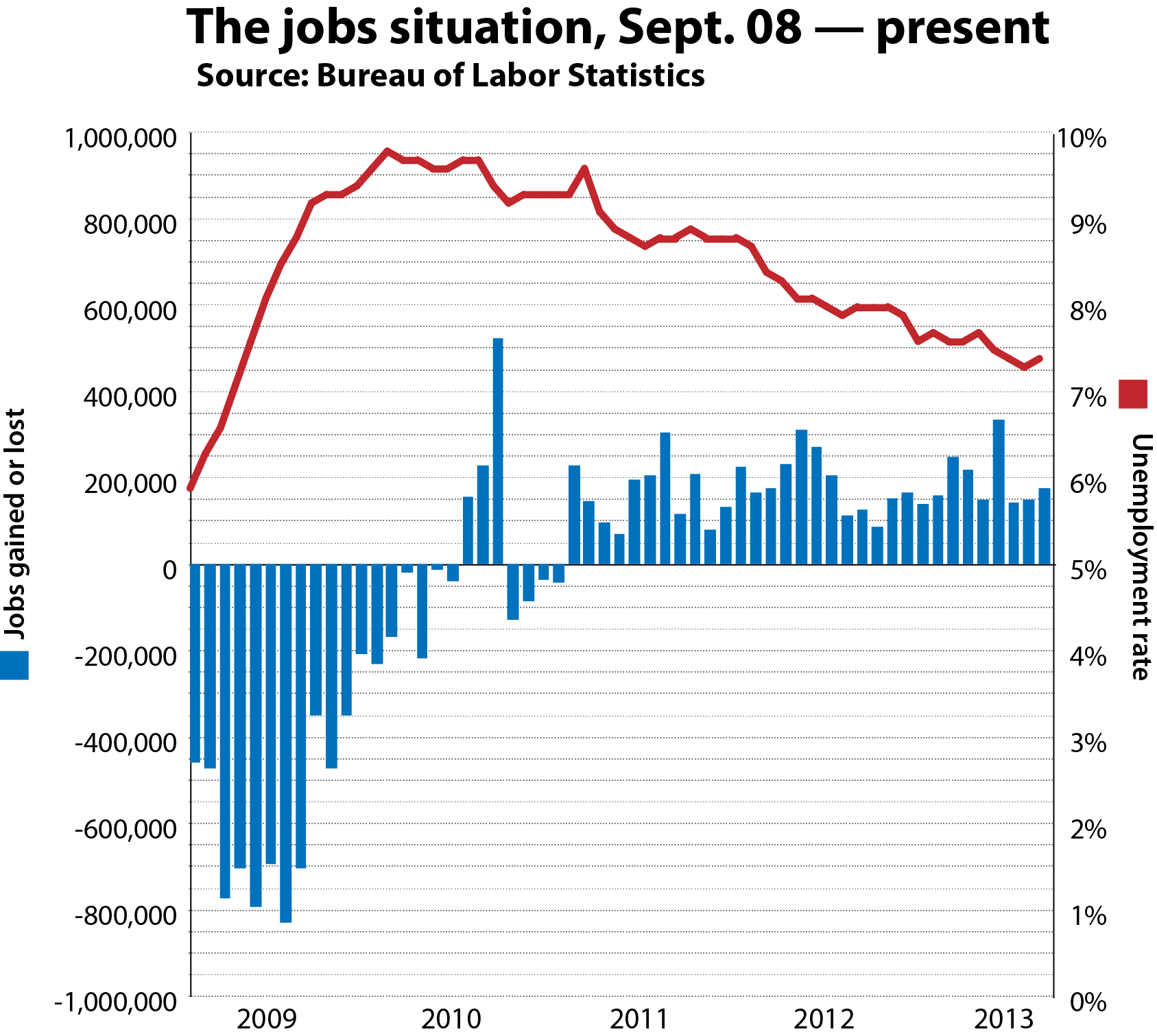
Jobs Report Reax: Treading Water

Jobs Unemployment

Dylan Matthews provides the above chart and a quick summary:

The May jobs report wasn’t spectacular, and it wasn’t disastrous. Unemployment ticked up to 7.6 percent, largely due to a slight increase in labor force participation. The nation gained 175,000 jobs, which is heartening, but the pace is not nearly fast enough to close the jobs gap anytime soon. In fact, according to the Hamilton Project’s calculator, it will take 9 years and 5 months to get back to pre-recession employment levels at this rate.

Ed Morrissey has a similar take:

This still isn’t a great jobs report.  It’s just better than expected.  The US economy needs ~150K new jobs each month to keep up with population growth, so this is just a little better than a maintenance level for job creation. … Basically, we treaded water, which is always better than sinking, but it really doesn’t get you anywhere.

Ryan Avent looks at the recovery as a whole:

Despite all the fretting over the slow pace of job creation in the recovery, and despite major shifts in the stance of economic policy, employment has risen at an extraordinarily stable pace.

That stability is a bit illusory. There are wiggles. In February private employers added 319,000 jobs, one of the best performances of the recovery. Last June the gain was only 78,000—the worst since payrolls began growing again. The composition of the employment recovery has also changed. Early on manufacturing helped lead the way forward. Now construction is pulling more weight (though less than many had hoped, and less than professional services and retail). At the first, federal government jobs were flat while state and local government employment tumbled. Now the latter is recovering while federal payrolls are shrinking rapidly. Over the whole of the employment recovery, of course, governments have been a major drag, slimming down by 622,000 workers since February of 2010. Strikingly, work in health care—long the stable core at the heart of the employment recovery—slowed noticeably in May.

Mark Perry puts a positive spin on the sector-specific numbers:

Although overall US job growth continues to be weak, we are seeing strong job growth in some sectors of the economy – temporary help services, construction, architectural and engineering services, motor vehicles, and oil and gas extraction.  Together, those five sectors added 40,600 jobs in May, which represents more than 23% of the overall increase in US payrolls last month of 175,000. Looking forward, we can expect increased hiring in those sectors, as America’s energy revolution continues, the housing recovery gains momentum, and auto production and sales continue on an upward trajectory.

Dean Baker reads the sector breakdowns differently:

Job growth was again narrowly concentrated, with the restaurant sector (38,100 jobs), retail trade (27,700) and temporary employment (25,600) accounting for more than half of the job growth in May. These are all low-paying sectors. It is worth noting that the job growth reported in these sectors is more an indication of the weakness of the labor market than the type of jobs being generated by the economy. The economy always creates bad jobs, but in a strong labor market workers don’t take them.

Neil Irwin finds some positive news buried in the unemployment stats:

While the headline unemployment rate ticked up one-tenth of a percent in May, a broader measure of joblessness actually showed slight improvement. U-6, a measure of unemployment that includes people who have a part-time job but want full-time work and people who want a job but have given up looking out of frustration, fell to 13.8 percent in May, from 13.9 percent in April. That measure has come down tremendously in the last year, from 14.8 percent in May 2012.

Drum searches the effects of sequestration:

Once again, the fiscal cliff deal and the sequester don’t seem to be showing up in the job numbers yet—though public sector employment was flat and federal employment was down, which might be partly due to cutbacks. In any case, the changes aren’t huge. So far, it looks like we’re continuing to tread water.

Annie Lowrey, on the other hand, thinks sequestration is beginning to show up in the numbers:

The monthly jobs report is starting to show the effects of the $85 billion in across-the-board budget cuts that the government needs to carry out before the end of the fiscal year in September. That’s not much in a $16 trillion economy, of course. But economists still expect it to slow growth and reduce employment in the coming months and years. And it is. Federal employment had been on a downward trend since the start of 2011, with the government shedding about 3,000 or 4,000 positions a month through February. Then sequestration hit on March 1. And in the last three months, the federal work force has shrunk by about 45,000 positions, including 14,000 in May alone. …

Sequestration is having an impact on private businesses as well, even if it is harder to see given the way the recovery continues to chug along. Millions of their customers have less money to spend. The government is trimming back on contracts awarded to private firms. But just because sequestration’s impact is diffuse and cumulative over time does not mean it is not there.

Catherine Rampell focuses on the sequester’s impact on the 7.6% still unemployed:

Almost every state has cut its unemployment insurance benefits as a result of the sequester, according to the National Employment Law Project, a labor-oriented research and advocacy organization. Some states, like Florida and Maine, are cutting the weeks for which jobless workers will continue receiving benefits, and others, like Illinois, are reducing the size of the weekly benefit checks (in Illinois, the cut was 16.8 percent). Some states, like Washington and Idaho, are also laying off employees who work in the labor agencies that help workers apply for benefits and find jobs. North Carolina is ending its federally funded extended unemployment benefits on July 1 because reductions in its state benefits left it ineligible for the federal money.

Jared Bernstein withholds judgment on the unemployment statistics:

What we have here is a high stakes game of musical chairs, as payrolls grow at a steady, if not-that-impressive, clip, essentially adding chairs to the game.  Meanwhile, more players are coming off the sidelines looking for places to sit.  Last month, there were more new players than seats.  In future months, we’ll keep a close eye on how that balances out.

The FBI May Have Your Phone Records, Ctd

Stephen Walt responds to my initial post on the NSA-Verizon story:

The United States is still going to be a major world power long after the contemporary jihadi movement is a discredited episode in modern history, even if the country repealed the Patriot Act and stopped all this secret domestic surveillance tomorrow. Second, after acknowledging the potential for abuse in this government surveillance program, Sullivan warns that the “consequences of its absence” could be “terrible.” This claim depends on the belief that jihadism really does pose some sort of horrific threat to American society. This belief is unwarranted, however, provided that dedicated and suicidal jihadists never gain access to nuclear weapons. Conventional terrorism — even of the sort suffered on 9/11 — is not a serious threat to the U.S. economy, the American way of life, or even the personal security of the overwhelming majority of Americans, because al Qaeda and its cousins are neither powerful nor skillful enough to do as much damage as they might like. And this would be the case even if the NSA weren’t secretly collecting a lot of data about domestic phone traffic.

Indeed, as political scientist John Mueller and civil engineer Mark Stewart have shown, post-9/11 terrorist plots have been mostly lame and inept, and Americans are at far greater risk from car accidents, bathtub mishaps, and a host of other undramatic dangers than they are from “jihadi terrorism.”

Meanwhile, Benjamin Wittes zeroes in on the key phrase justifying the court order that granted the NSA access to all Verizon’s domestic phone records:

To acquire such an order, the government does not have to do much—just as it doesn’t have to do much in a criminal investigation: It merely has to offer, in pertinent part, “a statement of facts showing that there are reasonable grounds to believe that the tangible things sought are relevant to an authorized investigation . . . to obtain foreign intelligence information not concerning a United States person or to protect against international terrorism or clandestine intelligence activities.”

I’m trying to imagine what conceivable of facts would render all telephony metadata generated in the United States “relevant” to an investigation, presumably of the bombing. This would include, of course, all telephony metadata that, as matters turned out, postdates the killing of one bomber and the capture of the other—though there’s no way the government could have known that when the application was submitted. And it would also include all telephony metadata that postdates the government’s conclusion that the Tsarnaev brothers were apparently not agents of any foreign terrorist group. But even if this were not the case, how is it possible that all calls to, say, Dominos Pizza in Peoria, Illinois or all calls over a three month period between two small businesses in Juno, Alaska would be “relevant” to an investigation of events in Boston—even if we assume that the FBI did not know whom it was investigating in the Boston area and did not know whom that unknown person was communicating with?

Orin Kerr’s answer:

If the [court] order is what it appears to be, then the order points to a problem in [the US legal code] Section 1861 that has not been appreciated. Section 1861 says that the “things” that are collected must be relevant to a national security investigation or threat assessment, but it says nothing about the scope of the things obtained. When dealing with a physical object, we naturally treat relevance on an object-by-object basis. Sets of records are different. If Verizon has a database containing records of billions of phone calls made by millions of customers, is that database a single thing, millions of things, or billions of things? Is relevance measured by each record, each customer, or the relevance of the entire database as a whole? If the entire massive database has a single record that is relevant, does that make the entire database relevant, too? The statute doesn’t directly answer that, it seems to me. But certainly it’s surprising — and troubling — if the Section 1861 relevance standard is being interpreted at the database-by-database level.

The FBI May Have Your Emails

The other shoe drops:

The National Security Agency has obtained direct access to the systems of Google, Facebook, Apple and other US internet giants, according to a top secret document obtained by the Guardian. The NSA access is part of a previously undisclosed program called PRISM, which allows them to collect material including search history, the content of emails, file transfers and live chats, the document says.

The program essentially provides [WaPo] the agency with a search bar into Americans’ lives:

To collect on a suspected spy or foreign terrorist means, at minimum, that everyone in the suspect’s inbox or outbox is swept in. Intelligence analysts are typically taught to chain through contacts two “hops” out from their target, which increases “incidental collection” exponentially. The same math explains the aphorism, from the John Guare play, that no one is more than “six degrees of separation” from Kevin Bacon.

The tech companies participating “include most of the dominant global players of Silicon Valley,” such as Apple, Microsoft, Yahoo, Google, YouTube, Facebook, and Skype. Ambers theorizes how this exchange works:

It is not clear how the NSA interfaces with the companies. It cannot use standard law enforcement transmission channels to do, since most use data protocols that are not compatible with that hardware. Several of the companies mentioned in the Post report deny granting access to the NSA, although it is possible that they are lying, or that the NSA’s arrangements with the company are kept so tightly compartmentalized that very few people know about it. Those who do probably have security clearances and are bound by law not to reveal the arrangement.

This arrangement allows the U.S. companies to “stay out of the intelligence business,” one of the officials said. That is, the government bears the responsibility for determining what’s relevant, and the company can plausibly deny that it subjected any particular customer to unlawful government surveillance. Previously, Congressional authors of the FAA said that such a “get out of jail free” card was insisted by corporations after a wave of lawsuits revealed the extent of their cooperation with the government.

Several of those tech companies immediately denied letting the government into their servers. Andrea Peterson explains what this might actually mean:

Comparing denials from tech companies, a clear pattern emerges: Apple denied ever hearing of the program and notes they “do not provide any government agency with direct access to our servers and any agency requesting customer data must get a court order;” Facebook claimed they “do not provide any government organisation with direct access to Facebook servers;” Google said it “does not have a ‘back door’ for the government to access private user data”; And Yahoo said they “do not provide the government with direct access to our servers, systems, or network.” Most also note that they only release user information as the law compels them to.

But the PRISM program’s reported access to data and the now repeatedly confirmed widespread access to phone records and other types of digital data appears to be almost exactly what the 2008 Protect America Act (PAA) allows Foreign Intelligence Surveillance Act (FISA) courts to compel tech companies to do — as many warned around the time of its passage. If tech companies are not providing direct access to their servers but are cooperating with the PRISM program, that leaves at least one other option: Companies are providing intelligence agencies with copies of their data.

Timothy B. Lee flashes back to when Congress passed the Protect America Act, on Sept. 11 2007:

Civil liberties groups warned that the PAA’s vague requirements and lack of oversight would give the government a green light to seek indiscriminate access to the private communications of Americans. They predicted that the government would claim that they needed unfettered access to domestic communications to be sure they had gotten all relevant information about suspected terrorists.

It now appears that this is exactly what the government did. Today’s report suggests that the moment the PAA was the law of the land, the NSA started using it to obtain unfettered access to the servers of the nation’s leading online services. To comply with the requirement that the government not target Americans, PRISM searches are reportedly “designed to produce at least 51 percent confidence in a target’s ‘foreignness’” — the lowest conceivable standard. PRISM training materials reportedly instruct users that if searches happen to turn up the private information of Americans, “it’s nothing to worry about.”

Tim Worstall defends the program:

[T]his sort of behaviour is not something that we should be shouting about government doing. It’s something that we should be shouting about government notdoing. The crucial point is here, from the DNI:

Section 702 is a provision of FISA that is designed to facilitate the acquisition of foreign intelligence information concerning non-U.S. persons located outside the United States. It cannot be used to intentionally target any U.S. citizen, any other U.S. person, or anyone located within the United States.

As I say that’s the important part of it all. The information, the data, may be in the US as a result of the global spread of the internet and the physical location of servers. But the information cannot be about either a US citizen or someone who is in the US. And, if we’re prepared to be honest about matters, we do actually want the government to be keeping an eye on foreigners in foreign lands. Which is what they’re doing.

Amy Davidson is unsatisfied with that explanation:

[T]his is all supposedly meant to stop terrorism by foreigners. When the N.S.A. looks through the private files of people who are one or two degrees of separation from the person who has caught its eye, though, it hasn’t just gone beyond that mission but has betrayed it. The Post article described analysts using “selectors” that are “designed to produce at least 51 percent confidence in a target’s ‘foreignness.’ ” If they turn out to have targeted “U.S. content”—beyond all the incidental information on Americans that’s swept up—they are supposed to submit it to yet another database, “but it’s nothing to worry about.” Actually, it is.

James R. Clapper, Director of National Intelligence, has released a terse statement on the leak:

Information collected under this program is among the most important and valuable foreign intelligence information we collect, and is used to protect our nation from a wide variety of threats. The unauthorized disclosure of information about this important and entirely legal program is reprehensible and risks important protections for the security of Americans.

What’s The Solution To Insider Trading?

Surowiecki recommends giving more information to outsiders:

In a world where companies increasingly know about their business in real time, it makes no sense that public reporting mostly follows the old quarterly schedule. Companies sit on vital information until reporting day, at which point the market goes crazy. Because investors are kept in the dark, the value of inside information is artificially inflated.

“Insider trading is, by definition, based on information that is not known to investors,” Baruch Lev, a professor of accounting and finance at N.Y.U. and an expert on corporate disclosure, told me. “If you increase transparency, the gains for insider trading must go down.” Back in 2002, Harvey Pitt, who was then the head of the S.E.C., told Congress that companies should be providing investors with regular updates about their performance, rather than just making quarterly disclosures. More consistent, if not real-time, data about revenue, new orders, and major investments would help investors make more informed decisions and, into the bargain, would diminish the value of insider information. If companies tell us more, insider trading will be worth less.

Felix doubts this will happen:

[T]here are two reasons why most companies would never go down such a road. The first is just that they’re not technically capable of doing so. And the second is that most companies reflexively seek to keep control of their financial information. Reg FD has stopped them from picking and choosing who gets the information, but they can at least control what information they disclose, and when. Most of the time, they err on the side of disclosing less rather than more, since information is power and the company wants to keep power for itself rather than make it public.

Do Mascots Need Modernizing? Ctd

Many more opinions from the in-tray:

I appreciate your Cleveland readers’ comments (I’m an Ms girl myself but I like Cleveland!). bl2d-fhccaafkq3Sadly, the attached image was supposed to be the Indians’ commemorative cap for the 4th of July (oh the irony there). It has reportedly been pulled. The Atlanta Braves were going to ressurect another horrendous image onto its hats, but then denied that was the case.

I also appreciate this whole thread. I have family who are Native and part Native (Blackfeet), so it’s personal to me. I recommend The Absolutely True Diary of a Part-Time Indian by Sherman Alexie. It’s written for young adults and is a very engaging, easy read and gives a funny, heartbreaking and real look at life on the rez.

Another takes issue with the reader who invoked the Fighting Irish mascot:

Notre Dame itself is not just a Catholic institution, but very much an Irish Catholic institution.  As such, its mascot is an expression of Irish identity by Irish Americans. The Washington Redskins is an institution originated, owned and operated by white dudes in a city where a long series of genocidal policies against Native Americans were planned and directed. So the situations are not analogous in any respect: not in the terms, not in the people, and not in the institutions.

Another pushes back on the second reader here:

To somehow equate the Cleveland Indians name to those of Negro league teams is to be grossly oblivious to the nature of those leagues. The Negro Leagues were segregated teams. The BlackBarons were called “Black” because they were black. By definition, they had to be, because black players were not allowed on white teams.

m-4810So this is entirely a different situation. The fact that there was this kind of color line is a shameful part of baseball history. But Negro League teams should be remembered and celebrated because of the great players who were excellent athletes that played hard. They were not ashamed of being black and wanted to show the world that black people could play ball just as well as whites. In this respect, your reader is correct about those names being marks of pride for the players.

This is not the same situation as the Redskins and Indians. The Cleveland Indians are not a team full of Indian players (The Sockalexis myth notwithstanding). When they took the name in 1915, Earlier Wahoothey were a team of white players, in a white league. They are named for a group of people who literally did not have rights at the time. This is an important distinction. Taking a team name that reflects pride in your group is vastly different than taking a name that caricaturizes a group with less power. To think that the name was not conceived from racism is to be ignorant of the world of 1915.

Another reader:

Before Atlanta hosted the Braves, for decades it was home to a white minor league team called the Crackers, and a Negro League team called the Black Crackers – seriously.

Another lightens the mood:

I always thought Penn’s Fighting Quakers were funny, in a stupid kind of way. Go Pacifists! Subdue them with Inner Light!

Another:

Sorry, I just had to respond to this reader’s comments you posted:

If I were living 50 years ago, I would of demand changing the nickname because of [racist Redskins owner George Preston] Marshall’s actions. Now, I think the Redskins reflect its true origin: pride, endearment and character from their football team.

This is just a bunch of happy horseshit.

In what way, precisely, do the Washington Redskins organization do anything to promote pride, endearment, and character among any Native American communities in the greater D.C. area, or nationally? I’m sure that the Redskins players and organization do a lot of charitable activities – all professional sports teams do as a way to engender good feelings among fans and because the players and management recognize how truly fortunate they are and want to give back to their communities. But do the Redskins do anything that is specifically targeted at Native American communities? Are they promoting education about Native American culture and history, working to preserve recordings of Native American languages as the last speakers of these languages grow old and die?

If they do, they’re remarkable for the lack of publicity such actions generate, because as far as I can tell there isn’t any.

Another:

Just wanted to add one more angle to the thread, which started in part with a quote from Doug Mataconis, who asked, “I have to wonder why this is something that Members of Congress need to be getting involved in, or why legislation is necessary to address something that is, in the end, a private business matter.”

Trademark is absolutely not a private business matter. Trademark is a system in which the government grants to people and business a set of rights in the usage of images and names. The underlying policy is both to protect consumers and to prevent unfair competition. Unlike say a contract agreed to by two parties, there is no private business conduct in trademark, the trademark holder gets rights that are granted by current legislation and the trademark office.

It seems the point of the proposed legislation is simply to deny the Redskins use the full force of the US Government to enforce its trademark. Currently, the Redskins can go to court, and in essence conscript the federal government into forcing people not to use their name or image, or pay them penalties for having done so. All the legislation would do is to say the government is not going to help them do that anymore. I understand that there may be reasons why the government shouldn’t pick and choose what symbols get Trademark protection, but that is a different argument than the standard “keep liberal government out of private business” trope that Mataconis puts forth.

More readers join the conversation on our Facebook page.

American Kids Aren’t Slackers, Ctd

A reader writes:

It doesn’t seem like you read that article with a critical eye.  The author cherry-picked facts to support what appears to be a predefined solution.  He keeps talking about required minimums, but then mentions they actually attend 25% more days. The minimums don’t mean anything; how many days/hours are they actually going is the only thing that counts.  If American schools are only meeting the required minimum but other countries are exceeding the minimum then you’re not making a fair comparison.

Another:

As someone who grew up in the “system”, I can tell you with first-hand experience that, in Taiwan, I was spending roughly 14 hours a day “in class”, with about 10 hours in school and 4 hours in cram school. On weekends, I was having up to 6 hours of cram school lessons. This is the reality of education in Asian countries.

Another points to a similar experience in another Asian country:

The thing is, India as a whole may require 800-900 hours per year, but that, I imagine, only applies to Indian government schools (equivalent to US public schools) that are on the whole, pretty bad. Most middle-class kids go to private schools in India, where the instructional demands are much higher. The kids I know in India go to school from 9 am to 3 pm, but before and after school they have extra private tutoring, especially in 10th and 12th grades when their performance on the exams determines their future. Additionally, in 12th grade they take nationwide or statewide exams for entrance into medical school or engineering school, and for each of these entrance exams they take more specialized tutoring. So the 800-900 hours does not begin to represent the total amount of academic work done by these kids.

Not that I’m recommending this approach. I think it’s brutal.

Game Of Brutality

Reactions to the latest episode of Game Of Thrones (major spoilers below):

Alyssa pushes back against those who view “evidence that the show is participating in some of its characters disgusting enjoyment of violence against women”:

Though Talisa’s murder is unspeakably cruel, it didn’t read that way to me. Rather, the decision to kill her by killing her fetus made, within the astonishingly cold-blooded context of the Red Wedding, a great deal of sense. A comprehensive attempt to make the Starks extinct would include an attack on everyone in their family line, born and unborn. And as an attempt to make Robb Stark feel unspeakable emotional pain before his physical death, an attack on his wife and his unborn child that he has to witness while he is physically incapacitated is a twistedly brilliant thing to do. As Talisa died and Robb held her, the focus was on their faces, and their shared pain, just as they’d shared joyful glances during Edmure’s wedding vows, and flirted during the banquet. Our sympathies and focus were on them, rather than on a pornographic contemplation of the violence to which they’d been subjected.

Rowan Kaiser argues the chief success of Game of Thrones is that “it’s a magnificent depiction of how sexist systems ruin everyone”:

So many of the show’s best scenes deal directly with how power is acquired, lost, and maintained in the patriarchal system that this becomes an effective lens for seeing when Game of Thrones loses its moorings. The show’s much-discussed—usually female—nudity is often illustrative of a sexist world, but occasionally and subjectively goes too far and illustrates no real point other than to show nude women. And some of the worst parts of the show’s third season have deviated too far from the theme of systemic oppression. For example, both the murder of the lowborn character Roz in the middle of the season and the constant torture of Theon Greyjoy have demonstrated little except for the personal cruelty of a few of the characters. The brutal depiction of Robb’s wife Talisa’s death at the wedding falls into that category as well.

But when Game of Thrones works, it’s a magnificent depiction of how sexist systems ruin everyone, even those they’re supposed to help. Every woman on the show is oppressed in some way. And the only men who can succeed are those who submerge their humanity and happiness, or were sociopaths to begin with. Westeros’ patriarchy may be a metaphor that can’t exist in our real world, but that’s what makes it so rhetorically powerful.

Meanwhile, Kelsey D Atherton analyzes Robb Stark’s strategic mistakes.