Peak Faggot?

The word has been going gangbusters on Twitter lately:
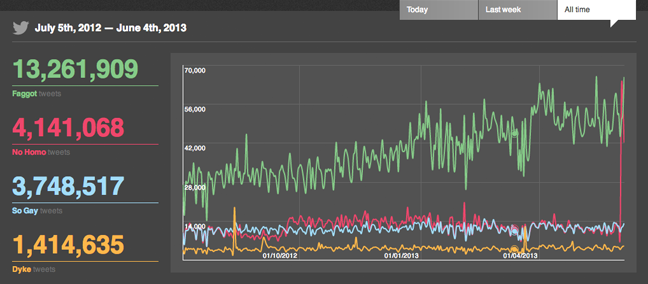
alltimenohomo-grab

What’s interesting is to click on NoHomophobes.com to read the actual contemporaneous tweets that contain the phrases “so gay”, “dyke”, “NoHomo”, and “faggot.” I have to say that “so gay” does seem, from reading the tweets, to be close to meaningless in terms of active, pre-meditated homophobia. Yes, of course it is a negative term and is rooted in the premise that being homosexual is lame. But it has become so generic I’m not really outraged by it. In fact, I’m not that outraged at any of this. Twitter is full of expletives and hate-words. I wonder if the n-word and the word “bitch”, for example, are much more common.

“Faggot” is also somewhat ubiquitous, ranging from the classic hate term against gay men to a general term of abuse for straight women and straight men. But some of that abuse in context is jokey. So this post – which will be tweeted – will register as hate-speech, just as a joke between two friends in which “faggot” has been drained of any explicit homosexual meaning. But “NoHomo” is almost entirely an ugly, nasty prejudice.

I may not be personally outraged, but I’m in a very privileged position (only gay-bashed once in my life), and the general the trend is disturbing, especially when we have seen a spate of anti-gay street violence from the Castro to the West Village, a few blocks from where I now live.

It gets more disturbing still when you also have the spectacle of a Republican candidate for Lieutenant Governor in Virginia like EW Jackson. The state’s GOP has effectively affirmed the legitimacy of a man who has used not just tired cliches but what I think has to be called “eliminationist” rhetoric, as defined by Daniel Goldhagen. Take this:

“[T]he homosexual movement is a cancer attacking vital organs of faith, family & military – repositories of traditional values.”

Or this:

“The ‘homosexual religion’ is the most virulent anti-Christian bigotry & hatred I’ve ever seen.”

Now look at the actual definition of “eliminationist” rhetoric:

Eliminationism is the belief that one’s political opponents are “a cancer on the body politic that must be excised — either by separation from the public at large, through censorship or by outright extermination — in order to protect the purity of the nation.

I’m a free speech absolutist. But when we find hate terms surging on Twitter, eliminationist anti-gay rhetoric from major candidates, and a rise in attacks on gay men in neighborhoods associated with them, we should take notice. There is a range of tweeted sentiments here – from innocuous to unthinking (the NoHomophobes website has a smart slogan: “Homophobic language isn’t always meant to be hurtful, but how often do we use it without thinking?”). But when they are legitimized by rhetoric that seeks to speak of gays the way Afrikaners spoke of Africans, and extremist Sunnis speak of Shiites, we have a problem. I urge readers to check out the site and tell me what they hear and read, and what they make of it. It can get complex and I have two confirmation biases: I’m gay and am attached to a non-victimology temperament in identity politics.

But one thing I do know in this atmosphere: The GOP is dipping into some of the foulest waters here. I just hope they aren’t legitimizing a wave of hatred.

The FBI May Have Your Phone Records

[tweet https://twitter.com/cgreensit/statuses/342451643381587970 ]

The NSA has been collecting the telephone records of Verizon customers, regardless of any suspected wrongdoing, after obtaining a court order in April. The FISA Court gave the FBI a court order to monitor all national and international calls on an “ongoing, daily basis” for three months. Glenn Greenwald, Ewen MacAskill and Spencer Ackerman report:

The order directs Verizon to “continue production on an ongoing daily basis thereafter for the duration of this order”. It specifies that the records to be produced include “session identifying information”, such as “originating and terminating number”, the duration of each call, telephone calling card numbers, trunk identifiers, International Mobile Subscriber Identity (IMSI) number, and “comprehensive communication routing information”.

The court order appears to explain the numerous cryptic public warnings by two US senators, Ron Wyden and Mark Udall, about the scope of the Obama administration’s surveillance activities. For roughly two years, the two Democrats have been stridently advising the public that the US government is relying on “secret legal interpretations” to claim surveillance powers so broad that the American public would be “stunned” to learn of the kind of domestic spying being conducted. …

It is not known whether Verizon is the only cell-phone provider to be targeted with such an order, although previous reporting has suggested the NSA has collected cell records from all major mobile networks. It is also unclear from the leaked document whether the three-month order was a one-off, or the latest in a series of similar orders.

Timothy B. Lee adds:

“This confirms what we had long suspected,” says Cindy Cohn, an attorney at the Electronic Frontier Foundation (EFF), a civil liberties organization that has long accused the government of operating a secret dragnet surveillance program. “We’ve been suing over this since 2006.”

The order is based on Section 215 of the Patriot Act, which allows law enforcement to obtain a wide variety of “business records,” including calling records. EFF has long criticized Section 215, which sets a threshold for obtaining records much lower than the “probable cause” standard required to get a search warrant.

But Cohn argues that the kind of dragnet surveillance suggested by the Verizon order exceeds even the authority granted by the Patriot Act. “Section 215 is written as if they’re going after individual people based on individual investigations,” she says. In contrast, the order leaked to the Guardian affects “millions and millions of innocent people. There’s no way all of our calling records are relevant to a terrorism investigation.”

Marc Ambinder weighs in:

My own understanding is that the NSA routinely collects millions of domestic-to-domestic phone records. It does not do anything with them unless there is a need to search through them for lawful purposes. That is, an analyst at the NSA cannot legally simply perform random searches through the stored data. He or she needs to have a reason, usually some intelligence tip. That would allow him or her to segregate the part of the data that’s necessary to analyze, and proceed from there.

In a way, it makes sense for the NSA to collect all telephone records because it can’t know in advance what sections or slices it might need in the future. It does not follow that simply because the NSA collects data that it is legal for the NSA to use the data for foreign intelligence or counter-terrorism analysis.

Unfortunately, we don’t know precisely what the NSA can do because its rules are highly classified. This disclosure will hopefully force the government to clarify the rules it uses to actually analyze the data it collects.

Amen. But like Ambers, I’m neither shocked nor that outraged. Meta-data is not the content of our phone records. Gregory Ferenstein’s view:

The revelation dovetails similar exposes on massive government spying projects, including one project to combine federal datasets and look for patterns on anything which could be related to terrorism.

Late last year, I wrote about a few actual harms that citizens should be worried about from these types of big-data spying programs. Blackmailing citizens critical of the government seemed like a distant hypothetical, until we learned that the IRS was auditing Tea Party groups and journalists were being wiretapped. Nefarious actors inside the government like to abuse national security programs for political ends, and that should make us all (even more) suspect of government spying.

Ed Morrissey compares Obama’s data-mining to Bush’s:

Hypocrisy is an unfortunately ubiquitous condition in politics, but in the case of NSA seizing Verizon’s phone records, it’s particularly widespread.  Some of the people expressing outrage for the Obama administration’s efforts at data mining had a different attitude toward it when Bush was in office.  Conversely, we’ll see some people defending Obama who considered Bush evil incarnate for the same thing.

On that front, this kind of meta-data gathering hasn’t outraged me too much under either administration. This kind of technology is one of the US’ only competitive advantages against Jihadists. Yes, its abuses could be terrible. But so could the consequences of its absence. Maybe the record shows my passionate denunciation of this by Bush. I don’t remember it. If someone finds me in a double-standard here, let me know. Pareene zooms out:

While the fact that the NSA has the power to do this has been public for some time, we’ve never seen, until the Guardian obtained one, an actual Foreign Intelligence Surveillance Court warrant. They are very top secret. Someone will probably be prosecuted for leaking this one. That, in fact, is one of the primary issues civil libertarians, like the ACLU and the Electronic Frontier Foundation have been raising: If the way the administration interprets the law is secret, the law itself is effectively secret.

Where Coming Out Takes Real Courage

Joe My God passes along the trailer for Call Me Kuchu, opening in NYC on June 14th and LA the following week. A synopsis:

In an unmarked office at the end of a dirt track, veteran activist David Kato labors to repeal Uganda’s homophobic laws and liberate his fellow lesbian, gay, bisexual and transgender men and women, or “kuchus.”  … But one year into filming Call Me Kuchu and just three weeks after a landmark legal victory, the unthinkable happens: David is brutally murdered in his home. His death sends shock waves around the world, and leaves the Bishop and Kampala’s kuchus traumatized and seeking answers for a way forward. With unprecedented access, Call Me Kuchu depicts the last year in the life of a courageous, quick-witted and steadfast man whose wisdom and achievements were not fully recognized until after his death, and whose memory has inspired a new generation of human rights advocates.

Elsewhere, Stephen Fry shares a shocking quote from his upcoming documentary Out There, which looks at the experience of being gay around the world:

I actually got a Ugandan minister to say on camera — he’s the Minister for Ethics and Integrity; it’s the only such ministry in the world — and I said to him, ‘Look, even if these… utterly false supports on which you base your homophobia were true, which they aren’t, there’s so much more to worry about in your country than the odd gay person going to bed with the other gay person. For example, you have almost an epidemic of child rape in this country, which is just frightening.’ And he said, ‘Ah, but it is the right kind of child rape.’ …

I said ‘That was on camera. Do you know that that was on camera?’ He said yes. I said, ‘Can you just explain what you mean? He said, ‘Well, it is men raping girls, which is natural.’

Attack Of The Patent Trolls, Ctd

A reader writes:

I’m a patent attorney (and subscriber…) with over 20 years of experience. I’m not saying patent “trolls” are not an issue, but they are nowhere near the problem made out the graph you displayed and the president’s release yesterday. In 2011, Obama signed what was then called “patent reform,” a large piece of legislation that made many changes to the patent system. One of the changes, which was put in solely to address the alleged patent trolling problem, required that, in effect, you can only file suit against one accused infringer per case. So if you have a patent you believe covers, let’s say, a memory chip, and all the memory chip makers manufacture essentially the same chip (which, due to industry standards, is the case), you can no longer file a single case naming all the memory manufacturers. Instead, you are forced to file separate cases against each. So what used to be one case is now 5-10 cases.

Funny how that law took effect in 2011, which is when the data shows the increase in the number of cases. As my father used to say, figures are for liars, and liars figure.

I’m with Drum. The only way to fix the patent system is the fix the Patent Office. They are overworked, abused, and starved of resources. I bet most people don’t know that the Patent Office is self-funded (i.e., all the money it needs to operate comes from user fees). By statute, the Patent Office’s fees are set at a level so that it collects all the money it needs to operate – not more, not less. The PTO does this, and then Congress raids that money and takes some of it away for other uses. We cannot expect the Patent Office to do its job without the money it requires to properly operate.

The 2011 statute I mentioned was supposed to stop fee diversion, but the word I’m getting is that it has not stopped Congress from raiding the Patent Office’s coffers.

Do Mascots Need Modernizing? Ctd

Seattle Mariners v Cleveland Indians - Game One

A reader writes:

As a long-suffering Cleveland Indians fan, I thought I would weigh in on this issue. I absolutely loath the “grinning Indian” that has been the team’s mascot for decades. In the club’s defense, it seems that they have been trying to limit its use despite what appears to be support for the image by fans. Today, the team uses either a script “I” or an uppercase “C” on its uniforms and caps. Eradicating the emblem altogether would be the right thing to do.

But what is not commonly known is that the team name actually came from a fan contest in the early 20th century to rename the Cleveland club. The name honors Louis Sockalexis, one of the first and only Native Americans to play major league ball. Is the term Indians anachronistic? Yes. But the name was not selected to disparage. I think that makes a difference.

Another:

As a Cleveland transplant who also happened to go to Florida State, I can’t stand the Indians logo (or name for that matter) and see it as something that holds back the city on par with Cuyahoga River burning.  Not sure what a suitable replacement would be, but dropping Chief Wahoo (yeah, seriously) would be a big start.  Maybe the team could just be “Cleveland” and continue to be referred to as “The Tribe” informally.

Here is a hint: when your physical mascot at the field has to look like [the photo seen above] because your real mascot is too offensive, you might want to change your mascot.

Another example is the Fighting Illini of the University of Illinois.  They retired their Chief Illiniwek mascot in 2007 after the NCAA deemed it a “hostile or abusive” symbol.  Originally, the entire name “Fighting Illini” was going to have to go, but it turned out that it predated Chief Illiniwek and referenced soldiers from Illinois that fought in WWI.

Should Congress be involved?  I honestly don’t know, but it did start a discussion here on your blog, so some good has already come of it.  The best pressure the government can do is to place the copyrights for the logos for the Chiefs, Indians, Braves, Redskins in the public domain. Once any guy with a screenprinting setup can use the logo to put on merchandise their would be some clear-cut economic incentives to finally change mascots.

Another:

I have been a Redskins fan all my life and when I first hear the word “Redskins” I immediately think about the NFL team. It was until my teenage years that some people use “Redskins” as a racial slur. For a long time, I was back-and-forth on this. But then I saw this Washington Post article about the origin of the term “Redskins.” It was created by … Native Americans. They used the term as pride and endearment. Whites used the term for endearment as well. Then in the mid 1800s, authors and writers started using “Redskins” to degrade the Native Americans.

For me, the question of whether “Redskins” is racist or not is tied to the person behind the team. George Preston Marshall, the original owner of the Redskins, moved the team from Boston to Washington to attract the Southern crowd. In the late ’50s, he changed one of the lines of “Hail to the Redskins” from “Fight for old D.C.” to “Fight for Old Dixie.” A year later, it went back to the original lyrics. Also at that time, the NFL pressured Marshall to get a player in color and the Redskins were the last team to integrate.

If I were living 50 years ago, I would of demand changing the nickname because of Marshall’s actions. Now, I think the Redskins reflect its true origin: pride, endearment and character from their football team. It started with the elder, late George Allen. Then the Redskins were really “The Redskins” when Joe Gibbs came in coach the team to three Super Bowl titles. Now with the ascension of Robert Griffin III, the Redskins are back to relevance in the NFL. It’s funny that when the Redskins are good, the critics propped up about the name and when they suck, they stay quiet and laugh at their futility.

Update from a reader:

Your reader repeats a commonly believed, but false legend. The Cleveland Indians were not, in fact, named in honor of Chief Sockalexis, or any actual Native American person. Rather, after the 1914 season, Cleveland’s American League team faced the prospect of playing without their star player, Nap Lajoie, for whom the press and public commonly called the team the Naps. The selection of the name Indians in 1915 was not the result of a “fan contest,” and it had nothing to do with Chief Sockalexis. Rather, it was pure corporate marketing, an attempt to steal some glory from the then-dominant Boston Braves of the National League. The Braves now play in Atlanta, after a stint in Milwaukee. And the Braves also gave their name to Boston’s football Braves, who adopted the nickname Redskins and moved to Washington in the 1930s.

As for the Braves? The team has long maintained, with some credibility, that the name originally referred to the patriot tax protesters of the Boston Tea Party, some of whom dressed as Indians for the event. Here’s the best linkable scholarly study of the Indians naming history.

(Photo: Cleveland Indians mascot Slider entertains the crowd during the game against the Seattle Mariners at Progressive Field on August 23, 2011 in Cleveland, Ohio. By Joe Robbins/Getty Images)

The National Weather Out-Of-Service

After the damage caused during last year’s hurricane season, Brian Merchant is gob-smacked that we’re not better prepared for the upcoming one:

This summer is going to be a stormy hurricane-filled hell—climatologists are predicting more extreme activity this season than the last, and remember Frankenstorm Sandy? So you’d think we’d be gearing up to brace for impact: Hiring on extra storm forecasters, investing in better satellites and modeling computers, all around getting more hands on deck.

Instead—and stop me if you’ve heard this one before—we’re doing the opposite. Fresh off the cusp of the biggest hurricane disaster to swamp the East Coast in decades, Congress is allowing budget cuts to hamper the nation’s most important storm-monitoring services.

Climate Progress provides the details:

The National Weather Service, already cash-strapped and under scrutiny for sub-par computer modeling, will be grappling with a hiring freeze and mandatory furloughs as it heads into a potentially daunting hurricane season. The NWS office in Tallahassee, which typically has 18 meteorologists on staff, is down to 14 due to the cuts. Though officials say they can maintain adequate staffing to provide critical services, such as forecasting at the National Hurricane Center in Miami and sending aircraft known as Hurricane Hunters into storms to measure speed and pressure, the staff and crews will be forced to take turns being furloughed. …

With resources and personnel already stretched thin, the prospect of multiple major storms becomes even more daunting. “The biggest concern would be if we have a very active hurricane season and we have back-to-back storms or we have multiple storms hitting the state, they would simply not have the manpower necessary to ensure they have the appropriate coverage in all their field offices to provide us with the most accurate and timely forecast,” said Bryan Koon, director of the Florida Division of Emergency Management.

Dear Life, You Might Be Shabby

Reviewing Alice Munro’s latest collection of short stories, Dear Life, Christian Lorentzen rants about the writer known for depicting “ordinary life, ordinary people”:

‘Alice Munro,’ James Wood wrote in the LRB in 1997 on the publication of her Selected Stories, ‘is such a good writer that nobody bothers anymore to judge her goodness … her reputation is like a good address.’

It’s an address I wouldn’t want to move to, and I didn’t enjoy my recent visit. But the impulse to say that makes me wonder whether I’m some sort of big city chauvinist, or a misogynist, or autistic, or a decadent reader deaf to the charms of simple sentences, perfectly polished (‘Alice Munro excites the writer in me,’ A.S. Byatt says, ‘there is something new to learn from her in every sentence’) and perfectly humourless. Reading ten of her collections in a row has induced in me not a glow of admiration but a state of mental torpor that spread into the rest of my life. I became sad, like her characters, and like them I got sadder. I grew attuned to the ways life is shabby or grubby, words that come up all the time in her stories, as well as to people’s residential and familial histories, details she never leaves out. How many rooms are in the house, and what sort of furniture and who used to own it and what is everybody wearing? To ask these questions is to live your life like a work of realism. I saw everyone heading towards cancer, or a case of dementia that would rob them of the memories of the little adulteries they’d probably committed and must have spent their whole lives thinking about.

‘You’re reading them the wrong way,’ someone told me. This too ought to go without saying. Munro’s stories suffer when they’re collected because the right way to read them is in a magazine, where they can be tucked between, say, a report on the war in Syria and a reconsideration of Stefan Zweig to provide a rural interlude between current atrocities and past masterpieces, or profiles of celebrities or sophisticated entrepreneurs.

In a recent interview, Munro discussed the role of repetition in her work:

You’ve said to me sometimes that we keep repeating things that are difficult until we work through them.

I think that’s particularly true probably of early childhood memories. And there’s always an attempt being made to work through them. But what does “work through” mean? It means that they don’t hurt anymore? That you’ve thought them through and have what you think is a fair idea of what was going on? But you never write about that. You have children. When they write their story of their childhood, it’s still going to be just their story, and the “you” in it is going to be a “you” that you maybe wouldn’t recognize. And this is why I think you have to acknowledge that the story that makes the most honorable effort is still not going to get at everybody’s truth. But the effort is worthy.

If you’re a writer, you’re sort of spending your life trying to figure things out, and you put your figurings on paper, and other people read them. It’s a very odd thing, really.

You do this your whole life, and yet you know that you fail. You don’t fail all the way, or anything, it’s still worth doing—I think it’s worth doing, anyway. But it’s like this coming to grips with things that you can only partially deal with.

This sounds very hopeless. I don’t feel hopeless at all.

A New Phase For The Catchphrase

Ben Yagoda traces how Arrested Development transformed the trope:

The main thing Arrested has done is take the traditional character-based catchphrase and make it fungible. It evolves and shape-shifts and gets used by different characters and in different situations, episode to episode and season to season, gathering comic and sometimes revelatory power in the process. Season 4’s seventh episode, “Colony Collapse,” had some pretty epic examples of this. (Read no further if you haven’t seen it yet and want nothing spoiled.)

Gob Bluth (Will Arnett) has experienced a series of unfortunate events befitting his homophonic namesake, the biblical Job, not least a love connection with his nephew’s former girlfriend, Ann, aka “Egg,” aka “her?” In a tour-de-force scene, Arnett breaks down and blubbers, his power of speech limited to fragments of catchphrases of his former cocky self, “Come on!” and “This is an [X]-dollar suit” (the latter made more poignant by the fact that he is actually wearing Ann’s bathrobe). As Vulture recapper Zach Dionne aptly put it, “Gob’s brain is short-circuiting with Arrested Development references.”

Albert Ching thinks this elevated the series above its contemporary comedies:

Arrested Development wasn’t a one-dimensional catchphrase-factory—if it was, it wouldn’t have been nearly as embraced or remembered as fondly. And that’s maybe its greatest accomplishment: It made you care about a family that could have been thoroughly unlikeable, but it didn’t achieve that through the usual means. George Michael and Maeby’s potentially incestuous relationship may not have been something audiences rooted for in a traditional sense, but it had its own twisted sweetness to it, and as a result felt more earned than something more calculated to tug at heartstrings. When Gob showed his brother, Michael, that he really cared, it was through a singing, racist puppet. Such was the power of Arrested Development‘s multifaceted approach to humor: It not only furthered the plot and fueled the characters, it also conveyed a subtle sincerity without being maudlin.

The Recipe For Romance

Hannah Gersen surveys the cookbooks she’s loved reading. One favorite? 1952’s Venus in the Kitchen, or Love’s Cookery Book:

This is a cookbook of aphrodisiac recipes. I would be surprised if anyone has ever cooked from it, and even more surprised if they derived aphrodisiac benefits from the entrees, which includes a large number of recipes for brains and kidneys. It is the most literary of cookbooks and the most bizarre. Many recipes begin with declarative, faintly poetic instructions such as: “Feed your snails for a fortnight on milk”; “Boil the meat until it is practically cooked into rags”; or, my favorite, “Take some pig guts.” Many recipes end abruptly with a vague opinion: “Rather banal, I venture to think” or “Not everybody cares to treat oysters in this fashion.” If Evelyn Waugh and Edward Gorey collaborated on a cookbook, it might look something like this one.

In 2002, The Guardian excerpted some of the book’s recipes for a Valentine’s Day meal plan, advising sparrows’ brains for the entrée:

Sparrows have always been praised as stimulants. Aristotle has written: Propter nimium coitum, vix tertium annum elabuntur. Recommended also by the school of Salerno.

Whoever wants to test this should take several brains of male sparrows and half quantity of the brains of pigeons which have not yet begun to fly. Take a turnip and a carrot and boil them in chick-pea broth. Cut in little slices the turnip and carrot, and put them in a deep pan with half a glass of goat’s milk, and boil till the milk is almost absorbed. Now put in the brains and sprinkle them with powdered clover seeds. Take off from the fire as soon as they come to the boil, and serve hot.

Where’s The Line Between Friendship And Networking?

Ann Friedman observes that when women “meet other women who seem happier, more successful, and more confident than we are, it’s all too easy to hate them for it”:

When we hate on women who we perceive to be more “together” than we are, we’re really just expressing the negative feelings we have about our own careers, or bodies, or relationships. Here’s my solution: When you meet a woman who is intimidatingly witty, stylish, beautiful, and professionally accomplished, befriend her. Surrounding yourself with the best people doesn’t make you look worse by comparison. It makes you better.

The benefits of this philosophy:

Approaching and befriending women who I identify as smart and powerful (sometimes actively pursuing them, as with any other crush) has been a major revelation of my adult life. First, there’s the associative property of awesomeness: People know you by the company you keep. I like knowing that my friends are so professionally supportive that when they get a promotion, it’s like a boost for my résumé, too, because we share a network and don’t compete for contacts. Also, it’s just plain tough out there — for all the aforementioned reasons about the economy and the dating scene and body-image pressures. I want the strongest, happiest, smartest women in my corner, pushing me to negotiate for more money, telling me to drop men who make me feel bad about myself, and responding to my outfit selfies from a place of love and stylishness, not competition and body-snarking.

Hanna Rosin has misgivings about aspects of Friedman’s article:

[T]he problem is that this worldview posits a definition of friendship I can’t really relate to as a strategic alliance, a self-improvement project, or maybe just networking, which is a fine and noble pursuit but not the same as actual friendship. I might have a “ranking system” in my mind (although I don’t spend all my time on it), but it involves my colleagues or fellow journalists, not my friends. My friends, even if they are journalists, are largely exempt from this ranking system.