What’s Erdogan’s Next Move?

Mustafa Akyol and HA Hellyer ponder the way forward for the Turkish government, noting a few encouraging signs:

The events of the past few days do not mean Erdogan has to resign – but it does suggest he ought to try to be a force for reconciliation. A good step was taken on Tuesday, when Bulent Arinc, Erdogan’s deputy, gave a press conference in which he promised police restraint, dialogue with the opposition, and “self-criticism” within the cabinet. Erdogan will do a great service, to himself and his country, if he uses similarly calming language on return from north Africa. His visit to that region ought to remind him that the best governments listen seriously to the demands of all citizens, not just those who voted them in. Erdogan’s accomplishments are so significant that the alternative route – of further confrontation and crisis – would be a great pity.

Claire Berlinski feels more pessimistic:

Erdogan may believe that he can outlast the protesters, and he may be right, particularly if the protesters succumb to the temptations of violence and vandalism. So far, they have been reasonably constrained. But the Robocops are exhausted—photos are circulating of them falling asleep on the street—and if there is one thing a prime minister best known for “taming the military” can’t do, it is to call in the army to settle things down. If the protests keep escalating and the crackdown intensifies, it’s hard to see how this can end well. Best case: the protests will spook the prime minister and give him a much-needed dose of humility. Worst case: The protests will spook the prime minister and leave him even more paranoid and vengeful.

Jenny White looks at how Erdogan has treated the protestors thus far:

[L]ike a rubber band after several years of liberal opening, the [ruling] AKP [party] has snapped back to what has long been the status quo of strongman autocracy, authoritarianism, patriarchy, and intolerance. These are characteristics that polls show are reflected by the population and characterize the still highly valued traditional family structure. But even an authoritarian father is expected to keep the welfare of his children foremost in mind. And that is where Erdogan has crossed the line. He dismissed the tens of thousands of citizens in the streets initially as purveyors of terror instigated by outsiders, then as “marginals,” as alcoholics, and finally, in perhaps the most revealing statement, as people who have an ideological gripe and who don’t like him personally.

It is the grandiosity of power and the increasingly punitive state that has pushed people onto the streets and keeps them hanging from the windows of their homes every day, banging pots into the night. Even the revered father of the traditional family is expected to care about all this. But Prime Minister Erdogan, after insulting the protesters and refusing to acknowledge that there was any problem whatsoever, instead left for Morocco to attend a trade meeting.
Gay-Baiting Josh Barro, Ctd

Conor takes apart another trope in Erick Erickson’s attack on Barro, the disdain for reformists from “Washington and New York, the two places least likely to lead any version of conservative reform”:

One minute, it’s inside-the-Beltway types who are worthless. The next, it’s disqualifying to have never had a job in policymaking. … It’s that “those of us outside Washington and New York” that really gets me. Erickson doesn’t live in Washington or New York, but is much more implicated in the conservative establishment in the northeast than Barro, for goodness sake; and much more of a media elite himself, with his regular gig on Fox News. That isn’t where Erickson started, of course; and it’s convenient for him to maintain the fiction that he is still an outsider relative to a 28-year-old editor at Business Insider. Barro is, in fact, going to rise in influence and prominence, given his intellectual honesty and smarts. Perhaps then Erickson can accurately attack him as more elite.

The tactic described in this post is one you’ll often see deployed against heterodox reformers.

Don’t ever fall for it.

Philip Klein defends Barro and Northeastern conservative reformers more generally:

For conservatives to have any chance of advancing their agenda, it’s not going to be a matter of whether reformist ideas are coming from inside or outside of the NY/DC corridor, as if it’s an either/or situation. It’s going to require conservatives from all regions — who bring their unique bases of knowledge, skills and backgrounds — working together to generate good ideas, hone them, write about them and then fight for them.

Krugman – surprise! – tells Barro to give up on the GOP:

[T]hings are actually a lot worse than Barro is yet willing to acknowledge; for the GOP’s derpitude doesn’t just involve the Ericksons and the Limbaughs, it extends to the party’s supposed intellectuals. … I feel for Barro; really I do. But he has no home in today’s GOP, which simply has no room for the non-derpy, and to all appearances never will.

Byers contrasts Krugman and Erickson:

I’m not sure what Barro is capable of achieving, but I am entertained at how Erickson and Krugman seem to be playing tug-o-war over his soul, both with the intention of destroying his raison d’être. Erickson is basically saying Barro isn’t a conservative; Krugman is basically telling him he can’t be. Still, they’re both taking seriously his effort to push the rock up the hill. Which is something.

Chris Christie’s Long Game?

The far-right is furious that Christie opted for a special election to fill Lautenberg’s now vacant Senate seat. Here’s Dick Armey:

Sean Trende, on the other hand, thinks Christie might be a “genius”:

Christie’s choice was basically a special election in October or a special election in November. Why October? This is simple: He doesn’t want to just win, he wants to win overwhelmingly. Right now he is leading his opponent by over 30 points in the RCP Average. A victory that big would be headline-grabbing, and would send the message that Christie can carry unfriendly territory. Perhaps more importantly, southeast Pennsylvania gets a lot of southern New Jersey news, and a Republican who runs well in southeast Pennsylvania has a very good chance of winning that state.

Moreover, a big win could have coattails. While Republicans are unlikely to pick up the five seats they need to take over the state Senate, and are very unlikely to pick up the nine seats they would need to control the General Assembly, Christie has been very successful implementing his agenda with a fairly unfriendly legislature. Even moving the ball slightly in his direction could make a big difference in what he can accomplish in the next few years.

A reader suspects a long game is at work:

I’d like to pose a question no one seems to be asking about Chris Christie’s recent moves that have caused so much anger among the Tea Party/GOP base: What if Christie doesn’t want the 2016 nomination?

Personally, I think Christie is positioning himself to be the leader of the GOP after it repudiates the far right, xenophobic, racist and christianist wing of the party. Obviously, you’ve written a lot about when or whether that repudiation is going to happen, but it looks to me like Chris Christie is betting it will, but not until after 2016.

Imagine this scenario:

Christie, again, refuses to run in 2016. The nomination goes to one of the young, far-right, “next generation” leaders of the current GOP like Rubio or Rand Paul or Ted Cruz or even Santorum. Such an inexperienced candidate wouldn’t have the clout or the confidence to stand up to the same GOP super PACs and consultants that bled the Romney campaign dry and offered up terrible advice, alienating ads and skewed polls. Once again, against undeniable demographic change, the GOP runs a campaign that alienates young people, minorities, immigrants, etc. The democratic nominee (Hilary?) uses President Obama’s/David Plouffe’s campaign machine and wins with a margin that closely resembles the 2012 election.

If there was ever an event that could give the GOP the will to break the deal with the devil that was the Southern Strategy (both the racist aspects and the alliance with hard-right evangelicals), it would be a 3rd straight loss to a non white male candidate. If anyone is in position to lead the insurrection within the GOP against the people who ran it into the ground, it’s Chris Christie.

That’s a big if. In my opinion, the Rove’s of the GOP have too much power and money behind them and they’re not going to give that up without a major fight. With Fox News on their side, the base won’t be willing to revolt against the people they have come to trust almost blindly. But if the base does get frustrated enough to look for a less offensive alternative, Christie is their man.

Chris Christie is smart. He’s proven that. He knows that the base won’t be ready to nominate someone who really wants to change the party in 2016. I think he’s decided that he doesn’t want to be the leader of this Republican Party, he wants to be the leader of the next one.

Christie’s poll numbers indicate that he currently has strong bipartisan support:

A new NBC News/Wall Street Journal poll shows 41 percent of Americans view Christie positively, compared to just 12 percent who view him negatively. And he gets equally strong marks from across the political spectrum, with 43 percent of Democrats viewing him favorably. That 29-point split is the best among any politician studied, including longtime leader and former secretary of state Hillary Clinton, who is viewed positively by 49 percent and negatively by 31 percent.

Malkin Award Nominee

“Racial groups like African Americans and Hispanics are predisposed to crime,” – 5th U.S. Circuit Court of Appeals Judge Edith Jones, as reported in a complaint against alleged judicial misconduct in a speech she gave on Feb. 20, 2013, at the University of Pennsylvania School of Law.

Jones was on a shortlist for the US Supreme Court under the last two Republican administrations. Here’s what the complaint against her alleges she stated that day:

That claims of “mental retardation” by capital defendants disgust her, and the fact such persons were convicted of a capital crime is itself sufficient to prove they are not in fact “mentally retarded”;

That Defendants’ claims of racism, innocence, arbitrariness, and violations of international law and treaties are really nothing more than “red herrings” used by opponents of capital punishment;

That certain “racial groups like African Americans and Hispanics” are “’prone’ to commit acts of violence,” and get involved in more violent and “heinous” crimes than people of other ethnicities;

That Mexican nationals would prefer to be on death row in the United States rather than serving prison terms in Mexico, and it is an insult for the United States to look to the laws of other countries such as Mexico; and

That the imposition of a death sentence provides a positive service to capital-case defendants because defendants are likely to make peace with God only in the moment before their imminent execution.

Every now and again, you get an unvarnished glimpse of the current Republican soul. And it is rank.

The Never-Ending Jihadist War Cycle, Ctd

BRITAIN-ATTACKS-MILITARY-MURDER

Thomas Hegghammer encourages counterterrorism agencies to refocus their efforts:

[F]oreign fighters as a group pose somewhat less of a terrorist threat to the West than is often assumed. The widespread view of foreign fighters as very dangerous stems from their documented role in several serious terrorist plots in the past decade. However, this reasoning selects on the dependent variable, because it considers only the small subset of foreign fighters who returned to attack, disregarding the majority who were never heard from again. A related, but equally flawed assumption is that all foreign fighters leave for training, as part of a cunning strategy to “come back and hit us harder”. The fact that some foreign fighters trained and returned does not mean that all foreign fighters departed with that intention. …

A first step toward a more efficient counterterrorism strategy is to differentiate between outgoing and homecoming foreign fighters and focus resources on the latter. Some countries might consider going a little lighter on outgoing foreign fighters. The US government today spends considerable resources investigating, prosecuting, and incarcerating Muslims who merely attempt to join conflict zones like Somalia. While there should clearly be sanctions in place to deter foreign fighting, the deterrence effort could be better calibrated to the documented threat. By contrast, Islamists returning from conflict zones or neighbouring countries should be watched very carefully. This is hardly news to Western intelligence services, but the fact that the last two major attacks in the West, the Boston bombings and the Woolwich murder, involved unsupervised returnees – from Dagestan and Kenya/Somalia respectively – suggests an even greater effort is needed.

Previous Dish on the subject here.

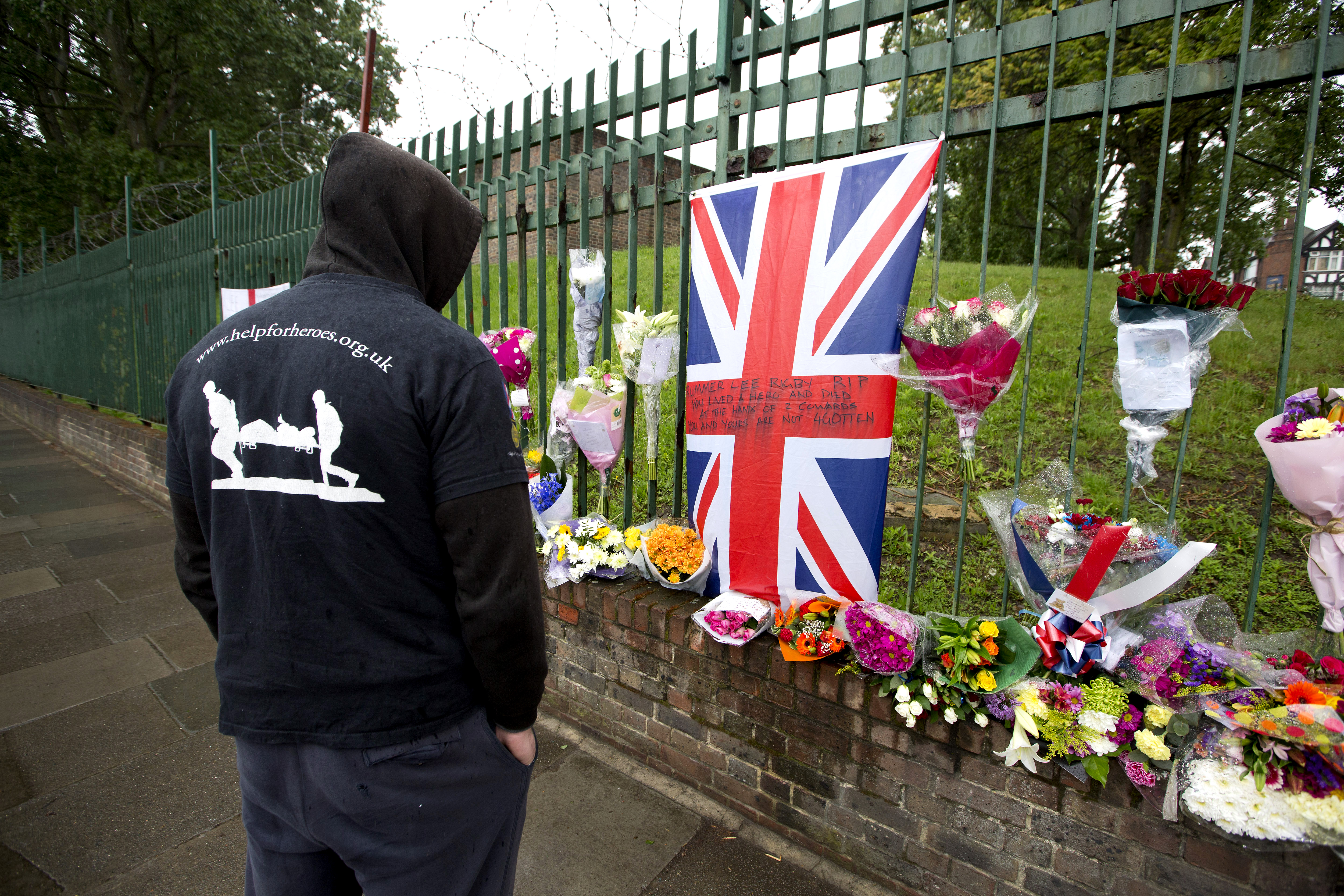
(Photo: A man wearing Help the Heroes hoodie on May 24, 2013 looks at floral tributes left at the scene where Drummer Lee Rigby of the 2nd Battalion was killed outside Woolwich Barracks in London. The brutal murder on May 22 has the hallmarks of a militant Islamist attack but one conducted by ‘lone wolf’ operators – a security nightmare, experts said. Counter-terror police are investigating the attack in which two men hacked the soldier to death in broad daylight. They were shot and wounded by police and are now in hospitals under armed guard. By Justin Tallis/AFP/Getty Images)

Messing With Michelle

Memorial Day Commemorated At Arlington National Cemetery

Barack won’t go there; Sash and Malia apparently tread very gently; but a self-described “old abrasive lesbian” did, heckling her at a private DNC gathering – and kinda regretted it:

“I think she was upset by the interruption, no doubt,” Sturtz said. “But I really didn’t feel like there was a lot of anger or felt like I was in danger at all. Even though she was pretty — I would like to say assertive — but obviously it was pretty aggressive.” …

“She cut me off immediately and leaned over podium, sort of her put her big hand towards me and said something to the effect of ‘You don’t do that to me’ or ‘I don’t do that,’” Sturtz said. “Then I made a comment that I’m interested in making sure that we have employment protections, and I’m not going to be quiet any longer.”

Sturtz said things became even more testy as Michelle Obama left the podium to talk to the activist face to face. “She came down from the podium and got into my face — probably within three inches of my face,” Sturtz said. “She basically took the microphone down, and she said to me, ‘I don’t do this, and if you want the microphone, it’s either I have the microphone or you have the microphone. I said, ‘I’ll take the microphone.’ And she said, ‘If you take the microphone, then I’m leaving.’”

Ms Sturtz was protesting for the Employment Non-Discrimination Act (see correction here), something over which Michelle Obama has precisely zero control, and that the Congress has to pass, and, despite this being the top priority for Big Gay Inc. for thirty years, somehow hasn’t. Quite how this protest in a private home was supposed to accomplish anything is somewhat beyond me, but sometimes an old abrasive lesbian’s gotta do what an old abrasive lesbian’s gotta do. But she picked the wrong woman.

The audio here doesn’t exactly sound very dramatic, but watch the right-wing jump all over this. Meanwhile, there is a genuine First Lady issue that Dan Drezner notes – a conflict between public diplomacy and family life:

In the grand scheme of things, the relationship between Michelle Obama and Peng Liyuan doesn’t matter. That said, the major theme in all of Tom Donilon’s leaks the press coverage has been that this summit is about Obama and Xi trying to forge a good personal rapport so as to better define the bilateral relationship. Furthermore, for the Chinese, this relationship is a lot about prestige. Even small gestures that acknowledge the importance of China in the eyes of the United States can matter. This is just smart diplomacy.

Michelle Obama not attending the summit is a diplomatic own-goal that could easily have been avoided.

I agree that Michelle should go to the summit, if only for necessary optics. What Dan does not account for is the First Lady’s relentless dedication to her children. It’s their last week of school this year. And she has been adamant for five years that their needs take first place. And don’t try to get between her and her daughters. You’ll get the same treatment as Ms Sturtz.

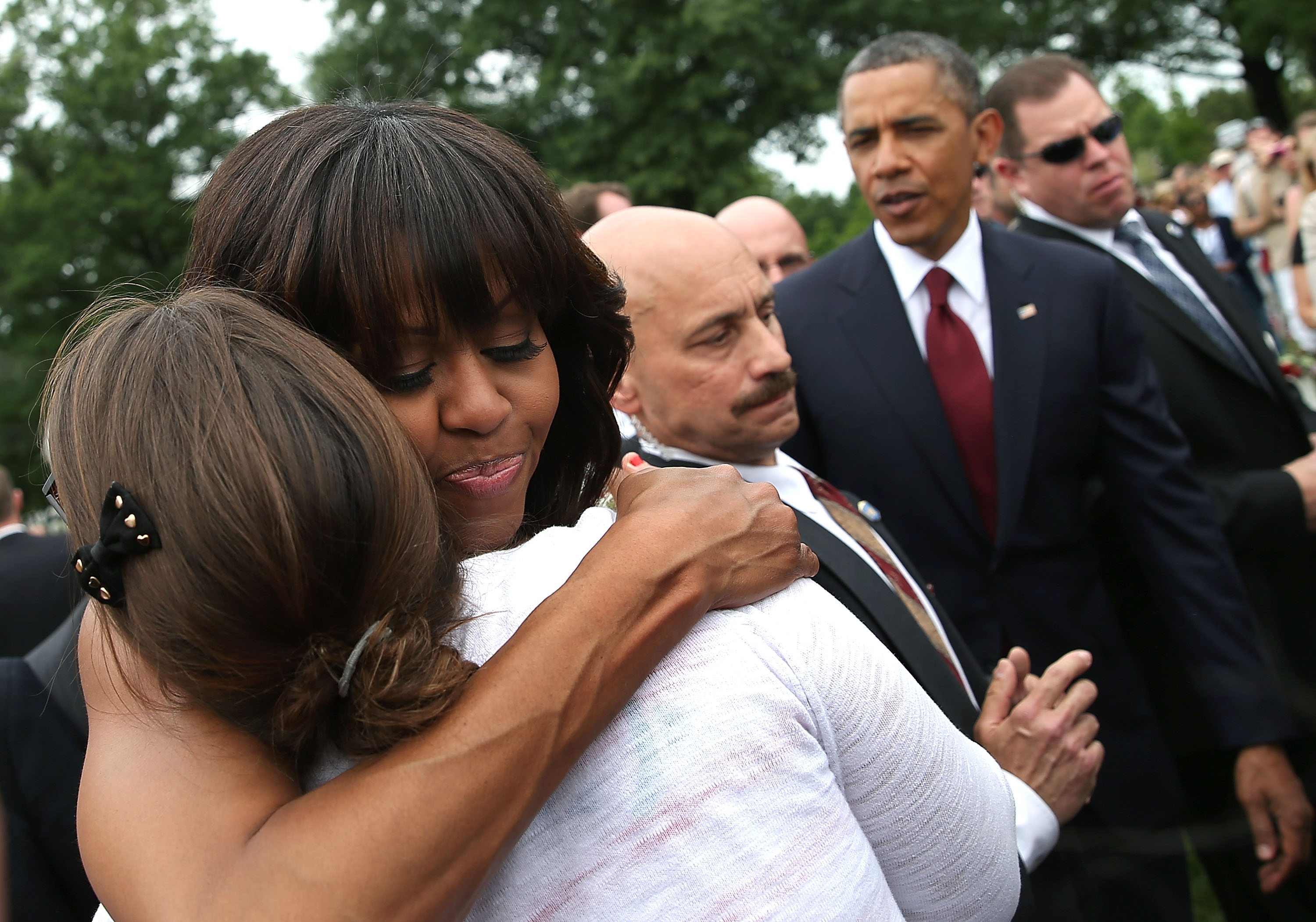
(Photo: First lady Michelle Obama hugs a women while she and her husband U.S. President Barack Obama (R), visit section 60 at Arlington Cemetery, May 27, 2013 in Arlington, Virginia. For Memorial Day President Obama layed a wreath at the Tomb of the Unknowns, paying tribute to military veterans past and present who have served and sacrificed their lives for their country. By Mark Wilson/Getty Images.)

In Pursuit Of Inbox Zero

Alexia Tsotsis encourages us to give up the “Sisyphean” task of clearing our inboxes:

If you’re like most people in information technology, you could spend 16 hours of your day replying to email without even touching anything else. You could achieve the ludicrous construction of Inbox Zero, and still, the next morning, wake up to Inbox 276. It’s overwhelming, and absurd, but for those of us who rely on that number to feel confident or useful, we start leak emailing. Answering an email in a taxi, or right before a meal or, the worst, after sex. You become the person whose phone is more alluring than other people, the person who’d rather have a digital conversation than a regular one. …

The revolt required in this case, before you spend six hours or more of your day in email, is to train people to not expect an answer. And to be okay with calling or finding some other method to get what you need if you don’t get a response. Otherwise you’re the guy sending an email from the toilet.

Even after sex? There’s nowt so queer as folk. I’ve trained almost all my friends to expect nothing. Somehow, they’ve adjusted.

Crossing The Red Line

AFGHANISTAN-UNREST-ATTACK

Jason Lyall reads into the recent attack on the International Committee of the Red Cross’ (ICRC) headquarters in Afghanistan:

[I]n the words of Kate Clark, the attack has “crossed a red line” in the war, for the ICRC occupies a unique position as the most respected NGO in Afghanistan — including by the Taliban itself. Relying exclusively on its reputation for neutrality for protection, the ICRC monitors compliance by all sides with the laws of war; arranges for the return of war dead to their homes for burial; conducts site visits of prisons; and provides medical assistance to civilians and combatants regardless of their allegiance. Wednesday’s attack represents the first time that its offices have been targeted since the ICRC first arrived in Afghanistan in 1987. There’s little question that this attack was deliberate rather than accidental. …

[W]hile new facts will undoubtedly come to light, the 29 May attack against the ICRC may foreshadow the changing nature of war over the coming year in Afghanistan. If the ICRC attack is any guide, we are likely to witness a continued shift away from insurgent violence against dwindling foreign forces and toward a deliberate targeting of aid organizations and government ministries in high-profile attacks. These attacks, in conjunction with efforts to destroy or subvert Afghan security forces, will place international organizations and NGOs in an increasingly tight bind: continue programming and suffer losses, or head for the exit?

(Photo: An Afghan policeman stands guard beside the burnt out wreckage of vehicles of the International Red Cross after an attack in Jalalabad on May 30, 2013. Militants launched a two-hour suicide and gun attack on a Red Cross office in the city, killing one guard, officials said. The assault was the latest in a series of high profile, co-ordinated attacks as insurgents pile pressure on the US-backed government ahead of the withdrawal of 100,000 NATO combat troops by the end of next year. By Noorullah Shirzada/AFP/Getty Images)

Poverty’s Cash Flow Problem

Charles Kenny extols the benefits of handing out cash to the deeply impoverished:

[Columbia University’s Chris] Blattman and colleagues looked at a program that gave $150 cash grants to 1,800 of the very poorest women in northern Uganda. Most began some sort of retail operation to supplement their income, and within a year their monthly earnings had doubled and cash savings tripled. The impact was pretty much the same whether or not participants received mentoring; business training added some value, but handing over the money it cost to provide would have added more.

Most cash-transfer programs do impose conditions—like requiring kids to go to school or get vaccinated, which does improve school attendance and vaccination rates considerably. But Blattman’s research suggests conditions aren’t necessary to improve the quality of life of poor families.

In fact, while analysis by the World Bank’s Berk Ozler shows that making cash transfers conditional on kids being in school has a bigger impact than a no-strings-attached check, even “conditionless cash” considerably raises enrollment. Conditional programs increase the odds of a child being in school by 41 percent; unconditional programs, 23 percent. Other studies of cash transfers in developing countries have found a range of impacts that had little or nothing to do with any conditions applied: lower crime rates, improved child nutrition and child health, lower child mortality, improved odds of kids being in school, and declines in early marriage and teenage pregnancy.

Do Mascots Need Modernizing? Ctd

NCAI-ad-mascots-racial-equality

Readers continue the debate:

Congress wants to be involved because the topic seems national, seems important (aggrieved minorities), seems controversial (big biz vs tribes), and gives the politician a platform on which to look important (spouting). The whole farce is just a simulacrum of doing the real work of legislating (which is slow, quiet, and requires hard work), and further proves that Congressional DC is becoming a theatre of the absurd, only play-acting in their mission to serve the people.

Another reader:

I wanted to write in as an alum of the Central Michigan University Chippewas. Your reader who worried about an overreach of political correctness – “Are the Atlanta Braves next? What about the Florida State Seminoles?” – might want to reconsider a few points:

(1) Your reader suggests that stigmas can be removed as a society matures. Would anyone find it appropriate to walk onto a Native American reservation and call the inhabitants “Redskins?”

Would anyone even think to use the term “Braves?” A word that can’t be said to the face of those it represents still carries a stigma. These are words that still hurt.

(2) The Atlanta Braves should absolutely be in this discussion. Another simple test: is it a net good when a 14-year-old Native American can turn on TBS and watch a stadium of predominantly white Southerners perform the “tomahawk chop?” Appropriating exaggerated stereotypes of a marginalized society is a harmful thing, even if the actions aren’t ill-intentioned.

(3) Finally, to answer your reader: it matters a great deal when tribes approve their names to be associated with a school. If the Seminole Tribe finds it positive to have a relationship with Florida State University, that’s their business. The same can be said of my school: having a Native American tribe tied into my identity at Central Michigan was extremely positive. Our student body was able to learn about a culture they otherwise might not have been exposed to and develop a greater appreciation of our neighbors.

Another sends the above image:

More images in the same vein on a website that examines racism in sports here. Bill Moyers speaks to Sherman Alexie about racist sports mascots and lack of power in the Indian communities here. Changing bullshit racism in sports matters, just as changing bullshit homophobia in sports matters. It contributes to what society does and does not think is okay.

(Image: “Mascots” from the National Congress Of American Indians‘ racial equality ad campaign)