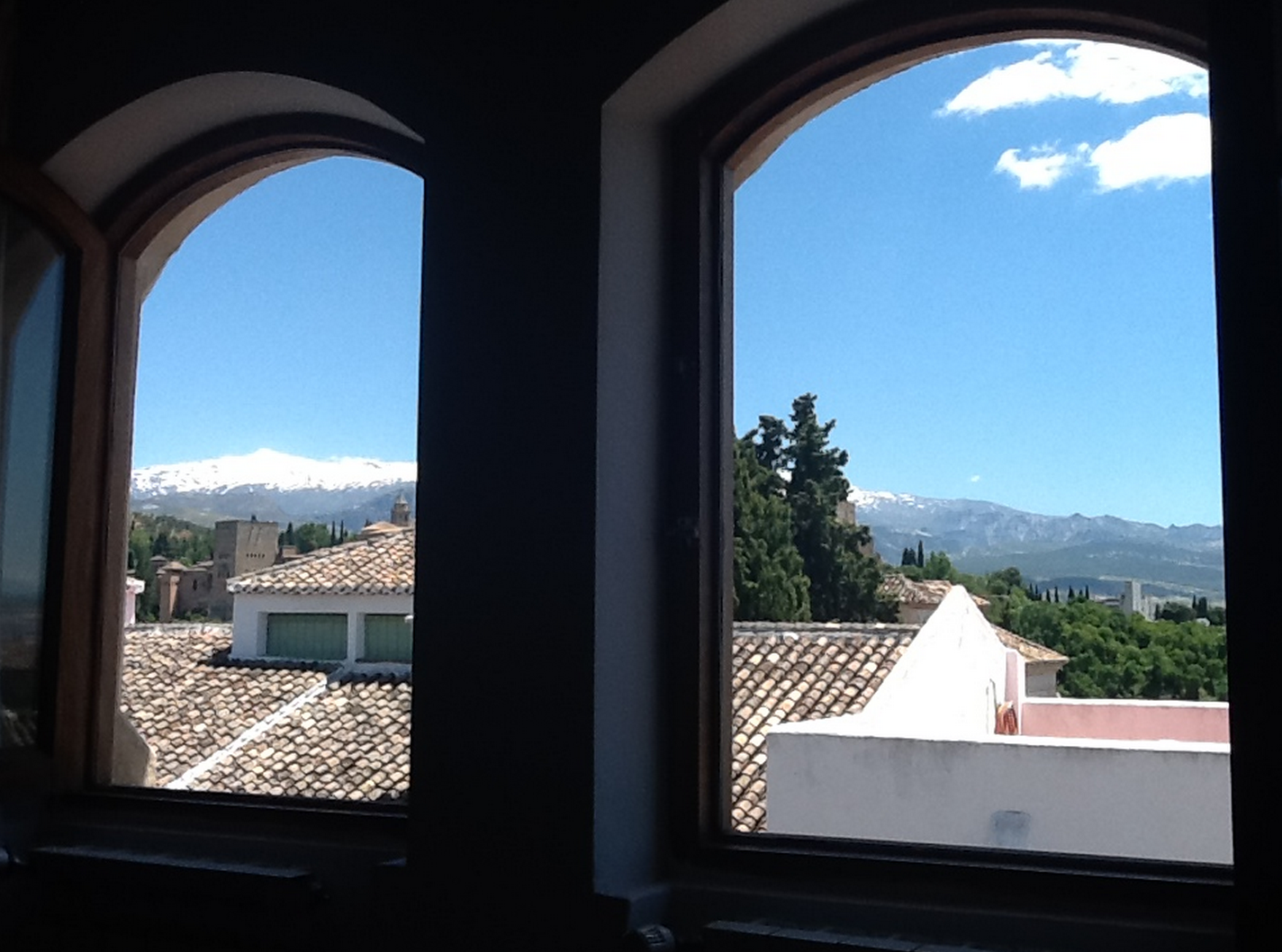
The View From Your Window Contest: Winner #156

Screen Shot 2013-06-01 at 5.07.26 AM

A reader writes:

This is hard, hard, hard. No street indications at all, just some Spanish-style roofs and a mountain top of snow. I immediately thought of South America (it’s winter down there) and for some reason, I came to Santiago, Chile. I could be wrong and this is from some northern campus of the California college system, but I don’t think so. We haven’t had any appreciable amount of rain in sometime, so there’s no large amount of snow on the mountains.

Where in Santiago? I have absolutely no idea. I’m sure I’ll lose to someone who knows Chile like I know parts of New Jersey and will be able to pinpoint that tower and the angle of mountain with ease. Next time, pick something that gives the rest of us a chance, huh?

Another:

Unlike last week’s contest, there’s nothing for me to immediately grasp onto beyond the mountain range and the architecture. I wish I knew what that orange thing in the next courtyard over (in the lower right corner of the frame) was because that’s probably a clue. It could South America or it could be Spain. I’m going to guess Santiago, Chile and be done with it.

Another:

I don’t have time to do in-depth searching, but a Google search for “red tiled roofs” and “mountain” let me to Cuzco, Peru, which looks awfully similar to the images in the photo.  A further search for hotels in the area found several with arched windows, but I’m going to guess: The Hotel Monasterio?

Another:

Well, it’s been 20 years since I’ve lived in the area, but I think this photo was taken from Laguna Niguel, California, looking away from the ocean toward the Saddleback Mountains.  I think that is Saddleback College off to the right, or I might have guessed Mission Viejo.

Another:

Not a lot of time to do any serious searching this weekend, so I’m gonna just throw out a guess: Flagstaff, Arizona, based on my very initial impression that the mountain range is the Sierra Nevadas. Of course, it could also be somewhere in the Pyrenees.

Another:

Looks like the Caucasus to me, and I think I can spot one of Georgia’s famous watchtowers through the left window. So I’m guessing it’s the town of Mestia in the Svaneti region of the Georgian Caucasus, where I once spent one of the best weeks of my life.

Another gets much closer:

I don’t have high hopes here, but feel I have at least identified the region.  This picture immediately screamed Italy.  (Of course last time the contest screamed Italy, it was France.)  So the roofs are distinctly reminiscent of wine country, the vegetation gives it away as not being California.  The mountains are either the Alps or Pyrenees, removing Tuscany.  Last time it was the Pyrenees, so I’m going Alps.  Piedmont gives roughly the same temperament to the mountains as shown here, and the village size is moderate, but not large enough for a city like Turin.  Susa was the lucky recipient of the mostly random guess based on region and city size.

Another gets the right country:

Okay, this seems like one of the easier ones.  The view screams Andalusia with the fortress-like church in the mid-view and snowcapped Sierra Nevada in the background. The tiled roofs are very Southern Spain, and the arched windows look like a modern nod to old Moorish architecture.  I’m going to say this is in Sevilla, a few miles from the city center.

Close. Another nails the right city:

The overall location is easy – this is Granada, Spain, looking SE to the Alhambra, with the Pico Veleta summit in the background (at over 11,000 ft, this is the second or third highest mountain in Spain if I remember my elementary school geography right).  The picture is taken from somewhere in the Albaicin or San Pedro areas, but I can’t figure out where.  Good to see my home region of Andalusia in the contest!

Another sends a visual of the city:
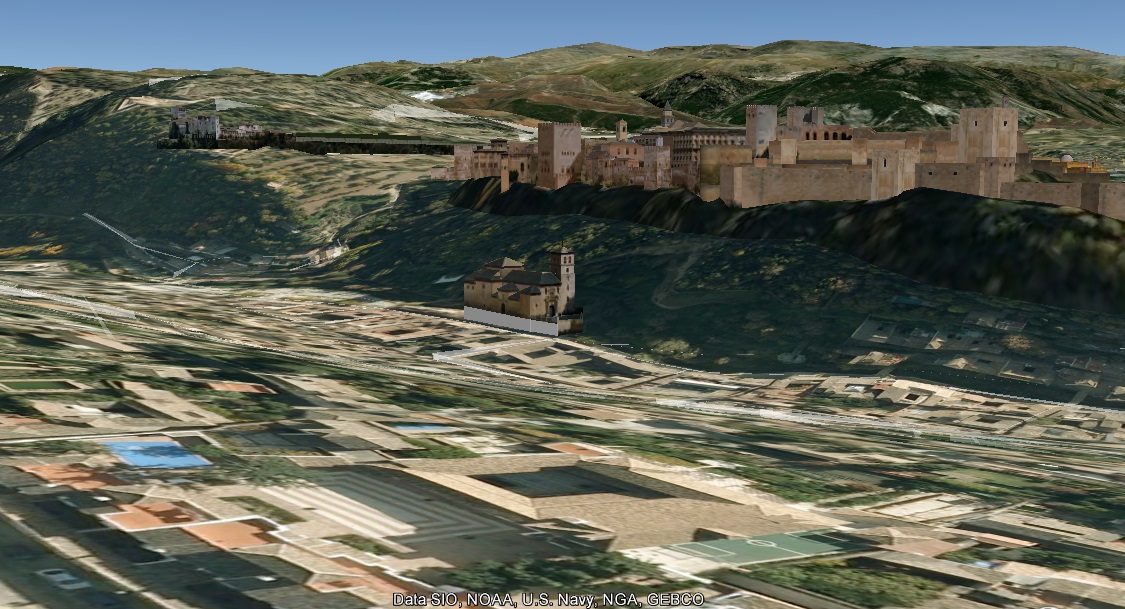
googlemapsgranada

Another reader:

I mistakenly went off down the monasteries and abbeys route first, before realizing it may be a castle. (It reminded me of the tower in The Name of the Rose, with Sean Connery – an oldie but a good movie…). After much searching, I found Alhambra. Aha! Depressingly, this looks like it’s going to be another easy one. Tours of Alhambra abound. It may be Palacio de Santa Ines, which gets pretty good reviews on Trip Advisor, but I’m not sure I have the angle quite right. I’ll guess 3rd floor, counting European style, 4th floor American-counting. My luck with guessing floors was good last week (I think I was one of the half-dozen that correctly guessed the seventh floor of the Sheraton Jiangyin Hotel).  Hopefully that luck will hold.  Two weeks in a row. Woot!

Another illustrates the right hotel:
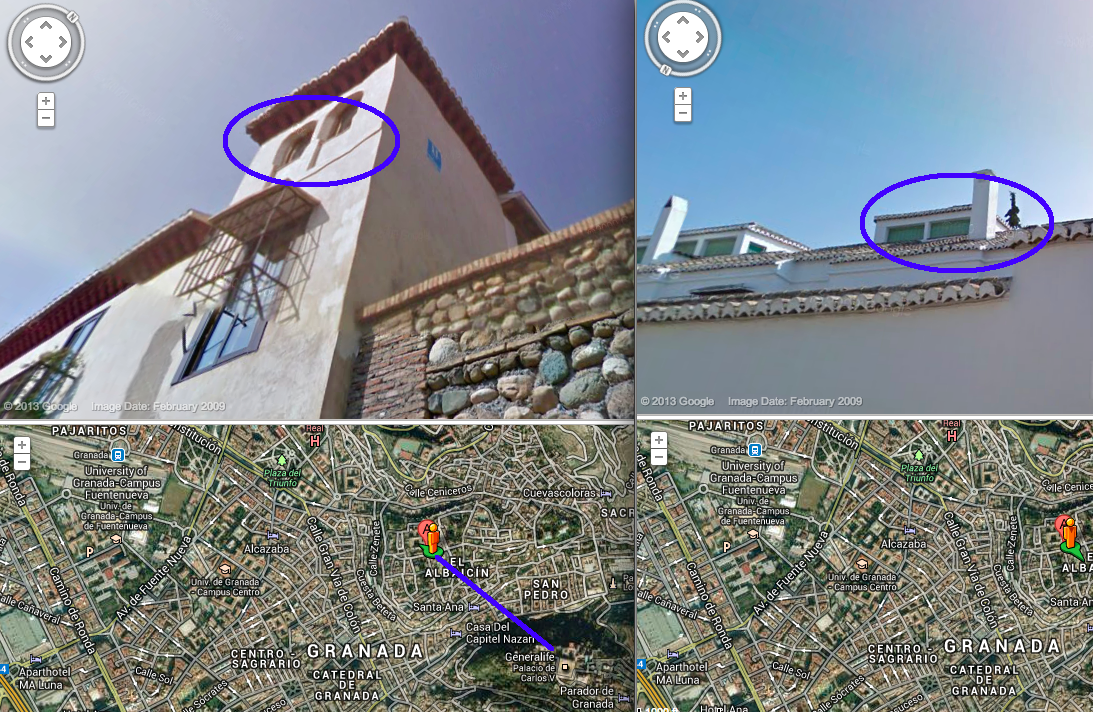
GranadaScreenshots

Another names the right hotel:

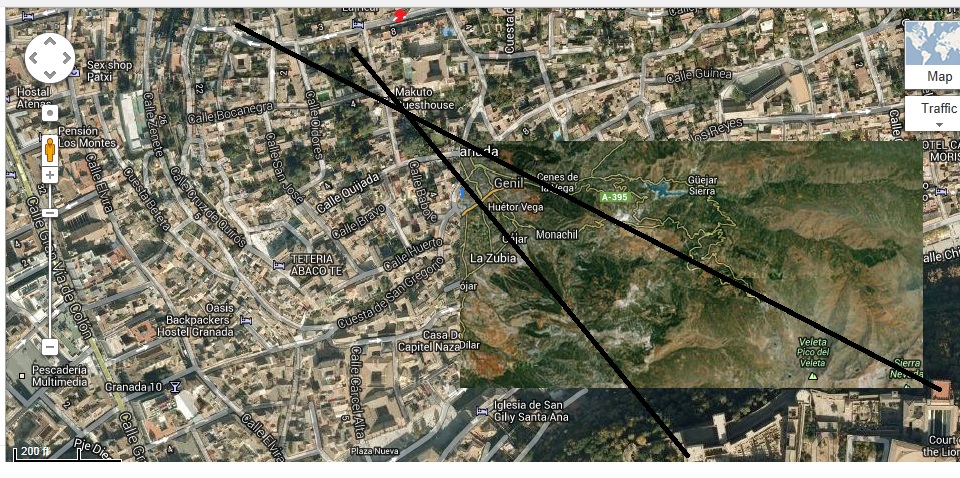
This is probably hopeless, because I expect about a zillion people to get this one.  The mountains in the background looked a lot like the Sierra Nevada of southern Spain (really living up to its name “snowy ridge” in the picture).  The towers not only looked reminiscent of the Alhambra, but are the Alhambra!  Just north of the Alhambra is a deep ravine, so the photo would have to be taken from the hill on the other side, in the neighborhood of El Albaicin.  The street level views on Google don’t provide any picturesque views of the palace and mountains, but I was able to determine the approximate location by noting that the main tower of the Nazarid Palace aligns with the highest mountain, and noting the approximate angle of the tower of the Generalife (on the right, partly behind the tree).  The triangulation lines are shown on the first attached picture (I didn’t get the location exactly right – the actual vantage point is shown in red):

granada-1

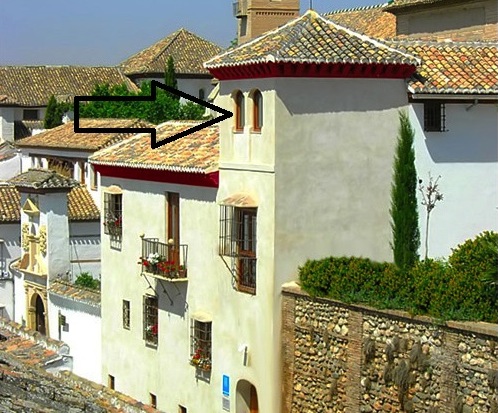
The next two photos show the Google street level views of the third floor room with the two round windows from which the contest photo was taken, and the buildings across the street, which matches the roof line shown in the picture.  The location is Hotel Santa Isabel La Real, Calle de Santa Isabel La Real, 15, 18010 Granada, Spain.

From the hotel’s web site come the final two photos, one with the viewing location indicated, and the second one a view from an adjacent room showing the same view as the contest photo (I’m sure the hotel’s owners are going to wonder why their site traffic just went way up!)

granada-6

Since I couldn’t win the contest with my last correct entry of Sacramento, I probably have no hope of winning one of Granada (interestingly, you can see the Sierra Nevada from both cities).  I have been to Granada twice, but not this hotel; once while I was in college, and a second time with my Spanish girlfriend.
Another:

So I’m sure you’ll get a billion correct answers from all your readers who have been to the Alhambra and I don’t have the patience to try to narrow it down to the exact room the pic was taken but I ‘m guessing in the Nicholas Square area. But I do have a story that might be of interest.

I arrived in Granada via train from Madrid on Sept 11, 2001. I went to an Internet cafe to check my email and saw an AOL headline about the attack on the World Trade Center but ignored it because I thought it was about the attack in 1993. So I went back to my hotel and then out for a drink at a local bar a couple hours later. There was a TV on and people were really intent on watching it. I glanced up and thought it was just some Spanish made-for-TV movie. It was only after a sip of beer that I realized what was happening. I met up in my hotel lobby with three groups of American travelers (complete strangers all) and the eight of us spent the evening together getting completely hammered. The next morning we planned an outing to see the Alhambra together and through booze-hazed eyes took in the magnificent monument to Moorish rule of southern Spain. The irony of being in the last bastion of Muslim rule and culture to fall in Europe was not lost on me on the occasion of the attacks on the WTC.

An aerial view of the hotel:

Overhead View from the Hotel Santa la Real

Another reader:

Once again, a great contest.  This one brought way too many memories of a trip I took to Granada seven years ago.  I was living in Sevilla at the time, I took a train trough Córdoba for the day, and an afternoon/overnight trip to Granada.  I made it just in time for the “candlelight tour” of the Alhambra and knew I had to come back for the day tour.  Thinking tourist season had passed, I made no accommodations so I had to sleep on different park benches until I took a taxi back to the Alhambra, where I slept on a bench until it opened again.  Sadly, I was alone and too shy to try so many things I was offered that night!

Of the dozen readers who correctly answered the Hotel Santa Isabel La Real, the following reader is the only one among them who has gotten a difficult view in the past without winning:

The picture is of the Alhambra in Granada with the Sierra Nevada in the background, taken from the Albaicin neighborhood.   It appears to be taken from the “torreon-mirador” tower-view room at the Hotel Santa Isabel la Real.  In the small picture of the room you can see the radiators below the windows, which can be seen faintly at the bottom of the VFYW photo. Also included is a street view of the same building seen in the foreground of the VFYW:

image[1]

FWIW, I’ve submitted two previous correct entries without winning (Madrid, Tirana), and had my own VFYW picture posted once.

Some parting words from a reader:

The poet Francisco de Icaza gave the city its most famous saying, addressed to a woman about to pass a blind beggar without giving him anything: “Dale limosna, mujer, que no hay en la vida nada como la pena de ser ciego en Granada.” (Give him alms, woman, for there is nothing sadder in life than being blind in Granada.)

(Archive)

Erdogan’s Turkey And Perry’s Texas

The strange parallels:

(a)  between Turkey’s AK Party and the Texas Republican Party—both of which combine a heavily pro-business unleash-the-market orientation (which helps explain why magazines like the Economist look so favorably on the AKP) and a fair amount of crony capitalism with often-intolerant cultural conservatism, moderately theocratic tendencies, uneasiness about the theory of evolution, and a culture-war mentality infused with deep resentment against the “elitism” of secular, cosmopolitan, big-city types who they think look down on them …

… and, specifically …

(b)  between Governor Rick Perry and Prime Minister Recep Tayyip Erdogan—both of whom combine a bullying tough-guy macho style with a tendency to shoot their mouths off and blurt out embarrassing and offensive statements … that draw unfavorable comments from outsiders and sometimes complicate life for their political colleagues, but don’t seem to bother their core supporters?

A Female Doctor Who?? Ctd

Laura Helmuth thinks it should be important even to those who don’t care about the show:

A female Doctor would go a long way toward making up for the show’s recent regression into tiresome Romana_(Doctor_Who)stereotyped sex roles.

The Doctor travels with human companions, usually one lovely young woman at a time.

As Ted Kissell writes at the Atlantic, the recent companions have been weaker and younger than the ones who accompanied the earlier Doctors.

Has Helmuth been watching the same show I have? Is Clara supposed to be weak? The woman in the photo, by the way, is the first female Time Lord in the series, Romana, in her first incarnation. Even the Times of London has weighed in:

The shift from male to female authority is difficult in politics and business but it is surely not beyond the capacity of the Doctor.

I’m cool as long as she isn’t called a Time Lady. And especially if they snag Helen Mirren. Alyssa Rosenberg argues a gender change is what the Doctor would want:

Wouldn’t he be curious, after all this time, to wonder what it’s like to occupy a woman’s body and to see what it’s like to live with a different set of gender roles (really, many different sets of gender roles)? Aren’t there some circumstances and societies where it might be more advantageous for the Doctor to be female or non-white? If the doctor was set up as an explicit exploration of masculinity, cycling him through all kinds of men’s bodies would make more sense, though it wouldn’t explain the Doctor’s continuing whiteness. But it’s not. And keeping the Doctor white and male over and over again is a contradiction to the show’s sense of wonder and exploration.

Previous Dish on the next Doctor here and here.

Roy Vey

Last week, Avik Roy, a former Romney healthcare policy advisor, wrote a post titled, “Rate Shock: In California, Obamacare To Increase Individual Health Insurance Premiums By 64-146%.” The post was picked up by large parts of the Republican blogosphere and has racked up over 1.2 million views in under a week. One part of Roy’s piece:

If you’re a 25 year old male non-smoker, buying insurance for yourself, the cheapest plan on Obamacare’s exchanges is the catastrophic plan, which costs an average of $184 a month. (By “average,” I mean the median monthly premium across California’s 19 insurance rating regions.) The next cheapest plan, the “bronze” comprehensive plan, costs $205 a month. But in 2013, on eHealthInsurance.com, the median cost of the five cheapest plans was only $92.

In other words, for the typical 25-year-old male non-smoking Californian, Obamacare will drive premiums up by between 100 and 123 percent.

Ezra Klein did the same searches Roy did. He found a plan for $109:

Click to buy the plan and eventually you’ll have to answer pages and pages of questions about your health history. Ever had cancer? How about an ulcer? How about a headache? Do you feel sad when it rains? When it doesn’t rain? Is there a history of cardiovascular disease in your family? Have you ever known anyone who had the flu? The actual cost of the plan will depend on how you answer those questions.

According to HealthCare.gov, 14 percent of people who try to buy that plan are turned away outright. Another 12 percent are told they’ll have to pay more than $109. So a quarter of the people who try to buy this insurance product for $109 a month are told they can’t. Those are the people who need insurance most — they are sick, or were sick, or are likely to get sick. So, again, is $109 really the price of this plan?

Ezra writes that Roy is not “just comparing apples to oranges,” he is “comparing apples to oranges that the fruit guy may not even let you buy.” Cohn piles on so bad you want to look away:

Insurance bids from eHealthInsurance are for new customers only. Insurers who sell to individuals—that is, insurers who sell in the “non-group market”—frequently raise rates dramatically, and unpredictably, because a particular group of customers have become too expensive to insure. In other words, if you buy on eHealthInsurance, you might get a reasonable rate the first year, only to experience eye-popping increases a year or two later. That won’t happen on the exchanges, because, under Obamacare, insurers can’t charge different prices to new and existing customers.

Roy responds to his critics:

The key thing to remember is that back when Obamacare was being debated in Congress, Democrats claimed that it was right-wing nonsense that premiums would go up under Obamacare. “What we know for sure,” Obamacare architect Jonathan Gruber told Ezra Klein in 2009, “is that [the bill] will lower the cost of buying non-group health insurance.” For sure.

In 2009, was Ezra saying that it’s ok that premiums will double for the average person, because a minority of people will pre-existing conditions will benefit? No.

I think it’s an unfair comparison to take the cheapest insurance program for the healthiest young adults today and compare it to rates in a system which is legally barred from discriminating in that way. So far, the universal rates seem to be coming in under expectations. We’ll see. Maybe there was some flim-flam about there being no trade-offs in Obamacare, especially for the young and healthy, back in 2009. But the real argument will take place when this is actually implemented. And it certainly won’t be fairly resolved by cherry-picking the cheapest plans now for the healthiest individuals and comparing them with predicted future costs.

The Dish will have our own experiment in buying Obamacare for our staff next year. We’ll keep you posted on what we find.

Ask Fareed Zakaria Anything: What’s Up In Turkey?

In our first video from Fareed, he explains why he’s not worried about the ongoing protests:

Henri J. Barkey points out that the country’s only opposition party is a mess:

[T]he Republican People’s Party, [or CHP,] is a party in name only. It has proven incapable of appealing to voters, organizing itself to contest elections; and, most importantly, offering alternative policies to the AKP. Instead, it is in a state of constant turmoil as cadres fight for spoils that can at best be described as crumbs. The hapless state of the opposition propels the demonstrators: people have found out that they cannot count on the opposition to fight for their rights. Hence, the only outlet they have is the street.

He also notes Erdogan’s increasing insularity:

Having surrounded himself with yes-men (and yes, they are all men), he has become a victim of groupthink.

His advisors only reinforce what he has already decided to do. This is not to say that he is always wrong; some of his calls have been gutsy and courageous—and if he listened to his advisors, he would have never risked taking them. The attempt to end the Kurdish uprising is one such bold move.

… When he has found himself in a tight spot, his superb political instincts have always helped him escape or allow him to pivot. …  But the crisis-management skills he’s displayed [in response to these protests] have been abysmal. Rather than defusing the situation, his public pronouncements have further inflamed passions. By blaming foreigners—the most standard Turkish defense mechanism—he has diminished himself. What is particularly worrisome is that by any stretch of the imagination, this was not a major crisis that endangered the very existence of his party or rule or threatened the well being of the republic. It was all about a shopping mall. Erdogan has now suffered a deep and self-inflicted wound.

Steven A. Cook offers explanations for Erdogan’s appeal as well as his paranoia:

Even today, as the tear gas continues to fly, there is no question that Erdogan would win an election. It is hard to see how the moribund opposition can capitalize on Erdogan’s missteps, and although AKP supporters may be watching developments with consternation, they are not ditching their membership cards. This is because, consistent with Erdogan’s record as mayor of Istanbul, he has done many things as prime minister to make the lives of Turks appreciably better. Advances in transportation, health care, and economic opportunity are profoundly important to a growing middle class who returns the favor in the form of votes.

Still, Turkey is decidedly split. Erdogan governs one half the country — his supporters — and intimidates the other. His political lineage and personal background have instilled within him a certain amount of paranoia. Turkey’s Islamists, no matter how powerful they become, are always on the lookout for the next coup or round of repression. (In 1998, for example, Erdogan was jailed for reciting a poem that was allegedly a call to holy war against the Turkish state even though the author is one of the most important theorists in Turkish nationalist pantheon.) For the rising new political and business class that Erdogan represents, correcting the past wrongs of the Kemalist elite — which discriminated and repressed the two bogeymen of the Turkish politics, Kurds and Islamists — has been a priority. They have worked to accomplish it through both democratic and (more often recently) non-democratic means.

Fareed Zakaria GPS airs Sundays on CNN, as well as via podcast.  Zakaria is also an Editor-at-Large of TIME Magazine, a Washington Post columnist, and the author of The Post-American WorldThe Future of Freedom, and From Wealth to Power: The Unusual Origins of America’s World Role. Our Ask Anything archive is here. Our previous coverage of the protests in Turkey is here.

How Do You Spell Glee In Urdu?

A Pakistani version of Glee, titled Taan – the Urdu word for “musical note” – is on the verge of becoming a reality:

The show revolves around the fictional Hayaat Haveli musical academy in Lahore. At its heart is a tension between a traditional music teacher and his younger rival, who trains budding pop stars, representing different faces of Pakistan. Among their pupils are the offspring of well-heeled bureaucrats and a talentless wannabe who dreams of becoming a Bollywood actress.

Some plotlines that differentiate it from its American counterpart:

One of the characters, Annie Masih is described as losing all her family in the 2009 attack on a Christian enclave in the town on Gojra, a real episode in which seven people were burned alive. Another storyline involves Fariduddin, a member of the Pakistan Taliban intent on blowing up the academy before he is eventually seduced by music.

Marya Hannun notes how the show plans on dealing with materials that might offend the country’s censors:

[A] love affair “between a Taliban extremist and a beautiful Christian girl” promises to give Rachel and Finn’s tortured romance a run for its money. And even more controversial is a planned storyline depicting a gay relationship.

The show’s creators have come up with creative ways to avoid angering authorities. Take the aforementioned plotline of two male lovers. “Let’s say in a certain scene, there are two boys talking to each other, they are not allowed to show their physical attachment to each other,” explains director Samar Raza, particularly since homosexuality is illegal in Pakistan. “So I bring a third character who says: ‘God designed Adam and Eve, not Adam and Steve.'” This third conservative character will theoretically enable Raza to discuss homosexuality while evading censorship.

Ahmadinejad’s Exit

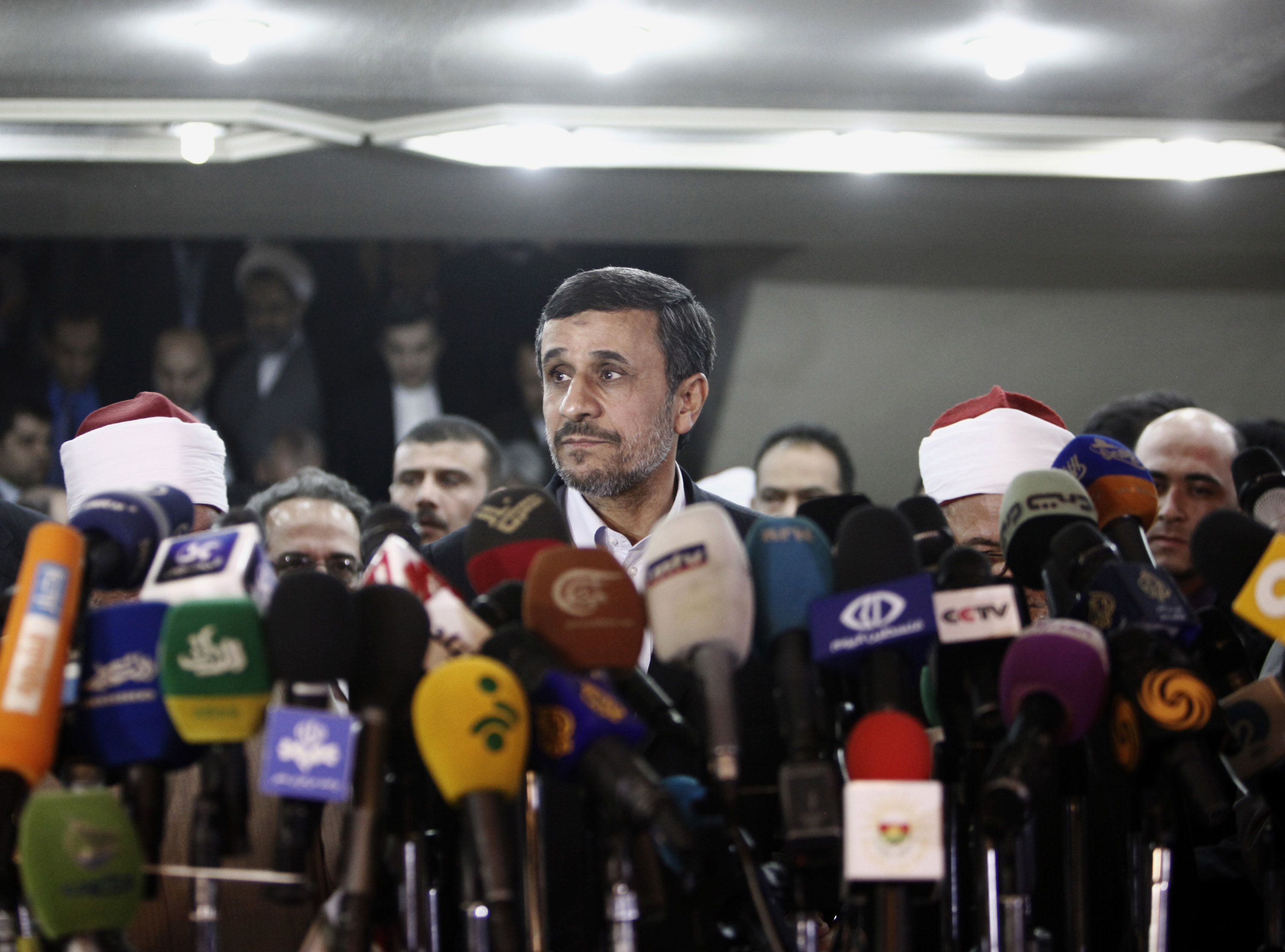
Mahmoud Ahmadinejad Arrives In Egypt On First State Visit In 30 Years

Cameron Abadi studies the outgoing president and his legacy in Iranian politics:

Ahmadinejad, canny populist that he is, soon began to privilege secular Iranian nationalism over fealty to Islam, and thumbed his nose at the Islamic establishment throughout his second term. He began calling explicitly for an “Iranian Islam,” a culture unembarrassed by Iran’s pre-Islamic grandeur. Rather than endorse the Islamic Republic’s traditional neglect of Nowruz—Iran’s traditional pre-Islamic New Year celebration, which was openly reviled by Ayatollah Khomeini—Ahmadinejad invited other heads of state to celebrate the occasion in Tehran. (Ayatollah Khamenei left town during the festivities.) He has offered repeated praise of Iran’s most celebrated pre-Islamic ruler, Cyrus the Great; suggested that men and women be allowed to attend soccer matches together; and openly attacked prominent clerics for their illicit accumulation of massive wealth. Meanwhile, Mashaei, his closest advisor, twice declared that Iran was not enemies with the Israeli people (forcing Khamenei to clarify that Iran and Israel are not “friends”).

All of this had an effect on the current elections:

Khamenei loyalists have labeled Mashaei a practitioner of “black magic” and attacked Ahmadinejad for “sinful” conduct (the latter for the crime of hugging Hugo Chavez’s mother at his funeral) and both Ahmadinejad and Mashaei have essentially been excommunicated from the political elite. The coming election seems certain to result in a president who has little inclination of challenging the primacy of the religious establishment. By the same measure, it seems unlikely to produce a president with any real connection to the Iranian people. Khamenei has even speculated that he might eventually abolish the presidency entirely. Having abandoned years ago any pretense to democracy, Iran’s regime may now be beginning to abandon any remaining claims to popular sovereignty.

(Photo: Iranian President Mahmoud Ahmadinejad speaks to the media during a press conference at the Al Ahzar headquarters on February 5, 2013, in Cairo, Egypt. President Ahmadinejad arrived in the Egyptian capital, becoming the first Iranian President to visit Egypt since the Iranian revolution in 1979. By Ed Giles/Getty Images)

Orwell On Censorship

The Believer has posted his 1945 essay “The Freedom of The Press,” originally composed as the preface to Animal Farm, with footnotes by John Reed. An excerpt from Orwell with Reed’s comment:

Obviously it is not desirable that a government department should have any power of censorship (except security censorship, which no one objects to in war time). But the chief danger to freedom of thought and speech at this moment is not the direct interference of the MOI [Ministry of Information] or any official body. If publishers and editors exert themselves to keep certain topics out of print, it is not because they are frightened of prosecution but because they are frightened of public opinion. In this country intellectual cowardice is the worst enemy a writer or journalist has to face.

That people were willing to live in a state of denial—ignoring war, ignoring injustice, ignoring tremendous threats to themselves and even the planet—continually amazed Orwell, and he struggled with the cartography of complacency. In a letter to a friend, he wrote, “In the face of terrifying dangers and golden political opportunities, people just keep on keeping on, in a sort of twilight sleep in which they are conscious of nothing except the daily round of work, family life, darts at the pub, exercising the dog, mowing the lawn, bringing home the beer, etc.” In “Notes on Nationalism,” Orwell marveled at “the lunatic habit of identifying oneself with large power units.”

And therein lies the answer to our twenty-first century state of denial. Our identities are under siege: advertising, education, the arts. We are built up and destroyed by lifestyles and categories (of race, of class, of culture) that exist primarily to contain, delimit, divide and exploit the human experience. If there’s anything you think you need to buy to be who you are—whether it’s curtains from Ikea or a CD or a book or liposuction or take-your-pick—you don’t own yourself.

Recent Dish on Orwell here, here, here and here. Recent Bukowski on censorship here.

Drowning In Student Debt

A discussion of student loan debt from a couple weeks back:

This embed is invalid


Without action from Congress, interest rates on federal Stafford loans will double (from 3.4% to 6.8%) on July 1st. Ned Resnikoff reviews the political playing field:

If this all sounds vaguely familiar, it’s because Washington had a similar fight last year. That was when Congress first extended the law which keeps student loan rates fixed at 3.4%, after President Obama made an issue of it during the 2012 campaign. Though that law did lighten students’ debt burden a bit, it did little to slow the years-long explosion in student debt. This year, total student debt passed the $1 trillion milestone.

Nancy Folbre worries about the implications of the increase in student indebtedness:

As Robert Kuttner explains… bailouts and bankruptcy proceedings both provide a means for businesses to get out from under bad debt. The obligations of a college loan, by contrast, “follow a borrower to the grave.” The rolling thunder of accumulating student debt sounds a lot like the perfect storm of mortgage liabilities that threatened major financial institutions and precipitated the Great Recession in 2007.

… Whether or not you call it a bubble, evidence shows something is likely to pop. Both delinquency and default rates have increased substantially since 2005. According to the Institute for Higher Education Policy, only a little more than a third of 1.8 million borrowers who entered repayment in 2005 repaid their student loans successfully without delay or delinquency for the first five years.

Meanwhile, Mandi Woodruff talks to Nicole Jackson, a Florida lawyer who has lost hope of ever repaying the debt she accumulated during law school:

She graduated in 1994 with more than $100,000 of debt. Within three years, she had one daughter, a surprise set of twins, and was earning less than $50,000 per year. “It’s always been a struggle,” she said. “I worked for the state of Florida most of my [career] and the most I was making was $50,000/year. With three kids, it wasn’t enough money.” …

“[My debt] is not going anywhere because I do not make enough money, not because I have just ignored it,” she said. Her private loans took top priority. The payments were only $130/month, but since private lenders don’t offer the same deferment options as federal, it was either pay or roll out the welcome mat for debt collectors. Meanwhile, her federal loans ballooned. With an 8% interest rate, they appreciated even after she consolidated, growing from a principal balance of about $80,000 in 1994 to $186,000 today. Other than her home and a car payment, it’s the only debt she carries to this day.

Shielding The Fourth Estate

Steve Coll argues that legislation that aims to protect journalists from “indiscriminate government subpoenas” is important, but only if done right:

[Current guidelines for federal prosecutors seeking evidence from journalists] are far from ideal—they have loopholes that give an Attorney General wide discretion. Yet they have often discouraged Justice from overreaching. The guidelines require that the Attorney General sign off on all media subpoenas, that any demands “be as narrowly drawn as possible,” and that, in all but the most exceptional cases, news organizations be notified of a subpoena, giving them time to appeal it in court. …

In the long run, to rebalance the national-security state and to otherwise revitalize American democracy, the United States requires a Supreme Court willing to deepen protections for investigative reporters, as the majority in Branzburg would not. In response to criticism about the A.P. case, Obama has reintroduced federal legislation that would clarify journalists’ rights. Such a federal “shield law” might be constructive, but new legislation with overly broad national-security exceptions would be even worse than the status quo.

Peter Sterne talks to the Society of Professional Journalists:

The proposed federal shield law before the Senate is even weaker than Colorado’s. It simply allows journalists to petition a judge, who weighs the story’s public interest value and decides whether the journalist should be forced to reveal his or her sources. The Society of Professional Journalists, which has been pushing for shield laws, said that something is better than nothing, but it nonetheless called for stronger protections.

Meanwhile, Dick Durbin equivocates on who should be protected by a federal shield law:

[H]ere is the bottom line – the media shield law, which I am prepared to support, and I know Sen. Graham supports, still leaves an unanswered question, which I have raised many times: What is a journalist today in 2013?

We know it’s someone that works for Fox or AP, but does it include a blogger? Does it include someone who is tweeting? Are these people journalists and entitled to constitutional protection. We need to ask 21st century questions about a provision that was written over 200 years ago.