Sarah Kliff talks to experts about the competitiveness between health insurers on Obamacare’s exchanges:
“I would characterize it as modest plan competition,” Caroline Pearson, vice president for health reform at Avalere Helath, said. “In most markets, there seems to be a bit more choice than what’s available in the market today. But we’re certainly not seeing a wild influx of plans into the market.”
Cohn claims that more insurers in isn’t neccesarily better:
[T]here’s such a thing as too much choice in health insurance. And it actually shouldn’t take more than a few plans to foster serious competition, particularly given all the other changes Obamacare is making. “It’s important not to lose sight of the obvious stuff,” says Larry Levitt, a senior vice president at the Kaiser Family Foundation. “This market will become much more competitive just because people will be able to compare prices (which they can’t now because of medical underwriting) and be guaranteed access.”
Yglesias explains why too much competitiveness in the exchanges could be bad:
With a lot of insurers in the field, what essentially happens is that market power shifts to the hospitals and other providers. Insurers need to “compete” to gain access to key providers, so providers can charge high prices that insurers then largely pass along to customers as high premiums. It seems to me that the optimal situation is to have a few insurers in the exchange so that competition plus Medical Loss Ratio regulations keep premiums reasonable, while ensuring that the insurers retain market power vis-à-vis providers and thus can act as bulk purchasing agents on behalf of patients. But how many is “a few”? Three? Four? I don’t know. But as states set exchanges up, this is something to think about.
I admire the season for its problem-solving skills, developing some intricate narrative structures that allowed them to make those limitations work in their favor on many occasions. I think one could look back on the season and observe a number of compelling choices that reflect a desire to create a new way of telling television stories (even if many of them proved unsuccessful). I appreciated returning to these characters, I’m glad that my $8 a month Netflix subscription gave me the ability to enjoy another season of a show I enjoy, and this in no way stains the series’ legacy in the way that some might have feared.
However, it’s also an experiment that didn’t work as often as it did. We admire experiments without fully embracing them, and there was never a point in the season where it felt like the show was fully comfortable in its own skin for more than an episode or two at a time. Taken as one larger story broken up into fifteen parts, the larger plot developments that string the various characters together are thin to the point of boredom, functional rather than funny; the election has no stakes, Michael’s movie becomes a background excuse for him to visit each member of his family, and the Cinco celebration is sketched in predictably enough to lose any of its convergent potential. And yet the season spent enough time developing these ideas that for the finale to pay none of them off seemed as though it left the puzzle unsolved, while simultaneously failing to provide enough points of interest to make me desperate to see the puzzle solved in the future.
Readers share their thoughts:
I’ve seen the first five episodes of Arrested Development Season 4, and I think in some ways it is even better than the first three.
It certainly seems to be more intricately plotted, and has at least as many subtle jokes per minute; I have no idea what Jace Lacob is talking about when he talks about a lack of finesse in this season. The mural at the end of episode one, while Ron Howard’s voiceover talks about Phoenix being Michael’s destiny, is pretty amazing (though I only caught it after someone mentioned it on a comment thread). The whole Google/privacy thread is fun. Rebel’s laughing when Michael says he knows Ron Howard is funny, but you don’t know why, because you don’t know that Isla Fisher’s character is Rebel at that point. The whole scene where Michael tries to get a copy of the inflight magazine from the guy at the airline counter is also priceless. I’m having a great time just recalling these scenes for this email!
I really have never seen anything so carefully plotted on TV. The closest I can think of is the 1960s comedy troupe The Firesign Theater, which did records that you had to listen to repeatedly, because they unspooled out of order – they’d do things like have one side of a phone conversation on one side of a record, with the other side of the conversation being on the other side of the record.
On the whole, I love season four. But as Jerry Garcia once said, when asked about the Grateful Dead’s lack of technical proficiency “You can’t please everyone.”
Another:
I binged on all the episodes yesterday, and I loved it. I immediately wanted to watch it again. It’s a matter of expectations. If you’re expecting a continuation of the first three seasons, everyone should know it’s not that. I went in thinking that it’s just the ice cream course after a hilarious meal of mayonegg and hot ham water. Many of the new episodes had us rolling on the floor laughing. The knee-jerk criticism was completely predictable. People view Arrested Development through rose-colored glasses. Some episodes of the original Fox series don’t even live up to the platonic ideal some people have crafted of “Arrested Development.”
After watching season 4, episode 15, Netflix cycled back to the pilot. It’s striking how different a show it is from season to season. Not better or worse, just different. For example, I actually love that season 4 doesn’t hold Michael Bluth up as a paragon in the way earlier seasons did. My recommendation: Watch the fourth season, then rewatch the show again. (Not redundant!) The beginning is just so bitter and acerbic that it’s jarring. The new episodes are softer. It’s a different feel, and that’s fine. I think it’s honestly done a little more lovingly, and all of the characters are treated with equal affection.
Remember that the thing is called Arrested Development. Their emotional development is still stunted, but 10 years have passed. They’re still immature, but now it manifests in new ways. It might take time for the audience to get used to it, but it’s still brilliant.
Another:
I’d like to tell the media critics to stop the hand-wringing and buy a damn Netflix subscription so there is monetary incentive for more Arrested Development. K thx.
A reader on the ground in Turkey shares his perspective:
I’m in Istanbul at the moment, and until this morning I was staying five minutes’ walk from Taksim Square. When I arrived there was tear gas everywhere, floating down the side-streets and punishing practically the entire Beyoglu neighbourhood. I can’t help but feel that this kind of collective punishment is doing plenty to turn people who would otherwise be content to sit aside against Tayyip Erdogan and his government. The protestors have been incredibly destructive to people’s property, especially down the main Isklidal street which is Istanbul’s main shopping avenue – but this hasn’t met with the kind of revulsion I saw a couple of years ago during the London riots, I think because the Istanbullos feel the protestors are defending rather than attacking the city. Whenever a crowd of protestors – who now wear gas masks as a badge of pride wherever they go – pass through town on their way to Taksim, ordinary, non-protesting people nevertheless stand up and applaud them as they go. There’s a quite diverse range of protestors – you have the usual anarchists and eco-warriors plus Kurdish nationalists, and I’ve even seen a couple of Hizbullah graffitos (though that’s probably just mischief-making) but on the whole it is just a range of ordinary people without any kind of political affiliation.
(Photo: Protestors clash with riot police near Turkish prime minister’s Recep Tayyip Erdogan office, between Taksim and Besiktas in Istanbul, on June 3, 2013, during a demonstration against the demolition of the park. By Gurcan Ozturk/Getty Images.
When it comes to Washington’s stance toward the increasingly authoritarian Erdogan government, Steven A. Cook and Michael Koplow point out the divide between hope and reality:
In the midst of the endless volley of teargas against protesters in Taksim, one of the prime minister’s advisors plaintively asked, “How can a government that received almost 50 percent of the vote be authoritarian?” This perfectly captures the more recent dynamic of Erdogan’s Turkey, where the government uses its growing margins of victory in elections to justify all sorts of actions that run up against large reservoirs of opposition. … Turkey’s anti-democratic turn has all taken place without much notice from the outside world. It was not just coercive measures — arrests, investigations, tax fines, and imprisonments — that Washington willfully overlooked in favor of a sunnier narrative about the “Turkish miracle.” Perhaps it is not as clear, but over the last decade the AKP has built an informal, powerful, coalition of party-affiliated businessmen and media outlets whose livelihoods depend on the political order that Erdogan is constructing. Those who resist do so at their own risk.
They argue that while the current protests will likely lead to much needed change for Turkey’s troubled democracy, the US must pursue a new approach as well:
Perhaps the Obama administration does not care about Turkey’s reversion or has deemed it better to counsel, cajole, and encourage Erdogan privately and through quiet acts of defiance like extending the term of Amb. Francis Ricciardone, who has gotten under the government’s skin over press freedom, for another year. This long game has not worked. It is time the White House realized that Erdogan’s rhetoric on democracy has far outstripped reality. Turkey has less to offer the Arab world than the Obama administration appears to think, and rather than just urging Arab governments to pay attention to the demands of their citizens, Washington might want to urge its friends in Ankara to do the same as well.
Claire Sadar distinguishes the Turkish protests from the movements that made up the Arab Spring:
Despite the fact that many are making the easy (and inaccurate) comparison between the Occupy Gezi movement and the protest movements that brought on the Arab Spring, in all likelyhood this movement will not birth a full out revolution. Unlike the Arab Spring countries, Turkey is a democracy. The importance of this cannot be overstated. … [T]he popularity of Erdogan and the AKP will certainly take a hit but when it comes down to the line, I am willing to bet that Turkey would rather go with the devil it knows (and elected) over the devil it doesn’t know. However, Erdogan’s ability to guide the creation of a new constitution, already compromised, is likely lost and with it his dream of becoming Turkey’s first American style president.
David Gardner stresses [FT] the increasing self-isolation among the AKP:
Part of this drama is the paradox that Mr Erdogan and the AKP, politically paramount but paranoid about plots against them, behave as though they were still the opposition – with the difference that the feedback loop of this normally well-oiled political machine has been short-circuited by sycophants. Before first winning power in October 2002, the AKP spent 22 months interviewing in depth 41,000 people across the country. Now, even allies admit, Mr Erdogan listens mostly to himself.
The Dish’s coverage of Turkey from over the weekend here, here and here.
(Photo: A man walks by makeshift barricades near Turkish prime minister Recep Tayyip Erdogan’s office on June 3, 2013 in Istanbul, Turkey. By Uriel Sinai/Getty Images)
Sixty-eight percent of Americans say the United States should not use military action in Syria to attempt to end the civil war there if diplomatic and economic efforts fail, while 24% would favor U.S. military involvement.
More to the point, 64 percent of Republicans oppose war there. This is a rare issue which unites far right, center and left. (There is no “right” in the US right now – just pseudo-conservative extremists). Allahpundit adds more context:
The -44 split on intervention is, I believe, the widest gap in any poll taken on this subject, a sign perhaps that the public’s trending away from action in Syria as the McCain-ians beat the Do Something drum more loudly. If you look at the numbers over time at Polling Report, though, you’ll see that when pollsters mention Assad using chemical weapons, the numbers look different.
A Pew poll taken last month found a 45/31 split on whether the U.S. should act militarily if chemical attacks by the regime are confirmed; two weeks ago, CNN got a 66/30 split on basically the same question. There are news reports published as recently as yesterday that Assad’s begun to use chemical weapons more frequently due to the west’s inaction over previous attacks. If Obama does end up deciding that it’s time for a no-fly zone, expect him to hammer the WMD point heavily as a way of building popular support. Realistically, it’s the only way he can sell intervention to the public.
The use of chemical weapons is, of course, horrifying. But the only way in which it affects the US directly is if the weapons eventually arrive here. And the fastest way to achieve that is to take sides in a war that is part of a regional Sunni-Shia conflict in which, in my opinion, the US should have no interest at all. These are forces we cannot fully understand, let alone control. We cannot be callous, but we have to be realistic. And the only realistic policy is to stay the fuck away. That’s why, as Larison argues, the Rand Paul foreign policy may begin to have the power to undermine the war-mongers in the GOP camp:
Even among Republicans, support for military action is an anemic 31%. When the Menendez-Corker bill approving funding for arming the Syrian opposition came up for a vote in committee earlier this month, Paul was the only Republican to vote against the bill, and to date he has been the only member of his party in the Senate to reject any greater U.S. involvement in the conflict. At the moment, he appears to be the only Republican in the Senate taking the side in the Syria debate that is favored by the vast majority of Americans and most Republicans. He is betting that his dissents from the party’s reflexive hawkishness are some of what will appeal to most Americans, and that “muscular positions” on foreign policy are exactly what most of us want Republican politicians to abandon.
Bill Maher compares marijuana legalization to marriage equality:
Meanwhile, Colorado is making progress on regulations for legal marijuana:
The regulations in House Bill 1317 would require marijuana retail outlets to license with the state and for the first nine months, only currently operating medical marijuana dispensaries can apply. Owners must also be Colorado residents. Initially, these stores must sell marijuana that they cultivated themselves, but by October 2014 this restriction will be lifted to allow independent growers and retail outlets. State residents will be able to purchase up to one ounce of usable marijuana at a time, while out of state visitors will be capped at one quarter ounce per purchase. Possession of up to one ounce of marijuana would be legalized for everyone over the age of 21, regardless of residency.
Washington state is also figuring out regulatory details:
Licenses will be handed out in three main categories—producer, processor and retailer—for a fee of $1,000. High, say some. Retail outlets will be limited and marijuana may only be grown in secure, indoor facilities. Background checks for the licenses, including fingerprinting, will aim to weed out unsavoury types. Residency and record-keeping requirements are designed to keep the pot business in-state.
Some of the draft rules seem draconian, but it is important that Washington get this right. Congress is closely watching state experiments with pot legalisation, the success of which would blunt criticism from moralistic lawmakers.
One early consequence of legalized marijuana in Washington? The drugs dogs need to be retrained.
I have to agree with Doug Mataconis; why does Congress need to be involved here? Moreover, how many people upon hearing the word “Redskin” conjure up negative stereotypical images of Native Americans? I’d have to think maybe 1 out of 10 thinks of Native Americans instead of football players.
But where would this political correctness end? Are the Atlanta Braves next? What about the Florida State Seminoles? Does it matter that the Seminole Tribe of Florida wants the college to keep the mascot? Or how about this one: I went to the College of the Holy Cross and we are called “The Crusaders?” Any members of Congress calling for us to change our name given what went on during the Crusades?
Words have meaning, and over time those meanings change. Why can’t the stigma be removed from a word as society matures and learns to use words for purposes other than demeaning others?
Another has a very different perspective:
Being a Comanche and Caddo Indian from Oklahoma, I have much gratitude for the actions of Tom Cole and the other members of Congress. They are doing one of the most important duties our elected representatives have: being a voice for their constituents, even those who don’t wield much political or economic power.
Unfortunately, Doug Mataconis is right.
The Washington NFL team will never get rid of their mascot unless there is a monetary detriment to not doing so. Making money on the backs of a voiceless minority is prevalent and acceptable in American society. However, this IS something that Congress has the right and even moral imperative to pursue. The government has always placed monetary incentives and detriments to businesses so that they might more align with the pervading government philosophy. It may not have an effect in the short run, but it begins the “bending of the arc of history” that eventually can lead to real change. Mataconis’ allusion to this being a “private business matter” is the same argument private businesses used to not serve any black patrons. It’s a wrong-headed and antiquated, if not racist, school of thought.
Only an ultra-elite athlete taking a stand to not play for a team with a disparaging mascot would make any waves with these owners. I fantasized that Sam Bradford (1/16th Cherokee), who was the #1 pick in the 2010 NFL Draft, would publicly take a stand and speak out against the Washington Redskins and the Kansas City Chiefs. Both those teams would mostly likely have chosen Bradford had they had the chance (they chose fourth and fifth in that draft, respectively). Until something like that happens, it’s up to our government to do the right thing.
Manjoo touts Karma, a mobile hotspot device. Its main advantage:
Karma charges $14 for 1GB of broadband, which is enough for a few days of heavy Web surfing (or several hours if you’re watching videos or streaming music). Karma’s plan has two major advantages over pay-as-you-go data services offered by large carriers.
First, Karma’s coverage doesn’t expire every month. For instance, my Verizon iPad’s 1GB plan resets every month—if I only use half of my gig, I lose the rest on the first of the month. Karma’s plan never resets. You can pay $14 and use your gigabyte over as long a time as you like—you can use 500 MB in June, nothing in July and August, and then 500 MB in September, and you’ll still have spent only $14 for access.
The second selling point:
Every Karma hotspot is “open”—that is, if you turn it on in an airport or coffee shop, other people can connect to it and begin surfing the Web. But get this: When they connect, they don’t use “your” data. Instead, when a new Karma user joins your hotspot for the first time, you and that user each get 100MB of free data access. The more people that you bring to Karma, the more free data you get.
In the last half-century, baby-naming has become more susceptible to trendiness:
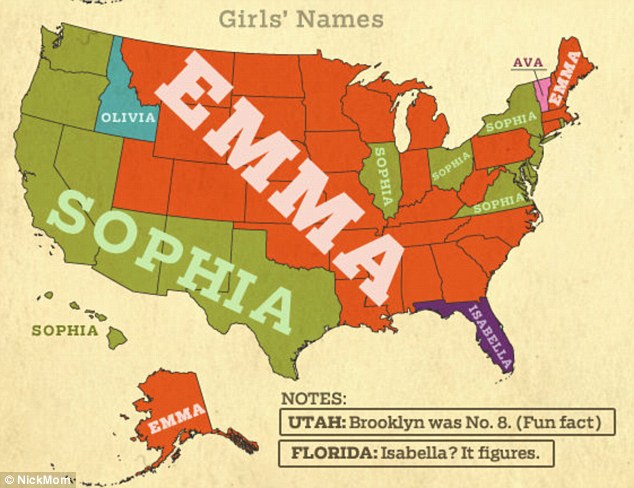
Last year, a total of 20,791 Emmas were born in the United States. The size of that cohort was only surpassed by the 22,158 Sophias added to the US population in 2012. Together, both names came out on top in 47 of the 50 states. …
Considering the top names for girls per state, we see two distinct blocks emerging: Sophialand is anchored on the West Coast, with 7 of its 16 states forming a contiguous territory, from Washington State all the way down to Texas. Its giant next-door neighbour Emmaland occupies a gigantic swathe of land across the west, ranging unimpeded into Pennsylvania. A few mutual enclaves and exclaves complicate the situation in the Midwestern to Northeastern area: there are four Sophia-enclaves (Illinois, Ohio, Rhode Island and a complex of 5 contiguous states: New York, New Jersey, Delaware, Maryland and Virginia). All the Emma states are contiguous, except for Emmaland’s New England province: Maine, New Hampshire, Massachusetts, and Connecticut. The US’s two non-contiguous states each declare for either of the main nations: Alaska is Emmaland, Hawaii is Sophialand.
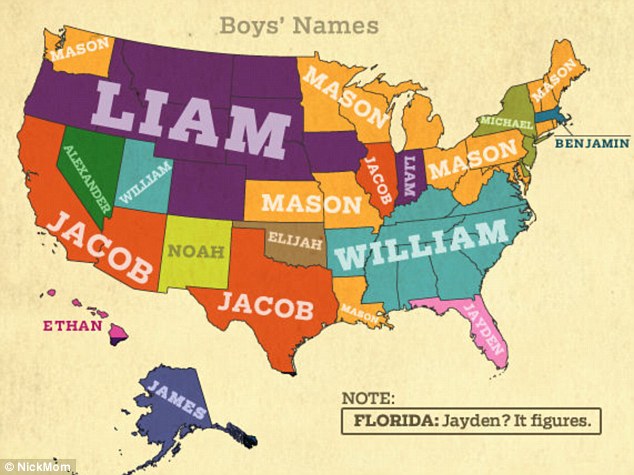
Frank Jacobs notes that the boy version of the map is “much more fragmented: 11 names circulate as states favourites, instead of only 5 on the girls’ side” – as seen below:
Rodge Glass pens an introduction to the emerging genre of climate fiction, or “cli-fi” – a sub-genre of sci-fi:
Engaging with this subject in fiction increases debate about the issue; finely constructed, intricate narratives help us broaden our understanding and explore imagined futures, encouraging us to think about the kind of world we want to live in. This can often seem difficult in our 24‑hour news-on-loop society where the consequences of climate change may appear to be everywhere, but intelligent discussion of it often seems to be nowhere. Also, as the crime genre can provide the dirty thrill of, say, reading about a gruesome fictional murder set on a street the reader recognises, the best cli-fi novels allow us to be briefly but intensely frightened: climate chaos is closer, more immediate, hovering over our shoulder like that murderer wielding his knife. Outside of the narrative of a novel the issue can seem fractured, incoherent, even distant. As Gregory Norminton puts it in his introduction to an anthology on the subject, Beacons: Stories for Our Not-So-Distant Future: “Global warming is a predicament, not a story. Narrative only comes in our response to that predicament.” Which is as good an argument as any for engaging with those stories.
Some places to begin for the intrigued:
Whereas 10 or 20 years ago it would have been difficult to identify even a handful of books that fell under this banner, there is now a growing corpus of novels setting out to warn readers of possible environmental nightmares to come. Barbara Kingsolver’s Flight Behaviour, the story of a forest valley filled with an apparent lake of fire, is shortlisted for the 2013 Women’s prize for fiction. Meanwhile, there’s Nathaniel Rich’s Odds Against Tomorrow, set in a future New York, about a mathematician who deals in worst-case scenarios. In Liz Jensen’s 2009 eco-thriller The Rapture, summer temperatures are asphyxiating and Armageddon is near; her most recent book, The Uninvited, features uncanny warnings from a desperate future. Perhaps the most high-profile cli-fi author is Margaret Atwood, whose 2009 The Year of the Floodfeatures survivors of a biological catastrophe also central to her 2003 novel Oryx and Crake, a book Atwood sometimes preferred to call “speculative fiction”.


 The Dish