According to Raymond Tallis, in defense of metaphysics:
In 2010 Stephen Hawking, in The Grand Design, announced that philosophy was “dead” because it had “not kept up with modern developments in science, particularly physics”. He was not referring to ethics, political theory or aesthetics. He meant metaphysics, the branch of philosophy that aspires to the most general understanding of nature – of space and time, the fundamental stuff of the world. If philosophers really wanted to make progress, they should abandon their armchairs and their subtle arguments, wise up to maths and listen to the physicists. …
But there could not be a worse time for philosophers to surrender the baton of metaphysical inquiry to physicists.
Fundamental physics is in a metaphysical mess and needs help. The attempt to reconcile its two big theories, general relativity and quantum mechanics, has stalled for nearly 40 years. Endeavours to unite them, such as string theory, are mathematically ingenious but incomprehensible even to many who work with them. This is well known. A better-kept secret is that at the heart of quantum mechanics is a disturbing paradox – the so-called measurement problem, arising ultimately out of the Uncertainty Principle – which apparently demonstrates that the very measurements that have established and confirmed quantum theory should be impossible. Oxford philosopher of physics David Wallace has argued that this threatens to make quantum mechanics incoherent which can be remedied only by vastly multiplying worlds. …
The dismissive “Just shut up and calculate!” to those who are dissatisfied with the incomprehensibility of the physicists’ picture of the universe is simply inadequate. “It is time” physicist Neil Turok has said, “to connect our science to our humanity, and in doing so to raise the sights of both”. This sounds like a job for a philosophy not yet dead.
Previous Dish on various approaches to metaphysics here, here and here.
George Packer recently wrote a piece in the New Yorker on the political culture of Silicon Valley in which he worried about inequality created by technological advances. After getting some pushback, he clarifies his main argument:
My analysis of the Valley’s politics isn’t about left-right in the usual sense. It’s about a particular brand of utopianism that sees solutions for social and political problems in the industry’s products and attitudes. There’s an example of this in what [author Steven] Johnson, in “Future Perfect,” calls “peer progressivism” (also mentioned in the piece). I am skeptical that Kickstarter and Airbnb provide models for solving more than superficial problems. I’m even more skeptical after reading Johnson’s argument that Silicon Valley is fighting back against inequality by creating large numbers of millionaires and distributing profits to its workforce in a relatively equitable way.
This is pretty much my point: life inside Silicon Valley can be a paradise (for its winners) of opportunity and reward. Meanwhile, life outside falls further and further behind. All those highly paid engineers, with their generous stock options and unheard-of buying power, aren’t making the Valley more equal—they’re making it less so. And their success isn’t extending very far into the rest of the economy. Unless everyone becomes a software engineer—a proposal that was floated to me by several tech people, in one form or another—egalitarian stock plans are not an answer to the deepest structural problems in America.
Over the long run, technology creates jobs we never even knew existed. The nonprofit Samasource farms out manual data-entry work to refugees in the bleakest war-torn areas on earth. Car-ride sharing service, Lyft, is giving steady income to San Francisco’s unemployed college grads. And Google’s new WiFi-network in sub-Saharan Africa will bring opportunity to the poorest of the poor. Technologists, however, must face the reality that their innovations create financial inequality. Building the technical infrastructure for entire industries or automating jobs inevitably benefits the designers in far greater proportion.
But, in many respects, equality is a lazy measure of social welfare. If certain political interest groups stall innovation, we may be all equally worse off. Instead, judge Silicon Valley by the free time, wellness, and educational value it creates for all of us. By those measures, the Internet economy is a welcome part of society.
After absorbing the above debate on the complicated subject, Jordan Bloom concludes:
Abortion is the issue that most complicates Reason’s narrative that libertarianism, defined as social permissiveness and fiscal restraint, is on the rise, for two reasons. One, Americans are not moving towards the pro-choice position with nearly the speed they are on other issues, and there’s considerable evidence they’re moving the opposite way. For another, that definition of libertarianism assumes a neutral deference to science’s ability to define questions like viability, and government’s ability to police them, and that libertarian ideas about non-agression end at the womb.
For many libertarians this is unsatisfying, I’d suggest far more than the one-third that Nick Gillespie throws out for the number that are pro-life. And not just because they have incidental traditionalist views, but because the right to life is integral to their understanding of liberty.
At P.A.U.L.Fest in Tampa last year I watched Walter Block—no natural rights slouch, him—give a speech on his theory of a woman’s right to evict a fetus but not kill it, citing competing rights to autonomy and life. This is an old debate, and Block has been trying to square the circle with his “evictionism” idea for some time, but until the invention of artificial wombs it’s entirely theoretical. In Tampa, he was booed for even explaining it. Urbane libertarians often think of the Paulista contingent as the “swivel-eyed loons” of libertarianism, but the rift is bigger than they admit.
Previous Dish on libertarian trends and abortion here.
Walter White is in a long tradition of meth-monsters. Fabienne Hurst traces the drug’s origins to the Third Reich:
When the then-Berlin-based drug maker Temmler Werke launched its methamphetamine compound onto the market in 1938, high-ranking army physiologist Otto Ranke saw in it a true miracle drug that could keep tired pilots alert and an entire army euphoric. It was the ideal war drug. … From that point on, the Wehrmacht, Germany’s World War II army, distributed millions of the tablets to soldiers on the front, who soon dubbed the stimulant “Panzerschokolade” (“tank chocolate”). British newspapers reported that German soldiers were using a “miracle pill.” But for many soldiers, the miracle became a nightmare.
As enticing as the drug was, its long-term effects on the human body were just as devastating. Short rest periods weren’t enough to make up for long stretches of wakefulness, and the soldiers quickly became addicted to the stimulant. And with addiction came sweating, dizziness, depression and hallucinations. There were soldiers who died of heart failure and others who shot themselves during psychotic phases. Some doctors took a skeptical view of the drug in light of these side effects. Even Leonardo Conti, the Third Reich’s top health official, wanted to limit use of the drug, but was ultimately unsuccessful.
Update from a reader:
Uppers in various forms were used in many societies well before the Nazis came to power and every military in World War II used speed.
Marisa A. Miller, a director at the National Institute of Allergy and Infectious Diseases, a unit of the U.S. Department of Health and Human Services, estimated in an article in “The American Drug Scene,” a 2004 book, that during World War II roughly 200 million amphetamine pills were given to American troops. Both the U.S. and British military studied the use of uppers on troops during the 1940s, ’50s and ’60s. “All of the important combatant nations in World War II used these drugs judiciously in aviation, especially during prolonged and hazardous bombing missions.” wrote Dr. Maurice H. Seevers, a pharmacology professor at the University of Michigan Medical School, in “Amphetamine Abuse,” a 1968 book.
During World War II, Japan’s pharmaceutical industry produced millions of doses of meth which were used by the military and civilians who were supporting the military in manufacturing and other similar industries. When Japan surrendered in 1945, those drug companies simply dumped their remaining product on the market. “After the war, the contract for a large amount of methamphetamine which had been stored by pharmaceutical companies for military use was canceled,” according to one study by a Japanese researcher in “Use and Abuse of Amphetamine and Its Substitutes,” a 1980 book. “The companies tried to sell these stocks on the open market by advertising the drug as one that would inspire the fighting spirits in daily life.”
The first man-made, amphetamine-like substances were reported by a chemist in Germany in 1887, according to “The Amphetamines: Their Actions and Uses,” a 1958 book by Chauncey D. Leake, a professor of pharmacology at Ohio State University. A Japanese chemist, identified only as A. Ogata in studies, first synthesized methamphetamine in 1919.
The Nazis did not create meth. It’s an awful drug, but this argument that says meth is bad because the Nazis made is both wrong and dumb.
Earlier this week, ten members of Congress sent a letter to the front office of the Washington Redskins, pushing them to select a new mascot:
In this day and age, it is imperative that you uphold your moral responsibility to disavow the usage of racial slurs. The usage of the “R-word” is especially harmful to Native American youth, tending to lower their sense of dignity and self-esteem. It also diminishes feelings of community worth among the Native American tribes and dampens the aspirations of their people. We look forward to working with you to find a solution to this important matter.
Their idea of a solution is a bill that would amend the 1946 Trademark Act to cancel any trademark that uses the term “redskin”. Pat Garofalo figures such federal intervention may be the only way the change will happen:
For precedent, it’s worth revisiting what led Washington’s football franchise to integrate. Then-owner George Preston Marshall was perfectly content to play up the team’s racist history, leaving it the last segregated squad in the league. He finally relented in 1962, not because of any change of heart, but after the John F. Kennedy administration threatened to refuse the team access to what is now called RFK Stadium, which was on federal land, unless it integrated.
Doug Mataconis disagrees with the liberal lawmakers’ strategy:
I have to wonder why this is something that Members of Congress need to be getting involved in, or why legislation is necessary to address something that is, in the end, a private business matter.
The people who don’t like the name are free to protest it. Dan Snyder and the rest of Redskins ownership are free to reject their pleas. If there ever comes a time when the public sympathizes with the protesters, then perhaps the team will feel the kind of economic pressure most likely to cause them to change positions, then we’ll likely see a name change of some kind.
Personally, I think the odds of that happening are pretty remote. The Redskins name has been in existence now since 1933 when the football version of the Boston Braves changed its name to Boston Redskins before moving to Washington, D.C. several years later. We’re not that far away from the 100th anniversary of that name. It’s going to be around for a long time to come, and I’m just fine with that.
(Photo: Fans of the Washington Redskins cheer against the Dallas Cowboys at FedExField on December 30, 2012 in Landover, Maryland. The Redskins defeated the Cowboys 28-18. By Larry French/Getty Images)
Suspicion is mounting over government interference in the now stalled Chilcot Inquiry exploring the former prime minister’s role in hyping the Iraqi threat in 2002:
The central allegation against Mr Blair is that he gave a private assurance in early 2002 to President Bush that Britain would join the United States in an invasion of Iraq. Thereafter, it is said, all was decided. Even though Mr Blair later highlighted Saddam Hussein’s alleged weapons of mass destruction, and misrepresented what he was being told by the intelligence services to the House of Commons, it was of little significance to him, because the die had been cast anyhow.
Hence the central importance of access to those conversations. They are likely to cast much-needed light on whether or not the allegations that the prime minister struck a private deal with the president are true. Yet, amazingly, the Chilcot Inquiry’s website states that it has “not yet” even “begun its dialogue” with government over the treatment of these Blair/Bush conversations.
David Owen, former foreign secretary, has launched an attack, accusing Blair and Cameron of a secret deal to prevent the truth coming out:
Speaking at a public meeting, Lord Owen said that the inquiry “is being prevented from revealing extracts that they believe relevant from exchanges between President Bush and Prime Minister Blair”. The culprits, he said, are Tony Blair and David Cameron: “Publication of the Bush extracts would not be blocked if Tony Blair had not objected, nor if that objection had not been supported by the present prime minister, David Cameron. Both men are hiding behind conventions that are totally inappropriate given the nature of the inquiry.”
I agree. It is of critical importance in a democracy that a declaration of war – the gravest decision a leader has to make – is made transparently, that the case be built on facts, and that the process of deliberation is a real one – and not effectively a farce because of a secret deal to go to war regardless of the arguments. If people cannot trust their own governments to be open and truthful on these matters, then the entire democratic project is in jeopardy. Massie, always worth reading, nonetheless sticks up for Blair:
The war may have proved a grievous blunder and those who opposed it look more prescient (in some ways) than those who backed it. But later mistakes – including, of course, the failure to find WMD – do not actually mean the argument for “dealing” with Saddam Hussein was based upon arguments that were known to be untrue at the time they were being made.
And so, what is the point of “revealing” these conversations [between Bush and Blair]? What, indeed, is the point of the Chilcot Inquiry? Who can it satisfy or whose mind can it possibly change? Some people will not be persuaded because they cannot be persuaded.
If there’s an irony here it is that there were people a decade ago who took any suggestion Saddam might not have active WMD programmes as evidence of Saddam’s utter deviousness. It was proof he could not be trusted and therefore, perversely, evidence he was up to no good. Ten years later we see the same thing: the absence of evidence against Blair is proof of the former Prime Minister’s cunning. He must have been up to something, otherwise why the need for secrecy? And so down the rabbit hole we merrily go.
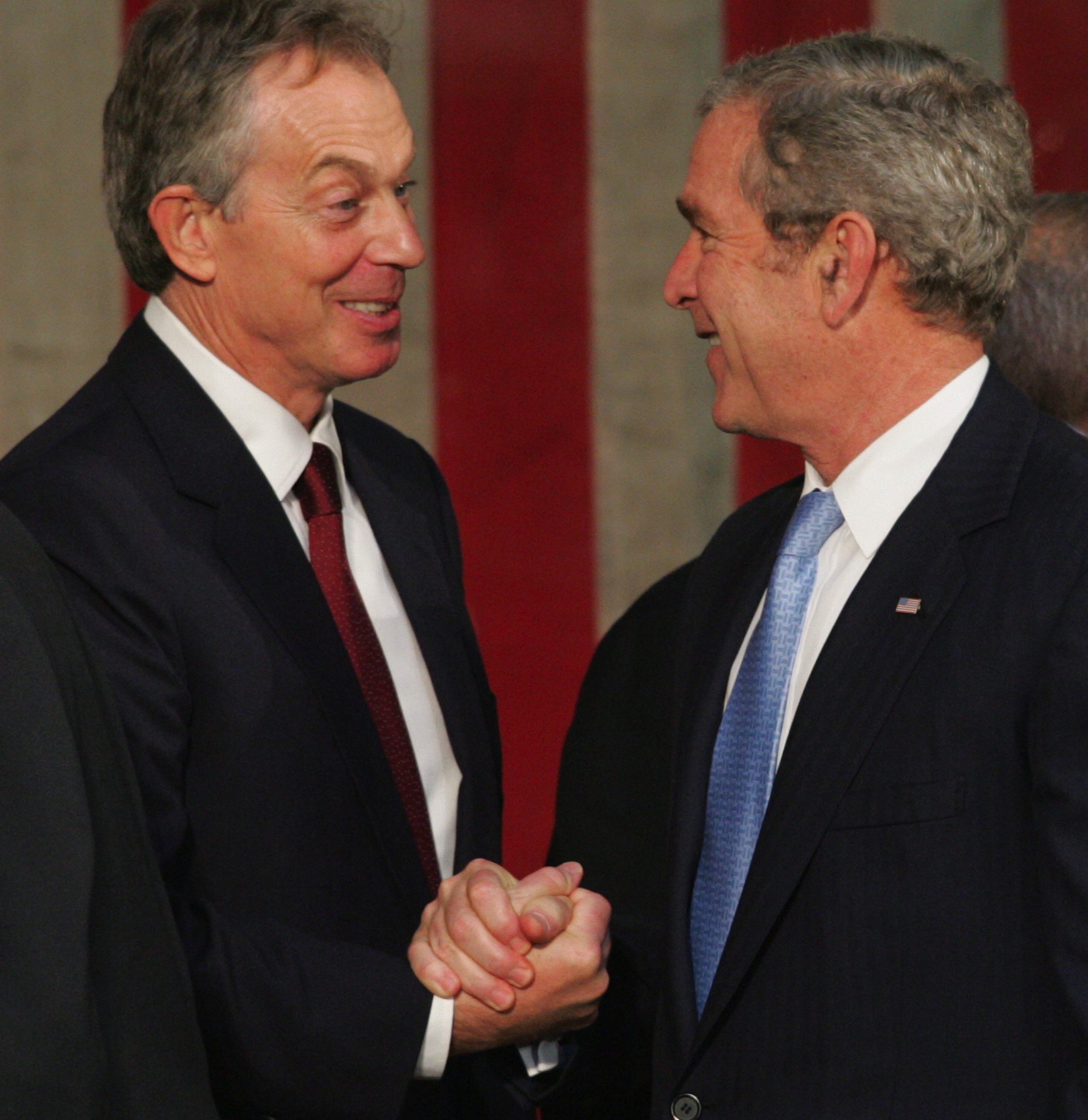
(Photo: Former British Prime Minister and Middle East Quartet Envoy Tony Blair greets US President George W. Bush following speeches during the Annapolis Conference in Memorial Hall at the United States Naval Academy in Annapolis, Maryland on November 27, 2007. By Saul Loeb/AFP/Getty Images)
William Galston and E.J. Dionne, Jr. provide highlights from their new report (pdf) on marijuana politics. Among them:
Support for legalization, though growing markedly, is not as intense as opposition, and is likely to remain relatively shallow so long as marijuana itself is not seen as a positive good. Whether opinion swings toward more robust support for legalization will depend heavily on the perceived success of the state legalization experiments now under way—which will hinge in part on the federal response to those experiments.
In many ways, I think that is the crucial barrier we have to break. We have to make an argument that legalized, regulated marijuana will be a fantastic good for society as a whole. We have to make a positive argument for the broader social and personal and health benefits of more marijuana use. We await that essay – because it requires courage and real depth. The number Clive Crook focuses on:
More than 70 percent think that “government efforts to enforce marijuana laws cost more than they are worth.” This wide margin of disapproval of the current system unites every demographic segment of U.S. society. Every ideological segment too: Large majorities of Republicans, Democrats, independents, conservatives, liberals and moderates all think the current costs of enforcement outweigh the benefits.
The analogy with alcohol, which was emphasized by the successful legalization campaigns in Colorado and Washington, does not require believing that marijuana is utterly harmless. It simply requires recognizing that marijuana, like alcohol, can be consumed responsibly and that prohibition is not a wise, fair, or cost-effective way to discourage excess. “Although a majority believe that alcohol is more harmful to individuals and to society than is marijuana,” Galston and Dionne write, “alcohol continues to enjoy much broader social acceptance.” I suspect that gap will shrink during the next decade or two as today’s anti-pot retirees die and the rest of us observe the results of the experiments in Colorado, Washington, and other states that follow their example.
Erik Erickson’s claim (seen above) about the rise of female breadwinners:
When you look at biology — when you look at the natural world — the roles of a male and a female in society and in other animals, the male typically is the dominant role. The female, it’s not antithesis, or it’s not competing, it’s a complementary role. We’ve lost the ability to have complementary relationships … and it’s tearing us apart.
I’m the furthest from a social constructionist on gender as you can imagine. Any policy that assumes identical needs and wants and temperaments among men and women is doomed to failure. We are biologically different as soon as testosterone arrives (but not before, when we are all default females). But that emphatically doesn’t mean male supremacy. Difference does not have to be hierarchical – and, in my view, tendencies toward making differences into hierarchies are immoral. But Erickson reveals the true beliefs of so many in the fundamentalist GOP. Wilkinson’s reply:
Mr Erickson’s appeal to the natural order points to a … conservative folly: the tendency to imagine the familiar, recent past in especial accord with timeless human nature. Once one considers how far we’ve come since the Pleistocene—what with all our capitalism, nation-states, dentistry and cable news—this sort of biological essentialism seems unbecoming of conservatives who, if they are about anything worthwhile, are about the defence and advancement of civilisation. The defence of atavistic privilege, which invariably proceeds on the basis of specious claims about natural hierarchy, is the hardy, incivil part of conservatism.
Or as someone once put it, art is man’s nature. Derek Thompson adds:
The majority of female breadwinners are single moms, who face an extraordinary tension between working pay and raising children. But I didn’t hear Erickson mention the phrase “single moms.” He was talking about women earning more than men. And the fact that some married women are out-earning their husbands isn’t tragic. It’s inevitable. And it’s good.
After millennia of the subjugation of women, it’s also exhilarating for all of humankind. That today’s GOP doesn’t really feel that at all is a sign of its decay and alienation from modern America.
In the long segment seen below, Megyn Kelly tears into Erickson:
“I was. It was only a few years after the war. Paris was different then, still poor. Men couldn’t get jobs and, in the male chauvinist Paris of that time, the women couldn’t get work at all. It was perfectly respectable for them to go into le milieu.”
Prostitution?
“Young women desperately needed money for various reasons. They were beautiful and young and extraordinary. There was no opprobrium because it was completely regulated. Every week they had to be inspected medically. The great bordellos were still flourishing in those days before the sheriff of Paris, a woman, closed them down. It was a different time.”
How did your involvement come about? You became friends with one of the prostitutes in Paris?
“We became great friends. When I ran out of money, I said, ‘I have to go home.’ She said, ‘No, you don’t. I’ll arrange for you.’ So she arranged for me to do it. I had to be okayed by the underworld; otherwise they would’ve found me floating in the Seine.”
Did you represent more than one girl?
“Yes, a whole bordello. I represented them all, but her especially. I did a roaring business, and I was able to live for a year. The French mecs didn’t exploit women. They represented them, like agents. And they took a cut. That’s how I lived. I was going through my rites of passage, no question about it. It was a great year of my life.”
(Image: Salon in the Rue des Moulins, Henri Toulouse-Lautrec, 1894, via Wikimedia Commons)
Frank Rich worries that rapid advances in gay rights are obscuring the discrimination faced by the gay community in the recent past:
For younger Americans, straight and gay, the old amnesia gene, the most durable in our national DNA, has already kicked in. Larry Kramer was driven to hand out flyers at the 2011 revival of The Normal Heart, his 1986 play about the AIDS epidemic, to remind theatergoers that everything onstage actually happened. Similar handbills may soon be required for The Laramie Project, the play about the 1998 murder of the gay college student Matthew Shepard. A new Broadway drama, The Nance, excavates an even older chapter in this chronicle: Nathan Lane plays a gay burlesque comic of 1937 who is hounded and imprisoned by Fiorello La Guardia’s vice cops. Douglas Carter Beane, its 53-year-old gay author, is flabbergasted by how many young gay theatergoers have no idea “it was ever that way.”
It’s particularly remarkable given the extreme trauma of mass death that the gay world experienced as recently as a decade and a half ago. But for today’s young gays, that’s not just another country; it’s another continent.
I have to say I feel very mixed feelings about this. Having struggled a quarter of a century ago to stop marriage equality from being treated as a joke by straights and as a neo-fascist plot by gays, it’s staggering now to realize that many young gay kids take their right to marry almost for granted – even though it still isn’t granted fully anywhere in the US yet (because of no federal recognition).
So yes, it’s oddly alienating to feel that one’s entire life has now been rendered moot. But also, exhilarating. One of the key reasons I always believed marriage and marriage alone could turn the gay-straight chasm into a bridge is its generational impact. When I figured out I was only virtually normal, I was around seven. And all I really knew about sex and love was that mummy and daddy were married and I never could be. That’s a huge psychic wound in the souls of gay kids. From that wound, often nursed alone and in private, comes a panoply of pain, pathology, self-destruction, and lack of self-worth. Few can afford the kind of intensive therapy required to get past this – because the wound is so deep and inflicted so young.
But today, that seven-year-old will know, simply if he or she watches the TV, that marriage is an option for him or her. They will know in a way my generation didn’t that they have a future in the society they live in, like their siblings. There are still wounds inflicted by misguided religion or panicked families. But the ur-wound is gone. And the generations of gay kids I meet today are simply way less fucked up at their age than I was, or may ever be. In that sense, I celebrate their amnesia and look up to them. I want the struggle of the past to be flooded by the normality of the present.
But we gays are also crippled in terms of communal memory. Ethnic minorities beget ethnic minorities; and parents are able to tell the stories of their past communal struggles, whether they be Jewish or African-American or even simply immigrant stories that link us to the past. But the parents of gay kids are, by and large, straight. They never went through the gay struggle. They have no gay history to share with their kids, who are born de novo, and required eventually to go outside their own families to find out about the history of their kind.
Most don’t. And I sure wouldn’t want them indoctrinated in any way. But can you imagine Jewish grandchildren of Holocaust survivors never being told about it? Or African-American kids never knowing fully about slavery?
We have no permanent national monument to commemmorate a plague that killed five times as many young men in the same space of time as the Vietnam War. Only now are we seeing the beginnings of memory – the revival of “The Normal Heart”; the documentary “How To Survive A Plague“; or the one-night revival of David Drake’s “The Night Larry Kramer Kissed Me.” Which is not surprising, if you have studied the end of plagues. The first sentence in my own plague memoir, Love Undetectable, is the following:
First, the resistance to memory.
That is understandable at first, as Camus noted, but it is becoming increasingly unforgivable. We need as a community to honor the veterans of that war, to hold them up and keep them close, and to retrieve the unimaginable agony of those days of psychological terror and excruciating physical pain. And if that makes me sound like a bitter war veteran, please know that bitterness is the very last thing I feel.
We lived for this moment, these years when we would finally see our freedom. Many of us doubted we would ever get to this mountaintop and were fully prepared to die somewhere in the foothills. But if we do not ever look back, and see the trail of corpses along the way, and the ocean of grief and pain we overcame, we will never fully grasp the dimensions of the victory. Or its real and deeper meaning: a spiritual awakening about the dignity of all human beings; about their universal need, above all other things, for love; about how Christianity, at a key moment of testing, sided against love and lost a generation.



 The Dish
