Obamacare Can Work? Ctd

Ezra Klein and Evan Soltas discourage putting too much stock in the recent polling on Obamacare and state-level premium projections:

[A]ll these numbers are simply guesses. Really. That’s it. California’s numbers are guesses. Maryland’s numbers are guesses. Oregon’s numbers are guesses. Vermont’s numbers are just guesses. Everyone is just guessing. … We’re covering those guesses in the press. When they come in low, we say it’s good news for Obamacare. When they come in high, we say it’s bad news for Obamacare. But we don’t really know whether the guesses are right or wrong either.

Even more interesting is what happens in year two. By then, insurers will know who signed up and how much their care actually cost. But at that point, their pricing won’t really be up to them. The law’s medical loss ratio rules require insurers in the exchanges to spend at least 80 percent of premiums on actual health care. If the care costs less than that, insurers have to send consumers a rebate — something many have already had to do.

Aaron Carroll wonders if political maneuvering based on these “guesses” will come back to haunt Republicans actively opposed to implementation:

[T]he gambit of those opposing Obamacare seems to be a full throated and all-out-effort to show that Obamacare doesn’t work. The danger, though, is that it might.

 The jury is still out, of course. But it’s important to recognize that full-out opposition to reform like this is somewhat novel in American politics. No one knows what such a strategy will bring in the long run.

Many thought passing the Affordable Care Act would be President Obama’s “Waterloo.” It wasn’t. In fact,  some have argued that the flat out refusal to negotiate in the law’s passage cost opponents the chance to get a final product more to their liking. Things are shaping up similarly now. If, a year from now, it appears that exchanges are working out in states that embraced them, and that the Medicaid expansion is succeeding in states that allowed it, then it may turn out that refusing to bend may have instead caused the opposition to break.

Fined For Hiring Americans

John Judis identifies a problem with the immigration bill denying Obamacare access to formerly undocumented immigrants – due to Obamacare’s employer mandate, “employers will be able to save from $2,000 to $3,000 a year by hiring a new immigrant over an American citizen”:

The bill’s denial of coverage doesn’t only give immigrants an advantage over citizens when it comes to new hires. It also gives larger businesses that employ immigrants a reason to drop insurance altogether. If they offer insurance to one employee, they need to offer it to all employees, including immigrants. But if they deny it to everyone, they’ll only pay fines for workers who are citizens.

Why this is a big issue:

As a Center for Immigration Studies report has shown, most jobs thought to be filled only by immigrants are, in fact, filled by a majority of native-born Americans. That includes 64 percent of grounds-maintenance workers, 66 percent of construction laborers, 73 percent of janitors, 51 percent of maids and housekeepers, and 63 percent of butchers and meat processors. Even on farms, the native-born constitute at least a third of the workforce. What seems to have misled people like [Lindsay] Graham is that many of the workers in these occupations are Hispanic—Graham has reported finding only “Hispanics” at some South Carolina workplaces—but Hispanic citizens make up a growing percentage of the American working class, and they too could lose employer health insurance because of immigration reform’s Obamacare loophole.

Iran Non-Election Update

IRAN-POLITICS-VOTE-ROWHANI

Abbas Milani zooms in on the aftermath of Rafsanjani’s disqualification:

On the one hand, sources representing the conservative ruling coalition deny that Rafsanjani’s fitness to serve as president has been rejected. “His fitness was simply not confirmed,” these sources claim. Other sources, like the daily Keyhan, the most reliable reflection of Khamenei’s views, have suggested that Rafsanjani in fact owes the Guardian Council a debt of gratitude. Reformists and opponents of the regime, Keyhan claims, were planning to use Rafsanjani against the regime, and the rejection of his candidacy saved him from this fate of becoming a puppet of the opposition, and of the U.S. and Israel. (By this logic, the man who is responsible for deciding what is “expedient” for the regime is somehow incapable of deciding what is expedient for himself.)

And lest there be any doubt about Khamenei’s real source of power, consider his first major appearance after the Guardian Council announced its list of approved candidates: He asked the Iranian people to vote for those who will stand up to the enemy, and said that those who were not allowed to run have nothing but themselves to blame—all while surrounded by [Revolutionary Guard (IRGC)] commanders and other military officials. A couple of days later, Iran’s police chief—another IRGC commander—announced that 300,000 policemen will be on hand on election day to forcefully abort any attempted demonstrations.

Milani sees the upcoming election as little but the regime’s continuing quest to consolidate power:

Unless there is a deus ex machina, Khamenei is unlikely to get the political “epic”—massive voter turnout—he repeatedly says the regime needs and wants. Instead, Iran is more likely to take yet another step toward becoming a Praetorian despotism dominated in every domain—politics, construction, oil, media, even soccer—by the IRGC.

Gareth Smyth goes over the campaign rhetoric thus far:

[N]either [the perceived frontrunner Saeed] Jalili nor any other candidate has so far offered much in the election other than banalities – despite Iran’s mounting problems, which now centre on the reduction of oil exports from 2.2m barrels a day to 1.1m in the past year due to tightening western sanctions. … In the face of 13% unemployment and 32% inflation, candidates have been slow to advance specific ideas for improving economic growth the IMF projects at -1.3% for 2013, or to explain how they might finance productive investment with lower oil sales cutting government revenue in the financial year ending in March from a budgeted $117bn (£77bn) to $77bn.

But a silver lining in this week’s news: the US relaxed the Iranian sanctions on laptops and mobile phones in an effort to help Iranians use technology to overcome the regime’s propaganda.

(Photo: Iranian supporters hold posters featuring Hassan Rowhani, moderate Iranian presidential candidate and former top nuclear negotiator, during one of his electoral campaign rallies in northern Tehran on May 30, 2013. Rowhani, the only cleric in the race, says his experience in leading talks with the so-called P5+1 group – the United States, Russia, China, France, Britain plus Germany – could help resolve the nuclear standoff. By Behrouz Mehri/AFP/Getty Images)

Policing Facebook

Amanda Marcotte praises the site for cracking down on content containing hate-speech against women:

This is good news, because things had gotten ugly. Women Action & the Media collected some examples of offensive posts, which included images of women who had been murdered, young girls being raped, and pictures of women tied up or assaulted with “joking” encouragement for men to rape and beat women. In one case, the example (a picture of a murdered woman with the caption, “I like her for her brains”) included a response from Facebook saying that the image didn’t violate its terms of service.

Jillian C. York dissents:

For years, activists all over the world have complained of arbitrary takedowns of content and unfair application of Facebook’s “real name” policy. Along with breastfeeding moms are people like Moroccan atheist Kacem Ghazzali, whose Facebook pages promoting atheism in Arab countries were regularly removed.  Before he rose to fame as the man behind the January 25 protests in Cairo, Wael Ghonim experienced a takedown of his famous “We Are All Khaled Said” page because he was using a pseudonym.  And not a week goes by where, as director for international freedom of expression at the Electronic Frontier Foundation, I don’t receive emails from individuals from the United States to Hong Kong telling me their account was deleted “for no good reason.”

This happens because the company is merely unequipped to deal with the sheer number of complaints it receives on a daily basis. One billion users undoubtedly translates into millions of reports through Facebook’s system, a system about which the company is famously opaque.  Whether these reports are fed through an algorithm or dealt with individually remains unclear, but what is certain at this point is that, like the atheism example above, many such reports are false positives. So while Facebook is well within its rights to determine what types of speech it wants to host, the company is inconsistent at best at managing its own policies, and at worst, biased in those policies.

Alyssa zooms out:

[T]here is no “YouTube Community” or “Facebook Community” with an agreed-upon set of standards for what constitutes hate speech or inappropriate content. There are multiple communities that are in some cases violently at odds. And if social media or technology companies want to keep some of their users–and as it seems, some of their advertisers–those companies may have to decide between their user communities when they come into conflict.

This is in violation of both tech-libertarian ideals and market principals that suggest that internet communities should be able to regulate themselves successfully, editing out offensive content and expelling members who don’t adhere to stated or unwritten codes of conduct. In reality, this has proven to be less true. Gated communities like the pay-to-play site Ask Metafilter, or heavily moderated sites like Ta-Nehisi Coates’ blog at The Atlantic exist, but they’re considered exceptions rather than the general rule, which tends more towards a consensus around sentiments like “don’t read the comments.” Sites like Facebook and YouTube aren’t so much communities as platforms on which many communities, some of them dedicated to the eradication of the ideas or sentiments expressed by others, can operate.

Shafer compares Facebook to the TV networks of old:

At the risk of reading Facebook’s mind, I suspect its capitulation has less to do with expunging transgressive content from its pages than protecting the flow of corporate advertising dollars that prop up its $56 billion market cap. Radio and television broadcasters were equally sensitive to protests and boycotts back in the old days when their business models — like Facebook’s — were providing a free, advertiser-supported service.

Whole “standards and practices” divisions were established at the networks to sanitize TV shows lest they offend. This CNN timeline of TV censorship gives you an idea of how aggressively corporate censors worked to keep such obscene words as “pregnant” off the air, to obscure Elvis Presley’s gyrating pelvis, to block the bare navels of Gilligan’s Island‘s Mary Ann, I Dream of Jeannie‘s Jeannie, and Gidget from the visual field of viewers.

But as radio and television began to migrate from their free venues to paid ones, that which was once forbidden has become almost compulsory. Smutty talk and naked bodies that would have given a network censor a brain hemorrhage back in the 1960s have been proliferating on every channel — even on the free channels!

The Obama Nerds Go NGO

Ted Greenwald checks in with the Big Data brains partly responsible for the president’s reelection:

[S]ome veterans of the campaign’s data squad are applying lessons from the campaign to tackle social issues such as education and environmental stewardship. Edgeflip, a startup [Rayid] Ghani founded in January with two other campaign members, plans to turn the ad hoc data analysis tools developed for Obama for America into software that can make nonprofits more effective at raising money and recruiting volunteers. … In Chicago, Ghani’s hometown and the site of Obama for America headquarters, some campaign members are helping the city make available records of utility usage and crime statistics so developers can build apps that attempt to improve life there. It’s all part of a bigger idea to engineer social systems by scanning the numerical exhaust from mundane activities for patterns that might bear on everything from traffic snarls to human trafficking. Among those pursuing such humanitarian goals are startups like DataKind as well as large companies like IBM, which is redrawing bus routes in Ivory Coast (see “African Bus Routes Redrawn Using Cell-Phone Data”), and Google, with its flu-tracking software (see “Sick Searchers Help Track Flu”).

Working for non-profits doesn’t have the same draw as other Big Data opportunities:

But one thing stands in the way of this vision: a lack of data scientists interested in applying their skills to social problems. … “A lot of the people who have the skills to do this kind of work end up working for Facebook, Google, or the latest online ad network,” [Ghani] says. “[I want to] show them that the same kind of data is available here, and the impact is bigger.”

Coal’s Comeback?

Brad Plumer sifts through the latest numbers:

Remember all the stories about how a glut of cheap shale gas was killing off coal in the United States and slashing the country’s carbon-dioxide emissions? It’s time to revise those headlines slightly. According to the latest data from the Energy Information Administration, coal has been reclaiming some — though not all — of its market share in 2013…

That said, coal could continue to struggle. It’s important not to go overboard here. Natural gas is still more dominant than it was in 2007, thanks to the fracking boom, and it’s not vanishing. Even in the EIA’s worst-case scenarios, natural gas prices only rise to about $6 per million BTU by 2020. That might make it easier for existing power plants to burn more coal. But, according to most projections, it will still be uneconomical for utilities to build new coal-fired facilities for the foreseeable future. What’s more, new pollution regulations from the Obama administration are constraining the coal industry.

Meanwhile, Stephen Gandel explores a nuance in the tax law that allows fossil fuel companies to drastically reduce their tax bills:

So-called master limited partnerships [MLPs] were created in their current form in 1987. The corporate tax exemption is available for passive companies that pay out nearly all of their income to shareholders, who then pay taxes — generally real estate or investment firms. But the law also extended the tax-free status to certain types of oil and gas companies. For a long time, the MLP structure was primarily used by the transport companies. U.S. pipeline owners argued that the tax break allowed them to attract investors to a low-growth, but vital, portion of the nation’s energy infrastructure. Recently, though, a growing variety of energy companies have been seeking out the tax-free status, many of which are not low-growth or lacking investment. …

[A]t a time when many are worried about the national debt, and when there is increased scrutiny on whether companies are paying their fair share of taxes, it’s worth noting that an increasing number of companies participating in [the energy industry’s] boom don’t pay corporate taxes. There is now $400 billion invested in publicly traded MLPs, up from $40 billion a decade ago. And the number of companies eligible for the status could soon grow dramatically. Industry lobbying groups are pushing a bill in Congress that would further extend the MLP-tax-free status to alternative energy companies, which currently don’t qualify.

Survival Of The Mathematical

One of Derek Thompson’s commenters explains Stephen Jay Gould’s theory about why cicadas emerge on prime-numbered years:

[Gould’s] thought was that it dealt with predators having a large production of young every few years. For example, if the cicadas produced every 16 years instead of 17 a bird species producing lots of young every 4 years and smaller broods in the other 3 years would have a bounty for their birds when it intersects with the cicada year. Therefore those that produced heavily every 4 years AND hit the jackpot on the cicadas every 4 cycles could produce enough that year to offset the inefficiency of producing too many in the other 3 years.

But since the cicadas are on a prime number timer this strategy doesn’t work. Producing too many young every 4 years misses the big year that comes on the 17th year as it does the 13th year. Making that a really crappy survival strategy.

Update from a reader:

That theory is not Stephen Jay Gould’s. There is a long history of discussion of the periodical cicadas’ life history going back at least to Darwin. I can’t be sure who suggested it first, but the theory goes back at least to Monte Lloyd and Henry Dybas in 1966.  Gould, as was his custom, was commenting on the work of others in his popular monthly column for Natural History (in fact, Gould credits Lloyd and Dybas in his original column, which makes him, in some respects, a sort of ur-blogger). If you want to get into all things cicadical, look at the website of Chris Simon at the University of Connecticut and click on the left on “Periodical Cicadas”.

Dan Nosowitz describes another fascinating survival strategy – “predator satiation”:

It’s contrary to the survival strategies of almost every other animal: it intends for a huge percentage of its population to be eaten. It doesn’t care. The idea is to overwhelm predators with numbers, since the predators can only eat so many. The only other species that practices predator satiation in the US is the salmon.

[Cole Gilbert, a professor of entomology at Cornell University] estimates that anywhere from 15 to 40 percent of this brood will be eaten, but the density of Brood II is massive. There could be up to 1.5 million cicadas per acre, so even a loss of 40 percent leaves, well, probably still a couple billion cicadas from this brood alone. That said, 1.5 million per acre is very high; many areas won’t have one percent that many. Gilbert estimates that the brood will need between 3,000 and 4,000 cicadas per acre “to swamp the predators.” So each acre will need significantly more cicadas than that to survive to breed in that area again.

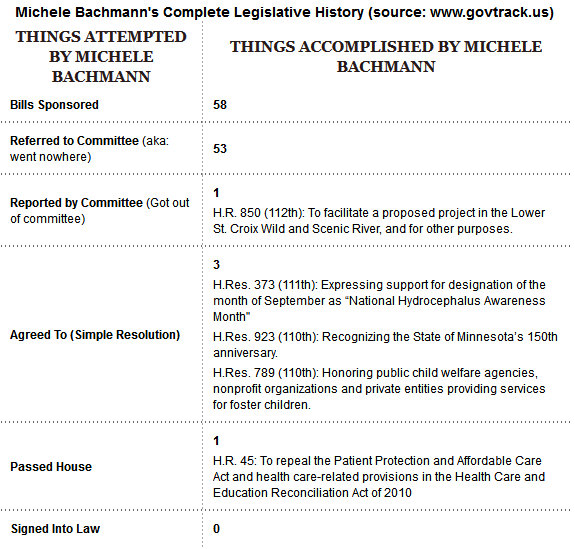
Bachmann’s Legislative Legacy

Nada:

Bachmann Record

Her retirement has significantly increased the GOP’s chances of keeping her seat:

Yes, it’s odd to argue that a party is better served by an incumbent retiring rather than running for another term in an institution where more than nine in 10 members who run for reelection are reelected, but Bachmann is no ordinary incumbent. The suburban Twin Cities Republican has always been controversial, and her image as the “Queen of the Tea Party” (as dubbed by the Weekly Standard) has proven to be a liability even in MN-6, the most Republican district in Minnesota. Only four Republican members of the House ran further behind Mitt Romney in their districts in 2012: three freshmen members and two-term Rep. Scott DesJarlais (R, TN-4), another incumbent with problems. Bachmann barely won reelection last year against wealthy Democratic businessman Jim Graves in 2012, and she was in for a tough rematch this time, particularly because she now has ethical and legal questions to go along with her highly polarizing image.

Silver agrees that Republicans’ fortunes have improved:

The Democrats’ chance of winning the Minnesota seat might now be on the order of 5 to 10 percent, versus perhaps 40 percent with Mrs. Bachmann on the ballot.

Update from a reader:

I found it interesting that Michele Bachmann’s one bill reported by committee was H.R. 850 in the 112th Congress.  If passed, the bill would have authorized the construction of an “extradosed bridge” across the St. Croix Wild and Scenic River.  In other words, had it passed, Bachmann’s one accomplishment would have been to make a designated “wild and scenic” river less “wild and scenic.”  Good riddance.

Her own bridge to nowhere. Update from another reader:

That “bridge to nowhere” that your reader derided is being built, to the region’s benefit.

It’s taking the role of the Stillwater lift bridge, the next major road crossing between Minnesota and Wisconsin, North of I-94 (which runs east from the Twin Cities). The lift bridge had been closed to traffic for long periods following the collapse of 35w, severing a major but ill-suited artery for the Twin Cities’ economy. The lift bridge sends commuters through the narrow streets of Stillwater’s historic downtown and is falling apart. The new project passed the Senate 99-0 after Senator Klobuchar lobbied vigorously for it.

I don’t know why it shows up in that table the way it does. I’m a liberal who’s been praying for Bachmann’s electoral defeat for years, but that bridge is a real accomplishment and I’m glad it’s happening. Good riddance to her, though.

The Never-Ending Jihadist War Cycle

Clint Watts compares the current jihadi movement to the Soviet Afghan campaign of the early ’80s:

For some fighters, the opportunity to fight in Afghanistan turned into a one-way ticket. Many Middle Eastern and North African countries preferred not to have trained, battle hardened mujahideen return home.  Likewise, some foreign fighters now craved more conflict and actively began seeking new theatres in which to fight.  Osama Bin Laden seized upon this first glut of idle foreign fighters to create a “base” – al Qaeda – which served as a focal point for the restless energy of homeless fighters.

While al Qaeda’s jihadi campaigns of Afghanistan after 2001 and Iraq after 2003 have not come to a complete close, these conflict[s] are both well past their peak with a second generation of foreign fighters returning to their homes and neighborhoods. This second generation of fighters has now repeated the cycle of their predecessors from the first foreign fighter glut, spinning tales of combat and facilitating the radicalization and recruitment of new crops of fighters to serve in jihadi campaigns as fresh battles arise.  In essence, the best recruiter of a new foreign fighter is a former foreign fighter.

He worries about the effect that these “second generation” foreign fighters will have on the civil war in Syria:

Why has Syria ignited foreign fighter networks so quickly, to such a great extent and in the presence of other conflicts across the Middle East and North Africa?  First, the Syrian revolution has continued far longer than any other Arab Spring uprising.  With each passing day, the Syrian conflict draws the attention of additional recruits.  Second, in Syria, foreign fighters have made a difference in sustaining the fight against Assad due to the absence of international support for the rebellion.  The longer the Syrian civil war goes on, the more foreign fighters will descend on the country. Western inaction in Syria will not only sustain foreign fighter flows to Syria, but will sustain a decades long jihadi foreign fighter recruitment cycle and likely produce a third foreign fighter glut fostering conflict for the next decade.

But what Western action wouldn’t also direct these Jihadists toward targeting the West rather than their own infidels or sectarian rivals? And wouldn’t this point also strengthen the Russian argument that Assad is better than what would replace him?