An Islamist Beheading In Britain, Ctd

67786092_67786091

Greenwald responds to my latest post. He protests:

That I “legitimated” the London attack or argued it was a “legitimate protest” is as obvious a fabrication as it gets. Not only did I argue no such thing, and not only did I say the exact opposite of what Sullivan and others falsely attribute to me, but I expressly repudiated – in advance – the very claims they try to impose on me. Even vociferous critics of what I wrote, writing in neocon venues, understood this point (“I do find myself wanting to agree with Greenwald in arguing that this is an atrocious murder rather than an act of terror”).

I don’t fabricate things. Look at this direct quote:

“[T]he term [terrorism] at this point seems to have no function other than propagandistically and legally legitimizing the violence of western states against Muslims while delegitimizing any and all violence done in return to those states.”

Here’s my objection: the West kills “Muslims”; the Jihadists target “states.” That framing, in the direct wake of an act of religious barbarism, actually places Jihadists on a higher moral plane than the West. We’re killing people of a different faith on purpose; they’re just protesting by killing the soldiers who murder them. Maybe Glenn didn’t mean for it to come out that way. But it did.

And yes, I can see (just) how an off-duty soldier might qualify as a non-civilian, although we don’t yet fully know the details of the plot, and therefore complicate the “terror” label. That’s a point worth considering. I also conceded that a defense of the killing as blowback was involved here. So we’re not that far apart on those matters.

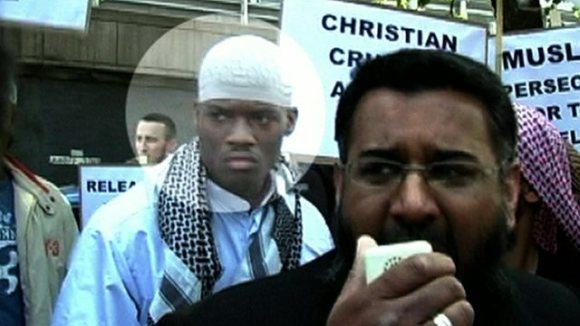
But I strongly resist the idea that the West has attempted to kill Muslims in the way that Jihadists have killed so many Muslims and infidels, even though civilian casualties have been a horrifying fact of the wars in Iraq and Afghanistan and the drone wars now winding down. We are seeking to defend ourselves from theocratic mass murderers after an unprovoked attack; they are seeking the triumph of their version of Islam, by any means, including mass murder. The US has not killed for religious reasons; the Jihadists kill solely for religious reasons, which include the sacrosanct nature of religiously-demarcated territory. That includes the Woolwich beheading, as the full context shows. The Jihadist was not defending the “land” he lives in. He is a British-born convert to a murderous form of Sunni Islam (which detests and seeks to murder Shiite infidels as much as any non-Muslims). He is, in fact, attacking his own land, its soldiers and its democratic norms. He wants to turn Britain into a Sharia-Islamist state. And he’s not shy about saying so. That equation of his land with, say, Pakistan, is a religious belief, not an objective fact.

Then there are the fabrications from Glenn. I “continuously justify any manner of violence and militarism” by the US. That accusation is just bizarre, given my record over the last several years, my support for withdrawal from Iraq and Afghanistan, my opposition to new wars in Libya and Syria, my long campaign against torture, and on and on. But, yes, I do believe we are in a civilizational war, as I wrote just after 9/11.

It is a war between violent Jihadist theocracy and the Western tradition of separation between church and state. It is a war we did not seek and it is a war we are trying to end. For the Islamists, in contrast, this war is for ever – until their version of theocracy is triumphant. And the butchers of Woolwich are quite clear about their goals: the imposition of Sharia law and the end of democracy in Britain, their actual native land. For them to assume other countries as “their land” is an obvious sign that what lies behind this is not strategic blowback only – it is a theology of theocracy.

Norm Geras is not as blinkered:

[I]f a man says that he’s butchered someone on the street because of… Afghanistan, it is then true, if he is not lying or self-deceived, that somewhere in the causal chain leading up to that murderous act Western intervention against Al-Qaida and the Taliban has played some part in bringing the atrocity about. But it is by no means a sufficient explanation, as you can quickly ascertain by starting to count up in your head all those angered or upset about Western intervention who haven’t butchered anybody. At the same time, you can start to compute how many people responsible for jihadist terrorism today not only cite Afghanistan and/or Iraq but frame the reference within the terms of an Islamist ideology according to which the slaughter of innocents is an apt response to Western foreign policy. That’s a very large number of people. It is also true, of course, that not all Islamists commit terrorist murder, so this isn’t a complete explanation either, but you’d think the ideological factor should have some prominence.

A rational explanation of these acts is therefore available that places central emphasis on its ideological causes, and doesn’t just parrot what the jihadists themselves say. And those leftists and liberals (verkrappt section) who always draw attention towards what the killers say and away from the belief system that inspires them are not just appealing to rational explanation, they are offering a very particular type of skewed ‘explanation’ that obscures a crucial element of the picture.

I think Glenn has gone from a completely legitimate critique of the West’s “war on terror” toward the equation of Jihadist murder with legitimate self-defense after 9/11. I can see why the latter can spawn the former. I cannot see how they are both morally equivalent.

Read the whole Dish thread on the Woolwich beheading here.

The View From Your Window Contest: Winner #155

Screen Shot 2013-05-24 at 6.18.25 PM

A reader writes:

We’ve crossed that bridge several times on our way from Paris to a small village in SW France where we like to stay. Beautiful. Just got back from NYC, so didn’t see this until this morning. If the 12 noon deadline is eastern time, I missed it.

Another:

Beylerbeyi, Turkey? That’s the Bosphorus Bridge that connects Europe and Asia.  I’m just guessing that the pic is from the Asian side.

Another:

Istanbul? I’m only making this guess because of the bridge in the background, which I think might be the Bosphourus Bridge.  Looking at a map of the area, I would guess this picture is taken from the Symbola Bosphourus Hotel.

Another Istanbul guesser:

This is as far as I’m going to get.  It’s taken from the European side, north of the Fatih Sultan Mehmet Bridge. But I’ve spent altogether too long on this, and I can’t get good enough resolution on Google Earth to figure out exactly where. First time try.  I’m betting that you’ll have lots of correct results on this one.

Another:

Hong Kong? I believe that’s the Tsing Ma Bridge in the background.

Another:

I suspect this one was too easy, if for no other reason than I was able to get a view for the first time. The bridge looked a lot like the second and newer Narrows Bridge near Tacoma, WA, but the first bridge wasn’t in the picture and nothing else matched. I looked up the list of suspension bridges on image004Wikipedia, considered and rejected the Mackinac Bridge and one of the Bosporus Bridges in Turkey, and then took a closer look at the third bridge of the right color and style and saw that it had Chinese writing on the crossbar which was also visible (though previously unnoticed) on the view.

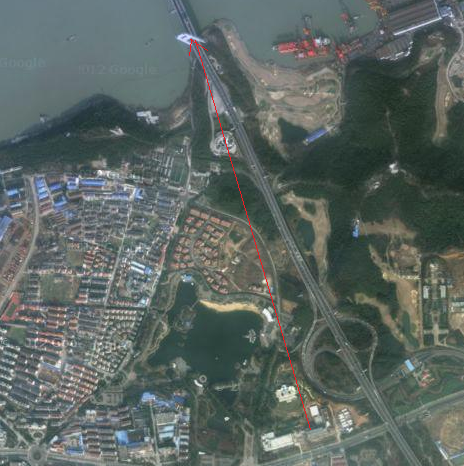
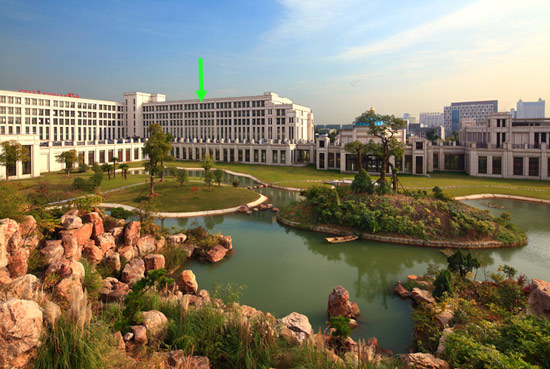
Then it’s just a matter of looking at the Jiangyin Bridge on Google Maps, confirming the view (which took seconds), and then trying to narrow down the exact window. It looks like it’s on the property of the Huangjia Sheraton Hotel, in Jiangyin, Jiangsu, China. It almost looks like the view is too close to be in the main body of the hotel, which could place it on the wall that extends from the building, but it also looks to be above ground level so I’m going to say it’s in the hotel but zoomed in to foreshorten the view. I can’t find a map of the hotel itself and so from there it’s a guess. Let’s say 4th floor of the hotel, facing north-northeast, roughly as shown in the following images.

Jiangyin, China it is. Almost all of the 200 readers who participated this week answered Jiangyin, making this contest probably the easiest one yet. Another:

The suspension bridge towers in the distance gave a me something to work with.  It looked like the bridge could be of some scale.  I googled “largest suspension bridges” and came across this YouTube video highlighting the ten largest:

The Jiangyin Bridge was listed at #6 and immediately looked promising with the blue main cables and white towers with characters on the lower cross beam of the tower.  The bridge, which apparently has a 1,385 meter main span constructed by Cleveland Bridge & Engineering Company (U! S! A!) completed in 1999, crosses the Yangtze River, connecting the northern and southern parts of Jiangsu province.

Great post from YangziMan here with historical details and photos from the area. Construction apparently completed in 2010; the current Google Maps satellite image looks to be mid-construction on the western half of the main building.  I was able to figure out that the building pictured in the foreground, which Starwood describes as “European Baroque” architecture, is the hotel’s VIP tower. If you go to this link and click on the picture shown then go to Image 2 of 2, I’m guessing that the photo was taken from a window on the 4th, 5th or 6th floor of the hotel near or above the head of the woman in gray and black seventh in from the right.

More readers try to guess the correct floor:

Most weeks I look at the photo and figure I’ll never get it.  Other weeks I think I have a shot, but don’t find anything conclusive after looking for a little while.  On this rainy Saturday afternoon, I’ve finally found my first window. This is Jiangyin, China.  The photo was taken from the Sheraton Tianjin Hotel from approximately the spot indicated in the attached image looking toward the Jiangyin Bridge over the Yangtze River:

20130525(1)

I’m going to guess it’s from the 3rd floor.  I’m sure someone will come up with the exact room number, but that’s beyond my meager skills.  Go ahead and give the book to the guy who proposed to his wife on the pretty bridge in the foreground.  I’m happy enough knowing I finally got one.

Another:

Oh my gosh I got one! I guess those hours on Geoguessr are paying off!

A visual guess from a previous winner:

VFYW Jiangyin Aerial with Marked Insert - Copy

Another reader:

How addictive is the VFYW contest?  My wife and I put off starting the new season of Arrested Development to work on it.

Another visual guess:

teti_vfywcontest_windowid

Another reader:

This is so cool! Hotel staff from the Sheraton in China actually responded to my email! I think that is so neat! I had already sent my VFYW answer in yesterday, but I’d like to add this additional detailed location info! Photo likely taken from 6 or 7th floor, from Block A Garden View rooms. Still hoping for a mention or dare I hope, a win … but getting a note from a woman on the other side if planet Earth helping a complete stranger guess was fun, in and of itself!

Another previous winner sends a visual guess of the correct floor:

hotel-334

Another reader:

Best bet of room location is west wing, 7th floor, probably Sheraton Club level, room 7035. I’m getting better at this each week so thought I would start entering.

The 7th floor it is – room 7028 to be exact. Of the half-dozen readers to guess the correct floor, the one who has participated in the highest number of contests so far (15) gets the tie-breaker this week:

Yay! A pleasantly easyish one. The suspension bridge took me straightish to it. It’s from a window in the Sheraton Jiangyin Hotel, Jiangyin 214400, China. I’m guessing lots of people will get this one, so I’m going with the 7th floor. I’ve never been to China, so I have no cute China stories. I don’t even live in a city with a China Town. I did visit China town in San Francisco when I was five. I remember getting to pick one souvenir, and I picked a small tool set. Yay!

(Archive)

Post Reagan Hubris

Daniel Larison wants to retire Reagan’s slogan “peace through strength”:

The most common abuse of Reagan’s legacy is the rote recitation of [this slogan]. Originally, the phrase implied support for creating a strong defense as a deterrent to aggression. As the threat of aggression by other states has receded, it has come to mean something very different. Many Republican hawks rely on this phrase to describe their foreign-policy views, but they long ago dismissed the importance of deterrence when dealing with states much weaker than the Soviet Union. It is common now for advocates of regime-change and preventive war to profess their commitment to “peace through strength,” but the substance of the policies they prefer shows that they reject the concept as Reagan understood it both in principle and in practice. Instead of deterring aggression to protect international peace, the new “peace through strength” often serves as rhetorical cover for the violation of that peace through acts of aggression.

Another dubious lesson from Reagan’s foreign policy:

The idea that Reagan “won” the Cold War is one of the more pernicious and enduring distortions of Reagan’s real success, which involved both opposing and engaging with the Soviet Union as its system collapsed from within largely on its own.

The claim of winning the Cold War greatly exaggerated the ability of the U.S. to shape events in other countries. That in turn has inspired later generations of conservatives and Republicans to imagine that they can successfully promote dramatic political change overseas in order to topple foreign regimes. As Kennan said in the same op-ed: “Nobody—no country, no party, no person—‘won’ the cold war. It was a long and costly political rivalry, fueled on both sides by unreal and exaggerated estimates of the intentions and strength of the other party.”

Congratulating Reagan for winning the Cold War is one more form of widespread abuse of Reagan’s legacy that has adversely affected how conservatives think about foreign policy and the proper U.S. role in the world. This has warped how the right understands American power and U.S. relations with authoritarian and pariah states for the last two decades. It also blinds many conservatives to the fact that other nations resent and reject American interference in their political affairs. In spite of the failures of nation-building in Iraq and Afghanistan and the collapse of the so-called Freedom Agenda, this myth continues to make many on the right overly confident in our government’s ability to influence overseas political developments to suit American wishes.

It’s called hubris. Peter Beinart made the definitive case for it after the end of the Cold War.

The Targeting Of James Rosen

My first instinct on hearing about the case of James Rosen was somewhat casual. Much too much so, in retrospect. Yes, Rosen was a pretty clueless reporter; yes, disclosure of a source in North Korea could have been extremely damaging to national security. Some kind of investigation was merited. But the move to issue a warrant to Rosen for possibly being a co-conspirator in leaking the information crossed a line. And it was crossed by Attorney General Eric Holder. Leakers are not journalists. That distinction got blurred.

Holder, in his defense, was pressured by the CIA and the Congress, which is why there’s been relatively little outrage there:

On December 3, 2009—just a few months before he approved the affidavit in the Fox case—Holder, FBI director Robert Mueller, and director of national intelligence Dennis Blair were hauled before a secret session of the Senate Intelligence Committee to explain why they weren’t punishing more leakers.

But it is the job of the AG to resist such pressure if the pursuit of the leak were to turn into near-prosecution of the press for doing its job. The good news is not that Holder is apparently experiencing regret – his excruciating remorse is expressed through Daniel Klaidman’s tiny violin here. It is that he is going to oversee new rules that will prohibit going near reporters’ records:

Among them would be stating a clear presumption in the guidelines against seizing reporters’ work product, either through subpoena or search warrant. Currently, the guidelines require that prosecutors “take all reasonable steps to obtain the information through alternative sources or means.” (A presumption test would be a higher standard to overcome.) Another priority will be making sure that search-warrant applications are subjected to the same level of internal scrutiny that subpoenas currently receive before they are approved by the attorney general. Some changes, meanwhile, will involve simply bringing the rules into the Internet Age. Originally established in 1970 and updated in 1982 to include telephone records, they don’t even mention emails, texts, or other forms of digital communication, like social media.

There’s more, as Klaidman notes. I’m not one of those people offended when government pursues leaks that could be detrimental to national security – especially a crucial source inside North Korea who was effectively deemed moot by Rosen’s report – and who may have suffered a terrible fate. But search warrants and subpoenas of reporters’ work need to end. The amateurishness of the reporter really isn’t salient here. Maintaining a bright line between the DOJ and the vital work of investigative journalism is.

And I should have seen that more clearly from the get-go.

A Domed Defense Against Tornadoes

A reader writes:

Your reader from OKC who had the shelter built in her garage is so right. When you live in Tornado Alley, you need to be prepared. On a recent road trip in Texas, I was intrigued by a site in the tiny town of Italy, Texas. It was the Monolithic Dome Institute.

I exited the interstate, toured the grounds and came away fascinated as to why this architectural wonder is not more employed in places prone to hurricanes, tornadoes and cyclones. They simply cannot be blown down. Further, monolithic dome buildings qualify for FEMA grants because they meet the agency’s standards for near absolute protection from tornadoes and hurricanes. The Monolithic Dome Institute has built them for schools (great start), churches and industry. A perusal of their site will show you plenty of very nice single family homes as well. I’m sure your average HOA would freak if you started to build a dome, but if your house is the only one standing after a natural disaster, maybe it’s time to rethink how we’re building. Imagine a community, a subdivision made entirely of dome houses. Weird? For a while, sure, but what a lifesaver.

The Skinny On Obesity

Virginia Hughes examines the links between body weight and health:

Some researchers contend that what really matters is the distribution of fat tissue on the body, with excess abdominal fat being most dangerous; others say that cardiovascular fitness predicts mortality regardless of BMI or abdominal fat. “BMI is just a first step for anybody,” says Steven Heymsfield, an obesity researcher and the executive director of the Pennington Biological Research Center in Baton Rouge, Louisiana. “If you can then add waist circumference and blood tests and other risk factors, then you can get a more complete description at the individual level.”

If the obesity-paradox studies are correct, the issue then becomes how to convey their nuances. A lot of excess weight, in the form of obesity, is clearly bad for health, and most young people are better off keeping trim. But that may change as they age and develop illnesses. Some public-health experts fear, however, that people could take that message as a general endorsement of weight gain.

In a follow up, she discusses obesity with molecular biologist Jeffrey Friedman:

Each of us, he argues, has a different genetic predisposition to obesity, shaped over thousands of years of evolution by a changing and unpredictable food supply. In modern times, most people don’t have to deal with that nutritional uncertainty; we have access to as much food as we want and we take advantage of it. In this context, some individuals’ genetic make-up causes them to put on weight — perhaps because of a leptin insensitivity, say, or some other biological mechanism.

In other words, morbidly obese people lost the genetic lottery. “The irony is, it’s the people who are the most obese who are stigmatized the most, and in fact, they’re the people who can do the least about it,” Friedman says.

The People’s Facebook

Ari Melber, Woodrow Hartzog and Evan Selinger push back against the imbalance of power that they see in the “terms of service” agreements employed by social media sites:

In return for driving the profits of social media companies, users get free software. But too often, the cost is unpredictable vulnerability: confusing, generic contracts that give companies control over your data, prose, pictures, personal information and even your freedom to simply quit a given website. This is a classic example of form contract abuse—when a single, powerful party pushes a contract onto a disparate group of other parties.

They call for a “People’s Terms of Service” developed by social media users to serve as “a common reference point and stamp of approval”:

There are two potential benefits: The result could be pressed on existing Internet companies, and also provide a model for new companies that want compete for users who demand respect for their freedom, choice and privacy. To be effective, the contract would use plain English, not legal jargon. It should be short enough so people can read it. (That’s a contrast to Facebook, which offers a contract almost as long as the US Constitution.) Beyond terminology itself, we propose five values worth considering for a model agreement: security, confidentiality, transparency, permanency and respect for intellectual property.

The Failures You Can’t See

David McRaney explains “survivorship bias” by using an example from WWII:

The military looked at the bombers that had returned from enemy territory. They recorded where those planes had taken the most damage. Over and over again, they saw the bullet holes tended to accumulate along the wings, around the tail gunner, and down the center of the body. Wings. Body. Tail gunner. Considering this information, where would you put the extra armor? Naturally, the commanders wanted to put the thicker protection where they could clearly see the most damage, where the holes clustered. But [statistician Abraham] Wald said no, that would be precisely the wrong decision. Putting the armor there wouldn’t improve their chances at all.

Do you understand why it was a foolish idea? The mistake, which Wald saw instantly, was that the holes showed where the planes were strongest. The holes showed where a bomber could be shot and still survive the flight home, Wald explained. After all, here they were, holes and all. It was the planes that weren’t there that needed extra protection, and they had needed it in places that these planes had not. The holes in the surviving planes actually revealed the locations that needed the least additional armor. Look at where the survivors are unharmed, he said, and that’s where these bombers are most vulnerable; that’s where the planes that didn’t make it back were hit.

The commanders’ mistake is very common: 

After any process that leaves behind survivors, the non-survivors are often destroyed or rendered mute or removed from your view. If failures becomes invisible, then naturally you will pay more attention to successes. Not only do you fail to recognize that what is missing might have held important information, you fail to recognize that there is missing information at all.

You must remind yourself that when you start to pick apart winners and losers, successes and failures, the living and dead, that by paying attention to one side of that equation you are always neglecting the other. If you are thinking about opening a restaurant because there are so many successful restaurants in your hometown, you are ignoring the fact the only successful restaurants survive to become examples. Maybe on average 90 percent of restaurants in your city fail in the first year. You can’t see all those failures because when they fail they also disappear from view.

Star Words

Kory Stamper notes how sci-fi influences our vocabulary:

Many words have their origins in science fiction and fantasy writing, but have been so far removed from their original contexts that we’ve forgotten. George Orwell gave us “doublespeak“; Carl Sagan is responsible for the term “nuclear winter“; and Isaac Asimov coined “microcomputer” and “robotics“. And, yes, “blaster”, as in “Hokey religions and ancient weapons are no match for a good blaster at your side, kid.

The genres also reintroduce or recontextualize already existing words:

Savvy writers of each genre also liked to resurrect and breathe new life into old words. JRR Tolkien not only gave us “hobbit”, he also popularized the plural “dwarves”, which has appeared in English with increasing frequency since the publication of The Hobbit in 1968. “Eldritch”, which dates to the 1500s, is linked in the modern mind almost exclusively to the stories of HP Lovecraft. The verb “terraform” that was most recently popularized by Joss Whedon’s show Firefly dates back to the 1940s, though it was uncommon until Firefly aired. Prior to 1977, storm troopers were Nazis.

Writing Through The Darkness

Jessica Grose ponders Sylvia Plath’s astonishing productivity as a writer, despite being a mother and wife who battled mental illness:

Plath battled the depression that would ultimately fell her throughout her entire working life, but she still managed to be highly productive, even during the period when she was a single mother of two young children after separating from Hughes. Work was so important to her sense of self that Plath’s suicide attempt during that summer of ’53 was in part because her depression rendered her unable to write.

Among the reasons for Plath’s copius output? Grose cites Diane Middlebrook’s biography, Her Husband, on the importance of the poet’s daily writing schedule:

“Daily routines were the kind of thing Plath liked to describe in letters to her mother, so we know that [she and Hughes] planned to write for four to six hours a day, 8:30-12:00 in the morning, 4:00-6:00 in the afternoon. In later years, after they had children, they split the day into two parts: Plath took the hours after breakfast, and she aimed to be at work by 9:00; Hughes had the hours between lunch and tea. Despite the evident differences in their dispositions, routines suited both of them, and what they considered good work flowed from Hughes’s pen and Plath’s keyboard for the whole of their first two months of married life.”

Even in the frenzied final months of Plath’s life, during which she was plagued by anxiety, depression, and insomnia, she would write from 4 a.m., when her sleeping pills wore off, until 8 a.m., when her son and daughter woke up and needed her. She wrote much of the heralded poetry collection Ariel in this fashion.