
The Body Politic’s Taste In Art

dish_zerbe_aroundthelighthouse

Advancing American Art was a 1946 art collection selected by US State Department; the shows were intended to fight the Cold War by promoting American cultural values abroad. The experiment was a domestic flop:

The highly conservative radio host Fulton Lewis Jr derided the art as “so far advanced that it’s completely out of sight and no one in his sane mind is ever going to try and catch up to it”. Upset citizens wrote letters to their elected representatives, deriding the use of taxpayers’ money for the project. Those politicians in turn spoke out in the press and on Capitol Hill.

The objections to the works took various forms. Complaints were made against the darkness of the works, both in palette and content, by those who felt that they failed to portray the nation as a thriving war victor. The “foreign-sounding” names of many of the artists, many of whom were in fact immigrants, was also an issue.

Perhaps most troubling for some protestors was the political orientation of many of the artists. … [T]he unfamiliar style, and hence artistic merit, of the work was called into question. Perhaps the most damning derision in this area came from none other than President Harry Truman, who in a letter to a State Department official leaked to the press, dismissed the art as “merely the vaporings of half-baked lazy people”.

The controversy came to a head in a series of Congressional hearings. While artists and museum officials around the country convened to try and save the programme, their counter protest was to no avail. Threats of State Department funding cuts put their other programmes at risk, which by that time included the popular Voice of America radio broadcasts, the Fulbright Programme and Unesco involvement. The outcomes of the hearings were the recall of the art to home, the dismissal of [State Department member Joseph LeRoy] Davidson and the elimination of his position.

A recreation of the exhibition can be seen at the University of Oklahoma through June 2nd. From there, it travels to Indiana University and the University of Georgia.

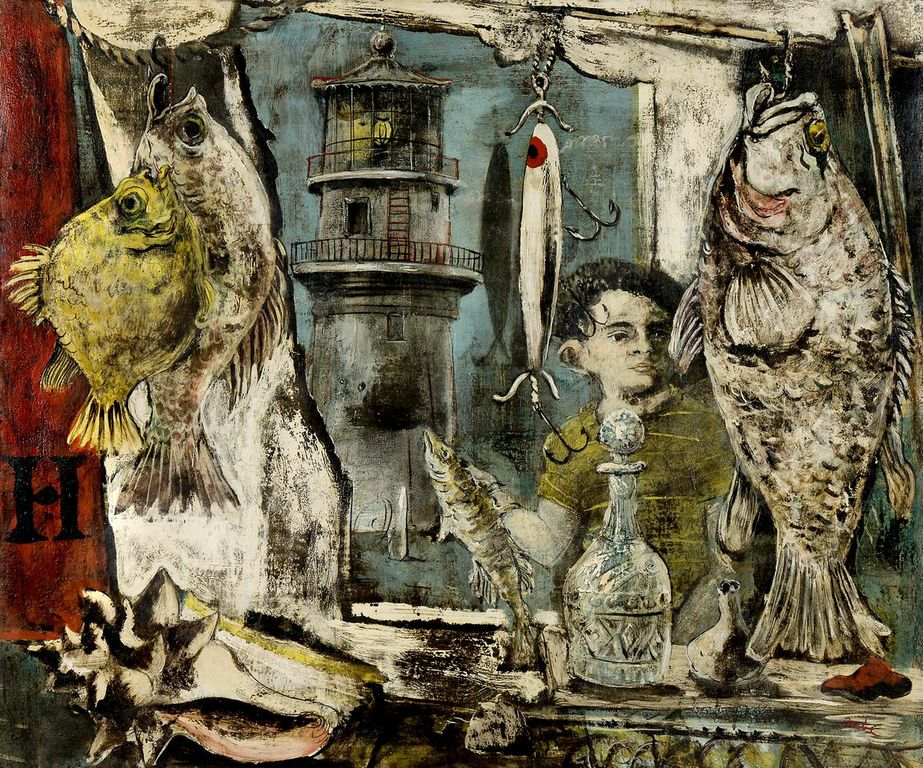
(Pictured: Around The Lighthouse, Karl Zerbe, n.d.)

Everest Going Downhill

The world’s highest mountain has become overcrowded and polluted, reports Mark Jenkins, in large part due to its draw as a tourist destination for inexperienced climbers:

Everest has always been a trophy, but now that almost 4,000 people have reached its summit, some more than once, the feat means less than it did a half century ago. Today roughly 90 percent of the climbers on Everest are guided clients, many without basic climbing skills. Having paid $30,000 to $120,000 to be on the mountain, too many callowly expect to reach the summit. A significant number do, but under appalling conditions. The two standard routes, the Northeast Ridge and the Southeast Ridge, are not only dangerously crowded but also disgustingly polluted, with garbage leaking out of the glaciers and pyramids of human excrement befouling the high camps. And then there are the deaths. Besides the four climbers who perished on the Southeast Ridge, six others lost their lives in 2012, including three Sherpas.

James Joyner is pessimistic:

The prospects of this happening are dismal. Nepal is a poor country and the government took in over $3 million in permit fees last year and climbers brought an estimated $12 million into the local economy. The corrupt, incompetent government diverts the money it brings in, re-investing very little in safety and cleanup of Everest.

Kashish Das Shrestha, a writer who offered insight into a sherpa’s view of the mountain’s “traffic jam” last year, compares his observations with Jenkins’s, noting the similarity of their visions for reform. From his May 2012 report:

While shutting down Everest for a season or two might seem radical, at least fiscally, it actually might not be.  There are 326 peaks that are open for mountaineering in Nepal. Of that, 25 are in the Solukhumbu region.

So shutting Everest down temporarily would not mean taking away revenues from Solukhumbu or the Sagarmatha National Park. It would only mean being able to offer a safer Mount Everest down the line, while promoting other peaks in the region and the country.

Mount Everest is not, and should not, be treated like an expensive amusement park. And nobody’s permit fee is bigger than somebody’s safety more than 7,000 meters above sea level.

In an update, he indicates that hope is not lost:

I was recently told that if one wanted the government to respond to certain public discourses, a document outlining the discourse or proposed policy suggestions had to be submitted to the relevant Minister or Secretary of the relevant Ministry. Perhaps it is worth submitting Mark’s and my propositions to those offices, as well as to the industry’s trade body, to see if there is a response.

Fiction Isn’t Friendship

In an interview with Claire Messud about her new novel, The Woman Upstairs, Publisher’s Weekly posed this question about the book’s main character: “I wouldn’t want to be friends with Nora, would you? Her outlook is almost unbearably grim.” In response, Messud unloaded:

For heaven’s sake, what kind of question is that? Would you want to be friends with Humbert Humbert? Would you want to be friends with Mickey Sabbath? Saleem Sinai? Hamlet? Krapp? Oedipus? Oscar Wao? Antigone? Raskolnikov? Any of the characters in The Corrections? Any of the characters in Infinite Jest? Any of the characters in anything Pynchon has ever written? Or Martin Amis? Or Orhan Pamuk? Or Alice Munro, for that matter? If you’re reading to find friends, you’re in deep trouble. We read to find life, in all its possibilities. The relevant question isn’t “is this a potential friend for me?” but “is this character alive?”

The editors of The New Yorker pointed to this as an example of “a critical double standard—that tormented, foul-mouthed, or perverse male characters are celebrated, while their female counterparts are primly dismissed as unlikeable,” and convened a roundtable on the issue of fictional characters’ “likeability.” From Margaret Atwood’s contribution:

Intelligent readers do not confuse the quality of a book with the moral rectitude of the characters. For those who want goodigoodiness, there are some Victorian good-girl religious novels that would suit them fine.

Also, what is “likeable”? We love to watch bad people do awful things in fictions, though we would not like it if they did those things to us in real life. The energy that drives any fictional plot comes from the darker forces, whether they be external (opponents of the heroine or hero) or internal (components of their selves).

Do women writers get asked this more than male ones? Bet your buttons they do. The snaps and snails and puppy-dog’s tails are great for boys. The sugar and spice is still expected for girls.

And here’s Jonathan Franzen’s response:

I hate the concept of likeability—it gave us two terms of George Bush, whom a plurality of voters wanted to have a beer with, and Facebook. You’d unfriend a lot of people if you knew them as intimately and unsparingly as a good novel would. But not the ones you actually love.

Stepping In Contemplative Bullshit

In an excerpt from his new book, Intuition Pumps And Other Tools for Thinking, Daniel Dennett offers guidelines for sound thinking, which includes a wariness of what he calls “deepities”:

A deepity (a term coined by the daughter of my late friend, computer scientist Joseph Weizenbaum) is a proposition that seems both important and true – and profound – but that achieves this effect by being ambiguous. On one reading, it is manifestly false, but it would be earth-shaking if it were true; on the other reading, it is true but trivial. The unwary listener picks up the glimmer of truth from the second reading, and the devastating importance from the first reading, and thinks, Wow! That’s a deepity.

An example:

Love is just a word.

Oh wow! Cosmic. Mind-blowing, right? Wrong. On one reading, it is manifestly false. I’m not sure what love is – maybe an emotion or emotional attachment, maybe an interpersonal relationship, maybe the highest state a human mind can achieve – but we all know it isn’t a word. You can’t find love in the dictionary!

We can bring out the other reading by availing ourselves of a convention philosophers care mightily about: when we talk about a word, we put it in quotation marks, thus: “love” is just a word. “Cheeseburger” is just a word. “Word” is just a word. But this isn’t fair, you say. Whoever said that love is just a word meant something else, surely. No doubt, but they didn’t say it.

Norm Geras submits a few of the deepities he’s encountered:

Some deepities I have grown to love and laugh at are these. There’s no such thing as an enduring human nature. Oh, you reply, so human beings don’t need to eat or rest? There aren’t common abilities like the use of language and such? Comes back the reply: we didn’t mean that by human nature; we meant that not all humans are greedy, or power-loving, or interested in unlimited wealth. So it turns out that the denial of an enduring human nature amounts to some changeable or non-universal features of the human character not being unchangeable. What else is new?

In a tutorial I used to run on the Modern Political Thought course at Manchester, I would sometimes ask students if there are any biologically-based differences between men and women. You’d be surprised how many of them answered ‘No’. What?! How about the ability to bear children? Oh… we thought you meant differences like being cleverer or more fit to govern. So there are possible differences then? Yes, perhaps.

Julian Baggini talked to Dennett. On Dennett’s engagement with science and philosphy:

He may not be crudely scientistic, but it is true that these days Dennett spends more time around scientists than other philosophers. “I find the discoveries in those fields mind candy, just delicious,” he says. “If I go to a scientific conference I come away with a bunch of new things to think about. If I go to a philosophy conference I may come away just having learned four more wrinkles in the debate about something philosophers have been thinking about for all my life.”

But Dennett also maintains that we need philosophy to protect us from scientific overreach. “The history of philosophy is the history of very tempting mistakes made by very smart people, and if you don’t learn that history you’ll make those mistakes again and again and again. One of the ignoble joys of my life is watching very smart scientists just reinvent all the second-rate philosophical ideas because they’re very tempting until you pause, take a deep breath and take them apart.”

Recent Dish on Dennett’s tips for arguing here.

Faithful Atheism

When her young son asked about where a pet dog went after dying, Julia Fierro refused to answer by saying “heaven” – a handy reply she admits would make being a parent easier:

No matter how much I’d love to tell my children that there is always a happy ending, I can’t tell them a story I don’t believe in. Faith was a precious relief in my own anxious childhood–as was the certainty that there was a beautiful and, more importantly, safe place like heaven, no matter what your earthly life. The rituals of prayer, and its accessories–rosary beads, the plastic-framed picture of a benevolent Jesus over my bed, my collection of Virgin Mary statues and the silver crucifix I wore around my neck–were amulets against the danger I felt lurking everywhere, which would, decades later, be diagnosed as Obsessive-Compulsive disorder.

What Fierro and her husband, also an atheist, have learned from their experiences:

We used to debate whether it was worse to have faith and lose it, or to never know it at all. The debate is no longer relevant because it is clear that as we’ve grown as a couple, become parents twice-over, surpassed challenges in our careers, in our relationship, and in our children’s lives, we have become more faithless. But only in our faith in God. We’ve become more faithful to our belief in, and practice of, family. The conception and birth of a baby, and the moment-to-moment bustle specific to parenting young children, is a constant reminder that life is an act of faith. I wonder, sometimes, if I live each moment more fully than my parents because I believe this life, and every moment I have to stare at my children’s smiles, is all I will ever have.

An Aristocracy Of Everyone

Veronique Greenwood runs down research showing just how much our genealogical pasts converge:

Chances are, if you have a famous ancestor far enough back that finding out about them is a surprise, you share them with a small city of other people. And the farther back you go, the truer that is. In 2004, statistician Joseph Chang, computer scientist Douglas Rohde, and writer Steve Olson used a computer model of human genetics to show that anyone who was alive 2,000-3,000 years ago is either the ancestor of everyone who’s now alive, or no one at all. Think about that: If a person alive in 1,000 BCE has any descendants alive today, they have all of us—even people from different continents and isolated populations. This line of thought led to the revelation that everyone of European heritage alive today is a descendant of Charlemagne, who ruled over much of Europe as the first Holy Roman Emperor. As science writer Carl Zimmer wrote last week, it’s “Charlemagne for everyone!” (Zimmer’s excellent post covers a recent paper that looked at actual genomic data from European populations and came to a similar conclusion: All living Europeans, from Turkey to England, Spain to Finland, are related many times over.)

She sees our sameness as an asset:

Given that people—especially those in melting-pot countries with only a vague sense of where they came from—often search out their genealogies to find their special background, this information might be a bit disconcerting. Everyone’s genomes and families are not as enduringly specific as we tend to think. But while genetics doesn’t reflect much of our imagined genealogical uniqueness, it’s shown that we’re more closely tied to our species as a whole than we might have realized. We’re all part of this enormous human fabric, full of fascinating tendencies and bizarre biochemistry. And research is revealing more and more about humanity as a whole and our incredibly beautiful, incredibly unlikely perch in the universe. That’s a tradition to be proud of.

Living Only In The Moment

From a review of Permanent Present Tense, Suzanne Corkin’s account of the fascinating life of Henry Molaison, perhaps the most famous amnesiac:

When he was 27, a disastrous brain operation destroyed his ability to form new memories, and he lived for the next 55 years in a rolling thirty-second loop of awareness, a ‘permanent present tense’. During this time he was subjected to thousands of hours of tests, of which naturally he had no recall; he provided data for hundreds of scientific papers, and became the subject of a book (Memory’s Ghost by Philip Hilts) and a staple of popular science journalism; by the 1990s digital images of his uniquely disfigured hippocampus featured in almost every standard work on the neuroscience of memory.

Henry, of course, did not comprehend his condition:

His short span of consciousness led to repetitive behaviour – making the same henrymolaisonobservation repeatedly, or mechanically eating two lunches in a row – but his conversation was characterised by a gentle wit and quizzical, punning exchanges that seemed to test every statement for possible meanings. … In many respects he displayed the serenity and detachment promised by the Buddhist ideal of living in the now, freed from regrets about the past or anxieties for the future. He was certainly more content than his most extreme opposite, Solomon Shereshevsky, the subject of A.R. Luria’s The Mind of a Mnemonist. Shereshevsky’s inability to forget became a life-destroying torment. ‘The trail of memory can feel like a heavy chain,’ Corkin observes, ‘keeping us locked into the identities we have created for ourselves.’ Henry was, by contrast, ‘free from the moorings that keep us anchored in time…’

Jenni Ogden, who worked with Henry, observes his lasting impact on science:

The last chapter, ‘Henry’s Legacy’, recounting the dramatic final journey of the most famous brain in the world, is a page turner as exciting—more exciting— than the best thriller, and takes us into the future; a future more mind-boggling than any science fiction book. After nine hours of in situ MRI brain scanning in Boston, followed by a delicate autopsy to remove the brain from the skull, followed by more scanning, Henry’s carefully protected brain had its own seat for the flight across America to the University of California, San Diego. There it was cut into 2,401 very thin slices, each one photographed. Now there is more work to do as the slices are stained and mounted on large glass slides, and the digital images used to create a 3-dimensional, stunningly detailed model of Henry’s brain that will be freely available on the internet. In the epilogue of her book, Dr. Corkin reminds us of the lovely man Henry was, as the people who cared for him and worked with him say their goodbyes, and reminisce about the good times they shared with the man who never remembered them.

(Photo: Henry Molaison at aged 60, 1986, taken at MIT by Jenni Ogden, author of Trouble In Mind: Stories from a neuropsychologist’s casebook, OUP, 2012.)

An Investment That Wasn’t A Lemon

Connor Simpson is impressed by Tesla’s early repayment of their Department of Energy loan, which has earned the government a $20 million profit:

It’s quite an accomplishment considering the fates that have befallen other green energy companies. The Department of Justice seized $21 million from electric car maker Fisker before the company went into bankruptcy after it received a $529 million loan guarantee in 2009. Battery maker A123 Systems spent $132 million of its $250 million guarantee from the Department of Energy before they bit the dust. That does not sound great, but the Department of Energy guarantees are actually creating jobs.

Peter Eavis notes that “Tesla has not fully weaned itself from government support” because buyers “of Tesla cars can get substantial tax credits that reduce the purchase price.” Yglesias defends this tax credit:

Now it’s quite right to say that current policy is not exactly optimal. A $20 per ton carbon tax with the funds used to lower other taxes would be much better nudge than a regressive tax credit initiative. But you rarely get optimal policy, and the course we’re taking is a reasonable and practical one.

An Islamist Beheading In Britain, Ctd

_67786092_67786091

Greenwald refuses to label the beheading in London “terrorism,” calling it just another attempt to stir paranoia against Muslims:

[T]he term at this point seems to have no function other than propagandistically and legally legitimizing the violence of western states against Muslims while delegitimizing any and all violence done in return to those states …

I really have to try restrain my anger here. First off, Glenn’s adoption of the view that the wars in Iraq and Afghanistan amounted to “continuous violence by western states against Muslim civilians” seems a new step toward the memes of Islamist propaganda. Does Glenn really believe that the wars in Afghanistan and Iraq, however flawed, were deliberate attempts to kill Muslim civilians, in the way al Qaeda deliberately targets and kills Muslim civilians?

If he does, then I beg to differ. The reason we invaded Afghanistan was not because we decided to launch a war on Islam. It was because wealthy, Islamist, hypocritical bigots launched an unprovoked Jihadist mass murder of Western innocents from a cell based in a country run by a regime that specialized and specializes in the mass murder of other Muslims.

Before 9/11, America had saved Muslims in the Balkans from Christianist fanatics. We helped liberate Muslims in Afghanistan from Soviet oppression. We continue to give vast amounts of money to Muslim countries like Egypt, and, because of our economic development and need for oil made multi-billionaires out of Saudi clerics. And the war against Saddam, though a criminal enterprise and strategic catastrophe, nonetheless removed one of the most vicious mass murderers of Muslims on the planet. And the sectarian murder of Muslims that followed, however the ultimate responsibility for the occupying forces, was not done by Westerners. It was done by Muslims killing Muslims. The West, moreover, is committed to removing its troops from Afghanistan by next year and is fast winding down drone strikes.

How can that legitimize a British citizen’s brutal beheading of a fellow British citizen on the streets of London? If we cannot call a man who does that in the name of God and finishes by warning his fellow citizens “You will never be safe” a terrorist, who would fit that description, apart, of course, in Glenn’s view, Barack Obama?

The barbarian with the machete was not born in a Muslim country or land. He was born in Britain, educated at Marshalls Park school in Romford and Greenwich University.

He does not have a history of concern with foreign policy – or even sensitivity toward the mass murder of Muslims. There is no record of his protest against the mass murders by the Taliban – because those kinds of murders of Muslims he approves of. He is a convert to the Sunni Islamism of Anjem Choudary, whose street thugs were involved in a melee in a London street only last week as they attacked and scuffled with Shi’a Muslims. Choudary’s group wants Sharia law imposed on the UK, a war against Shiites everywhere, the brutal subjugation of women, and suppression of every freedom Glenn cares about. The idea that this foul, religious bigotry – when it provokes its adherents to the kind of barbarism we saw two days ago – is some kind of legitimate protest against a fast-ending war is just perverse.

I want the war in Af-Pak to end. I agree that blowback is a real problem. I was horrified by the Iraq war. I remain appalled by GTMO and the legacy of torture. But I cannot defend any analysis of what happened in London as some kind of legitimate protest against Western foreign policy rather than terrorism in its most animal-like form, created and sustained entirely by religious fanaticism which would find any excuse to murder, destroy and oppress Muslims and non-Muslims in the name of God.

They did this before 9/11 and before our invasions of Afghanistan and Iraq. They are doing it now in Syria in the name of the same God. These genocidal theocrats did not need to be spurred by the US and UK’s actions – although they can view those as a further inflammation. They are living out their twisted, foul faith – which requires them not merely to kill, but to hack and mutilate and dismember another human being and celebrate that fact with a glee and a pride that has absolutely nothing to do with foreign policy and everything to do with the evil lurking in the totalitarian’s soul.

I have to say I have always respected the sincerity and clarity of Greenwald’s critique of the war on terror. But his blindness to the savagery at the heart of Salafism is very hard to understand, let alone forgive.

Recent Dish coverage of the Woolwich beheading here, here, here and here.
What The Hell Is Happening In Sweden?

There has been rioting in Sweden for the past five nights (NYT):

As the unrest spread from the outlying district of Husby, where it was apparently set off on Sunday by the fatal police shooting of a local man wielding a knife, gangs of youths have torched schools and other public buildings and set alight scores of cars. The rioting, for which the authorities have sought to blame a small group of troublemakers, has been focused in areas with a majority population of poor immigrants and asylum-seekers.

The Guardian adds that the rioting has “exposed a faultline between a well-off majority and a minority, often young people with immigrant backgrounds, who cannot find work, lack education and feel marginalised.” Niklas Pollard and Phillip O’Connor find that the violence shows the “ugly side of the ‘Nordic model'”:

Conversations with residents of this immigrant neighborhood soon bring tales of fruitless job hunts, police harassment, racial taunts and a feeling of living at the margins that are at odds with Sweden’s reputation for openness and tolerance. … The Swedish model of welfare – such as its 480 days of parental leave for each child – hides another side. Some 15 percent of the population is foreign born, the highest in the Nordic region. … [And e]ven second generation immigrants struggle to find white collar employment. As one Asian diplomat puts it: “On the one hand Sweden has all these immigrants. On the other hand, where are they? It sometimes seems they are mostly selling hotdogs.”

Elias Groll records the reactions of the politicians. Samuel Goldman examines the implications for Americans:

What’s happening around Stockholm, then, can’t be explained away as a reaction to official neglect or poverty. Rather, it’s a predictable consequence of mass immigration from the Third World into a small, ethnically and culturally homogeneous society.

Immigration critics on this site and elsewhere worry that the United States is failing to assimilate the millions who have come here, legally and illegally, since the 1960s. I think those fears are mostly exaggerated. Although fashionable multiculturalism can inhibit assimilation, American life has proven to be an reliable solvent of foreign identities. As Christopher Caldwell has argued, however, the classic nation-states of Europe lack the cultural resources to absorb an influx of population from some of the poorest and most backward societies in the world. I’m glad I don’t live in Stockholm tonight.