Obamacare Can Work? Ctd

Yesterday California announced premium rates for its healthcare exchanges. Sarah Kliff points out that the premiums are lower than many estimates:

Health insurers will charge 25-year-olds between $142 and $190 per month for a bare-bones health plan in Los Angeles. A 40-year-old in San Francisco who wants a top-of-the-line plan would receive a bill between $451 and $525. Downgrade to a less robust option, and premiums fall as low as $221. These premium rates, released Thursday, help answer one of the biggest questions about Obamacare: How much health insurance will cost. They do so in California, the state with 7.1 million uninsured residents, more than any other place in the country.

It’s also worth noting that, thanks to Obamacare’s subsidies for the poor, many will pay less than the already low sticker prices. In case you missed it, Jonathan Cohn weighed in this morning in a must-read. Ezra notes how California is a vital test:

It’s not just the largest state in the nation. It’s also one of the states most committed to implementing Obamacare effectively. Under Gov. Arnold Schwarzenegger — remember how that really happened? — California was the first state to begin building its insurance exchanges. The state’s outreach efforts are unparalleled. Its insurance regulators are working hard to bring in good plans and make sure they’re playing fair. If California can’t make the law work, perhaps no one can. But if California can make the law work, it shows that others can, too.

Elspeth Reeve adds that other states have had similar experiences:

We’ve see this happen in other states. Earlier this month, rate proposals released by insurance companies in Washington state showed some people’s premiums would actually go down. Premera Blue Cross had estimated that premiums would rise about 50 percent to 70 percent. When Oregon released proposed health care premiums online in May, two insurers requested the chance to adjust their rates — to make them lower. Why is this happening? “The premiums and participation in California, Oregon, Washington and other states show that insurers want to compete for the new enrollees in this market,” the Kaiser Family Foundation’s Gary Claxton told The New Republic. The glories of the free market.

Let us now praise the Heritage Foundation, that Marxist-Leninist den that originally came up with the idea of healthcare exchanges.

When Freedom Threatens Social Stability

George Packer enumerates a long list of “technological advances that make life easier, tastier, more entertaining, healthier, longer; and socio-political changes that have made the [United States] a more tolerant, inclusive place”:

The bottom line in all these improvements is freedom. In America, that’s half the game.

The flip side:

[W]hen the results are distributed as unequally as they are at this moment, when the gap between promise and reality grows so wide, when elites can fail repeatedly and never lose their perches of privilege while ordinary people can never work their way out of debt, equal opportunity becomes a dream. We measure inequality in numbers—quintiles, average and median incomes, percentages of national wealth, unemployment statistics, economic growth rates—but the damage it is doing to our national life today defies quantification. It is killing many Americans’ belief in the democratic promise—their faith that the game is fair, that everyone has a chance. That’s where things have unquestionably deteriorated over the past generation.

Samuel Goldman argues that social equality actually encourages economic inequality:

[I]t is hard for a society characterized by ethnic and cultural pluralism to generate the solidarity required for the redistribution of wealth. People are willing, on the whole, to pay high taxes and forgo luxuries to support those they see as like themselves. They are often unwilling to do so for those who look, sound, or act very differently. In this respect, the affirmations of choice and diversity that now characterize American culture, tend to undermine appeals to collective action or shared responsibility. If we’re all equal in our right to live own lives, why should we do much to help each other?

Which is where my libertarianism cedes to conservatism. At some point, freedom must be tempered if its impact undermines the very social contract that allows it to exist. The inequality we are experiencing as a function of globalization, technology, recession and a tax system so complex it beggars understanding is a real and direct threat to our social coherence and stability as a democratic society. It seems to me conservatives should be among the first to recognize this danger – as Bismarck and Disraeli once did – and forge a public policy to counter it.

This conservatism would embrace universal healthcare as a bulwark of democratic legitimacy in an age of such extremes; it should break up the banks and bring back Glass-Steagall; it should drastically simplify the tax code, ridding it of special interest deductions; it should construct an international agreement to prevent the egregious and disgusting tax avoidance of a company like Apple; and it should seek to invest and innovate in education and infrastructure.

Some of this inequality cannot be stopped, the globalizing forces behind it are so strong. But mitigating its damage is a real challenge. And conservatives who believe that we are one nation should rise to it.

Obama’s War On Terror Speech: Reax II

suspects1and2

From Jane Mayer’s write-up of Obama’s speech:

What kind of solution for indefinite detention can be arrived at, however, Obama left for later. It won’t be easy. As Joseph Margulies, clinical professor at Northwestern University Law School and lead counsel in the first Guantánamo case in the Supreme Court, noted, “The devil is in the details.” Obama’s speech has, at least, put the right questions on the table. Even Margulies, who has been critical of Obama for not doing more to close Guantánamo in the past, admitted he was “excited” by the speech. He said, “All the high-flying rhetoric about values and ‘who we are,’ and national identity is great.” But, he said, “Unless he follows up on it, it’ll all be for naught.” Much of the burden of moving forward, however, is not in Obama’s hands. Within minutes of his speech, conservatives on Capitol Hill had already begun jumping on him for having a “pre-9/11 mindset”—as if, somehow, the 9/11 mindset should last forever.

Daniel Klaidman reports on first steps the administration is taking:

So for many advocates of closing the detention facility, who Obama appoints inside the White House will be a key measure of his commitment [to closing Gitmo]. “The president has the authority to close Guantanamo,” says Thomas Wilner, a prominent Washington lawyer who has argued landmark cases at the Supreme Court on behalf of Gitmo detainees. “What he’s got to do is act and put the full authority of the White House behind getting the prison closed.”

Wilner and his allies may soon get some good news. A White House official confirmed to The Daily Beast that Obama has asked his chief counterterrorism adviser, Lisa Monaco, to handle the day-to-day responsibilities for Guantanamo. Monaco has daily access to the president and clout within the national-security bureaucracy. She also has deep experience dealing with the Guantanamo conundrum. When she first joined the administration in 2009 as a senior Justice Department official, she worked on Gitmo.

Fallows celebrates Obama’s call to wind down the War on Terror:

I am long on record in arguing that, even though America will continue to face threats and endure attacks including from Islamic-motivated extremists, it needs to move off the open-ended, permanent-war footing that was used to justify invasions and constraints on civil liberties. Yes, there will still be attacks, perhaps (I hope not) even as horrific as the recent one in London. But we do not let the tens of thousands of annual highways deaths justify banning cars; nor the toll of alcohol justify a new Prohibition; nor take an absolutist approach to a range of other risks, starting with guns. So too with “terror” risks. We cannot end them, but we don’t have to be driven mad by them.

Mary Ellen O’Connell was unsatisfied by Obama’s defense of the drone program:

The President attempted to defend drone use for several reasons other than legality. He said there are places where it is difficult, expensive, or dangerous to send special operations forces. Yet people everywhere know—as a matter of common sense and decency—that you cannot use military force because the police forces of a state are weak or because it is expensive or dangerous to send your own police or military to act under police rules. The reasons for this are already codified in international law.

Freddie deBoer wants more than words:

We have lived with this “war on terror” for a third of my life. And liberals: speeches do not walk the dog anymore. The time for flowery speeches is over. It’s time for action. Saying “we’re going to end the AUMF eventually” is not enough. Talking about closing Guantanamo is not enough. It has to actually happen. Like Anthony Romero of the ACLU says, actions are more important than words. If Obama actually closes Guantanamo, I promise I will applaud. If Obama actually reduces or ends the drone campaign, I will celebrate. But those specific policies will only be valuable if they are part of a broad attempt to end the hostilities between the United States and the Muslim world. Given that every Muslim terrorist who announces their motives says that they are based on our incursions into the Muslim world, that can only happen if we withdraw.

Yes and yes. My support yesterday for the arguments of the speech is, of course, contingent on actual progress. Friedersdorf is in the same ballpark:

All things considered, Thursday’s developments were an improvement on the status quo. Obama constrained himself rhetorically in ways he hadn’t before, expressed agreement with core civil libertarian critiques, and signalled that future policy will shift in that direction as a result. But talk is cheap, Obama has a history of breaking promises to civil libertarians, and drone strikes remain surrounded in enough secrecy that it will remain difficult to verify what’s going on. Moreover, policies implemented at the president’s prerogative can be changed on his determination too. There remains an urgent need for Congress to step into the breach and constrain the president, even if only in the ways that Obama says that he has constrained himself.

Agreed. But this Congress? Good luck. My thoughts here. Earlier reax here.

Dissents Of The Day

US-POLITICS-OBAMA-COUNTERTERRORISM

A reader quotes the president yesterday:

When a U.S. citizen goes abroad to wage war against America – and is actively plotting to kill U.S. citizens; and when neither the United States, nor our partners are in a position to capture him before he carries out a plot – his citizenship should no more serve as a shield than a sniper shooting down on an innocent crowd should be protected from a swat team.

President Obama (and you) may feel that way, but the Constitution says otherwise.  There’s no “unless he’s a terrorist” exception anywhere in that document; if you’re a citizen, you’re entitled to due process.  If you and the president find the Constitution to be inconvenient, I suggest that you petition your respective representatives to Congress and ask them to amend it.  Due process isn’t a luxury; it’s the dividing line between being a nation of laws and a nation of presidential death squads.  We are better than this.

Give me a break. If you have joined up with an army of the enemy and are involved in the planning and execution of mass murder and intimidation of American citizens, and you cowardly choose to launch such attacks from a foreign country where you cannot easily be captured, you have forfeited the rule of law for the rules of war.

When you take up war against your own country, you are a traitor. When you do so on the battlefield itself, and join the enemy’s army, and declare war on your fellow citizens, there is no reason on earth why, after careful sifting of the evidence, the US president shouldn’t fight back by the same means you have chosen. And, look, there is no constitutional question here. Ex parte Quirin (1942) has established the constitutionality of defending this country from traitors who have joined the enemy’s army abroad. Most of the traitors captured in that case were sentenced to death by military commission, as authorized by the executive branch. They were executed outside the civilian justice system. Another reader:

You criticized George W. Bush harshly and appropriately for his suspension of habeas corpus of suspected terrorists (American or not) during his administration and in fact revisited that criticism during the South Carolina Republican Presidential debate when you said, sarcastically, referring to the Republicans,  “Habeas corpus is no big deal because presidents don’t abuse power. Unlike monarchs, I suppose. This is the party of restoring the Constitution?”  And yet, in a jaw dropping show of chutzpah, you defend Obama when he says referring to an American terrorist suspect, “his citizenship should no more serve as a shield than a sniper shooting down on an innocent crowd should be protected from a swat team.”

So in your warped sense of government, it’s unthinkable to imprison a person indefinitely without judicial review under presidential fiat but killing a U.S. citizen without judicial review under presidential fiat is just prudent policy. This from a person who is against the death penalty, for heaven’s sake.  Life imprisonment without judicial review sounds a lot better than getting killed via Hellfire missle.

I just want to know, what unconstitutional act would this president have do in order for you to criticize him?  By my figuring, a limited support role in Libya in violation of the War Power’s act will get some criticism from you but an out-and-out violation of the 5th Amendment that expressly limits the government’s power against its citizens gets support and lauding.  Unbelievable.

It would be if it were true. I have harshly criticized the failure to live up to the Geneva Conventions by initiating prosecutions of war criminals. I have criticized not releasing the Yemeni prisoners. I want GTMO bull-dozed. I have urged more caution on drone warfare. I have called for the release of even the 50 most dangerous suspected terrorists. But my reader tries to make a rhetorical point about a choice between detention without trial or murder by hellfire missile. Those are not the choices. If Awlaki were to turn himself in, he would be given proper due process and a civilian trial. But since he cannot be captured and brought to justice, and since he is at war, trying to kill American citizens, a commander-in-chief has a duty to fight back.

My readers seem to have no grasp of the concept of war, as opposed to peace, or a deliberately distant and unreachable battlefield in a foreign country, as opposed to a citizen at home. I wonder if the word “treason” has any meaning for them at all. They keep acting as if Awlaki is a suspected criminal in the US and just arbitrarily murdered by the government. It just baffles me that the actual context is just absent in their analyses. Another reader:

I’m afraid you’re missing a key point about what the president said in the speech. Drones are NOT about just Awlaki, even if I don’t share your own view on that matter (there’s a difference after all between a police sniper taking an in the moment judgment call and a the pre-meditated murder of an American citizen, however vile, by an executive without judicial oversight). In theory, the President’s case today could have been more convincing if what his administration has consistently done is actually identify targets ahead of time that are worthy of assassination. But by far the most controversial component of the drone program (morally to be sure) is the use of so-called ‘signature strikes’, which requires no prior identification of individuals being targeted.

That ridiculously low standard, coupled with the administration’s own past broad grouping of those who can be targeted (“The definition is a male between the ages of 20 and 40” as former Ambassador to Pakistan, Cameron Munter, said previously), makes any claims to self-policed rigor utterly fatuous.

That is a standard you simply would not have allowed for Bush. Why the crickets now? I say that knowing that you have criticized Obama for not clearing up drone usage before. Well, here was his chance. Where was the legal basis now? Setting up drones as an alternative to Bush’s wars or torture is a straw man, and nothing more.

It is only a straw man if you have no actual responsibility for the security of the country. And the president has clearly signaled a winding down and eventual end to the drone strikes. And he argued for a clearer and more transparent process. He went a great distance in addressing the real concerns of all of us about the endless war, and yet we still get this continued self-righteous obloquy on the man.

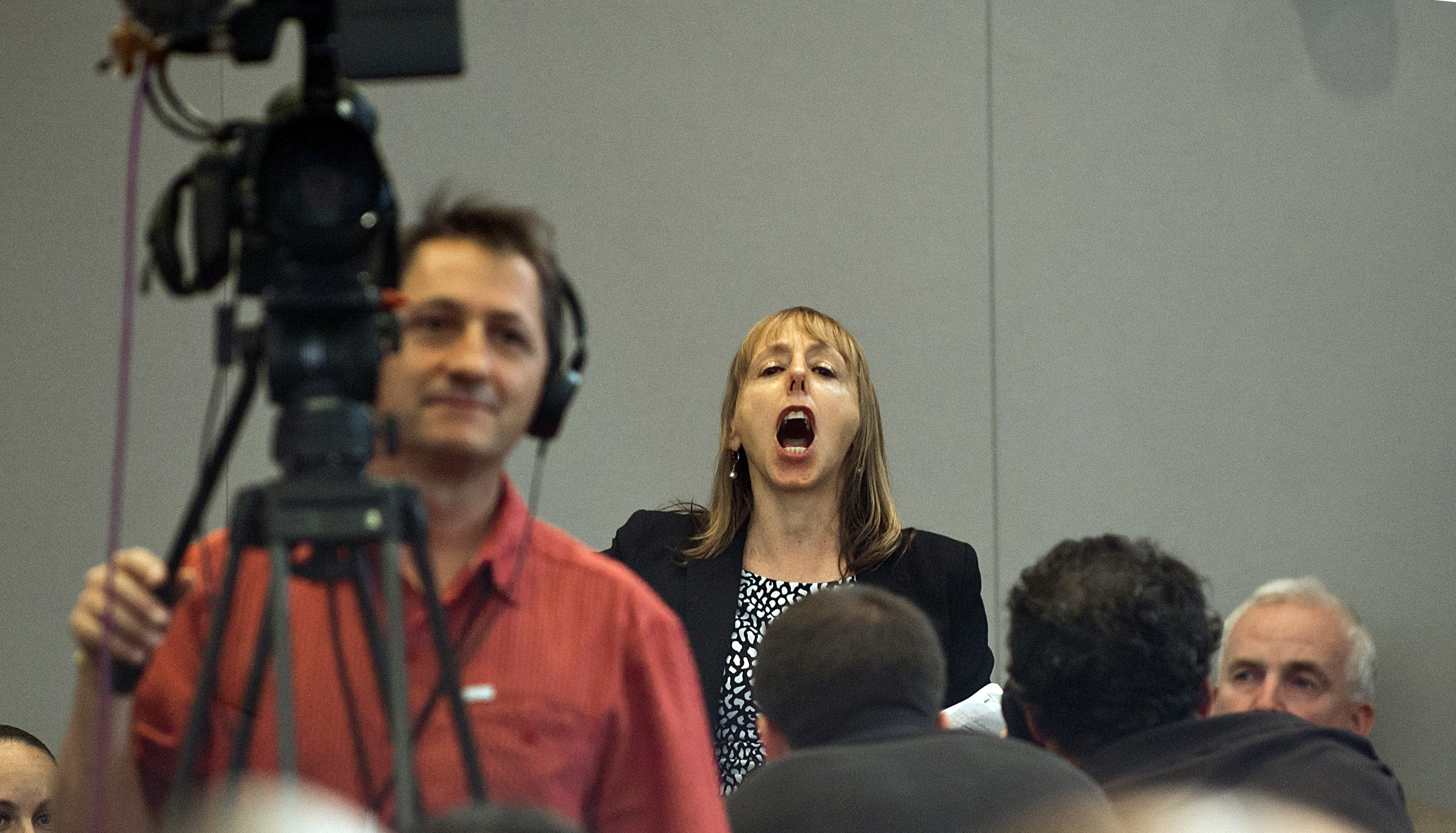
(Photo: Medea Benjamin, a protester and co-founder of Code Pink, shouts as US President Barack Obama speaks about his administration’s drone and counterterrorism policies, as well as the military prison at Guantanamo Bay, at the National Defense University in Washington, DC, May 23, 2013. By Saul Loeb/AFP/Getty Images)

White Picket Fence Poverty

It’s on the rise:

According to a new report put out by the Brookings Institute, more poor inhabitants of the U.S. now live in suburbs than in cities and rural areas. Between 2002 and 2011, the population of the suburban poor rose 67%. That’s over twice the number seen in urban areas.

Brad Plumer summarizes key points from the report:

The biggest driver is that suburbs simply grew faster than urban areas during the 2000s, particularly in the South. At the same time, jobs have been migrating to the suburbs for many years — and that includes low-paying jobs in retail and hospitality. As a result, many of the working poor have been moving to the suburbs, too.

Reihan’s perspective:

[T]he fact that a fifth of New York city’s population lives in poverty while the same is true of only 9 percent of the population in its suburbs doesn’t represent a failing — rather, it reflects the fact that density and the widespread availability of mass transit are particularly valuable to the poor, who find it more difficult to purchase and maintain automobiles and for whom density facilitates greater access to service jobs. … So suburban poverty poses problems that poverty in dense cities well-served by transit does not. The problem we face is that the U.S. has relatively few dense cities that are well-served by transit, as such cities can greatly facilitate upward mobility for the very poor.

The Story Of Wikileaks

Daniel Stuckey chats with Alex Gibney about his Wikileaks documentary:

I think the seeds of whom Assange has become today were always there: In his childhood, in the way he approached the world through the computer, in his kind of solitism, in the way he kind of took to himself and also imagined himself to always be a grander figure than he necessarily was, a kind of self-regarding narcissism. These were always there, but they were balanced with a healthy sense of idealism, and a self-deprecating humor. The Julian Assange that Mark Davis captured just before the Afghan War logs is a more interesting figure.

I think in the late scene, and through much of the more vicious attacks on Wikileaks, his character flew out of balance, and now he’s something that’s closer to a human megaphone. If you look at the Wikileaks’ twitter page, I think there’s something like 1.5 million followers. And then look at how many people that site is following. Two. And they’re both Wikileaks sites, so, you know (laughs), that’s kind of a grand metaphor. Lots to say, but not much to listen. Not much patience for listening, not much bandwidth for listening.

Reason also has an excellent new interview with Gibney about his film:

Machine Gun Parties

Bryan Schatz attends a “building party”, where gun enthusiasts privately collect and assemble pieces from various assault rifles:

Although US customs laws ban importing the weapons, parts kits—which include most original components of a Kalashnikov variant—are legal. So is reassembling them, as long as no more than 10 foreign-made components are used and they are mounted on a new receiver, the box-shaped central frame that holds the gun’s key mechanics. There are no fussy irritations like, say, passing a background check to buy a kit. And because we’re assembling the guns for our own “personal use,” whatever that may entail, we’re not required to stamp in serial numbers. These rifles are totally untraceable, and even under California’s stringent assault weapons ban, that’s perfectly within the law.

His takeaway:

I’m left wondering: Seeing how easy this is, are build parties monitored? Do hand-built weapons ever surface in crimes? Are the cops worried? When I call local law enforcement representatives from Los Angeles, Orange County, Santa Ana, and Garden Grove, they say they’ve never heard of such a thing. “That doesn’t happen here,” says Bruce Borihanh, an LAPD spokesman. But a cursory browse of online gun forums is enough to show that, well, clearly it does. There seems to be one about every month. Plus, I just attended one less than an hour’s drive from his office.

I’m reminded of what one of the build party hosts said before I left: “Remember that thing I told you about why people do this: These builds can happen only because they aren’t blown out to the public and law enforcement.”

An End In Sight

US-POLITICS-OBAMA-COUNTERTERRORISM

[Re-posted from earlier today. Blogosphere response to the pivotal speech here.]

The challenges that Barack Obama faced upon taking office were, even his critics would admit, daunting: an economy tail-spinning toward a second Great Depression, two continuing, draining and tragically self-defeating wars, and an apparatus of vastly expanded executive power (including torture) which had only just begun to be checked by the judiciary. More to the point, the United States was formally at war in a conflict which seemed to have no conceivable end.

And so easily the most important thing the presidents said today, it seems to me, was the following:

We must define the nature and scope of this struggle, or else it will define us, mindful of James Madison’s warning that “No nation could preserve its freedom in the midst of continual warfare.” … The AUMF [Authorization for Use of Military Force Against Terrorists] is now nearly twelve years old. The Afghan War is coming to an end. Core al Qaeda is a shell of its former self. Groups like AQAP must be dealt with, but in the years to come, not every collection of thugs that labels themselves al Qaeda will pose a credible threat to the United States.

Unless we discipline our thinking and our actions, we may be drawn into more wars we don’t need to fight, or continue to grant Presidents unbound powers more suited for traditional armed conflicts between nation states. So I look forward to engaging Congress and the American people in efforts to refine, and ultimately repeal, the AUMF’s mandate. And I will not sign laws designed to expand this mandate further. Our systematic effort to dismantle terrorist organizations must continue. But this war, like all wars, must end. That’s what history advises. That’s what our democracy demands.

“Ultimately repeal the AUMF’s mandate”. I wish the word “ultimately” were not there. But the announcement of an eventual, discrete, concrete end to this war may have been a step enough for now. For my part, I think it should be a critical goal of this administration to repeal that AUMF by the end of its second term. Our goal must not be an endlessly ratcheting of terrorist and counter-terrorist violence that creates more enemies than friends. Our goal must be normalcy and freedom, even as we continue strong counter-terrorism strategies outside of the context for warfare.

I’m glad the president defended the strike against Anwar al-Awlaki as forcefully as he should:

When a U.S. citizen goes abroad to wage war against America – and is actively plotting to kill U.S. citizens; and when neither the United States, nor our partners are in a position to capture him before he carries out a plot – his citizenship should no more serve as a shield than a sniper shooting down on an innocent crowd should be protected from a swat team.

My view entirely. I’m struck too by his Niebuhrian grasp of the inherent tragedy of wielding power in an age of terror – a perspective his more jejune and purist critics simply fail to understand. This seems like a heart-felt expression of Christian realism to me:

It is a hard fact that U.S. strikes have resulted in civilian casualties, a risk that exists in all wars. For the families of those civilians, no words or legal construct can justify their loss. For me, and those in my chain of command, these deaths will haunt us as long as we live, just as we are haunted by the civilian casualties that have occurred through conventional fighting in Afghanistan and Iraq. But as Commander-in-Chief, I must weigh these heartbreaking tragedies against the alternatives.

Indeed he must. And in the aggregate, I think history will look back on the balance he struck and see more wisdom in it than the purism on the civil liberties left and right or the lawless violence and torture of the Bush-Cheney years.

A few more key points: he will end the moratorium on releasing Yemeni prisoners at GTMO; he has appointed a figure to expedite the closure of the former torture camp (perhaps his newfound friendship with John McCain can accelerate the process). But he offered no real solution to the 50 or so prisoners deemed still dangerous to the world but who cannot be tried for lack of admissible evidence. He had noting really on that – except a self-evidently vain appeal to a Congress unwilling to give an inch on anything.

But the broader framework of the speech was the most important: the possibility of a return to normality, to a point where the understandable trauma of 9/11 no longer blurs our ability to construct a realist but restrained counter-terror strategy. That’s the promise of his presidency: the healing of a giant wound to this country’s psyche and values. And here’s where it came through most tellingly for me:

The scale of [the current] threat closely resembles the types of attacks we faced before 9/11. In the 1980s, we lost Americans to terrorism at our Embassy in Beirut; at our Marine Barracks in Lebanon; on a cruise ship at sea; at a disco in Berlin; and on Pan Am Flight 103 over Lockerbie. In the 1990s, we lost Americans to terrorism at the World Trade Center; at our military facilities in Saudi Arabia; and at our Embassy in Kenya. These attacks were all deadly, and we learned that left unchecked, these threats can grow. But if dealt with smartly and proportionally, these threats need not rise to the level that we saw on the eve of 9/11.

We can envisage a world in which this war is over, and yet our counter-terrorism continues “smartly and proportionally”. It is a tough and usually lonely task to make these calls. Which is why a president is ultimately accountable for them. Today, he stood accountable; and he neither shirked from responsibility nor apologized for the inherent tragedy of any armed conflict.

From this hard realist assessment, however, came a light at the end of a psychological and political tunnel; a small flicker hope at the end of a long dark night of fear.

(Photo: US President Barack Obama speaks about his administration’s drone and counterterrorism policies, as well as the military prison at Guantanamo Bay, at the National Defense University in Washington, DC, May 23, 2013. By Saul Loeb/AFP/Getty Images.)

Good Enough For Government Work?

Ezra wants the IRS to clean house:

A number of IRS employees developed criteria that was politically biased both in appearance and in effect. They were reined in once by their superiors, and then they changed the criteria again, and had to be reined in a second time. Their actions called the fairness of the agency into question and kicked off a national scandal. Even if their intent was pure, they showed bad judgment, more than a bit of incompetence, and perhaps even a touch of insubordination. That is reason enough to fire people, even if the process is difficult.

Daniel Foster doubts that Lois Lerner, director of the misbehaving IRS office, will get axed:

Statistically speaking, the firing of a federal employee is a rare event. A Cato Institute study showed that in one year, just 1 in 5,000 non-defense, civilian federal employees was fired for cause. A widely cited analysis by USA Today found that in FY 2011, the federal government fired just 11,668 out of 2.1 million employees (excluding military and postal workers). That’s a “separation for cause” rate of 0.55 percent, roughly a fifth the rate in the private sector.

And the firing of employees who fit Lerner’s profile is rarer still. Lerner is very much a “white-collar” employee, and the same analysis found that blue-collar employees (such as food-service workers) were twice as likely to be fired.

Conor Friedersdorf zooms out:

There are many more examples [of misbehaving employees] at the local, state, and federal level. None so far has prompted Democrats or progressives to acknowledge that public employees are so well-protected that the ability to run well-functioning institutions is sometimes being compromised. In one way, the IRS controversy is sure to be unrepresentative since it is getting so much more press than almost any other act of wrongdoing by federal employees. But it will afford us a high-profile opportunity to watch the process play out.

Obama’s War On Terror Speech: Reax

How Chait understands Obama’s remarks (seen above):

President Obama’s speech today defending his conduct in the war on terror was notable for what he was defending it against — not against the soft-on-terror (and maybe sorta-kinda-Muslim) attack that Republicans have lobbed against him since he first ran for president, but against critics on the left. … Politically, if not substantively, Obama’s speech today represents a watershed moment. For the first time in the post-9/11 world, the domestic political threat in the war on terror comes from the left rather than the right.

Matt Welch wants more than a speech:

There was much to like in Obama’s speech today if you like words, and share the broad worries he outlined above. And it is surely true that changing policy becomes easier after you make public arguments about changing policy. But the fact is Barack Obama is the president of the United States, and according to both the Constitution and especially the way executive power has accrued over the past century, Obama actually has quite a bit of latitude to impose his values on the waging of American war. After 52 months in office, it’s long since past time to stop judging the man by his words alone.

Max Fisher focuses on the case Obama made for drones:

Although there’s a complexity to Obama’s moral case for drones, it reduces down to a binary: Using drones can kill civilians, but not using them would lead to even more civilians being killed. There are many, many more moral, ethical and legal issues related to drones, some of which are in the speech and some of which aren’t. And there is a wide range of gray areas in how they’re implemented, against whom, under what circumstances and what guidelines. But it’s this basic proposition – taking lives to save others – that seems at the heart of Obama’s case.

Ackerman’s bottom line:

Obama’s new approach to the drones in Year Thirteen of the war on terror should feel familiar. It contains an echo of how he wound down the Iraq and Afghanistan wars: not by drawing a hard and fast end to them, but by allowing military commanders to very slowly reduce the size of their forces. If it worked well enough for flesh-and-blood troops, Obama is basically saying it’ll work well enough for robots.

PM Carpenter praises the speech:

One phrase deployed by Obama really struck home. In America’s continuing battle against terrorists, there is “no moral safe harbor.” Not, anyway, for a president, this one or the next. Virtually every counterterrorism path that a president pursues is a trade-off–a little security here for a piece of your liberty there; 10 innocents killed in exchange for a thousand later saved–and it’s just so damn refreshing to hear a president admitit rather than suppress it through a fog of uberheroic, hyperpatriotic neocon bullshit. Wars do compromise our values; we eventually become what we hate; and President Obama appeared to be running the clock back. He knows where this is headed, and it ain’t good.

Allahpundit heard little new:

He’s offering a robust defense of drone warfare to a public that already accepts it. The speech is really just an unusually exhaustive compendium of the foreign-policy establishment’s favorite counterterror bromides. Foreign Policy magazine has a Cliff’s Notes version of the four major takeaways, but none of them are actually major. He wants to close Gitmo, which we knew; he kinda likes the idea of independent oversight on drone strikes but maybe not too much, which we could have guessed; he wants to codify drone practices to make sure they’re used as narrowly as possible, but an Obama official couldn’t tell FP how that differs from the current policy; oh, and he thinks it’s time to stop thinking of this as a “boundless” global war on terror and start thinking in terms of discrete actions, which is semantic nonsense.

Kilgore was stuck by how often Obama blamed Congress:

One thing is fairly clear: the speech poses a challenge to congressional Republicans that may not be that easy for them to meet, distracted as they are and as divided as they tend to be on national security policy these days. As Slate’s Dave Weigel quickly noted, Obama four times shifted responsibility for current dilemmas at least partially to Congress: on drones (where he insisted the appropriate congressional committees have known about every single strike); on embassy security; on the 9/11-era legal regime that still governs anti-terrorist efforts; and on Gitmo (where Republicans have repeatedly thwarted effort to transfer detainees to U.S. prisons).

And Benjamin Wittes thinks Obama is more powerful than he lets on:

Obama does not need Congress to narrow or repeal the AUMF or to get off of a war footing. He can do it himself, declaring hostilities over in whole or in part. And Obama, needless to say, did not do anything like that. To the contrary, he promised that “we must finish the work of defeating al Qaeda and its associated forces” and while he used a lot of nice words about law enforcement and a lot of disparaging words about perpetual states of war, he also promised to continue targeting the enemy with lethal force under the AUMF. In other words, he promised—without quite saying it directly—to keep waging war

My thoughts here.