Letters From Oklahoma

Massive Tornado Causes Large Swath Of Destruction In Suburban Moore, Oklahoma

A reader writes:

I live in Moore about a block south of the corner of SW 19th and S Santa Fe, less than 2 miles south of where Plaza Towers Elementary used to be. I drove past Moore Medical Center every day on my way home from work. If the tornado had turned east toward Santa Fe just a quarter of a mile sooner than it did, our home would have taken a direct hit. Our power has been restored, and though our yard is filled with trash (a familiar refrain: I have found strangers’ family photos on our lawn), our house is largely untouched. Almost everything north of us has been obliterated. I came very close to losing everything, yet came out largely unscathed. What I keep returning to in my mind is that just a few blocks away, seven kids lost their lives.

Another:

I just wanted to make sure that you know that, although the tornado warning was issued with 16 minutes warning, we had multiple days of warning that Sunday and Monday were high risk tornado days in our area. Scroll through the Facebook posts from the US National Weather Service in Norman (just south of Moore) and you will see what I am talking about. On Monday morning they warned that the risk in our area would be maximal at about the time kids were to be let out of school, and that we might need to make different plans. I picked my children up from their elementary school in Oklahoma City early that day in response to their video update from around 11 AM. Had I waited until close to their usual 3:10 pick up time, I would not have been able to get them, as the school was on lock down due to the tornado warning. My kids’ school does not have underground shelter. With an F5 tornado, that’s what they need. I know the schools need improved safety, but with that monster coming I was glad we had an in-ground shelter in the floor of our garage.

Anyway, the National Weather Service has been the unsung hero of this, and I wanted you to know about them and their relatively new foray into social media. (They are facing sequester cuts, which is terrible.) Oh, and on the subject of shelters, I wanted to add my curmudgeonly two cents.

My family has a small in-ground shelter in our garage. I got it after we moved into a new house and realized that it had no good interior rooms for shelter and no basement (they all leak around here). One tornado siren with my husband, my newborn and my 20-month-old, huddled in a hallway under a mattress, was enough to make me bite the $5000 bullet and get one. That was five years ago.

My neighbors saw the shelter crew jackhammer the hole in our garage floor and put it in. They took interest, but none of them bought one.

On Monday as the sirens blew, and while I was upstairs keeping close track of our excellent meteorologists on TV and frantically trying to think of the things I needed to grab that would be crucial to us if the house blew away, my bicycle-helmeted kids were safely in the shelter. So were my two crated cats, my two dogs, my computer hard drive and my wedding album, along with our prescription drugs, several lanterns, a battery operated fan, my kids most favorite stuffed animals, and my plastic tub containing our emergency supplies (crowbar, blankets, water, food, emergency contact information, cash, etc.). It was pretty jam-packed down there.

I would have tossed everything but my kids out without hesitation to save my neighbors if that tornado had come to our house (some neighbors have come over in past storms). But I have to admit that I am just a bit ticked off that none of them have gotten their own shelter. Not everyone can afford them, but my neighbors could. They all have their places to go in the event of a tornado, but when it is an EF5 and you know you won’t survive above ground, you need an underground plan. I don’t mind if my shelter is someone’s accidental plan. I just don’t want it to be the place they depend on. I feel guilty saying it, but I want to be able to keep my wedding album and my hard drive and my kids’ stuffed animals, and especially my pets!

Want I want to say but never would is this: “Get your own damn shelter!”

Another:

One of your OKC subscribers writing in. We are all devastated. Seeing this type of destruction in your own city is a difficult feeling to describe.

My husband was huddled in an underground room of his school with high school students not far from the storm. When our local weather man said that the storm was taking the same path as the May 3, 1999 storm, I shuddered. That would have meant it was coming for my husband’s school, which was hit by that storm. Fortunately for us, the storm went east instead of north this time, thereby missing Tinker AFB and Midwest City.

What we spoke about last night, though, as we watched our local anchor report the gut wrenching news, was what will change now? When we grew up here as kids they told us go to an interior closet or bathroom, put on a helmet, put a mattress over your head if you can. But after May of 1999, they knew yesterday to tell us on the TV, “Get underground or get out of the way.” They kept repeating it, knowing they were trying to save lives. These “grinders,” as they call them, are different. They literally scour the earth. With a storm that can go from nothing to EF5 in under an hour, what about those parents who do work far from their kids schools? Many times growing up I was huddled against a hallway wall in duck and cover position, and that was not enough to save some of those kids.

What do we do? I can tell you that it is a conversation many of us are having right now. We have always dealt with tornadoes here – they are a part of life. But we are all thinking about what types of emergency plans we need to reconfigure, how our mindset will be different the next time. For a state full of people already extremely knowledgeable about what to do during a tornado, what can we do to be better prepared?

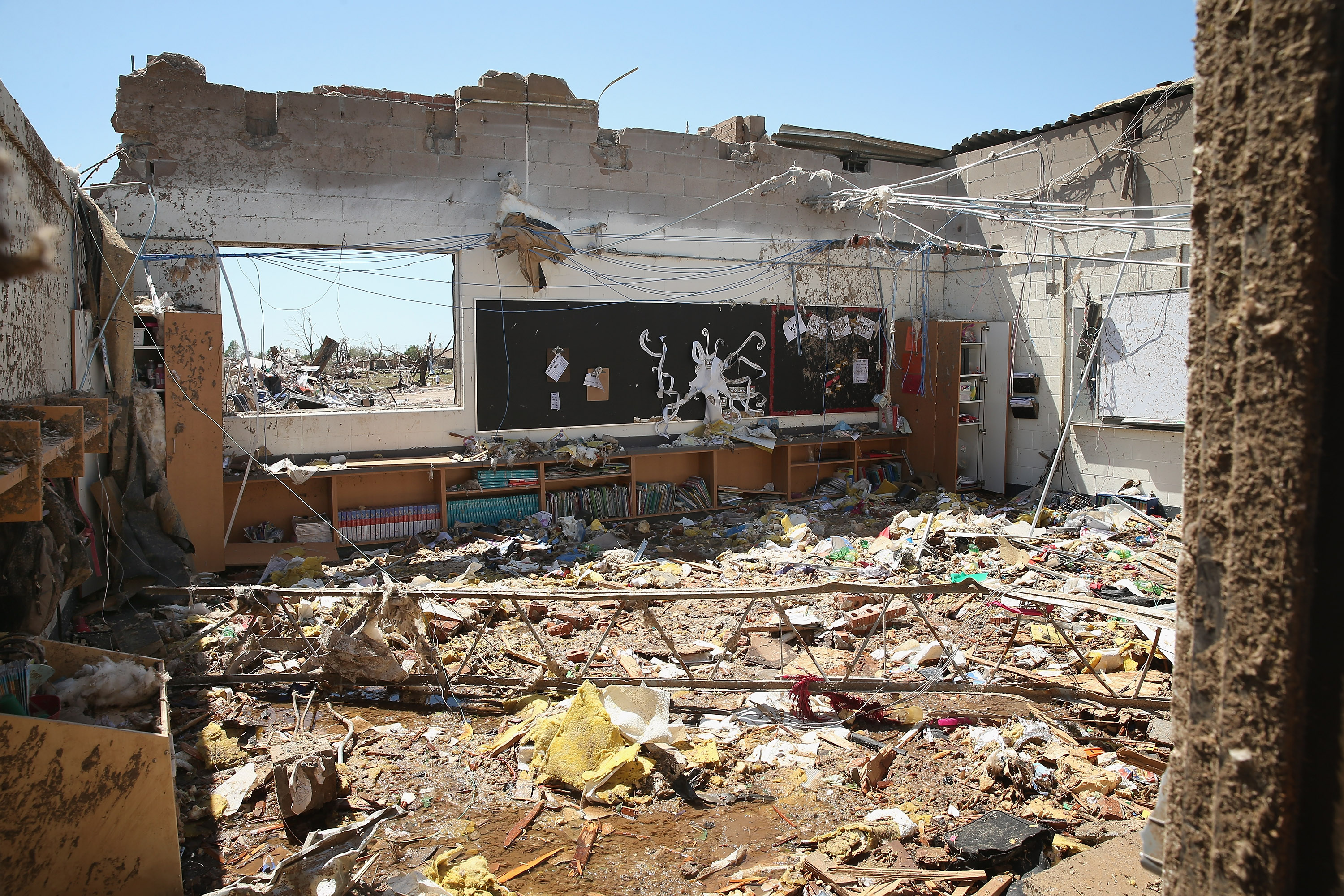
(Photo: Debris litters what remains of a classroom at Plaza Towers Elementary School after it was destroyed by a tornado that ripped through the area on May 22, 2013 in Moore, Oklahoma. Seven children died in the school during the tornado. The tornado of at least EF4 strength and two miles wide touched down May 20 killing at least 24 people and leaving behind extensive damage to homes and businesses. U.S. President Barack Obama promised federal aid to supplement state and local recovery efforts. By Scott Olson/Getty Images)
“He Said It Was A War”

I’m feeling things today in the wake of this act of religious barbarism on the streets of London that I haven’t felt for a while. The monster who paraded around on the street after hacking a soldier to pieces is chilling in many ways. But everything points to a religious act of terror, motivated by the same Jihadist rage that captured the Tsarnaev brothers. For these men, “our land” is not Britain; it is the land of Islam in their minds. Here’s the full quote of the Jihadist:

We swear by the Almighty Allah we will never stop fighting you until you leave us alone. The only reason we have killed this man this is because Muslims are dying daily. This British soldier is an eye for an eye a tooth for a tooth … We must fight them as they fight us. An eye for an eye a tooth for a tooth. I apologize that women had to witness this today but in our lands our women have to see the same. You people will never be safe. Remove your government. They don’t care about you.

This eye-witness account shows that even in the midst of this Islamist barbarism, some shred of humanity remained:

“I saw a guy with no head lying on the ground. He had been decapitated. There were two black guys walking around his body saying ‘This is what God would’ve wanted’. My friend and her mum were walking up the hill and the mum came straight to the victim. She asked the black guys ‘can I help him?’ And one of them said he was already dead but she could go. Then one of them said ‘No man is coming near this body, only women’. She was so brave, she didn’t care what happened to her – she knelt down by his side and comforted him. She held his hand and put her other hand on his chest. I think she might have been praying.”

There is no formal confirmation that the victim, who was run over on the sidewalk by the Islamists’ car, was actually a soldier, but he was wearing a t-shirt that referred to a charity for veterans, and was near a barracks. Mercifully, the response from the Muslim community in London has been unequivocal:

This is a truly barbaric act that has no basis in Islam and we condemn this unreservedly. Our thoughts are with the victim and his family. We understand the victim is a serving member of the armed forces. Muslims have long served in this country’s armed forces, proudly and with honour. This attack on a member of the armed forces is dishonourable, and no cause justifies this murder.

A girl scout leader, Ingrid Loyau-Kennett, was on the scene and managed to talk to the butchers as they hung around, bragging for the cameras, their hands dripping with blood:

I spoke to him for more than five minutes. I asked him why he had done what he had done. He said he had killed the man because he [the victim] was a British soldier who killed Muslim women and children in Iraq and Afghanistan. He was furious about the British army being over there.

There was blood on the pavement by the car where the man on the ground had been hit by it. At first there was no blood by the body but as I talked to the man it began to flow which worried me because blood needs a beating heart to flow. But I didn’t want to annoy the man by going back to the body.

I asked him what he was going to do next because the police were going to arrive soon. He said it was a war and if the police were coming, he was going to kill them. I asked him if that was a reasonable thing to do but it was clear that he really wanted to do that. He talked about war but he did not talk about dying and then he left to speak to someone else.

Two things are true here. The first is that this was a religious sacrificial murder, authorized by God in the eyes of the killers. The second is that this is clearly motivated by blowback from the wars in Iraq and Afghanistan. The first is indefensible on any grounds. The second is a reminder that in the war against this religious barbarism, occupying Muslim countries is not an answer.

Judging A Society By Its Word Choice

David Brooks considers [NYT] recent studies on the frequency of given words in published books over time:

The first element in this story is rising individualism. A study by Jean M. Twenge, W. Keith Campbell and Brittany Gentile found that between 1960 and 2008 individualistic words and phrases increasingly overshadowed communal words and phrases. That is to say, over those 48 years, words and phrases like “personalized,” “self,” “standout,” “unique,” “I come first” and “I can do it myself” were used more frequently. Communal words and phrases like “community,” “collective,” “tribe,” “share,” “united,” “band together” and “common good” receded.

The second element of the story is demoralization. A study by Pelin Kesebir and Selin Kesebir found that general moral terms like “virtue,” “decency” and “conscience” were used less frequently over the course of the 20th century. Words associated with moral excellence, like “honesty,” “patience” and “compassion” were used much less frequently.

Robin Lakoff, professor of Linguistics at UC-Berkeley, counters with an example:

Consider “racism.” It is first attested, according to the Oxford English Dictionary, in the first decade of the 20th century. By Brooks’ standard, that would imply that racism, the attitude and behavior, only came into being then, and therefore only then needed a word to describe it. Similarly, “sexism,” in its current sense, is only attested in the mid-1960s. What should we make of that?

Actually, the appearance of these words at those times is a positive indicator. Racism and sexism have been endemic in our species as far back as the historical record allows us to determine, and probably further. But it was only in the 20th century that people first began to see these kinds of behaviors as something other than normal and inevitable, and therefore worthy of naming and eventually changing.

The “Loneliness Epidemic”

Douthat, noting [NYT] that violent crimes are on the decline while suicides are up, blames increased isolation:

As the University of Virginia sociologist Brad Wilcox pointed out recently, there’s a strong link between suicide and weakened social ties: people — and especially men — become more likely to kill themselves “when they get disconnected from society’s core institutions (e.g., marriage, religion) or when their economic prospects take a dive (e.g., unemployment).” That’s exactly what we’ve seen happen lately among the middle-aged male population, whose suicide rates have climbed the fastest: a retreat from family obligations, from civic and religious participation, and from full-time paying work.

Nate Cohn pushes back:

Contrary to what Douthat might expect, there’s no correlation—zero—between a states’ suicide rate and religion, marriage rates, or single occupancy homes.

State economic growth or unemployment don’t line up, either. … If anything correlates with suicide rates, it’s a states’ population density: In populous areas, suicide rates are low; in the sparsely populated hinterlands, suicide rates are high. Perhaps depression and loneliness is particularly harsh in desolate areas, and maybe it’s easier to cope in a major city like D.C. or New York.

A more intriguing possibility is gun ownership, which, like suicide rates, is highest in the West and lowest in the Northeast. The relationship between gun ownership and suicide isn’t hard to envision, since more than half of suicides are by firearm. Therefore, accessible firearms could plausibly increase suicide rates. Then again, the South has high levels of gun ownership and higher levels of depression than the inland West, but suicide is rarer in Alabama than Montana.

Douthat goes another round:

A strong link between population density and suicide hardly demonstrates that social belonging doesn’t play a role in suicide rates: It just suggests that the literal physical component in loneliness can matter as much or more than emotional and institutional ties. And the geographic pattern Cohn describes is perfectly compatible with other factors — from unemployment to divorce to, yes, gun policy — playing a role in national trends. There are plenty of cases where longstanding patterns don’t suffice to explain emerging trends that cut across regions and demographic groups: The fact that crime rates are generally higher in cities doesn’t mean that “population density” suffices as an explanation of changes in the crime rate, for instance, and the fact that out-of-wedlock birth rates are higher among African-Americans than whites doesn’t mean that “race” suffices as an explanation for the post-1960s rise in unwed childbearing.

One factor that might be salient in increasing suicides is the staggering increase in the use of prescription drugs. Here’s what I recently wrote in my column for the Sunday Times:

Consider that for eleven consecutive years, drug overdose deaths have risen in America, from 4,000 in 1999 to 16,000 by 2010, according to the latest statistics from the Centers for Disease Control. The majority of these deaths are now from drugs prescribed legally in the US and the world – opiate pain-killers like Oxycodone leading the way, but often combined with anti-anxiety medications. Yes, these require a prescription – but just sit down and see how easy it is to get these drugs online through fake doctors or doctors for hire. Yes, more monitoring is now recommended and more crackdowns on unethical doctoring. But you get the distinct sense that this is a losing struggle. Both the technologies of pharmaceuticals and of their distribution have been revolutionized in the last couple of decades. It’s going to be as hard to return to more social control as it will be to sustain newspapers printed on paper.

But that may simply confirm Ross’s worry about social isolation, and the consequences of untrammeled libertarianism. The trouble is that if you accept Ross’s analysis, it’s not clear what the solution is. Freedom is contagious; community fragile.

Rejecting Rafsanjani

Iranian influential cleric and former pr

Yesterday, Iran’s Guardian Council shocked the country by disqualifying the presidential candidacy of Rafsanjani, one of the architects of both the Iranian Revolution and the country that resulted from it. Thomas Erdbrink passes along [NYT] this succinct reaction from an Iranian citizen:

“They say a revolution eats its children,” said Mehdi, 27, a teacher. “But in the case of Rafsanjani, the revolution has eaten its father.”

Erdbrink makes a key observation with regards to what this election, on its current course, may mean for Iran:

Since its founding in 1979, the Islamic republic has been characterized by constant and often public competition among opposing power centers, a back-and-forth that gives ordinary citizens and private business owners the ability to navigate among the groups.

Barring further surprises, the winner of the June election will now be drawn from a slate of conservative candidates in Iran’s ruling camp, a loose alliance of Shiite Muslim clerics and Revolutionary Guard commanders. That would the presidency under their control and would mark the first time since the 1979 revolution that all state institutions were under the firm control of one faction.

Meanwhile, Iranian MP Ali Motahari, a Rafsanjani ally, has voiced his outrage over Rafsanjani’s disqualification in a public letter that has already been deleted off of some Iranian news sites:

“My strong assumption is that if Imam Khomeini were alive and he registered under a pseudonym, he would be disqualified, because sometimes he expressed criticism.” Although Rafsanjani has never publicly criticized Khamenei, after the 2009 contested elections Rafsanjani took a moderate tone with regard to the protesters, and it is commonly understood that the two are at odds over various political and economic issues of the country.

Motahari wrote, “You are informed that with the entry of Rafsanjani to the political scene, how much enthusiasm it created among the people and how much hope it gave them for reform and growth. With his disqualification, naturally, this enthusiasm and hope has disappeared.” He continued, “My recommendation is that with a [government decree], you approve of Rafsanjani’s” candidacy.[“]

Ayatollah Khomeini’s daughter has similarly asked Khamenei to reinstate Rafsanjani’s candidacy. Suzanne Maloney thinks through the regime’s reasoning:

However absurd the Islamic Republic’s vetting process has been in the past – and more than two dozen elections over the course of 34 years have provided plenty of fodder – the suggestion that a man who has been at the apex of power in the Islamic Republic since its inception no longer meets its constitutional standards for the presidency carries the farce to a new level.

Rafsanjani sits on the Assembly of Experts, which appoints Iran’s supreme leader, and leads its Expediency Council, which adjudicates challenges to proposed legislation. The determination that he is unfit for the presidency inevitably calls into question the credibility of these other institutions. The other rationale on offer— the aspersions on Rafsanjani’s advanced age (78) that were invoked by a number of conservative power brokers— is similarly insupportable. The Islamic Republic is, after all, a clerical gerontocracy. Rafsanjani may be closing in on 80, but he cuts a relatively spry figure among the Iranian political establishment, including by comparison with its late founder who seized power as a septuagenarian.

Regardless, Maloney doesn’t buy the idea that Rafsanjani would have been some kind of savior:

The image of the former president as an infallible architect of economic reform is in fact greatly exaggerated. He did spearhead the post-war reconstruction program against considerable domestic opposition, but his policies also instigated a destabilizing debt crisis and spiraling inflation. Rafsanjani’s reputation for personal enrichment, the ascendance of his sons and daughters and nephew, and the culture of crony capitalism that emerged during his tenure left deep resentments among ordinary Iranians whose share of the post-war spoils typically did not expand.

As part of an extended look at the complicated relationship between the Rafsanjani and Khamenei, Max Fisher highlights how Rafsanjani’s flirtation with the American oil industry during his presidency may have played a role in his disqualification:

Despite those years of post-presidential loyal service to the supreme leader, Rafsanjani is still closely associated with the signature foreign policy issue that appears so anathema to Khamenei: outreach to the United States. The supreme leader, after years of tension with his country’s president during Rafsanjani’s tenure, during Khatami’s more reformist administration and, finally, in the now-ending Ahmadinejad era that saw the two grapple for power, perhaps does not want to grapple with Rafsanjani again.

Marcus George rounds up Iran’s remaining pre-approved presidential candidates:

“All of the approved candidates are either loyal to Supreme Leader Ayatollah Khamenei or are mostly irrelevant,” said Alireza Nader, an analyst at RAND Corporation. “Khamenei may still overturn the decision, but Rafsanjani’s disqualification shows that Khamenei is determined to wield all power. This appears to be a presidential selection rather than an election.”

BBC has a primer on the eight approved candidates.

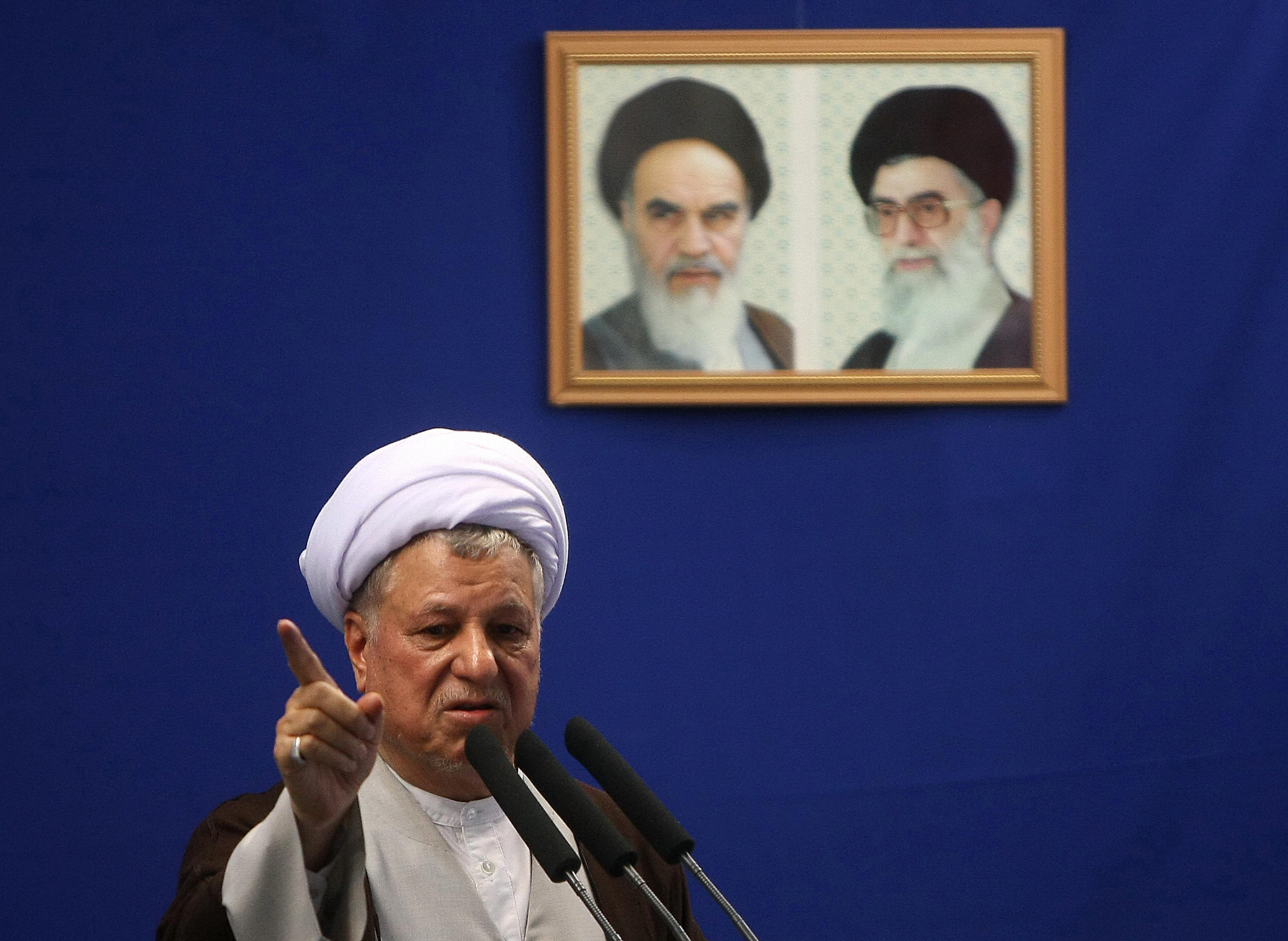
(Photo: Iranian influential cleric and former president Akbar Hashemi Rafsanjani delivers his sermon during Friday prayers at Tehran University in the Iranian capital on July 17, 2009. By Ali Rafiei/AFP/Getty Images)

When Equality Requires Big Government

Frum comes away with a new view of the postwar-South after reading The Warmth of Other Suns, Isabel Wilkerson’s book about the Great Migration:

Many of us on the right would like to tell a story of the post-Civil War South that indicts segregation as a product of government regulation only. Wilkerson’s quashes that illusion.

The oppressive actions of the Southern state presupposed the oppressive organization of Southern society and the Southern economy. It was no act of government that imposed the rule that a black customer in a shop must wait until all the white customers had been served. Store owners did not worry that mistreating black customers would cost them business, because the post-1865 settlement had failed to compensate ex-slaves in any way for their unpaid labor, meaning that even in freedom they remained nearly as landless and poor as ever. The stark divide between economic wealth and political power that matters so much to libertarian theory does not describe reality in the South of 1915.

In the North, the migrants encountered discrimination. No matter how much wealth they accumulated – and some accumulated a great deal – they could not gain the highest degree of status. But in the South, the utter lack of status had prevented black Southerners from accumulating wealth in the first place. To transform the South into something more like a market economy, open to all participants, would require the forceful application of federal government power in the years after World War II.

The Current Irrelevance Of A Flat Tax

Carol Matlack reports on the recent move away from flat taxes in the Czech Republic, Slovakia and Bulgaria:

The lesson: Flat taxes seem to work pretty well when an economy is growing—but not so well when it is stagnant or shrinking. Across Central and Eastern Europe, “every country is in need of more revenue because of debt and public deficits,” says Andreas Peichl, a senior research associate at the IZA think tank in Bonn, Germany. “There is a feeling that the crisis has affected poorer people more than the rich and that the rich should contribute more. But that is not easy to do if you only have one tax rate.”

Given the extremes of inequality we are now facing – and likely to intensify as technology cuts yet another swathe through entire industries that sustain a middle class – I have to say I am pragmatically against such a tax now, even though I have consistently supported one in the past. I’m only flip-flopping, I hope, in the best way. A flat tax remains theoretically and symbolically deeply attractive to me. I still believe that penalizing people for succeeding in our economy is unjust to those individuals. But in our current contingency of accelerating inequality, a flat tax would be socially destructive.

And a true conservative seeks to avoid social destruction more than he enshrines ideological purity (which is why I really have no love, and a lot of distaste, for the current GOP). Nonetheless, we clearly, desperately need simpler taxation. And surely that is one area of potential compromise for both the GOP and the president, if the GOP hangs on in the House.

You would have to make it revenue neutral at first. But taking not a scalpel but a sledge-hammer to deductions, especially corporate welfare, could finally create a tax code that is comprehensible to most citizens.

It is deeply damaging to our core democratic legitimacy that the average citizen has no hope of understanding the tax code. If we cannot understand it, we cannot truly monitor it. And thereby lies one root of profound distrust of government, of the way in which powerful interests, like Apple, can find ways to avoid tax, while the struggling middle class has no way out. Yes, we need new revenue. Desperately. But if the actual politics prevent it, why not the next best thing: radical tax simplification. Some may argue that this could ultimately hurt the Democrats’ leverage for more revenue. So be it. We have four years of what could be stalemate – and this framework could unite sane people in both parties to make our tax regime comprehensible, reduce the income of lobbyists, and restore a sense that the game is not rigged. Those are important – close to indispensable – elements of a functioning democracy.

Obama At Morehouse, Ctd

A reader writes:

As an African-American, I respect your point about the value of Obama’s speech at Morehouse, but ultimately, I completely agree with TNC’s critique.  Why?  Because I am tired.  It seems that every time Obama comes to the black community to address us, he lectures us; he does not simply speak to us. He gives us a lesson about personal responsibility; he preaches to black men about responsible fatherhood; etc.  These are crucial topics, and matters that we, as a community must solve and address, but must he talk about them every goddamned time he comes into the community?

This is especially galling when he refuses to address in explicit terms the specific policy needs of the black community (and they do exist).

I understand that he is the President of ALL of America, but would it kill the man to fight for at least a few policy initiatives that would specifically benefit low-income African-Americans, in particular?  God knows we fought for him when we stood in lines across this country, often times for hours, in the face of relentless Republican efforts to disenfranchise us, simply so that he could put up with those boneheads for another four miserable years.  If he is going to be our constant scold, it would ease the sting if he was occasionally more than our symbolic benefactor.

I will close on one last note, and I want you, in particular, to be mindful of this.  Some of the best and brightest young African-American men in the country attend Morehouse, and many of those men grew up in middle and upper middle-class families (a number of which are likely still intact).  I would not be surprised if there are at least 1-2 men in each class who turn down Harvard, and a handful more who turn down other Ivy League schools, in order to attend Morehouse.  It has a storied history, and the men who attend that institution graduate, attend exceptionally fine graduate institutions, and often lead wonderfully productive lives.

Of all the groups of young men in the world who needed to hear the lecture that the President gave, they should not have been high on that list.  He should have treated them like he would have treated the graduating class at Harvard: like bright young people with a world of possibilities in front of them, who had the right to pretend on just one day that a legacy of pain and the assumption of inadequacy did not accompany their every step.

I’m grateful for that perspective. And for my reader’s sharing of it.

Which Storm Shelters Are Worth It?

Powerful Tornado Rips Through Moore, Oklahoma

David Cay Johnston believes that “costly specialized storm shelters—big public structures that would be used only every few years or even every few decades” aren’t smart investments:

In Webb City, next door to Joplin, the Federal Emergency Management Agency gave $3 million last year to build a safe room at the local high school. It can shelter 3,000 people, if they can get there before a twister strikes. (And that’s a big if, given the short time between a tornado warning and the moment when the doors need to close; just picture how tough it is to get 250 people into a jumbo jet in 40 minutes.) The shelter cost $1,000 per person it can protect from a tornado; building shelters for everyone in Missouri at this rate would cost $6 billion. Based on Missouri’s average of two deaths per year from tornadoes, this measure would save 100 lives over 50 years at a cost of $60 million per life. Even if the shelters last 200 years, the cost would be $15 million for each life saved.

An alternative:

A planned addition to Andalusia Middle School in the southern part of Alabama includes an interior multipurpose room designed to withstand deadly storm winds. Its walls are made of thick concrete with rebar reinforcing rods. And the hallways are built with the doglegs that Roberts favors. The new school also has windows, which are good for education and a sense of well-being. If a tornado approaches, heavy steel shutters inside the building lock in place, letting the winds throw the glass outward, but leaving those inside safe.

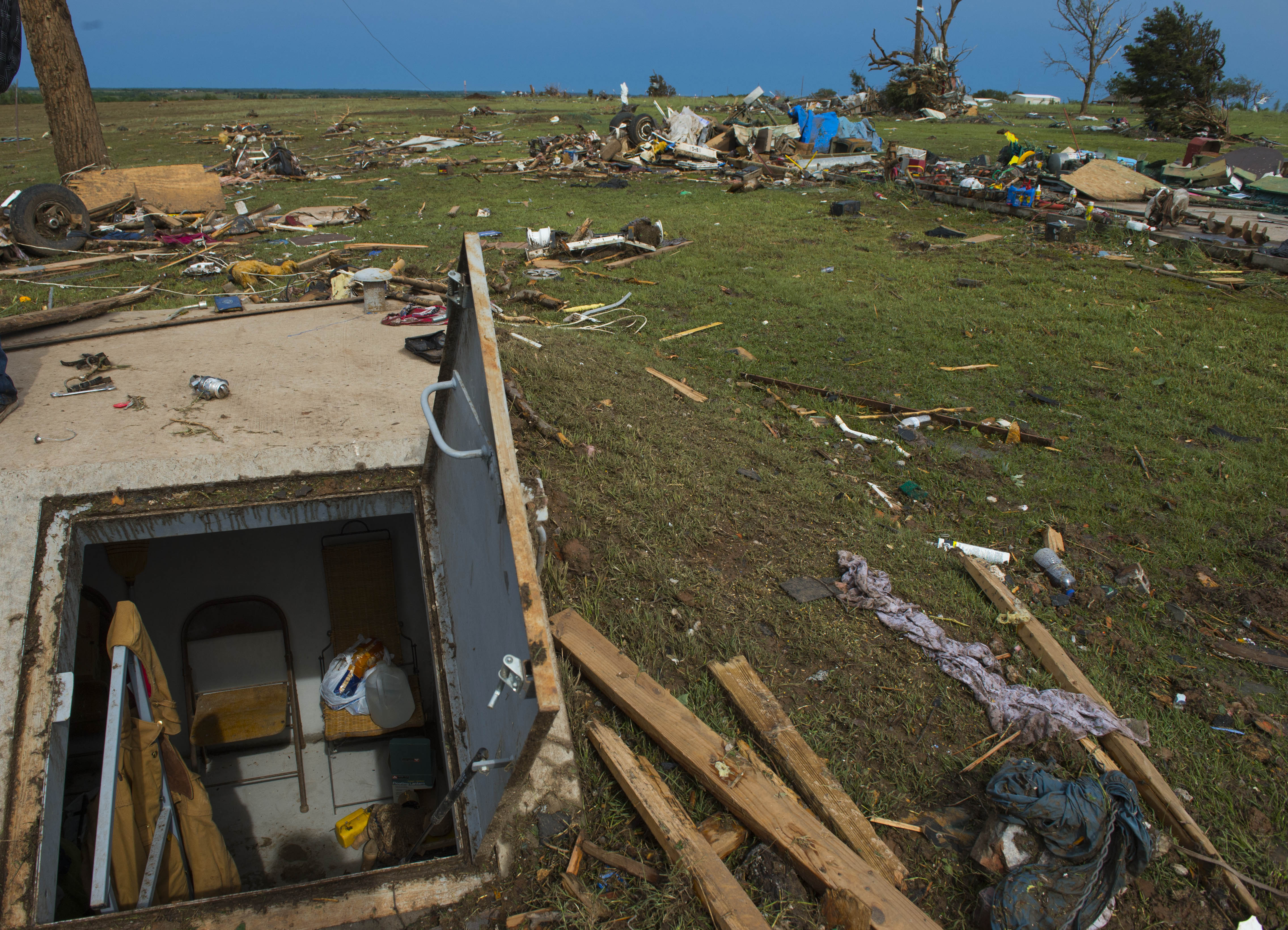
(Photo: Shown is the storm shelter that Gary and Ferrell Mitchusson used to ride out a massive tornado on May 21, 2013 in Moore, Ok. Their home was completely destroyed in the massive tornado. By Ricky Carioti/The Washington Post via Getty Images)

The Long Struggle For Marriage Equality

Evan Wolfson criticizes Michael Kinsley for prematurely declaring victory on marriage equality:

We’ve built a 58% majority for same-sex marriage nationwide, up from 27% in 1996, when Congress passed the so-called DOMA as I was co-counseling the world’s first-ever trial on whether the government actually has a good reason for denying the freedom to marry in Hawaii. We are, happily, winning … but we are far from having won.

Freedom to Marry … is gearing up for the next round of work and battling it will take to turn the public opinion we have persuaded into the actual legal and political action that will be the true “mission accomplished” that Kinsley is prematurely celebrating. We know we will win, but also know we have a huge amount still to do – organizing, educating, enlisting, lobbying, door-knocking, fundraising, and campaigning that Kinsley’s piece trivializes when he writes, “The challenge [is] simply getting people to think about it a bit.” If only it were, or had been, or will be that simple.

I think Evan mistakes Mike’s enthusiasm – and the extraordinary gains we have indeed made – with complacency. But they’re both right; we have won the argument in a way few movements have so swiftly; but we still have not come close to accomplishing the mission. We saw the still-enormous gap to overcome yesterday as gay couples were removed from being covered under the new immigration reform. The reform tries to include everyone weddingaisletrapped in immigration hell or limbo (and sometimes, trust me, purgatory), but it explicitly excludes only one group of people: gay and lesbian Americans who have taken up the responsibilities of civil marriage.

These people are not immigrants; they are American citizens forced to choose between their country and their spouse. No heterosexual would see that exclusion as anything other than what it is: the American government’s persecution of its own citizens, even as it seeks to ease the plight of its resident non-citizens. And breaking up families or forcing them to move abroad to stay together is more than discrimination. It’s cruelty. It doesn’t get clearer than that. Gay citizens are regarded as less worthy than straight non-citizens by their own Congress.

The quote of the day was from Lindsey Graham: “You’ve got me on immigration. You don’t have me on marriage. If you want to keep me on immigration, let’s stay on immigration.” There are things I would want to say to Butters that only human decency prevents. I wish he’d treat Americans like my husband with a scintilla of such respect.

Harry Enten examines the deep-red states least hospitable to equality:

With the exception of Virginia, it’s pretty clear that southern Republican support for gay marriage is lower than among Republicans nationally. As such, it’s difficult to see how support among southern Republicans will hit 50% anytime before 2040. It’s hard to imagine more than the stray Republican voting for same-sex marriage. Polarization is at all-time high, and politicians are more afraid about losing primaries than general elections. Republicans have no need to vote for same-sex marriage.

Thus, unless the federal government jumps in, most, if not all southern states won’t legalize same-sex marriage for the foreseeable future. Most of their citizens don’t want it, and by the time they do, most Republicans still won’t. Considering you’ll need a majority or supermajority of state legislators to get the bans reversed, and that Republicans have a strong hold over these chambers, same-sex marriage in the south doesn’t have much of a chance anytime soon.