The Neanderthals’ Handicap, Ctd

Annalee Newitz introduces more theories as to what happened to the human subspecies:

Anthropologists, according to [Professor John] Hawks, often ask the wrong questions of our extinct siblings: “Why didn’t you invent a bow and arrow? Why didn’t you build houses? Why didn’t you do it like we would?” He thinks the answer isn’t that the Neanderthals couldn’t but that they didn’t have the same ability to share ideas between groups the way H. sapiens did.

Their bands were so spread out and remote that they didn’t have a chance to share information and adapt their tools to life in new environments. “They were different, but that doesn’t mean there was a gulf between us,” Hawks concluded. “They did things working with constraints that people today have trouble understanding.” Put another way, Neanderthals spent all day in often fatal battles to get enough food for their kids to eat. As a result, they didn’t have the energy to invent bows and arrows in the evening. Despite these limitations, they formed their small communities, hunted collectively, cared for each other, and honored their dead.

When H. sapiens arrived, Neanderthals finally had access to the kind of symbolic communication and technological adaptations they’d never been able to develop before. Ample archaeological evidence shows that they quickly learned the skills H. sapiens had brought with them, and started using them to adapt to a world they shared with many other groups who exchanged ideas on a regular basis. Instead of being driven into extinction, they enjoyed the wealth of H. sapiens’ culture and underwent a cultural explosion of their own. To put it another way, H. sapiens assimilated the Neanderthals. This process was no doubt partly coercive, the way assimilation so often is today.

Recent Dish on Neanderthals’ extinction here.

Listservs With Strangers

Claire Evans welcomes a daily email from a stranger, brought to her inbox via a peculiar community:

The Listserve is a mailing list lottery. Sign up for the Listserve, and you’re joining a massive e-mail list. Every day, one person from the list is randomly selected to write one e-mail to everyone else. That’s it. As of this writing, the Listserve has 21,399 subscribers. There has been one email per day since April 16th, 2012. Run by a group of Masters Candidates in NYU’s Interactive Telecommunications Program (ITP), the Listserve emerged from a class exploring new ways of creating conversational spaces online. There were other ideas: chain letters, or a message board for only 100 people at a time. But eventually email’s directness and ease-of-use won out. An email flies straight, circumventing the myriad distractions of other online gatherings, where some voices pack disproportionate clout (or, er, Klout).

She goes on to differentiate the list from other forms of modern social media:

Where Facebook has devalued the word “friend” to the point of worthlessness, Listserve takes the opposite tack: it has imbued “stranger,” with its associations of danger and otherness, with an immediacy much more akin to real friendship. Listservers don’t spam you with vacation photos or cheap pleas for attention. Instead, they share long, personal stories of adversity and dole out big-picture life advice. “With the lottery mechanism slowing down interaction,” says [Listserve co-founder Greg] Dorsainville, “the emails have a pleasant tone: people talk about their own lives, and how they have battled against hardship or achieved success in their life. People share slices of their own identities and what have shaped them.”

Syria From The Outside

Jenna Krajeski looks at how the Syrian conflict has bled into Turkey:

It has cost Turkey seven hundred and fifty million dollars to host the [Syrian] refugees, with about one hundred million more coming in from outside sources. Members of Syria’s opposition—both armed and not—consider Turkey their base, and the Turkish government’s support for them has made the country an opponent of the Assad regime in more than just words. The border is being knocked down piece by piece—whether by journalists and soldiers crossing back and forth or shells falling on Turkish towns. In a report issued this April called “Blurring the Borders: Syrian Spillover Risk for Turkey,” the International Crisis Group says that that Turkey “now has an uncontrollable, fractured, radicalized no-man’s-land on its doorstep.” The two car bombs that exploded in Reyhanli last Saturday were like two deadly exclamation points at the end of that sentence.

Julia Ioffe captures Russia’s perspective:

“Moscow understands that something has to be done because the war has been going on for two years and it has to stop,” [Maxim Yusin, the deputy foreign affairs editor of the Russian newspaper Kommersant] explains. “But if Assad’s opponents win, there will be a bloodbath. Shiites and Alawites will be slaughtered.” Moreover, he adds, echoing the official Russian position, that the successors to Assad will likely be the ones flying the black flag of jihad and sponsoring terrorism outside Syria’s borders. Lukyanov points out that Syria has long been home to those displaced by the upheavals in the Caucasus, which has become a hotbed of terrorism and Islamist insurrection. “Getting rid of a dictatorial but secular regime, and replacing it with an Islamist regime creates yet another support network for the terrorists in our backyard,” Lukyanov explains. Yusin makes a starker analogy. “Assad does not want to target America, but these guys do,” he says. “These are thousands of potential Tsarnaevs, and France and Britain want to arm them!”

Meanwhile, Nikolas Gvosdev tries to parse American views on Syria from both sides of the aisle:

It was often said that the first Gulf War in 1990-91 exorcised the ghost of Vietnam. Today, the ghost of Iraq is alive and well, prowling the halls and counsels of government. Some want that ghost to be heeded and for the United States to stay out of Syria. Others argue that decisive action is needed to banish that apparition once and for all. How this plays out in the coming weeks remains to be seen.

Daniel Larison takes a less charitable view of those calling for intervention:

While their goals of regime change and opposition victory may be very ambitious, Syria hawks seem to have little interest in the positive transformation of Syria. Their principal concern seems to be the destruction of the current regime, and just as in Iraq there is little or no attention paid to what would be done to reconstruct a working Syrian government once this is achieved. … For many Syria hawks, the reason to intervene in Syria is not to promote a more liberal or democratic political order. Indeed, some Syria hawks may understand that any post-Assad regime will be illiberal and majoritarian, but this doesn’t stop them from wanting to bring it to power.

No, the reason most Syria hawks want to overthrow Assad is to reduce Iranian influence, and there’s not much more to it than that.

What Will Become Of Syria?

Michael Totten hazards a guess:

Lebanon is an interesting case and could be held up as a partial example for post-Assad Syria. It has never been unified. It never had a homegrown dictatorship. It never went through a socialist phase. Lebanon never wanted those things, never tried. It has a weak central state by design. That way, no one group can seize power and rule over the others. If anyone does seize power like Hezbollah recently did, it hardly makes any difference because the state’s teeth are so few and so small. Aside from Lebanon’s foreign policy shift, hardly anything changed after Hezbollah took over the government. Lebanon is still just as freewheeling and decadent as it was before. …

We shouldn’t forget that Syria’s borders were drawn not by Syrians, but by French imperialists.

The Alawites wanted a state of their own north of Lebanon and south of Turkey in the green part of Syria between the Mediterranean and the an-Nusayriyah Mountains. They actually had a semi-autonomous Free Alawite State, complete with their own flag, before the French forced them back into a merger with the inland Sunni Arab region. The Kurds in the north and northeast likewise never wanted to be part of Syria. They wanted, and still want, an independent Kurdistan of their own. If the people of Syria had drawn their own borders, the country would be smaller and more cohesive than it currently is. It has only been held together thus far because it has been ruled by a totalitarian terrorist state.

“Look,” [Lebanon MP Amine Gemayel] said, “you have to understand something. There is no multicultural country in the world that can survive without some kind of a composite state. All multicultural nations are federate states. Belgium, Switzerland, Canada are all federal states. Spain doesn’t like to be called a federal state, but it is in fact a federal state. Multicultural states that don’t go to federalism go to partition like Yugoslavia. It’s very difficult without federalism. You’re asking people who are very different, who have different attachments to the region around them, to rule the country together. It’s impossible.”

Disappointed With Daddy Lit

Davy Bry pans the recent spate of memoirs about fatherhood:

While most genre memoirs seek to explain a specific and unique experience, shared by some but not by many, the fatherhood memoir is a study of a common phenomenon. And there’s a too frequent problem with studies of this common experience. It has to do with a thing that lots of people learn when they have a kid and so find themselves sitting around with other parents talking about their kids a lot: No one is ever going to think the way your kid mispronounces words when he or she is learning to talk is as cute as you think it is. (No one except the kid’s grandparents.) So when Magary repeatedly quotes his son saying “oat-kay” instead of “okay” (“Deddy, are woo oat-kay?”) and when Price, throughout the book, has his sons refer to each other as “brudda” (“It’s OK, Big Brudda is here!”), it’s like listening to the parents on the next table over at Chuck E. Cheese’s coo babytalk and pet names at children you don’t know. Such pitfalls makes an author’s job harder—the more mundane a story a book tells, the more exceptional the telling must be. Magary endured the premature birth of a child, and a serious health crisis that followed. But neither he nor Price can claim access to parental experience that falls very far outside of the norm.

Racism In The World, Ctd

Siddhartha Mitter takes issue with Max Fisher’s map of racism by country:

[T]he biggest problem, of course, is that “race” is impossible to operationalize in a cross-national comparison. Whereas a homosexual, or an Evangelical Christian, or a heavy drinker, or a person with a criminal record, means more or less the same thing country to country, a person being of “another race” depends on constructs that vary widely, in both nature and level of perceived importance, country to country, and indeed, person to person. In other words, out of all of the many traits of difference for which the [World Values Survey] surveyed respondents’ tolerance, the Swedish economists – and Fisher, in their wake – managed to select for comparison the single most useless one.

Mitter thinks this is representative of broader problems in the blogosphere:

The specialty of foreign-affairs blogging is explaining to a supposedly uninformed public the complexities of the outside world. Because blogging isn’t reporting, nor is it subject to much editing (let alone peer review), posts like Fisher’s are particularly vulnerable to their author’s blind spots and risk endogenizing, instead of detecting and flushing out, the bullshit in their source material. What is presented as education is very likely to turn out, in reality, obfuscation.

This is an endemic problem across the massive middlebrow “Ideas” industry that has overwhelmed the Internet, taking over from more expensive activities like research and reporting. In that respect, Fisher’s work is a symptom, not a cause.

Dan Drezner disagrees:

[I]n this instance, the primary fault lies not with foreign policy bloggers, but with academics.

It’s not like Fisher commissioned a bogus survey and then wrote up the findings in a misleading manner.  Rather, he relied on a survey that goes back three decades and has been cited pretty widely in the academic literature.  He got to that survey via an academic article that got through the peer-review process.  Almost all journalists not in possession of a Ph.D., going through that route, would have taken the data as gospel.  … I’m all for better education in the ways of statistics and social science methodology in the foreign affairs community, but methinks Mitter is setting the bar extraordinarily high here.

Second, the blog ecosystem “worked” in this particular case.  Fisher posted something, a bunch of social scientists looked at the post and found something problematic, and lo and behold, errors in the data were discovered and publicized.  As I’ve opined before, one of the signal purposes of blogging is to critique those higher up in the intellectual food chain.  I understand that Mitter would prefer that the original error never take place.  By its very nature, however, the peer review process for blogging takes place after publication — not before.

Drezner updates:

Mitter has responded in part here, and at more length in a constructive comment to this post.  Both are well worth reading, and put some more context into his original post.  He’s getting to some interesting tensions about the nature of expertise and “publicity” in a changing media landscape that are worth mulling over before responding.

Obama’s “War On Journalism”?

In 2010, while attempting to track another purported leak, this time relating to North Korea, the Justice Department claimed that Fox News reporter James Rosen could be designated “an aider and abettor and/or co-conspirator” for communicating with the government source:

They used security badge access records to track the reporter’s comings and goings from the State Department, according to a newly obtained court affidavit. They traced the timing of his calls with a State Department security adviser suspected of sharing the classified report. They obtained a search warrant for the reporter’s personal e-mails. … Court documents in the Kim case reveal how deeply investigators explored the private communications of a working journalist — and raise the question of how often journalists have been investigated as closely as Rosen was in 2010.

Yes, but …  the leak was real, comically obvious – and deeply compromising for US intelligence in a totalitarian state. Shafer notes how badly Rosen failed to protect his source, how amateurish his techniques were, and how he was all but begging for an investigation:

The story described the CIA’s findings, “through sources inside North Korea,” of that country’s plans should an upcoming U.N. Security Council resolution pass. Although Rosen’s story asserts that it is “withholding some details about the sources and methods … to avoid compromising sensitive overseas operations,” the basic detail that the CIA has “sources inside North Korea” privy to its future plans is very compromising stuff all by itself. As Rosen continues, “U.S. spymasters regard [North Korea] as one of the world’s most difficult to penetrate.”

Once the North Koreans read the story, they must have asked if the source of the intel was human or if their communications had been breached.

And if the US government is to have any grip on how to handle that dangerous regime, it needs such sources to be protected. And what was the story in the first place? It was entirely that the US had a successful inside source in North Korea. And that seems to be it. I’m with Josh Marshall:

It’s difficult for me not to be more shocked by the self-interested preening of fellow journalists over a comically inept reporter and source than the arguable dangers this episode holds for press freedoms. Indeed, I’ve tried and failed. I can’t.

Iran’s Election Just Got Really Interesting

 
The Guardian Council has now barred the surprise candidacies of former president Rafsanjani and the Ahmadi-allied Mashaei. Rumors over the weekend said the rationale for disqualifying Rafsanjani would be his age (78), and security services had already been readying themselves for negative reaction to today’s announcement. Yesterday, Yasmin Alem noted the problems that Ayatollah Khamenei and his allies could face by shutting out Rafsanjani:

[Using his old age as] a pretext would expose the Guardian Council to potential ridicule, since its powerful secretary, Ayatollah Ahmad Janati, is eight years Rafsanjani’s senior. Another pretext could be to accuse the former president — as the minister of intelligence did a few days before his registration — of complacency in the 2009 revolt. But that would undermine the Supreme Leader’s own credibility since he reappointed Rafsanjani in 2012 as the chairman of the Expediency Council, a body that advises him directly.

Alem added that there may be consequences for ruling out Mashaei as well:

[There is] a risk that Ahmadinejad could go ballistic if his dauphin is barred from the race — a spectacle that would be problematic for at least two reasons. First, the president is technically in charge of conducting the election, meaning that the ruling clique’s hopes of an incident-free ballot could be dashed. Second, Ahmadinejad has threatened to blackmail regime insiders with a supposedly thick dossier of damning documents that implicate officials close to Khamenei in corruption scandals. But the Supreme Leader might well call Ahmadinejad’s bluff; experience has shown that the president typically caves when faced with Khamenei’s immense institutional power. Even if he doesn’t, Khamenei loyalists have laid the groundwork to soften the blow, announcing in advance that anyone who interferes with the electoral process or questions its results is doing the bidding of Iran’s enemies.

Both candidates can still appeal directly to Khamenei for inclusion in the race. Abbas Milani recently summarized why he thinks Rafsanjani would be trouble for the Supreme Leader:

In a sense, the Rafsanjani candidacy has put Khamenei and his IRGC allies in a lose-lose situation. If they allow him to run, they have, in effect, accepted defeat in their eight-year project of eliminating him and his moderate allies in favor of Ahmadinejad’s harebrained economic ideas and foreign policy adventurism. If they block his candidacy, though, they won’t have the “epic” election they so desperately need. With no economic rebound in sight, a controversial election will only worsen Iran’s politically explosive climate. Some IRGC commanders are warning of post-election riots not just in Tehran but around the country; they predict a “Russian style” riot that, according to IRGC’s political commissar, might be significantly worse and more widespread than the 2009 demonstrations, which were concentrated in Tehran. These anxieties indicate that a long hot summer is ahead in Iran.

Meanwhile, Saeed Kamali Dehghan reports that, with the election nearing, opposition activists are being increasingly targeted:

Iran has launched a public crackdown on dissent before next month’s presidential election, executing two men charged with espionage and waging war against God, arresting a group of activists and summoning campaigners for questioning. Political prisoners in some of the country’s most notorious jails have had their parole or visiting rights withdrawn and some transferred to solitary confinement.

Internet access in the country has been throttled, another sign that the regime is trying to stifle dissent. Previous Dish coverage of the election here and here.

Dissents Of The Day

A reader fisks me:

With every word you wrote here, I questioned more and more whether this was the same person I read religiously day after day. Your defense of Jon Karl is complete and utter nonsense.

When he and I were at TNR together, I saw nothing in him but good sense, good humor, and ambition.

Well, then his journalistic integrity is beyond reproach!

And the alleged sins of Karl are extremely petty – and designed to pile on after his regurgitation of Republican summaries of emails that were, shall we say, slanted a little.

Far from petty. Karl represented that he had seen the actual emails and was quoting from them firsthand. Your dismissal of his actions as “regurgitation of Republican summaries of emails” ignores the fact that they weren’t represented to readers as “summaries”, nor was it revealed that the source was a Republican. And they weren’t “slanted”; they were fabrications. Fabrications presented as fact. And Karl printed these lies and presented them as true, throwing the entirety of his journalistic integrity behind their authenticity.

But Jon apologized for being a little suckered.

Umm, nope. He didn’t apologize. Have you actually read what you linked to as an apology? Even worse, he doubled down on the fact that his story “still entirely stands.”

Yes, he’s not a left-liberal which means he may choose stories or emphases that liberals wouldn’t. But isn’t that a good thing? And isn’t it even better that a single MSM news source can include reporters of varying opinions and hold them all to the same standard?

Sorry, I was unaware journalism involved ANY sort of bias. The word “reporters” and “opinions” should never be in the same sentence. Were Karl offering his opinion, he should have said so. But instead he presented as fact complete fabrications. I don’t care about “varying opinions”; I care about being told the truth. And Karl did not tell the truth. Simple as that.

My post was a response to the notion that Karl was a “right-wing mole”. I thought that way over the top. Jon’s report was clearly flawed, but it did include the following phrase: “summaries of White House and State Department e-mails”. I also notice in the televised report, that the images are not of actual emails but obviously summaries of emails. Jon should have made that much clearer, and not directly quoted from summaries as if they were direct quotes. My guess is that he was too excited about a scoop to make that clear and hyped the story excessively. He and his editors deserve some heat. But I don’t think he’s a right-wing mole. Josh Marsall fisks Karl’s statement. Another reader:

Karl still chooses to treat the Republican agent as a source and not a provocateur. Why does he protect and not expose the person who played him for a fool? That guy/gal is clearly not a true source, as per journalistic term, and doesn’t deserve anonymity. Maybe it’s because Karl is a co-conspirator. It’s either/or.

When you and he were together at TNR, that was >20 years ago. Is he frozen in amber? Are you saying it’s not possible for people to change? Sometimes people devolve under the pressure of ambition, money, fame, etc.

Indeed they do, although I have bumped into Jon many times since and regard him as a straight-up dude who made a serious error but should not be tarred as some sort of “right-wing mole” at ABCNews. Another:

I’m sure I’m not the first and definitely won’t be the last, but it does seem that you tend toward a double standard when it comes to people you personally know. Jon Karl did not retract his story, the foundation of which was pretty much wiped out when the emails he built his story on turned out to be selectively edited by someone in the GOP. But, according to you, this is ok, because he’s a good guy and all that and sins should be forgiven ASAP. The same argument has recently been made by you when it came to Niall Ferguson’s comments about Keynes’s personal life, and also, if my memory is correct, about Michael Kelly in your series of reflections 10 years after the start of the Iraq War. In the past you’ve been prone to giving Hitch a pass when he was wrong or just downright douchey.

I’m not saying that they are bad people. What I am suggesting is that you should be more willing to call out friends when they are objectively wrong than telling your readers just how nice they are. You can let us know about their inherent goodness after you tell them they were wrong, or as in Karl’s case, still wrong. Not trying to sound like a prick, just felt obliged to let you know what a long-time reader (at least 10 years now) has noticed lately.

I take the point. I’m human. I try hard not to let that get in the way of honest blogging – and I have lost many friends over the years. After my takedown of Niall’s Romney essay, for example, he temporarily ended our friendship. I did not subsequently excuse what he said about Keynes, calling it “stupid, offensive, and absurd.” I cannot count the number of neocon or Republican friends I have burned this past decade. But when it comes to someone I respect who is killed reporting in Iraq or dying of cancer, I plead guilty to some partiality. Another long-time reader:

I’m sure I’m not the only one reminding you of what you wrote about Dan Rather:

Rather and Heyward must resign. The original error was bad enough; the refusal to acknowledge it is inexplicable. And who is the source? There is no need for a reporter to keep confidential the identity of a source who provided false and fake information. That’s the next ten-ton shoe to drop on Dan’s head. It’s over, boyo. Leave now.

Why is it different for Jon Karl?  Have you changed your mind on the situation?  Why?

If I were to defend myself on that one, it would be that Karl did not get completely fabricated data, but skewed data that he should have followed up on more closely. It’s also true, as Kessler notes, that the State Department was implicitly among all the agencies Ben Rhodes tried to reconcile. But I don’t think this story by Karl was politically motivated. And my short post was defending him from an over-the-top attack on his integrity. I was a little too forgiving and glib in retrospect. Which is what you readers are there for. Thanks.

The View From Your Window Contest: Winner #154

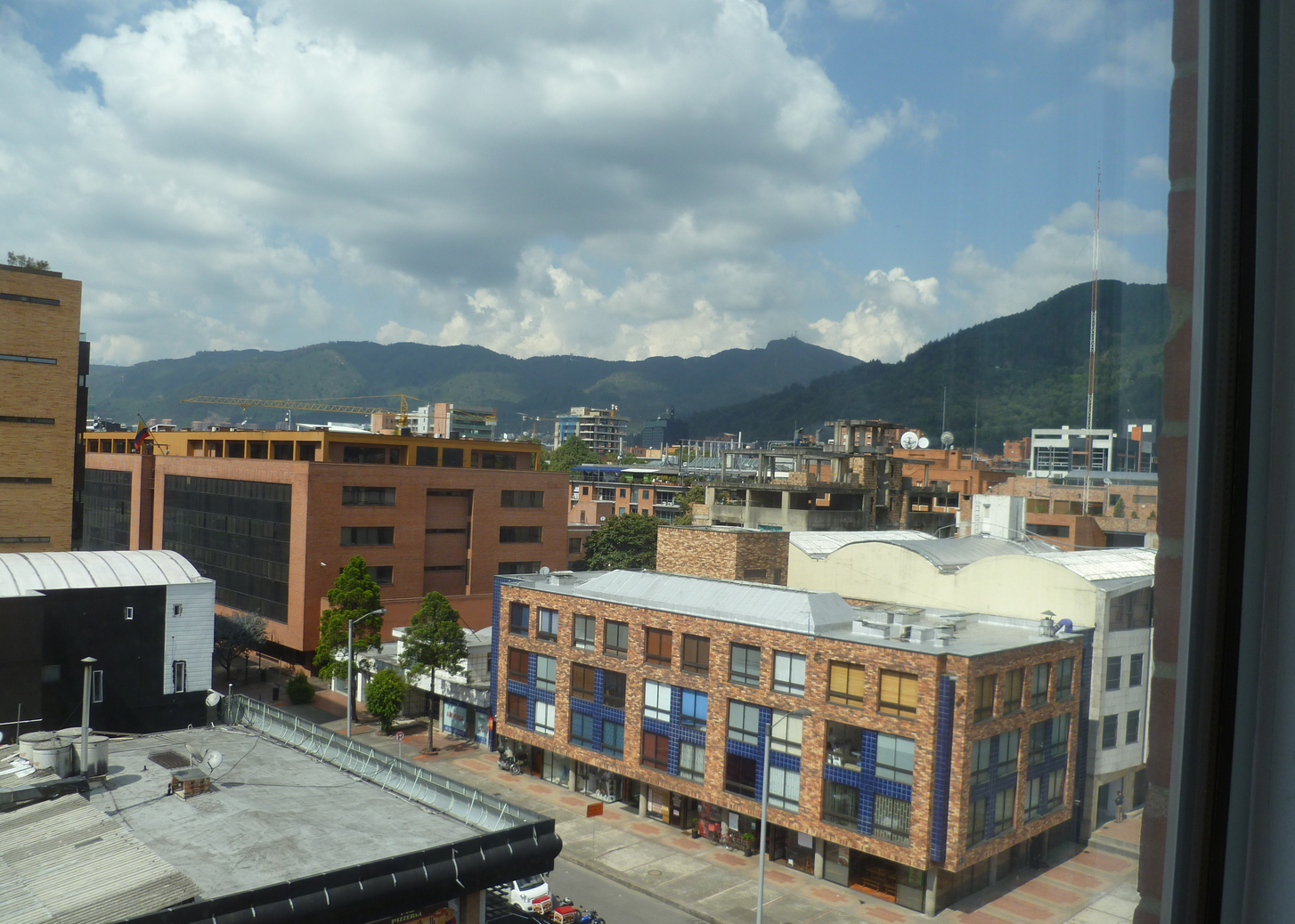
Screen Shot 2013-05-17 at 4.35.28 PM

A reader writes:

Satellite dishes and shadows say somewhere not far from the equator.  Karst-ish mountains, slightly exotic architecture, a Pizzeria. I’m going to go with some moderately biggish upland city in Malaysia. Maybe Indonesia.

Another:

This reminded me of the view from an office I worked in many years ago. It was located just west of Main Street, north of Broadway in Vancouver, B.C., Canada. The mountains in the background look similar to a mountain range that is affectionately referred to as Sleeping Beauty on Vancouver’s North Shore. I imagine we can all see what we want to see for when my partner looked at the photo he sais, no it could not be Vancouver as the mountains appear too close. He is right of course, but it sure brought me a sense of deja vu. It was fun to think I might of solved my first “view”.

Another:

I hate you. Or to be more precise, my wife hates you for taking me away from her this Saturday for nearly 90 minutes while I was going crazy trying find out where in the Vancouver area this photo was taken. (Juneau was briefly considered, but no dice.) So where is it? Vancouver proper? North Vancouver? Burnaby? I’m burned out and discouraged! Please let me know if I wasn’t thorough enough with my googling OR if I was on the wrong track altogether. Whichever it is, my wife won’t forgive you, but I will.

Another:

You can see a DirectTV logo on the satellite on the roof, but other than that I’m stumped. Apparently DirectTV can only be found in the Western Hemisphere, so at least it’s narrowed down a bit. The motorcycles and the lush green hills suggest central or South America to me. Just now I’m noticing the Venezuelan flag on the opposite building, so assuming that’s not an embassy, I’m guessing this is Caracas, Venezuela. No doubt someone will find the exact window, but I don’t have much time left, so I’ll have to leave it at that.

Another:

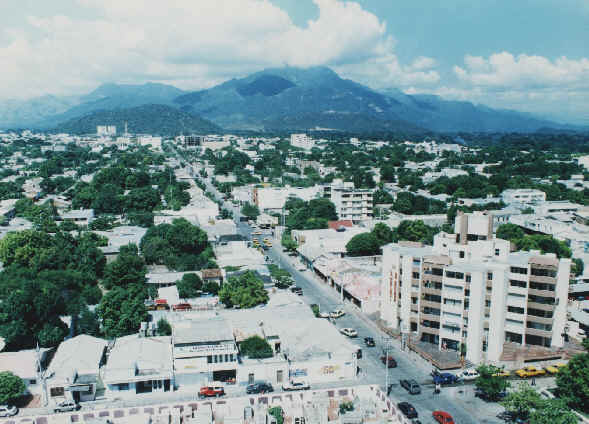
This is my first attempt to send in my ideas about a VFMY contest, although I am a regular if often befuddled contestant. At first I got very first world northern vibes from the photo – the deciduous valled18kmtrees, the general buildup of strip malls, clean streets, good lighting, etc., but then decided the flag flying on the building in the left portion of the photo was the flag of Colombia, South America and was forced away from my preconceived notions. From there I poked around a few maps – veering north away from the equator, due to the lack of palm trees, etc., and looking at a topical map for hilly areas. I settled on the town of Valledupar, Colombia, a rather nice low rise city set against the foothills of Sierra Nevada de Santa Marta. From there I looked at many a Google picture, but never did get much farther. ( I have enclosed a small photo of downtown Valledupar for your perusal.) Of course, I am hopelessly wrong, but still, as always I enjoyed the ride. And I do think I may be close; close as in the right hemisphere, lol.

Another:

Cucuta, Colombia is a wild guess. I have no idea what city this is, but the Colombian flag in the photo makes the country pretty obvious. I did learn a few things while searching vainly for further clues to this week’s location:

1) Colombia has no Street View, which made this quite difficult. I’d hoped to be able to spot that radio/TV tower from street level.

2) Every city in Colombia is nestled at the foot of thickly forested mountainsides.

3) Colombia is an absolutely gorgeous country. It has now moved the top of my bucket list of travel destinations.

Another:

Judging by the tall buildings and the peninsula peak in the background, this is obviously Christchurch, New Zealand. The Colombian flag is the kicker, seeing as the two countries have a good relationship.

Another:

It’s definitely Colombia. Even I couldn’t miss the flag flying from the building in the foreground. If it turns out this is a Colombian embassy in another country, please let me kick the photographer in the shins. But I’m pretty sure it’s in Colombia because the the No Parking sign that’s visible matches what I found online. (Would you believe that Colombian road signs have their own Wikipedia page? Because of course they do.) I’m going to guess Cali, Colombia and hope that either that radio mast or those satellite dishes belong to Telepacifico.

Another pins down the correct city:

With the yellow, red and blue flag partially visible, I’m figuring this window is in either be in Venezuela or Colombia (unless you’re throwing us a huge curve ball). With the death of Chavez and the “election” of Maduro, Caracas would be logical, but I’m going to go against the grain and go with the downtown business district of Bogota, Colombia.

Another clarifies the flag distinction:

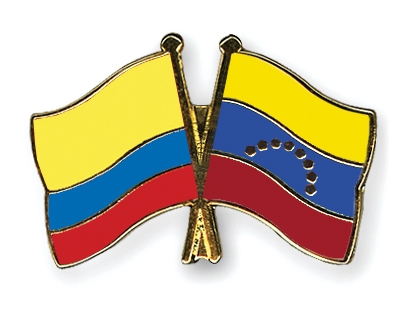
The flag was a giveaway (unless there are stars in the blue field, which would make it Venezuela):

Flag-Pins-Colombia-Venezuela

The formations of the mountains in the background suggest Bogota.  So, there we are.

Another gets the right address:

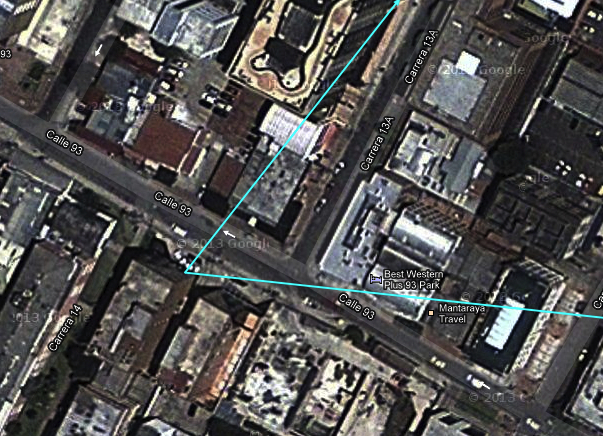
It’s Bogota, Colombia, probably a Sunday by looks of no traffic, near Parque 93; from the Google maps, Calle 93 w/Carrera 13A. the nice northern neighborhoods, Chico, looking east north east to the hills.  You can see the trace of the road to La Calera going up the forested hill on the right. I’m a loyal, currently freeloading, reader.  Dag, for karma I’ll [tinypass_offer text=”subscribe”], now that I’m on the proverbial map.

I would add that this northern privileged neighborhood, with fine restaurants and walkable parks, is a prospect well known to the privileged (diplomats such as my family) but it literally turns its back on the bulk of the teeming, 9 million people mega-city that is filling the high mountain valley, la sabana; the poor live in the south, about 10 miles away.  The city is relatively flat and sprawling; you can drink the tap water because it comes from the pristine paramo ecosystem in Chingaza National Park, up in the mountains to the east. Air pollution from chronic congestion and dirty diesel busetas make the city gritty and smelly most places, particularly to the south and west; public transport is a big challenge for most Bogotanos.  Sundays and holidays, however, the city closes many kilometers of road to cars for ciclovia from early in the morning until 2:00 p.m. and thousands of Bogotanos ride, walk, run, skate with whatever means of conveyance available, fresh fruit and juice stands pop up on corners, aerobic classes are held in parks, no matter the rain or sun, and the city seems democratic, even optimistic.

Another sends an image of the correct building, seen to the right. Another almost gets the right floor:

The word is out and Colombia is officially on the backpacker trail in South America – much to the chagrin of the burgeoning expat community here. Most international travelers will make a stop at best-westernsome point in the capital city pictured here, Bogotá. Sitting on a wide plateau at an elevation nearly two miles up, the city of about eight million hardly fits the stereotype of a tropical city. In fact, some nights here are downright chilly. The good news is that day trips close to the capital abound and you’re never too far from tierra caliente. Unlimited live music options, vibrant nightlife, great restaurants, markets, colonial neighborhoods, low cost of living, and beautiful people are all reasons to visit.

The mountains, architecture and street signs on buildings in the picture (not to mention the flag flying above a nearby building) pointed immediately to Bogotá. The photo is facing the mountains East-Northeast from a spot close to Parque 93, an upscale restaurant and bar district. If you have money and want to see and be seen, this is one of the more popular areas in the city. You will likely have dozens of correct guesses for Bogotá this week, but fewer who can decipher the location given the sprawl of the city. The key for me was the pizzeria in the bottom left-hand corner. It’s a new location of a local chain called ‘Da Quei Matti’ that has a decent, if overpriced pie. The picture was taken from an apartment building across the street, just west of Carrera 13A on Calle 93. The weird address system here might throw some people this week. Calles run East-West, and Carreras North-South. The first number of an address is the street you’re on, the second the closest cross street plus the building number. I’m going to guess this was taken from a 5th floor apartment at Calle 93, #13A-08.

So close: 6th floor. The winner this week was the only reader among the dozen to guess the right floor who has guessed a difficult window in the past without yet winning (but those dozen will now be added to the “Correct Guessers” list, giving them an edge in future tie-breakers):

Another fun/challenging one. The flag was either a gimme or the Colombian Embassy anywhere, and if the latter I was hosed, so I chose the former. Green mountains in the background suggested Calle93BogotaColombiaBogota, but not much success until I identified the large black building in the far background, which shows up in several of the photos taken from the ridge to the east of the city. From there it was a matter of wandering off in the right direction until the right collection of roofs showed up. Not the usual hotel/motel, at least Google doesn’t admit to it. I’m guessing just from sight lines that this was taken from the sixth floor, north-east corner of the building (see attached photo). BTW I tried googling pizzarias to see if I could narrow it down that way and had zero luck.
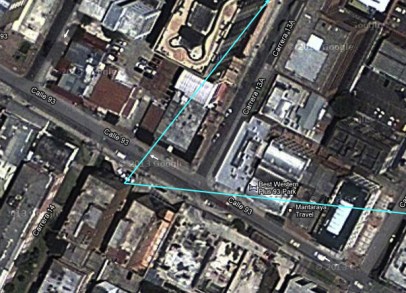
Thanks again for running these contests. I was on travel all weekend so started late Sunday night and finished Monday afternoon (some work intervened).

(Archive)