Phone Rage

Last week, Kevin Williamson took matters into his own hands when a fellow audience member wouldn’t stop using her smartphone during a theater performance:

The lady seated to my immediate right (very close quarters on bench seating) was fairly insistent about using her phone. I asked her to turn it off. She answered: “So don’t look.” I asked her whether I had missed something during the very pointed announcements to please turn off your phones, perhaps a special exemption granted for her. She suggested that I should mind my own business. So I minded my own business by utilizing my famously feline agility to deftly snatch the phone out of her hand and toss it across the room, where it would do no more damage.

He was subsequently ejected and could face criminal charges. I’m with Kevin 100 percent. He didn’t grab the phone before talking with the management. The management simply refused to stop the disruption. It was only then that he lost it. And I fully understand why.

I refuse to have dinner with someone constantly consulting their iPhone. I ask them to put it away or end the meal. I’m also an Acela Quiet Car Nazi. The plague of smartphone chatter is slowly destroying whatever space individuals once had to separate ourselves from the maddening crowd of gabbers. When some of us are allowed an oasis of calm – the quiet car – and others refuse to abide by its strictures, talking loudly with one another or yelling into their phones, I simply point to the quiet sign and remind them that this is supposed to be a library atmosphere. Others are too polite to address the rudeness. But they seem grateful for my being the necessary asshole. My gripe is that I am forced to be an asshole by the poor manners and contempt for others of gabbing phone-addicts. In my Acela experience, it’s often the executive white male types who simply ignore me and force me to find a conductor. Yes, in the end, my objections can make more noise and disruption than the asshole on the cellphone. But he started it.

I’ve stopped going to the movies entirely because of this. You cannot ignore a sudden light appearing three rows down. You cannot ignore the tippity-tap of the texter behind you. You can try – but there’s a reason the lights are kept low in theaters – so you can focus on the stage or the screen. These anti-social yahoos are destroying the performance for everyone – and then act all affronted when told how douchy they are. John Del Signore is among many calling Williamson a hero:

How many stern warnings do obnoxious assholes get before there are actual consequences? Unlimited, apparently. “I don’t think we’re going to start a new policy of ejecting customers,” [said Howard Kagan, one of the producers of the show Williamson was attending].

[But as Williamson notes,] “The Alamo Drafthouse has a very strict policy about this sort of thing. If you talk, if you use your phone, you’ll be thrown out. And it’s a very successful business model. People are willing to pay more for it! Theater managers have to do something about this… I wish twice a month some Broadway theater would jack somebody, do a high profile ejection. I think you would establish a new set of social norms.”

Me too. Or maybe one movie theater in a complex where cellphone use is explicitly barred. Alas, there remains some kind of deference to these morons, as if they had some kind of right to spoil Tyler Coates thinks Williamson acted just as selfishly as the person he was admonishing:

Williamson engaged in an angry conversation with a stranger during a musical performance, one that is set in an intimate cabaret environment. Surely that was distracting to his fellow audience members, not to mention the actors. In the end, he was forced to leave the show, and I can imagine that the scene of watching a woman slap her neighbor and then having security escort him out disrupted the performance for many more people than the woman’s silent Googling. I don’t find it inspiring; I find Williamson’s actions to be just as (if not more) rude than the woman who annoyed him. It’s not commendable, and it’s a shame to see an amateur provocateur take the attention away from the people on stage in the show whose job it is to perform for an audience.

There is no “silent Googling”. The management should, in my view, throw the Googler out. Dreher sympathizes with Williamson’s vigilantism:

More and more people, it seems, simply do not understand how to behave in public, and how to respect others. I wouldn’t recommend seizing the phones of rude old ladies and throwing them across the room. But I understand the impulse, and would pay Kevin Williamson’s court costs, if it came to that.

And Tod Kelly doubts that the incident really happened:

[N]othing in the exchanges Williamson notes sound or feel like the exchanges real people have in real life – it reads more like something he imagined doing while stewing in his seat.  Being the latest in a long, long line of Irish Storytellers, I can usually tell a story from an account, and Williamson’s feels like the former.

Well, we’ll see as the legal process unfolds.

(Video: Hugh Jackman discussing when he, from the stage, had to admonish an audience member whose phone kept ringing through a crucial scene in the play A Steady Rain.)

(Thumbnail photo by Jenny Cestnik)

Obama At Morehouse, Ctd

US-POLITICS-OBAMA

TNC is less than enthusiastic about the tone that the Obamas struck in their recent commencement speeches:

Taking the full measure of the Obama presidency thus far, it is hard to avoid the conclusion that this White House has one way of addressing the social ills that afflict black people — and particularly black youth — and another way of addressing everyone else. I would have a hard time imagining the president telling the women of Barnard that “there’s no longer room for any excuses” — as though they were in the business of making them. Barack Obama is, indeed, the president of “all America,” but he also is singularly the scold of “black America.”

TNC even goes on to call Obama’s defense of and call for personal responsibility and fatherhood “targeted scorn”. Good Lord. Why so defensive? The importance of personal discipline and responsible fatherhood are surely central to many of the issues facing black America. Without them, it is hard to see how African-Americans are going to thrive in an increasingly competitive global marketplace or leave behind some of the family breakdown that has so contributed to poverty and crime. Fallows is more forgiving:

We all take a different tone in setting expectations for “our own.”

I can hold Americans overseas to a different standard than I would Russians or Japanese; I can harangue (and have!) my colleagues in the press about why we should do better; I expect something from myself and my kids I wouldn’t expect from you and your kids, and so on. The challenge for Obama, exactly as Ta-Nehisi pointed out, is that he is simultaneously addressing all Americans as his own (apart from those who consider him alien) while also in this speech addressing as his own the most historically distinct subset of our population. …

I increasingly think of Obama as walking a tiny, little rope suspended across a Grand Canyon. Through four and a half years he has mainly kept his footing, in a way that becomes cumulatively surprising — and I say that even while disagreeing with many of his policies, notably including the recent security-state extensions.  Every now and then, as with this speech, we see how hard what he is doing is.

And how unforgiving and touchy his audience can be. My thoughts on Obama’s speech here.

(Photo: Graduating students with rain soaked mortar boards, listen as US President Barack Obama delivers the commencement address during a ceremony at Morehouse College on May 19, 2013 in Atlanta, Georgia. By Mandel Ngan/AFP/Getty Images)

The Sanity Of The American People, Ctd

This embed is invalid


Blumenthal finds that Obama’s approval ratings are holding steady:

The current HuffPost Pollster estimate of Obama’s job approval rating, based on the combination of all available public polls, is 47.6 percent. His approval rating has been declining since the January inauguration, but at a glacial pace, erasing gains made during and after the fall campaign. However, a closer look at the most recent daily tracking polls shows no dramatic change in the past week.

Maybe it’s because, as yet, there is no real scandal. Even the IRS targeting of dubious Tea Party (c)4s is beginning to seem less insane as we discover the scale of their sleaze and the bipartisan calls for oversight. The AP leak was a very serious one, exposing a crucial agent inside a dangerous Yemeni Jihadist cell. Benghazi? There’s very little there there. Nate Silver credits the economy for Obama’s resilience:

Based on the historical relationship between Mr. Obama’s overall and economic approval ratings in the poll, you’d predict that his overall approval rating would be 53 or 54 percent given an economic approval rating of 48 percent. Instead, it’s 51 percent. So it may be that the talk surrounding Benghazi, the I.R.S. and the Justice Department has negatively affected Mr. Obama’s approval rating by two or three percentage points, but that the economy has lifted his numbers by about the same amount.

Ezra sees Obama’s poll numbers as evidence that “scandals are likely to simply harden the Democratic perception that Republicans are out to get Obama, and the Republican perception that Obama is a corrupt president”:

“People respond along party lines,” writes Alan Abramowitz, an Emory political scientist who predicted last week that the polls would remain unchanged, “just like members of Congress. Republicans believe the worst of Obama, but they already believed the worst of Obama. Democrats (correctly) see Republicans pushing these things because they are out to get Obama and stop his agenda and/or they think Obama is responding correctly to the problems that do exist. So it’s like almost every other issue or controversy.”

Except for Independents who, I suspect, are somewhat bored/exhausted by the Washington minutiae. And every day the GOP obsesses about these details, they fail to propose any set of sane policies to address the national problems. In the end, that matters. Under Clinton, at least the GOP had an agenda, other than pure oppositionism. Seth Masket notes that, during the Lewinsky scandal, Clinton famously saw an approval rating bump. The causes of that bump that may also apply to Obama:

One [theory] is that the public largely sympathized with Clinton. Not that they approved of his behavior—far from it—but that they felt that his affair did not warrant impeachment or the media firestorm that surrounded it, and they registered their dissent with the media and with overly enthusiastic congressional Republicans by supporting him.

Another theory, offered by John Zaller, my advisor when I was in graduate school, is that the public generally doesn’t factor scandals in when evaluating presidential performance. What they do care about are the same things they care about during elections: peace, prosperity, and moderation. The intense scandal coverage caused people to pay attention to politics in a non-election season. They evaluated Clinton’s performance and generally judged him to be running things well.

I suspect they think the same of the current president. With good reason.

“Racists Love Race Science”

Freddie DeBoer has a new post on the race and IQ debate that deserves to be read in full. A key part:

People insist: hey, you’ve got to let the science be the science, you’ve got to look at the facts, you’ve got to let them make the case. And I try. I read their essays. I follow their links. I do make a good faith effort. But I do not make that effort with similar credulity or sympathy that I do when I read someone write about tweaking the Earned Income Tax credit or make an argument about alcohol licensing. Why? Because one of these arguments has been used for the perpetuation of a system of chattel slavery and racist domination. That’s why. And, sure enough: whenever people pop up to tell me, “Here, check this link, read the facts,” and I click and read around, and then I follow more links, inevitably, I end up at Stormfront or similar houses of explicit racism. Inevitably, the people who are arguing about inherent black and Hispanic tendency to be unintelligent are also arguing about “black aggression” or “hypersexuality” or “inherent tendency to criminality.” This will apparently come as a shock to Andrew: racists love race science.

Is the correlation between belief in race science and racism 1? No. But it’s a lot closer to 1 than it is to 0. Is that dispositive of the question? Of course not. If there’s a racial bias towards low IQ, and if IQ is really an adequate gauge for real-world, lived intelligence, then the truth will out, just as it will if homosexuality is pathogenic. But to pretend as if people who are pushing the idea of inherent racial inferiority in IQ don’t tend to be the kind of people who believe all sorts of racist things is stupid. It’s moronic. It’s exactly the kind of willful failure to see connections that Andrew is accusing other people of.

I do not doubt that many of those pursuing this question are doing so for ugly reasons. Probably a hefty majority. That should make one especially leery of their arguments and make one very aware of the need to use empiricism almost pathologically. But, of course, one reason why this area is so clogged with racists is that non-racists don’t want to go there. My worry is that not going there will only rebound against the case that such data should not in any way be used for public policy. If affirmative action is finally abolished, we may be able to get race as an identifier out of policy discussions altogether. But what happens if affirmative action goes and we have universities that are overwhelmingly Asian-American and Jewish? What will liberals do then? Another important section from Freddie:

I appreciate that Andrew has, as he always does, engaged with criticism and opposing opinion on this issue. But I am frustrated by Andrew’s continuing ahistorical credulity on this issue, his tendency to read the people making these arguments with the most possible charity. And he matches that with a distinct lack of charity for those resisting them, the constant invocation of liberal piety and political correctness.

I would like very much for Andrew to consider whether his long history with this issue, and the attendant criticism he’s received, has rendered him too ready to see those pushing the race-IQ connection as principled empiricists untouched by emotion or animus. To posit that they are sober-minded, rational minds merely pursuing the scientific truth disinterestedly while their opponents are motivated by groupthink and emotion is a pretty great way to make yourself gullible on an issue where gullibility has profoundly negative consequences.

I cannot analyze myself – but I’m sure I am affected by my history on this. One part, as I’ve written before, is that my entire education was made possible by an IQ test at age eleven, which gave me entrance to what Americans would call a magnet school. I owe a lot to that test – and it was initiated by the left. Today’s liberals forget that testing IQ was once a leftwing idea. It was designed to rescue the poor from the trap of poverty by giving bright kids from poor backgrounds a swift entry to the British elite. That was the left of the 1940s – and you can look up Keynes and eugenics for further insight into how socialist this idea was in origin. Another part was, indeed, the reaction to my convening a debate on “The Bell Curve” at TNR, in the best-selling issue in that magazine’s history. I saw how some liberals really do not believe in free debate where race is concerned.

But I do not believe that critics of the whole project are fueled by groupthink or emotion alone. There’s a very solid case against race as anything meaningful in our culture, and an even stronger case that in the process of constant miscegenation, we are rendering the whole idea of race moot. I sure hope so. There’s also a strong argument that IQ is of extremely limited use – and, in fact, misses a whole range of intelligences that are often more important to our lives and cultures as humans.

I just refuse to wish the data away. The data shocked me when I first read it, and shocks me still.

Programmed For Your Personal Pleasure

Bill Wasik considers the next step in the tech revolution – a world in which our appliances talk to one another and anticipate our next moves:

Think about where you spend most of your waking hours: your office, perhaps, or your living room or car. There are all sorts of adjustments you make over the course of any given day that are reducible to simple if-then relationships. If  the sun hits your computer screen, then you lower a shade. If  someone walks in the door, then you turn down your music. If  there’s too much noise outside, then you close your window. If  you have a Word document open but haven’t finished writing a sentence in 10 minutes, then you brew another pot of coffee. Would you want to automate all of these relationships? Not necessarily. But you might find that automating some of them would make your life easier, more streamlined.

Deciding what to call it is a whole other matter:

Some have called it the Internet of Things or the Internet of Everything or the Industrial Internet—despite the fact that most of these devices aren’t actually on the Internet directly but instead communicate through simple wireless protocols. Other observers, paying homage to the stripped-down tech embedded in so many smart devices, are calling it the Sensor Revolution.

But here’s a better way to think about what we’re building: It’s the Programmable World. After all, what’s remarkable about this future isn’t the sensors, nor is it that all our sensors and objects and devices are linked together. It’s the fact that once we get enough of these objects onto our networks, they’re no longer one-off novelties or data sources but instead become a coherent system, a vast ensemble that can be choreographed, a body that can dance.

Leaving Bad Enough Alone

Vaughan Bell cautions against “psychological debriefing,” a single-session therapy treatment intended to help trauma victims process their experience:

In our trauma-focused society, it is often forgotten that the majority of people who experience the ravages of natural disaster, become the victims of violence or lose loved ones in tragedy will need no assistance from mental health professionals.

Most people will be shaken up, distressed and bereaved, but these are natural reactions, not in themselves disorders. Only a minority of people – rarely more than 30% in well-conducted studies and often considerably less – will develop psychological difficulties as a result of their experiences, and the single most common outcome is recovery without the need of professional help.

… [W]hat the individual therapist can’t see is that [recovery] would happen more effectively, leaving less people traumatised, if they did nothing. To put icing on the rather grim cake, researchers also asked patients whether they found the technique helpful as they walked out of the door. The patients reported that it seemed useful even though follow-up assessments showed that it impaired their recovery.

Bell clarifies:

Disaster, war, violence and conflict, raise the number of mental health problems in the affected population. The appropriate response is to build or enhance high-quality, long-term, culturally relevant mental health services – not parachuting in counsellors to do single counselling sessions.

Signing Up For Servitude

Aylin Zafar explores the dark side of the music industry, focusing on artists who “have found themselves fighting either to release their music or release themselves from their contracts”:

“The fact is, when any new artist signs their first record deal, they have absolutely no bargaining power,” [entertainment lawyer Paul Fakler] says. Unless you’re an artist that’s built up a following on your own and can gain leverage that way, it can be hard to negotiate a contract that will favor the artist, Fakler says, who calls the terms “pretty much akin to indentured servitutude.” “They’re exclusive contracts, the record company has absolute authority with respect to the decision of whether to release the albums that are turned in or not,” says Fakler. “Most artists are just so happy to get signed, they’ll sign anything.”

High-profile examples also include Bow Wow, Metallica, Big Boi, and Amanda Palmer, among others:

Lupe Fiasco went public with his frustrations against his label, Atlantic Records, in 2010. He delivered speeches and interviews discussing the three-year process to release his third album, Lasers, which he claims was artistically controlled by Atlantic. His fans even organized a protest outside the label’s offices in late 2010. “I am a hostage,” Fiasco told the Chicago Sun-Times the following year. “I gave them what they wanted. If I didn’t, at the end of the day the album wasn’t coming out.”

Prince also famously resorted to writing “Slave” on his face, during the 1995 Brit Awards, to try to drum up noise and be released from his contract with Warner Bros. And while he didn’t have an issue with the label holding back his music, his bold act is an example of the creative lengths some artists go to break their contracts.

Is Race Only A Social Construct? Ctd

My challenge to Ta-Nehisi:

[W]hat I really want TNC to address is the data. Yes, “race” is a social construct when we define it as “white”, “black,” “Asian” or, even more ludicrously, “Hispanic.” But why then does the overwhelming data show IQ as varying in statistically significant amounts between these completely arbitrary racially constructed populations? Is the testing rigged? If the categories are arbitrary, then the IQs should be randomly distributed. But they aren’t, even controlling for education, income, etc.

His response:

I do not know. Andrew is more inclined to believe that there is some group-wide genetic explanation for the IQ difference. I am more inclined to believe that the difference lies in how those groups have been treated. One thing that I am not convinced by is controlling for income and education.

African-Americans are not merely another maltreated minority on the scale of non-WASPs.

They are a community whose advancement was specifically and actively retarded by American policy and private action. The antebellum South passed laws against teaching black people to read. In the postbellum South, black communities were the targets of a long-running campaign of terror. The terrorists took very specific aim at the institutions of African-American advancement. They targeted churches. They targeted businesses. And they targeted schools. In the mid-20th century, as we have been documenting, it was the policy of this country to deny African-Americans access to the same methods of wealth-building, that it was making available to whites.

This alone would be bad enough, but what makes it much worse is segregation. In his book American Apartheid, Douglass Massey looks at the dissimilarity indexes among African-Americans in various cities across the country in the mid to late 20th century. To summarize (and I can talk more about this) the lowest levels of dissimilarity in black communities are higher than the highest levels of dissimilarity among “white” immigrants.

This is not merely a problem for your local diversity and sensitivity workshop. It is a problem of wealth and power. When you create a situation in which a community has a disproportionate number of poor people, and then you hyper-segregate that community, you multiply the problems of poverty for the entire community–poor or not. That is to say that black individuals are not simply poorer and less wealthier than white individuals.  Because of segregation, black individuals and white individuals of the same income and same wealth, do not live in communities of equal wealth.

The consequences of this are profound.* In this paper sociologist John Logan looked at the intersection of housing and segregation and found that, because of segregation, affluent African-American families, on average, lived in poorer neighborhoods than white families of much lower income.

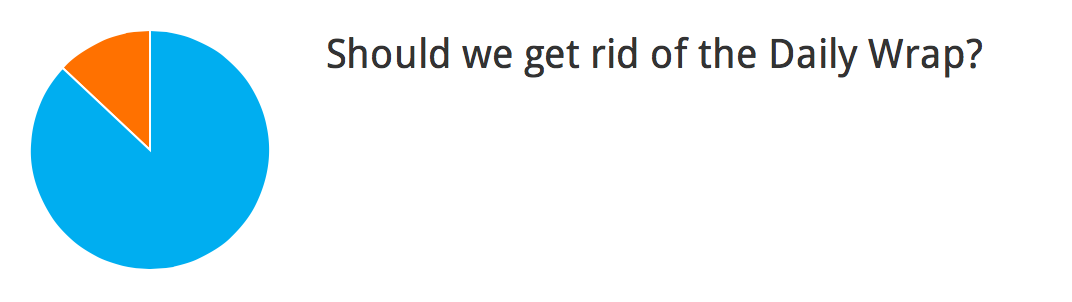
Wrap RIP

Screen Shot 2013-05-20 at 12.54.40 AM

A resounding Yes from readers – only 9 percent of this polled say they read the Daily Wrap on a regular basis and only 14 percent find the Weekend Wrap useful. One writes:

It’s a nice feature but if it takes away from you doing better things, it’s not worth it. If other subscribers can’t be troubled to scroll through the Dish, they’ve got other problems.

About a third of polled readers are the same page as this one:

The Daily Wrap is the Dish’s equivalent of those “We now conclude our broadcast day” messages that TV stations used to air, back in the days when TV stations actually went off the air. It basically says to me, “Don’t bother checking your RSS feeds again until tomorrow morning.”

Another suggests an alternative:

Now that you mention it, The Daily Wrap takes the diffuse, webby, bloggy feel of your work and tries to hammer it into four or five tidy paragraphs, which was a neat feat at first, but now seems strangely redundant.  The day’s work becomes a motley heap of curios, like Harper’s Index.  Sounds like it’s not worth the effort anymore.

But how about a Daily Mash?  Something that takes the day’s (or week’s) posts and stitches them together in a new graphic form? Whether it’s simple like a word cloud or some new, artful link collage, I like the idea of a routine playful, mash-up of your work.

Another gets closer to what we’ve been considering:

I LOVE the re-posting that you have done recently.  For example, I was offline last night and a good portion of the early morning.  So, I would have missed the Peggy Noonan post and I really want to see that damn post. So, I like the reposting of selected stuff and I think you should do more. Maybe that’s the solution to the Daily Wrap.  I rarely read it – the only time I EVER do is when I want to find a post from the prior week – but since you have a decent search feature.

Another suggestion:

You could pick a stand-out video/image, and an automated list linking to the top-3 read, or “read-on”-ed, articles of the day – similar to the “Most-Read” tabs on most major news sites, but posted once at the end of the day.

Another:

Why not end the day with a post containing the headlines and a link to the day’s posts?  That way, a reader trying to keep up with a thread (“Racism in the World, Ctd”) or a particular feature (VFYW, Face of the Day, etc) would have a simple navigation tool to catch up on a day away from the Dish.

And another:

Why not replace it with an automated index of the day’s stories? Since you are using WordPress, this would be a very easy thing to program, and that way you solve two problems at the same time (your time input, which goes to almost zero, and reader usefulness, which stays rather high).

One of a handful of readers defending the status quo:

I was shocked to read that you’re considering nixing the Daily (and Weekly?) Wrap, and that such a large majority want it gone, according to the poll when I took it earlier today. I admit I haven’t used it much recently, though still a little bit, but the Weekly Wrap was especially helpful when I was in South Africa for two years with the Peace Corps. I didn’t have any Internet connection at site, but I did get to go into Polokwane, the provincial capital of Limpopo, once a week. So on Saturdays, I would have a three to four hour block of Internet time, during which I would read through the Weekly Wrap, select the stories I was interested in, save the pages on my desktop, and read the articles throughout the week. I know this isn’t the case for a majority of your readers, but maybe at least the Weekly Wrap is worth keeping for your less than well-connected readers.

No Drama Obama

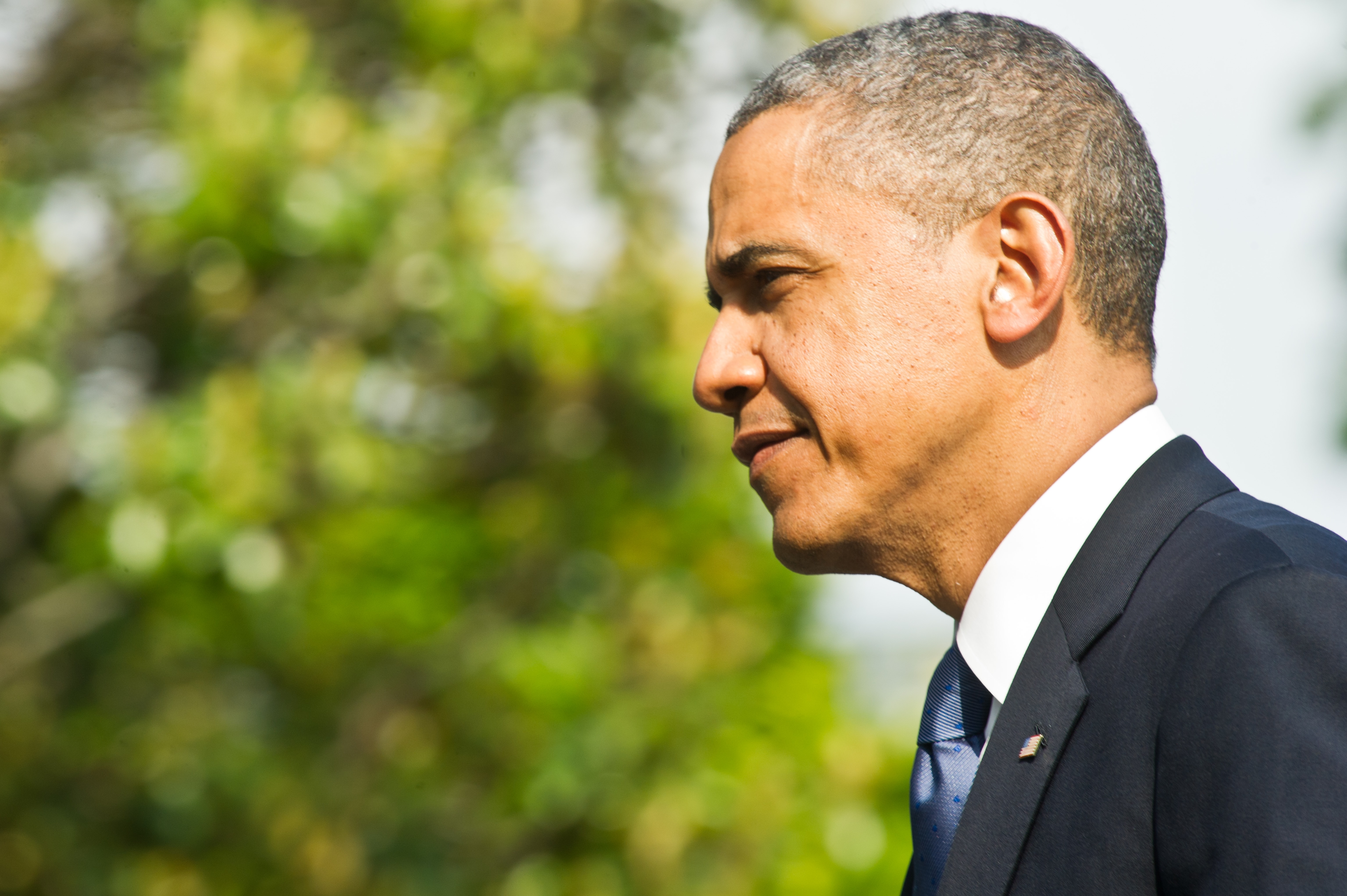
US-POLITICS-OBAMA

Former Obama speechwriter Jon Favreau describes how Obama handles scandals:

The handwringers and bed wetters in the D.C. punditocracy should know that Barack Obama will never be on their timeline. He does not value being first over being right. He will not spend his presidency chasing news cycles. He will not shake up his White House staff just because of some offhand advice offered to Politico by a longtime Washingtonian or a nameless Democrat who’s desperately trying to stay relevant. And if that means Dana Milbank thinks he’s too passive; if it means that Jim VandeHei will keep calling him arrogant and petulant; if it means that Chris Matthews will whine about him not enjoying the presidency, then so be it. He’ll live.

Favreau knows him as well as anyone – and that rings true. It’s also a deep political strength. Most mortals cannot manage that no-drama glide – I sure can’t. Hillary is more easily provoked into hunkering down rather than sailing through. What troubles me, though, is not that the IRS clusterfuck and the VA backlog are signs of malevolence, but rather that they are indications of a government that doesn’t work right. And no president should glide past that.

We’ve been at war for over a decade. The imminence of vast numbers of disability and pension claims can have been no surprise for the VA. And yet they are two years’ behind schedule. And the more I read about the IRS scandal, the more it seems to me less a political campaign than complete mismanagement:

Over three years, as the office struggled with a growing caseload of advocacy groups seeking tax exemptions, responsibility for the cases moved from one group of specialists to another, and the Determinations Unit, which handles all nonprofit applications, was reorganized. One batch of cases sat ignored for months. Few if any of the employees were experts on tax law, contributing to waves of questionnaires about groups’ political activity and donors that top officials acknowledge were improper.

“The I.R.S. is pretty dysfunctional to begin with, and this case brought all those dysfunctions to their worst,” said Paul Streckfus, a former I.R.S. employee who runs a newsletter devoted to tax-exempt organizations. “People were coming and going, asking for advice and not getting it, and sometimes forgetting the cases existed.”

Much of this arises from the Supreme Court’s unleashing of so much money into the electoral process via groups that were not easy to assess as legit. But the IRS had plenty of advance notice, and yet no one seemed to foresee the challenge or the dangers of getting things wrong. If you want to know why Americans remain leery of government, it’s because of this combination of power and incompetence. All bureaucracies – private and public – are susceptible to this, but when it comes to veterans being denied benefits or political groups being effectively hazed to get the right tax designation, we have a right to question government’s expansion.

That’s the real problem here, it seems to me. The right is paranoid and delusional enough to turn all of this in their minds to a Nixonian war on them. You can’t do much about that, except note that it will likely improve their chances in 2014. But the reasonable center worries simply that government is incompetent and expensive and too complex. If liberals want to restore an activist government, this is the core area they need to focus on – especially when it comes to implementing universal healthcare.

(Photo: Nicholas Kamm/AFP/Getty.)