Which Syrian Rebels, Exactly, Should We Arm?

The Economist has a helpful graphic on key rebel groups in Syria:
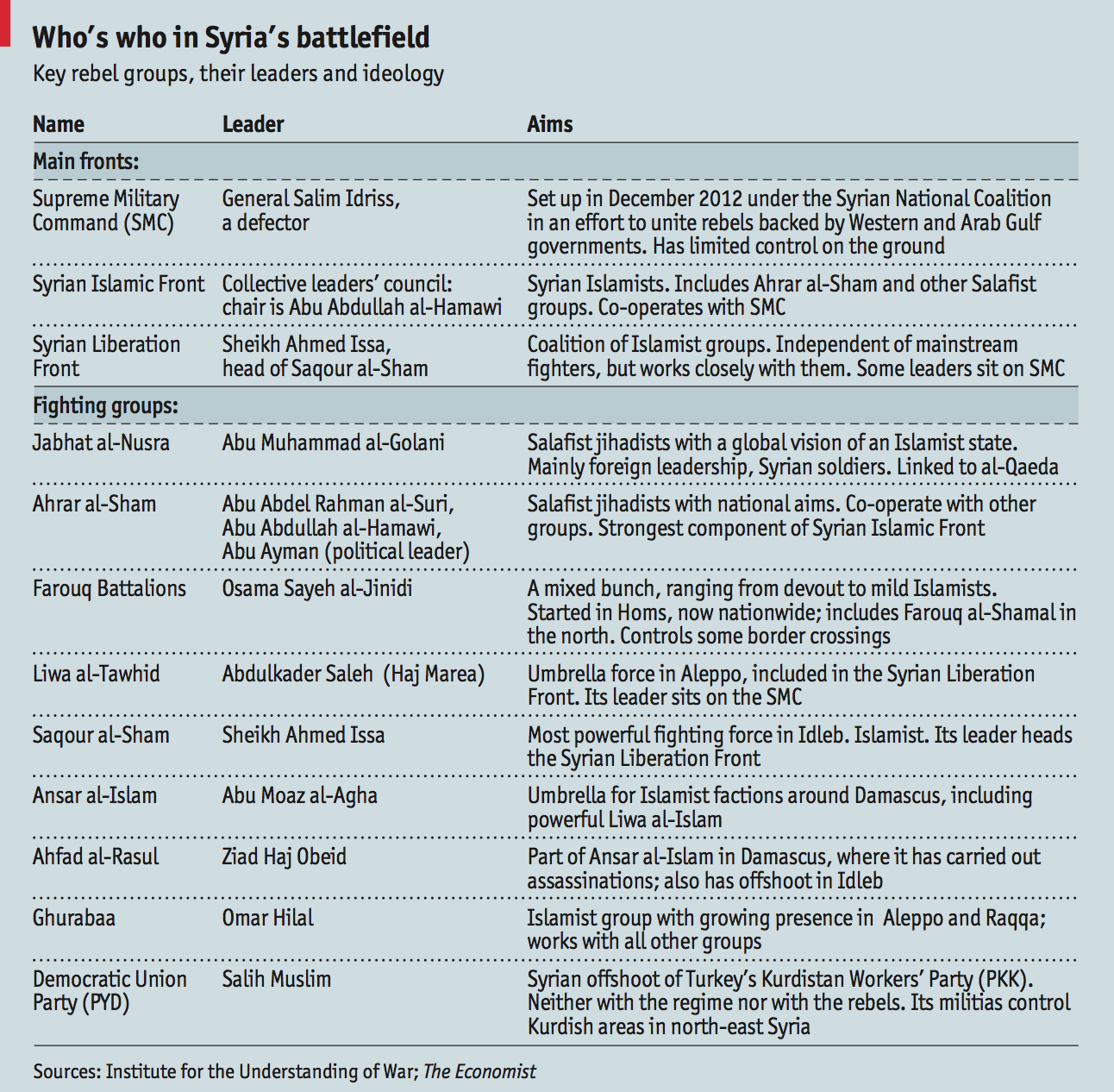
Syria_Fighting_Groups

Note how may of these groups are described as “Islamists” or “Jihadists.” Matt Steinglass doubts there is much we can do:

[W]hat about trying to just end the bloodshed and freeze the current situation? Given that the country’s population has effectively split into irreconcilable warring camps, wouldn’t it be best for all concerned if those camps were each acknowledged as legitimate in their areas of control? If those areas of control are more homogenous than the overall Syrian state, couldn’t that form a more stable basis for governance? Should America aim for a resolution along those lines in the talks it’s convening with Russia?

Maybe. Then again, maybe not. The problem with formally acknowledging armed secessionist groups as soon as they gain control over a patch of territory is that it encourages new armed groups to secede, provoking yet more civil wars. (See under: Yugoslavia.) And in the middle east, hopes that such splinter groups will grow into non-belligerent stakeholders once they’ve become responsible for controlling populations and territory are often disappointed. (See under: Hamas; Gaza.)

Even Jeffrey Goldberg, who has been itching for a new war, is now wary of getting involved. He thinks the US may have missed its chance:

Early intervention — a coherent, active attempt by the U.S. and its allies to build up, finance and advise what was then a moderate opposition — might have worked. Now, though, the Assad regime is showing signs of real resilience, and the opposition is showing signs of real brutality. It is easy to blame Obama for his early passivity. It is slightly harder to blame him for looking at Syria as it is today and then choosing to ignore calls for deeper intervention on the side of the rebels.

And Conor Friedersdorf wants interventionists to consider non-military ways to alleviate suffering around the world:

When an interventionist wants to put boots on the ground, arguing that it’s necessary to save lives, it means asking ourselves, before acceding, “can more lives be saved by spending this money on anything other than a war”? The fact is that, even granting the smartest critiques of international development work, it is usually a better way to help people than war, and it engenders good feelings rather than blowback.


Obama At Morehouse

Every now and again, an event happens that makes you see much more clearly how divorced from its previous ideals the GOP has become. Obama’s speech at Morehouse was something every conservative has always asked of African-American public figures. We have in Obama a black man raised by a single mother who is now, as even his critics acknowledge, a dedicated father to two daughters, whom he obviously adores. If the right is concerned about the black family, they should be falling over themselves to celebrate what Obama’s family is, and means. But they don’t. It would kill them to say anything gracious about this president.

Drudge yesterday cherry-picked only those parts of the speech that could divide people racially, only those moments when Obama dared to recognize the discrimination and difficulties of young black men – before urging them to overcome them. There’s a racial nastiness here that decent voters still hear and that Republicans have deployed constantly. Their historic refusal to cooperate even one iota with the first black president betrays, it seems to me, a staggering lack of grace and historical sense.

But as with everything Obama says, the speech balanced calls for equality with an admonition that personal responsibility is the inextricable complement to equality. And he did something more in the interstices. A member of the Morehouse faculty writes:

Morehouse is a college dedicated to African American men, the only one of its type in the country.  To hear the first African-American male U.S. president address a class of 500+ African-American men was moving, especially as he touched on his personal struggles of not having a father in the home.

But the reason I’m writing to you though is because he gave two shout-outs to gays.  He encouraged the young men to be a better husband to their wife but then added “or to your husband or partner”.  Later, he told them that their experiences as African-American men should make them more empathetic to others who feel left out, such as Hispanics because of their immigration status, gays and lesbians because of who they love, and Muslims because of how they worship. The ease with which he address gay issues now is striking to me.  Just like with the second inaugural address, it’s just a part of his normal speaking.  It is even more noteworthy because Morehouse once had a reputation as a homophobic place due to several factors, including a student beating about ten years back.

This speech reminded me once again why I supported this man and continue to do so.

Me too. While Washington obsesses over scandals that so far have no connection to him, the president stays calm and carries on.

Ask Sue Halpern Anything: Our Special Relationship With Dogs

The author weighs in on why dogs and humans get along so well, with a follow up about what her therapy dog Pransky was able to teach her about that special relationship while they worked together at a local nursing home:

Back in March, Halpern wrote a piece on the human relationship with dogs that we very much enjoyed here at the Dish. Here’s another excerpt from it:

[M]ost dogs that were originally bred to work—herding sheep, ferreting rats, retrieving game, or even, like those first labradoodles, guiding the blind—now live out their days as suburban or urban habitués, with little to do all day but wait for the return of family members from work or school. The fact is that dogs—at least dogs like [author John Homans’] Scout and Stella, and my dog and probably yours—come into our world for our pleasure, whatever that pleasure is. They are here at our invitation, and exist under our control. We determine what they eat and when, and how much they exercise and how, and we train them—à la [Jill] Abramson’s Scout—to live according to our rules and standards. The human–canine bond is inherently unequal. Like it or not, it is a power relationship.

Yet at the same time, we love our dogs.

We feel sure that they know us and like us, although we never know just how well; we sense they adapt to our moods, but we also know that they very naturally may be more interested in dogs they meet on the street; we believe we can count on them to be absolutely loyal companions, something we may not be able to say about most people we know. Maybe more than at any other time in history, we love our dogs as we love one another, and sometimes even more than that.  …

From the start of our lives together, our relationship to dogs has told us something about ourselves: what we have valued, how we have behaved, and our connection to the natural world and to our animal selves. These days, unlike days past, some of us appear to be uncomfortable with our dominion over our dogs, perhaps because canine science offers a nuanced and thought-provoking take on a dog’s capacities, sensibilities, feelings, and intelligence. Still, the elevation of our dogs to honorary human status is not exactly new. Fourteen thousand years ago, people chose to be buried alongside their dogs. Yet you have to wonder: fourteen thousand years hence, when archaeologists uncover Swarovski crystal–encrusted dog collars and that trove of canine Harley gear, what will they say it says about us?

Sue’s new book, A Dog Walks Into a Nursing Home: Lessons in the Good Life from an Unlikely Teacher, came out last week. Watch her previous answers here. Full AA archive here.

How They Got To “Sesame Street” Ctd

A reader reflects:

That first Sesame Street episode made a big impression when I was five. The show’s premier was a major event for the white progressive moms in my neighborhood in Evanston, IL.  I was actually wrangled before the TV set and told to watch it, a strange act for my mother, who was very anti-TV and later, in my early adolescence, refused on principal to repair the same set, leaving me tube-less until I moved away to university.

I was hooked on Sesame Street from the downbeat of the almost funky comp that underlies the theme song. The beautiful, gritty but fun scenes of children in New York fascinated me. They reminded me and eased my fears of what I considered to be a scary, urban world, only blocks away, across Howard St., the border of leafy, suburban Evanston with the City of Chicago.

At the time, the show didn’t seem so radical. Evanston was integrating. I had strong, quiet, proud, loving black teachers like Sesame Street’s Gordon, as well as black, Latin and Asian friends. I was a non-denominational child surrounded by Jewish and Catholic neighbors.  But looking at it again from four decades on in the age of Obama, my goodness! It premiered the year after Martin Luther King’s murder, and its first scene has Gordon leading a little white girl down a big-city street and introducing her to all her new neighbors as if it was normal.  My God, it wasn’t normal, but because of the show many of us were given the idea that it could be and, you know what, it’s no longer strange. We weren’t in bloody Kansas anymore.

Sesame Street was such a glorious, stealthy challenge to the status quo. I and millions of others, all blank slates, had the A-B-Cs, 1-2-3s and message of how people from different backgrounds can learn, grow and live together, written on us. It was given gently and with love by Gordon, Mr. Hooper, Big Bird, Cookie Monster, Ernie & Bert and Grover.  Even Stevie Wonder got into the act. If you want to see how cool Sesame Street is, look up the video of Stevie playing Superstitious on the show.  It would make a great Mental Health Break if you haven’t run it already.

How people can get so worked up about PBS when it costs so little and has delivered things as great as Sesame Street and Mr. Rogers, Julia Child, Masterpiece Theatre and Nova  seems to me small and cruel.

Face Of The Day

dish_kumi-1

Kumi Yamashita‘s “Constellation – Mana no.2″ is comprised of only three elements: a wooden panel painted white, more than 7,000 tiny galvanized nails and a single, unbroken black sewing thread.  Rodrigo at designboom observes, “The highly intricate multidimensional textures of the compositions bring out a realistic and almost organic quality to the faces.” A close-up of Yamashita’s piece after the jump:

dish_kumi-2

(Images courtesy of Kumi Yamashita Studio)

After The Apocalypse

Robert Macfarlane considers the way Cormac McCarthy’s The Road isn’t the usual novel about apocalyptic events:

Until Cormac McCarthy’s novel…apocalypse had always seemed a baroque affair, lavish in its melodramas of asteroid strike, nuclear blast and tidal wave; populated by petrolheads in rabbit-skin loincloths and black leather dog-collars. McCarthy stole apocalypse’s thunder, and produced something far more terrible because more tentative. He saw that apocalypse is about aftermath rather than grand finale. He knew that the one thing more terrifying than dying in a global catastrophe is surviving it. The disaster is over and done with in a single sentence: “A long shear of light and then a series of low concussions.” What follows is the desperate business of endurance.

Why he finds it to be more than a tale of despair:

I have read “The Road” more, probably, than any other book. A tale so fiercely bleak, so cauterised in its vision, is still a page-turner. It has entered my soul as a black version of a possible future, its effects felt bodily first: the steady creep of chill, an urge to hold my children tight. Man and boy plod on, page after page, and I read on, page after page, puzzled at my own persistence.

Hope lurks in both activities. It survives in McCarthy’s language: austerely beautiful, and proving the paradox of apocalyptic art, that to annihilate the world one must also summon it into being. Hope is there, too, in the boy, whom the father strives so hard to protect, and whose presence brings the possibility, however faint, of life after ruin. And hope is there in the father’s memories of the land as it was before: brook trout finning against the current of mountain streams, green-wooded glens humming with life, birds flocking and shoaling in the air. A world, in fact, not wholly unlike our own, in which human relations with nature are not yet irrevocably broken. This great novel is an act of hope because it is a warning, a calmly urgent reminder of what we stand to lose. “You can read me a story, the boy said. Can’t you Papa? Yes, he said. I can.”

The Theology Of Stephen Colbert

With graduation season upon us, David Zahl revisits Stephen Colbert’s 2011 commencement address at Northwestern University. An excerpt:

After I graduated from here, I moved down to Chicago and did improv. Now there are very few rules about improvisation, but one of the things I was taught early on is that you are not the most important person in the scene. Everybody else is. And if they are the most important people in the scene, you will naturally pay attention to them and serve them. But the good news is you’re in the scene too. So hopefully to them you’re the most important person, and they will serve you. No one is leading, you’re all following the follower, serving the servant. You cannot win improv.

And life is an improvisation. You have no idea what’s going to happen next and you are mostly just making things up as you go along. And like improv, you cannot win your life. Even when it might look like you’re winning…

In my experience, you will truly serve only what you love, because, as the prophet says, service is love made visible.  If you love friends, you will serve your friends. If you love community, you will serve your community. If you love money, you will serve money. And if you love only yourself, you will serve only yourself, and you will have only yourself.

Zahl comments:

There is a sense in which all of us want what Colbert is describing: more acts of love and service in the world–more people doing what they love both for its own sake and the sake of their fellow citizens. You might say that we all want to be happy, and we are happy to the extent to which we have lost sight of the winning/losing spectrum–which also happens to be the extent to which we’ve lost sight of ourselves (or at least that part of us which is so helplessly caught up in justifying itself). The problem invariably comes when you talk about the How. How are people inspired to do good?

Does it happen through admonition and instruction? Or does it happen when those things are removed and/or allayed? Colbert seems to be in agreement on this issue with the man who executed his New Testament namesake. After all, when it comes to success, both inherited and achieved, the apostle Paul was clearly a “winner”. Yet in light of his conversion, Paul came to view those point tallies–indeed, the entire game itself–as a profound dead-end. Perhaps it should come as no surprise that he also spoke so beautifully about the fruit of the Spirit, that is, of the organic nature of life lived in the shadow of the cross–which is simply life lived from a place of gratitude rather than fear.

The Not Self-Assured Believer

Morgan Meis ponders the similarities between Kierkegaard and the New Atheists:

Søren Kierkegaard was not an atheist. He was a Christian. All of his writings are either directly or indirectly about Christianity. He’s thus a natural opponent to Dawkins, Dennett, and Harris. Except for one thing. Kierkegaard detested Christianity as he found it. He considered the vast majority of Christians to be hypocrites. Kierkegaard took a look at the Christianity practiced in his time and proclaimed it complacent and self-satisfied. Christianity, thought Kierkegaard, was mostly an excuse for being lazy and dumb.

How they differ:

Real religion, thought Kierkegaard, is doubt-wracked. Real faith, Kierkegaard wanted us to know, is profoundly involved in working out the deepest paradoxes of being alive. That’s why Kierkegaard once said, “The self-assured believer is a greater sinner in the eyes of God than the troubled disbeliever.”

That’s a strange thought for most Christians. What did Kierkegaard mean? He meant that if you are self-assured in your belief then you have neutered faith to make it intellectually palatable. Faith requires belief in things that are insane from the perspective of reason. It doesn’t make sense that God became man on earth. No amount of thinking about it is going to make it logical. It is a strange and shocking and downright crazy notion. If you are going to believe it (and live your life accordingly), you are going to have to find resources within yourself that transcend reason.

Recent Dish on Kierkegaard here.

No Writer Is An Island

Tarn Wilson found an unexpected benefit from being in an MFA program:

When I started my program, I hoped only that the structure would help me make writing a priority and I’d pick up a few advanced skills. I’d underestimated the power of mentors. I should have guessed: in my work with at-risk teens, I’d researched what fosters resilience in those from disadvantaged backgrounds. The number one predictor of future success? Mentors. The number one way to increase the percentage of underrepresented minorities in top career fields? Mentors. Yes, my MFA mentors were skilled writers generous with their wisdom, but even more, they showed me, in their various creative ways, how to build a writing life—especially in a culture that rewards very few writers financially and that offers constant, bombarding distraction. They modeled how to make a living, prioritize writing, navigate the demands of family and friends, and manage emotions around success and failure.

The critics don’t argue against mentors, but suggest writers should find them organically. Think Hemingway gathered with the expatriates in Gertrude Stein’s Paris salons. But not all of us know where to find a mentor, and even if we did, we’re too polite or shy to impose on their precious time. Critics argue that MFA programs are classist, but I also believe it’s classist to demand writers find their own support.  Now that I teach privileged teenagers, I recognize how much easier it is for those raised in well-off families to find mentors. They have spent their lives cultivating an appealing, graceful assurance. They know how to network, have access to people who know people, and have the confidence to ask for what they want. The rest of us need an MFA program.

Life’s A Bitch And Then You Laugh

From a review of Marc Maron’s Attempting Normal:

The comedian knows well… that “real life” can be a real challenge: “If you are alive and awake, sadness is a fluctuating constant.” As Maron explained during a keynote address at a comedy festival in Montreal… humor is one of our greatest analgesics. Growing up, he felt that comics “were the only ones that could make it seem okay. They seemed to cut through bullshit and disarm fears and horror.” At certain key moments, Attempting Normal does so as well. For comics like Maron and his colleague Louis C.K., stand-up is not simply about making people laugh. It is about making people laugh by exposing one’s innermost vulnerability.

Maron’s greatest comedic successes, including his podcast and his self-titled IFC TV show, have come from speaking honestly and emotionally about his life. As C.K. put it in his epic two-part interview on WTF, a portion of which is included in this memoir: “I’ve always [thought] that your progress [came from] taking away more and more layers of your defenses away;” and “I started watching you humiliate yourself more on stage, which is a good thing.” This book reveals that more than ever, Maron’s defenses seem to be down. Despite his tendency for abrasiveness, Attempting Normal is filled with softie remarks like: “I felt my heart open in relief”; “there are beautiful things in the world if you look”; “sometimes you just can’t fight being in love.”