Don’t Drink And Scribe

Caitlin O’Neil compares writing to mixing drinks. But:

Mind you, I’m not advising mixing writing and drinking, even if Christopher Hitchens begged to differ. Hemingway and Faulkner, God love them, got away with it, but in my experience the only thing gained when writing while inebriated is confusion (and spelling errors). Drinking and writing are over-romanticized companions. Writing well requires more clarity, rigor and vision, not less. It involves getting closer to uncomfortable truths about ourselves and the world, not anesthetizing ourselves against them. If you find yourself craving a drink to dull the pain while you’re writing, you’re on the right track. But I’d recommend resisting the urge. Save the cocktail for later, when you’ve put down the pen.

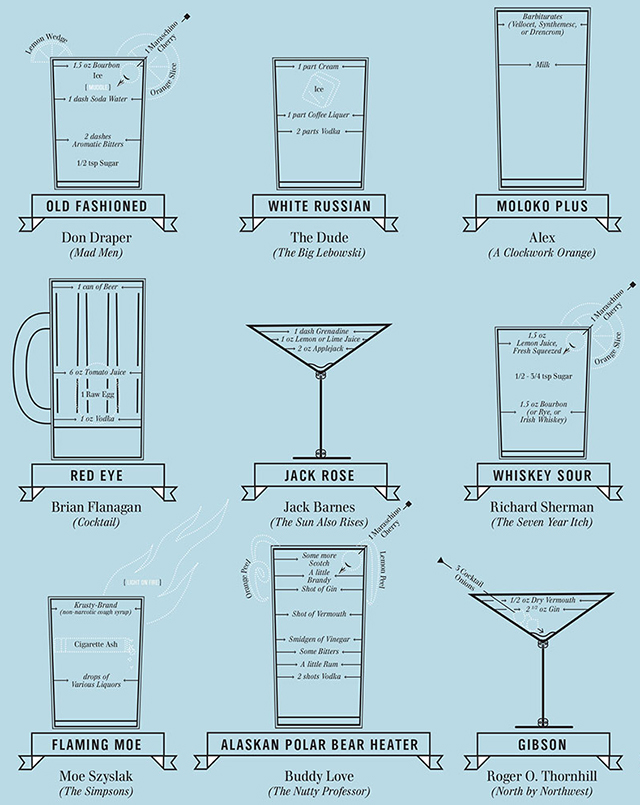
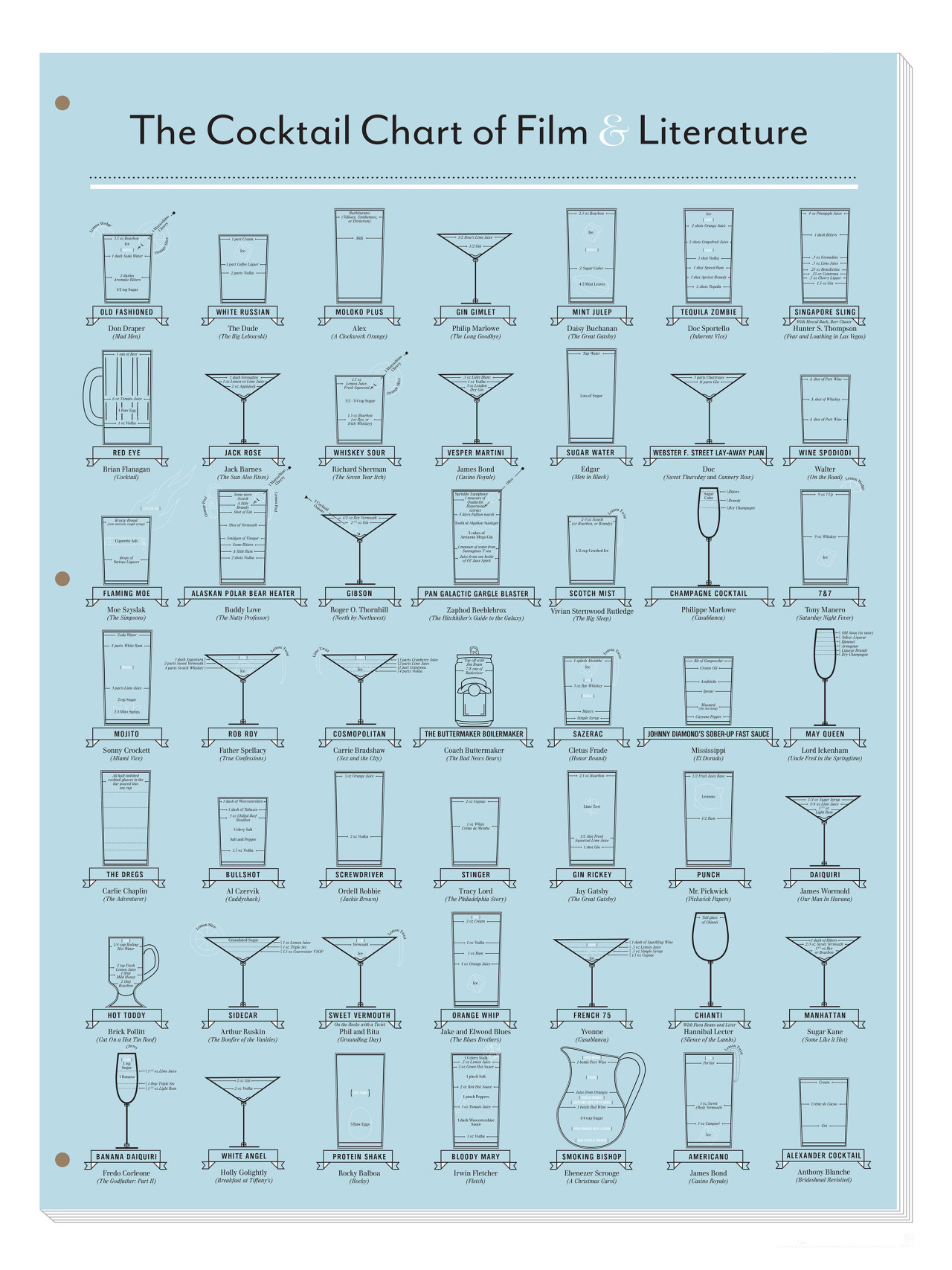
After the jump is a portion of the Cocktail Chart of Film & Literature, a “catalog of 49 drinks culled from great works of film and literature”:

P-Famous_Cocktails_0513

Zoom in on the complete chart here.

Curses!

Melissa Mohr, author of Holy Sh*t: A Brief History of Swearing, discusses profanity with the Boston Globe’s Ideas section:

IDEAS: Are there… old curses that 21st-century people would be surprised to hear about?

MOHR: Because [bad words] were mostly religious in the Middle Ages, any part of God’s body you could curse with. God’s bones, nails, wounds, precious heart, passion, God’s death—that was supposedly one of Queen Elizabeth I’s favorite oaths.

IDEAS: Have religious curses like that lost their power as the culture becomes increasingly secular?

MOHR: We still use them a lot, but we just don’t think of them as bad words. They’re very mild. If you look at lists of the top 25 swear words, I think “Jesus Christ” often makes it in at number 23 or something. … The top bad words slots are all occupied by the racial slurs or obscene—sexually or excrementally—words.

IDEAS: You mentioned Queen Elizabeth cursing. Do all kinds of people swear?

MOHR: Everyone swears.  People tend to think lower-class people swear more, and this is an old idea.  There are old [expressions] like, “He swears like a tinker.” The Victorians were convinced that the only people who swore were lower class, uneducated, horrible people. Modern studies do bear out that people in the lower working class…swear the most and use the worst words.

But also there’s this idea historically that aristocratic people swear a lot, and that’s also borne out by modern studies: People in the highest social classes [also] tend to swear more and use worse words. Not as bad as the people in the quote-unquote lower classes, but much worse than people in the middle class. There’s this idea that middle-class people are strivers, who really need to differentiate themselves from the lower class. One way they do that is by having very clean, very proper language.

Vaughan Bell adds:

Interesting[ly], there is good evidence that swear words are handled differently by the brain than non-swear words. In global aphasia, a form of almost total language impairment normally caused by brain damage to the left hemisphere, affected people can still usually swear despite being unable to say any other words.

Picking Wedding Poetry

Ruth Graham considers the challenge:

A wedding poem can’t be too irreverent, too abstract, too weird, too long, or too sexual. It must speak to a private relationship in a public setting. (The poet’s own private lives mustn’t be too distasteful, either: Ted Hughes and Sylvia Plath are out.) Your grandmother should enjoy it, but so should your friends. Like the baby names favored by couples who have wildflower-and-mason-jar weddings, the poem must somehow be classic and unusual at the same time. It must summarize your love: the stories you tell about its past, its abundance in the present moment, and your deepest hopes for its future.

So who is today’s go-to poet?

[Kahlil] Gibran has fallen out of fashion, it seems, and been replaced by E. E. Cummings, whose “i carry your heart with me (i carry it in / my heart” recurs over and over in anthologies, anecdotes, and online lists of suggested readings. … You could look at Cummings as a favorite son for our era, because he enjoys a popular reputation as an experimental poet even though much of his work makes perfect conventional sense. “I carry your heart with me” is not exactly an indecipherable sentiment, but its punctuation and meter give it a frisson of sophistication. My first reaction to this is a snobbish one: Cummings as cliché.

But it’s not such a bad thing, or even an embarrassing one, that modern brides and grooms gravitate to the same poems over and over.

Despite our best attempts at uniqueness, we have generated a canon (as people do). And so what if the canon shifts over time (as canons do)? If, in 30 or 40 years, Cummings brands an early-21st-century wedding as indelibly as Gibran brands a 1970s wedding, well, so be it. Marriage means stepping into an ancient institution marked by hundreds of temporal particulars—everything from the cut of the bride’s dress to who is legally allowed to marry. We hope the marriage lasts forever, but we have to expect the wedding itself will age. Maybe we’ll all look back on our wedding poetry the same way we’ll look back on our wedding photos: with a fondness for those young, goofy people who had no idea how their tastes would change, or what was to happen to them.

Previous Dish on wedding readings here.

Mass Concentration

Contemplating how TV shows become addictive, Andrew Romano looks to a study (pdf) that suggests certain formats command more of our attention:

Employing fMRI technology, [psychologist Uri] Hasson and his neuroscience colleagues screened four film clips—from Sergio Leone’s The Good, the Bad and the Ugly, Alfred Hitchcock’s “Bang! You’re Dead,” Larry David’s Curb Your Enthusiasm, and an unedited, single-camera shot of New York’s Washington Square Park—and then watched as viewers’ brains reacted. Their goal? To measure the degree to which different people would respond the same way to what they were seeing.

The results varied widely, depending on which film was shown. The unstructured, “realistic” video from Washington Square Park, for instance, elicited the same neurological reaction in only about 5 percent of viewers. Responses to Curb Your Enthusiasm were slightly more correlated, at roughly 18 percent; and The Good, the Bad and the Ugly ranked even higher, 45 percent. But ultimately, Hitchcock was the runaway “favorite”: a full 65 percent of the study’s cerebral cortices lit up the same way in response to the clip from “Bang! You’re Dead.”

Hasson’s conclusion was fascinating:

[T]he more “controlling” the director—the more structured the film—the more attentive the audience. “In real life, you’re watching in the park, a concert on Sunday morning,” Hasson tells me. “But in a movie, a director is controlling where you are looking. Hitchcock is the master of this. He will control everything: what you think, what you expect, where you are looking, what you are feeling. And you can see this in the brain. For the director who is controlling nothing, the level of variability is very clear because each person is looking at something different. For Hitchcock, the opposite is true: viewers tend to be all tuned in together.”

Is it possible, then, that the recent trend toward more structured, page-turning narratives on television might be generating ever-higher levels of cerebral correlation—and viewer engagement—in living rooms across the country?

“Absolutely,” Hasson says.

Taking Down Dan Brown

Clive James, who recently translated The Divine Comedy, has some damning words for Dan Brown and his Dante-inspired Inferno:

Having read The Da Vinci Code with close attention to its sales figures, I have a great belief in Dan Brown’s attractions as a writer. The belief is all the greater because I can’t quite define what those attractions are. Certainly they don’t have anything to do with his prose, which would be unreadable if it were not so riveting. From that strange anomaly, I deduce that it’s his ability to ‘tell a story’ that pulls in the customers. (I once met a man who told me that he was reading all of Jeffrey Archer’s novels for a second time because of Archer’s ability to ‘tell a story.’ I asked for more details, but the man was led away to take his meds.) …

All I can say at this point is that Dante can ‘tell a story,’ too, and that I have tried to make my translation faithful to the story he tells. Dare I say that there are moments of narrative poetry in the Divine Comedy that would challenge even Dan Brown’s subtlety and sense of nuance? Catching the shades and tones took me all the skill I had, which meant that it took a lifetime to get ready: a lifetime of writing verse, with the occasional very small check and a croak of approval from a literary critic. Dan Brown has spent his lifetime learning to write the kind of prose that has earned him nothing except millions of dollars. I pity him deeply.

Recent Dish on Brown’s Inferno here. Update from a reader:

Gotta tell you I am sick to death of all the interwebz literary snobbishness. So, FINE, Dan Brown probably won’t win the next Pulitzer or Man Booker or whatever. Neither will James Patterson or Nora Roberts or Robert Parker (RIP) or Terry Pratchett or Christopher Moore or whoever? But what is so Goddamned wrong about wanting to just ESCAPE for a few hours, laying aside our OH SO HEAVY INTELLECT for just a little while? Do we always have to be reading something “IMPORTANT”? Clive James seems like a real drag, and should probably get over himself as soon as possible.

Are There Jobs Americans Won’t Do?

American Mexican Workers

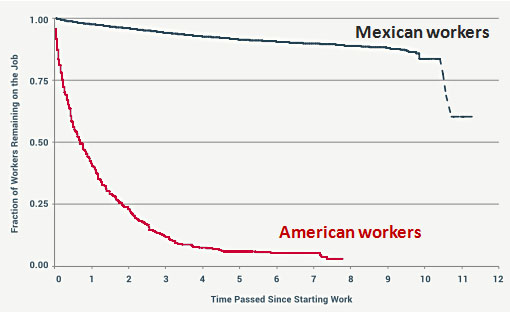
Kevin Drum thinks so. He posts the above chart, which compares the percentage of American and Mexican agricultural workers in North Carolina who stayed on the job over a 12-month period:

Within two months, 80 percent of the native workers had quit. By the end of the growing season, only seven were left. Now, as Matthews notes, this report doesn’t exactly come from a neutral source. It’s from a pro-immigration group working with a group of pro-immigration farmers. But unless they’re flat-out lying here, the numbers are pretty compelling. Most Americans just aren’t willing to do backbreaking agricultural labor for a bit above minimum wage, and if the wage rate were much higher the farms would no longer be competitive.

One of Drum’s readers objects:

Farm laborers in Australia make much more than American ones. And yet they still have a functional agricultural sector. It turns out that allowing companies to import an unlimited number of foreign workers desperate to work at a wage of epsilon will create shitty working conditions and low wages!

Noah Millman wonders about the consequences of paying farm workers more:

What would happen if agricultural labor were better-compensated? To some degree American agricultural enterprises would become less-competitive—we’d import more of some kinds of food from abroad. Which would mean more money flowing into the agricultural sector in those countries, and more employment for agricultural labor there, as opposed to here. From the perspective of the farm laborers that’s not obviously a bad outcome—they have jobs and not have to uproot themselves to get them.

Another possibility is that American farmers would innovate, and find ways to get the same crop yields with fewer workers, through the application of automation. That advance in productivity would reduce agricultural employment overall, with the remaining employees earning a higher wage, more conducive to economic and social security. Genuine advances in productivity are usually counted as a good thing for everybody.

What Should Count As Drunk Driving?

The National Transportation Safety Board (NTSB) wants to lower the legal limit:

Currently, the threshold is set at a blood alcohol content of 0.08 percent, as a result of a transportation bill signed into law by President Clinton in 2000, which stated that states had to adopt the 0.08 threshold by 2004 or else have their highway funding revoked. But in a new report, the NTSB argues that this threshold is too high, and that it should be reduced further to 0.05. For reference, the average woman weighing 165 pounds would have to consume three beers to top 0.05, four to top 0.08, and five to top 0.10 (change that to four, five and six for the average man weighing 195 pounds).

Kathryn Stewart supports the change:

The United States is among a handful of countries that sets the illegal blood alcohol concentration as high as 0.08 percent. Perhaps that is one reason we trail behind many other developed countries in our traffic safety record. In virtually every country where the illegal level has been lowered, lives have been saved.

When several European countries lowered their levels to 0.05 percent, researchers tallied the reductions in traffic deaths to be somewhere between 8 percent and 12 percent among drivers ages 18 to 49. And in Australia, fatal crashes decreased by 18 percent in Queensland and 8 percent in New South Wales after those states lowered their limits to 0.05 percent. In Sweden, when the illegal level went from an already-low 0.05 percent to 0.02 percent in 1990, the proportion of alcohol-related fatalities declined sharply, from 31 percent in 1989 to 18 percent in 1997. In our own country, lowering the limit from 0.10 to 0.08 was associated with reductions in impaired driving crashes and fatalities from between 5 percent and 16 percent.

The View From Your Weirder Windows

photo (44)

“It’s from the floor of a yurt, an hour’s ski into a forest near Flagstaff, Arizona.” Several more after the jump:

DSCF0883

Stockholm, Sweden

IMG_0592

The ferry from Flam, Norway to Bergen, Norway

photo (45)

Heceta Head lighthouse, in an RV between Yachats and Florence, Oregon, 3 pm

photo (51)

Glencoe, Illinois

photo (47)

Wasilla, Alaska

What IQ Tests Measure

Brink Lindsey makes some important points about IQ scores. They are designed to predict outcomes in a post-industrial advanced society:

IQ scores clearly tell us something of genuine importance. They are a reasonably good predictor not only of performance in the classroom but of income, health, and other important life outcomes.

Then this qualifier:

IQ tests are good measures of innate intelligence–if all other factors are held steady. But if IQ tests are being used to compare individuals of wildly different backgrounds, then the variable of innate intelligence is not being tested in isolation. Instead, the scores will reflect some impossible-to-sort-out combination of ability and differences in opportunities and motivations.

I’m pretty sure that’s true. The trouble is: IQ researchers are not dumb. And they have done their best to control for background, culture, education, wealth, etc. And when they do, the differences between population subgroups of different ancestries do not go away completely. Brink is dead-right that upbringing is a big deal and can greatly affect the result. But those results tend to start at 8 years’ old and are hard to budge thereafter.

Leaving immigrants aside, in the US, we have not seen among longtime residents what we would expect: a convergence of IQ among all population subgroups. We do have rising IQ rates in general – as our brains adjust to the new and more complex set of tasks our modern society has created for them. There’s no reason to believe that immigrants of one population subgroup won’t rise in IQs over generations – and they have. But the other subgroup populations have rising IQs as well – and the differences do not go away.

Why else do they have a de facto Asian quota at Harvard?  Why else did they once have an explicit Jewish one? That’s one of the ironies of affirmative action. The very liberals who deride “race” as a category, use it reflexively all the time in the case of affirmative action. And the upshot of their use is direct discrimination against population subgroups because of their higher scores. Accusations of racism cuts both ways. If the Supreme Court strikes down affirmative action this year, as seems likely, how will resilient differences in IQ between subgroups of differing ancestries be hidden?

Another important bit of Lindsey’s argument, with which I fully agree, is that the kind of intelligence measured by IQ is a very specialized and post-industrial-specific one. It has, as I’ve repeatedly, said, no intrinsic value, morally or otherwise. It’s entirely contingent on our particular kind of society and what kind of brain succeeds best in it on its own terms (of socio-economic advantage). There are many other just as valuable (in my view more valuable) forms of intelligence.

IQ tests reward the possession of abstract theoretical knowledge and a facility for formal analytical rigor. But for most people throughout history, intelligence would have taken the form of concrete practical knowledge of the resources and dangers present in the local environment. To grasp how culturally contingent our current conception of intelligence is, just imagine how well you might do on an IQ test devised by Amazonian hunter-gatherers or medieval European peasants.

The mass development of highly abstract thinking skills represents a cultural adaptation to the mind-boggling complexity of modern technological society. But the complexity of contemporary life is not evenly distributed, and neither is the demand for written language fluency or analytical dexterity. Such skills are used more intensively in the most advanced economies than they are in the rest of the world. And within advanced societies, they are put to much greater use by the managers and professionals of the socioeconomic elite than by everybody else. As a result, American kids generally will have better opportunities to develop these skills than kids in, say, Mexico or Guatemala. And in America, the children of college-educated parents will have much better opportunities than working-class kids.

And yet the median score for very wealthy subgroups is often lower than the median score for poorer subgroups. That’s the truly surprising result of the research, as you will find if you ever actually bother to read The Bell Curve, rather than simply dismissing it. Reihan calls Lindsay “entirely correct”:

Yet its implications for the immigration debate are not entirely clear. As a matter of distributive justice, discriminating against a given class of persons on grounds of inherited disadvantage seems profoundly unfair. And if we collectively decide that our immigration policy ought to be crafted with global distributive justice foremost in mind, admitting large numbers of less-skilled immigrants is obviously the right thing to do, given the size of the “place premium.” But if our goal is instead to recruit immigrants who are likely to flourish in an advanced economy, the case for assessing immigrants on the basis of whether or not they possess the highly abstract thinking skills associated with success seems much stronger. This would be the case whether or not a relative lack of the skills in question reflects some intrinsic quality (which, like Brink, I’m pretty sure is not the case) or contingent historical circumstances.

That’s why I favor giving foreign grad students an automatic green card with their diploma. But there should be no IQ-based testing of immigrants. We’d be a much less rich and genuinely diverse country if we did that.

“We Call It ‘Dick Drunk’”

Mistresses And Fetishists Gather At Annual DomCon Convention

After reading Emily Witt’s essay detailing the shoot of an extremely graphic BDSM porn film, Dreher worries that we have entered an era in which consent is the only criterion for sexual relations:

The essay is full of descriptions of public sadomasochistic rituals involving willing participants and crowds. It is difficult for me to imagine anything more degrading than what is recorded in this essay, though it is important to note that the women who submit to being spat on, humiliated, beaten, tortured, and sexually violated consented to the experience, and later speak about how great it was. The horror on display here is not only that people will do that to others for sexual pleasure, but that others will take pleasure in being so humiliated. This, as we know from the Marquis de Sade at least, is nothing new. What is new about it, I think — and this is why the essay got to me — is that it is becoming more acceptable in a world in which there is no strong moral framework to push back against this stuff. You can have whatever you desire. If you choose hell, then we will call it good, because it is freely chosen, and brings you pleasure.

But it wasn’t hell for the woman involved. When asked how she felt about a public sexual humiliation, she replied, “I had a great time, it was amazing. There was so much going on.” Then this question:

DONNA: On a scale of one to ten, how would you rate your happiness leaving the shoot?

PENNY: Eleven!

Noah Millman puzzles at Dreher’s “visceral reaction to a bunch of freaky Friscans flying their freak flag. Why? What’s his stake?”  Dreher answers:

I have to live in a world  – and, more to the point, raise children in a world — in which perversity like this is available, via the Internet, to more and more people. I have to raise children in a world in which human sexuality and the general idea of human dignity is degraded by pornography. I have to live in a world in which utopians are working very hard to tear down the structures of thought and practice that harnessed humankind’s sexual instincts and directed them in socially upbuilding ways. I have to raise my kids in a world that says when it comes to sex, there is no right and no wrong, except as defined by consent.

San Francisco freak parties are not “the world.” And consent is, as Rod would surely acknowledge, integral to moral sexual behavior. But what this is about, it seems to me, is fantasy. In our modern bourgeois world, one of the few areas left for real psychic risk and thrill is sexual fantasy. It’s a form of play. The only core argument against it seems to be the core non-procreative one that the Catholic Church’s magisterium upholds. But once you have severed sex from procreation, why is one person’s fantasy somehow illicit? Don’t we all have sexual fantasies? Isn’t most sex a form of fantasy? Whom does it harm if we can realize them, without actual risk of injury, in a sex-play completely under the control of the bondage “victim”?

Friedersdorf is unsure that contemporary society is any more sexually depraved than previous generations. He notes that greater tolerance of consensual kink has coincided with a decline in rape:

I happen to think [BDSM and kink] doesn’t in fact threaten civilization, that transgressive sex cannot, by definition, become the norm. Others may differ, and I’m just guessing there; but it is to say that, whatever you think of the porn shoot, the scattered, unconsensual sex that went down in the Bay Area that night was more worthy of condemnation, more uncivilized, more destructive and less moral. I hope it is clear that I’m not suggesting my interlocutors are insufficiently horrified by rape. What I am saying is that really grappling with and evaluating consent as a sexual ethos makes it harder to assume, as Dreher seems to, that he’s raising his sons in a more sexually depraved society than the one in which he grew up. What to make of the fact that the undeniable rise in pornography has coincided with a startling, steep decline in the rate of forcible rape? If fewer men are raping and fewer women are being raped, isn’t there, at minimum, a strong case to be made that young people today are less sexually depraved than before? I realize that doesn’t make it any easier for a father to explain extreme porn to his teenager, and deeply sympathize while acknowledging that I’d be confounded by and dread the task myself.

Meanwhile, Pascal-Emmanuel Gobry suggests the real moral degradation in Witt’s essay lies elsewhere:

It’s not kinky sex. It is, and the piece screams this at me, an utter absence of love. What this piece is is a description of is what happens when not only people don’t love each other but don’t even have the idea that that is something they ought to do. If with orthodox Christian theology we describe Hell as the absence of God and God as love, then Rod is absolutely correct that this piece is a glimpse of a Hell on Earth, but perhaps not for the reasons Rod had in mind.

Recent Dish thread on sexuality and porn here.

(Photo: A participant called SgChill is bound in rope at a dungeon party during the domination convention, DomConLA, in the early morning hours of May 11, 2013 in Los Angeles, California. By David McNew/Getty Images)