Racism In The World, Ctd

A reader writes:

I found your post intriguing, but then I saw this takedown of errors in the dataset. I think a correction is definitely due, since at least some of the results appear to be opposite to the truth.

Yep: one stats expert has spotted a “fat finger” in the Bangladesh data:

“Yes” and “No” got swapped in the second round of the survey, which means that 28.3% of Bangladeshis said they wouldn’t want neighbors of a different race – not 71.7%.

That’s a huge difference. But it may be restricted to Bangladesh. Another reader:

I don’t see how that map gives us a grasp of racism around the world. With the exception of France and a couple of other First World countries, this seems to be a much better indicator of each country’s knowledge of First World norms.

A study like this has to be tailored to each country’s level of sophistication. The average person in America or Canada lives in a metropolitan area with easy access to mass media. Regardless of whether or not they are racist, the average American KNOWS that you can’t say “I don’t want to live with people of another race.” However, the average person in India or Bangladesh lives in a rural area and has almost no interaction with people of other races and very little exposure to mass media. When you ask them them a question about neighbors, all they’re really thinking is “I don’t know want my village taken over by foreigners.” Racist? Possibly. Unsophisticated thinking? Definitely.

I am an American of Indian descent and briefly lived in India. I have no trouble believing India is the most racist country out there, but my experience in India also gives me some insight into how the survey questions are perceived by the average person there. You simply can’t ask the same question in the U.S. and India and think that you are measuring the same thing.

Another:

Regarding India, I would not discount Islam or religion in general as a big part of the explanation. For starters, India has (depending on the source) between 160 and 180 million Muslims, more than any country other than Indonesia and Pakistan. And most of the rest of the population are Hindu and Hinduism is very much tied into being Indian and therefore of a certain physical appearance if not race. When I spent a semester in India 21 years ago, I certainly at times felt like I was being treated differently (for good and ill) because I was white. Mixed up in the religion issue is the fact that skin color is a big deal in Indian society. Light skin is an ideal physical trait, especially in northern India. Most of the movie stars have light skin (and would not stick out in Rome) and there are skin lighteners for sale in every drug store or grocery. Additionally, you have the legacy of British rule. Indians have certainly not forgotten that they were relatively recently under the thumb of white folks.

Another:

You don’t mention it, but France’s racism status has a lot to do with Islam too. Hatred from and for Arab and African muslims is incredible there. As an American married to a French woman, the amount of open and overt racism coming from both sides is incredible to see. (Jews don’t feel too good there either, but that’s another conversation.)

Iran’s Election Just Got Interesting, Ctd

IRAN-VOTE-REGISTRATION-MASHAIE

First, former President Rafsanjani made a surprise entrance into the race. Now, the Guardian Council has delayed its announcement of the approved candidates for the election, which will give those candidates just over three weeks to campaign. David Patrikarakos notes how the regime is already attempting to discredit Rafsanjani:

Rafsanjani would have support from both conservatives and reformists, and, critically, he could win. So the question remains: will he pass the vetting process?

Ayatollah Ahmad Jannati heads the Guardian Council and is a close ally of Khamenei. He would probably like to reject Rafsanjani’s candidacy outright, but things are not that simple. … Rafsanjani is too powerful to be swatted aside like so many other candidates but, equally, the regime is determined to avoid a repeat of the popular unrest of 2009. … It is a sign of how isolated Iran’s ruling elite have become that Rafsanjani, a commercially minded pragmatist who never displayed any great love of reform beyond what was practically necessary, is now seen as a grave internal threat to the regime. Even were he elected there is no knowing how reformist he would be: his track record shouldn’t give any hope to the regime’s opponents, and how far he has changed remains to be seen.

Meanwhile, Laura Rozen takes a look at Saeed Jalili, the country’s top nuclear negotiator, who may emerge as the hardline establishment’s choice now that Rafsanjani is running:

Jalili, 47, a trusted Khamenei aide who has served since 2007 as the secretary of Iran’s Supreme National Security Council (SNSC) — the Iranian equivalent of National Security Advisor–has managed to largely bypass the bitter feuds that have polarized Iran’s ruling factions, analysts and associates observe. As a candidate who may be able to unite key conservative factions, a Jalili presidency potentially offers the prospect of a more consolidated Iranian leadership, which might be able to muster internal Iranian consensus if the Leader decides to make a deal, some analysts suggest. …

“I think he is the anointed one,” Suzanne Maloney, a former State Department Iran analyst at the Brookings Institution Saban Center, told Al-Monitor. The regime “may test run it, see how he [does], if anybody else appears to take off.” … Current and former Iranian associates describe Jalili as a pious and intelligent man, who has earned the trust of the Supreme Leader, but shown a disinclination to deeply engage with the modern world.

(Photo: Iranian President Mahmoud Ahmadinejad (R) and Esfandyar Rahim Mashaie (L) flash the sign of victory during their press conference after Mashaie registered his candidacy for the upcoming presidential election at the interior ministry in Tehran on May 11, 2013. Iran is expected to wrap up the five-day registration of candidates on May 13, leaving the fate of the hopefuls in the hands of the Guardians Council, an unelected body controlled by religious conservatives appointed by Khamenei. By Behrouz Mehri/AFP/Getty Images)

Buying Good Press

Jeff Saginor is bothered by the $1,299 gift bag that Google gives away free to attendees of its annual Google I/O conference:

[T]his year at I/O, Google upped the ante, giving everyone in attendance a Chromebook Pixel—a laptop running Google’s own operating system, retailing for $1,299. It’s the equivalent of Apple handing everyone a MacBook Pro on the way out the door. It made headlines across the web. And it’s everything that’s wrong with tech reporting.

Technology events are not giveaways for Oprah’s favorite things—journalists don’t get to go home with bags full of expensive toys and then pretend to critically cover the companies that bribe them. As James Temple explains in The San Francisco Chronicle, tech writers will “tell you they’re routinely offered pricey gift baskets and all manner of smart phones, software, tablets and computers, often with no obligation to return or write about them.” And last year, Brad Stone of Businessweek wrote that reporters at a Spotify launch party in San Francisco were treated to $300 bottles of tequila as parting gifts. It happens constantly. Of course most reporters don’t accept the gifts. But the casual relationship undermines the nature of serious technology reporting.

What IRS Scandal? Ctd

A few readers with tax expertise chime in:

All I do all day is advise c3s and c4s on this stuff (only liberal and nonpartisan ones – so I write this email as an ideological opponent of the Tea Party groups).  And I can tell you Noam’s argument is off.  Only a very experienced nonprofit tax lawyer is likely to know that c4s don’t have to file IRS Form 1024 in order to be recognized as tax-exempt.  In fact, within the past few months, it was a topic of discussion on an email list of nonprofit tax lawyers, with the “experts” trying in vain to find confirmation from the IRS that these groups aren’t required to file.

Most importantly, the IRS deceptively tried to get groups to think they needed to file.

If you’re a grassroots group of activists trying to figure out the law without paying an expert, you’d never know you can skip the 1024.  An activist would do some Googling and find IRS Publication 557, which says on pg. 57, as the first sentence of the section on c4s: “If your organization is not organized for profit and will be operated only to promote social welfare to benefit the community, you should file Form 1024 to apply for recognition of exemption from federal income tax under section 501(c)(4).”  (Not the IRS used “should” rather than “must.”  Who but a tax lawyer would notice?) In addition, earlier this year the IRS issued a new revenue procedure (Rev. Proc. 2013-9) that was intended to force c4s to file a form 1024.

So it’s only the big, well-funded c4s that would know enough to skip the 1024, and the IRS is changing its rules to try to get them to file, too.

Another:

An accounting professor here. Scheiber’s argument is weak at best.  Yes, a social welfare organization can theoretically operate as a tax exempt entity without filing for 501(c)(4) status.  However, being tax exempt is not the point.  After all, PACs and Super PACs are also tax exempt entities.  A social welfare organization cannot represent to the public (i.e., donors) that they are a 501(c)(4) without applying for recognition as such (by filing form 1024).  What distinguishes 501(c)(4)s from (explicitly) politically-minded tax exempt entities is that they don’t have to disclose their donors.  If a social welfare organization wants to represent to its donors that they will remain anonymous, the only way of doing so is applying for 501(c)(4) status.

For what it’s worth, saying these guys singled themselves out is even worse.  The IRS chose to conduct a further review of a disproportionate sample of those who applied.  That is, even among those who “singled themselves out”, the IRS further singled out tea party groups.  Is it a big scandal?  Maybe not.  But it is unfair to dismiss the whole thing as meaningless.

The Global Fertility Decline

World Fertility

Martin Lewis wants more attention paid to it:

I find it extraordinary that the massive global drop in human fertility has been so little noticed by the media, escaping the attention of even highly educated Americans. The outdated idea that Mexico has a crushingly high birthrate continues to inform many discussions of immigration reform in the United States, even though Mexico’s TFR (2.32 in 2010) is only slightly above that of the United States.

It almost seems as though we have collectively decided to ignore this momentous transformation of human behavior.

Scholars and journalists alike continue to warn that global population is spiraling out of control. A recent LiveScience article, for example, quotes a co-author of an April 2013 Science report who argues that “the poorest nations are caught in a downward spiral that will deplete resources and cause a population explosion.” The article goes on to argue that “with the world population slated to hit 9 billion by the year 2050, many scientists and others worry that unchecked population growth and increasing consumption of natural resources will cause dire problems in the future.”

Although the LiveScience article notes that the original report focused on sub-Saharan Africa, it does not mention the fact that high birthrates are in fact increasingly confined to that part of the world, or that fertility rates are persistently declining in almost every country in Africa, albeit slowly. Many African states, moreover, are still sparsely settled and can accommodate significantly larger populations. The Central African Republic, for example, has a population of less than 4.5 million in an area almost the size of France.

(Chart from Mark Perry)

Links Through Their Lives

Tom Shone previews Richard Linklater’s new film Before Midnight, a follow-up to Before Sunrise (1995) and Before Sunset (2004), a trilogy that tracks one couple’s relationship every nine years:

The release of Before Midnight has been greeted with the sort of enthusiasm that normally precedes Oscar campaigns—the R.S.V.P.’s to the first screening were returned within hours, the publicist tells me. “That never happens.” At the risk of spoilers—the first ten minutes are close to pure bliss for fans—the film finds Celine and Jesse, the lovers of the first two films, on holiday in Greece, where they walk and talk and argue and flirt, as they have always done, the ancient backdrop only serving to underline the real subject of the films, a ménage-à-trois between the couple and a third, as-yet-unbilled character: Time.

Put like that, the films’ achievement suddenly seems very grand indeed—a ringing confirmation of those critics who compared Linklater’s experiments in real-time dramaturgy to Satyajit Ray’s Apu trilogy and Truffaut’s Antoine Doinel films. …

[Linklater] pauses, looking momentarily panicked, as if I am about to start talking about his themes or oeuvre. “I’m fascinated with that relation, which we all have, with our previous selves. We all have that, that’s all we have, our whole life—who you were as a kid, who you were at 20—the great thing about getting older is you can reference yourself. But I’m equally sure that if we really could meet ourselves, we’d be surprised. Because we’ve re-characterized ourselves so many times to fit our current needs: ‘Oh, I was an idiot then, but now I’m smart.’ Not giving yourself enough credit, or giving yourself too much. It’s a fascinating relationship. That’s what these films have become about.”

(Video: The official trailer to Before Midnight. Here is a fan trailer combining clips from the first two films.)

Noonan Just Loses It

Her column today is simply unhinged from the first sentence:

We are in the midst of the worst Washington scandal since Watergate.

Can she actually believe this? Has this president broken the law, lied under oath, or authorized war crimes? Has he traded arms for hostages with Iran? Has he knowingly sent his cabinet out to tell lies about his sex life? Has he sat by idly as an American city was destroyed by a hurricane? Has he started a war with no planning for an occupation? Has he started a war based on a lie, and destroyed the US’ credibility and moral standing while he was at it, leaving nothing but a smoldering and now rekindled civil sectarian war?

So far as I can tell, this president has done nothing illegal, unethical or even wrong.

You have to bend yourself into several pretzels to even understand what the Benghazi thing is about. All the emails Obama And Turkish PM Erdogan Meet At The White Housereleased show what amounts to a classic inter-agency conflict, resolved dispassionately by Ben Rhodes, in a period of considerable confusion. For the half-baked talking points, someone has been already fired. On the DOJ’s aggressive pursuit of a leaker who might have endangered national security, I thought Republicans like Noonan approved of that. But not when it’s Obama, when it suddenly becomes an “assault”.

The IRS story is a different matter and an entirely legitimate scandal at a lower level. I want those responsible to be fired or prosecuted.  But there is no proof whatever of any connection to the president, his campaign or anyone near the administration itself.  Sarah Hall Ingram, who was in charge of the office scrutinizing 501 (c) 4s has no business still working in the IRS, let alone on healthcare reform. She should be fired as well as her then-deputy, who is out the door June 3.

But how exactly is all this a crippling scandal for the president? He is not involved in any of these issues directly. In fact, it would be highly inappropriate for the president to be micro-managing the IRS or, for that matter, the DOJ. If he were, Noonan would be calling him Carter. At some very distant level, he is formally responsible – but not in the way that Reagan was directly responsible for Iran-Contra, or Clinton for lying under oath about his sex life, or Bush for making brutal torture his central strategy in the war on terror. That’s what makes a scandal a real scandal: the political involvement of a president or a key member of his administration in a cover-up or criminal offense or lie. That simply isn’t here – with the caveat that something may emerge later.

So what on earth is she banging on about? She cannot connect the president directly to this scandal – the first in his four and a half years in office (which must be a record). So she simply assigns blame to him because he is the president. Or this higher bullshit:

A president sets a mood, a tone. He establishes an atmosphere. If he is arrogant, arrogance spreads. If he is to too partisan, too disrespecting of political adversaries, that spreads too. Presidents always undo themselves and then blame it on the third guy in the last row in the sleepy agency across town.

I would say, especially after the catastrophic consequences of the last president, and the continuous siege of the Clinton White House, Obama’s record is extraordinarily clean and remains so. And this president is not partisan, as many Democrats will tell you. He’d love to do a deal with the GOP – if only they were capable of compromise.

I guess what I’m saying is that my own confidence in this president’s integrity and abilities is completely unfazed by these unconnected stories. I have seen no evidence of his involvement in any of them. Noonan hasn’t either. She just invents a conspiracy to audit conservatives with two anecdotes. She writes that “it is not even remotely possible that only one IRS office was involved,” even though we have no evidence that any other one was. The Washington response, moreover, was to tell Cincinnati to cut it out. She then writes:

And why — in the matters of the Associated Press and Benghazi too — does no one in this administration ever take responsibility?

How about this on the DOJ’s leak investigation from today from the president:

“I make no apologies and I don’t think the American people would expect me as commander-in-chief not to be concerned about information that might compromise their missions or might get them killed.”

Yes this is no ordinary scandal, Peggy. Because, as far as the president is concerned, there is as yet no scandal at all.

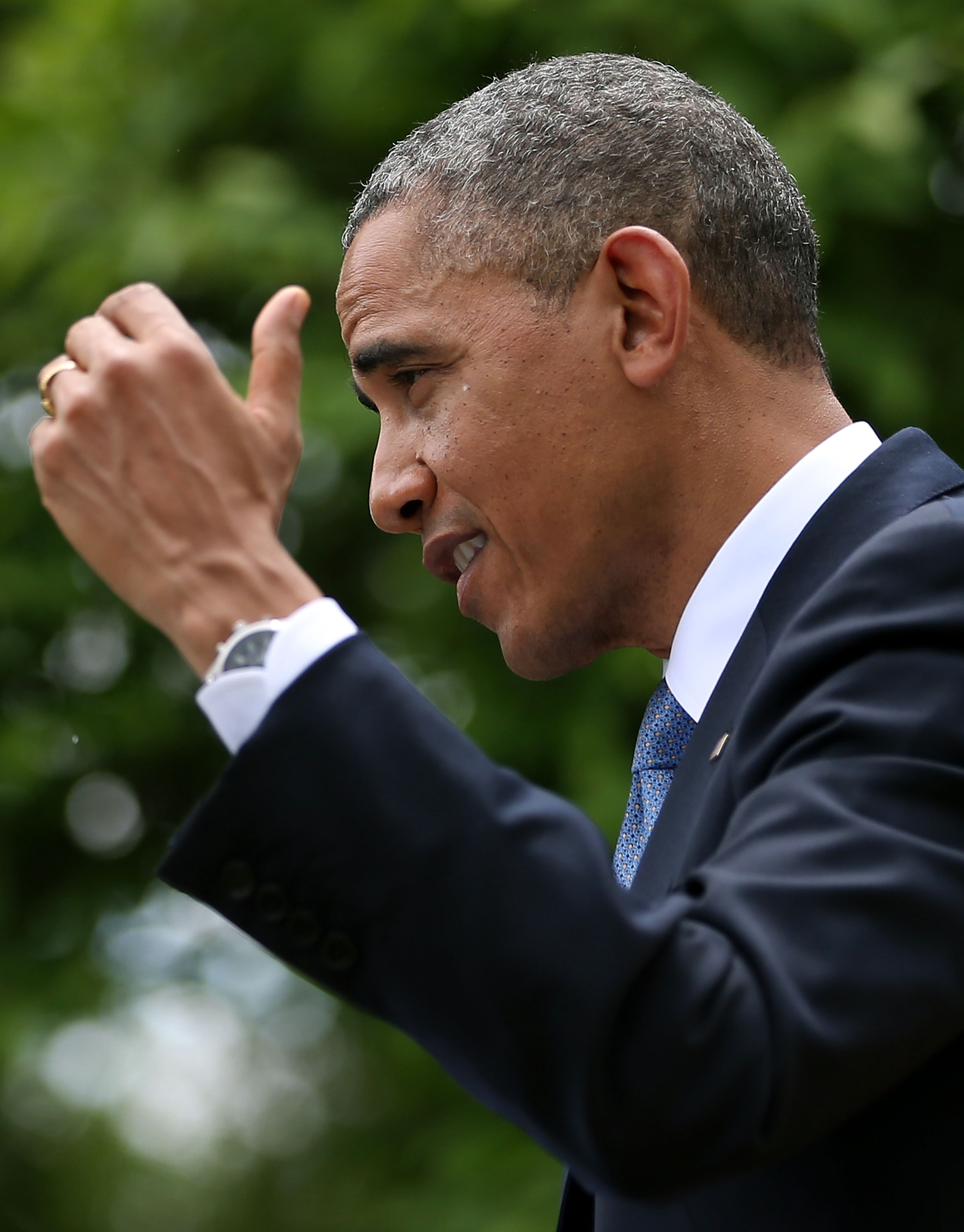
(Photo: Obama today by Mark Wilson/Getty Images.)

Is Pakistan On The Right Path?

PAKISTAN-UNREST-VOTE-INDIA

In what “appears to have been the freest and fairest election in Pakistan since the country’s first democratic national election in 1970,” two-time prime minister Nawaz Sharif’s and his Pakistan Muslim League-Nawaz (PML-N) have pushed out the ruling Pakistan People’s Party (PPP) with a broad and decisive victory:

For the first time since Nawaz Sharif’s ouster in a 1999 military coup, civilian power in the Pakistani political system will be re-centering in the office of the prime minister rather than a powerful president. This represents a shift from the past five years, which had seen a general diffusion of power within the country. The PPP tenure was marked by significant compromises on power-sharing with the opposition and between the central and provincial governments.

Ahmed Rashid sees room for cautious optimism that “a civilian government might at last be equipped to tackle some of [Pakistan’s] challenges”:

Above all, many Pakistanis want Sharif to concentrate on the economy, to improve the energy supply and create jobs. The economy is teetering on the edge, as the country is close to defaulting on its foreign loans. At the moment, it has state-held foreign reserves of about US $6 billion, or about six weeks worth of imports. In many parts of the country, there is no electricity for up to sixteen hours a day and diminishing gas supplies, which has led to industry shut-downs and soaring unemployment among young people.

Like most Pakistani parties in recent years, Sharif’s Pakistan Muslim League has voiced anger at Washington, in particular over the use of drone missiles. Now that the PML is in power, Sharif will have to deal with the Americans more adroitly, particularly if he wants their support to gain the huge loans from the IMF and the World Bank that Pakistan desperately needs. If the army and the new government are able to seize this opportunity, Pakistan could finally begin to emerge from the chaos, lawlessness, and terrorism that has gripped the country for much of the past decade.

Walter Russell Mead remains pessimistic:

Not so long ago Nawaz Sharif wasn’t much more than a corrupt thief, like many of his colleagues in the Pakistani civilian political elite. He and his party have visible links to some very nasty groups of sectarian militants, especially in the Punjab, a PML-N stronghold. Pakistan’s deep state, where the real power lies, doesn’t seem likely to let Sharif do more with his time in office than take the blame for the government’s inevitable failures and economic setbacks. …

Pakistan is on the brink of a new era but only in the sense that one group of corrupt politicians have been dumped out of office in exchange for another group of equally corrupt civilians. The country still faces the same problems it faced five years ago and will likely face five years from today.

One challenge for Sharif gets personal:

[His] longtime tormentor, Musharraf, is under arrest in Pakistan after returning from his own exile to run in the elections. Musharraf was ousted by popular pressure in 2008, became a billionaire in exile in London, and then foolishly decided he was Pakistan’s savior this winter and decided to go home to be swept back into power by the people.  He miscalculated badly. No one in Pakistan wanted the self-appointed savior, and he is now under house arrest. He faces a number of charges and could be tried for the coup he orchestrated against Sharif. The irony is rich.

But Sharif faces a real challenge over what to do with Musharraf. The general has few supporters even in the Army, but the officer corps will be very uncomfortable with the prospect of one of its own serving prison time, or worse. Since many of the senior commanders in the Army today, including chief of Army staff Ashfaq Parvez Kayani, are former Musharraf protégés who rose with him to power, the question of what to do with Musharraf now is a dangerous challenge.

(Photo: Pakistan’s incoming prime minister Nawaz Sharif speaks to journalists at his farm house in Raiwind on the outskirts of Lahore on May 13, 2013. Sharif said that he would be “very happy” to invite India’s Manmohan Singh to his swearing-in ceremony. Nuclear-armed India and Pakistan have fought three wars, two of them over the disputed Himalayan region of Kashmir. By Roberto Schmidt/AFP/Getty Images)

The Fracking Debate, Ctd

Readers from both sides of the divide tell their stories:

The oil and gas industry has been fracking wells for decades. It is not a new technology. I have worked in the industry for more than 30 years and took classes in the early 1980s on fracking. The majority of wells in Oklahoma have been fracked. The water supply has not been affected adversely. Having toured the water treatment facility in Tulsa there was no mention of contamination from oil and gas drilling and there have been thousands of wells drilled in northeastern Oklahoma since the early 1900s.

The major change in the drilling of oil and gas wells is that prior to the last decade most wells were vertical wells, meaning that a hole was drilled to a certain depth and the producing formation was fracked sending the fracking material into the zone so the oil and/or gas would be freed and sent to the surface. The amount of oil and gas that could be recovered was limited to the area around the vertical hole.

In recent years technology has improved to where a vertical hole is drilled to the desired formation and then it turns at a right angle and the hole is drilled horizontally for the length of one or two sections.

After the well is completed, it is fracked in that formation. The recovery with a vertical well was limited to as far as the fracking reached horizontally into the formation. The recovery from a horizontal well is much more efficient since the pipe runs horizontally through the formation. The well is fracked at predetermined intervals along the horizontal line. New technology also allows for a number of wells to be drilled from one drill site rather than the need for several drill sites.

The oil and gas industry is like any industry. Most of the players are responsible and it is the few bad actors that give the rest a bad name. The risk of pollution and danger are much more likely to happen when a well is depleted and it is not properly plugged and abandoned. Luckily the records we have today are very good and what took place in the early 1900s is not happening today.

Also it is important to remember that the oil and gas companies are in the business to turn a profit. The cost to drill a horizontal well is between $5,000,000 and $15,000,000 depending on depth and length of the horizontal leg. The well has to produce a lot of gas at $3.50 and/or oil at $90 a barrel to pay out. It is in the companies interest to make sure that the hole is secure and that the pipe does not leak or break. The amount of oil and/or gas in a formation is finite, and the oil company hopes that there are enough reserves to recover the drilling costs and make money far in the future. Wells are not all equal and many do not pay out.

I lean liberal and would rather live with oil and gas as a source for energy than nuclear and the question of keeping all the spent rods. Wind is also a good option but requires much more land space and, in my opinion, is a bigger eyesore than oil and gas development. I do worry about the amount of water that is used but there are ways to clean it up. There is also an online resource to find out the chemicals used in wells called Frac Focus.

Another is much more worried about the water issue:

I am the Director of Admissions at a small “environmentally aware” independent boarding school in Ohio that has considerable land resources. With the contraction of the independent school market that followed the recession in 2008, our school has seen a precipitous decline in enrollment and is located in a rural area that has traditionally been economically depressed. As you can imagine, we are a prime candidate for the oil and gas companies to woo into signing away our mineral rights. We have held out thus far. In my position I have been able to see the influence with which oil and gas companies have exercised to their benefit.

First, they work heavily with municipal leadership. Since these municipalities are cash strapped, mayors and city counselors are eager to bring money (doesn’t matter how much) into the town. Our head of school has been “called” into meetings with the mayor, who insists on breakfast and lunch meetings with representatives from the O & G folk. As it turns out, on top of the lease agreement that is signed for say, $6,000 per acre (a hefty sum for an area that has seen nothing but net population decrease since the 1950s), the company then goes out of its way to grant “gifts” to institutions that sign away the mineral rights. For example, our town has recently signed the property of the public high school to the O & G people. A week later, the company decides to spontaneously gift a sum of $40,000 to the high school. Same with the hospital. This is done with fanfare at a public event (in this case, a Chamber of Commerce meeting with local business owners). Though this is presented as a gift in the interest of being “corporate citizens,” in reality this is a signing bonus that is agreed upon before the lease is signed. The cherry on top.

The amount they are offering is chump change compared to both the net profits they will make in addition to the “unseen” costs of unregulated drilling. With the inflow of workers from out of state, rents in the area have skyrocket, pushing lower income residents out of town. They aren’t using local labor, and since wells only last 1-2 years, the influx of money to the local economy is only temporary, and is used to plug budget gaps that will just come up again in the near future. Retail and services benefit with the influx of new people, but will contract again in 8-10 years when the company moves on to greener pastures, leaving the town worse than where it started.

I must apologize, as I seem to be ranting, but there are two environmental angles that haven’t been covered as far as I have seen.

One is clearing. A local teacher found himself approached by the company, asking to lay pipe foundations across his property. In the contracts, the company stated that clearing 50 feet of forest on either side of the pipe was necessary for maintenance of the line (100 feet across). This would have effectively leveled most of his property. Though he didn’t sign, there are many more people who do because in addition to the mineral rights lease, they are given a sum of money per foot of pipe laid.

The second is the volume of water used, rather than just the pollution of our groundwater. We live in the watershed of a creek that flows into the Ohio River. The same teacher referenced above had taken students towards where the creek flows into the river, and found a well-cap that had been drilled in the flood basin of the creek, with hoses drawing water directly out of the creek. Where this gets particularly worrisome is that Ohio is a “free use” state, meaning these companies can draw up to 100,000 gallons of water from the creek per day regardless of time of year. The creek cannot sustain that kind of water draw, especially during the summer when the water levels drop. Especially when you have one well-cap per square mile all drawing water from the same creek.

We got in touch with the Ohio Department of Natural Resources, who issue the permits for gas wells. They do no monitoring of the amount of water drawn, and instead referred us to three different agencies: Soil and Water, the EPA, and the Army Corps of Engineers. After attempting to get in touch with those three organizations, we realized there is no enforcement, only data-tracking at best.

These are huge problems that aren’t getting addressed because these companies are able to come into areas and dangle vast quantities of money in front of cash-strapped municipalities. This is where I disagree with an earlier reader, who said that putting this in charge of municipalities will make sure local issues are discussed. What is unfortunate is that most of the time these municipalities do not have the resources necessary to adequately assess the affect of fracking on their communities before its too late.

More views from readers here.

The Traits Of An American

Like me, Conor is opposed to using IQ scores to determine immigration eligibility. He observes that “barring the hypothetical low IQ people would imply that intelligence determines worth, and that our project as a nation is intimately tied to constantly maximizing material wealth”:

I wouldn’t go so far as to say that recruiting human beings with impressive skills is illegitimate. In fact, I think it is prudent, and I’m glad that lots of talented scientists, athletes, artists, and programmers want to come here. More, please. I’m glad that lots of farm workers and janitors want to immigrate too. I recognize that the economic contributions of the two groups are different, but I don’t conclude that the low skill immigrants are less worthy of citizenship or less valuable citizens. Are they kind? Honest? Wise? Fun? Hardworking? Inclined to embrace core American values as articulated in the Declaration of Independence? To what extent do they participate in the civic process? Do they raise children who flourish? Do the best of their ethnic traditions and cultural insights enrich the American character? Do they contribute to the common defense? Are they invested in their new country? It’s amazing how often bygone immigration debates have focused on a couple narrow metrics to the exclusion of all else. There are so many important traits, and seemingly no one clamoring to measure or recruit for most of them.