Singing Spaceman Of The Day

A pretty great voice for an astronaut:

Context for the recording:

Commander Chris Hadfield is one of the most memorable astronauts to have gone into space, so it was fitting that his farewell moment to the world saw him record the first ever music video from space.  Ahead of his return to Earth on Monday after five months at the International Space Station (ISS), the 53-year-old Canadian astronaut fittingly covered the David Bowie classic ‘Space Oddity’ in a poignant video.  Hadfield has maintained strong links to folks at home, having entertained his 700,000-plus Twitter followers with regular photos and commentary, and taken part in a Reddit AMA interview, but music was always a focus for hom. He recorded the first song in space last December, and, speaking before his latest mission, he admitted that he would record a range of songs in space. Here he discusses playing music in space in more detail.

Alex Knapp notes that this is likely Hadfield’s last trip because “cuts by the Canadian government have forced the space agency to cut back its manned program, meaning that no Canadian astronauts are likely to spend anytime in space soon”:

I’m willing to bet that it was with the knowledge that his current space mission is likely his last that led Hadfield to produce this poignant cover version of David Bowie’s Space Oddity. He recorded the vocals and guitar while on board the International Space Station. Piano and other musical accompaniment were provided by folks down on Earth. The video itself is gorgeous, featuring some amazing shots of Earth through the windows of the space station as Hadfield sings Bowie’s famous tune.


New Dish, New Media Update

Screen shot 2013-05-10 at 2.58.06 PM

To remain transparent about our experiment in reader-supported web-journalism (subscribe [tinypass_offer text=”here”]!), here’s a graph from the last two months, once the meter was in place, and the original flood of subscriptions subsided from long-time Dishheads. What does it tell us?

The “conversion rate” in blue is defined as the number of sold subs divided by the number of unique viewers in any given week. The “user reach” in red is simply the number of unique readers who encounter our meter message asking them to subscribe to continue full access to the Dish.

You can see that the number of readers hitting the meter is pretty consistent, once it kicked in (March, basically) without the early distortion of the numbers by the flood of early start-up money. And the percentage of those deciding to sign up has varied from 1.6 percent to 3.8 percent since then. The average since March 10 has been 2.8 percent – a little higher than the industry average. The bumps may have been driven by news events. The second bump was right around our 24/7 coverage of the Boston bombings.

Weekly sales for the last ten weeks look like this:

Screen shot 2013-05-13 at 12.23.00 PM

The sharp drop at the end if just a function of this being Monday, the first of a new week. That’s an average of over $6,000 a week overall. In the second half, this has stabilized to around $4,000 a week. We have no idea if this will continue, but the numbers now seem to be going up and down a little within the same ballpark. If it does continue exactly like this, we should reach a final gross revenue total of around $800,000. If it fades, think more like $750,000. There are now 23,000 or so readers who have used up their read-ons. If you’re one of them, you could instantly nearly double the subscription numbers for this blog for just [tinypass_offer text=”$1.99 a month or $19.99 a year”].

Subscribe [tinypass_offer text=”here”]! And make it happen!

Big Brother Behind The Wheel

Greg Beato imagines that Google’s driverless cars will further erode personal privacy:

In time, Google will know when you arrive at work each morning, how many times a week you go to Taco Bell, how long you spend at the gym. As illuminating as our searches and other online behavior might be, there’s still some room for ambiguity. Maybe you’re doing all those searches on “brain tumor” because a relative is sick, or you’re doing some sort of report, or you’re simply curious. Combine that info with the fact that you start visiting the hospital every week, however, and Google knows you’ve got cancer.

The driverless car, in short, is a data detective’s dream, a device that can discern when you get a new job, how many one-night stands you have, how often you go to the dentist. As demarcation lines between the real world and the virtual world continue to blur, autonomous cars will function not so much as browsers but links, the way we get from one appointment or transaction opportunity to the next. In theory, Google will determine the route to your desired destination based on distance, available infrastructure, and current traffic conditions. But what if Google, which already filters cyberspace for you, begins choosing routes as a way of putting you in proximity to “relevant content”?

It’s Good To Be Coach

[Re-posted from earlier today.]

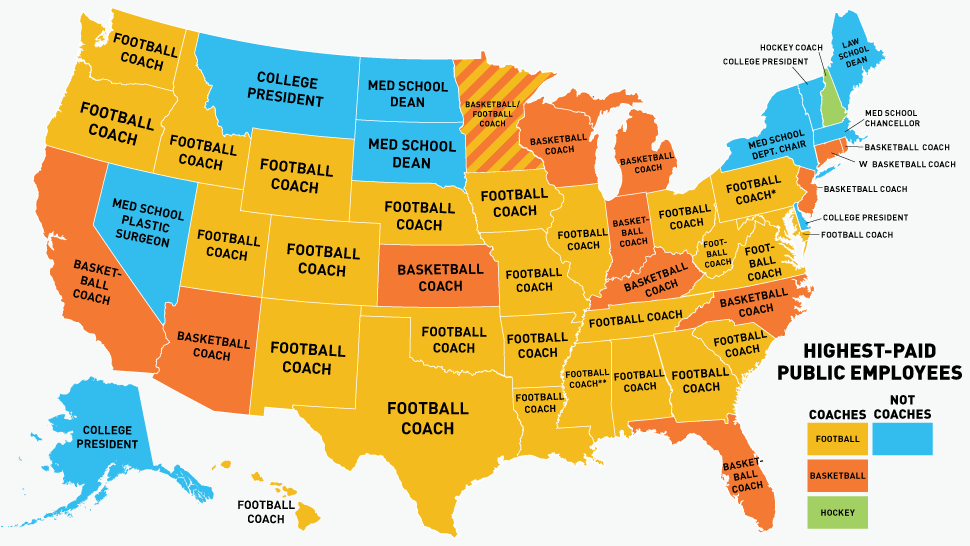
This Deadspin graphic, which went viral last week, identifies the highest paid public employee in each state:

Highest Paid

The accompanying article by Reuben Fishcher-Baum argues that coaches don’t deserve such wealth:

Looking at data from 2011-2012, athletic departments at 99 major schools lost an average of $5 million once you take out revenue generated from “student fees” and “university subsidies.” If you take out “contributions and donations”—some of which might have gone to the universities had they not been lavished on the athletic departments—this drops to an average loss of $17 million, with just one school (Army) in the black. All this football/basketball revenue is sucked up by coach and AD salaries, by administrative and facility costs, and by the athletic department’s non-revenue generating sports; it’s not like it’s going to microscopes and Bunsen burners.

Richard Vedder singles out college presidents, who are the highest paid in only four states:

The Chronicle of Higher Education tells us the median salary of public university presidents rose 4.7 percent in 2011-12 to more than $440,000 a year.

This increase vastly outpaced the rate of inflation, as well as the earnings of the typical worker in the U.S. economy. Perhaps, most relevant for this community, it also surpassed the compensation growth for university professors. Moreover, the median statistic masks that several presidents earned more than double that amount.

He goes on:

My associate Daniel Garrett analyzed the relationship between presidential compensation and academic performance for 145 schools, using the Forbes magazine rankings of best colleges. … Adjusting for enrollment differences, no statistically significant relationship was observed between academic quality and presidential pay.

Foreign Language Requirements

James Harbeck highlights some of the world’s most challenging linguistic quirks:

Some languages have a situation called diglossia, in which the written form actually represents a different dialect from the spoken form. The numerous (and not all mutually intelligible) dialects of Arabic are written in a different version of Arabic from what’s spoken. The same is true of Tamil and Sinhala: the spoken versions of the languages are now different in not just sound but some points of grammar and vocabulary from the official standard written versions.

That’s a lot harder than just having an awkward writing system. It gets to be like needing to know two languages. It’s like having an everyday spoken language that’s like what you hear in, say, rap music, or country music, or teenage slang, and having to read and write everything like you see in Shakespeare.

Relatedly, Olga Khazan examines a recent study on how immigrants assimilate into their new countries, based on how dissimilar their native language is:

By examining nine host countries, 70 sending countries, and 1,559 test scores, he then found that immigrants who come from languages that are most linguistically dissimilar have the worst literacy scores in their new host countries. A Turk in the Netherlands, the author posits, has about the same linguistic proficiency scores as a native who has little or no primary schooling. …

The awkward thing here is that there aren’t that many linguistically-similar Danes or Swedes banging down the doors to U.S. visa offices. Most of our immigrants come from Mexico (though they’ve dwindled significantly in recent years), while most holders of high-skilled worker visas are from Asia. But it seems like if the U.S. wants those individuals to perform their best economically, it could offer some sort of welcome package of its own — in the form of some generous language assistance.

“The New Yorkiest Show Of All Time”

Jonathan Zeller marks the 15th anniversary of the Seinfeld finale by ranking the 15 “New Yorkiest” episodes of the sitcom. Number two on the list? “The Maid”:

While Elaine’s quest to retain a 212 phone number amid the introduction of the 646 area code—which has now become firmly entrenched—doubtless rings true to some New Yorkers (in fact, it’s still timely), the most Manhattan mileage in this one comes from Kramer’s sad attempt to maintain a “long-distance” relationship with a girlfriend who’s moved downtown. While, as the Official Guide to NYC, we must note that New York’s transit system and street grid make it easy to navigate the five boroughs, it’s also true that the City is very neighborhood oriented; sometimes it’s tough to muster the mental energy to, say, leave Brooklyn and visit a friend way uptown in Manhattan. Sadly, Kramer and his girlfriend get into a fight and he gets lost at First (Avenue) and 1st (Street)—”the nexus of the universe.” While NYC’s legendarily confusing lineup of Ray’s pizzerias—Famous, Original, both and neither—have given way to a single dominant chain of Famous Original Ray’s Pizza, the outpost of the latter that Jerry asks about during a panicked pay-phone call from Kramer still stands not too far from Katz’s Delicatessen (though Kramer, disoriented by his surroundings, insisted, “It’s just Original, Jerry!”).

Should We Kill Cursive? Ctd

Another twist on the popular thread:

I have a perspective on cursive that may be shared by a sizable minority: left-handers.

It’s hard enough for us lefties to print, let alone to write in an “artistic” cursive style. In elementary school, handwriting lessons were downright traumatic for me. I had such a hard time following the precise loops and whorls, and connecting every letter in one continuous line was just impossible. Handwriting was the only subject I ever failed in school, and I failed it every single year in elementary school. To this day, I can concentrate hard enough to write maybe two words in cursive before I devolve into the hybrid chicken scratch that is my personal handwriting style.

What’s worse, I see this trauma being passed down through the generations in my family. My leftie father always wrote in block letters because he couldn’t write one word in cursive. Now I see my four-year-old, left-handed daughter struggling with printing and I worry about how she’ll deal with cursive.

I understand the readers who would miss the beauty of cursive, and feel that children shouldn’t learn only instrumental skills. But I would say this: We may want children to learn about and appreciate art, but it would be impractical and somewhat cruel to force every child to be able to paint a realistic, recognizable portrait. I second your previous reader: “Hell yeah, kill cursive.”

A Liberator Of Doubt

hirschman

Reviewing Worldly Philosopher: The Odyssey of Albert O. Hirschman, Cass Sunstein underscores the remarkable life of the German-born writer and thinker, whose works include The Rhetoric of Reaction and Exit, Voice, and Loyalty:

In dealing with events during the difficult period between 1935 and 1938, Hirschman showed a great deal of resilience and bravery. He decided to fight in the Spanish civil war against Franco with the very first Italian and German volunteers, some of whom were killed on the battlefield. For the rest of his life, Hirschman remained entirely silent about this experience, even with his wife, though “the scars on his neck and leg made it impossible for her to forget.” Returning from the war, he worked closely with the anti-Fascist Italian underground, carrying secret letters and documents back and forth from Paris.

As war loomed between France and Germany, Hirschman became a soldier for a second time, ready to fight for the French in what many people expected to be a prolonged battle. After the French defense quickly collapsed, Hirschman lived under German occupation and engaged in what was probably the most courageous and hazardous work of his life. Along with Varian Fry, a classicist from Harvard, he labored successfully to get stateless refugees out of France. In 1939 and 1940, they created a network that would enable more than two thousand refugees to exit. As Adelman writes, the “list of the saved reads like a who’s who.” It included Hannah Arendt, André Breton, Marc Chagall, Marcel Duchamp, and Max Ernst.

And like his hero Montaigne, doubt was essential to Hirschman’s thinking:

Hirschman sought, in his early twenties and long before becoming a writer, to “prove Hamlet wrong.”

In Shakespeare’s account, Hamlet is immobilized and defeated by doubt. Hirschman was a great believer in doubt—he never doubted it—and he certainly doubted his own convictions. At a conference designed to celebrate the thirtieth anniversary of his first book, who else would take the opportunity to show that one of his own central arguments was wrong? Who else would publish an essay in TheAmerican Economic Review exploring the “overproduction of opinionated opinion,” questioning the value of having strong opinions, and emphasizing the importance of doubting one’s opinions and even one’s tastes? Hirschman thought that strong opinions, as such, “might be dangerous to the health of our democracy,” because they are an obstacle to mutual understanding and constructive problem-solving. Writing in 1989, he was not speaking of the current political culture, but he might as well have been.

In seeking to prove Hamlet wrong, Hirschman was suggesting that doubt could be a source not of paralysis and death but of creativity and self-renewal. One of his last books, published when he was about eighty, is called A Propensity to Self-Subversion. In the title essay, Hirschman celebrates skepticism about his own theories and ideas, and he captures not only the insight but also the pleasure, even the joy, that can come from learning that one had it wrong.

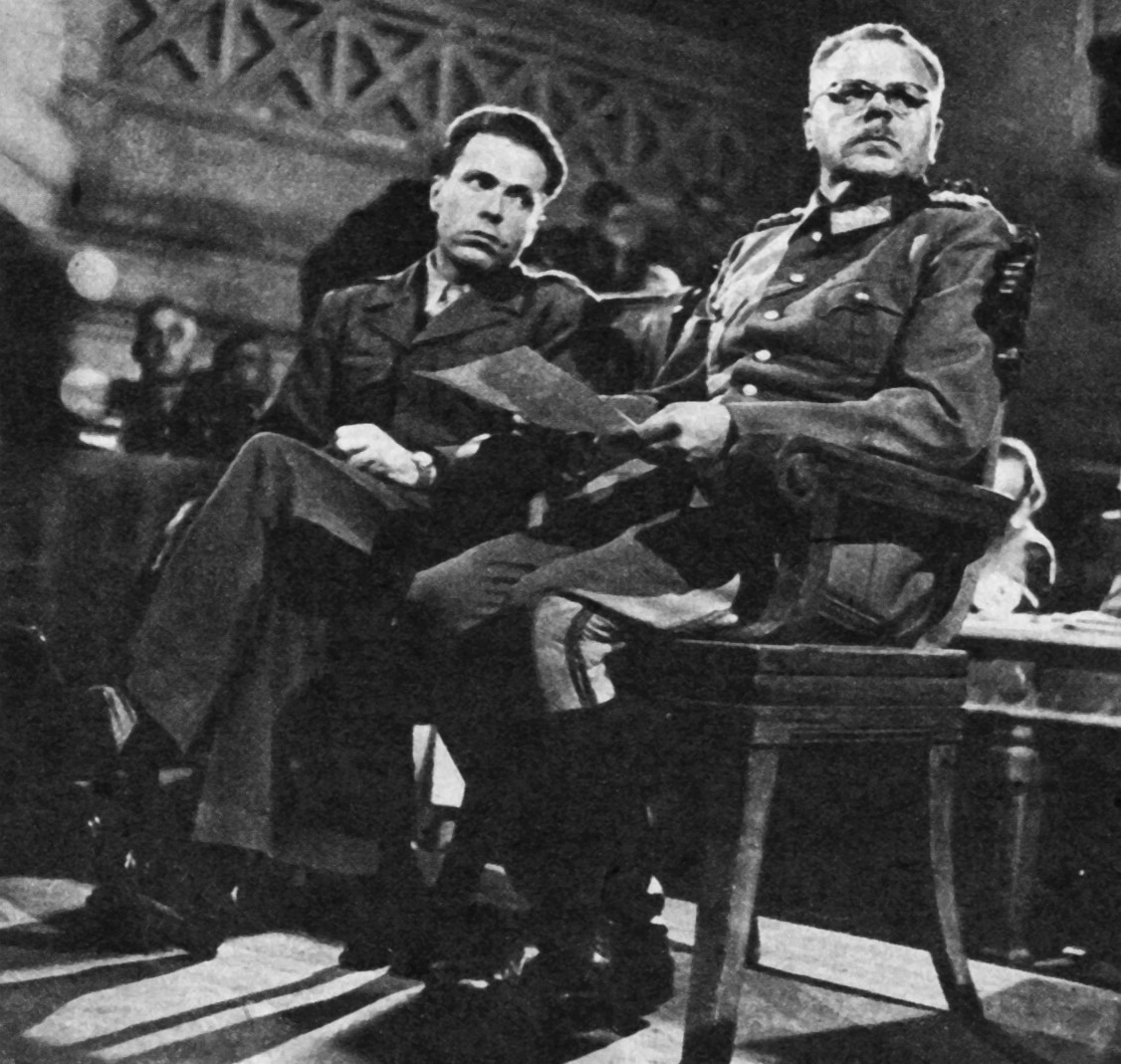
(Photo of Hirschman, on the left, in 1945, serving as a translator during the war crimes trial of German Anton Dostler, via Wikimedia Commons)

The Cold Cradle Of The Internet

dish_dr-strangelove_large_verge_medium_landscape

David Banks describes how the ethos of the Internet is rooted in the rivalry between the US and USSR:

The Cold War is usually associated with big, hulking organizations that rely on strategic planning and mathematical theory: Historical accounts are replete with continental super powers strutting along each others’ borders with military technologies that are, themselves, highly centralized and ordered entities. Both sides tried to out-maneuver the other by decentralizing resources and populations. In America, it meant spending lots of defense money on building the first peer-to-peer computer networks and the nation’s first interstate highways. Decentralization and redundancy is the best defense against centralized power. [T]he decision to decentralize cities and computer systems was a political (not to mention military) decision.

Perhaps the Cold War logic that birthed the Internet has such a tenuous bearing on how we currently use the Internet, that it barely warrants mentioning.

The intentions of the early Internet’s designers probably do not factor into my choice of Tumblr theme, or the Instagram filter I put on a photo of my houseplants. But intentions aren’t even half the story. Technologies live and act beyond their creators’ intentions and quite often produce unintended consequences. Think about all of the decentralized, rhizomatic organizations and social movements that have been earmarked or popularly associated with the digital technologies they used so well: the Arab Spring, Occupy Wall Street, Anonymous, and the BART protests have all out-maneuvered (at least for a time) the state and corporate bureaucracies that sought to shut them down. The Internet doesn’t unilaterally impose or determine certain political organizations, but it does assist and afford their continued existence.

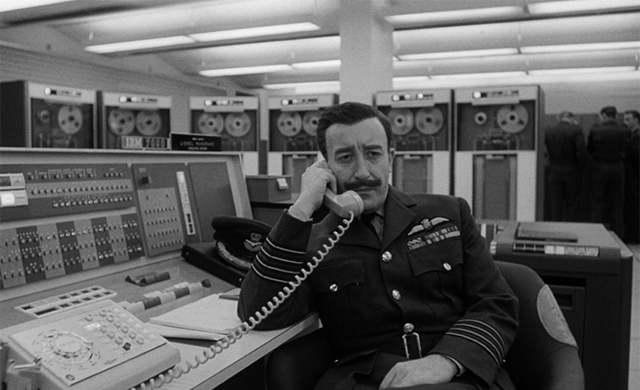
(Photo: Peter Sellers as Group Capt. Lionel Mandrake with the IBM 7090, from Dr. Strangelove, 1964)

The Human Cosmos

Reviewing Anthony Pagden’s The Enlightenment: And Why It Still Matters, Ollie Cussen praises the way the historian clarifies the movement:

The Enlightenment’s great achievement, Pagden argues, was to repair the bonds of mankind. Its distinctive feature was not that it held history, nature, theology and political authority to the scrutiny of reason, as most of its critics and many of its champions claim, but instead that it recognised our common humanity—our ability to place ourselves in another’s situation and, ultimately, to sympathise with them. Adam Smith and David Hume taught us that man is neither a creation of God nor a selfish pursuer of his own interests; at the most fundamental level, man is the friend of man. This, Pagden argues, was the origin of cosmopolitanism: the central Enlightenment belief in a common humanity and an awareness of belonging to some world larger than your own community.

For Pagden, the significance of this turn in human thought cannot be exaggerated. Cosmopolitanism “was, and remains, possibly the only way to persuade human beings to live together in harmony with one another, or, to put it differently, to stop killing each other.” It is inextricably tied to the Enlightenment’s “universalising vision of the human world” that ultimately led to a conception of civilisation in which questions of justice can be applied and upheld at a global level. Pagden admonishes critics of the Enlightenment project such as Gray and Macintyre for reducing it to a movement based on autonomous reason and objective science. Instead, the Enlightenment was about sympathy, the invention of civilisation, and the pursuit of a cosmopolitan world order.

(Video: A segment of Koyaanisqatsi set to King Crimson’s “Court of the Crimson King”)