Commuter Marriages

Meher Ahmad highlights a growing trend:

Married couples who live apart for reasons other than legal separation [has] nearly doubled since 1990, when roughly 1.7 million American couples did it.

How much of that is for financial reasons, however, isn’t clear. Whereas couples like [Allen] Shainman and [Collette] Stallone live in the same city but in two different apartments, Candice and David Knox live and work in different states. “People think that we’re weird,” said David Knox. “When you’re married, you’re supposed to live together. It just freaks them out.”

But the perks may outweigh the “weirdness.” Considering you wouldn’t get in fights with your significant other about petty things like dishes or walking the dog, living by yourself also means that you can effectively “do you” but file for joint taxes. Professor Aaron Ben-Zeev of the University of Haifa argues that couples who live apart, while lacking daily intimacy and interaction, gain in other aspects of their relationship:

Distance may focus the partners’ attention on the profound aspects of their relationships and hep them disregard the superficial ones. And if the profound aspects are perceived to be positive, then the whole relationship is seen this way. Like other incomplete romantic experiences, commuter marriages are also typically romantically intense.

What Really Made The South Republican? Ctd

Sean Trende emails the Dish:

I came across your readers’ factcheck of my earlier piece. This subject is near-and-dear to my heart, and an area where I’ve devoted quite a bit of writing. I think a lot of the confusion comes from the fact that I’ve written pretty extensively about this elsewhere (namely my book, which you were kind enough to link). So in some areas I didn’t fully explain myself. Here, my goal was actually to avoid some of the thornier issues of causation as much as possible and to stick to the more factual question of whether 1964 represents some “sudden realignment” hypothesis we hear so often. That latter point may be of purely academic interest, but it is misstated so often in popular media that I figure it must have some sort of general salience.

My big picture view is that there are really four southern realignments: the mountains in the 1860s, the cities from the 1920s to the 1950s, the rural areas in the 1960s-90s, and the upcountry, Jacksonian areas in the 2000s and 2010s. All of these really do have separate causes. My main beef is that everyone acts as if the third realignment, which was heavily racialized in many respects, is the entire story.

It is true, as the first reader notes, that the Republicans didn’t fare that well in presidential elections in the South in the 1920s.  My point is just that if you look at the results closely, you see the seeds of GOP ascendency here. In 1924, Coolidge got 2% of the vote in South Carolina. But there were three counties where Coolidge exceeded 10%: Beaufort, Charleston, and Georgetown. Not accidentally, these were three of the more urban counties in the state at the time, if barely so.

Similarly, in Florida Coolidge carried Pinellas (St. Petersburg) and Palm Beach counties, and came close in Orange (Orlando) and Dade counties.  Coolidge carried Arlington in Virginia. The trick is that these places were relatively urban, but still small (Dade County cast 11,000 votes; Pinellas 6,000; Arlington 3,000). As they grew, the Southern Republican Party grew. In other words, the *template* sprung up in the 1910s and 20s, even if the effects were minimal at the time (think of it like the Hispanic vote in the 1960s: still heavily Democratic, too small to make a difference, but in retrospect an important datapoint).

It’s wrong to write off 1928 as an exception due to Smith’s Catholicism. That played a huge role, but contemporaneous accounts ascribe an almost-equal role to the fact that he was a “wet” on prohibition. It showed the party would have trouble if it became too northern, ethnic, urban, and liberal. In fact, there’s a pretty high correlation between the counties Hoover won, and those Ike won. And again, the urban template is there: Hoover wins Texas because he gets 61% in Dallas County, 56% in Harris (Houston) and 69% in Tarrant (Ft. Worth). Ike got 63%, 58%, and 58% in 1952, but won the state by a wider margin because those areas grew. Ike does worse that Hoover in the highland South, where racial issues were less salient (though arguably less intense) and the prohibition issue was more important in 1928, but made up for it because the urban counties were larger than in 1928.

I actually do compare the South to the country as a whole in an earlier piece, which I referenced. As an aside, I don’t know why your reader would exclude Texas and Florida, especially in this time period, and especially since they were home to some of the bigger centers of growing Republican strength in the South. If you include them, the South drops from 23.4 percent more Democratic than the nation in 1932 to 18.2 percent more Democratic in 1944 (if you use two-party vote, it drops from 22.2% to 20.2%). On average, the South was 21% more Democratic than the country as a whole during FDR’s term, compared with 27% from 1904 through 1924 (25% including 1928).

These aren’t huge drops, but then again, my claim was that the huge drops occurred in 1952. Also, remember that a drop in Democratic vote share of six points corresponds generally to a 12 point diminution of the point spread.

As for MS and SC, I concede in the piece that MS was a state where Goldwater made a real breakthrough, along with AL and, to a lesser extent, GA. But SC had been a very close state in 1952 and 1960. It may have swung big from 1916 to 1964 toward Goldwater, but most of that swing from 1944 (88% Roosevelt) to 1952 (51% Stevenson). That’s the whole point: By 1964, the GOP was mostly there in most of the southern states.

Obviously what was going on on the Democratic side was important, as both readers note. But again, I don’t really spend a lot of time on causes in the piece; it’s just a fact that the South had been a swing region for the 12 years prior to Goldwater, regardless of what the reason was. I certainly don’t mean to suggest that race had nothing to do with it. I think a lot of the switch in the 1950s and early 60s had to do with the fact that, post-1948, racist southerners had no place to go on segregation.

But – and this might seem to be splitting hairs too finely – the question of why Southern Democrats left the Democratic Party is somewhat distinct from why they voted Republican. If the parties were on equal footing on segregation-and given the Eisenhower Administration’s record on civil rights, I’m not sure I’d go that far-why did so many southerners turn to the GOP? And why was it uneven, with urban areas moving at a much faster pace than rural ones? My view – incidentally, borrowed from Shafer and Johnston’s convincing, data-driven “The End of Southern Exceptionalism” – is that if the South had stayed poor and rural, it would have stayed Democratic or started a third party after the ’48 convention. Why? Because this is what the poor, rural South did.

This goes to most of what the second reader writes. Obviously this story is well-known to specialists, but the “1964-as-sudden-turning-point” is nearly ubiquitous in the commentariat. Even political scientists like Tom Schaller in Whistling Past Dixie make reference to it. And I certainly don’t deny that Republicans exploited racial tensions, nor that they often ran racist candidates, especially in the post-1964 period, in order to win over rural southern whites; in fact, I’m pretty sure I said as much in the piece.

Sorry about the length. I could write about this for hours, and feel blessed that I can. Love this stuff!
The Degree Of Inequality

Jeffrey Selingo, author of the new book, College (Un)bound, addresses wealth disparity when it comes to college degrees:

[College] was always seen as the great leveler in this country, especially after World War II. One of the most disturbing numbers I came across in research for this book was that if you come from a family with a family income above $90,000, you have a 1 in 2 chance of getting a bachelor’s degree by the time you’re in your mid-20s. If you come from a family under $35,000, you have a 1 in 17 chance. One of the fears, and one of my fears, is that we might become a country where the next generation is less educated than the generation that preceded it.

An excerpt from his book:

Even as more of our citizens need an education past high school, elite colleges are making themselves even more exclusive, proudly boasting each spring about the smaller and smaller percentage of applicants they have accepted (in 2012, Harvard rejected nine in ten applicants, including at least 1,800 high-school valedictorians). At the 200 colleges that are most difficult to get into, only 15 percent of entering students in 2010 came from families in the bottom half of incomes in the US (under $65,000). Nearly seven in ten students on those campuses come from the top income group (above $108,000).

The result is that the US higher-education system is becoming less of a meritocracy. In the last decade, the percentage of students from families at the highest income levels who got a bachelor’s degree has grown to 82 percent, while for those at the bottom it has fallen to just 8 percent.

College (Un)bound also tackles the luxury amenities that schools increasingly offer students. Alan Jacobs illustrates:

A major part of the problem is that colleges and universities have invested more strenuously in amenities than in education, with the assumption that students absorbed in the delights of their dining halls and climbing walls won’t notice that their teachers are largely underpaid adjuncts who have to jump from course to course and college to college to try to get something close to minimum-wage levels of pay. (Consider this: “About 70 percent of the instructional faculty at all colleges is off the tenure track, whether as part-timers or full-timers, a proportion that has crept higher over the past decade.”)

You want to think some about amenities? Then read Freddie DeBoer’s account of his visit to the France A Cordova Recreational Sports Center at Purdue University.

The Cordova Recreational Sports Center is five stories and about 338,000 square feet— not a misprint— of Gleaming Fitness Palace. I don’t say “gleaming” loosely. Like most new construction at American universities, the GFP is a beautiful melding of glass and steel, designed, no doubt, by some pricey architect.

The Original Men’s Magazine

Brett McKay stumbled across it:

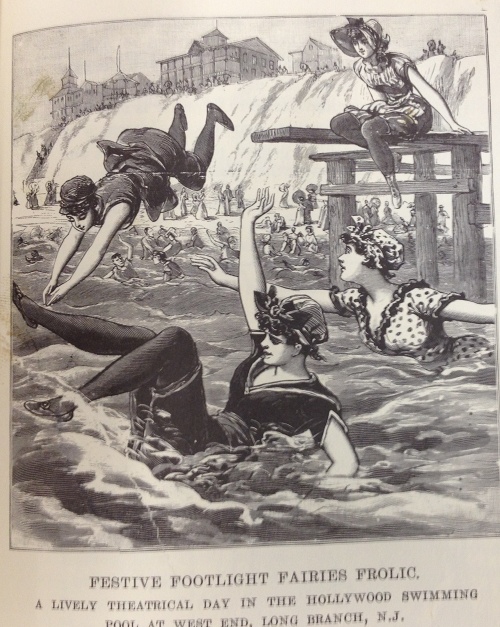
Several years ago I was wandering the stacks at the University of Tulsa library when I happened to chance upon an old, pink book with the words “Police Gazette” gilded on the spine in fancy script. pg30I don’t know why, but I took it off the shelf and started to thumb through it. Inside I found page after page of 19th-century newspaper re-prints that featured big, bold, and inflammatory headlines along with cool illustrations of bare-knuckle pugilists, old-time strongmen, and lots of women in bloomers slugging each other senseless.

Little did I know that the musty book in my hands was a collection of facsimiles of America’s first hugely popular men’s magazine: The National Police Gazette. Intrigued by what I saw in the book, I began researching the history of the Gazette and discovered that it was the magazine of American men living in the late 19th and early 20th centuries. Not only was the Police Gazette insanely popular, but it played a large role in shaping modern America’s idea of rugged and rebellious manhood and pioneered the pillars of much of today’s male-orientated media. The Police Gazette’s content consisted of a mish-mash of true-crime stories, gossip, sports, and pictures of buxom babes; basically, it was Sports Illustrated, National Enquirer, and Maxim rolled into one weekly magazine.

He captioned the above illustration, “A few Footlight Favorites frolicking in their swimsuits. Hubba hubba.” A somewhat more revealing scene after the jump:

wifebeater

Many more images here.

The Outlandish Heroes Of The Internet

Gene Demby wonders whether we are laughing with or at Charles Ramsey, the man who helped three women escape from their captor in Cleveland:

On the face of it, the memes, the Auto-Tune remixes and the laughing seem purely celebratory. But what feels like celebration can also carry with it the undertone of condescension. Amid the hood backdrop — the gnarled teeth, the dirty white tee, the slang, the shout-out to McDonald’s — we miss the fact that Charles Ramsey is perfectly lucid and intelligent. “I have a feeling half the ppl who say ‘Oooh I love watching him on the internet!’ would turn away if they saw him on the street,” the writer Sarah Kendzior tweeted. [Antoine] Dodson and [Sweet] Brown and Ramsey are all up in our GIFs and all over the blogosphere because they’re not the type of people we’re used to seeing or hearing on our TVs. They’re actually not the type of people we’re used to seeing or hearing at all, which might explain why we get so silly when they make one of their infrequent forays into our national consciousness.

Aisha Harris is on the same page:

It’s difficult to watch these videos and not sense that their popularity has something to do with a persistent, if unconscious, desire to see black people perform. Even before the genuinely heroic Ramsey came along, some viewers had expressed concern that the laughter directed at people like Sweet Brown plays into the most basic stereotyping of blacks as simple-minded ramblers living in the “ghetto,” socially out of step with the rest of educated America. Black or white, seeing [Michelle Clark] and Dodson merely as funny instances of random poor people talking nonsense is disrespectful at best. And shushing away the question of race seems like wishful thinking.

But Elahe Izadi thinks Ramsey can be “both a hero and a meme”:

While it may feel uncomfortable to focus on Ramsey’s funnier lines, to pretend otherwise—that there was no humor whatsoever in his interviews—is to ignore a big chunk of who Ramsey is.

He repeatedly told his tale with a plain-spokenness that feels fully him and unrehearsed; he wasn’t performing. He also expressed exasperation at the mini-media firestorm: When a local TV reporter asked him to tell the story once more, he replied, “Again?!” And his most-quoted line was a refreshingly unsubtle commentary about racism in America: “I knew something was wrong when a little pretty white girl ran into a black man’s arms. Something is wrong here—dead giveaway, dead giveaway,” he said. As the reporter began to move away, Ramsey finished his thought. “Either she’s homeless or she’s got problems. That’s the only reason she’d run toward a black man.”

In a hyper-controlled media environment, people long for that kind of unscripted “real talk” from genuine people who aren’t trying to manipulate their images for personal gain. And that’s a big part of the reason why Ramsey is compelling. He didn’t seek this fame, and so far he’s said he doesn’t want reward money for his actions (and even if he did, we could hardly begrudge him that). Rather than exploring Ramsey just for laughs, a meme done right could be a way of celebrating him for who he is: a hero who helped rescue kidnapped women.

Don’t Fear The Budget Bus

Jim Epstein tears into the National Traffic Safety Board study (pdf) that concluded that curbside bus companies such as Boltbus, Megabus and the various Chinatown companies “were ‘seven times’ more likely to be involved in an accident with at least one fatality than conventional bus operators”:

The study is bogus. Not only is the “seven times” finding incorrect, the entire report is a mangle of inaccurate charts and numbers that tell us virtually nothing meaningful about bus safety. There’s no evidence that curbside or Chinatown buses are any less safe than any other kind of bus.

How did the study authors figure curbside bus companies are “seven times” more prone to fatal accidents? For starters, they counted 37 accidents during the study period involving curbside buses in which there was at least one fatality. When I rebuilt the study data and contacted the companies involved, I found that, in 30 of those 37 accidents, curbside buses were not involved. In fact, 24 of those 30 misclassified cases involved Greyhound’s conventional bus fleet. (Greyhound’s curbside subsidiary BoltBus had no fatal accidents during the study period.) …

“When I first read the NTSB report, I thought this is just terrible statistics,” says [quantitative analyst Aaron] Brown. “But it goes way beyond that. It’s almost as if someone took some random data and shook it together.”

Previous Dish on curbside buses – “the fastest growing [pdf] form of intercity travel in the U.S.” – here, here, here, herehere and here.

Combating Military Rape, Ctd

A reader writes:

As someone who leads sexual assault prevention programming and has worked with soldiers, I will attest that sexual assault is a serious issue in the armed forces. While the statistics that the military released about the increase in sexual assaults are alarming, it may actually be a good thing. The more education you provide to service men and women around sexual assault, the more you are going to initially find an uptick in incidents whether documented or unreported, because people are more aware now.

The military is doing a ton of primary prevention education with their soldiers currently around sexual assault. Problematic behavior that would have been minimized or not even viewed as sexual assault is now being properly viewed, because of this education. Therefore you will see an uptick in reporting. This is a good thing, not a bad thing. Cultural change takes a long time, therefore you will see increased reporting and increased incidents in the military around sexual assault, but over time this should decrease. So this doesn’t mean that sexual assault is happening now more frequently; it means that people are now recognizing the problem or feel comfortable enough to properly report it.

But we should not just view sexual assault as a military issue, but a larger social issue.  Females between the ages of 16-24 are more vulnerable to sexual assault than any other age group – at a rate almost triple the national average (think about the average age of women serving in the military). What we need to be looking at is the issue of men and sexual assault. Men are responsible for 90% of all sexual assault. The question, we should be asking ourselves is what about the military (and society in general) is fostering this hyper-masculinity that equates strength with power and sexual control over women.

Yes, Of Course It Was Jihad, Ctd

John Knefel casts doubt on the concept of Internet-inspired jihad, as well as the policies that such thinking leads to:

“Nobody watches YouTube or reads Inspire and becomes a terrorist. It’s absurd to think so,” says John Horgan, director of the International Center for the Study of Terrorism at Pennsylvania State University. “YouTube videos and reading Al Qaeda magazines tends to be far more relevant for sustaining commitment than inspiring it.”

Knefel reports that it’s most often a variety of motivations that converge to make a terrorist:

“I have found that many young home-grown al-Qaeda terrorists are not attracted by religion or ideology alone – often their knowledge of Islamist theology is wafer-thin and superficial – but also the glamour and excitement that al-Qaeda type groups purports to offer,” [notes Jamie Bartlett, head of the Violence and Extremism program at the think tank Demos.] When it comes to why someone chooses to engage in terrorism, Horgan says, “there are the bigger social, political and religious reasons people give for becoming involved” – for instance, anger over government policies or a foreign occupation. But that leaves out a key part of the story. “Hidden behind these bigger reasons, there are also hosts of littler reasons – personal fantasy, seeking adventure, camaraderie, purpose, identity,” adds Horgan. “These lures can be very powerful, especially when you don’t necessarily have a lot else going on in your life, but terrorists rarely talk about them.”

Those are certainly part of the mix. And I don’t think Inspire made Tamerlan a Jihadist. From the evidence we have of his religious epiphany, it was not out of a magazine. But did the online Jihadist network encourage, train and make his act of Jihadist violence more likely? Duh. Meanwhile, apparently the online jihadi community has been unimpressed and even annoyed by the Tsarnaev brothers:

[This] is unusual and borne of several reasons. The first is that al Qaeda attacks in the West are typically characterized by high casualty rates and widespread panic. The death of three civilians and the quick demise and arrest of the perpetrators is, for supporters, something of a comedown.

The second reason is that al Qaeda and the global jihad movement have become far less concerned with the West since the dawn of the Arab Spring. Jihadists are instead now looking back to the Muslim world, where the contours of power still are far from settled in Mali, Libya, Egypt, Yemen, and, most dramatically, Syria. “Why should we waste our time on this?” Hamil al-Mask, a member of the Ansar forum, asked. “Lone wolves will always be part of our cause so let’s say Allah Akbar and move on.”

That strikes me as one more reason to stay out of Syria – if a brutally realist one. To turn George W Bush’s phrase around: if they’re fighting each other over there, they’re less likely to fight us over here.

Read the whole ongoing discussion thread here.

Combating Military Rape, Ctd

The head of the Air Force’s sexual assault prevention and response branch has been charged with sexual battery after groping a woman in a parking lot over the weekend. Syreeta is slack-jawed:

[I]f your “advocate” who was supposed to investigate and seek justice for the survivors becomes a predator, how can we believe that the Air Force enforces their code of conduct? How can you combat the culture of rape and sex abuse in your own house if your “chief” isn’t present enough to see how he can become [an] abuser? This isn’t irony as much as it is a tragic indicator of how seriously the Air Force takes sexual abuse, and may be complicit in a system that turns a blind eye to abuse or brands victims “crazy” to avoid addressing the epidemic of sexual assault in the military.

A day after the arrest, the Pentagon released a new report showing that the problem of sexual assault in the military has only gotten worse:

The report from the Department of Defense’s Sexual Assault Prevention and Response Office for Fiscal Year 2012 found a 6 percent rise in reported assaults over the last year, for a total of 3,374. But much more troubling is the estimated number of sexual assault incidents that were never officially reported. In last year’s report, there were an estimated 19,000 instances, but this year the number has jumped to an unprecedented 26,000 instances of assault, leaving thousands unreported.

Ackerman uncovers another troubling document:

An Air Force brochure on sexual assault advises potential victims not to fight off their attackers.

“It may be advisable to submit [rather] than resist,” reads the brochure (.pdf), issued to airmen at Shaw Air Force Base in South Carolina, where nearly 10,000 military and civilian personnel are assigned. “You have to make this decision based on circumstances. Be especially careful if the attacker has a weapon.” The brochure, acquired by Danger Room, issues a series of guidances on “risk reduction” for sexual assault. …

While the brochure also explains that sexual assault is not always committed by people who “don’t look like a rapist” — attackers “tend to have hyper-masculine attitudes,” it advises — it does not offer instruction to servicemembers on not committing sexual assault. Prevention is treated as the responsibility of potential victims. “Rapists look for vulnerability and then exploit it in those who: are young (naive); are new to the base, deployment, area, etc.; are emotionally unstable,” the brochure (.pdf) continues.

The Dish has covered the issue extensively.

Should We Kill Cursive? Ctd

A reader continues the popular thread:

No cursive?  Tell that to my dyslexic daughter.  She mastered writing and decoding through cursive (using the Slingerland method [illustrated above], which is an excellent multi-sensory approach).  Print reading and writing caused too much confusion precisely because so many printed letters look similar and/or a variants of each other (e.g. the typical b and d).  She went form being behind in her class to not only zooming up to grade with reading and writing, but was fluent in cursive a full year+ before her classmates.  Among many devices Slingerland uses a methodology of tracing the cursive letters in the air while seeing and saying them.  It’s brilliant, and not just for dyslexics.  Lots of research there to look at.

As for hand-eye-motor-brain coordination that is developed through handwriting and penmanship.  I believe there is ample evidence of it’s benefits in learning.  Being a product of that world versus pure keyboarding, which the new generation is being brought up on, I don’t have any direct experience.  THAT is a fascinating question.  How will our brains and motor skills develop and change when tots only use keyboards?

A reader with a different condition writes:

As a child, handwriting class was uniquely humiliating for me.

I stopped breathing shortly after I born, which damaged my cerebellum. As a result, my penmanship was an unsightly, illegible scrawl. Many times my instructors would berate me despite the fact that I could do nothing to correct the problem. I would be graded down on my assignments simply because my instructors didn’t want to read my sloppy answers, even when they were right. One classmate even saw my class notes and said to me, “Dan, I didn’t know you could write in Chinese.” I cannot.

Learning to type, although I do it clumsily and slowly, was a revelation. People could finally understand my writing, and it was easier for me to send messages that looked and read like they were the work of a professional. Writing anything by hand still fills me with dread. I even hate writing checks. I now make my living writing computer instructions, so all of the time I spent in school studying how to make perfect cursive letters seems like a waste. I envy people who write beautiful flowing letters, but feel no nostalgia towards creating anything like that myself.