It’s been a long time since I attended a country concert, but when I was growing up in South Carolina, it was standard practice on all country radio and TV shows to sign off with a gospel number. It was just expected. There was a ton of hypocrisy; I know for a fact that a popular local gospel quartet kept its tour bus well stocked with Jack Daniels. This isn’t to put down George Jones; he really was the greatest, and the loss of that voice is a loss indeed. It’s just to point out that there’s a lot of ritual to the Saturday Night/Sunday Morning pattern of country music.
Jones’s songs lifted country-music aphorisms to a kind of high art, and his life and now death seem to demand aphorism as well, something blunt and simple like: George Jones was an imperfect man with a perfect voice. …
The stories of Jones’s drunken antics are legion, and while their hard-living, hard-loving particulars might inspire a bit of awe (and gave him cred with rock and punk artists), just ask the women in his life what it was like to live with him. Yet, even in some of his lowest personal moments, Jones created great, signature music. He recorded “Bartender’s Blues,” written by James Taylor, in 1978. His rendering of the chorus, with its “four walls around me to hold my life,” may be the best expression of his incredible vocal gifts—despair and joy fighting out their eternal battle.
The recording sessions for “He Stopped Loving Her Today” took a long time, and were contentious. Jones was capricious and unreliable—other words for saying that he was a drunk. He never liked his nicknames. “Possum” disparaged his middling looks. “No Show Jones” impugned his reliability and professionalism. Both were unkind, and both were deserved. He idolized Hank Williams, and it seemed like he was bound to follow him to an early grave. Yet “He Stopped Loving Her Today” was a hit, and three years later, at rock bottom, Jones quit the drinking and drugs, and lived on for three more decades, making music, recording too many albums, lending his golden voice to innumerable duets. He was Nashville royalty, name-checked by every young country singer with any sense.
He’d been married to his fourth wife, Nancy, for those thirty years. In the end, he wasn’t the lonely, regretful man in his most famous song.
“She’s My Rock”, seen above, was released shortly after marrying Nancy. “He Stopped Loving Her Today” can be heard here.
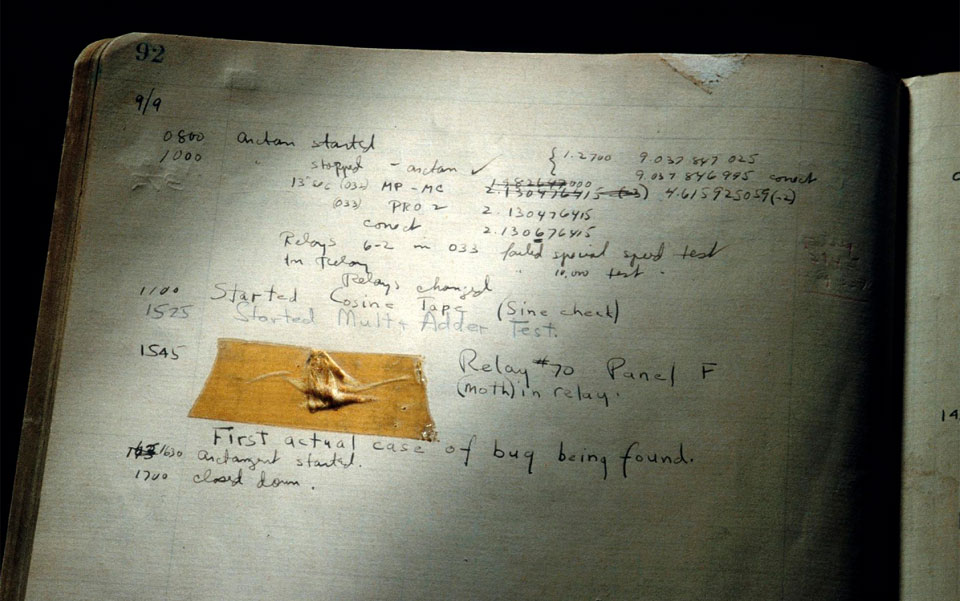
Matthew Battles unearths the above logbook from the Mark II, one of the “early electromechanical computers, instantiating computational logic in a vast, greasy array of switches, shafts, and clutches”:
In effect, the logbook, which resides in the Smithsonian’s Museum of American History in Washington DC, is a record of early computer bugs rendered in precise, empirical terms. And in those records, one bug stands out: on page 92, at 1545 on 9/9 1945, an actual moth was fixed to the page with a piece of tape. ‘Relay #70 Panel F/(moth) in relay,’ reads the journal; below, in what is likely Hopper’s hand, the line ‘First instance of actual bug being found.’
Alas, that use doesn’t mark the origin of the term “bug”:
Already in the late-19th century, technicians in Thomas Edison’s lab were using the word ‘bug’ to describe thorny technical problems. From the syntax of Hopper’s notes in the journal, it’s clear that engineers working on the Mark II were familiar with this usage; the ‘actual’ bug was entered into the log as a cheeky aside, a bit of lab humour. Bug is an ancient word, and its use in specific reference to creeping arthropods dates only from the 17th century, according to the Oxford English Dictionary. Prior to that, the word named the nameless: bugbears, monsters and creatures of mystery and shadow.
(Photo courtesy Smithsonian’s National Museum of American History)
The above video shows an Israeli airstrike in Damascus on Saturday night, reportedly targeting regime munitions bound for Hezbollah. It comes on the heels of another attack late last week, on missiles stored at Damascus airport. Assad’s regime now declares it will retaliate, and the IDF says this won’t be the end of the strikes:
Officials [in Israel] are concerned that as the Syrian state devolves into chaos, sophisticated weapons not previously available to Hizballah will make their way across the border to Lebanon, altering the military equation between Israel and the well-armed Shi‘ite militia sponsored by Iran and aided by the Syrian government.
We are told this was not an act of war. Why? Er, because Israel did it and therefore it is not an act of war. It may have killed close to 100 Syrian army soldiers, among many others; it may have been the biggest single explosion in Syria’s capital city throughout the entire conflict; it may have required entering another country’s airspace and bombing its capital city; but this is not a war. Moreover, this not-war is embraced by the US. Because Israel did it:
In a series of high-level meetings between U.S. and Israeli officials over the last year, the Israelis explained in detail the conditions that would lead them to attack targets inside Syria. Israel’s “red lines,” articulated in private and public, include the shipment from Iran of advanced anti-aircraft weapons, advanced missiles, and chemical or unconventional weapons to the Lebanese militia and political party Hezbollah, according to public reports and U.S. officials. … President Obama signaled Sunday that the U.S. had no objections to the strikes.
Which begs the obvious question:
If Syrian planes bombed Israel’s Ramat David Airbase because it houses US-supplied weaponry, what would the appropriate Israeli reaction be?
Imagine a foreign military bombing Washington. Would we not regard that as an act of war? At what point are we going to admit that, in our view, all the rules of international law apply to every party but the US and its allies? Blake Hounshell considers the impact of the air strikes on all parties:
[W]ow, this is awkward for the Syrian opposition. The regime will seek to exploit the raids to tie the rebels to the Zionist entity, after spending two years painting them as an undifferentiated mass of “terrorist gangs.” (Syrian television is already testing out this line, according to Reuters: “The new Israeli attack is an attempt to raise the morale of the terrorist groups which have been reeling from strikes by our noble army.”)
But the propaganda can cut both ways. The rebels can point to the Israeli attacks as yet more evidence that Assad’s army is for attacking Syrians, not defending the country. It’s not clear to me which argument will carry the day.
The strikes also promise to hypercharge the debate over Syria in the United States. Advocates of intervention will ask: If Syrian air defenses are so tough, as U.S. officials have been saying, why was Israel able to breach them so easily? Of course, a no-fly zone is a much more difficult and risky endeavor than a one-off raid, but you can expect that important distinction to get blurred.
It was, in fact, amazing to see how Israel’s complication of an already metastasizing conflict did not prompt concerns in the US about the war expanding – but immediately gave us commentary that this proves how easy war against Syria can be – and so why are we waiting? Yes, a decade after “Mission Accomplished” we are asking why not go to war in a Middle Eastern Muslim country racked by a splintering insurgency? Here’s why:
The Israeli strikes aim at specific, identifiable direct threats to vital Israeli interests and use the smallest force and lowest risk possible to eliminate those threats. The Israelis may not be able to solve the problem of potential arms transfers to Hezbollah writ large, but standoff strikes against discrete targets do not tie down Israeli forces enough to make it a distracting quagmire.
A [No-Fly-Zone], on the other hand, requires massive amounts of aircraft and munitions in both standoff and air superiority roles to even deliver the basic goal of grounding the Syrian air force. A Syrian NFZ presents an even larger operation than the Libyan air campaign, and one that is likely to be even less effective, especially if it is a pure NFZ that refrains from the additional aircraft, munitions, and ground/intelligence efforts that would be necessary to support a campaign to target the Syrian army. Syria’s mix of ground forces and paramilitary groups appear far more combat effective than their Libyan regime equivalents, and, even without air cover, would not be operating at crippling loss without their air force (Syrian aircraft appear far more competent at terror bombing than tight close-air support).
What we have here is a regional, sectarian war that has been brewing since the Iraq implosion tore the region’s fragile stability apart – and further fueled by the energies unleashed by the Arab Spring. Beneath the Iran-Israel stand-off, we also have a Shia-Sunni struggle, in which Assad and Khamenei and Hezbollah and Maliki are fighting off the hardcore Sunni Jihadists and democrats trying to depose Assad. My point is that this is emphatically not our fight, it is an intensely complex one in a fractured and splintering region, that there are no good options, but that remaining on the sidelines seems to me to be the least worst one right now.
To intervene is to help some faction directly or indirectly, which means alienating another faction directly or indirectly. It swiftly becomes a maze from which no adventurer exits. Part of this maze of confusion: the fact that the UN has now said it has found evidence that it may be the rebels, not the regime, who have used Sarin gas:
The United Nations independent commission of inquiry on Syria has not yet seen evidence of government forces having used chemical weapons, which are banned under international law, said commission member Carla Del Ponte.
“Our investigators have been in neighboring countries interviewing victims, doctors and field hospitals and, according to their report of last week which I have seen, there are strong, concrete suspicions but not yet incontrovertible proof of the use of sarin gas, from the way the victims were treated,” Del Ponte said in an interview with Swiss-Italian television. “This was use on the part of the opposition, the rebels, not by the government authorities,” she added, speaking in Italian.
So, sorry, Mr Keller, but Syria is very much like Iraq. A dictator leaving a vacuum in a half-liberated country? Check. A sectarian war we cannot understand let alone direct? Check. A Sunni insurgency increasingly allied with Jihadist elements? Check. Nebulous accusations and counter-accusations about WMDs, without hard proof of much at all? Check. A conflict swayed by interference across the region – from the Sunni monarchies to the Shi’a powers? Check.
You can argue that this could have somehow been prevented. I doubt it. You could also argue that the United States has an interest in an outcome that is neither Assad nor the al Nusra brigades. But no one can explain to me how to get from here to there. This is their regional war, not ours’. And our only reliable ally in the region seems perfectly capable of protecting itself and its own interests, without even informing us in advance.
Please, Mr President: just say no. You were elected to end this kind of hubristic, short-sighted, if well-intentioned military intervention. We did not elect you over McCain in 2008 merely to watch you follow that unreconstructed neocon’s advice, which is always to intervene first and figure out what to do once we have.
You know better. Trust your instincts. Do as little as possible.
Iris-recognition technology is now being used at the Dubai airport, with an automated two-gate system:
Scanning your passport opens the first gate; an iris print opens the second. Once the system is fully deployed, the company says it will bring wait times down from 49 minutes to 22 seconds. A private company called Clear is already trying this on an opt-in basis in the US. In exchange for a quick iris scan, their service will let you skip security in half a dozen American airports.
The bargain is simple enough: In exchange for one more biometric, you get to skip an hour in customs, or the indignity of a TSA checkpoint search. And as an ID technology, it simply works better. It’s less invasive, harder to fake (although still possible), and more effective at everything we want ID tech to be good at.
Glenn has now conceded that religious extremism seems to be the main motive behind the Boston bombings, so our real difference is now simply when that became obvious (a legitimate debate) and whether the younger brother was as motivated by religion as his older brother. I suspect a mixture of actual, hidden religious fanaticism and family dynamics, and this piece in the NYT remains required reading on that fact.
But Glenn insists that Anwar al-Awlaki was merely exercising his American constitutional rights in speaking out for violence against the American government, and as such was not a legitimate target at all. We’ve gone through all this before and yes, the First Amendment does apply to abstract calls for violence against the US government.
But Anwar al-Awlaki was not just abstract. Ask cartoonist Molly Harris, now in hiding after participating in “Draw Mohammed Day”. In Inspire, the magazine where the Tsarnaev brothers found their bomb instructions, Awlaki wrote of eight Western cartoonists:
“The medicine prescribed by the Messenger of Allah is the execution of those involved.”
So this was a specific threat of violence against specific people – including a specific American – for exercising their freedom of speech. She remains under fatwa, protected by the FBI. Glenn’s response to that point would be:
This, I guess, is where I differ. The sliver of difference between Awlaki threatening to murder Molly Harris himself – while calling on all other Muslims to murder her while ensconced in Yemen – is not one I consider salient.
If a mob leader orders a hit, he is not exercising his First Amendment rights. He is ordering a hit.
When that mob leader has called law-abiding American Muslims “traitors” to the true nation of Islam, when he has left the country and changed his name and joined the group designated as the enemy in wartime by the US Congress, when he has celebrated individuals who have murdered others – and been in communication with them, as with the Fort Hood shooter – then I do not recognize him as engaging in the world of ideas.
I recognize him as engaging in the world of religious murder and the incitement to religious murder. From the grave, he helped murder some more in Boston. And not members of the US military or representatives of the US government. He gave the instructions and inspiration to murder an eight-year-old boy who was waiting to see his dad finish a marathon.
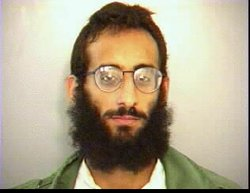
(Photo: San Diego Police Department mug shot of Anwar al Awlaki after he was arrested in San Diego on April 5, 1997. As reported by KPBS San Diego.)
Rowan Jacobsen raises concern about lost apple varieties:
In the mid-1800s, there were thousands of unique varieties of apples in the United States, some of the most astounding diversity ever developed in a food crop. Then industrial agriculture crushed that world. The apple industry settled on a handful of varieties to promote worldwide, and the rest were forgotten. They became commercially extinct—but not quite biologically extinct.
It is true, that in 1905 W.H. Ragan published a catalog of apples with some 7000 varieties. Varieties of apples come and go, however, like rose varieties or fashions and Ragan’s catalog listed any apple that had ever been grown during the entire 19th century. (Moreover, most varieties are neither especially good nor especially unique). At the time Ragan wrote, Heald and Chapman estimate that the commercially available stock was not 7000 but around 420 varieties. What about today?
The Fruit, Berry and Nut Inventory for 2000 lists 1469 different varieties of apples, a massive gain in terms of what growers can easily find for sale. The Plant Genetic Resources Unit of the USDA, in Geneva, New York, maintains orchards containing an additional 980 apple varieties that are not currently being offered in commercial catalogs. Scions from these trees are typically available to anyone who wishes to propagate their variety. The USDA numbers bring the total varieties of apples available to 2450.
In fact, there are more than 500 varieties of apples from the 19th century commercially available today–thus there are more 19th century apples available today than probably at any time in the 19th century!
Larison dutifully picks apart Keller’s case for intervention:
Keller claims that “we have a genuine, imperiled national interest, not just a fabricated one,” and he is referring to the danger of a failed state serving as a haven for terrorists, but all of the proposed options for intervention involve hastening the failure of the Syrian state and aiding in the empowerment of jihadist groups. If the U.S. has an interest in preventing state failure in Syria, that is a reason to avoid intensifying and prolonging the conflict by backing the opposition.
Keller completely ignores his second lesson later in the op-ed when he mentions chemical weapons use, which causes him to overlook some new information that ought to make a difference in his thinking. According to reports over the weekend, U.N. investigators have determined that sarin may have been used by anti-regime forces. It’s possible that the investigators have it wrong, but it makes absolutely no sense for the U.S. to lend support to forces that are willing to use chemical weapons.
Max Fisher scrutinizes the Sarin reports at length. In one way, Larison agrees with Keller that “Syria is not Iraq”:
Unlike Iraq, there would be no fig leaf of a Security Council resolution that hawks could hide behind to defend the war, and there would likely be even less multilateral support for a Syrian war than there was for the invasion of Iraq.
James Rubin demands that the U.S. ensnare itself in Syria’s conflict, and then has the gall to say this:
Second, it is astonishing to hear so much hand-wringing about the possibility of America entering another Middle Eastern war. That’s not going to happen; even the most hawkish of hawks are not proposing some sort of U.S. invasion.
Rubin is being disingenuous here, since even the measures that he calls for would require the U.S. to commit acts of war against the Syrian government. Of course the U.S. might be entering another war in the region. That is what Syria hawks want the U.S. to do, and it is absurd to claim otherwise.
Syria hawks are not yet proposing an invasion, because they know as well as anyone that there is no political support for that in the U.S. or in any other country. That doesn’t mean that an invasion or the preparation for an invasion won’t happen if the U.S. starts using force in Syria. The first thing to remember about all interventionist arguments is that they always minimize the costs and risks at the beginning while exaggerating the danger of “inaction.” When an interventionist dismisses the idea that ground forces may be necessary to achieve the goals he wants, he is usually trying to sell the audience on a bad policy that he knows the audience would reject if they were confronted with the full costs of “action.”
I recently wrote that “talking about the Israel lobby in exactly the same way that everyone talks about the gun lobby is not and never has been ipso facto anti-Semitism.” Pascal-Emmanuel Gobry doesn’t fully disagree but thinks there are good reasons we treat the lobbying groups differently. The core of his post:
Our society, quite reasonably in my view, has developed a taboo against the use of words associated with group hatred, as a way to stigmatize said hatred. White people can’t use the n word in contemporary polite American society because that word is associated with the memory of white people who used that word and bought and sold black people as chattel… So we stigmatize it … Expressions like “Jewish lobby”, which carries the anti-Semitic trope that Jews are a shadowy clique that secretly controls the government have been — for centuries, around the world, to this very day in some places — used as spurs to mass violence.
This is an important point that lays bare the problem. One of the tropes of anti-Semitism has indeed been the notion that secret, powerful cabals of Jews somehow control the world from behind the curtain. That’s why I think Gobry is right to stigmatize a phrase like the “Jewish lobby” and why Chuck Hagel was right to apologize for that phrase. But “Israel lobby”? Or “Greater Israel lobby”, as I prefer to use? Not so much.
That phrase recognizes the existence of a lobby as powerful as the NRA, and just as distortive of rational public policy. It also recognizes that the Israel and Greater Israel lobbies are increasingly Christianist rather than Jewish, as the Christian fundamentalists in America find common cause with the Jewish fundamentalists on the West Bank. The Americans who show up for new settlement openings are increasingly called Huckabee.
But Gobry won’t even allow for such a neutral phrase:
Yes, phrases like “The Israel Lobby” are redolent of anti-Semitism. Yes, using crypto-anti-Semitic language is stigmatized by any decent society worthy of the name.
This is where I think the rhetorical game is rigged. Note the qualifications: phrases “like the ‘Israel Lobby'”; “redolent of”; “crypto-anti-Semitic”. It reminds me of Leon Wieseltier accusing me of “something much darker” than anti-Semitism, in order to be able to state that he never accused me of being an anti-Semite. It’s bullying blather. But it does have the advantage of making the Israel Lobby the only such lobby to be rendered immune from being described as exercizing control over the Congress like the NRA, even if it does.
This blog will avoid such a double standard for the simple purpose of telling the truth, as I can best discern it.
Moynihan investigates Islamic extremism on the web:
I decided to try an experiment: I would spend seven days creeping through the Internet using disposable IP addresses, inhabiting the milieu of radical sites and Facebook pages. In Manhattan coffee shops, on subway platforms, between tasks at work, I would take up residence in the darkest corners of the Web—and see what I could learn about the fetid swamps where self-made jihadists are allegedly born.
His big takeaway? It works – by numbing followers to violence:
The further I crawled down the extremist rabbit hole and the more caved-in skulls and headless corpses I saw, the more I found that my natural revulsion, usually an uncontrollable instinct, was easier to suppress.
And it wasn’t just my revulsion to violence that seemed to dull: the casual Jew hatred, homophobia (yes, there were references to the “sick” revelation that NBA player Jason Collins is gay), and sexism (“The beauty of a woman lies in her SILENCE rather than her SPEECH”) were so eye-glazingly common that after a week of uninterrupted consumption, I found myself scrolling past it without a second thought.
Americans were jarred by a gruesome—and now iconic—photo of Boston Marathon spectator Jeff Bauman being rushed toward an ambulance, one of his legs blown off below the knee. In the universe of electronic jihad, such images are banal. To be a social-media jihadi for a week is to be reminded of French essayist Alain Finkielkraut’s admonition: “Barbarism is not the inheritance of our pre-history. It is the companion that dogs our every step.”
A couple of points that may inform two long-running debates between me and Glenn Greenwald. The first is the motive for the Boston bombings. Of course, we should always wait for the full evidence, and there is always an interplay between a particular psychological journey and religious fanaticism. I’ve said that from the get-go. But we can now pretty safely say – as we could pretty quickly – that the bombings were an almost text-book case of Internet Jihad, a chilling example of how fundamentalist zeal can become murderous right here in our midst, with no necessary international network.
After Mr. Tsarnaev emerged as a suspect in the bombing, Mr. Lamichhane said, a mutual friend from the University of Massachusetts recounted his last conversation with Mr. Tsarnaev, two weeks before the marathon. Mr. Tsarnaev told their friend, “God is all that matters. It doesn’t matter about school and engineering,” Mr. Lamichhane said. “He said, ‘When it comes to school and being an engineer, you can cheat easily. But when it comes to going to heaven, you can’t cheat.’ ”
Five words: “God is all that matters.” If some secular liberals could grasp that a modern human can say those words and mean them, they would have a better grasp of our core predicament. The religious conversion was relatively recent – and had an obvious effect:
A second Chechen friend since boyhood, 18-year-old Baudy Mazaev, said that the older brother and their mother, Zubeidat Tsarnaeva, “had a deep religious epiphany” about two or three years ago. At the time, Tamerlan’s new devotion only irritated Dzhokhar, he said. During one visit about two years ago, he said, Tamerlan ordered him and Dzhokhar to sit and forced the two teenagers to read a book about the fundamentals of Islam and prayer… In February 2011, roughly when the boys’ mother embraced Islam, she separated from her husband, Anzor, a tough man trained in the law in Russia who was reduced in Cambridge to fixing cars in a parking lot. The two divorced that September, and Anzor returned to Russia, followed later by his ex-wife. Tamerlan filled the void as head of the family’s American branch. On Twitter, Dzhokhar wrote that he missed his father.
Fundamentalism took over that family. It drove the father away. The second point worth noting (and relevant to a debate Glenn and I have conducted) is the man who personally seemed to have inspired and help train the Tsarnaev brothers from the grave – Anwar al Awlaki:
Two U.S. officials tell The Daily Beast that, during his hospital room interrogation, Dzhokhar told FBI agents that he and his brother were influenced by the Internet sermons of Anwar al-Awlaki, the American-born preacher who was killed in a U.S. drone strike in Yemen in September 2011…
We know Awlaki influenced the Tsarnaevs at least indirectly, through one of AQAP’s main propaganda organs. According to law enforcement sources, Dzhokhar has admitted to the FBI that he and his brother learned how to the build pressure cooker bombs they allegedly used in Boston from the terror group’s English-language Internet magazine, Inspire. For much of its existence, Inspire was run by Samir Khan, an American propagandist for AQAP who was close to Awlaki and was ultimately killed in the same U.S. drone strike that killed the Yemeni-American cleric.
It seems to me that Anwar al-Awlaki was clearly complicit in the Boston marathon bombers and that the bulk of his propaganda was about inciting domestic terrorism in the US along the Tsarnaev lines. That makes him a little more than an icon for the First Amendment. It makes him a traitor allied with forces that want to kill American citizens.


 The Dish