When Breaking Up Is Smart To Do

Miles Raymer assesses the unlikely success of Neutral Milk Hotel:

[This week], the indie-rock group Neutral Milk Hotel announced that it will be playing a series of live dates this fall. If you’re not familiar with the band (which would be forgivable considering the level of obscurity that they’ve maintained over the years), you might wonder why it is that this news is being breathlessly reported not only on blogs devoted to the exploits of obscure indie rock bands, but at major news outlets like USA Today and the Huffington Post. How is it, you might ask, that the reunion of a band who released two albums in the ’90s (only one of which anyone actually cared about), and broke up in 1999 to complete deafening silence outside of the small community of fans who’d flocked around the previous year’s In the Aeroplane Over the Sea, could be such a big deal? …

Neutral Milk Hotel’s breakup was, career-wise, the best move it could have possibly made. Without a band around to promote [In The Aeroplane Over The Sea], the album relied on word of mouth to find its audience, giving the burned copies of it that would pass from hand to hand a kind of samizdat allure, and making its discovery a more meaningful personal experience. (Neutral Milk Hotel and its fans are all about the meaningful personal experience.) And soon after the split, the group’s mastermind Jeff Mangum essentially went into hiding, which added a Salinger-like element of mystery and mythology to the entire package. The more that Mangum stayed underground, the more anticipation his fans had for the messianic return they imagined in their heads.

That Asparagus Aftersmell

From a primer on the pungent odor that Proust said “transforms my chamber-pot into a flask of perfume”:

Some people simply don’t smell anything different when urinate after they eat asparagus. Scientists have long been divided into two camps in explaining this issue. Some believe that, for physiological reasons, these people (which constitute anywhere from 20 to 40 percent of the population) don’t produce the aroma in their urine when they digest asparagus, while others think that they produce the exact same scent, but somehow lack the ability to smell it.

On the whole, the evidence is mixed. Initially, a pair of studies conducted in the 1980s with participants from France and Israel found that everyone produced the characteristic scent, and that a minority of people were simply unable to smell it. People with the ability to detect the scent, though, were able to smell it even in the urine of those who couldn’t smell it, indicating that the differences were rooted in perception, not production.

More recent studies, though, suggest the issue is a bit more complicated. The most recent study, from 2010, found that differences existed between individuals in both the production and detection of the scent.

Consumed With Grief

BANGLADESH-BUILDING-DISASTER-TEXTILE

David Von Drehle cautions against overreaction from Western consumers in the wake of the textile factory collapse:

It’s natural to look at the horror in Bangladesh and weigh a vow never to buy another t-shirt sewn in that country. But no one suffers more from a boycott than the impoverished workers for whom even an unsafe job is better than no job at all. Better to press our retailers, our fashion brands, our investors, and our governments to use their influence — their power — with foreign leaders to promote the idea that corruption is not just a moral problem; it’s bad business. Killing workers is no way to build an economy, nor will a system of bribes and spoils ever lift a nation to lasting prosperity. That’s a message even hard-hearted people can understand, and you need them to get things done.

Pope Francis has weighed in, characterizing the workforce of the collapsed Dhaka factory as “slave labor”.  Disney has already banned production [NYT] of its licensed goods in the country, but that move had been planned since March and affects less than 1% of their total business. Susan Berfield notes that it’s unlikely other brands will be able to take a similar stance:

For companies that rely more heavily on Bangladesh, simply shutting down operations isn’t really an option. For one thing, where would they go? Other low-wage countries are likely to have the same kinds of problems that Bangladesh does: lax regulation, corruption, and little history of support for workers’ rights. And Bangladesh, of course, relies on these companies. Bangladesh has quietly become the world’s second-largest apparel exporter, after China. As Bloomberg News reports, textiles contribute more than 10 percent of Bangladesh’s gross domestic product and about 80 percent of the nation’s exports, mainly to the U.S. and the European Union. So these retailers have some clout—but so far haven’t chosen to exercise it altogether.

The low wages throughout Bangladesh’s garment industry are the result of trying to poach business from China:

“There is no other reason why a company would be doing business there,” [says Elizabeth Cline, the author of Overdressed: The Shockingly High Cost of Cheap Fashion]. “These deaths are happening because they are trying to step into the shoes of China. The cost of labor, the costs are going up in China and fashion companies are trying to maintain their margins and trying to maintain their cheap prices, so they want Bangladesh to do what China was doing. But Bangladesh can’t do that.” It’s a numbers game, says Cline, Bangladesh has around 4,000 garment factories compared to China’s 40,000. The average wage for a garment worker in China is close to $200; the average for a worker in Bangladesh is $37.

Earlier Dish on the harsh economic breakdown of garments in Bangladesh here.

(Photo: A Bangladeshi family member poses as she holds up the portrait of her missing relative, believed to be trapped in the rubble of an eight-storey building collapse in Savar, on the outskirts of Dhaka, on May 3, 2013. The death toll from last week’s collapse of a garment factory complex in Bangladesh has passed 500 as the country’s prime minister said Western retailers had to share some of the blame for the tragedy. By Munir uz Zaman/AFP/Getty Images)

Failed Fronts In The Drug War

Jonah Engle believes that if “Colombia can’t win the war on drugs, no one can”:

As drug-related violence engulfs parts of Mexico and Central America, Washington has touted Colombia as a rare drug war success story. “Colombia has served as a model of success for the entire hemisphere,” says Rafael Lemaitre, communication director for the U.S. drug czar’s office. But up close, Colombia’s drug war successes appear far more meager — and the country’s top politicians are beginning to realize it.

At the end of 2011, President Juan Manuel Santos became one of the first sitting heads of state to come out against the war on drugs. “A new approach should try and take away the violent profit that comes with drug trafficking,” Santos told the Observer newspaper. “If that means legalizing, and the world thinks that’s the solution, I will welcome it. I’m not against it.” Santos’s words have yet to translate into policy changes at home. But they have both reflected and fuelled a growing challenge among Latin American leaders to the cornerstone of U.S. security policy in the Western Hemisphere. By saying what a half-dozen recent Mexican, Colombian, Brazilian, and Chilean presidents waited for retirement to say, Santos broke a taboo — and other politicians soon followed him out of the closet.

Meanwhile, Kathleen Frydl declares the war on drugs in the US to be a “total failure,” and looks for lessons:

One of my takeaways was reinforced when I read Dana Priest’s piece in The Post on Sunday, which is that these complex security regimes, like the war on drugs or the war on terror, have essentially produced their own feedback loops, and we’ve forgotten how to step back and ask “Is this even working?” Priest noted that the very close ties between the U.S. government and the just-ousted Mexican government produced no effect in terms of the production, price or potency of drugs, but U.S. policy officials are bemoaning the loss of those ties nonetheless.

It’s time to step back and look at the forest. In 1968, a dime bag of heroin cost $5 and was about 15-40 percent pure. Today, without adjusting for inflation, it costs $5 and it’s 15-40 percent pure. That’s a crude measure, but that’s the definition of failure, right there. … It’s time to step back and recognize that these expenditures have performed a lot of functions for state, be it policing inner cities or justifying certain kinds of international engagement. But the one thing they have not done is control the price and purity of drug–the reasoning which ostensibly justifies our costly drug war.

Unlocking Our E-books

A year after they decided to stop using Digital Rights Management anti-piracy protections in their e-books, fantasy and science fiction publisher Tor Books observes “no discernible increase in piracy on any of [their] titles”:

When we made the announcement there was an immediate reaction from the media. The Guardian explained how ‘Tor rips up the rulebook on digital rights management’ and the BBC featured a long article with arguments from both sides, drawing links with the music industry’s experience of the transition and highlighting that “the key difference with the music business is that the book trade can see what mistakes the record labels made and avoid them.”

But the most heartening reaction for us was from the readers and authors who were thrilled that we’d listened and actually done something about a key issue that was so close to their hearts.

Mike Masnick wonders which publisher will be next:

I’m still amazed that any publisher thinks that DRM is a good idea. Now Tor’s provided more evidence that removing it doesn’t increase infringement rates. So, in one single move, publishers can provide significantly more value and convenience for ebook buyers, and take some of the power away from Amazon without any risk of greater infringement. It’s astounding that publishers aren’t pushing each other aside to make a similar move.

Obama’s Leadership: Power With, Not Power Over

US-POLITICS-OBAMA

Jon Favreau has a must-read in the Beast today. It pushes back against the infantile MoDo notion that the stalemate in Washington is a function of the president’s poor political skills, rather than a completely gerrymandered and dysfunctional Republican House, special interest group abuse of the system, and a nihilist GOP base that has basically decided to give up any thinking about policy in order to rely on opposition to anything the president does as one wing of a losing, bitter culture war struggle.

Favreau also notes the recurring rhetorical theme of this community-organizer president in Obama’s own words:

This campaign can’t only be about me. It must be about us—it must be about what we can do together. This campaign must be the occasion, the vehicle, of your hopes, and your dreams. It will take your time, your energy, and your advice—to push us forward when we’re doing right, and to let us know when we’re not.

There is another factor, I think. The president understands his role differently than his predecessor. He is not the “decider”; he is the catalyst for change that must come from below and from the other branches of government. He is not a legislator. And the Congress is the part of government that is currently failing us – not the president.

The blogger Smartypants also recognizes this:

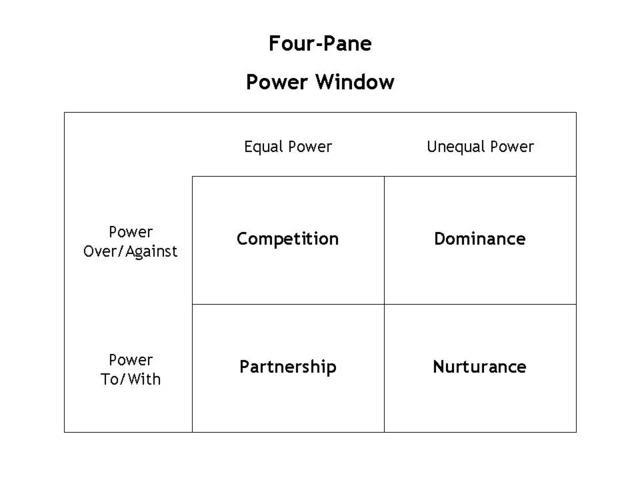
I’ve often talked about the fact that in his days as a community organizer, President Obama studied and taught about power relations. Its clear to me that he has an understanding of the power of partnership PowerWindow2and is constantly calling on us to join him in exercising that power.

Practicing leadership from a position of “power with” requires that you have an independently strong ego and don’t need to dominate in order to prop it up or feed it. And it also requires trust in the people you set out to lead. These are some of the characteristics I most admire about President Obama and ones that are often most misunderstood by his critics on the left and the right.

Its only natural that when people are so used to the power of dominance that they would dismiss the reality of the power of partnership. Its why we so often hear Obama criticized as weak and naive. But history tells us that all of the battles won by the left in this country have been based on a partnership model of power … enough people finally spoke up in ways that couldn’t be ignored. We see that in the battle for civil rights, unions, women’s suffrage, anti-war, etc.

The archetypal achievement of this president in that regard is his deployment of “power with” with respect to gay rights. The power to change came from below – but he masterfully guided it, nudged it, and helped without getting in our way. Ditto universal healthcare when he refused to impose a bill, but demanded that the Congress come up with one along similar lines.

This is the same dynamic with immigration reform. A president is not a dictator or even a decider. He presides and enables, articulates and maneuvers the entire body politic. He can screw up – Toomey and Manchin were not the most connected Senators on Capitol Hill and couldn’t deliver many votes compared with the NRA’s relentless fanaticism. Baucus wasted critical momentum for universal healthcare. But he is emphatically not a legislative dictator in our system. And real conservatives will admire this – not leap to dismiss him as a “lame duck” because of it.

The trouble right now is that a certain narrative is over. It began with the 2000 election, continued with 9/11 and a dubiously legitimate president marching the country into two deeply divisive and disastrously costly wars, trashing the country’s hard and soft power, and wrecking the government’s balance sheet before leaving his successor with the worst recession since the 1930s. Obama was elected to heal that gaping wound. And he has: one war is over, the other winding down; torture is over; alone among Western countries, the US economy is slowly, slowly returning to health – its rebound cramped by spending discipline. Obama’s re-election also cemented a deep social shift: we are now emphatically a multicultural country that celebrates that fact. Latinos and gays are part of the American spectrum. These are profound changes in five short years. And many seem ready now to relax and see his re-election as the end of the central narrative of the 21st Century so far. Hence the difficulty of leading from below today.

You want more from him? Get off your asses and make him and the Congress do it. We’re a republic, not a benevolent dictatorship. And we remain lucky to have such a sane, stable, no-drama pragmatist to marshall the forces we can muster. But without us? He is head of state and not much more.

(Photo: US President Barack Obama holds a press conference in the Brady Press Briefing Room of the White House in Washington on April 30, 2013. By Saul Loeb/AFP/Getty Images.)

Anne Frank, Ourselves

A mother in Michigan has complained about the teaching of the Diary of Anne Frank due to one of its less-quoted passages, where Anne explores and describes her vulva. Emer O’Toole thinks it’s actually a key moment that makes the iconic heroine relatable to young girls:

[The mother] is, of course, wrong to call the passages pornographic. Pornography is material intended to arouse sexual excitement, and I very much doubt that was Anne’s intention when she wrote to her imaginary confidant Kitty about her journeys of self-discovery. But the reason [she] gives for complaining in the first place is that the passages made her daughter uncomfortable. I can well believe this. I can imagine that if, age 13, I had been asked to read or discuss the passages in class, I would have felt deeply uncomfortable (my own nocturnal explorations notwithstanding).

Anne is going through puberty, and she describes her changed vagina in honest detail, saying, “until I was 11 or 12, I didn’t realise there was a second set of labia on the inside, since you couldn’t see them. What’s even funnier is that I thought urine came out of the clitoris.” (Oh Anne, we’ve all been there.) She continues: “In the upper part, between the outer labia, there’s a fold of skin that, on second thought, looks like a kind of blister. That’s the clitoris.” It’s beautiful, visceral writing, and it’s describing something that most young women experience.

Jobs Report Reax: A Durable, Slow Recovery

Job Losses

Jared Bernstein summarizes today’s jobs report:

Payrolls increased by 165,000 last month and the unemployment rate ticked down to 7.5%, in a jobs report that painted a considerably brighter picture than last month’s version.  In fact, the disappointing 88,000 payroll gain for March was revised up in today’s report to 138,000, and in February, new revisions show a large increase of 332,000 jobs.

That means employers added 114,000 more jobs in February and March than we thought, bringing the monthly average payroll gains over the past three months to a healthy 212,000 per month.  Job growth at that pace, if it persists, should be enough to gradually, albeit slowly, bring down the unemployment rate.  In fact, the decline in the jobless rate from 7.6% in March to 7.5% in April was due not to a shrinking labor force (i.e., people giving up looking for work) but to more people getting jobs.

Neil Irwin’s take on the state of the economy:

This isn’t a good economy. By a lot of measures it’s terrible. Still, we should note what we have achieved: a durable kind of recovery that, if it can go for several more years, will eventually get us out of the muck. But it is also slow enough that the human toll of the crisis will be long and enormous.

Binyamin Appelbaum looks at the percentage of Americans with jobs:

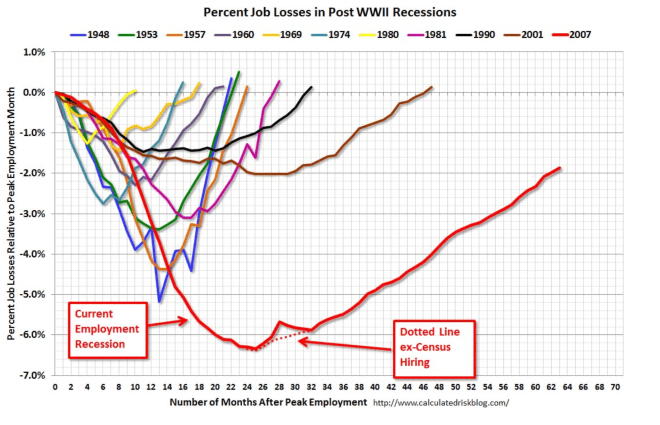
The American economy continues to add jobs in proportion to population growth. Nothing less, nothing more. The share of American adults with jobs has barely changed since 2010, hovering between 58.2 percent and 58.7 percent. This employment-to-population ratio stood at 58.6 percent in April. That is about four percentage points lower than the employment rate before the recession, a difference of roughly 10 million jobs. In other words, the United States economy is not getting any closer to recreating the jobs lost during the recession.

Floyd Norris focuses on the plight of the long-term unemployed:

There are still 4.4 million workers who have been unemployed for at least six months. That is down from the peak of 6.7 million, but it is still very high. And that number does not include people who have given up looking for work.

Bloomberg’s editors also worry about unemployment duration:

The average unemployed person has been out of work for 36.5 weeks. That’s not much better than the December 2011 duration of 40.7 weeks, which was the longest since World War II. Long-term unemployment at the start of the recession in December 2007 was 1.3 million people, and the average duration was 16.6 weeks.

Terrible things happen to people when they are out of work for long periods, numerous studies show. Beyond a sharp drop in income, long-term unemployment is associated with higher rates of suicide, cancer (especially among men) and divorce. The children of the long-term unemployed also show an increased probability of having to repeat a grade in school.

Daniel Gross examines wages:

The jobs growth is good. But wage growth is less impressive. One of the major—and frustrating—features of this recovery has been that capital is beating the living daylights out of labor. Companies have been able to rack up record profits and are demanding that employers work harder and more productively without necessarily paying them more. Why? There’s a lot of slack in the labor force, unions have declined in power, and there’s a pervasive sense among CEOs that they just don’t need to pay more. This trend continued last month. “In April,” BLS noted, “average hourly earnings for all employees on private nonfarm payrolls rose by 4 cents to $23.87. Over the year, average hourly earnings have risen by 45 cents, or 1.9 percent.” That’s weak. And we are nearing a point where we will really need companies to start giving it up if the expansion is going to continue.

Yglesias compares public and private workforces:

The big story of the recovery that continues to be clear and not subject to small revisions is the rebalancing of the American economy out of public-sector employment and into private-sector production. There are 89,000 fewer people employed by the government than there were one year ago, and almost 2.2 million more people employed in the private sector. Given sequestration, I would expect that trend to continue.

Greg Ip is relatively pessimistic:

There is little reason to expect the economy to accelerate in the near term. Barack Obama desperately wants to scrap the sequester, but unless Congressmen heard a groundswell of protest in their districts during this week’s recess, they are unlikely to return to Washington motivated to fix it. The Federal Reserve had expected to start tapering off quantitative easing (QE), under which it buys $85 billion of government bonds a month with newly created money. The March air pocket prompted it to reconsider, and this past week it opened the door to ramping up QE. But the April report does not show the sort of stall that would prompt the Fed to pull the trigger. The year 2013 has so far held less economic drama than 2012, 2011 or  2010, but nor has it given any reason to expect the final result to be different.

And Leonhardt puts the employment numbers in perspective:

For the last year and a half, average 12-month employment growth has hovered around 1.6 percent, precisely where it was in the 12 months ending in April. That’s faster than most of the last 12 years, which included two recessions and a mediocre recovery. But it’s far cry from the growth rates of between 2 percent and 3 percent, and briefly above 3 percent, in the mid- to late 1990s.

Chart from Calculated Risk.

Ask Josh Fox Anything: Safe Fracking?

The filmmaker and environmental activist explains whether or not, with proper regulation and precautions taken, he could support a safer form of hydraulic fracturing:

Michael Coren points out an alternative to liquid-based fracking that may be a climate win-win:

A technique of pumping pressurized carbon dioxide (CO2) into wells to shatter the rock and push out more oil and gas is gaining steam. Researchers in Japan, publishing in Geophysical Research Letters, showed injecting super-critical CO2 into granite blocks creates more extensive fracture patterns and theoretically outperforms conventional water-based techniques. Eliminating the need to truck, pump and process millions of gallons of water, compared to CO2 is a major benefit. But the most promising, if still uncertain, advantage is using shale formations for carbon dioxide storage, potentially removing a major source of warming greenhouse gas emissions (GHG) to the atmosphere while extracting cleaner energy than today’s coal mines. …

But it’s not without costs. Carbon dioxide from wells must be separated out from the natural gas, and CO2 pipelines– 3,900 miles of the infrastructure already exists–will never reach every well. Finally, the economics aren’t always a money maker. For CO2 to gain traction away from existing pipelines, either hydraulic fracking must cost more due to its risks or water scarcity, or the benefits of CO2 from carbon sequestration and lower pollution must be monetized. Still, the potential to tap into cleaner burning energy while slashing carbon emitted into the atmosphere may change the equation for the future of fracking.

Josh Fox’s Gasland Part II will air on HBO this summer. His other Ask Anything answers are here. Full archive here.

The Shirts Off Their Backs

After the recent factory collapse in Bangladesh that killed more than 500, Rosemary Westwood calculates the cost of cheap clothing:

According to a 2011 report by the consulting firm O’Rourke Group Partners, a generic $14 polo shirt sold in Canada and made in Bangladesh actually costs a retailer only $5.67. To get prices that low, workers see just 12 cents a shirt, or two per cent of the wholesale cost. That’s one of the lowest rates in the world—about half of what a worker in a Chinese factory might make—and a major reason for the explosion of Bangladesh’s garment industry, worth $19 billion last year, up from $380 million in 1985. The country’s 5,400 factories employ four million people, mostly women, who cut and stitch shirts and pants that make up 80 per cent of the country’s total exports.

For that $14 shirt, the factory owners can expect to earn 58 cents, almost five times a worker’s wage. Agents who help retailers find factories to make their wares also get a cut, and it costs about $1 per shirt to cover shipping and duties. Fabric and trimmings make up the largest costs—65 per cent of the wholesale price.

Sarah Stillman spoke to Bangladeshi garment worker Sumi Abedin:

Last November, Abedin was sewing clothing for Walmart and other American brands at a factory called Tazreen Fashions, on the outskirts of Dhaka, when she heard a colleague yell, “Fire!” She thought of sprinting toward the stairs when the factory owner said, “He is lying,” and padlocked the doors.

As the air of Tazreen Fashions filled with dark smoke, Abedin told me, “I was running around the factory floor, screaming, crying for help.” After the power went out, she followed the dim light of other workers’ cell phones to the factory’s third production floor, where she saw a man removing the bars from a window. She decided to leap.

“I didn’t jump to save my life,” she told me, much as she has told reporters, students, and anyone who would listen over the past several weeks of touring the country. “I jumped to save my body, because if I stayed inside the factory I would burn to ash, and my family wouldn’t be able to identify my body.” When she landed, she broke her foot and arm. She considers herself lucky; a hundred and twelve of her colleagues died in the Tazreen fire. The parallels to New York’s Triangle Shirtwaist Factory fire, in 1911, where doors were locked and a hundred and forty-six workers died in the space of twenty minutes, are obvious.

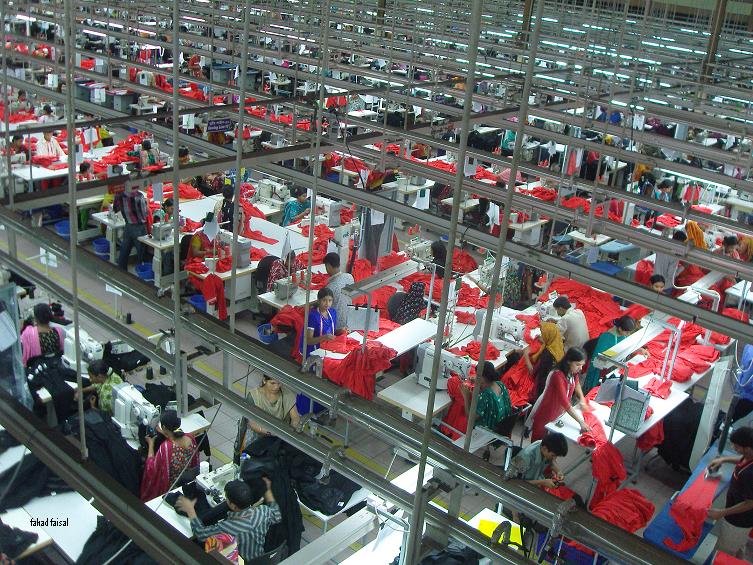
(Photo: Garments Factory in Bangladesh by Fahad Faisal from Wikimedia Commons)