All Politics Pack A Punch

Praising Kelsey Grammer’s political series BossProspero sets the gritty, Chicago-based thriller against the more polished and presidential House of Cards:

“Boss” is a grand, operatic tale. And yet it plays out within the modest confines of contemporary city politics. [Mayor Tom] Kane’s epic quest is not to conquer another country, amend the constitution or avenge a terrorist attack. He just wants to add some extra runways to O’Hare airport. This is very much a municipal melodrama. …

In “Boss”, small-ball is hard-ball.

The mayor and his enemies bring buckets of guile and gumption to bear on their un-presidential struggles. Municipal showdowns motivate titanic clashes, deadly conspiracies and orotund speeches. The success of the show is that it makes all this seem entirely fitting. Of course the mayor’s encroachment on the bureaucratic turf of a local housing authority must be resisted like a fascist invasion. Of course a runway expansion must stand as a monument to man’s will to imprint himself on the world. The show makes you believe that the last mile of politics is the only mile that matters. Kane can stroll through parks he has built and trespass on ghettos he has neglected. His political achievements and failures are tangible, visible, inhabitable. If politics is the “slow boring of hard boards”, then city wrangling is where the gimlet pierces the wood.

The Cannibal Colony

A fresh excavation at Jamestown uncovered a body that reveals that life in the settlement was even grimmer than previously thought:

[Anthropologist Douglas] Owsley speculates that this particular Jamestown body belonged to a child who likely arrived in the colony during 1609 on one of the resupply ships.

She was either a maidservant or the child of a gentleman, and due to the high-protein diet indicated by his team’s isotope analysis of her bones, he suspects the latter. The identity of whoever consumed her is entirely unknown, and Owsley guesses there might have been multiple cannibals involved, because the cut marks on her shin indicate a more skilled butcher than whoever dismembered her head.

It appears that her brain, tongue, cheeks and leg muscles were eaten, with the brain likely eaten first, because it decomposes so quickly after death. There’s no evidence of murder, and Owsley suspects that this was a case in which hungry colonists simply ate the one remaining food available to them, despite cultural taboos. “I don’t think that they killed her, by any stretch,” he says. “It’s just that they were so desperate, and so hard-pressed, that out of necessity this is what they resorted to.”

Dana Goodyear explains why the Donner party’s cannibalism is well-known but Jamestown’s isn’t:

The difference between the tale of the Jamestown colonists and that of the Donner Party is transmission: in 1847, a noisy newspaper culture reported on every available detail; two hundred and thirty-seven years earlier, there was no domestic press. There was only word of mouth.

“Brand-Affiliated” “Journalism”

Jessica Bennett went from being a reporter at Newsweek (among other outlets) to becoming the executive editor of the now-defunct Storyboard, “an independent journalistic platform hosted at Tumblr.” She talks to Ann Friedman about working at a “brand-affiliated publication”:

Consumers are getting smarter about traditional advertising and marketing, she adds, and some companies are taking the unorthodox approach of directly employing journalists—whose ideas and copy they don’t directly control—to cover their brand or community … For reporters and editors tired of layoffs and buyouts, these jobs offer a middle ground between journalism and copywriting, a way to take home a decent paycheck without feeling like you’ve sold out completely.

Whose copy they don’t control? Buzzfeed would never tolerate that. Despite the fact that many of the Storyboard pieces were published in other traditional journalistic outlets, she struggled with how her work was being perceived by others:

“There is a lot of crap journalism out there, so sometimes it bothers me when people get all high and mighty about branded content. I really think it’s the story, not where it comes from.” But it’s increasingly difficult to figure out where a story comes from. As sponsored journalistic content and branded advertorial and brand-affiliated independent publications proliferate, the lines are getting blurrier and blurrier. It might be helpful for media consumers to demand more up-front information on how a story was produced—who paid for it? And who signed off on its publication? The Storyboard editors never published a statement explaining their editorial independence or decision-making process, though Bennett says, “we probably should have.”

The Ribbon Epidemic

Over the weekend, Peggy Orenstein put breast cancer activism under the microscope:

Before the pink ribbon, awareness as an end in itself was not the default goal for health-related causes. Now you’d be hard-pressed to find a major illness without a logo, a wearable ornament and a roster of consumer-product tie-ins. Heart disease has its red dress, testicular cancer its yellow bracelet. During “Movember” — a portmanteau of “mustache” and “November” — men are urged to grow their facial hair to “spark conversation and raise awareness” of prostate cancer (another illness for which early detection has led to large-scale overtreatment) and testicular cancer. “These campaigns all have a similar superficiality in terms of the response they require from the public,” said Samantha King, associate professor of kinesiology and health at Queen’s University in Ontario and author of”Pink Ribbons, Inc.” “They’re divorced from any critique of health care policy or the politics of funding biomedical research. They reinforce a single-issue competitive model of fund-raising. And they whitewash illness: we’re made ‘aware’ of a disease yet totally removed from the challenging and often devastating realities of its sufferers.”

Felix Salmon summarizes Orenstein’s article:

Americans are loving, compassionate people who really want to think that they can help, or make a difference. So they wear pink t-shirts, and ribbons, and football cleats; they spread the word in the name of “awareness”; they file up in their millions for mammograms and encourage everybody else to do so as well. (“If you haven’t had a mammogram, you need more than your breasts examined.”)

Orenstein does a good job of glossing the unpleasant consequences of such actions. Money which could be put to research into treating metastatic cancer — the kind of cancer which kills you — is instead put overwhelmingly into “awareness” campaigns and mammograms. There’s an epidemic of overtreatment, which carries massive physical, psychological, and economic costs. (And even attempting to measure such costs is considered almost treasonous in the cancer community.) More recently, the pink wave has spread to teenage girls, who are being educated, as Orenstein says, “to be aware of their breasts as precancerous organs”.

He goes on to draw larger lessons about charitable donations to various causes. The Dish has discussed the lameness of ribbons and tackled the commercialization of cancer before.

The NRA’s Grip Loosens?

Michael Tomasky sees hope in the public approval hit suffered by senators like Kelly Ayotte (R-NH) who voted against the Manchin-Toomey gun control bill:

How stupid does the Senate background-check vote look now, I ask the pundits and others who thought it was dumb politics for Obama and the Democrats to push for a vote that they obviously knew they were going to lose. I’d say not very stupid at all. The nosedive taken in the polls by a number of senators who voted against the bill, most of them in red states, makes public sentiment here crystal clear.

PPP finds that Senators Kay Hagan and Mary Landrieu, who voted for the gun control bill, have benefited from that vote:

Polling we released earlier in the week showed what a backlash there was against Senators on both sides of the aisle who voted against the background checks bill. But what this polling shows is that voters aren’t just mad at politicians who voted against Manchin/Toomey- they’re also ready to reward Senators who supported it- even in states that voted for Mitt Romney last year like North Carolina and Louisiana. With Hagan and Landrieu facing tough reelection contests in 2014, that could go a long way.

Greg Sargent is less optimistic:

[T]here are no indications that these Senators are prepared to change their votes, and there is not another vote on Manchin-Toomey scheduled for anytime soon. Such a vote won’t happen until there are genuine signs that one or two or three Senators are prepared to flip. While I’m told that there are still multiple conversations underway, there’s no sign that this is imminent.

It’s good that gun control advocates are beginning to bring pressure to bear that shows that a political price will perhaps be paid for this vote. That’s crucial, and it cuts a bit against the conventional wisdom which held that the effort would die completely after Manchin-Toomey’s defeat. That said, it’s still unclear whether any of it will end up mattering.

“I’m Black. And I’m Gay.”

Charles Pierce sees Jason Collins’ coming out as especially symbolic:

His explanation for his decision to come out is rich with the historical “dual identity” forced on black Americans under Jim Crow, and the similar dynamic within which he lived as a gay man. Homophobia in the black community — indeed, even among the leaders of the civil rights movement of the 1960s — was some of the most virulent and stubborn of all, and there are still some who resent the equation of the gay rights movement with their struggle. In his announcement in Sports Illustrated, then, Collins gave every indication that he’s fully aware of the historic and cultural dimensions of his decision, and of the sacrifices made elsewhere so that he would be free to make it now.

Adam Serwer takes issue with Pierce, arguing that the race-sexuality issues in Collins’ case “deserve a more thoughtful examination”:

There was certainly homophobia in the civil rights movement—but in the 1950s and ’60s, American society was homophobic, and Pierce offers no evidence that the civil rights movement was more homophobic than any other American institution during that period.

Given that one of the architects of the civil rights movement’s nonviolent strategy was Bayard Rustin, it was arguably less homophobic than much of society at the time. With a few notable exceptions, surviving leaders of the movement—from Rep. John Lewis (D-Ga.) to Rev. James Lawson to Jesse Jackson to Julian Bond—are all in favor of gay and lesbian rights.

There’s also little evidence for the proposition that black homophobia is “the most virulent and stubborn of all.” Black folks, who were disenfranchised for centuries, didn’t put any of those old anti-sodomy laws on the books. The legal architecture of discrimination based on sexual orientation is one of the few things in America that dates back to colonial times that wasn’t built by black people.

Previous Dish on Collins’ announcement here and here.

Lessons Of Bush v. Gore, Ctd

A reader writes:

McArdle’s memory is faulty.  The 2000 election was held November 7. Gore asked for recounts in four counties on November 9, but offered to accept recounts in all counties on the 15th. This offer was rejected by Bush later that day. The Supreme Court decision was December 8. So the idea to “count all the votes” came 8 days into a process that lasted 31, not “very late in the process,” as McArdle claims.

Another goes into greater detail:

You approvingly quote Megan McArdle’s judgment that it was basically Gore’s fault and endorse the historical scenario she uses to justify that judgment:

The original sin, in my view, was Gore’s attempt to recount just the votes in a few heavily Democratic counties.  [….]  ”Count all the votes”, which most progressives now remember as the rallying cry, actually came very late in the process, and only after the Supreme Court of the United States told the Florida Supreme Court that no, it couldn’t just let Al Gore add in some new votes from Democratic Counties his team had personally selected.

I’m sorry, but this is just flatly incorrect. After the Florida Supreme Court’s first ruling in favor of the Gore campaign, on November 15, Gore immediately made a public offer to conduct a state-wide manual recount of all the votes in Florida, if the Bush campaign would also agree.  Gore did so on several occasions before the US Supreme Court had issued any rulings on the matter. November 15:

I am also prepared, if Governor Bush prefers, to include in this recount all the counties in the entire state of Florida. I would also be willing to abide by that result and agree not to take any legal action to challenge that result. If there are no further interruptions to the process, we believe the count can be completed within seven days of the time it starts.

The Bush campaign rejected that proposal.  A lot of lawsuits, countersuits, political fireworks, and other shenanigans followed.  The most crucial ruling in favor of the Gore campaign by the Florida Supreme Court came on November 21.

The US Supreme Court first agreed to hear the Bush campaign’s appeal on November 24.  The first arguments in the US Supreme Court (which, of course, came before their ruling) were on December 1, 2000.  Here’s something that Gore said before December 1, on November 28:

Two weeks ago, I proposed to forego any legal challenge if Governor Bush would let a complete and accurate count go forward, either in the counties where it was proposed or in the full state of Florida. He rejected that proposal and instead became the first to file lawsuits. And now, two weeks later, thousands of votes still have not been counted. [….]  Let me repeat the essence of our proposal today: Seven days, starting tomorrow, for a full and accurate count of all the votes.

I’m sorry, but the plain fact is that the Republicans stole the 2000 election, and did so with the active complicity of the US Supreme Court.  I know that’s serious language, which we should not use carelessly or casually, but I say it with due consideration, and I think that judgment is clearly supported by the facts.

Some may disagree.  But at the very least, we should not rewrite history along the lines of Republican propaganda (currently being spouted, perhaps sincerely, by Megan McArdle.)

How To Kick Off A Publicity Tour

Or why I still worship the Pet Shop Boys:

Stereogum: Hello boys. Where are you?

Neil: We are in London.

Stereogum: Are you doing a ton of press for the new record?

Chris: Not if we can help it.

Neil: You are the first one, actually … and possibly the last.

Chris: We’ll see how this goes and then decide whether or not to move forward with publicity for this album.

They also capture the core thing I admire about my favorite working artists, writers, singers, actors, et al. They do it for no other reason than they love it:

Neil: If we had run out of musical ideas ten years ago or something, I can assure you that we would NOT now be touring as some kind of 80′s revival act. We’d simply just be doing something else with our lives. We would have moved on. Really, the making of new music is what fuels and re-fuels an interest in the old songs … and being able to see the through-line of continuity within all the work and how both the new material and the old somehow tie together. We’ve always just really loved the process of writing songs and recording albums and then choosing remixers to work on the songs — we love all that stuff. Our love for that has never dimmed, it has never felt like chore. I can assure you that if it had ever felt like a chore, we are lazy enough to have given it up. We both still have the constant impetus to go into a studio and make songs.

Sometimes I wake up in the morning and Chris has sent over three or four demos that he’s made the night before at home in his studio … It remains one of the constants in both of our lives. We do it for pleasure, really. That’s how we started … we started making music together as a hobby and it just kind of took off from there. It never ceased to have that playful element … and I think it’s really important to stay connected to that childish, playful element to making music. Some people cut themselves off from that when they become a “grown up”… and when you do that, you generally cut yourself off from your own creativity.

Chris: We’re also still enormous music fans as well. We follow everything happening in popular music and are constantly being asked about it. People want to know what we think of the new Daft Punk single. It’s an issue for us. (laughs)

Neil: Oh, more than an issue. I mean, is there anything more important right now than that that Daft Punk single?!

How Barbaric Is Force-Feeding?

Kent Sepkowitz describes the procedure, which many Gitmo prisoners have been subjected to:

During my training, I placed countless feeding tubes (and larger hoses to pump stomachs). Without trsuffragetteschquestion, it is the most painful procedure doctors routinely inflict on conscious patients. The nose—as anyone knows who ever has received a stinger from an errant baseball—has countless pain fibers. Some patients may scream and gasp as the tube is introduced; the tear ducts well up and overflow; the urge to sneeze or cough or vomit is often uncontrollable. A paper cup of water with a bent straw is placed before the frantic and miserable patient and all present implore him to Sip! Sip! in hopes of facilitating tube passage past the glottis and into the esophagus and stomach.
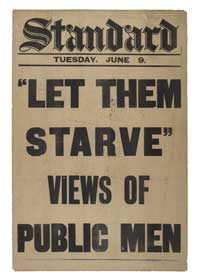
The procedure is, in a word, barbaric. And that’s when we are trying to be nice.

It’s a grotesque attack on a human being’s dignity. Here is how it was described by Vladimir Bukovsky in a must-read essay on torture when it was done by the Soviets:

“The feeding pipe was thick, thicker than my nostril, and would not go in. Blood came gushing out of my nose and tears down my cheeks, but they kept pushing until the cartilages cracked. I guess I would have screamed if I could, but I could not with the pipe in my throat. I could breathe neither in nor out at first; I wheezed like a drowning man — my lungs felt ready to burst. The doctor also seemed ready to burst into tears, but she kept shoving the pipe farther and farther down. Only when it reached my stomach could I resume breathing, carefully. Then she poured some slop through a funnel into the pipe that would choke me if it came back up. They held me down for another half-hour so that the liquid was absorbed by my stomach and could not be vomited back, and then began to pull the pipe out bit by bit.”

The method in Gitmo is unlikely to be as severe – but every time I have assumed simple decency from the US government with respect to “enemy combatants,” I have often been wrong. But some forced-feeding is rightly judged to be a form of cruel, inhumane and degrading treatment. The UN Rapporteur on Human Rights issued this statement yesterday:

According to the World Medical Assembly’s Declaration of Malta, in cases involving people on hunger strikes, the duty of medical personnel to act ethically and the principle of respect for individuals’ autonomy, among other principles, must be respected. Under these principles, it is unjustifiable to engage in forced feeding of individuals contrary to their informed and voluntary refusal of such a measure. Moreover, hunger strikers should be protected from all forms of coercion, even more so when this is done through force and in some cases through physical violence. Health care personnel may not apply undue pressure of any sort on individuals who have opted for the extreme recourse of a hunger strike.

You think it isn’t cruel or inhumane? Even in Soviet Russia, the practitioners could break down because doing this to another human being against his or her will is so traumatizing:

There had just been time for everything to start healing during the night when they came back in the morning and did it all over again, for 10 days, when the guards could stand it no longer. As it happened, it was a Sunday and no bosses were around. They surrounded the doctor: “Hey, listen, let him drink it straight from the bowl, let him sip it. It’ll be quicker for you, too, you silly old fool.” The doctor was in tears: “Do you think I want to go to jail because of you lot? No, I can’t do that. . . . ” And so they stood over my body, cursing each other, with bloody bubbles coming out of my nose. On the 12th day, the authorities surrendered; they had run out of time. I had gotten my lawyer, but neither the doctor nor those guards could ever look me in the eye again.

For America to be doing this now is, moreover, a direct result of both Congress’s and Obama’s failure of nerve on this hideous legacy of the dark years of Bush and Cheney. Leith Passmore thinks that the US has no good options:

The U.S. military is understandably wary of the potential fallout over inmate deaths. A member of the Irish Republican Army, Bobby Sands, starved to death in prison in 1981, and his death increased recruitment and sectarian violence. Force-feeding may prevent this type of martyrdom, but it also leaves the United States open to further accusations of state torture.

While Sands was starving himself in Northern Ireland, hunger striking terrorism suspects in West Germany were being forcibly fed. The treatment of Red Army Faction prisoners produced a groundswell of support for the prisoners’ cause and helped to recruit new members. The Red Army Faction survived for decades on the back of force-feeding.

In his recent comments, President Obama has shown an awareness of Guantánamo as a potential recruiting tool for terrorist groups. Neither the ethical nor the unethical treatment of prisoners will reduce that risk.

(Image: a newspaper from the period when activists’ for women’s suffrage were routinely force-fed in hunger strikes.)
Ask Josh Fox Anything: “We Have A Choice”

The Gasland filmmaker weighs in on whether or not the US can completely ditch fossil fuels and switch to renewable energy like wind and solar:

The Mark Jacobson renewable energy article for the US that Josh mentions is here (pdf). Jacobson’s plan for New York state is here. Elsewhere, Todd Woody profiles a new technology that reduces wind’s intermittency problem:

The rap against wind energy is that it’s fickle, generating massive amounts of electricity one hour and next to nothing the next. That plays havoc with the power grid and the problem is only growing as wind becomes a bigger part of the power mix. … But what if every wind turbine became a node in an energy internet, communicating with the grid and each other to adjust electricity production while storing and releasing electricity as needed? That’s the idea behind General Electric’s new “brilliant” turbine, the first three of which the company said today will be installed at a Texas wind farm operated by Invenergy.

The 2.5-MW windmill is something of a technological leap in an industry where turbines have gotten bigger and bigger but not necessarily smarter. The turbine’s software captures tens of thousands of data points each second on wind and grid conditions and then adjusts production, storing electricity in an attached 50 kilowatt-hour sodium nickel chloride battery. If, say, a wind farm is generating too much electricity to absorbed by the grid—not an uncommon occurrence in gusty west Texas—it can store the electricity in the battery. When the wind dies down, the electricity can be released from the battery and put back on the grid.

And related to yesterday’s video, in which Fox made a case for all fossil fuels being equally bad, Michael Levi, responding to a report indicating that there are sufficient worldwide coal reserves to warm the planet by 27° F, worries that we are not weaning ourselves off coal fast enough:

Even if the natural gas boom were to eventually spread from the United States to the rest of the world, coal-fired power could well continue to dominate much of the global energy system for decades. So natural gas doesn’t let us off the hook for a decade or two while we figure out how to make zero-carbon energy thrive. Indeed it doesn’t even give the United States a pass. In May 2012, fracking briefly spurred gas to pass coal as the top source of U.S. electricity. But as natural gas prices recovered, coal regained its top rank, a position most expect it to retain for decades to come. That won’t cut it if we’re going to seriously tackle climate change. To be certain, cheap gas makes it less expensive to cut our emissions, by shifting away from traditional coal. But we’ll still need governments to step in and tip the balance, whether through new regulations or a price on carbon that gives gas an advantage over coal. …

A shortage of fossil fuels isn’t going to save us from dangerous climate change. And plans that depend on one or another technological breakthrough are far too risky to bet our future on. We need to move forward with gas, using it to edge aside coal, even as we push ahead on a host of zero-carbon opportunities. That’s the best way to maximize the odds that we’ll ultimately be able to deal effectively with climate change.

Josh Fox’s Gasland Part II will air on HBO this summer. His other Ask Anything answers are here. Full archive here.