The View From Your Window Contest: Winner #151

Screen Shot 2013-04-27 at 3.09.02 AM

A reader writes:

This appears to be the view of Pico from Faial, both central islands in the Azores. While not exactly tropical, the climate is warm enough to sustain the odd palm tree. I believe you can see the town of Horta smack in the middle of the snapshot.

Another:

Long-time follower, first time responding! I believe this picture was taken from somewhere on the eastern side of the Azorean island Faial. The mountain in the background looks to be Mount Pico, on the nearby island of Pico. I’m sure someone else will be much more exact, but my best guess is that it was taken somewhere on the outskirts of the city of Horta, possibly Conceição?

Since I can’t offer too much more detail, let me add a personal anecdote about Faial. My family is originally from mainland Portugal and my grandfather originally applied for a visa to come to the US in 1947, but didn’t get one until 1960. It took a series of volcanic eruptions in 1957/58 on the western side of Faial to finally open the door for my family and thousands of others to enter the US.  The eruptions led to Congress passing the Azorean Refugee Act of 1958 (co-sponsored by then Senator John F. Kennedy), which greatly  increased the amount of visas provided to Portuguese, both from the Azores and the mainland.

Another:

This looks like it might be Nevis in the distance, the island that is very close to St. Kitts. The country is St. Kitts Nevis, Nevis is so-called because Columbus thought that the peak was covered in snow, or nieves in Spanish, but it was just clouds.  There are no snow capped islands in the West Indies.  Nevis is just south of St. Kitts, which was named by Columbus for his patron saint.

Another:

It could be any tropical, volcanic region in the world, so most likely Central America or Southeast Asia. With that in mind, I’m guessing that this was taken from the port town of Balingoan on the north coast of Mindanao in the southern Philippines, looking across to Camiguin Island which is famous for its volcanoes.

Another:

krak small

Well, this week’s contest was too easy, as Anak Krakatoa Island is the subject of the photo. (Even were it not for the profile of the famous volcano, the red tile/metal roofs in the tropical paradise setting clearly suggest an Indonesia-like locale.)  The photographer has to be a tourist visiting Anak Krakatoa (Child of Krakatoa), with accommodation on one of the three islands that make up the remnants of the original Krakatoa island obliterated in 1883.

Another:

Well, we’re looking at a volcano in the tropics, sitting near a body of water.  Could be a lot of different places (it quite reminds me of my recent trip to Arenal volcano in Costa Rica), but searching Indonesia alone would take hours, I’m going to make an educated guess that we’re looking at Mayon Volcano in the Philippines, known for its majestic symmetry.  It sits on a body of water, the Albay Gulf, and there’s the little town of Manito right across the gulf from Mayon, so that’s what I’m guessing. (Watch, the volcano will probably turn out to be Concepcion in Nicaragua, or something in Indonesia and I’ll be off by thousands of miles.)

Another:

Costa Rica? Overlooking the Tenorio volcano, from Tilaran, or somewhere close? My husband and I went to Costa for our honeymoon in January and I’ve been dying to go back and this has the look, from the palms, architecture, terrain. Might be another volcano, but definitely Central America.

Another:

I spent the winter holiday cruising down the Pacific coast and stopped in both Guatemala and Nicaragua. Volcanoes in both places, but I’m guessing Guatemala.  Is that Lake Atitlan in the foreground? I don’t expect I’ll ever win the book – I’m just not computer savvy enough to do the calculations and draw the intersecting vector lines and give GPS data … but fuck it, let’s say this is taken from the top of the chicken coop on the farm of Pedro Zacapa on the outskirts of Santa Catarina Palopo, Guatemala.

Another:

Back in the 1980s, when I lived in Guatemala, Panajachel on Lake Atitlan was one of the places I’d go for a respite. At that time there were few tourists and even on Peace Corps wages I could stay in a decent hotel. I believed and still believe that it is one of the most beautiful places on earth. And the people were as beautiful as the land. Many of the villages on the lake were considered too dangerous to visit, but I would go anyway. Stupid youth. There was a Catholic mission in one village that was very welcoming. I had tremendous respect for the work of these people – nuns, priests, and others – doing such good work in a troubled place. I would visit the orphanage to get my hug quota fulfilled. The only negative was that many were from Minnesota and I had to withstand a barrage of Iowa jokes whenever I stopped by.

Another gets the right country:

I have never dared to respond to the VFYW contest before but the most recent one just screams Central America to me, and since I lived for a year and a half in Nicaragua, I’m going to go with that. The mix of vegetation, the layout of the house, the rusty corrugated tin roof, and the volcano on the lake is the spitting image of Mombotombo. The bricks in the foreground even look like the type made by all the towns along the Highway from Managua to Leon. I’m getting some serious nostalgia just typing this. So I’m going to take a guess based on the towns around Lake Managua and say this was taken outside either La Esperanza or Nagarote. Let’s just go with Nagarote. Thanks for the blast from the past!

Another nails the exact location:

Screen shot 2013-04-27 at 10.29.19 AM

A Google image search using the phrase “volcano island” quickly serves up a variety of candidates, including Volcan Concepcion, on the island Ometepe, in Nicaragua, with a cone-like shape similar to the mountain in the contest photo.  A subsequent search on “Ometepe” turned up photos so strikingly similar to the contest photo that they must have been taken from the same window. It didn’t take long to find the location by looking at Ometepe accommodations on Tripadvisor. The location is the Finca Magdalena guest house, near the town of Balgue, on the island of Ometepe, in Lake Nicaragua, Nicaragua.

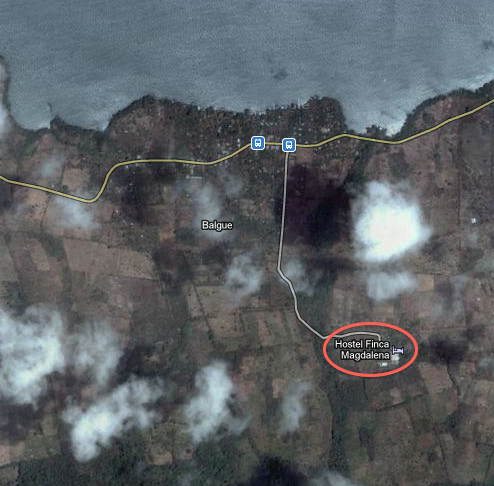
Screen shot 2013-04-27 at 10.28.57 AM

Another:

On Google maps, my wife and I started moving north along the Venezuelan coastline in search of islands just off the mainland.  Eventually we reach Central America, and Nicaragua.  At this point one might notice a rather large lake set in Nicaragua named Lake Nicaragua, and set in the middle of that lake is … a volcanic island called Isla Ometepe.  In the lake.  Like a motherf*cking Bond villian lair.  It’s the coolest thing ever and I never knew it existed and it’s shit like this that keeps me doing this contest every week.

Another focuses on the hostel:

I am afraid this one will generate a lot of correct results, based on the fact that I found it rather quickly (20 minutes).  Clearly Caribbean landscape, but no island volcanoes seem to match the geography. I found some links to Costa Rica volcanoes and expanded my search to include Central America, which immediately produced several photos almost identical to this weeks view, all with the same outbuildings and varying degrees of cloud cover and snow on Volcán Concepción. Anyway, I believe the photo was taken from the upper floor of the Finca Magdalena Hostel on Isla de Ometepe in Lake Nicaragua. Judging by the angle and the window frame in the photo, I am pretty sure it was take through the small side window circled:
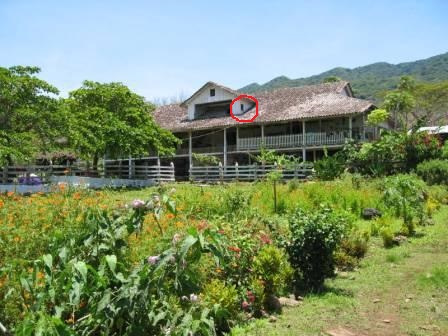
red-circle

Another:

I have never been there, but my Brooklyn-dwelling daughter traveled there last year, visiting a friend and climbing the other volcano, Maderas, which is dormant. She reported spectacular wildlife and loved hiking up through the rainforest; it is a nature preserve and a UNESCO Biosphere preserve.

Another:

This place is fantastic if you like troops of howler monkey. As a monkey enthusiast myself this locale was great for sneaking into the woods up the hill and grabbing a quick pic of the monkeys. We stayed monkeyhere one night on our way around the island back in 2010, since we’d heard they’d had this great fried mango food like Mango French Fries!  The whooping and screeches of the monkeys did not thrill most residents during the night, but boy was I wooed by their subtle songs. Just Beautiful! It had a great little restaurant style bed and breakfast feel, and there was a fantastically cute pet raccoon tied to tree. He did little tricks for food throughout the meals, although he didn’t seem too happy about the leash. Not sure how they got him – are raccoon’s common pets in “Nici”? I need get one of these!

But back to the monkeys! Howler monkeys can be heard from over three miles away. Amazing! We went all around the island listening for them. I felt like Jane Goodall or something finding these monkeys! HUZAAAAHHH!!! There they were! They mostly enjoyed the slopes of the volcano, which – woooweee – are a little steep for my legs. I practically fell right off of Conception. I’m not great at sketching but tried my hand at it – getting sooo much better at anatomical sketches. Probably should write my own book on this stuff.

Another:

When I saw this week’s VFYW, I nearly had a heart attack. Finally, a VFYW that I’d seen with my own eyes! This is the Finca Magdalena, a rustic farmhouse inn on an organic coffee farm, where I stayed with my husband and our three-year-old daughter, Isabel, several years ago. The Finca was our last destination on our trip to Nica. The ride in was rather complicated, hopping from ferry to bus to motorbike, but let me tell you, it was worth it. My husband and I loved the simplicity of the food, the staff, and most of all, the COFFEE! Nothing like some caffeine to get you up those steep Nica hikes! We ditched some clothes just to leave room in our suitcases to bring home as much coffee as possible.

The kind staff even introduced our Isabel to their “mapachito”, the cutest little raccoon they keep tied to a nearby tree. He was friendly as ever. Needless to say, this was the highlight of Isabel’s trip, and she played with him constantly. Talk about a free babysitter ;)

Another:

Arriving to volcano island

During a winter break in law school, I traveled to Nicaragua with one of my best friends.  As I’m sure most tourists would be, we were intrigued by the existence of a volcano in the middle of a lake.  We set aside a couple of days of our whirlwind tour of the country to travel to Isla de Ometepe.  On our only full day on the island, we spent an exhausting eight hours scaling the muddy slopes of Volcan Concepcion.  We brought our cameras for what we believed would be the incredible views on top.  Unfortunately, we had not thought through the implications of the term “cloud forest.”  As the moniker would suggest, the top of Concepcion is entirely banked in by clouds and thick mist at almost all times (as the entry photo depicts).  Despite having no views, the slopes were still a wonderfully dense jungle of packed vegetation, tangled tree limbs, and howling monkeys.

Another:

I knew this one immediately, not because I’d been there but because growing up we constantly had Ometepe coffee around the house.  The distinctive shape of the volcano was printed on the coffee bags.

About a third of the roughly 150 entries correctly identified Ometepe, and seven of those were from readers who have identified difficult views in the past without winning (“difficult” being defined as a view in which only 10 or fewer readers correctly answer it).  To break that tie, the reader among the seven who has participated in the most contests (11) is the winner this week:

This week’s view is from the top (mansard) floor of the Finca Magdalena Hostel. It is located on Ometepe Island, which rises out of Lake Nicaragua. Two volcanoes dominate the island: Concepcion, seen in the original view, is the taller, more symmetric one; and Maderas is the flatter one on the right at the link above. The hostel is on its northern slope. I knew this had to be in the Americas, since there is a cactus in the foreground, on the roof (all cacti but one are native to the Americas). I tried ‘volcano island Central America’ as a search phrase and Ometepe was the top result. I found this almost identical image on Panoramio and then the building it was taken from. (The window in question is the small one on the right.)

One more view:

VFYW Ometepe Interior Actual Window - Copy

(Archive)

End Of Life Over-Treatment

Rauch covers it:

The U.S. medical system was built to treat anything that might be treatable, at any stage of life—even near the end, when there is no hope of a cure, and when the patient, if fully informed, might prefer quality time and relative normalcy to all-out intervention.

He talks with Angelo Volandes, who creates informational videos about medical interventions: 

Volandes shows me some of the footage he plans to use. We watch a patient with advanced Alzheimer’s being fed through a tube that has been surgically inserted into her stomach. An attendant uses a big syringe to clear the tube, then attaches a bag of thick fluid. Over the footage, Davis’s voice will say, Often, people hope tube feeding will help the patient live longer. But tube feeding has not been shown to prolong or improve the quality of life in advanced dementia. Tube feeding also does not stop saliva or food from going down the wrong way.

… “Let me ask you this,” Volandes says. “Suppose I’m having a conversation with you about whether your father would want this. And I said ‘feeding tube,’ and you’re thinking to yourself, Food, yeah, I could give food to my mom or dad. We just want to make sure that regardless of the way the gastroenterologist is presenting the procedure, the patient’s loved ones know this is what we’re talking about.”

Cities Don’t Have A Reset Button

Tim Fernholz distills lessons about urban planning from the new version of SimCity:

While playing, it’s easy to solve your early economic problems by zoning more land and collecting more taxes. But soon you run out of land, your budget is in the red, pollution is becoming a problem, and your industries are running out of workers. As the city grows and more services are demanded, density becomes your watchword. This is a true nod to the realities of urbanism, where building up is the only way to efficiently capture the economic benefits of new residents.The most important lesson of SimCity, and of the real Detroit, is that growth is the only successful urban policy. But the brilliant decisions of the past become traps as you realize how they limit new development. It makes for an engaging, obsession-creating game, and a troubling reality.

The game also allows for maneuvers that real cities do not: 

One common rap against young market urbanists today is that they are too impatient with the human realities of politics. It’s true that SimCity takes politics out of the picture, but there are moments in the game when this very absence is instructive, eerie, and conspicuous: When a poorly planned city of my design ran out of residential space—and workers—it became clear that only massive restructuring would save the city from failure. An entire neighborhood would need to be wiped out and re-zoned for the greater whole to thrive. My digital bulldozers wasted no time. Obviously, the real world doesn’t work that way.

That’s partially the point. In his 1994 critique of the SimCity’s simulated approach to politics, Starr concluded that the best simulations work to expose their assumptions. What cities need to do to survive can be a political mess.

“I Loved An Imaginary Being”

Michelle Legro recounts a cruel, cautionary tale, as told in Wendy Moore’s How to Create the Perfect Wife:

In the spring of 1769, twenty-one-year old Thomas Day received a letter informing him that his fiancée was breaking up with him. Margaret, the attractive, cultured, and spirited sister of a friend he had met the summer before, was clearly no match for the awkward, sullen, and serious Day, who had resolved at a young age to live a hermetic life with a devoted wife at his side. Margaret’s ultimate folly wasn’t that she was in every way incompatible with Day, but instead that she had been corrupted by the world by simply living in it.

Women were “universally shallow, fickle, illogical, and untrustworthy.” But Thomas Day wasn’t bitter. He had simply thought he could bend the will of a grown woman into his perfect partner. He would have to experiment with a less fully formed individual. He wrote to a friend:

There is a little Girl of about thirteen upon whose Mind I shall have in my Power to make the above mentioned Experiment … she is innocent, & unprejudic’d; she has seen nothing of the World,& is unattach’d to it.

Thomas Day used Rousseau’s novel Émile as a model:

Day poured hot wax into Sabrina’s arms; he threw her into a lake, unable to swim; and he fired unloaded pistols at her to accustom her to loud noises.

He would also test her “feminine” will by giving her a new dress, the first she ever had, and commanding her to throw it into the fire and watch it burn. The tests left Sabrina confused, angry, and willful. Her education made little sense, as did her place in Day’s household, where he continued to tell her he was training her as a housekeeper. At fourteen, an age when her “wifely” qualities should have bloomed, Sabrina was no closer to Day’s perfection. Annoyed, he packed her off to boarding school, providing her with an allowance and a dowry, but otherwise discarding her as a failure. …

How to Create the Perfect Wife is the tale of a modern Pygmalion, whose intentions, however misguided, reflected an extraordinary age of educational reform for children, male and female alike. Writing to a friend about his former fiancée Margaret before he began his lifelong quest to train a wife, he had an uncharacteristic moment of insight that would have served him in his desire for a perfect partner: “I loved an imaginary being.”

Out In The NBA: Reax


Jon Wertheim tells the story behind Jason Collins’ decision to come out:

Collins didn’t do this to make a political statement, much less to satisfy a sponsor. To his great relief, he didn’t do it under duress; that is, he wasn’t outed or “caught” by the smartphone paparazzi … Collins had simply grown tired. Tired of being alone; tired of coming home to an empty house; tired of relying on Shadow, his German shepherd, for company; tired of watching friends and family members find spouses and become parents; tired of telling lies and half-truths — “cover stories like a CIA spy,” he says with his distinctive cackle — to conceal that he’s gay. He was also tired of … being tired. For most of his life, he’s had trouble sleeping, which he attributes to struggles with his sexuality.

Collins’ twin brother Jarron, who played ten seasons in the NBA, further explains Jason’s motivation for the announcement:

What does Jason want out of this? He wants to live his life. He wants a relationship, he wants a family, he wants to settle down. He wants to move forward with his personal life while maintaining his life as a professional basketball player. That’s all, really.

Marc Tracy compares Collins to Jackie Robinson:

I can’t help feeling that Collins is equally as brave as Robinson was. It is true that Robinson accepted more risks, including to his physical security. The stakes were higher for Robinson. But so were the rewards. Robinson was offered the chance to be a superhero, and he took it, and he is now, indeed, a superhero. More than that, he is one of the most important American figures of the 20th century—not only in sports, but in everything. By contrast, what incentive did Collins have? It was already unclear whether he was going to get another payday, and his coming out could plausibly make his signing by an NBA team less likely. (Horrible, but true.)

Shaun Powell looks ahead:

Had he kept his private life to himself, he’d be a last-minute addition to any team, not a free agent in big demand this summer. But now, will his announcement affect his chances, good or bad, of seeing a 15th season? General managers can’t speak on the record about Collins, but one scout said: “It’ll have no effect whatsoever. If someone needs him, someone will sign him.” It’s very possible that an organization will need Collins for his ability and also want him because of his announcement. He’s a solid presence in the locker room, a quiet leader with an intelligent voice and can still defend big centers. And he’s not expensive. … Any team looking for a veteran backup center who brings more than just basketball ability could do a lot worse than Jason Collins. Expect to see him this fall.

June Thomas wants to see Collins play:

As a free agent, he’s currently on the job market, and I hope a front-office bean counter somewhere in the league realizes the business opportunity Collins has just opened up.

I’ve never been to an NBA game, though I’ve twice lived within walking distance of an arena. If someone signs Collins next season, I’ll gladly head down to the Barclays Center and slap down an outrageous sum to cheer on a pioneer—a guy who can take a charge and knows gay history. I’ll even buy a T-shirt.

Nate Silver finds that 61 percent of pro-basketball players around Collins’ age with comparable stats have gone on to play another year:

My concern is that if no team signs Mr. Collins, it may incorrectly be deemed as a referendum on whether the league is willing to employ an openly gay player — when players in Mr. Collins’s position see their N.B.A. careers end fairly often for all sorts of reasons. Alternatively, if a team does sign him, it may be incorrectly dismissed as a publicity stunt — when 7-footers who can provide some rebounding and defense off the bench often play well into their thirties.

Josh Barro urges more pro-atheletes to come out:

[Collins] says he waited out of “loyalty to his team” and not wanting his homosexuality to become “a distraction.” In other words, he was concerned about impacts on his career. Those concerns were probably reasonable. But civil rights causes, including gay rights, don’t advance without personal sacrifices on the part of pioneers. Gay athletes will expose themselves to career risk by coming out. They ought to do it anyway because of the broader positive effects they can create.

Will Leitch happily notes the widespread support Collins’ announcement has received:

Like a lot of people, I combed through Twitter to look for any sort of negativity, and while there were a few cretins (Twitter being Twitter), I couldn’t find a single “respectable” person doing anything other than being unequivocally supportive. The NBA basically pushed its playoffs coverage down its Website to splash out the news, Kobe Bryant tweeted that he was “proud” of Collins and even Bill Clinton weighed in positively. NBA players, across the board, came out on Collins’ side, as if there is such a “side” to take in someone simply saying who he is. And that was about it. By 1 p.m., ESPN was back to Tim Tebow, and everyone on Twitter was back to self-promotion again. It was fantastic.

Cyd Zeigler applauds:

We knew this day would come. We didn’t know if it would be this week or next year. But now that it has, I get the feeling that, unlike David Kopay 40 years ago, this may open the door to many more in the near future when everyone sees it worked out just fine for Collins. He did it in the perfect way: In his own words. The column he wrote was strong, and it sends a clear message: I’m OK with who I am.

We’ve said for years that the best timing for this announcement would be early in the offseason. Just two weeks after his regular season ended, and six months before the season starts, it couldn’t be a better time to do this. The media will get the story out its system before tip-off of the next season.

And Brian Phillips urges everyone to just “be happy” for Collins:

[I]t’s good news; it’s an occasion for simple happiness, and God knows there aren’t enough of those. But we of the Internet have all become such sophisticated consumers of media that it takes only about five minutes for any cultural conversation to become confused. We have a tendency, or anyway I do, to skip past the important part of any given issue, which we usually grasp right away, and stake out positions on some knowing or contrarian periphery. … [W]hatever your angle vis-à-vis complex media metanarratives, Jason Collins is a person, and he just did something that was hard for him to do, and that thing will help other people. That’s what matters here. That’s what happened.

Stay-At-Home Healthcare

Ezra Klein worries that Medicare is missing a big opportunity by discontinuing support for Health Quality Partners, which provides chronically-ill Medicare patients with regular home visits from a professional nurse and has dramatically reduced those patients’ hospitalizations and Medicare costs:

I asked a half-dozen seniors what difference Health Quality Partners made in their lives. Every one of them began the same way: They could ask their nurse questions, they said with evident relief. They could get help understanding and navigating their doctor’s orders. They didn’t feel like they were being a burden if they needed to ask one more thing, or have their medications explained to them again.

Ezra zooms in on importance of the 33% reduction in hospitalizations among Health Quality Partners patient pool:

If there is a secret to the success of Health Quality Partners at preventing hospitalizations, it’s this: No one else is checking in with [elderly couples like] the Bradfields or the Allens every week. Medical technology — from pills to devices to surgical procedures — is so advanced and so competitive that making further gains requires enormous investment and rarely brings high returns. But the exciting field of knocking-on-the-Bradfield’s-farmhouse-door is almost totally empty. Medicine has been so focused on what doctors can do in the hospital that it has barely even begun to figure out what can be done in the home. But the home is where elderly patients spend most of their time. It’s where they take their medicine and eat their meals, and it’s where they fall into funks and trip over the corner of the carpet. It’s where a trained medical professional can see a bad turn before it turns into a catastrophe. Medicine, however, has been reluctant to intrude into homes.

For the most part, the medical system treats the old very much like it treats the young. It cares for them when they’re sick and ignores them when they’re well. Coburn’s basic insight is a discomfiting one. He doesn’t really believe in “better,” at least not for elderly, chronically ill patients. He wants someone going over frequently to see if they’re depressed, if their color is good, if they understand their medications, if there’s anything they need. This isn’t medicine so much as it’s supervision.

Yes The Internet Enables Democracy

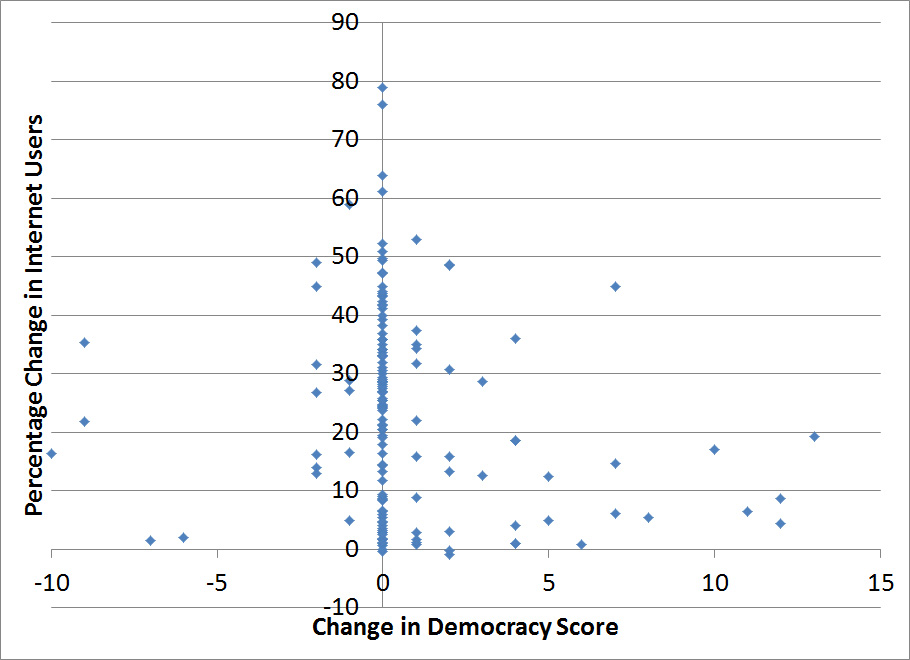
Internet_Democracy

Leon Wieseltier’s favorite curmudgeon/sock-puppet, Evgeny Morozov, demanded a graph showing that web interaction undermines autocracy. Philip N. Howard obliges (see above). The bottom line:

There are still no good examples of countries with rapidly growing internet populations and increasingly authoritarian governments.

A thought experiment for what it’s worth. The core truth about the Internet is that, unlike previous media, it truly rewards non-zero-sum interaction.

When I ran a dead-tree magazine, I was always aware of the competition, feared it, tried to beat it, saw its interests and ours (The New Republic back in the day) as opposed. With the Dish, every other website is a way to find new interesting material, direct more eyeballs toward it, and thereby encourage readers to use the Dish as a hub for other material. And that, in turn, helps us.

It’s even more salient now we’re independent and not even reliant on a parent media company’s home-page. Our major sources of new readers? Today: search engines, reddit, Twitter, Facebook and Google are our top five referrers. We need them the way they need us. Linking to other sites is essential to making your own part of the conversation. It’s a little thing – but it has definitely shifted my own psyche to more non-zero-sum interactions. Which is a fancy way of saying generosity and sense of our interconnectedness. I can see why the spread of that mindset – remember how many hours a day we now spending existing and communicating virtually – might help democratic civic culture.

The Last Blood Libel Trial

One hundred years later, David Mikics recounts the last recorded trial of blood libel in the West—Mendel Beilis, falsely accused of draining the blood of a young boy killed by gangsters, in Kiev:

In his trial, Beilis was defiant when he needed to be. He answered one of the judge’s opening questions, “To what religion do you belong?” with, he remembered [in his memoir], “something approaching a shout”: “I am a Jew.” As the trial went on, the prosecution’s case collapsed. The workers that Beilis supervised testified to his honesty; they knew he was incapable of murder. A 10-year-old boy, a friend of the dead [victim] Andrei, had been primed by the Tcheberiak gang to testify that Andrei had often played near the brick factory and had been chased off the factory grounds by Beilis. Instead, the boy stated that Andrei had never gone near the factory. The student who had distributed the anti-Semitic leaflets at Andrei’s funeral fainted when he took the stand. Then, in a moment of high drama, the lamplighter who had originally said that Beilis had chased Andrei from the brickyard recanted his testimony, proclaiming, “I am a Christian and fear God. Why should I ruin an innocent man?”

An Unscientific Ad

A male version of Dove’s latest ad campaign:

Virginia Postrel criticizes Dove’s “social experiment”:

Gil Zamora, the forensic artist, is indeed a well-respected professional who worked for many years doing composite sketches for the San Jose, California, Police Department. But, unlike his interview subjects, he knew the point of the exercise going in.

The “experiment” wasn’t double-blind. Zamora’s knowledge matters because a verbal description of any given feature allows a lot of interpretative leeway, and he could have unconsciously biased his drawings. “This is a social experiment,” he said in an interview, repeating the Dove mantra. “We were trying to show how women are their own worst beauty critics and how they see themselves and how others see them.” Right.

Exacerbating the potential for bias, Zamora deviated from his standard procedure, which includes giving the witness a chance to review the sketch and correct any misinterpretations. There are two possible sources of error in a composite sketch: the witness’s memory of what the person looked like and how that memory gets translated from impression to words to drawing. One witness’s “round face” is fat but oval, another’s is round and not especially fleshy, while another’s is what an artist would call square. Proportions mean different things to different people. And some people simply have limited vocabularies.