The Weak Recovery Continues

GDP Breakdown

Ryan Avent analyzes today’s GDP report, which came in under expectations:

Worringly, today’s figures reflect very little impact from the “sequester”—automatic spending cuts that only recently began to take effect and which may hack off a further 0.6 percentage points from GDP growth this year.

The main source of fiscal pain in the first three months of the year was instead a series of tax changes that took effect at the beginning of 2013 as part of the “fiscal cliff”. Marginal income tax rates rose on top earners at that time. Perhaps more important, a stimulative cut in the payroll tax was allowed to expire, delivering a direct blow to workers’ take-home pay. Despite this, personal consumption spending held up in the first quarter, growing at a 3.2% annual pace. That encouraging performance suggests that household deleveraging may have many families feeling more financially secure and ready to spend. That, in combination with continued contributions from residential construction, hints at the potential for healthy domestic demand growth, if only the government would relax the pace of deficit reduction.

Neil Irwin’s read on the situation:

The report should scratch any thought that our economy is heading into “escape velocity” and breaking into a higher, self-reinforcing trajectory of growth. That had appeared to be the case in the first couple of months of the year. But it just isn’t so. We’re muddling along at basically the same pace we’ve been at for nearly four straight years of this dismal recovery, with growth too slow to make up the lost economic ground from the 2008-2009 recession.

Bernstein looks at year-over-year real GDP:

[G]rowth by this measure is down a bit over the last six months, with the economy growing slightly below its trend growth rate of around 2%.  If this underlying pace of growth persists, it will be very difficult to generate the jobs needed to “legitimately” bring down unemployment rate (meaning through job growth, not through people leaving the labor force).

Dylan Matthews provides the above chart.
A Sequester – But Not For The Wealthy

Brian Beutler sighs:

The short version is that late last night it took a break from its regular schedule of lacking 60 votes to shampoo the chamber carpet and unanimously passed a bill that will provide the FAA unique flexibility under sequestration — and thus halt the furloughs that have been causing travel delays around the country. Today the House will follow suit, and the White House has made it clear President Obama intends to sign it. Great if you fly. Bad, bad news if you’re on head start or rely on meals on wheels or otherwise aren’t a Priority Pass holder.

Noam Scheiber gives Democrats a piece of his mind:

[I]f the political case for holding firm on the FAA furloughs was solid, the moral case was overwhelming. Consider where we stand with the sequester:

As my colleague Jonathan Cohn pointed out Thursday, the cuts have been hurting a lot of vulnerable Americans for several weeks now thanks to their effects on programs like Head Start, Meals on Wheels, and unemployment insurance. As of this week, the cuts were also nicking a lot of non-vulnerable Americans by forcing them to watch an extra loop of Headline News at Hartsfield International. At the risk of revealing my warped moral sensibilities, this strikes me as roughly in line with what you’d want in a set of budget cuts. If the political class insists on sacrifice, the sacrifice should, at the very least, be distributed among both poor and affluent. (Of course, it would be even better if they disproportionately affected the affluent, but let’s not get crazy.) This is just a basic principle of justice.

Ask Brill Anything: Flaws Of Obamacare?

Over at Stories I’d Like To See, Brill addressed the aspect of the ACA he discusses above:

[O]ne of the little-noticed provisions of Obamacare, which was passed three years ago this week, requires that non-profit hospitals, as a condition of keeping their tax exempt status, must adhere to rules to be promulgated by the IRS that would, among other things, not allow them to send bill collectors or lawyers after patients except under certain conditions.

Those conditions include that the patients first be informed through aggressive outreach efforts of the availability of financial aid for patients unable to afford the bills and, more important, that for patients whose incomes are below certain levels, hospitals can only dun them or sue them for the discounted amounts they usually charge insurance companies, rather than the far higher chargemaster prices.

In theory, the IRS, which is a unit of the Obama Administration’s Treasury Department, could have promulgated those regulations at any time after March 23, 2010, the day Obamacare was signed into law. But the first draft of the rules was not issued until two and a half years later – last summer. And then the American Hospital Association’s lobbyists pushed back, calling the proposed rules “too prescriptive.” (To me, if anything, they seemed not prescriptive enough.) Since then, nothing has happened. No final rules have been published. That means that three years after the Obamacare signing ceremony in the White House there is still no protection from hospital lawyers and bill collectors for the patients least able to pay.

Yesterday, Brill talked about how the US healthcare system compares to the rest of the developed world. Before that, he discussed hospital profits and why our medical costs are so exorbitant. You can also go herehere and here to read the Dish’s coverage of his must-read Time cover-story, “Bitter Pill: Why Medical Bills Are Killing Us”. Ask Anything archive here.

Israel’s Accelerating Descent

Another sign of an increasingly apartheid state:

The Knesset has approved a further extension of the “temporary” order known as the ‘Citizenship Law’ (83 votes for, 17 votes against). This temporary provision prevents Palestinian spouses of Israeli citizens from attaining citizenship.

This “temporary” law is now more than a decade old. And, as you can see, the Knesset doesn’t seem likely to repeal it any time soon. I know what it’s like to be legally married to an American and yet denied citizenship because of my HIV status (a situation now mercifully over). It’s an attack on the family, a way to prevent Israeli-Palestinian understanding, and an effective second-class status for Arab spouses of Israeli citizens. It surely risks radicalizing Arab spouses, rather than helping to integrate them.

This kind of racial discrimination is also seeping into US law. Israel wants to join the 37 countries that allow travel to the US without a visa. But AIPAC wants this free visa exchange to be different than any other country’s. They want to retain an ability to discriminate against Arab-American or Muslim American citizens. Even the most loyal toadies for the Israel Lobby see this as a step too far:

“It’s stunning that you would give a green light to another country to violate the civil liberties of Americans traveling abroad,” said a staffer for one leading pro-Israel lawmaker in the U.S. House of Representatives.

Notice the anonymity of the quote. Not that they’re scared of AIPAC, of course. To say that would be “anti-Semitic.” And note the bipartisan nature of this AIPAC campaign.

It’s led by Barbara Boxer, a California liberal who would never countenance racial discrimination against US citizens – unless she’s asked to by Israel. Boxer’s bill, moreover, is backed by the American Jewish Committee as well as AIPAC. Brad Sherman, another Democrat pushing for this bill, actually says Israel is better than the US in terms of discrimination:

“There are thousands of people with Arab American backgrounds who visit Israel each year and they face far less hassle than Israeli Christians, Jews or Muslims trying to visit the United States.”

More on this from Greenwald here and Richard Silverstein here. Meanwhile, those who still believe that Israel wants a two-state solution at some point have to grapple with the latest polling of Israeli Jews in that country:

The survey, conducted by the Geocartography Institute on behalf of the Israeli university in the West Bank, found that 35 percent of respondents said the government should annex the entire West Bank, 24% said only the settlement blocs should be annexed, 20% answered that any annexation should only take place as part of an agreement with the Palestinians, and 12% said Israel doesn’t need to impose its sovereignty over any part of the West Bank. Nine percent had no answer.

Greater Israel is here to stay. The only question is whether the US will continue to support its expansion.

Are Guest Workers Unworkable? Ctd

Serwer looks at past, present, and future guest worker programs:

[U]nder the current program, guest workers’ tenuous legal status means they have little if any leverage over their employers, who can simply hire more, less-troublesome foreign workers and send the others home.

The bipartisan Senate Gang of Eight thinks they’ve solved that problem. Crafted with the input of business and labor, their plan introduces a new visa program for nonagricultural workers called the W visa, which, unlike the current H-2B visa, won’t tie the workers to a single employer and will allow them to eventually apply for citizenship. That’s supposed to prevent employers from taking advantage of workers: If workers don’t like one job, they could apply for another similar one. But W visa workers would have to find a job quickly—within two months—or risk losing their status.

The cap on W visas is relatively low:

While the W visa undoubtedly has more protections for foreign workers than the H-2B visa, it won’t be replacing it. Up to 66,000 H-2B workers will be allowed in every year. Returning guest workers will be exempt from the cap for at least five years. That means, at least at first, the H-2B program—under which Diaz and Uvalle say they were exploited for years by an abusive employer—will be far larger than the new program that gives workers more protections. While legislators expect the W visa will appeal to employers who want more skilled workers and don’t want to retrain new ones, there’s nothing in the bill itself that keeps employers from choosing the H-2B instead of the W visa.

Earlier Dish on guest-worker programs here.

Will ACA’s Exchanges Work?

A new study in Health Affairs has Aaron Carroll worrying about their ability to bring down costs:

This study looked at people in Massachusetts’ health exchange and asked them about the issues they face due to health care costs. They found that 38% of patients reported a “financial burden,” defined as having problems paying medical bills, having to set up a payment plan to pay medical bills, or having trouble paying for things like food, heat, or rent because of medical bills. They also found that 45% of people reported higher-than-expected out-of-pocket costs for health care. This isn’t great news. It means that a significant number of people are still finding health care costs to be a real problem. It gets worse, though. Families with more children had more problems. So did families who make less than 400% of the federal poverty line.

Christine Vestal fears a lack of competition:

Health economists predict that in states that already have robust competition among insurance companies—states such as Colorado, Minnesota and Oregon—the exchanges are likely to stimulate more. But according to Linda Blumberg of the Urban Institute, “There are still going to be states with virtual monopolies.” Currently Alabama, Hawaii, Michigan, Delaware, Alaska, North Dakota, South Carolina, Rhode Island, Wyoming and Nebraska all are dominated by a single insurance company. The advent of the exchanges is unlikely to change that, according to Blumberg. …

[I]t is unclear how many insurance carriers will decide to seek approval for selling their products through these online marketplaces. Insurance companies have been mostly silent about their plans, with some citing uncertainty about federal and state rules as a reason for holding back.

Kerry, Keystone, And The Climate

Ben Geman reports on John Kerry’s reluctance to get involved in the battle over the Keystone XL pipeline:

“I am staying as far away from that as I can now so that when the appropriate time comes to me, I am not getting information from any place I shouldn’t be, and I am not getting engaged in the debate at a time that I shouldn’t be,” Kerry told the House Foreign Affairs Committee … Kerry noted the decision would ultimately come to him, but that until then the various steps of the review process aren’t complete. “It is not ripe,” he said. Kerry spoke in response to a question from Rep. Matt Salmon (R-Ariz.) about State’s years-long review of the Keystone project, which would bring oil from Alberta’s oil sands over the border and down to Gulf Coast refineries. …

Salmon and other advocates of the project were buoyed by the draft State Department review, which found that approving it would not have much effect on the rate of expansion of oil sands development, dealing a blow to critics.

Joe Romm worries about the State Department report’s blind spots:

Right now, Kerry has the State Department’s Draft Supplemental Environmental Impact Statement, but if that is all he information he relies on, he won’t get the full picture. While he will see that the project will only bring 35 permanent jobs, which is true, he would also see almost no discussion of the pipeline’s impact on the climate. (Oddly, he will be able to read an extended discussion of climate change’s projected impacts on the construction and maintenance of the proposed pipeline.)

Romm says Kerry should read the new report out from Oil Change International, which argues that the idea the the tar sands will be developed without Keystone is “simply incorrect”:

The Keystone XL tar sands pipeline is a project that will carry and emit at least 181 million metric tons of carbon dioxide equivalent (CO2e) each year. This is a conservative figure, based on industry analysis of the carbon emissions associated with current tar sands production. … [This] is equivalent to the tailpipe emissions from more than 37.7 million cars. This is more cars than are currently registered on the entire West Coast (California, Washington, and Oregon), plus Florida, Michigan, and New York – combined.

Between 2015 and 2050, the pipeline alone would result in emissions of 6.34 billion metric tons of CO2e. This is greater than the 2011 total annual carbon dioxide emissions of the United States.

David Biello summarizes the EPA’s comments [pdf] on the study:

[State Department A]nalysts assumed the tar sands oil would find a way out with or without the new pipeline. The U.S. Environmental Protection Agency does not agree. Keystone XL’s ability to carry an additional 830,000 barrels of tar sands oil per day is vital to expanded production of the tarry crude in Alberta. The EPA contends that the analysis by State got the economics all wrong. In particular the consultants were too optimistic about the ease with which the oil could be moved by railroad—an alternative already in use. But such tar sands oil transportation alternatives can more than triple the cost of moving crude. State’s report also neglected to consider the potential for congestion on the railroads with an uptick in oil transport, EPA contends. Of course, from a greenhouse gas perspective, transport by pipeline results in fewer emissions than transport by rail, truck or barge.

From West, Texas To Bangladesh

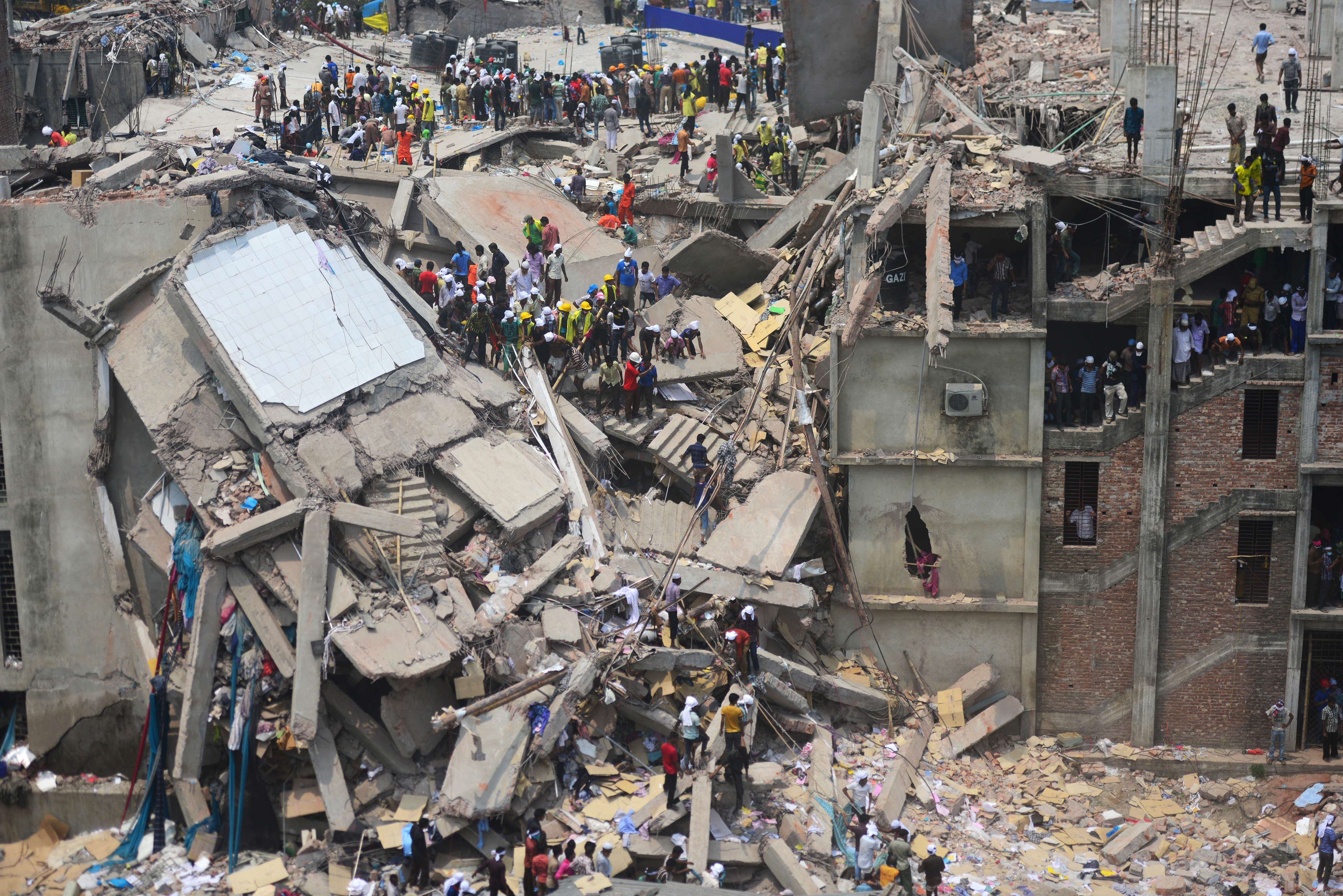
BANGLADESH-BUILDING-DISASTER-TEXTILE

Erik Loomis argues that the reason we don’t see more tragedies like West, Texas is because the US has outsourced industries to places like Bangladesh, where a decrepit, eight-story clothing factory collapsed this week, killing at least 218 people. Loomis wants our labor laws to apply abroad:

In my mind, this is the only way to fight the outsourcing epidemic that provides a cover for irresponsible corporate policies. The injured workers and the families of the dead deserve financial compensation. The American corporations who buy the clothes produced by this factory should be required to pay American rates of workers compensation. Ultimately, we need international standards for factory safety, guaranteed through an international agency that includes vigorous inspections and real financial punishments.

Yglesias pushes back, arguing that “it’s entirely appropriate for Bangladesh to have different—and, indeed, lower—workplace safety standards than the United States”:

Bangladesh is a lot poorer than the United States, and there are very good reasons for Bangladeshi people to make different choices in this regard than Americans. That’s true whether you’re talking about an individual calculus or a collective calculus. Safety rules that are appropriate for the United States would be unnecessarily immiserating in much poorer Bangladesh. Rules that are appropriate in Bangladesh would be far too flimsy for the richer and more risk-averse United States. Split the difference and you’ll get rules that are appropriate for nobody. The current system of letting different countries have different rules is working fine. American jobs have gotten much safer over the past 20 years, and Bangladesh has gotten a lot richer.

Kimberly Ann Elliott sees the situation differently:

[C]ore standards like freedom of association, nondiscrimination, child labor, or forced labor are both fundamental rights, and they’re also framework rights in terms of having a well-functioning rule of law system in place for your economy. Those rights they can vary in the details but, and this is what the 1998 ILO declaration said, all countries, regardless of level of development, should respect these core rights.

Then you have all these other standards like health and safety, like wages, that will necessarily differ by a country’s level of development and, as Matt Yglesias says, by their choices. I wouldn’t go so far as Yglesias to say that therefore it’s only up to them. In a lot of these cases the workers aren’t making a fully informed choice to take these risks. They don’t know the chemicals are toxic. They don’t know that the building’s unsafe.

(Photo: Bangladeshi volunteers and rescue workers assist in rescue operations after an eight-storey building collapsed in Savar, on the outskirts of Dhaka, on April 25, 2013. Survivors cried out to rescuers April 25 from the rubble of a block of garment factories in Bangladesh that collapsed killing 175 people, sparking criticism of their Western clients. By Munir uz Zaman/AFP/Getty Images)

Can The Kochs Save Conservative Journalism?

With their latest round of newspaper acquisitions, Yglesias thinks it’s possible:

[T]he big problem with right-leaning media in America isn’t that it doesn’t exist. It’s that it’s terrible. There is a large audience out there that’s so frustrated with the vile MSM that it’s happy to lap up cheaply produced content from Rush Limbaugh and Sean Hannity, and you can make lots of money serving that kind of thing up. By contrast, to build a great media company that’s top-to-bottom staffed with conservatives is going to be very expensive.

Expressing skepticism about the possibility of a “pro-business conservative media chain”, Garance Franke-Ruta explains a big reason why newspapers frequently lean liberal:

The main reason is that all major U.S. newspapers are based in cities. Cities in America are in the main run by Democrats, because they are populated, by and large, with Democrats, and very often also surrounded by Democratic suburbs. And because cities are run by Democrats, and populated by not only by Democrats but, very often, by liberal, minority, and immigrant Democrats, they tend to have laws on the books that at least formally signal a desire to serve the interests of these voting groups — their residents, let’s call them. …

American newspapers originated as physical objects designed to be distributed in defined, geographically constrained regions. They originated as urban creations because only in urban areas was there enough commerce, enough politics — enough news — for them to grow, and enough readers to make them strong. There are newspapers based in rural areas, but it is hard for them to grow large, both because of the lack of regional news, and because of the difficulty of getting the physical object of the paper to enough people to scale it.

Blogging Mexico’s Drug War

Closeup on one of the corpses of two mur

Bernardo Loyola describes the book Dying for the Truth, based on Blog del Narco:

According to the book, in 2012, their website—whose aim is to collect uncensored articles and images about the Mexican cartel’s extreme violence, their activities, and the government’s fight against them—registered an average of 25 million visits a month. According to Alexa, it is one of the most visited sites in Mexico. Although criticized by some media outlets for publishing gory images and information that’s given to them by cartels (such as executions and video messages aimed at rival organizations), the blog has become an essential source of news for journalists, citizens, and visitors.

Loyola interviewed the site’s female editor, anonymously, about where traditional media in Mexico have failed the public:

People began to wake up, to realize there’s a shoot-out going on two blocks away from their home and they’re seeing nothing about it in the news or in the papers. Citizens realize drug traffickers have set up a road block on the main avenue in broad daylight and no one is covering that. People got angry with the traditional media and started using the blog as a means to express what’s going on. That’s what it was created for, so that people could use it to their advantage, to protect themselves. If no one will take care of us, we’ll take care of ourselves.

From an excerpt of the book on the threats the site’s editor and programmer have endured:

Shortly before we completed this book, two people – a young man and woman who worked with us – were disemboweled and hung off a bridge in Tamaulipas, a state in the north of Mexico. Large handwritten signs, known as narcobanners, next to their bodies mentioned our blog, and stated that this was what happened to internet snitches. The message concluded with a warning that we were next. A few days later, they executed another journalist in Tamaulipas who regularly sent us information. The assassins left keyboards, a mouse, and other computer parts strewn across her body, as well as a sign that mentioned our blog again.

However, we refuse to be intimidated. Until writing this, we have never confirmed that we knew these people, so as not to let the narcoterrorists think we are scared or influenced in any way by their threats. We would never give criminals that satisfaction. Yet the attacks continue. In the last four days, they’ve sent us photos of nine people, dead, with messages on their skin that read: “You’re next, BDN.”

(Photo: Closeup on one of the corpses of two murdered men found near the Costera Avenue in Acapulco, Mexico, on February 5, 2011. By Pedro Pardo/AFP/Getty Images)