Should We Sell Citizenship?

Gary Becker thinks so:

Elsewhere (see my monograph, “The Challenge of Immigration: A Radical Solution”, 2011) I use as an illustration a price of $50,000. I show that such a price would attract young, skilled, and ambitious men and women since they would gain the most from coming here. Many illegal residents would be willing to pay that price too in order to legalize their status since there are huge economic and other advantages of becoming a legal resident. A loan program analogous to the student loan program would lend money to poorer but ambitious immigrants, so that they are not kept out by the cost of entry.

Richard Posner seconds him:

Depending on the price, the option will more or less automatically open a quick path to citizenship for precisely those foreigners whose skills, matching U.S. business needs, will give them reasonable assurance of earning enough money in this country to make the exercise of the option cost-justified to them—and to us as beneficiaries of the labor of high-skilled workers.

Of course “selling” U.S. citizenship, like selling kidneys and other organs, is just the kind of sensible economic proposal that shocks people who lack an understanding of economics—and that’s almost everybody.

The Decline Of Workplace Accidents

Barro hopes that the West, Texas tragedy won’t overshadow the improvements the US has made in workplace safety. He points out that “4,700 Americans died in workplace-related incidents in 2010,” which is “down from 6,200 in 1992, even though the number of employed Americans rose from 109 million to 130 million over that period”:

As Matt Yglesias notes, this isn’t an artifact of sectoral shifts away from manufacturing toward services. Manufacturing work is safer than average, and its on-the-job death rate has fallen almost by half since 1994. Construction, a relatively dangerous sector, has also gotten much safer. Sectors where safety hasn’t improved include agriculture, forestry, fishing and hunting (which includes some of the most dangerous jobs in the U.S., logging and fishing), and transportation and warehousing.

The bulk of deaths are not due to “industrial accident” events of the type seen in West. In 2010, 40 percent of on-the-job deaths were due to transportation accidents, and an additional 18 percent were due to violence. America’s main workplace safety problems aren’t directly related to the workplace at all: They’re subsets of our general problems with road safety and violent crime.

The World Of Jennifer Rubin

rubin

[Re-posted from earlier today]

Come join me, for a while, in an alternative universe. In this universe, Obama is clearly a worse president than George W. Bush. Now how do we get there? Here’s a start:

Many of [Bush’s] supposed failures are mild compared to the current president (e.g. spending, debt).

But by far the biggest factor in today’s debt are the unfunded wars Bush launched and lost, the massive tax cuts which took us from surplus to deficit, a spending spree on Medicare, and a collapse of the economy which occurred on Bush’s watch after eight years of negligent regulation of Wall Street. This sentence is therefore almost perversely deceptive.

Unlike Obama’s tenure, there was no successful attack on the homeland after 9/11.

Does 9/11 not count? The biggest national security failure since Pearl Harbor – resulting in more than 3,000 deaths? After the president was explicitly warned about its likelihood a month before it happened? Can you imagine what Rubin would be saying if a Democrat had presided over that?

People do remember the big stuff — rallying the country after the Twin Towers attack, 7 1/2 years of job growth and prosperity, millions of people saved from AIDS in Africa, a good faith try for immigration reform, education reform and a clear moral compass.

Credit where it’s due: Bush’s speech to Congress after 9/11 was extraordinary. The original reaction? Not so much. He didn’t return to Washington in that crisis. He panicked. And Cheney went bonkers. Yes, his record on AIDS in Africa remains a great legacy. But the economic growth under Bush was relatively anemic, despite the huge increase in demand caused by the tax cuts. He failed on immigration reform and on social security reform. His education reform has not survived. And the first American president to authorize and defend torture is not a man I would regard as in possession of a “clear moral compass.” Then this:

To the left’s horror, it turns out that most of his anti-terror fighting techniques (e.g. the Patriot Act, enhanced military commissions, Guantanamo) were effective and remain in place. Even the dreaded enhanced interrogation, according to two CIA agents and the former attorney general, contributed to our locating and assassinating Osama bin Laden.

Seriously?

As Emily Bazelon noted, the rigged military commissions have managed to prosecute 7 terror suspects successfully. The civilian courts – which Bush disdained – have convicted almost 500 in comparison. 84 prisoners at Gitmo are on hunger strike; and it has become a rallying cry for Jihad across the globe. Prisoners there were subjected to brutal torture, their meetings with lawyers are bugged and secretly recorded, and the reputation of the United States as a civilized country has been for ever tainted. Maybe soft power doesn’t exist in the mind of Rubin. But Bush did more to destroy America’s soft and hard power by trashing one and over-using the other – and failing to achieve anything of value in return.

Then torture. Note the lack of any discussion about its morality. Note the absence of any mention of the Constitution Project’s report that definitively found that Rubin’s term “enhanced interrogation” meant without question torture. Note the refusal to acknowledge that those with the most information, the Senate Intelligence Committee, have emphatically denied that torture helped get bin Laden. Note also no mention of the fact that Bush had eight years to find and capture or kill bin Laden and failed. Obama found and killed him in three years. We get two CIA agents and an attorney general arguing that their own torture worked. And they have no vested interest in believing or saying that, do they?

As for the surge? It failed dismally on its own terms, but succeeded in getting us out of there. Its own terms were a solid non-sectarian representative government in place to leave behind. Instead, we have a return to brutal sectarianism – only this time with the Shiites in charge. 33 Sunnis were murdered today by government forces – and elections in Anbar and Nineveh, Sunni areas, did not take place.

The country Bush broke is still broken. And the cost in terms of human life and tax-payers’ dollars still looms over us all. And yet some like Rubin still do not see the failure staring at them in the face. Because they cannot. Late-era neoconservatives can never admit error. They do not have the intellect for it.

(Above screenshot from Rubin’s “Ask Anything” series – all five videos are here.)

Could The West Explosion Have Been Prevented?

Fertilizer Plant Explosion In West, Texas

In the wake of last week’s tragedy, the regulatory framework that governs fertilizer plants is getting increased attention. Terrence Henry describes the outcome of a 2006 investigation of the West facility by the Texas Commission on Environmental Quality (TCEQ):

The Commission doesn’t generally pay a visit to facilities like the one in West unless someone complains. “Historically, fertilizer plants have not been given the level of attention of scrutiny that other industrial or petrochemical facilities have received,” Craft says. The plant was also regulated by other state and federal agencies, a gallimaufry of acronyms like PHMSAOSHA, DSHS, and others, but there appears to have been little communication and coordination among them. …

In its report to the EPA in 2011, West Fertilizer said its worst-case scenario was a release of one of its storage tanks of anhydrous ammonia “as a gas over 10 minutes.” It said nothing of fire risk. It also said nothing of ammonium nitrate at the site. But according to records from the Texas Department of State Health Services obtained by StateImpact Texas, the plant had as much as 270 tons of ammonium nitrate at the site in 2012. To put that in perspective, the bombing of a federal building in Oklahoma City on April 19, 1995, which killed 168 and injured hundreds, used 4,800 pounds of ammonium nitrate mixed with other chemicals and diesel fuel, or about 2.4 tons.

Bill Buzenberg places some of the blame on the Chemical Safety Board:

Each year there are some 200 serious industrial accidents like the fertilizer plant explosion that are deemed to be of “high consequence.” Yet the Chemical Safety Board — modeled after the National Transportation Safety Board — is able to investigate only a handful, and then often takes years more to issue a report.

Tim Murphy worries that a House bill proposed in February will take away one potential avenue for regulation:

[The fertilizer industry] introduced a bill to formally prohibit the EPA from using the Clean Air Act to regulate security and safety at chemical production and storage sites, by mandating that any such inspections be carried out by the Department of Homeland Security instead. Their bill also left it up to manufacturers to determine whether or not to make improvements to the safety of their workplace. … “Dividing safety and security has been a game that the chemical industry has tried to play for many years,” [chemical safety consultant Paul] Orum says. “That’s the point of the Pompeo bill—divide safety from security. But they’re not separable.”

(Photo: Search-and-rescue workers comb through what remains of a 50-unit apartment building the day after an explosion at the West Fertilizer Company destroyed the building on April 18, 2013 in West, Texas. According to West Mayor Tommy Muska, around 14 people, including 10 first responders, were killed and more than 150 people were injured when the fertilizer company caught fire and exploded, leaving damaged buildings for blocks in every direction. By Chip Somodevilla/Getty Images)

The New Open Internet Fight

The Cyber Intelligence Sharing and Protection Act (CISPA), aimed at investigating cyber-threats, just passed in the House. Digital-rights activist Mark Jaycox outlines the precise effects of the bill in its current form:

Companies have new rights to monitor user actions and share data – including potentially sensitive user data – with the government without a warrant. Cispa overrides existing privacy law, and grants broad immunities to participating companies.

Andrea Peterson explains the rationale of the bill’s proponents:

[U]nderneath the problems of scope and privacy, the goal of CISPA is to create a functional structure for coordinating information about cybersecurity vulnerabilities and threats so intelligence can be shared. This would allow the government to share information about the tactics of adversaries with victims, or send up a warning flare about an emerging threat. Consider the report released earlier this year by cybersecurity firm Mandiant about a group of hackers engaging in corporate espionage likely affiliated with the Chinese military: It came along with a cache of threat intelligence indicators that could help identify other attacks by the group in the future, such as domain names, IP addresses, encryption certificates, detailed descriptions of over 40 families of malware they use.

The Electronic Frontier Foundation (EFF) is marshalling opposition:

The Fourth Amendment limits the government’s ability to use CISPA powers, but there would still be constitutionally dangerous implications: the government would also be granted broad legal immunity for any “decisions based on” cyber threat information, and CISPA’s “notwithstanding” clause could override government privacy laws like the Privacy Act (which protects personal information in government records) and the Computer Matching and Privacy Protection Act (which limits the use of automated matching of government records).

As it stands, CISPA is dangerously vague, and should not allow for any expansion of government powers through a series of poorly worded definitions.  If the drafters intend to give new powers to the government’s already extensive capacity to examine your private information, they should propose clear and specific language so we can have a real debate.

Paul Tassi explains why the Internet hasn’t protested the CISPA the same way it did SOPA:

Pitched as a cybersecurity bill and not an anti-piracy measure, most will think it doesn’t affect them the way SOPA could have. Additionally, there’s probably some level of fatigue from the first protest, as there are probably always going to be bills like these floating around, and major websites can’t really black themselves out multiple times a year in protest.

Dana Liebelson adds that big corporations won’t be coming to the rescue either:

The Obama administration last week declared that it “remains concerned that the bill does not require private entities to take reasonable steps to remove irrelevant personal information when sending cybersecurity data to the government or other private sector entities.” But privacy concerns may not be enough to stop the bill. CISPA supporters spent 140 times more money on lobbying for the bill [than] its opponents, according to the Sunlight Foundation. Big-name companies that openly support CISPA include AT&T, Intel, IBM, Time Warner Cable, and Verizon, and other tech giants are  quietly on board, including Google and Facebook[.]

An Award For The Dish!

It’s the Sidney Hillman Award for opinion and analysis for yours truly and the Dish as a whole. The awards are given “to journalists whose work highlights important social and economic issues and helps bring about change for the better.” I’m truly honored. The award usually goes to progressives and liberals, so I am a particularly grateful outlier. The citation:

Sullivan’s leadership in the fight for marriage equality is the principal reason he has earned a Hillman Prize. But this is not a single-issue award. Though there are many areas of disagreement between Sullivan and the Hillman judges, we commend, among numerous other things, his fierce condemnations of torture and the impunity granted to its perpetrators, his critique of the cruelties of the failed drug war and the policy of marijuana prohibition, his opposition to all forms cartoon-patrick-chrisof intolerant religious fundamentalism (including the American variety he correctly calls Christianism), and his campaign for reform and accountability in the hierarchy of his own beloved Catholic Church.

We commend him, too, for the creation and nurturing of a sturdy and consistently innovative journalistic institution—one that has recently embarked on a brave experiment: seeking to sustain itself purely on subscriptions from its devoted readers, without advertising or corporate backing. For those readers, The Dish is a source of almost addictive pleasure as well as a forum for stimulating discussion and a uniquely energetic and intelligent collator of news and opinion.

For courage and constancy in the struggle for marriage equality, for the defense and advocacy of humane values, and for imagination and creativity at the digital cutting edge, we honor Andrew Sullivan and The Dish with the Hillman Prize for Opinion & Analysis Journalism.

So I share this award with everyone else at the Dish (especially Patrick and Chris, my indispensable colleagues for the past few years) and with you, who have made this experiment in self-sustaining new media viable. Thanks.

And if you really want to help us celebrate, [tinypass_offer text=”subscribe!”]

A Truther For Every Tragedy

Spencer Ackerman notices the instant emergence of claims of the Tsarnaevs’ innocence and a cover-up in Boston:

The #freejahar hashtag on Twitter is about what you’d expect after the most highly publicized manhunt in the country. It’s a mix of conspiracy theories, sympathy for Tsarnaev and skepticism of the official narrative surrounding the 19-year old’s arrest. Much of it is consumed with an effort to crowdsource Tsarnaev’s exoneration, pointing to photos from the scene and speculating about them — similar to what took place on 4Chan and Reddit to hunt the bombing perpetrators.

“He’s fucking innocent. If he were “guilty”, it wouldn’t take this long to fucking prove it, and there would actually be evidence,” says one supporter, although the government has yet to charge the incapacitated, hospitalized Tsarnaev with a crime.

Meanwhile, in contrast, the anti-American extremists are laying low:

[Online extremism researcher Jarret] Brachman and others believe that the unclear motivations of the bomb suspects place a damper on the online jihadi forums’ ability to claim Boston as a success. That’s despite the mystique of the young Tsarnaev nearly escaping a huge Friday manhunt; and, if he is proven to be one of the culprits, the ability to construct bombs that killed three and wounded over 180. But the U.S. government has to be similarly cautious about how to combat any popular mythos, like the hashtags, developing around Tsarnaev.

“We are dealing with conspiratorially minded individuals who don’t believe anything the government says anyway,” says Thomas Hegghammer, a terrorism researcher at Stanford University. “The simplest and most effective strategy is probably to highlight the suffering caused by the bombs. Let them see the injured women and children. The most hardcore extremists won’t care, but some fence-sitters might.”

Dismembering Liberal Bullshit On Islam

Bill Maher backs me up. I’m not Islamophobic; I’m trying to tell the truth and understand what happened last week. A reader chimes in:

Here’s a quote from Tocqueville, in Democracy in America:

Muhammad brought down from heaven and put into the Koran not religious doctrines only, but political maxims, criminal and civil laws, and scientific theories. The Gospels, on the other hand, deal only with the general relations between man and God and between man and man. Beyond that, they teach nothing and do not oblige people to believe anything. That alone, among a thousand reasons, is enough to show that Islam will not be able to hold its power long in ages of enlightenment and democracy, while Christianity is destined to reign in such ages, as in all others.

This is a parallel point to the question of violence, or at least Tocqueville is not directly addressing the issue of violence, but it’s not hard to make the connection. Politics is a realm of coercion; the state has a monopoly on violence, as we’re taught in introductory political science courses. Jesus opts out of that whole system. He never sought political power. He never was a law-giver. He founded no political regime. He claimed no direct authority over any land or people. Indeed, he was sacrificed at the hands of the reigning political power.

Tocqueville’s point is that because Jesus was in this sense apolitical (along with not pronouncing on matters of science), Christianity has no intrinsic reason to be in conflict with modernity.

Because Jesus laid down no precise pattern for political order, it need not fear the coming of democracy. Because Jesus taught love, rather than scientific theories, nothing Jesus said contradicts what we know through the advance of science. Followers of Jesus, for Tocqueville, can adapt, can engage the age in which they live with a certain openness, rather than hunker down with rage and suspicion. He thought that this wasn’t the case for Islam, not because it was intrinsically violent (neither he nor you are arguing for that) but because the circumstances of Islam’s founding set in motion certain problems that were bound to be exacerbated by modernity.

It always is difficult, even foolish, to draw a straight line from the origins of a religious tradition to contemporary events. But it also is a mistake to pretend a religion’s point of departure matters not at all. For Christians, however hypocritically or poorly they follow Jesus, the witness of Jesus in the Gospels really is a rebuke to violence and political striving. It always is there as a corrective, and throughout Church history, however corrupt Christian institutions have become, Jesus’s life has inspired movements of renewal and repentance. That is worth noting, as you have. It’s not entirely clear such an unambiguous witness from Islam’s founder exists to perform the same function.

That’s putting it diplomatically.

Dissents Of The Day

Many readers are upset with this post:

Wow, Andrew. I’ve been with you since 2007, and I can’t recall reading a more blatantly ridiculous statement from you than this one: “And when will they grasp that a religion that does not entirely eschew violence (like the Gospels or Buddhism) will likely produce violence when its extremist loners seek meaning in a bewildering multicultural modern world?”

You know it’s bullshit too. Because otherwise you would’ve said “Christianity” instead of “the Gospels,” keeping it consistent with your blanket characterizations of Buddhism and Islam. But you knew you couldn’t, because of Christianity’s and the Old Testament’s indisputable record of violence, which refutes your narrative that doctrine was the primary cause.

And otherwise you wouldn’t have qualified it with that long modifier of producing violence “when its extremist loners seek meaning in a bewildering multicultural modern world.” How many contingencies do you have to stuff into the interpretation and practice of a religion before you realize those contingencies matter a hell of a lot more than the words in the document everyone’s reading into in whatever way suits their condition? What a logically, linguistically, and sociologically inept attempt to baldly enforce your double standards of religious causation upon your readers.

I do not write things I know are “bullshit.” They may be, but I write in good faith. Perhaps I should have put it this way: All religion, including Christianity, is susceptible to the violence associated with tribalism and fundamentalism. Christianity’s murderousness through the ages is a matter of historical fact, from the Crusades to the Inquisition and beyond.

What distinguishes Islam is that its founder practiced violence, whereas Jesus quite obviously favored the exact opposite – nonviolence to the point of accepting one’s own death. Unlike Christianity, but like Judaism, Islam also claims sacred land, and, along with extremist forms of Judaism, the divine right to repel intruders from it. Religion is dangerous enough. A religion founded by a violent figure, with territorial claims, and whose values are at direct odds with modernity is extra-dangerous. Which other major world religion believes that apostates should be killed? Or regards negative depictions of the Prophet as worthy of a death sentence? As I wrote more than a decade ago now:

The terrorists’ strain of Islam is clearly not shared by most Muslims and is deeply unrepresentative of Islam’s glorious, civilized and peaceful past. But it surely represents a part of Islam — a radical, fundamentalist part — that simply cannot be ignored or denied.

Another reader:

What is “Jihad”? It’s only a religious war in the minds of those who believe that it is. Do we need to broadcast this to people who may be susceptible? Can’t we fight this war without feeding the enemy’s propaganda machine? My worry is that using Jihad/religious war is going to do two things:

1. Help radicalize more people

2. Rev up the right wing into the frenzy we saw post 9-11, which makes us lose our heads and do dumb things, and also reinforcing point No. 1 – it’s a self fulfilling prophecy: “See, the West is after us. Fight the infidels, etc.”

I think this older brother absorbed these radical ideas through osmosis – speaking to a radicalized (but not a member of a radical group) person, all the messaging in the media/Internet, etc., visiting Russia and seeing/experiencing it. But there does not seem to be a direct link to a radical group, where he was directly trained, was meeting with a group, etc. Maybe we just haven’t learned that yet, but until then, we should not jump to conclusions. It seems to me, media outlets calling this a religious war/Jihad are only going to make these people more susceptible to this stuff and give them  greater justification for their feelings and actions.

If I were writing to maximize public safety, I would minimize the religious aspects of this terror attack. But I am writing in order to tell the truth as best I can. Another reader:

It’s terrifying to me that you can write sentences like: “Legally, the case for the presumption of innocence is absolutely right. But come on.”

“But come on” was the animating logic of the drumbeat for war in Iraq. It was the ideological territory of Cheney, Wolfowitz, and Co. It was why Guantánamo Bay and Abu Ghraib happened. “But come on” says, to me: “I know I can’t justify this with reason so I’m going to appeal to a general sense of hysteria.”

But that is precisely why we have these laws and safeguards in the first place. Mirandizing a suspect, presuming innocence and so on were not primarily intended for the low-key cases that take place in America every day. No, they were in large part designed specifically for moments such as this, to prevent a nation in the throes of a huge emotional overreaction (more on that in a moment) from stepping out of bounds. “But come on” represents precisely the arbitrary, emotional desire for overreach that our Constitution and legal system was specifically supposed to neutralize.

If I had simply said the words “come on” and not followed them with a superfluity of evidence, my reader might have a point. But I didn’t.

The View From Your Window Contest: Winner #150

Screen Shot 2013-04-20 at 12.22.41 AM

A reader writes:

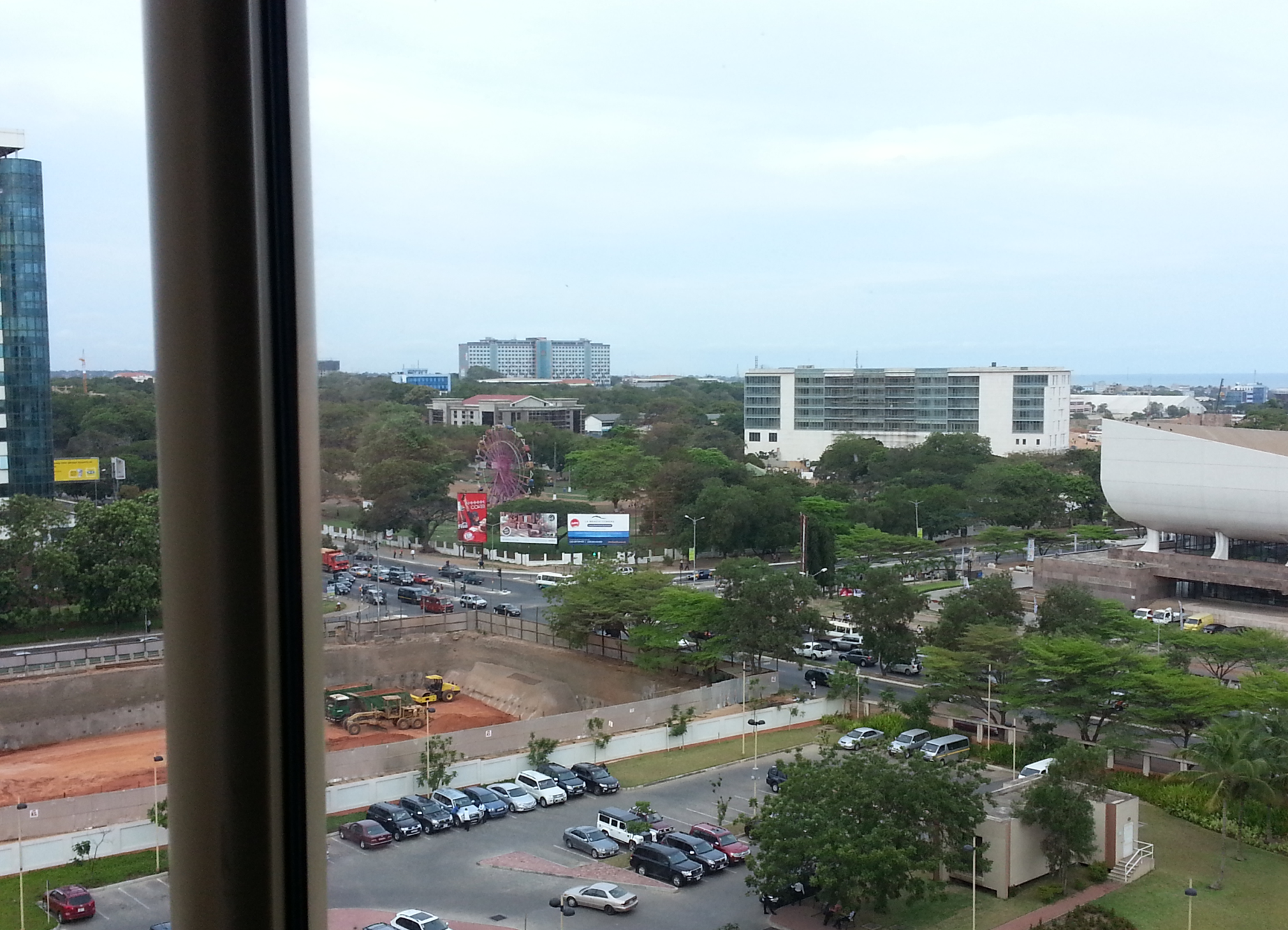
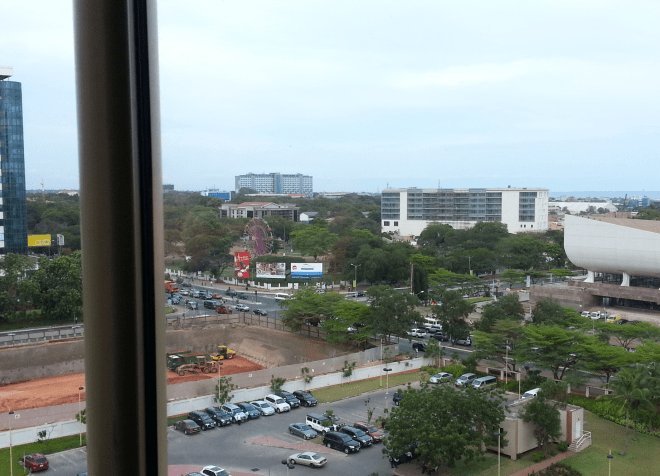
The presence of the large billboards, bordering this lovely park, Tivoli Gardens, was dismaying to see, when I visited Copenhagen some years ago.  They seem to have proliferated. The juxtaposition is unfortunate. The architectural feature of the building to the right is reminiscent of the ultra-modern museum which was completed less than 10 years ago. The presence of both classical and modern architecture, as can be seen in the photo, is also typical of Copenhagen. The Baltic is in the distance.

Another:

This looks like it was taken from the back of the Prince Hotel & Residence in Kuala Lumpur, Malaysia – quite possibly in one of the restaurants or conference rooms there.  The big clues are (a) the red soil that is so common in SE Asia – especially Malaysia and Thailand; (b) the Japanese SUVs  and (what may be) a few of their drivers hanging out around one of them and (c) the Ferris-wheel with the over the top lighting around it.  I’ve stayed at the Prince before and this looks a lot like it.

Another:

With ten minutes to spare, I’m going to guess Lima, Peru.  The clues I used to make my guess are: primarily Japanese cars, driving on right hand side of road, and coastal billboards appear to have Roman script. I used that to rule out most of Asia, and I thought about countries that have a strong tie to Japan but are not in Asia. I know that there is a strong cultural link between Japan and both Peru and Brazil as many Japanese emigrated to those countries in the 20th century.  I don’t know if a cultural link translates into whether the citizens will buy cars, but I don’t have a lot of time.

Another is on the right track:

Definitely sub Saharan Africa. Cars are driving on the right side of the road, so we can eliminate a lot of the Southeastern countries in Africa. There’s a lot of greenery, so I’ll go with what I imagine is the greenest country in Africa. I’m guessing this is Kinshasa in the Democratic Republic of the Congo. The architecture is so distinct that I know someone is going to get the right window, but here’s hoping I’m at least somewhat close.

Another:

I thought this would be an easy one – how many fancy new buildings could there be that look so much like a bath tub? More than one unfortunately, since a very fancy new museum that looks exactly like a bathtub was just built in Amsterdam, and pictures of it filled every Google image search I could think of. Damn you, Stedelijk! The pink ferris wheel was no more help. But the trees in the lower right look like I imagine sub-saharan Africa, so I’ll say Addis Ababa because a friend hails from there, and I’d like to think it’s as nice a place as the photo seems to depict.

Another:

I flailed around a great deal with this one. I couldn’t find any building that matched the weirdly-shaped one to the right, and I’m sure someone has been there before. I was going to settle on Luanda, Angola, based on the traffic (not much) and the climate. But then I remembered Luanda has been an answer in the past, so I decided to go to the other side of Africa. I can’t find a great match for anything, so I’m just going to shoot for Maputo, specifically the Cardoso Hotel. Hopefully I’m not the dreadest “first guesser” who is always the farthest away!

Another nails the right city:

This is my first time to get one of these!

I knew it had to be Africa, with the acacia trees lining the roads, the wall around the parking lot, and, for some reason, the vertical red billboard. I was going to guess Nairobi, Kenya, because of how green it is (and I love Nairobi), but then I noticed the ocean in the background. Accra, Ghana! It’s got to be! I remember the city shocking me with how modern and western it looked compared with Cotonou, Benin and Lomé, Togo, where I had just spent a summer completing an internship in ethnomusicology.

So, it was Accra – I went straight to Osu, which I remember being very built-up, then drifted west toward downtown. Behold, the National Theatre! The shape of that building stood out. The picture is taken from the Mövenpick Hotel, Victoria Borg, Accra, Ghana, looking roughly east-southeast at the intersection of Independence Avenue and Liberia Road. Maybe the 4th floor? The National Theatre is in the right midground of the picture and the Atlantic Ocean is in the background. Woo!

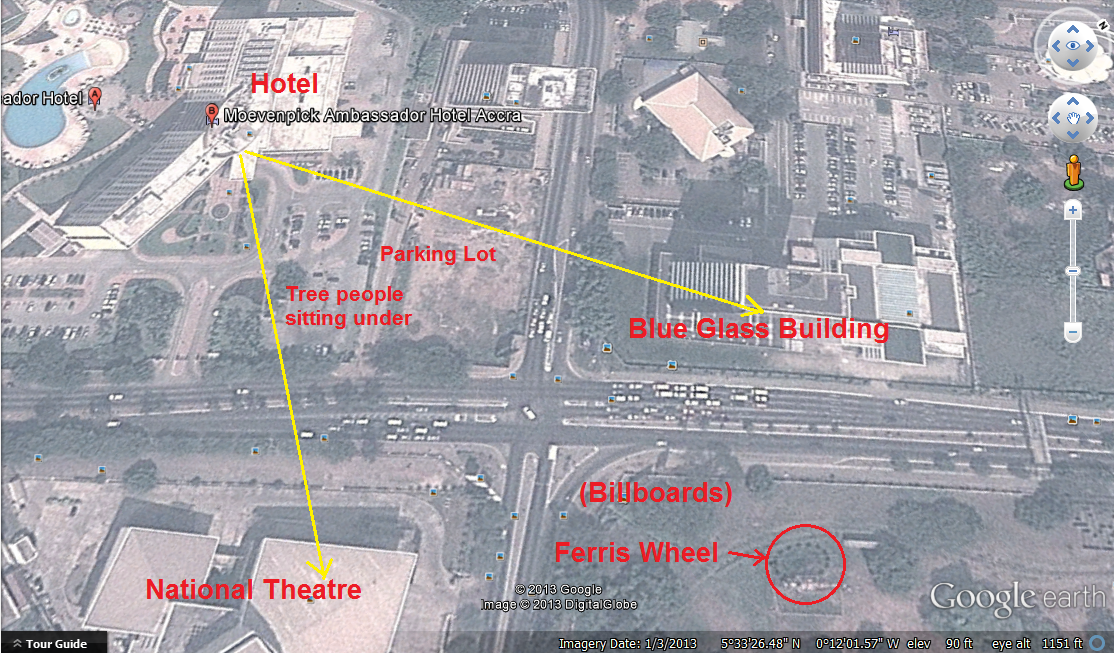
Another sends an aerial view:
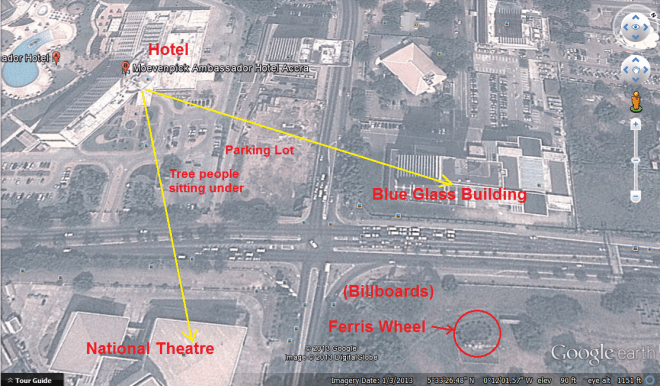
VFYW Accra

Another:

I feel like I am cheating here. This is downtown Accra, Ghana. I recognize it because I am originally from Ghana (presently a graduate student at the University of Virginia).

Another:

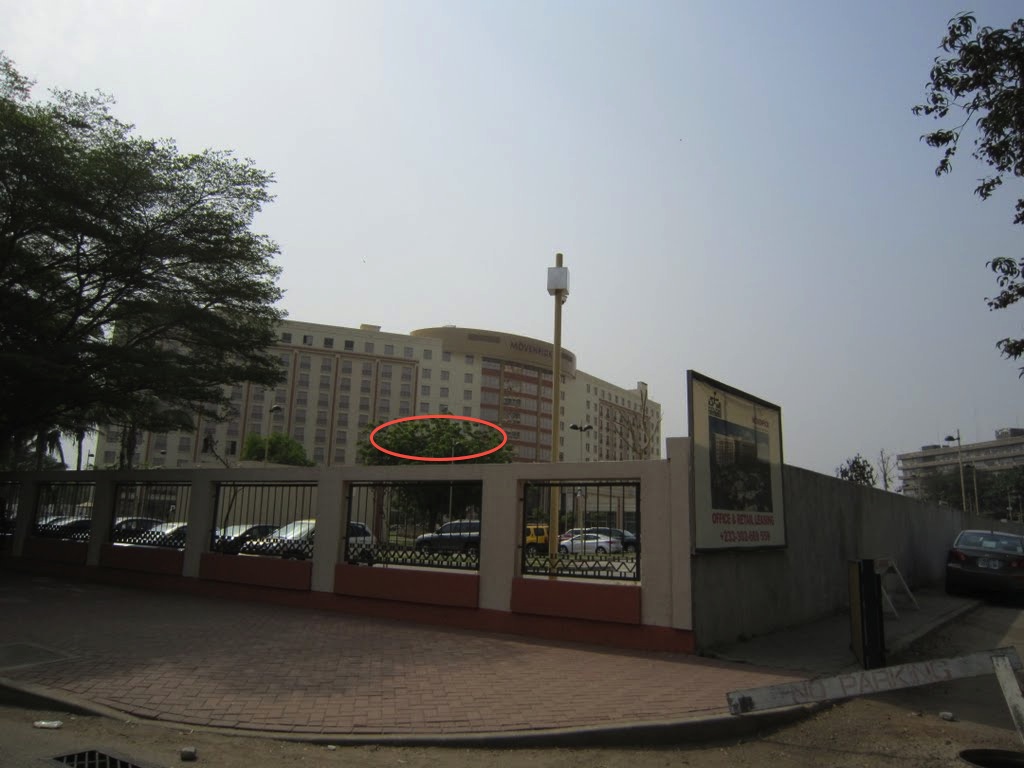
The Möevenpick Ambassador Hotel, Accra, Ghana near the corner of Liberia Rd. and Independence Ave. technically, postal address is PMB CT 343, Cantonments Ridge, Accra, Ghana. GPS: 5.554369,-0.202426. Bonus points for using the umlaut, please. Extra bonus points:  my photo of the National Theater, from 7 years ago, whilst visiting my beautiful daughter on her semester abroad from NYU:
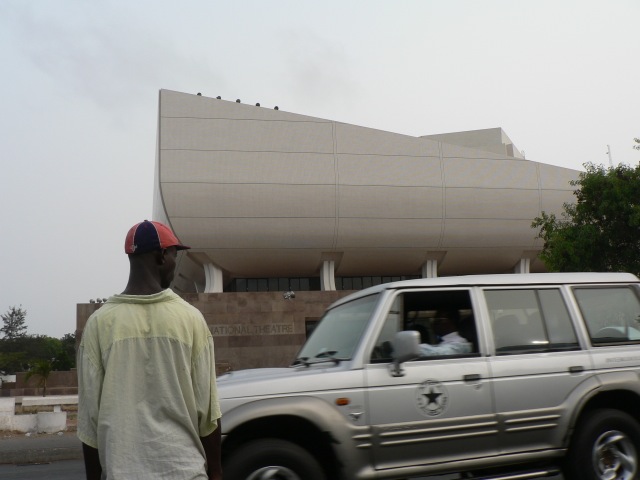
P1020241

Super-bonus points: I lived in Accra as a child, many many moons ago, well before the National Theater was built, as a “gift” from China.

Another:

What a fun feeling to immediately know the view when the picture flashes on the screen! The distinctive building on the right is the National Theatre in Accra (where my wife and I enjoyed a stunning performance by Ismael Lo about 15 years ago); across the way is the new (well, used) Ferris Wheel in the Efua Sutherland Children’s Park (where our daughter had her first ride on a pony even longer ago), and the road in front is Independence Avenue is where we watched armored cars roll in Ghana’s final coup more than 30 years ago.

Thank goodness Ghana is now growing extremely rapidly and is firmly stable (stable enough to have its own controversial supreme court case about the recent presidential election – arguments are being held right now, and everyone is confident that the dispute will be resolved peacefully). The picture is taken from a reasonably high, north-facing room in the gorgeous new Moevenpick Ambassador Hotel (somebody has a nice expense account!). I won’t bother guessing the specific room; I’m sure you’ll get a few who will do the calculation.

A closer look at the hotel:

Window - Moevenpick Hoteld

Another nails the right floor:

This week’s photo is from the either the 6th or 7th Floor of the Movenpick Ambassador Hotel in Agra, Ghana. If I had to guess it would be the 6th floor, Room 637. This photo is from an odd numbered room, likely one of the ambassador suites (since those are on the upper floors) looking out towards the intersection of Liberia Rd and Independence Avenue. The taller building on the left side of the photo is part of the World Trace Center Complex and the white building on the right side of the image is the National Theatre.

But the winner this week is the most detailed entry among the three readers who correctly guessed the 6th floor:

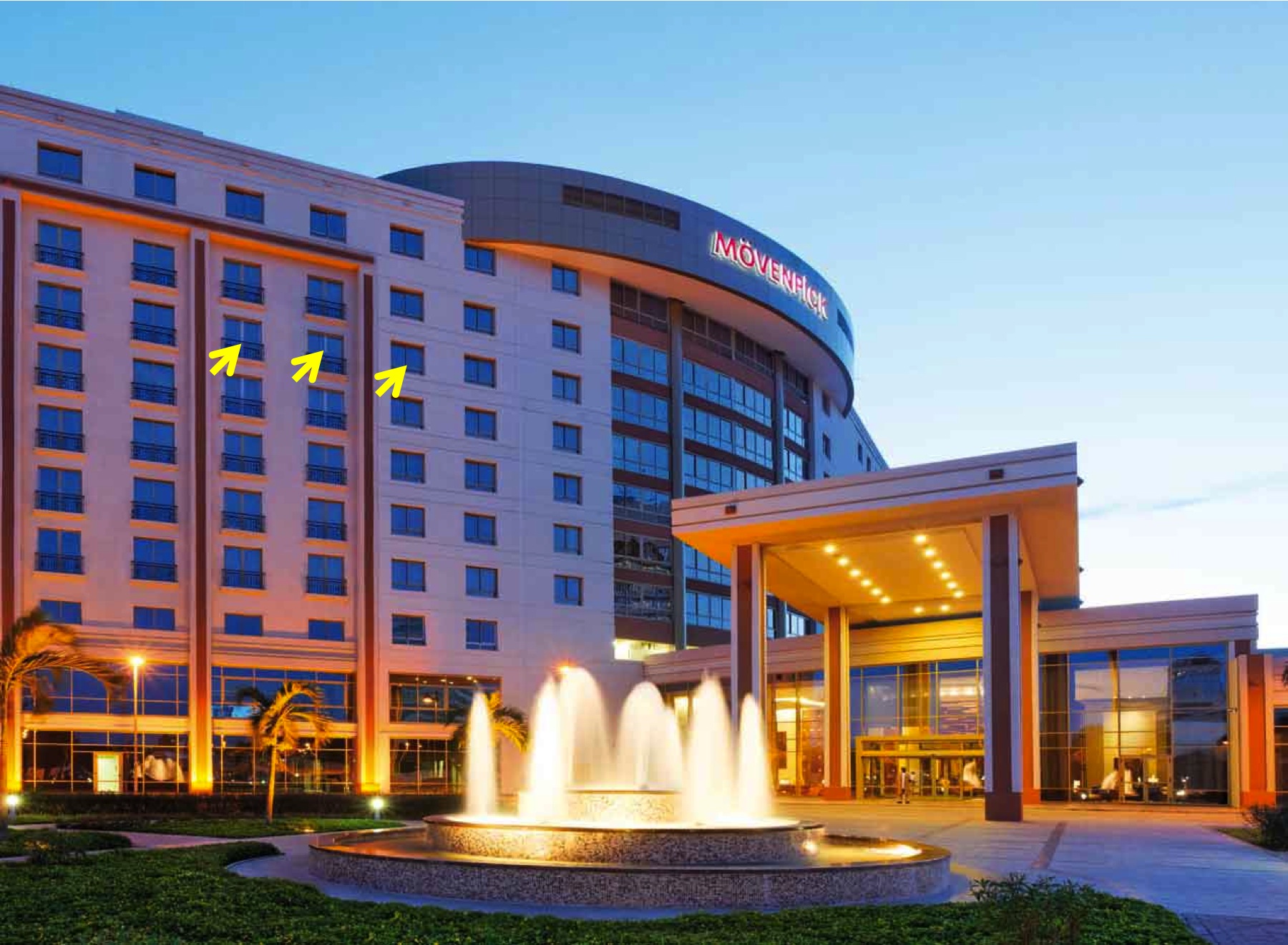
Bam.  This photo was taken from the Movenpick Ambassador Hotel in Accra, Ghana looking south of east. Based on dead eyeball reckoning it was taken from one of the three indicated windows on the 6th floor:
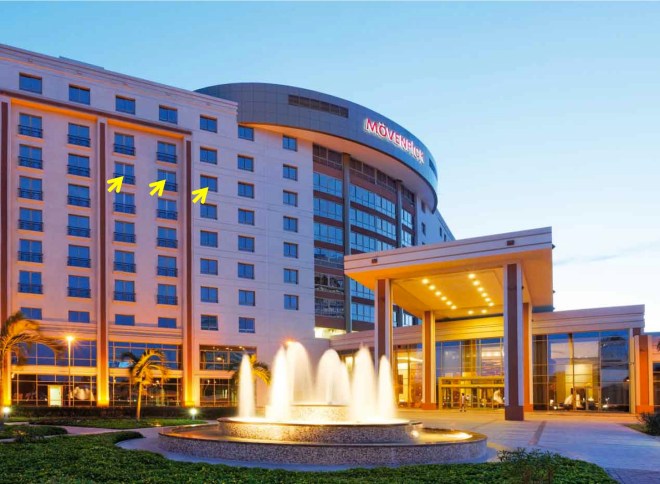
window-arrows

Undoubtedly, others making correct guesses will have recognized the oddly shaped building on the right to be the National Theater of Ghana, stayed at that very (swanky) hotel, or somehow read one of the unreadable advertisements next to the Coke billboard (I Googled ‘comb’ before figuring it out). My clue, however, was the dark green van with a yellow stripe in the road just below that Coke billboard.  It is probably a tro-tro, which are basically large taxis that serve as a bus system in Ghana. The tro-tros, especially how they were always packed and had religious slogans prominently displayed, were among the many things that fascinated me during my recent visit to Ghana:

Oh Grace, please let us reach our destination in one piece!

My brother interns for Global Brigades in Ghana coordinating groups of undergrads that come in to staff medical clinics.  Since he wasn’t going to make it home for either holiday for the first time in our lives, my aunt, a family friend, and I brought the family to him for Thanksgiving.  It was quite an experience seeing him in his element, and also because it was my first time in a developing country.  Thus, the country roads, and I mean country roads, were mortifying, but seeing an elephant take a relaxing dip (in poem form) made the trek worth it.

And to think, the other day I contemplated skipping over the VFYW contests for good.  I shall travel more so that won’t happen again.

From the submitter:

As a previous winner (contest #55 – Luanda, Angola) and a weekly follower of the VFYW contest, I would like to submit this view from my hotel room in Accra, Ghana. The photo was taken from the 6th floor, room 641 of the Movenpick Ambassador Hotel facing east.  This week in Ghana marks the beginning of the Supreme Court hearing in their version of the 2000 U.S. Presidential election dispute. Everywhere I went, the public was glued to their TVs as the case of the disputed Ghanaian presidential election of 2012 was being aired. Ghana is a model for other African countries in terms of respect for democracy and rule of law on one hand, and entrepreneurship and progress on the other hand.

(Archive)