Overachieving Gays

Screen shot 2013-04-23 at 12.13.32 PM

Tracy Clark-Flory examines the “Best Little Boy in the World” hypothesis:

This theory holds that closeted young men in bigoted environments often respond by overachieving in certain areas, like sports or academics — the idea being that it’s an adaptive means of finding a sense of self-worth where they can. It can also serve to distract from their sexuality: As Andrew Tobias wrote in his 1976 memoir, “The Best Little Boy in the World,” a key “line of defense” was his endless list of activities. “No one could expect me to be out dating … when I had a list of 17 urgent projects to complete,” he wrote.

Despite the prevalence of this idea in gay coming-of-age narratives, it’s never been tested empirically, until now.

In a study recently published in the journal Basic and Applied Social Psychology, researchers interviewed 195 male colleges students who identified as either heterosexual or a “sexual minority.” They found that the sexual minority men based their sense of self-worth on “academics,” “appearance” and “competition” more so than the straight guys. Interestingly, the amount of time the gay men had spent hiding their sexual identity positively predicted their investment in these areas. The researchers also developed a way to objectively measure the amount of stigma each participant faced in their particular environment by evaluating their home state’s general stance toward sexual minorities. That measure of stigma also positively “predicted the degree to which young sexual minority men sought self-worth through competition.”

For what it’s worth, I fit the model pretty perfectly – and my high school helped. Each class would be graded in every subject every month and then a list would be posted ranking everyone in the class. The first time this happened, after my first month at the school, I was stunned to find out that I was in the top position. Stunned and suddenly proud. Staying there became my over-arching goal for the rest of my high school life. I buried my way into books to prove my self-worth … and to distract attention from my sexual orientation. It worked: I was labeled a nerd rather than a fag – or, in the original English, a “swot” rather than a “poof.”

And those patterns have not truly changed – I’m just more aware of them. Why am I still trying to push the envelope in new media – and risking my own money – when I could have found a more comfortable perch writing somewhere? Why do I still need to prove something every day? Part is obviously an attempt to gain self-worth after homophobia had done its silent, brutal work on my seven-year-old soul. “Does God know everything about you – everything?” I once asked my mum, according to her (I don’t recall the exchange). She said: “Yes, of course. Everything.” I replied, “Then there’s no hope for me, mum.”

But it’s also a positive desire not to allow such prejudice affect you, to break through certain barriers, to push yourself to be a living impediment to homophobic prejudice. One extremely insightful book has been written about this: The Velvet Rage. I really recommend it. It shows how many gay men, propelled by these dynamics for years, sometimes find themselves in middle age at the top of their field and yet deeply depressed or overworked. They realize that rage – even constructive, efficient, effective rage – is no substitute for love.

My fundamental hope in helping to make marriage equality a possibility is that young gay boys and girls, as I once was, can now see a future filled with love rather than rage, intimacy rather than “achievement”.

Ask Brill Anything: “$77 For A Box Of Gauze Pads”

In his first video, Steve explains why US healthcare is so expensive, including a follow-up on what he found most surprising in the course of researching his excellent Time cover-story, “Bitter Pill: Why Medical Bills Are Killing Us”:

Previous Dish on “Bitter Pill” here and here. Relatedly, Trudy Lieberman recently wondered why we don’t try to reduce costs by requiring “drug makers [to] negotiate prices with the government for the drugs used by Medicare beneficiaries” – something other countries do to keep costs down:

Brill estimated that that if drug makers were paid what other countries pay them, Medicare could save some $250 billion over 10 years and, depending on whether that amount is compared with GOP and Democratic deficit reduction proposals, “that’s a third or a half of the Medicare cuts now being talked about.” Liberal economist Dean Baker, co-director of the Center for Economic and Policy Research, crunched numbers from the Organization for Economic Cooperation and Development and came up with similar savings. He found that if seniors paid the same prices as people in Canada, the federal government would save nearly $230 billion over the next decade. States would save about $31 billion and Medicare beneficiaries $48 billion. If the federal government paid the same prices as are paid in Denmark, its savings would be more than $500 billion.

But such numbers are apparently not persuasive when they’re up against the lobbying might of the drug manufacturers. According to Open Secrets.org, drug makers spent $152 million on lobbying in 2012, an amount that has steadily increased since 2002-2003, the time when Congress was debating Medicare’s prescription drug benefit, which handed drug makers the gift of no negotiations over the prices they charge.

Thomas Bollyky highlights another growing issue in international drug prices – patents in developing countries:

Why does Gleevec, a leukemia drug that costs $70,000 per year in the United States, cost just $2,500 in India? It’s seemingly simple. Gleevec is under patent in the U.S., but not in India. Accordingly, Novartis, its Swiss-based manufacturer, may prevent competitors from making and selling lower-cost versions of the drug in the U.S., but not in India.

Last week, India’s highest court rejected an application to patent Gleevec. While the legal issue in the case is important — the patentability of modifications to existing drugs under Indian law — the impact of the decision will likely be broader than just that issue, escalating a long-simmering fight over patented cancer medications in emerging markets.

Indonesia, China and the Phillipines are taking similar measures to amend pharmaceutical patent laws:

The measures that India and other countries have taken — compulsory licensing and adopting strict standards on patentability — are consistent with its international trade commitments, but will be corrosive to the way that pharmaceutical research and development (R&D) is funded internationally. More countries are likely to follow India’s lead. Cancer is not the only NCD on the rise in developing countries, with rates of diabetes, cardiovascular, and chronic respiratory illnesses likewise increasing. U.S. patients will not indefinitely pay a 20-fold increase on the price of medicines that Indian consumers pay.

Our Collective 9/11 PTSD

Manhunt Underway For Marathon Bombing Suspect

Michael Cohen echoes me on the difference between America’s reactions to events like the marathon bombing and gun violence:

Londoners, who endured IRA terror for years, might be forgiven for thinking that America over-reacted just a tad to the goings-on in Boston. They’re right – and then some. What we saw was a collective freak-out like few that we’ve seen previously in the United States. It was yet another depressing reminder that more than 11 years after 9/11 Americans still allow themselves to be easily and willingly cowed by the “threat” of terrorism. …

If only Americans reacted the same way to the actual threats that exist in their country.

Which is to say that the terrorists succeeded in almost every way possible. The day after the IRA bombing of the hotel in which she was staying, injuring 31 and killing five, Margaret Thatcher gave a speech, on schedule, to her party conference. The IRA suspects were still at large and threatening to kill again:

Today we were unlucky, but remember we only have to be lucky once. You will have to be lucky always.

Norman Geras thinks these arguments miss the point:

The supposed ‘overreaction’ to terrorist attacks isn’t primarily about the extent of risk relative to accidental death, or about fear for one’s own safety. It’s about people taking quite proper exception when, finding it morally outrageous indeed that, individuals moved by some grievance or other and/or the tenets of a murderous ideology, freely choose to put the innocent in peril by random acts of violence.

I wrote about this for my Sunday column. I am second to none in finding these acts morally outrageous, which is why we need to exercise more control in not giving them more power over our psyches than we need to. I think, in many ways, we’re still living with 9/11 collective PTSD:

Last week shows how terrorism works. It terrorizes – and the trauma of that terror lies often buried in the psyche for years, and untreated and un-addressed, it can suddenly return, without perspective or rationality. In some ways, this is understandable. Before 9/11, Americans outside Pearl Harbor, had lived for centuries feeling relatively invulnerable to the terrorism that I grew up with in Britain in the 1970s, or that occurs routinely as a consequence of the US invasion of Iraq (on the day of the Boston marathon, 65 Iraqis were murdered by terrorist bombs). 9/11 was so traumatic, in fact, that it led the US to adopt the torture techniques of totalitarian regimes and to invade and occupy two countries. Americans lost it. And I cannot say I was immune. It changed Americans because we allowed it to traumatize us.

Before 9/11, terrorism didn’t have this kind of power. The first bombing of the World Trade Center did not “change everything”. Last week, the historian Rick Perlstein noted that in Christmastime, 1975, an explosion at a La Guardia baggage claim killed 24 civilians, with severed limbs and heads flying all over the place. No one was ever found responsible – and the city of New York was not under lockdown. It’s different now.

Which means bin Laden succeeded as well – in simply terrorizing Americans. Take this statistic: the National Consortium for the Study of Terrorism and Responses to Terrorism found that the number of terror attacks in the US in the decade before 9/11 was 41 a year. Since 9/11, it has been 19 a year. And yet our terror panic endures – and even grows. It seems we cannot yet simply live with and through occasional terror. We demand its complete absence, in the black-and-white way Americans often do:

We think in absolutes, in terms of avoiding all harms and dismissing potential benefits instead of debating the relative contributions of both. … “Never eat red meat”. “Never let kids watch TV or play video games”. “Never eat soft cheese while pregnant”. “Never fail to screen for disease”. And so on.

Is this a United States thing? Or am I just wired differently? I’m just not sure that the way we react to potential harms is the best approach. This includes, by the way, our response to terrorism.

Previous Dish on Americans’ response to terrorism here.

(Photo: At around 11:45 a.m., April 19, this was the view on Congress Street looking towards Post Office Square as a lockdown-in-place was in effect in Boston during the during the ongoing manhunt for a suspect in the terrorist bombing of the 117th Boston Marathon earlier this week. By Jim Davis/The Boston Globe via Getty Images.)

A Pre-Tenderized Meal

Montana recently made moves to legalize eating roadkill. Nicola Twilley consults the rest of the country’s laws:

Florida is the most permissive: according to Marketplace, “If you hit a deer, it’s legal to take it home and do whatever you want with it. You don’t need permission.” Most states with roadkill bills do require drivers to notify the authorities; for example, in New York state, residents can salvage deer, moose, or bear from the highway, but only if the collision is reported and deemed to be accidental. A handful of other states expressly forbid the collection and consumption of roadkill, including, somewhat counter-intuitively, that well-known home of guns, “freedom,” and feral hogs, Texas. In some rural counties in Alaska and Vermont, you can even add your name and number to roadkill phone trees: the state game warden will give you a call when there’s a fresh moose or deer “that’s not too smooshed.”

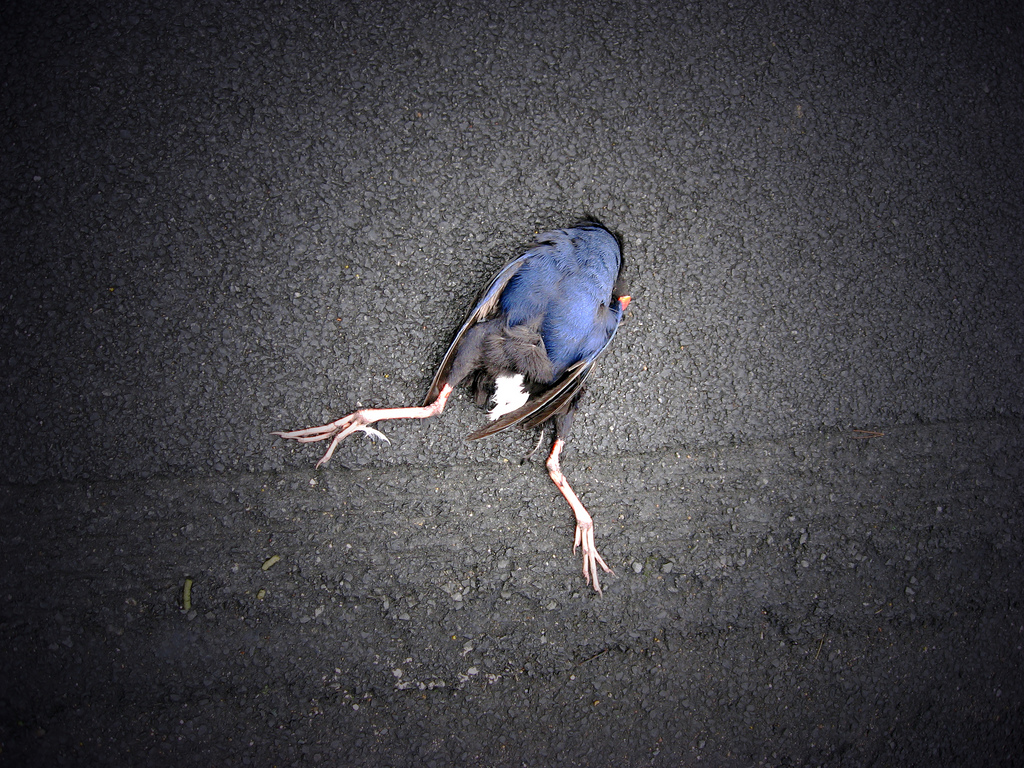
Update from a New Zealand reader, who identifies the above bird and offers advice on eating roadkill:

The bird in your post a Pukeko, a prolific New Zealand waterfowl species that gets run over often. It does not get run over in Montana though.

Roadkill is ok to eat, but it depends on where it is hit. Rabbits and hares that get run over by a wheel are too badly bruised, but those that stick their heads up and get hit by the underside of the grill are fine. Birds can be good, but preferably if they come off the windscreen obliquely, rather than getting hit by the grill. Pheasants usually hit the windscreen and are not too badly damaged.

Pukeko is not regarded as a table bird in New Zealand, as it has suffered from the adage boil it with a rock and throw the pukeko out and eat the rock. It is ok to eat but you don’t get much meat, and it is tough if it is not allowed to settle in a fridge for about two weeks to allow the proteins to break down.

(Photo by Lee Taylor)

The Shutting Down Of Boston, Ctd

Boston Marathon Bombing Investigation Continues Day After Second Suspect Apprehended

Thoreau notes how Tsarnaev was caught:

The authorities announced that people could again go outside, and then a sharp-eyed citizen noticed something. He escaped from the cops the night before, and was caught thanks to a sharp-eyed citizen once the authorities let people go outside and go about their business.

Marc Tracy adds:

There is no way to definitively play out the what-ifs. Authorities might not have coaxed a lockdown, people might have walked around Watertown, and somebody might have gotten hurt. Conversely, authorities might have kept the lockdown longer than they did, and Tsarnaev, who was taken to a hospital for urgent treatment, might have sat in the boat even longer, undiscovered, and bled to death. We don’t know.

The problem with the lockdown, as a matter of principle, isn’t that it could have prevented us from capturing Tsarnaev alive. Rather, the way Tsarnaev was captured alive is further suggestion that life in America is a Constitutionally codified experiment, and that the worst time to suspend experiments is when you don’t have all the answers.

Ross Anderson believes the shut-down was disproportionate:

In the London bombings, four idiots killed themselves in the first incident with a few dozen bystanders, but the second four failed and ran for it when their bombs didn’t go off. It didn’t occur to anyone to lock down London. They were eventually tracked down and arrested, together with their support team. Digital forensics played a big role; the last bomber to be caught left the country and changed his SIM, but not his IMEI. It’s next to impossible for anyone to escape nowadays if the authorities try hard.

Meanwhile, Alex Seitz-Wald examines the impact of Boston’s shutdown last Friday on workers:

“Most low wage workers can’t afford to lose a day’s pay, and there’s no doubt this lockdown will adversely impact the city’s working poor,” said Jessica Kutch, a labor activist who co-founded the organizing site coworker.org, in an email to Salon. “I’d really like to see employers state on the record that their hourly workers will be paid for the time they were scheduled to work today — but I suspect that most employers will place the burden of this shutdown squarely on the backs of people who can least afford it.”

Previous Dish on the Boston shutdown here, here and here.

(Photo: Investigators work around the boat where Dzhokhar A. Tsarnaev was found hiding after a massive manhunt, in the backyard of a Franklin Street home, in an aerial view April 20, 2013 in Watertown, Massachusetts. By Darren McCollester/Getty Images)

Are Musicians The New Critics?

Watch out, Pitchfork:

Musicians think and talk about music all day, so they have lots of practice discussing it. They hear lots of new stuff and find out about it before most people. They certainly know how the sausage is made. And guess what: a lot of them can write really well. … Writers don’t write like critics — instead, they show us how a musician hears music. It’s organic, relatively free from marketing initiatives, because the writers choose what they want to write about. And, like most music fans today, musicians have broad, often surprising tastes: you don’t have to like They Might Be Giants to be amused by Parquet Courts’ bassist Sean Yeaton’s delirious take on that band; plenty of people will be curious to hear what Laurie Anderson has to say about the latest Animal Collective album; what on earth does Andrew W.K. have to say about the new album from Robert Pollard of Guided by Voices? And Zac Pennington of the art-rock band Parenthetical Girls has an enthusiastic and trenchant take on… Taylor Swift?

Michael Azerrad helped found Talkhouse, a website where musicians write about music. From a review of Bowie’s new album by Jonathan Meiburg, singer for the band Shearwater:

Singers’ voices tend to age in interesting ways, sometimes gracefully, sometimes not.

Joni Mitchell’s, burnt (with grim purpose, one suspects) to a dry husk by cigarettes, is an extreme example, as is Robert Plant’s, whose much-abused high register has deserted him, though he seems to delight in combing through its damaged remains. Dylan, of course, went through a phase in which his voice seemed to give up on the very idea of singing (though I have an affection for the weird Jim Nabors-like “country” voice of Self Portrait and Nashville Skyline).

Closer to the present, Michael Stipe’s voice, originally grave and gritty, turned dark and husky, then brightened, cheered up, and became strangely weightless; Bill Callahan’s voice opened, dived, and doesn’t yet seem to have found the bottom; Gil Scott-Heron’s oratory ripened into a splendid growl; Lou Reed’s went kind of warbly, lost its once-unassailable authority and eerie tenderness, and hasn’t been able (or perhaps doesn’t want) to find it again.

There are exceptions, naturally — Jimmy Scott kept his high notes up to the very end, though with a slight wobble; Morrisey’s voice lost its fun but carried on otherwise, Neil Young’s voice seems to have emerged from the egg more or less in its present state, Patti Smith’s grew into the age it once affected, and Mick Jagger’s cartoony honk is a sort of museum piece, a dogged re-creation of a funny voice he stumbled into as a teenager and milked for half a century.

Which brings us, I guess by way of “Dancing in the Streets,” to Bowie, and his voice (or voices) on The Next Day. The choice of “Where Are We Now” as the first single from the record was canny, as it presents a new Bowie voice: plain, vulnerable, a little weary, and — it must be said — old, its glassy surface showing more hairline cracks than when we last heard it a decade ago. But it’s bravely, even defiantly old, and it dares you to do the one thing we’re not accustomed to doing with an artist who has so fully and publicly embraced method acting: to take him at face value.

Earlier Dish on Bowie’s new album here.

The Chechen Connection

Charles King downplays its significance:

[T]here is no direct information linking the North Caucasus to the attack in Boston; armed groups in the region, including the Dagestani branch of the so-called Caucasus Emirate — the jihadist network in the North Caucasus headed by Chechen warlord Doku Umarov — issued a formal statement denying any connection to the Tsarnaev brothers. The jihadists claimed instead that the brothers were pawns in an elaborate attempt by Russian security services to turn American opinion against the North Caucasus underground and against Muslims more generally. That might be far-fetched, but it would hardly be the line of argument the Emirate would pursue if it were suddenly using American operatives to expand attacks outside of Russia. The logical thing would have been for the Emirate to claim responsibility.

Instead, he argues that the bombing might have more implications for the ongoing violence in Syria:

There are somewhere “between 600 and 6,000” Chechens from the North Caucasus fighting in Syria, said Kotliar in a recent interview with Russian media, “and from what happened in Boston, perhaps Americans will finally draw the lesson that there are no good terrorists and bad terrorists, no ‘ours’ and ‘yours.’” Keep arming the Syrian rebels, the argument goes, and sooner or later you will have to face the consequences of a Syria overtaken by Islamist radicals.

Larison isn’t buying it:

Considering how strongly opposed Russia already was to Western intervention and to any Western support for the Syrian opposition, I don’t know that their opposition can be “hardened” much more than it is. American public opinion was already heavily against greater U.S. involvement in Syria before the bombings, and the Syria policy debate among politicians and pundits will likely remain more or less unchanged.

A Ban On Gay Role Models

The Boy Scouts plans to end its ban on gay troops. J. Bryan Lowder urges the group to also allow gay troop leaders:

What message do you think it sends to a gay teenager when the adult version of himself is considered unworthy of being a role model? Indeed, when the official policy feels that he would be a “distraction” to the process of becoming a good adult? Amanda pointed out in her post that the BSA should stop trafficking in the notion that adult gay men are dangerous to youths, as studies have shown time and again that that is not the case. Seconded. But my suspicion is that they already have. What really scares them is not the malign influence of lecherous gay men on boys; rather, it’s the validation, comfort, and hope that having strong gay role models would provide to boys with an identity that the BSA wishes would go away. If the goal is to transform boys into men who are “physically strong, mentally awake and morally straight,” then the BSA must acknowledge that gay men can be all of those things, too.

A Vatican Spring?

The First Signs Of Spring Are Seen At Kew Gardens

One major piece of disappointment came with Pope Francis’ endorsement of the on-going inquisition of American nuns. I’m not sure entirely what to make of it – is it an early indicator of Francis’ theological conservatism or simply acquiescing to a process already long underway? We will see by the disciplinary actions eventually taken (or not). The nuns would seem to have more in common with the Jesuit Francis, if only because he is aware of the need for outreach among religious orders – even to places and people that discomfort others. That was Jesus’ call, and Saint Francis’ and St Ignatius’. We’ll see what transpires in the end, but, obviously, I hope the Sisters can soon renew their vital work without constantly looking behind their backs.

But three other developments strike me as encouraging. The first – and least sexy – is the establishment of a global council of advisers in the governing of the church. This may seem a trivial reform. It isn’t. It restores the Second Vatican Council’s desire to place the Pope in a less dictatorial position, and to open up areas of authority within the global church as a counter-balance. And so this new governing commission – made up of highly effective cardinals in every continent – is a big shift:

More profound thinkers have read the Pope’s creation of a group of advisers as a bold new step towards fully implementing a model of ecclesial government evoked by the Second Vatican Council – one that is 418W7QTZEEL._SY380_less centralised, more collegial and based on the principles of ­subsidiarity.

“What Pope Francis has announced is the most important step in the history of the Church of the last 10 centuries and in the 50-year period of reception of Vatican II,” said the noted church historian Alberto Melloni. Writing in the Milan daily Corriere della Sera, he said the Pope had “created a synodal organ of bishops that must experiment with the exercise of the consilium”. In other words, shared governance of the Church between the Bishop of Rome and all the world’s bishops.

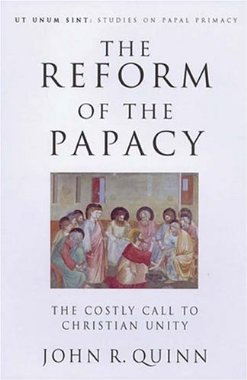
Detailed proposals for this were put forth in Archbishop Quinn’s book, [“The Reform of the Papacy“] which in 2005 appeared in Spanish. Pope Francis read that work when he was still just a cardinal in Argentina and, at around that time, he reportedly expressed his conviction that at least some of its ideas should be adopted.

More surprising is the support for civil unions for gay couples that seems to be percolating on the margins. The Pope argued for them in Argentina within the Jesuit branch he ran (it was the sole argument he lost in his years in president of the Conference), and earlier this year, some wiggle room for gay couples in civil law was mentioned by Archbishop Vincenzo Paglia, president of the Pontifical Council for the Family. This was only a defensive action against civil marriage rights for gay couples, but it was a concession to reality one cannot imagine Benedict XVI ever making. Now this:

The latest expression of support for civil recognition as an alternative to gay marriage comes from Archbishop Piero Marini, who served for 18 years as Pope John Paul II’s liturgical master of ceremonies. “There are many couples that suffer because their civil rights aren’t recognized,” Marini said.

The third indication of good news is the fact that Pope Francis has unblocked Oscar Romero’s path to beatification:

The Vatican’s Congregation for the Causes of Saints has been studying the Romero case since 1996, after the church in El Salvador formally opened the procedure in 1990. At the end of his 20-minute homily Sunday, Paglia said: “Just today, the day of the death of Don Tonino Bello, the cause of the beatification of Monsignor Romero has been unblocked.” Paglia had been received by Pope Francis on Saturday, and presumably the decision to authorize moving forward with the cause came out of that session.

Romero was shot to death while saying Mass in El Salvador on March 24, 1980. While he is seen as a hero to many because of his solidarity with the poor and his opposition to human rights abuses, his cause has also been viewed with suspicion in some quarters, partly because of Romero’s links to the controversial liberation theology movement.

Know hope.

(Photo: Crocuses in bloom. By Oli Scarff/Getty Images)

Terror And America, Ctd

1946 Boston Marathon

Rafia Zakaria, a columnist for Pakistan’s largest English newspaper, tries to explain the disproportionate coverage of the Boston attacks – compared with, say, 65 terrorist deaths in Iraq on the same day or the West, Texas, catastrophe:

Attacks in America are far more indelible in the world’s memory than attacks in any other country. There may be fewer victims and less blood, but American tragedies somehow seem to occur in a more poignant version of reality, in a way that evokes a more sympathetic response. Within minutes American victims are lifted from the nameless to the remembered; their individual tragedies and the ugly unfairness of their ends are presented in a way that cannot but cause the watching world to cry, to consider them intimates, and to stand in their bloody shoes. Death is always unexpected in America and death by a terrorist attack more so than in any other place.

It is this greater poignancy of attacks in America that begs the question of whether the world’s allocations of sympathy are determined not by the magnitude of a tragedy—the numbers dead and injured—but by the contrast between a society’s normal and the cruel aftermath of a terrorist event. It is in America that the difference between the two is the greatest; the American normal is one of a near-perfect security that is unimaginable in many places, especially in countries at war. The very popularity of the Boston Marathon could be considered an expression of just this. America is so secure and free from suffering that people have the luxury of indulging in deliberate suffering in the form of excruciating physical exertion; this suffering in turn produces well-earned exhilaration, a singular sense of physical achievement and mental fortitude.  The act of running a marathon is supposed to be simple, individual—a victory of the will over the body, celebrated by all and untouched by the complicated questions of who in the world can choose to suffer and who only bears suffering.

(Photo: Stylianos ‘Stelios’ Kyriakides, of Greece, runs up Heartbreak Hill in Newton, Mass. during the 1946 Boston Marathon. He won the race. By Charles Dixon/The Boston Globe via Getty Images.)