Obama’s Proposals Are Pretty Modest

That’s Jordan Weissman take:

Combined, Obama’s hikes would raise $320 billion over a decade, or $32 billion per year. That’s just a smidge more than 1 percent of last year’s federal tax revenue—more than a rounding error, but not much more. Obama isn’t looking to soak the rich at this point so much as lightly spritz them.

Christopher Flavelle declares that Obama’s “prescriptions mostly demonstrate the timidity of the ideas that Democrats are willing to offer”:

At some point, I hope a leading Democratic politician offers prescriptions that challenge the status quo — if only to remind Americans that what now seem like the outer bounds of policy choices actually represent a narrow range of options, at least by the standards of other developed countries.

Daniel Gross points to a tax loophole Obama hasn’t targeted:

[C]apping IRA amounts does little to address the way Romney really made his money—and that represents one of the most egregious, income-inequality-inducing wrinkles in our tax code. It’s the factor that has really allowed hedge-fund titans and private-equity barons to routinely mint Rockefeller-size fortunes. It’s called the carried interest rule, and Obama doesn’t look like he’s ready to do away with it yet.

Drum sees this as part of a larger strategy:

This actually fits with everything Obama has been doing lately: neither his legislative proposals nor his executive actions have been world shaking. It’s all small-ball stuff, designed as much to make a point as it is to actually make a difference. If you put them all together, Obama’s actions are a way of showing that (a) Democrats are reasonable folks, (b) they’re on the side of the middle class, and (c) Republicans continue to be the party of plutocrats, adamantly opposed to even modest proposals that would tax the rich ever so slightly more.

Book Club: Should Even Heroin Be Legal?

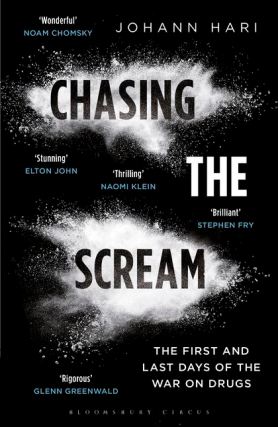
It’s time for our first selection of 2015: Johann Hari’s new book, Chasing the Scream: The First and Last Days of the War on Drugs, which you can buy here in hardcover and here for the e-version. From the publisher’s description:

It is now 100 years since drugs were first banned [in the US by the Harrison Act]. On the eve of this centenary, journalist chasing-screamJohann Hari set off on an epic three-year, 30,000-mile journey into the war on drugs to uncover its secrets – and he found that there is a startling gap between what we have been told and what is really going on. As strange as it may seem at first, drugs are not what we have been told they are; addiction is not what we think it is; and the drug war has very different motives to the ones we have seen on our TV screens.
In Chasing the Scream, Hari reveals his startling discoveries entirely through the true and shocking stories of people across the world whose lives have been transformed by this war. They range from a transsexual crack dealer in Brooklyn searching for her mother, to a teenage hit-man in Mexico searching for a way out. It begins with Hari’s discovery that at the birth of the drug war, Billie Holiday was stalked and killed by the man who launched this crusade – while it ends with the story of a brave doctor [in Portugal] who has led his country to decriminalize every drug, from cannabis to crack, with remarkable results.

Miranda Collinge of Esquire calls the book a “fascinating, extensively researched and heartfelt contribution to a debate over drugs policy that continues to rage today”:

It’s a pattern Hari observes again and again through the decades: a zealous, misguided or sometimes deeply prejudiced person in power decides to eradicate the social blight of drugs, forcing, even offering, the drugs trade to criminals, while the hopeless and the helpless are caught in the crossfire. He meets scientists, counsellors, addicts and dealers who point out the folly of this approach, which he backs up with studies of murder rates, the workings of the human brain and, particularly memorably, self-fellating rats.

bookclub-beagle-trJohann has a hard time writing a bad sentence. I’ll be up-front bout my friendship with him, which is deep. He made some mistakes in the past, for which I think this book is by far the best atonement. It’s very hard to put down, and it offers a series of gripping narratives about this blight on our world – not of drugs, but of the failed “war” on them.

By the way, Johann will be in DC talking about his book at Politics and Prose on January 29, then in NYC at the 92nd Street Y on the 30th, then in Baltimore at Red Emma’s on the 4th of February. He’s even more engaging in person than in prose.

Pete Guither of DrugWarRant “highly recommends” Chasing the Scream:

… I’ve read so much about the war on drugs that it’s hard to get excited about reading a book about it. But less than halfway through the first chapter, I couldn’t put it down – it’s an amazing read. … For drug policy experts like me, it’s a great read with some fascinating personal perspectives, while filling in a few historical knowledge gaps.

Decca Aitkenhead is also impressed by the book:

[Johann] has never spoken publicly about [his plagiarism scandal from 2011] until now. My other worry was whether johann-hari-680x1024anyone would want to read yet another polemic about drugs. I wouldn’t, and I’m quite interested in the subject. The prohibition-versus-legalisation debate tends to be interminably dreary, chiefly because neither side ever seems to change anybody’s mind.

“I think that’s totally right,” Hari agrees. “I did not want to write a 400-page polemic about the drug war. I didn’t want to have an argument about it, I wanted to understand it.” For that matter, he admits, “It’s struck me that, actually, polemic very rarely changes people’s minds about anything.” He says so as a former columnist? “A recovering former columnist, yes.” He laughs. “It’s not just that polemic doesn’t change people’s minds. It says nothing about the texture of lived experience. People are complex and nuanced, they don’t live polemically.”

Hari’s book turns out to be a page-turner, full of astonishing revelations.

I had no idea that the war on drugs was single-handedly invented by a racist ex-prohibition agent [in the US], who needed to find a new problem big enough to protect his departmental budget. One of the first victims of his ambition was Billie Holiday, whose heroin addiction enraged him to the point where he hounded her to death. After he’d had the singer jailed for drugs, she was stripped of her performing licence, and as she unravelled into destitution and despair, his agents continued to harass her, even summoning a grand jury to indict her as she lay dying under police guard in a hospital bed.

Politico published a long passage of the chapter on Holiday:

Narcotics agents were sent to her hospital bed and said they had found less than one-eighth of an ounce of heroin in a tinfoil envelope. They claimed it was hanging on a nail on the wall, six feet from the bottom of her bed—a spot Billie was incapable of reaching. They summoned a grand jury to indict her, telling her that unless she disclosed her dealer, they would take her straight to prison. They confiscated her comic books, radio, record player, flowers, chocolates and magazines, handcuffed her to the bed and stationed two policemen at the door. They had orders to forbid any visitors from coming in without a written permit, and her friends were told there was no way to see her. Her friend Maely Dufty screamed at them that it was against the law to arrest somebody who was on the critical list. They explained that the problem had been solved: they had taken her off the critical list.

So now, on top of the cirrhosis of the liver, Billie went into heroin withdrawal, alone.

Her NYT obituary from July 1959 is here. As far as Johann’s credibility with the book, Malcolm Forbes is more than assured:

Given that he devotes his last 70 pages to detailed notes with sources and a lengthy bibliography, it seems a safe bet to say we can [trust the book]. (There is even a link to audio recordings of the quotes that appear within the book, along with the invitation to email Hari with any errors found.)

Meanwhile, The Guardian‘s Ed Vulliamy scrutinizes the book from the far left:

Legalisation would no doubt suit places such as Vancouver, New York or Liverpool. But how would it work in wretched barrios around the cities of central and South America, townships of Africa and eventually dormitory towns of China and Bangladesh? Hari insists that “responsible drug use is the norm, not the exception”. He reports a UN statistic that “only 10% of drug users have a problem with their substance. Some 90% of people who use a drug – the overwhelming majority – are not harmed by it.” But this is not the whole story in the desperately poor, wider world that services the countries where Hari’s book is set. …

Because if hard drugs are legal, who is going to make them? Presumably the experts who already do, working not for narco syndicates but Big Pharma, another kind of cartel. And do we really trust Big Pharma to manufacture methamphetamine and process crack or heroin in order to sell as little as possible in the developing world? That’s not how Big Pharma works; that’s not how capitalism works.

And from the right-wing Spectator, Duncan Fallowell:

Hari also blames Washington for the horrific battles between drug gangs in Latin America and the Caribbean. But non-prohibition is no guarantee of peace and harmony. Look at the merciless gang wars in central Africa over precious stones and metals. And prohibition can be a vital tool: against illegal logging in the Amazon for example, or the slaughter of elephants.

He says the war against drugs has been going on for a century and is still not won, so it’s been pointless. Some wars are eternal and to expect otherwise is utopianism — the war against weeds, for example, which is called gardening. The war on drugs can be called public health. One of Hari’s own informers raises this: ‘We need to approach drug addiction not as a criminal justice situation but as a public health situation.’

That indeed is how it is regarded. Criminal prohibition was never considered enough in itself, even to the most rigorous Washington hardliner. It should be noted that liberalisation has already begun in some US states and that the world’s harshest anti-drug laws — by far — are in Muslim and Asian countries, which Hari ignores.

John Harris calls the book “important and largely convincing” but still had mixed feelings about it:

Chasing the Scream is a powerful contribution to an urgent debate, but this is its central problem: in contrast to the often brutal realities it describes, it uses the gauche journalistic equivalent of the narrative voice found in Mills & Boon novels. Amid Mexican sand dunes, he tells us, Hari thought about the drug wars’ endless downsides as he “ran my fingers through the prickly hot white sand” and crassly imagined the joyous lives of local teenagers in a world free of gangsters (“Juan, stripped of his angel wings, is chatting with Rosalio about World of Warcraft”).

Barbara Spindel points to the personal nature of the book:

Hari notes at the outset that he has been close to several addicts — that they “feel like my tribe, my group, my people” — and he confesses that, while not narcoleptic, he for years took “fistfuls” of narcolepsy pills because they enabled him to write for weeks without rest. He structures the book as a personal journey, weighing the pros and cons of legalization himself as he presents them to his readers. … “Chasing the Scream” is a riveting book, and Hari is an effective storyteller; he would have been better off keeping the focus off of himself and entirely on Chino, Rosalio and the others.

David Robinson credits Johann for “talk[ing] to some truly amazing people in the three years he spent researching this book,” but Robinson had qualms about its conclusions:

[Johann’s] ex is an addict. So when Hari points out that “the opposite of addiction isn’t sobriety. It’s connection,” it comes straight from the heart: his ex is passed out on his spare bed as he writes. “If you are alone,” he adds, “you cannot escape addiction. If you are loved, you have a chance.”

I’m sure that’s true. But am I going to vote to legalise crack, and have children smoking their father’s legally held crack stash just as, in my day, they used to smoke their dad’s cigarettes? I think not.

The Dish will be debating such questions starting in mid-February. To join the conversation, buy the book at this link (if you’d like to help out the Dish with a little affiliate revenue) and email your thoughts to bookclub@andrewsullivan.com.

The Politics Of “Fertility Fog” Ctd

A reader summarizes his email upfront:

Testosterone doesn’t boost sperm count like your one reader hinted.  It’s quite the opposite  (see here). At the very least, please clear that issue up so others aren’t misled.

Also, below is my story of how testosterone replacement made me sterile and almost left my wife and me needlessly childless.  It’s a story worth sharing so others aren’t disappointed when they decide to have kids.  Testosterone is given way too freely without mention of the fertility side effects and without dealing with underlying conditions.

I have read with interest your posts on fertility, especially the recent comments from men.  Regarding the 42-year-old fellow with low sperm count, he noted the issues of stress and other factors that impacted sperm quality – this is all very true.  He also mentioned that the doc said “to keep trying and come back in 8 months…If we weren’t pregnant, he’d give me a shot of testosterone to boost my system as another step in fixing my sperm count issues. “  Testosterone does NOT boost sperm count – it can actually reduce it.  In fact, testosterone is a prime candidate for what some hope will be the first male-oriented hormonal contraceptive. He’s probably thinking HCG or human chorionic gonadotropin, which is used to boost male fertility.  Why do I know this?  I was given testosterone but never told the impact it could have on fertility – until it was almost too late.

About 5 years ago I presented to my doctor with erection and low energy problems.  He tested and found I had low testosterone and prescribed testosterone gel, which I used for a few years.  After grad school and at the ripe old age of 40, we decided it was time.  After a few months of trying I tested my sperm with a home test kit.  It’s pretty cool; it comes with a microscope, slides, and everything else you need to do a basic test.

There was nothing moving on the slide.  A visit to a fertility clinic confirmed that I was 100% sterile.  It was then that I did some research and discovered that a side effect of testosterone replacement is infertility.  An endocrinologist switched me to HCG, which has the dual benefit of boosting testosterone AND sperm production.  Today I am 43 and have a 12-week-old daughter at home.

Turns out doctors prescribe testosterone all the time without considering the root cause and without explaining the fertility impact.  In my case, I actually had sleep apnea that was only discovered after yet another endocrinologist insisted I check it to rule it out before continuing HCG after my wife got pregnant.  I’m fit and otherwise healthy – sub 1:50 half marathoner – and yet I still have sleep apnea.

Bottom line, if a man wants to get his significant other pregnant, stay away from testosterone.  And if a doctor suggests testosterone, insist on a full workup to rule out apnea, pituitary problems, and other issues before taking the stuff.  You might find yourself infertile otherwise and, perhaps, overlooking a more serious medical condition.

The Flu Shot Is Still Worth Getting

Aaron Carroll begs everyone to get some perspective:

I see headlines telling people the vaccine is “only 23% effective”. I’d like a list of all medicines people take, diets they go on, behaviors they change, devices they employ, and procedures they undergo which are better than 23% effective. I’m willing to wager the number is quite low.

In other flu news, Kaleigh Rogers covers research on a “universal” flu vaccine:

If clinical trials go well, a new u​niversal flu vaccine that would treat all strains of flu with a single shot could be just five years away. That would mean a future where nearly 20,000 p​eople won’t die due to a pandemic of the virus. A future where we wouldn’t have to spend a week in bed in misery even though we got​ a fucking flu shot this year.

Researchers at the Icahn School of Medicine at Mount Sinai and at Canada’s McMaster University began developing the vaccine three years ago after the discovery of a subclass of antibodies. When the body encounters influenza, it naturally produces these antibodies, which are able to recognize all strains of flu and mutations of the virus.

Until such a vaccine becomes a reality, Meeta Shah warns that emergency departments (EDs) are being overrun:

When interviewing emergency department directors regarding their experiences with this year’s flu season, I was shocked to hear the numbers.  Some EDs reported volume increases 15 to 25 percent higher in December compared to November or when compared to last December.  One director I interviewed joked that this epidemic was so significant he had colleagues who had coined it “The Flunami.”

Why is this important? Well, increased volumes like this don’t make it easy for an ED to function normally, and puts a strain on resources and staff. You or your loved one may need treatment from an overcrowded ED that is struggling to be efficient amongst this chaos.

The President’s Approval Hits 50 Percent

Obama Bump

Obama’s numbers are on the upswing:

His approval rating has risen nine percentage points in the past month alone, while his disapproval has dropped by 10 points. The gains are pretty even across the board, but the biggest are among Democrats (10 points), moderates (10), Hispanics (22), and even white evangelical Christians (10), who generally tilt heavily toward the GOP. Obama also has gained 19 points among adults younger than 30.

Sargent cautions that it’s “too early to say whether Obama is really in the midst of a sustained recovery”:

But one thing that will be worth watching is whether positive feelings about the economy — and about Obama — boost support for his individual initiatives, particularly those which Republicans are criticizing most bitterly, and whether they scramble the political landscape more generally.

Josh Marshall doesn’t want to read too much into recent polls:

Just as we should probably all resist the urge to write doomsaying chin-scratchers on the end of the Obama dream when the President’s numbers are soft, we should probably equally resist the urge when they’re more robust. The economy is by no means everything. The President won reelection solidly with a still anemic economy. But it’s always the place to start when the numbers move.

Something Harry Enten will be keeping in mind:

The approval rating at which an incumbent president running for re-election goes from an underdog to a favorite is in the high 40s. Obama can’t run again, and the relationship between his approval rating and the eventual 2016 Democratic nominee’s chances is a bit messier. But if Obama’s popularity inches up a bit more, he may go from being a drag on the nominee to an asset.

Nate Cohn comments along those lines in today’s NYT:

The balance of evidence suggests that the break-even point for the presidential party’s odds of victory is at or nearly 50 percent approval. If the only thing you knew about the 2016 election was Mr. Obama’s approval rating on Election Day, you might guess that the Democrats had a 37 percent chance of holding the White House with a 46 percent rating — rather than a 23 percent chance with a 41 percent rating. The difference between 41 and 46 might be worth between one and two percentage points to the Democratic candidate in 2016 — the difference between a close race and a modest but clear Republican victory.

Making It Harder For Cops To Take Your Stuff

That’s what Eric Holder did last week. Drum is pleased:

It’s bad enough that civil asset forfeiture even exists as a legal doctrine, but it’s beyond comprehension that the feds would actively encourage abuse of forfeiture laws by creating a program that allows police departments to keep most of the money they seize. This is practically an invitation to steal money from innocent people. So good for Holder for ending this program. If cops are going to be allowed to seize property from people they merely suspect of crimes—or, in some cases, pretend to suspect of crimes, wink wink nudge nudge—they sure as hell shouldn’t be allowed to keep the stuff and sell it in order to buy themselves a bunch of shiny new toys.

McArdle also welcomes the news:

Libertarians like to say that the nearest thing to immortality on this earth is a government program. Programs change their names or get absorbed into bigger programs, but they rarely just die. I’m pleased to see that there’s an exception to this rule, and it’s one that really matters. We’re all a little bit more free today.

Balko insists that “this new policy is one conservatives should love”:

First and most obvious, civil asset forfeiture is a major affront to property rights, a principle conservatives hold dear. The idea that the government can take your property without ever even charging you with a crime, much less convicting you of one, is a pretty appalling abuse of power. And sure enough, much of the effort to reform these laws over the years has come from the right. (Although to be fair, the laws themselves were pushed heavily by the Reagan administration as part of the 1980s drug war — albeit with little-to-no resistance from Democrats).

The other reason the right should cheer this move is that it’s basically a nod to federalism. Several state legislatures saw civil asset forfeiture as unfair and moved to make it fairer. The suitable sharing program thwarted their efforts. Holder’s move ends that interference. It returns policymaking on this issue to the states. Personally, I think there’s a Fifth Amendment argument to be made that the federal government should actually prevent the states from engaging in the practice. But allowing state legislatures with a conscience to end the practice on their own is a good first step.

Kleiman hopes the new policy has a big impact:

The order excludes federal-state-local task forces, but – if I read it correctly – does include the multi-jurisdictional local task forces where much of the worst mischief has been done; some of those agencies are entirely dependent on forfeiture funds (plus Byrne Grant money) and thus under no control whatever from civilian authorities. There’s more to be done to rein in the forfeiture system, but this is a terrific start.

Jacob Sullum is more skeptical:

Holder’s policy explicitly exempts “seizures by state and local authorities working together with federal authorities in a joint task force,” “seizures by state and local authorities that are the result of joint federal-state investigations or that are coordinated with federal authorities as part of ongoing federal investigations,” and “seizures pursuant to federal seizure warrants, obtained from federal courts to take custody of assets originally seized under state law.”

Since there are hundreds of federally funded “multijurisdictional task forces” across the country, that first exception could prove to be very significant. Holder’s order “does not prohibit the worst uses of the equitable sharing asset forfeiture program, particularly excepting seizures in which there is federal task force participation or direction,” says Eapen Thampy, executive director of Americans for Forfeiture Reform. “As virtually every drug task force I know of has a federal liaison on call, this means business as usual by local law enforcement using civil asset forfeiture through the Equitable Sharing Program to enforce the Controlled Substances Act and other federal statutes. In other words, the exception swallows the rule.”

Even if the new policy ends up having teeth, Leon Neyfakh expects civil asset forfeiture to continue “because the majority of America’s 50 states—42, to be exact—still have laws on the books providing huge incentives for police departments to keep doing it”:

According to Louis S. Rulli, a professor at the University of Pennsylvania Law School who has studied civil forfeiture closely, no fewer than 26 states allow police to keep 100 percent of the assets they seize. And Scott Bullock, a senior attorney at the Institute for Justice—the libertarian public interest law farm—says there are 16 others where police keep 50 percent or more.

“The law has to be changed in the states too,” said Bullock. “This closes one window, but you’ve got to close all the windows.”

The First Legislature To Legalize Pot

Vermont

It could be Vermont’s:

It’s far too early in the process to gauge whether the legislature will approve marijuana legalization. But Gov. Peter Shumlin previously said he’s not opposed to it, although he would like to see more data from Colorado and Washington, the first two states to legalize, before Vermont follows through.

Last week, RAND released a study on the legalization options for the Green Mountain State. Niraj Chokshi reads through it:

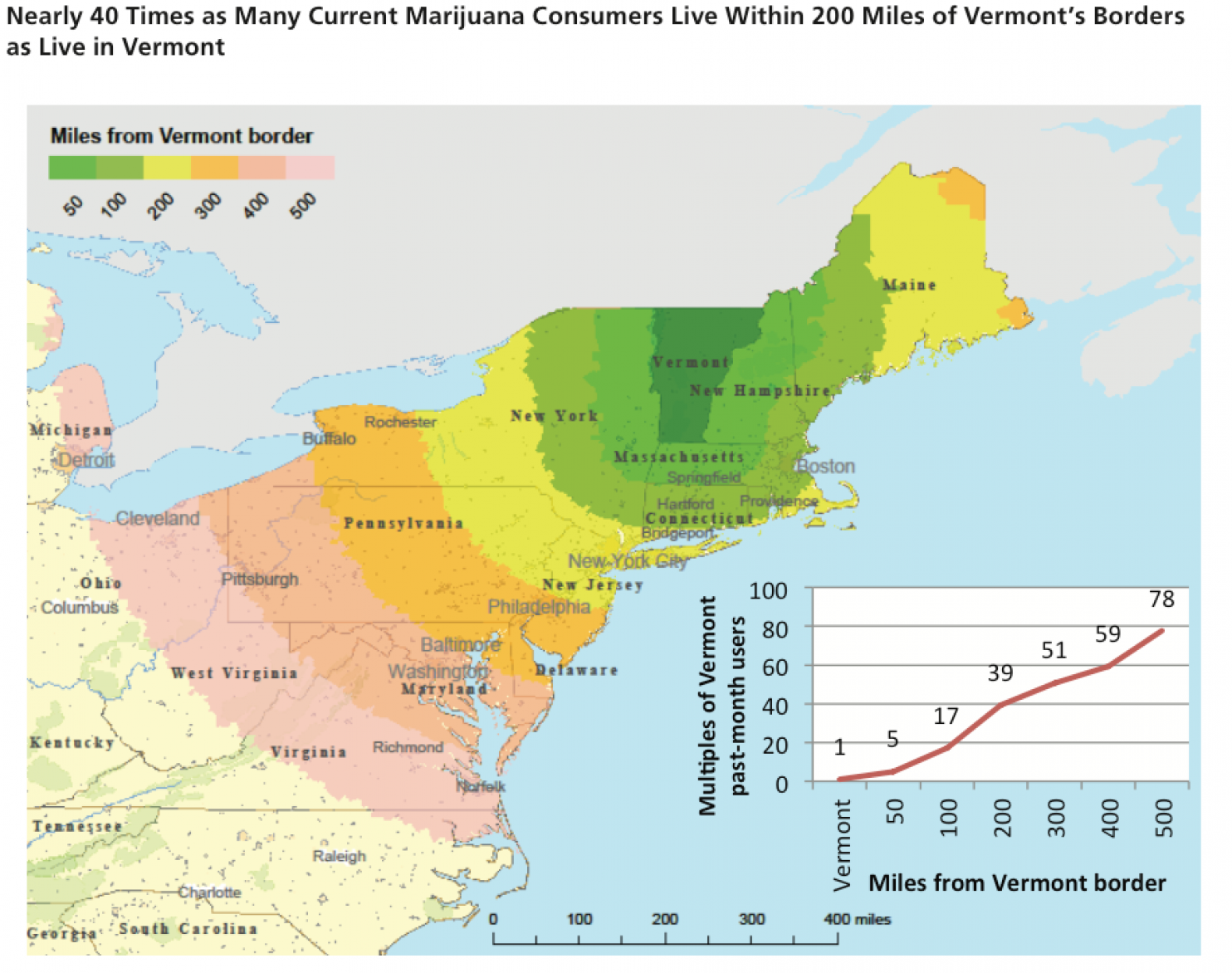
If passed, legalization could have big implications for the region. There are nearly 40 times the number of regular marijuana users within 200 miles of Vermont’s border as there are within its borders, RAND estimates. That means the state could see a huge boost in tourism by legalizing, unless of course other states legalize.

Kleiman, who contributed to the RAND report, is excited:

The Vermont process holds out great promise, because the normal legislative process – ugly as it can be – has the possibility of producing a result much more nuanced and more carefully considered from multiple viewpoints than the initiative process, under which propositions are drawn up by advocates with the advice of pollsters, no one ever holds a hearing, and any idea that can’t be explained in a 30-second TV spot has to be dropped. The key point of the RAND report is that there are legalization options other than full commercialization.

But Josh Voorhees makes clear that full commercialization is working out pretty well for Colorado thus far:

Retail and medical weed generated more than $60 million in tax and licensing revenue for the state in 2014, the lion’s share of which is helping to pay for school construction and the regulatory system that legalization requires. Opponents looking to nitpick can—and do—point to the fact that the total is a far cry from the $100 million windfall that state officials predicted at the start of last year. But even though legalization advocates hyped a major influx in tax revenue as a selling point, evaluating legal weed on a metric tied so tightly with consumption has always been an awkward proposition. The goal, after all, was never to encourage more people to light up a joint or gobble down a brownie. More revenue would be better, but too much more would represent its own type of problem.

A Sneak Peek At Hillarynomics

A report released last week by The Center For American Progress is being touted as “the potential seed of [Clinton’s] economic agenda”:

It tackles the issues Americans consistently list as their top priority in polls – jobs and the economy – but in a way that’s less likely to alienate the business community and financial sector, or appear inauthentic to her own identity. The report’s international focus also plays to the former secretary of state’s strengths, and it would allow her to promote lessons she’s learned from her many travels abroad.

Yglesias calls the report “the best guide to what Hillarynomics is likely to look like”:

In some ways, it defies stereotypes of the Clintons as standard-bearers for neoliberal centrism by endorsing fiscal stimulus and a strong pro-labor union agenda while downplaying the strong education-reform streak of the Obama administration. But it’s also notable for the Obama-era liberal ambitions it pushes aside. In the main recommendations for the United States, there’s no cap-and-trade or carbon tax in here, no public option for health care, and no effort to break up or shrink the largest banks. Nor is there an ambitious agenda to tackle poverty.

Instead, you get a multi-pronged push to boost middle-class incomes. After an extended period in which Democratic Party politics has been dominated by health care for the poor, environmental regulation, and internecine fights about Wall Street, Hillarynomics looks like back-to-basics middle-class populism.

However, Frum believes that, with actions like his SOTU address, Obama is trying to force Hillary to adopt his agenda:

Almost as much as a Republican victory, a Clinton succession would punctuate the Obama presidency with a question mark. Obama’s highest priority over the next two years seems to be to convert that question mark into an exclamation point, to force Hillary Clinton to campaign and govern on his terms. Whatever happens after that, he can at least say that it was his kind of Democratic Party—not Bill Clinton’s—that won a third consecutive mandate, after having twice done what Clinton never did: win an outright majority of the presidential ballots cast.

Of course, Hillary Clinton can see all this, too. So can Bill Clinton, perhaps even more acutely. The next fascinating question is: what will they do about it?

In Which The Democrats Finally Get A Clue, Ctd

Among other assessments of the Obama strategy for the next two years (mine here), Cassidy unpacks Obama’s new tax proposal:

On Tuesday night, for once, the policy contents of the speech may well dominate things. Over the weekend, White House aides let it be known that President Obama will propose raising taxes on the very rich, to pay for tax breaks for the middle class. More specifically, he wants to increase the tax rate on capital gains for high earners, from 23.5 per cent to twenty-eight per cent, and he also wants to remove the so-called “step up in basis” loophole, which allows rich families to reduce, often greatly, the amount of taxes they pay on their estates. The money generated by these changes would be used for a variety of purposes, including a modest tax cut for middle-class married couples, an expansion in wage subsidies to low-paid workers, and an expansion of tax credits for students in higher education.

Khimm notes that the “proposal is specifically targeted at the wealth gap, which is actually far greater than the income gap”:

Over the last 30 years, top 1% by earnings received one-fifth of all income; by comparison, the top 1% by net worth owned one-third of the country’s wealth — and in recent years, it’s risen to 42%. That’s because wealth compounds itself over time and is taxed at lower rates than income for rich Americans. And it’s also because many ordinary Americans don’t save enough, and barely half are invested at all in the stock market. (The wealthiest 5% of Americans own more than two-thirds of stocks.)

Neil Irwin remarks that “one way to read President Obama’s plan is that it is a first try at what a post-Obama economic policy vision for the Democratic Party might be”:

It is elegantly sculpted to avoid some of the pitfalls of Obama-era partisan warfare. The president’s first term was an extended battle over stimulus, deficits and the role of government. The administration’s first, polarizing political battle was to enact a fiscal stimulus. Next was to expand the role of government in the health care system. Then, battles over deficit reduction that began when a Republican House took office in 2011 were really proxy fights for both parties, with those on the left pushing for continued stimulus and those on the right using the high deficits as a reason to reshape the scale of America’s social welfare state.

The new plan may stand little chance of passage, but it signals that we are moving into a different phase of the nation’s debates over how the government taxes and spends. As Ezra Klein of Vox tweeted Saturday night, this is the first big proposal of the “post-recession, post deficit panic era.”

Leonhardt declares that “the key to understanding President Obama’s new plan to cut taxes for the middle class is the great wage slowdown of the 21st century“:

The wage slowdown is the dominant force in American politics and will continue to be as long as it exists. Nothing drives the national mood — and, by extension, national politics — the way that the country’s economic mood does, as political scientists havedemonstrated. And nothing drives the economic mood as much as wages and incomes, which are the main determinant of material living standards for most households.

Matt O’Brien calls Obama’s plan “Piketty with an American accent”:

Okay, that’s a little bit of an exaggeration, but not a huge one. Obama’s State of the Union, you see, will call for $320 billion of new taxes on rentiers, their heirs, and the big banks to pay for $175 billion of tax credits that will reward work. In other words, it’s fighting a two-front war against a Piketty-style oligarchy where today’s hedge funders become tomorrow’s trust funders. First, it’s trying to slow the seemingly endless accumulation of wealth among the top 1, and really the top 0.1, no actually the top 0.001, percent by raising capital gains taxes on them while they’re living and raising them on their heirs when they’re dead. And second, it’s trying to help the middle help itself by subsidizing work, child care, and education.

Andrew Sprung is amazed by “the extent to which Thomas Piketty’s tome Capital in the 21st Century, published in the U.S. in January 2014, has focused the U.S. policy debate on income inequality”:

Democrats’ willingness to credit core conservative tenets — that raising taxes on high incomes and investment gains always inhibits growth, that deregulation always spurs it — are melting away. Fresh from their November drubbing, Democrats are beginning to heighten rather than soft-pedal the policy contrasts between the parties. Wounded politically by perceptions that the Affordable Care Act helps the poor at the expense of working people, they are looking for proposals obviously attractive to the middle class. Emboldened by accelerating growth and employment gains, they are perhaps shedding inhibitions about leveling the playing field between workers and management.

Derek Thompson glances at the big picture:

The United States has been, and will quite surely remain in the foreseeable future, the best place in the world for the very rich and an increasingly difficult place to earn a rising inflation-adjusted salary for the country’s bottom half. The road out is not hopeless, and the CAP paper on how the U.S. can learn from the rest of the world offers fine solutions across education, infrastructure, and working with cities to develop talent clusters. But this sort of ambitious policy landscaping is purely fanciful with today’s Congress. In this government, all big ideas are rain dances.

Yglesias agrees:

The White House is at pains to note that most of the individual middle- and working-class tax benefits they are proposing enjoy some measure of bipartisan support. But Obama is proposing to pay for them with what amounts to a series of tax increases on rich people. Republicans have made it very clear over the years that they do not believe that rich people should pay higher tax rates. To embrace this plan would entail not just a spirit of compromise that is generally lacking on Capitol Hill, but for the GOP to totally abandon one of its core economic principles.

Paula Dwyer points out that some of Obama’s proposals have Republican roots. But she argues that Obama just made tax reform less likely:

[A]ll of these details are obscured by Obama’s soak-the-rich message, one that Republicans won’t sign on to, despite their desire to help the middle class. In the past, they would have proposed government spending cuts, yet all the easy trims (and even some tough ones) have been made, and the declining deficit has put them in a tough spot on this issue. That’s a tough spot Obama could have exploited for compromise had he not rhetorically boxed in Republicans.

Regardless, Waldman hopes that Obama will spark a real debate:

You can argue — and many will — that it’s pointless for Obama to introduce significant policy proposals like this when he knows they couldn’t make it through the Republican Congress. But what alternative does he have? He could suggest only Republican ideas, but he wouldn’t be much of a Democratic president if he did that. Or he could offer nothing at all, and then everyone would criticize him for giving up on achieving anything in his last two years. If nothing else, putting these proposals forward can start a discussion that might bear legislative fruit later on. Major policy changes sometimes take years to accomplish, so it’s never too early to start. And if Republicans have better ideas, let’s hear them.

Francis vs The Theocons, Round II

saint-francis-birds

For the far right, the recent Synod on the Family was bad enough, with its gestures of decency towards gay Catholics. But the impending encyclical on climate change seems to have sparked a new level of mania. At First Things, Maureen Mullarkey calls the Pope “an ideologue and a meddlesome egoist”. Robbie George notes that Francis “has no special knowledge, insight, or teaching authority pertaining to matters of empirical fact of the sort investigated by, for example, physicists and biologists,” and that his views on climate change “could be wrong”. And Steve Moore, writing in Forbes, claims that the Pope has adopted “the language of the radical green movement that is at its core anti-Christian, anti-people, and anti-progress”. I find this all preposterous. We have just discovered that last year was the hottest on record, eclipsing 2010. Whole eco-systems are being wiped out; our oceans may be heading toward the point of no return; and the rape – rather than conservation – of our natural habitat is not even faintly defensible in Catholic or Christian terms.

And he’s Pope Francis, if you’ll recall. He took as his namesake a Christian mystic and ascetic who burrowed into nature and Creation as the great mysteries and beauties there are, who looked at animals and saw something precious to be treasured rather than material merely to be eaten. He preached to the birds, legend has it. He tamed wolves, folklore tells us. And he composed one of the more beautiful canticles in literature in praise of Creation:

Praised be You, my Lord, through Brothers Wind and Air,
And fair and stormy, all weather’s moods,
by which You cherish all that You have made.

Praised be You my Lord through Sister Water,
So useful, humble, precious and pure.

Praised be You my Lord through Brother Fire,
through whom You light the night and he is beautiful and playful and robust and strong.

Praised be You my Lord through our Sister,
Mother Earth
who sustains and governs us,
producing varied fruits with coloured flowers and herbs.

If you believe that is an anti-Christian canticle, as Stephen Moore does, then you need to re-check your understanding of Christianity. Damon Linker analyzes the revolt:

The problem is simply that Francis has broken from too many elements in the Republican Party platform.

First there were affirming statements about homosexuality. Then harsh words for capitalism and trickle-down economics. And now climate change. That, it seems, is a bridge too far. Francis has put conservative American Catholics in the position of having to choose between the pope and the GOP. It should surprise no one that they’re siding with the Republicans.

Under Popes John Paul II and Benedict XVI, a number of neoconservative Catholics (or theocons) went out of their way to make the case for the deep compatibility between Catholicism and the GOP. But not just compatibility: more like symbiosis. For Richard John Neuhaus, Michael Novak, George Weigel, and their allies, the GOP would serve as a vehicle for injecting Catholic moral and social ideas into American political culture — while those Catholics ideas, in turn, would galvanize the Republican Party, lending theological gravity and purpose to its agenda and priorities.

In the hands of the theocons, the Republican platform became more than a parochially American mishmash of positions thrown haphazardly together for contingent historical reasons. Rather, it was a unified statement of High Moral Truth rooted in Thomas Aquinas’ medieval theology of natural law — the most highly developed outgrowth of Christian civilization.

And one that, in many respects, simply falls apart through the prism of modern science. The theocons created an abstract fusion of GOP policy and an unrecognizable form of Christianity that saw money as a virtue, the earth as disposable, and the poor as invisible. It couldn’t last, given the weight of Christian theology and tradition marshaled against it. And it hasn’t. Francis is, moreover, indistinguishable on this issue from Benedict XVI and even John Paul II. As in so many areas, it’s the American far right whose bluff is finally being called.

Previous Dish on the far-right opposition to Francis here and here.