Farewell, Fayyad

Palestinian prime minister Salam Fayyad, known for his moderation and efforts at state-building, retired over the weekend. Matt Duss sums up his legacy to date:

He attempted to reform and develop the Palestinian economy, with a particular focus on greater transparency and accountability, in order create a sense of momentum among Palestinians toward statehood. In one of the surest signs of the Western intelligentsia’s blessing, the doctrine was endowed by The New York Times’ Tom Friedman with its own special title: “Fayyadism … the simple but all-too-rare notion that an Arab leader’s legitimacy should be based not on slogans or rejectionism or personality cults or security services, but on delivering transparent, accountable administration and services.”

Four years later, Fayyadism has foundered on the reality that economic development—genuine, sustainable economic development—is all but impossible amid the conditions of a hostile military occupation that the West Bank continues to experience under Israeli rule.

Beinart argues America and Israel blew their chance to work with a committed moderate leader:

In 2011, after Obama failed to convince Netanyahu to enter peace talks based upon the 1967 lines, Abbas bypassed the U.S.-led peace process and took his case for statehood to the U.N. instead. In 2012, he went there again, and won, in a vote in which America was abandoned by its key allies. Now Fayyad, who for more than a decade has been the most pro-American Palestinian official, is leaving the scene. Unless John Kerry can restart meaningful peace talks—which seems unlikely given Netanyahu’s continued hostility to using the 1967 lines as a benchmark—it’s likely that Abbas will take his case to the International Criminal Court, thus bypassing the United States yet again.

Tax-Deductible Crimes

Jack Shakely reviews a new book, With Charity for All, written by former NPR president Ken Stern about the dark side of nonprofits:

His blood-boiling chapter on nonprofit fraud will make you wonder if the IRS ever checks on these miscreants, especially those with the word “veteran” in the title. Well actually, Stern says, it doesn’t. It is the very rare and very unlucky nonprofit thief who gets caught. Less than one percent of all nonprofit tax returns are even reviewed. And nonprofit theft is pervasive, we learn:

The average charitable theft is estimated to be $100,000, meaning that money is walking out in large chunks. Given that the average bank robber in the United States gets away with only about $4,000 and runs a far higher risk of apprehension, one might expect that in a sensible theft marketplace, more people would be attracted to the soft targets of charities.

Previous Dish on Stern’s book here.

Why We Fear Terrorism

Ross Pomeroy reviews research on the subject:

In 1987, psychologist and risk perception expert Paul Slovic skillfully summarized in the journal Science how we calculate risk. In general, humans tend to be wary and apprehensive of risks that are uncontrollable, potentially fatal, possibly catastrophic, and relatively unknown.

The danger of terrorism put in perspective:

In the last decade, you’d be hard-pressed to go one day without hearing about [terrorism]. However, as Reason‘s Ronald Bailey wrote in 2011, an American’s chances of being killed by a terrorist are approximately one in 20 million. Heck, even if all of the thwarted terrorist attacks over the last 10 years were carried out, that still would translate to a risk of one in 1.7 million. Compare that to an infinitely more dangerous activity you may undertake every morning: climbing into a car. The annual risk of dying in a motor vehicle crash is one in 19,000.

It’s So Personal: Hydrocephalus

A reader adds another horrific and heartbreaking medical condition to this collection:

As someone who last year chose to terminate two pregnancies for massive hydrocephalus (all brain structures blown away by the pressure of the fluid), I find it very frustrating that the foetus-insetdiscussion of North Dakota’s law banning abortions for genetic defects largely centers on children with mild cases of Down’s Syndrome.  Because the conversation focus is on a trisomy, a case of improperly separated chromosomes that might happen to any couple, but almost certainly only once, it misses the truly spectacular cruelty of this law.

We don’t have a diagnosis, but my husband and I must have a recessive gene that combines to cause hydrocephalus. For every pregnancy, we have a 1 in 4 chance of this happening.

There are lots of diseases like that.  Tay-Sachs is another fatal example. Because of this, I spend a lot of time chatting on an Internet forum with other women in my situation.  They approach their pregnancies in few ways.  Some absolutely know that they will carry to term, with the hope of spending a few moments with their baby while it lives.  Some are so terrified that they use every kind of expensive fertility technology to avoid carrying a baby that carries a fatal flaw.  Those cost tens of thousands of dollars, with no guarantee that the pregnancy will take.  Some women choose to terminate their pregnancies if the genetic test come back wrong or it shows on the anatomy scan.  But they want living children.  They pin their hopes on a 3 in 4 chance of a healthy baby.

One of the women waiting on the genetic test results has a three year old at home on hospice care.  She is terrified of losing another and will terminate if the tests come back wrong.  She can’t watch another die at age three.  One woman had a baby boy who lived to be nearly one before he died.  Her second baby boy died at eight months.  Then she got a diagnosis and was able to test during her third pregnancy – another boy. It had the disease.  She chose to terminate.

The thing I cannot believe is the unbelievable, astounding cruelty of anyone who would dictate her choice in this.  Force her to birth and care for another dying baby?  She knows what that means!  She chose not to!  How can anyone be so cruel that he would tell her she must go through pregnancy, birth, months-long death of her baby before she can try again to have a living child?

Trisomies are one thing, and they are most often fatal.  They do not usually lead to living children that can interact socially. Mostly healthy Down Syndrome children are the exception – not a good example for policy-making. But for almost all couples who come up against that tragedy, a trisomy is a one-off.  The people who face the dilemma of a recessive gene that kills their children, at different paces and with different amounts of pain – those are the people who know what it means to choose to go through with or terminate a pregnancy for genetic reasons.  How dare anyone else tell them which they should do?  Who would give them additional burdens if they get the awful diagnosis?  Who would do that?

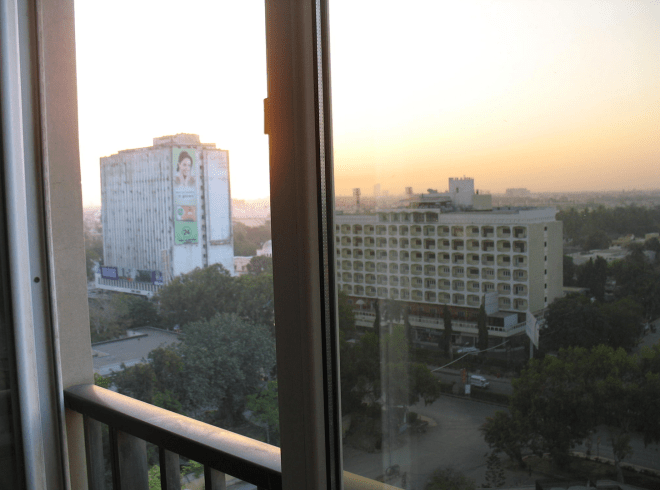
The View From Your Window Contest: Winner #149

Screen Shot 2013-04-13 at 3.31.10 AM

A reader writes:

The city in the picture has a very East-African vibe to it. My first thought was Khartoum but the greenery is generally lacking in Khartoum’s city center. I also noticed the traffic was left-sided. My gut tells me this is Kampala, Uganda.

Another:

The buildings and the advertising look very familiar (we like to backpack often, usually in Asia) and so I have decided to go with my gut and say Malaysia.  A look online for stadiums suggests a likely candidate is Stadium Merdeka, right in Kuala Lumpur.  While I cannot suggest what window this shot is taken from, my guess is somewhere like the Swiss Inn, on Jalan Sultan.

Another:

Not too much to go on this week. It’s warm, wherever we are, and there’s a language that uses the Roman alphabet, from what I can tell by squinting, and cars are on the “British” side of the road. I’m guessing Indonesia, not Malaysia, because the abundance of flat land reminds me of the east coast of Sumatra, and the haziness in the air reminds me of the smoke that used to blow across the Melaka Straits to Singapore when I lived there. Both Indonesia and Malaysia have a ton of those ads for skin-lightening creams, which is what the sign looks like (a terrible industry that too many Western cosmetic companies get away with participating in). So here’s a vote for Medan, Indonesia. I’m going to throw a dart and say the Tiara Medan Hotel. Someone with more time and better Google-mapping skills will probably beat me, but here’s hoping I’m on the right side of the world.

Another:

My guess this week, with no fancy computer analysis: Cairo, Egypt.

Another:

My initial reaction was that this was somewhere is Asia, but upon further inspection, I think it is southern Europe somewhere. People will undoubtedly try to decipher the ad on the building, but the best clues are beyond the buildings. One of my colleagues noticed that one of the buildings in the background looks like a castle, and off to the left it seems that there are stadium lights and stadium seating. There is also one palm tree that is visible. The air quality looks somewhat like it does here in southern California, and I think it is a fairly large city. But since we discovered these background buildings only a few minutes ago and time is running out, I am going to have to take a wild guess rather than an educated one: Seville, Spain.

Another:

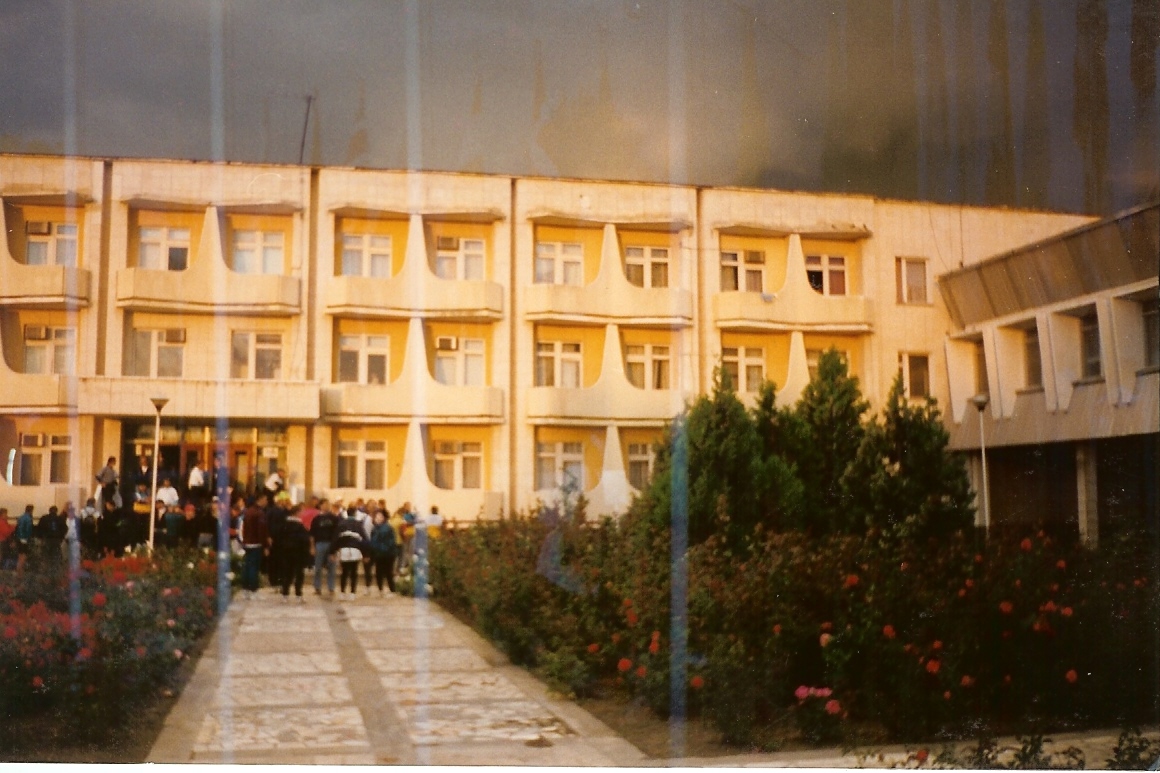
I suspect there is zero chance I’ll get this right, but it looks very much like a town in Russia I visited once on the Black Sea called “Anapa”:

32

However, most Eastern Bloc architecture looks like this.

Another:

Finally!!!  A place I recognize. This has to be India – that is an advert for Dettol soap. The image of a woman, with much lighter skin than the rest of the populace – where else but India!

Another:

Oh now you are just torturing me. Just like that bank branch near the Albania window gave me hope, I was psyched to figure out after a few false starts that the big ad on the side of the building is for Dettol Re-energize soap (“skin so healthy it glows!”). Turns out Dettol soap is sold all over the world, but the particular brand seems to be an Indian thing. So there we have it: India. How hard can that be? Not much help beyond that. There seems to be a stadium in the distance between the buildings with large light stanchions. I can’t spend too much of my like searching for Indian stadiums, and hotels nearby (that building in the foreground sure looks like a hotel). After a desultory look at New Delhi, Mumbai, and just for fun Karachi, I say forget it. I’m sure a Dishhead from India knows it on sight, but let’s just say New Delhi, near Delhi Gate. I look forward to finding out how far off I am.

Another gets the right country:

You must be flooded with Pakistan guesses.  Mine is the equivalent of a dart thrown from across the room. The Ashoka trees (those pointed leafy trees that grow so easily in the tropics) and the architecture all suggested South Asia. And the ad for Dettol soap on the building on the left looks like this one. Lahore is a wild guess. Road, building, etc: no freaking clue, really.

Another gets the right city:

Hmm, looks tropical, Middle-Eastern architecture, perhaps. Yellow plates with black lettering is a good clue … I’d guess this is Karachi, Pakistan.

Another goes into great detail:

At first glance, this week’s view looked promising – a large city, distinguishable buildings, tree lined VFYW1(2)boulevard, and a stadium in the background. The landscape alone was not enough to determine the region. It looks like places I’ve been in Africa, Southeast Asia, or the Indian subcontinent. The one signage that was clear (but may not be familiar to your American viewers) is the Dettol soap advertisement on the side of the office building. Searching Google for Dettol soap ads, I was able to determine the exact country where this advertisement runs.

Using the stadium as a landmark, the view was found to be from the Avari Towers Hotel in Karachi, Pakistan. The building on the right side of the view is the Hotel Mehran and the taller commercial building on its left is the Kashif Center. The landmark stadium in the background belongs to the Hockey Complex of Pakistan. My guess is that the view is from the 7th floor, as seen in the photo. Hope I’m right! (or closest).

Another adds:

A Google search of “Skin So Healthy It Glows” leads me to this Tweet by a Pakistani advertising agency identifying the lady in the billboard as actress Sonya Jehan.  A Google image search of “Sonya Jehan billboard” fortuitously – because Google mislabeled the image – leads me to this photo of the Kashif Center in Karachi, the building on which the billboard appears.  Google Satellite view tells me that the VFYW photo was likely taken from the Avari Towers building, 242 Fatima Jinnah Rd, Karachi, Pakistan.  I’ll take a wild guess and say the photo was taken from the 14th floor.

A previous winner writes:

Some contests, like last week’s, are difficult because they provide you with few distinct clues. Contests VFYW Karachi Actual Window Marked2 - Copylike this one, however, are challenging because the abundance of small clues means that a few will be red herrings. Whether you won or lost this week therefore turned on whether you chose the right clues to focus on. Some readers, for example, will have found the region’s architecture via Google and located the city almost immediately. But for those lured in by, say the row of cypress trees, it might have been a long weekend wandering through that tree’s native habitat in the eastern Mediterranean.

In any case, this week’s view comes from the heart of Karachi, Pakistan. The picture was taken just after dawn by a reader staying on roughly the 9th floor of the Avari Towers located at 242 Fatima Jinnah Road. The photo looks east, southeast towards the balconies of the Hotel Mehran at center frame. Just behind that building and to its left are the light towers of the Karachi Hockey Club’s stadium, whose grandstands are also partially visible. As for that giant billboard with the woman holding her hands to her neck, it’s an ad for an Indian hand soap called Dettol.

Another:

Woohoo! After years of being amazed at the folks who research the Internet to determine the location of your windows, I finally got one using that most wonderful sense – gut instinct!

Saw the picture and immediately got the vibe of Karachi, where I lived in the late ’80s and early ’90s. The Suzuki Carry in the image cinched it for me. Showed the picture to my dad who confirmed the building on the right was the Mehran hotel. Google told me the rest! The picture has been taken from the Avari Towers hotel, I’m guessing 10th floor, eastern-most room. I’m attaching a Google map picture:

avari towers

Karachi is a vibrant city that sadly is being torn apart by violence against religious minorities.

I’ve not submitted an entry in the past, so I probably won’t win, but I’ve been meaning to write in for so long this just seemed like a sign too blatant to avoid! My excuse for not writing earlier is that if I wait a day someone almost always says what I want to say before I say it. Anyway, good luck with the subscription model; you had my money on Day 1.

From the submitter:

Delighted again to be part of the contest. Sorry to be late; just back late last night from another trip, this time to exotic Columbus, Ohio.

The room number was 816, obviously facing southeast. Looking at the Bing maps view, if you think of the swimming pool as being south of the tower, the 816 window is the easternmost of five vertical bands of windows, approximately aligned with the east edge of the pool.

Normally I’d make a joke about my two recent submissions – Iran and Pakistan – something about Petraeus having been unavailable … but events today and yesterday lead to other associations: The major earthquake this morning in an area that Pakistan maps as a low seismic risk, felt about 800 miles away in Karachi. And the Boston bombing yesterday – just the sort of nonsense Karachiites have been living with for years.

Btw, I’m just finishing Steve Inskeep’s very good book, Instant City, about the impact of Islamism and ethnic factionalism in general on the development of Karachi as a megacity.

The following entry was the closest to room 816:

Wow, that was almost too easy. I’m a bit giddy at how things just fell into place. The name on the hotel is visible, but not sharp enough to properly read (HOTEL _ _ _RA…?). After a few wild guesses, image-karachiI decided to just do an image search for “Pakistan hotel” and just scan the results. I knew it was a silly stab in the dark, but unbelievably, it took no more than two minutes to come across this image of the hotel in question, Hotel Mehran. Then identifying the submitter’s location as Avari Towers was a simple matter of checking the area on Google Maps and a quick image search to confirm the building on the left is indeed Kashif Center.  No doubt this will will come down to the floor and perhaps even room number, so let’s say 8th floor and … room 807?

This is my first VFYW contest submission, as I usually don’t have much patience, but I might just be hooked now. I’m a Dish subscriber who splits his time between Hong Kong and Taipei. Keep up the great work!

Congrats to our reader on the tough win.  See everyone else on Saturday for the next contest.

(Archive)

Obama’s Gitmo Disgrace

Guantanamo Military Prison Stays Open As Future Status Remains Uncertain

We all know that the Congress is fundamentally responsible for keeping the former torture camp open, by preventing the executive branch from financing the transfer of any prisoners to elsewhere in the US. We also know that some terrorists were captured but with no real proof; and that some have been transferred to other countries. Of those some have taken up arms; some have simply melted back into society.

But we also know that 86 human beings there have not been found guilty of anything and are eligible for transfer – but must remain in prison limbo for the rest of their lives. We also know that there have been prisoner deaths at Gitmo that are extremely hard to explain without a working assumption that they were accidentally tortured to death by suffocation. Now we discover that lawyers for Gitmo prisoners going before the military commissions are subject to surveillance by the government, through secret microphones in cells and extremely sensitive video recording equipment. The farce of the commissions extends to outright violation of the most basic attorney-client privilege.

Seton Hall Law School’s Center for Policy and Research has a new report: “Spying on Lawyers at GTMO? Guantanamo Bay Military Commissions and the Destruction of the Attorney-Client Relationship.” It’s a comprehensive exploration of the legal crapshoot. Take a look. Money quote:

We now know that the government has installed surveillance devices with the capacity to listen even to whispers between attorneys and clients, and to read the Screen shot 2013-04-15 at 10.45.27 PMattorneys’ own notes.
• Of all the facilities in Guantanamo Bay for attorneys to meet with their clients, the military chose Camp Echo, the former CIA interrogation facility
• Listening devices in the attorney- client meeting rooms are disguised as smoke detectors.
• The listening devices are so hypersensitive that they can detect even whispers between attorneys and their clients.
• Cameras in the attorney-client meeting rooms are so powerful that they can read attorneys’ handwritten notes and other confidential documents.
• The camera models can be operated secretly from a location outside of the room.
None of the capacities of the eavesdropping equipment would be necessary for CIA interrogations. Instead, the equipment has been implemented in a practice of multi-layered deception of defense attorneys.

Under those conditions, how can there be even a semblance of a fair trial? And if you were subjected to such a farce, and knew that you were being prevented from ever leaving a prison where you were wrongfully detained in the first place. wouldn’t you go on hunger strike? You’ve been captured by military forces with no charges, taken to a torture camp, hooded and shackled, beaten and tortured, and now – even when found innocent – kept in the same black hole of indefinite detention. Yes, I’d go on hunger strike.

Sure, Obama appended a signing statement, but the 2012 National Defense Authorization Act bars any transfer of prisoners out of Gitmo and president Obama signed it. His administration has defended the US government’s previous positions with respect to the rights of the detainees; and the military commissions are a legal farce of a kind you only find in totalitarian systems of government. And Obama is emphatically not a bystander in this.

Greenwald gets into the details:

Obama’s task force in early 2010 decreed that “48 detainees were determined to be too dangerous to transfer but not feasible for prosecution” and will thus “remain in detention”: i.e. indefinitely imprisoned with no charges. Given these facts, one cannot denounce the disgrace of Guantánamo’s indefinite detention system while pretending that Obama sought to end it, at least not cogently or honestly … In January, 2010, Obama – not Congress, but Obama – announced a moratorium on the release of any Yemeni detainees, even ones cleared for release.

The Yemeni government will take them – and is, in fact, demanding them. But Obama himself has decided he cannot risk letting innocent prisoners go to a country dealing with an Islamist insurgency itself. Many of the hunger strikers are precisely these Yemenis, and, as Greenwald notes, Obama as commander-in-chief has the power to grant a ‘national security waiver’ for the prisoners. He should use it. Is there a danger that these prisoners might turn to Jihad as a form of revenge for a decade of illegal imprisonment? Yes, there is. Is there a danger whenever an actual criminal is released from jail? Yes, there is. But the indefinite imprisonment of individuals cleared of all crimes is simply a violation of basic human rights. It cannot – must not – stand in America.

Obama did not create Gitmo and he wanted to close it. But he cannot have it every which way. By sustaining the prison and former torture camp, by keeping human beings locked up for ever for no reason but his own political fears of looking weak on terror, he is now fully responsible for the deaths that may ensue or the barbaric force-feeding that now appears to be routine. These men are not guilty. For America to imprison them indefinitely in that knowledge and not transfer them to their country of origin is simply a betrayal of core values. That the Obama administration is also spying and videoing confidential attorney-client conversations is also an outrage. Where is the Chicago Law professor when you need him?

We didn’t elect and re-elect Barack Obama to trash American values. We elected and re-elected him to restore them. As Glenn notes, this is not about his or anyone else’s legacy. It’s about the core question of whether in a free society, the government has a right to imprison people without charge, deem them innocent and eligible for release and yet keep them in prison for the rest of their lives.

For those in that haunted torture camp, there really is a fierce urgency of now. Let them go.

(Photo: A detainee stands at an interior fence inside the U.S. military prison for ‘enemy combatants’ on October 27, 2009 in Guantanamo Bay, Cuba. By John Moore/Getty, after Pentagon review.)

The Deconstructed Pop Star

Adam Ash toasts David Bowie:

Before him, public figures worked at creating an enduring single persona. Even actors did it — John Wayne as avuncular cowboy; Clara Bow as vamp; Cary Grant as the ideal gentleman date; Humphrey Bogart’s cynical tough guy covering up a morally upright soft heart (when he started off as an upperclass white-tie fop on Broadway). But Bowie said, nope, I’ll create a new self every now and then. In his public personas, Bowie exemplifies the psychological theory which says we consist of various self-states, who need to make peace with one another. Except his self-states are so various, there’s no way they could be integrated.

And the singer is still taking England by storm: 

His first album in 10 years is top of the charts, and a V & A museum exhibition, “David Bowie Is,” devoted to all things Bowie and drawn from his personal archive, is the greatest thing that this august establishment museum has ever put on: double the ticket sales of any previous exhibit in its 160-year-long history. Selfridges has pop-up stores where you can buy Bowie T-shirts and stuff, and there’s a makeup kit for you to Bowie-make-over your quotidian visage. His album is tipped to win the Mercury prize. Not a day goes past that there is not a Bowie pic or article in the popular press. There’s even been an April Fool’s joke about Bowie opening a pet shop called Spiders from Mars, which would sell some of his favorite spiders as pets.

Did Obama’s Race Hurt Him? Ctd

Nate Cohn recently argued that “the long term decline in Democratic fortunes in the South and Appalachia” largely explains why Obama did worse in the more racist parts of the country. Seth Stephens-Davidowitz pushes back:

First, if this were true, any Democrat, not just Obama, should have underperformed in such areas. In early 2008, SurveyUSA polled hypothetical match-ups between each of Obama, Hillary Clinton, and John Edwards and various potential Republican nominees. Obama consistently underperformed among whites in areas with higher racist search rates. Clinton did not. Edwards did not.

Second, if areas with higher racist search rates were punishing all Democrats in 2008, relative to 2004, a similar relationship should be seen in House voting patterns. House Democrats should have also underperformed in these areas in 2008, relative to 2004. They did not.

Converting To Atheism, Ctd

This embed is invalid


A minister criticizes Susan Jacoby for cherry-picking religious arguments:

Why is there polio? Why are there diseases?” If there is a good God why are there these things? The answer of the religious person is “God has a plan we don’t understand.”

That is not the religious answer.  That is a religious answer.  It happens to be a bad answer.  It is bad theology.  Atheism is a rational rejection of bad theology – and more power to them.  But there is also good theology out there – good religious answers which do justice both to our reason and to our spirits.

Why does God allow polio and disease and other bad things to happen to good people?  Because God is not an omnipotent manipulator of the world.  Because God works through the system, not over-powering it.  Because we have free will that allows us to create justice and love, and also evil.  God’s power is not coercive (“you must not do that horrible thing and I will stay your hand”) but patiently persuasive (“there’s a better way, make a better choice”).  God’s “plan” was not to create polio, or human beings, but to set the conditions and watch what we do, and to use that “still, small voice” to gently urge all creation toward divine ideals of deep rich experience, consciousness, love, marvelous beauty, and thoughtful theology.

As any teenage theologian can see, the idea of a simultaneously all-powerful and all-loving God is impossible based on the evidence of the tragedies that befall us everyday.  But there is better theology available.  The churches should be better teachers.  And atheists shouldn’t give up so soon.

Another reader views her youthful conversion to atheism as simply a step in her lifelong spiritual development:

During those early years it is not just typical but imperative for intellectual development to question all received wisdom. Everything that once made sense no longer does. Faith in God is a great example of that because it is taught to children when ultimately, to be authentic, it must be felt.

But the years after do something to us. We have hard times and unexpected joys and we begin to see nuance and complexity where everything had previously been so black and white. We’re humbled by this, by the sense that what we accepted may have been wrong, that we are and always will be a work in progress. For many people, that means discovering faith in a more mature and meaningful sense than what we were given as children.

I certainly followed that trajectory. As a teen and young adult, God just didn’t make sense to me. I couldn’t understand how anyone could believe that irrational nonsense. But at some point in middle age, as I negotiated the rough contours of my life, I began a kind of inner dialogue – sometimes accusatory and angry and sometimes grateful – with, I thought, myself. Eventually I realized I was engaging in a personal relationship with God. And once I understood that, fully grasped it, atheism just didn’t make sense to me anymore. Once again, everything that had made sense to me no longer did. I have a faith that I never thought I would have.

One reader takes issue with Jacoby’s tone:

My beef is actually with Susan Jacoby and the flippant way that she deals with the conversion of Paul. The problem with atheists has always been that they pride themselves on having discovered ‘the truth’ and hence also accord themselves the licence to belittle people of faith. In Susan’s words, ‘A voice appears out of the sky, you fall off your horse, you hit yourself on the head, and when you wake up you know Jesus is the lord.’ To deal with the conversion of Saul in such a disparaging way is why people of faith have no patience with the logic put forth by atheists. Saul didn’t fall down from his horse and hit his head and wake up a loony. I can take any text from any book and put forth the same derisiveness. All it requires is a little sarcasm and cynicism.

According to the Bible, you don’t need to worship stones and trees or have Gods with exotic names like Baal and Astaroth. When atheists are unwilling to entertain an opposing thought and are dogged about their determination to have converts, then it’s just another religion.

Another reader focuses on Saul’s conversion, and describes his similarly sudden conversion to atheism while visiting Mecca:

There I was in the middle of the teeming masses, observing an essentially pagan pilgrimage co-opted by Islam to gain the support of Mecca’s merchant class whose livelihoods had depended on it, a fact conveniently ignored/forgotten by most Muslims. And it hit me right there and then! None of this made any sense! NONE! Why are we going around this big black cube? Why do we have to pray five times a day? If God is all-knowing and all-powerful, surely he doesn’t need us to reaffirm our faith in him five times a day.

I left Mecca with the firm conviction that I was better off not worrying. I was already 40 years old, and I had a strong sense of right and wrong, and how to live the best life I could possibly live and how to be the best human being I could possibly be; a work in progress admittedly. I guess I had a Damascene conversion in Mecca!

Another points to Ricky Gervais (in the above video) as a similar “Damascene convert.”

The Atheist’s Belief In Medicine

Seamus O’Mahony, a physician, reads Hitch’s Mortality:

I am intrigued by Mortality for one main reason, which is this: Hitchens’s beliefs about his advanced cancer and its treatment were, for a man whose fame rested on his scepticism, uncharacteristically Hospice Cares For Terminally Ill During Final Daysoptimistic. I hesitate to use the word delusional, as he admitted that he would be very lucky to survive, but he clearly steadfastly hoped, right to the end, that his particular case of advanced cancer might lie on the sparsely populated right side of the bell-shaped curve of outcome statistics.

He famously mocked religious folk for their faith in supernatural entities and survival of the soul after bodily death, yet the views expressed in Mortality are just as wishful and magical. “The oncology bargain (oncology is that branch of medicine which deals with the treatment of cancer),” writes Hitchens, “is that in return for at least the chance of a few more useful years, you agree to submit to chemotherapy and then, if you are lucky with that, to radiation or even surgery.” Years? I must now confess to a professional interest. I am a gastroenterologist in a large acute hospital, and I have diagnosed many patients with oesophageal cancer. “Years” is a word not generally used when discussing prognosis in Stage Four oesophageal cancer, “months”, in my experience, being a more useful one.

I’ve no watched two friends – an atheist and a Christian – go to extraordinary lengths to extend their lives against great odds. They were both relatively young – especially David at 34 when he found out. No one wanted them to go. But I wonder if all that medicine – which was, in fact, a form of poison – was worth it. David got ten more years, and two young children. But he also endured a disfiguring, disabling, brutal physical battering from the surgeries and chemo-sessions that tackling a tough brain tumor allow for. I say “allow for” because “required” is not the right word. What the chemo did to Christopher was beyond description – and what’s left of your body, even if the chemo works, can be extremely vulnerable to infections and diseases that can be worse than the cancer.

It seems odder to me for Christians to be as exercized by life-extension as the atheist. Put that down to the strange extremism of Ratzinger’s innovations on the question of “life”. But our culture’s gradual alienation from the fact of our deaths – our distancing ourselves even from the old and infirm in ways previous cultures didn’t and couldn’t – is not, in my view a healthy thing.

No one should seek to die or give in to a disease they can legitimately fight. God knows how many pills I take a day to keep the virus – and all its and their side-effects at bay. But I get to live healthily and meaningfully. The way some elaborate and cutting edge treatments all but kill the patient in order to save her troubles me. It’s a loss of perspective as well as immensely expensive for the entire system. Unquestionably, these sophisticated treatments are taking healthcare money away from the young, taking up more and more of our collective healthcare resources, and extending lives only be perpetuating continuous agony and nausea and pain for the patient and devastating consequences for families and friends.

We will all die. We should not seek it. But we should not flee from it for ever. I walked a 94-year old friend home last night in her wheelchair after a visit. She told me that she had worse and worse panic attacks. What are you afraid of? I asked. “Death,” she replied, with characteristic candor. I cannot blame her. And I cannot blame all of those who do everything and anything to avoid it. But at some point what seems to me to matter more is not the length of our lives but the content of them and the manner of our deaths.

At some point, medicine is a function of a social disease of modernity: the flight from our own mortality. But fleeing it does not defuse it. Only facing it does.

(Photo: John Moore/Getty.)