Bonding Over Booze

Jessica Freeman-Slade reviews Rosie Schaap’s memoir, Drinking with Men:

As a teenager, she’d dress like a Gypsy and offer tarot card readings on the Metro-North New Haven line for free beers; as an adult uncovering her latent spirituality, she’d find refuge in bars between stints as a volunteer chaplain at the foot of ground zero; as a married woman, it took a special bar in Montreal to feel her relationship coming apart. To be a bar regular, she says, is all about “adapting—and about enjoying people’s company not only on one’s own terms, but on others.” We go to bars to find ourselves in other people’s habits, and in finding other people, find ourselves.

Freeman-Slade tested out Schaap’s advice in bars across New York City: 

[Midtown East and West] is where I first started to see what Schaap was drawn to in her favorite bars: the friendships between the patrons, and the warm greetings by the bartenders that recognize them. At the Archive, a little place in Murray Hill where the happy hour red wine was perfectly quaffable, I found a gaggle of midtown lawyers, each clinging to his bar stools and ordering an elaborately named scotch or whiskey of choice. “Can you believe how expensive it is to drink in NY?” asked a red-faced man in a too-tight shirt, leaning across my chair to snatch his vodka-and-soda. “It’s a luxury activity,” I respond, and we clink our happy-hour drinks in solidarity. A frizzy-haired woman to my left swished a diluted cocktail between her teeth as she complained about her work week to the bartender, but even she declined a refill. “I’m going to surprise my husband tonight,” she snickered, and then added, with a low raspy chuckle, “I hope it’s not a bad surprise.”

Such confessionals would be out of place at a fancier bar, but watching people ease out of the workdays can be your first instruction in how to drink like a grown-up. Schaap said, “I’ve come of age in bars,” and perhaps the post-work drink is how you first observe functional adults at play.

When Will All Americans Get To Enjoy Havana? Ctd

Jay-Z composes a response to the critics of his trip:

This embed is invalid

Full lyrics here. A reader talks about his trip:

I was a senior in high school in 2001. That year, I was taking a class on Caribbean Civilization, which included a trip to Cuba. September 11th was the second week of school, and all international trips were canceled in its wake. My parents, after realizing how much money they were saving (I was also slated to go on a band trip to Italy), decided that they’d always wanted to go to Cuba. The school trip was legit, with educational visas and all. My parents and I took the easy route: we drove to Canada. From there it was an easy flight to Havana (on Air Cubana, but on a leased Airbus as opposed to, say, a Soviet-era Tupolev). We had a lovely week in Cuba (perhaps not as educational as if I’d gone on an exchange with my class) and certainly broke the travel ban (which is really a spending money ban).

At the time, everything in Cuba was available for US dollars, so we had no issue paying for anything. We were with a tour group, but we were four of the six in the group, so we were able to cajole the driver to let us drop in on state-run stores, fruit stands and the like. We were certainly tourists. But there was something fulfilling to flouting a ludicrous ban.

When we arrived, our passports weren’t stamped, but customs gave us a separate sheet of paper to get stamped (this is SOP for Americans visiting). Coming back in to the States from Canada there was no passport check at the time, and customs in northern Vermont thought we were a family coming back from a week in Quebec. (We were, we just happened to jet south for a few days.) At the time, enforcement of the ban was very sporadic. Apparently, if you were caught, you’d get a letter telling you that you were being fined $11,000. If you ignored it, you’d get a second, strongly-worded letter. If you ignored it, the Feds would go do something more useful – which is, of course, pretty much anything.

Apparently, the Bush administration went and staked out some airports (good use of government resources, guys!) but that has lapsed in the Obama presidency. In fact, there have been efforts to have the fine applied to push the law into the courts (it’s dubious whether it would withstand constitutional scrutiny, especially in the current state where people with family in Cuba are regulated differently than everybody else) but even open flouting has not been punished. And when Forbes is publishing opinion pieces by AEI guys arguing the ban is folly, well, there you go.

In any case, had Jay-Z and Beyonce been caught, they would have been hit with a $55,000 fine. Which I’m sure they could have afforded. Maybe the only way to get rid of the ban is to say that the fine amounts to a tax, and the Republicans in the House will all jump up to vote it down.

Another reader:

I travelled to Cuba almost exactly one year ago, and it was eye-opening. I didn’t need to obtain special permission from my government to travel there because Canada, despite its conservative government’s open opposition to the Castro regime, permits its citizens to freely travel to Cuba.

It’s a beautiful country, and full of natural wealth just waiting to be exploited. (We drove passed several Chinese- and Canadian-run oil wells on the way to Havana.) But its greatest resource is its people. Cuba is a country with a bright future ahead of it, because its people, while poor, are very well-educated. The Communist regime in Cuba does a lot of things wrong, but education is not one of them. Education at all levels is free for everyone in Cuba, and people take advantage of this. Sure they teach a specific version of history etc., but despite the government’s efforts to inculcate loyalty to the Revolution, the young people are just not buying it, much to the chagrin of their elders.

And things are changing. Our tour guide into Havana operated a private taxi company – he owned his taxi and made his own money. He was a fountain of information, actually the main source for most of what I’m writing. He believed that Raul Castro was going to accelerate the pace of change, because unlike Fidel, Raul is not an ideologue. He wants two things; for his regime to survive him, and for Cuba to thrive.

The fact that Raul claims to be stepping down in a few years offers hope that America might finally end its ghastly embargo, which succeeds in doing nothing but keeping Cuba’s educated and industrious population poor and driving a museum of classic cars from the 50s (which is very cool for visitors, but very uncool for them). Our guide claimed that the government just uses the embargo to stay in power anyway – they have the ultimate excuse. Every economic woe can be blamed on the embargo. They even blame natural disasters on the embargo he joked. (Or maybe he wasn’t joking?)

So the embargo is doubly ineffective – it impoverishes Cuba’s population by robbing them of their natural trading partner, and it gives the Communist government a trump card it can always play against all criticism. That’s pretty much a textbook lose-lose.

Low-Caliber Gun Control, Ctd

A aspect of the new legislation that holds promise:

The Hadiya Pendleton and Nyasia Pryear-Yard Anti-Straw Purchasing and Firearms Trafficking Act, which is also being considered, would make it a felony to purchase a gun on behalf of someone else who is prohibited from owning it. The penalties range from 15 to 25 years.

In theory, this part of the package could be strong where the background checks are weak. The street has to get its guns from somewhere, after all. Someone with a clean record can buy 60 guns at a gun show and then begin selling them at a healthy mark-up on the street. With no records of the gun-show sales, and weak laws around private sales, the police have little ability to crack down on these suppliers.

Earlier Dish on the Senate’s gun control bill here.

What’s A Silencer For? Ctd

A reader writes:

Do you want to know why silencers are used in few crimes?  Because they’re controlled very strictly and because they’re bulky and attract suspicion.  Most gun crime is committed by relatively poor people using disposable guns that have been stolen or straw-purchased, then kept concealed someone’s pants.  Silencers are hard to come by and specialized, and counterproductive when it comes to concealment.  If they were easy to get, however, I suspect you’d see an uptick in their use in assassination-type crimes and home invasions.

Another:

Just wanted to take a sec because this whole debate annoys the hell out of me. This is a case where a very small number of radical gun owners are making a bad name for the rest of gun owners by blatantly misrepresenting facts.

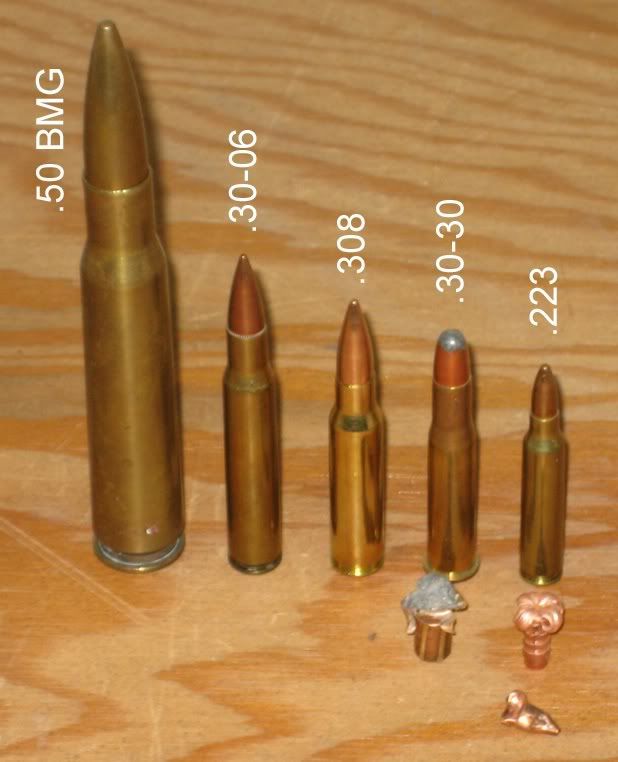
Silencers CAN make guns nearly silent. There’s a reason why every video sent around by pro-silencer groups features either weapons that shoot high velocity rounds or large caliber rounds. A 30-06, which is a very common deer rifle round, is much much larger and more powerful round than a .22, as you can see in this image. The problem is a .22 round can still easily kill a person. And a .22 pistol is not at all uncommon in violent crimes. [Above] is a video of a suppressed .22 caliber rifle. The only sound the rifle makes is from discharging and chambering a round. You could be 10 feet away and not notice the sound.

There’s no reason for people to own suppressors.

I’ve shot pests from the back yard before. My neighbors do it too. People act as though it’s a bad thing that neighbors know that they’re shooting behind their house. That’s insane! It’s a GOOD thing guns are loud. It’s a GOOD that the neighbors hear the shots. It’s terrifying to me that a neighbor could be firing weapons right next to me and I don’t know it. What if I walk over to say hi? I could walk into the line of fire without having any clue.

On the flip side, a few more readers defend suppressors:

I thought I would pass along this study (pdf), which compares the noise-reducing values of ear protection v. suppressors. As you can see, even if you wear ear protection on non-suppressed firearms, there is still a chance of hearing impairment. That danger is removed with the use of a suppressor.

Some argue that hunters do not need suppressors because they can wear ear protection. Are you kidding me? Hunters use all their senses in the field, especially hearing. How can we detect which direction the deer is coming from or how can we hear the approaching geese while wearing ear protection? How can I be aware of other concealed hunters who whistle to reveal their position for safety reasons if I’m wearing hearing protection? Those who base their opinions of suppressors or hunting off of movies or their imagination need to put a silencer on their muzzles (yes, terrible pun intended). Goldblog being one of them.

The other:

As an owner of several, I can tell you there is an important function to suppressors that’s been overlooked in the discussion so far: safety. I’m a responsible gun owner and take pride in introducing friends and family to how much fun recreational shooting can be. Many people who have gone shooting with me have taken their first shots on a suppressed weapon because it eliminates the overwhelming sound (and associated adrenaline rush) that comes with firing a gun. Shooting suppressed allows me to stress the fundamentals, make sure they hear any safety warnings without being muffled by hearing protection and don’t have to compete with the shaking hands and tunnel vision that happens when I let people start shooting unsuppressed.  On a roller coaster or some other controlled environment, adrenaline can be fun.  With a firearm in unfamiliar hands, not so much.

In fact, when my two young daughters are old enough, their first shots will be suppressed.  I’d much rather they know how to safely operate a gun than simply be afraid of the loud noise.  I’ll have them continue to shoot suppressed to protect their hearing and allow them to develop the muscle memory required to be an accurate, safe shooter.

I disagree with NRA on many issues.  But on this one, more access to suppressors is a no brainer.

A Custom High

Vanessa Grigoriadis explores the wild frontier of synthetic drugs and the “underground scene of hobbyists and tinkerers, hippie-meets-hipster drug geeks, who like to call themselves psychonauts” experimenting with them:

They’re most interested in the ability to custom-match a substance with a desire—even if, in some cases, the new drugs are substandard to known ones (making your heart race; shoving you through a fractal landscape with elves coming out of the gloaming; making you feel weird, and not good weird, but bad weird). “You can pinpoint what you want now: ‘I’d like something of four hours’ duration with mescaline effects, or twelve hours’ duration with alternating mushroom and LSD rushes,’ ” says a 37-year-old software engineer … .

The government is trying to crack down of course:

Morris calls the current situation an “infinite game of cat and mouse,” where the government schedules a drug, then chemists race to find a new legal compound.

“Three weeks ago, we had our first detection of new derivatives, PB-22 and 5F-PB-22,” says Kevin Shanks, a forensic toxicologist in the Midwest. “Quinoline derivatives are uncontrolled by the federal government, and I see them becoming prevalent very quickly.” Adds Lapoint, the toxicologist: “Until we can break the model of releasing a new chemical that retains the same affinity for the receptor of an illegal drug but is structurally dissimilar enough that you can avoid getting popped, this is the new normal. Brick-and-mortar quasi-legal head shops are hard enough to stop, but the Internet vendors are fully whack-a-mole … The new drug dealer is the mailman.”

Will the cat finally catch the mouse? Some psychonauts fear that the government, in desperation, might take a pharmacode dynamic password approach, looking at the receptor activated by the drug and scheduling backward from there, claiming that any organic molecule that binds to the CB1 receptor and makes you stoned is a schedule 1 drug. But then they’d have to schedule other drugs with CB1 affinity, including Tylenol.

Everything is chemistry, as Walter White has taught us. The rest is our often arbitrary moral judgments about varieties of human pleasure and experience.

The Burke-Buckley Divide

Carl Bogus examines it:

At the most fundamental level, Burke was a communitarian. It is institutions — governmental, professional, religious, educational, and otherwise — that compose the fabric of society. … For the Burkeans of the 1950s, emphasis on community was at the heart of a properly conceived conservatism. [Russell] Kirk wrote: “True conservatism … rises at the antipodes from individualism. Individualism is social atomism; conservatism is community of spirit.” Robert Nisbet titled his book The Quest for Community.

Though it may surprise people who have been taught that Edmund Burke is the father of modern conservatism, the Burkeans were, in fact, defeated by a rival group with a nearly diametrically opposed view. The leader of that group was William F. Buckley Jr., founder of National Review. When, in 1952, Buckley first articulated his philosophy in God and Man at Yale, he called it “individualism,” though the nearly absolute laissez-faire philosophy he advocated became better known as libertarianism.

He wonders if modern conservatives might find their way forward by looking back:

Maybe Buckley’s was the necessary path in the 1950s. Conservatism then needed to differentiate itself starkly from the prevailing liberalism. Burkeanism would have made that difficult because, as Kirk often observed, Burke was both a conservative and a liberal. But if conservatives today are looking for wisdom — and maybe even a less truculent partisanship — they might consider the path not taken.

The Buckley wing is perhaps best illustrated by Margaret Thatcher’s famous pronouncement that “there is no such thing as society.” I think that phrase has been a little distorted from its context, as David Frum has noted. Here’s the full context:

I think we have gone through a period when too many children and people have been given to understand “I have a problem, it is the Government’s job to cope with it!” or “I have a problem, I will go and get a grant to cope with it!” “I am homeless, the Government must house me!” and so they are casting their problems on society and who is society? There is no such thing! There are individual men and women and there are families and no government can do anything except through people and people look to themselves first… There is no such thing as society. There is living tapestry of men and women and people and the beauty of that tapestry and the quality of our lives will depend upon how much each of us is prepared to take responsibility for ourselves and each of us prepared to turn round and help by our own efforts those who are unfortunate.

You can see it’s an attempt to restore a better balance between the individual and the society as a whole – because in her time, the collective had become culturally enervating. It was a provisional correction to an emergent social problem (i.e. a Tory argument) rather than some kind of sternal philosophical pronouncement (the Randian approach).

I favor a balance between Burke’s Whig instincts (that was his party, after all) and his Tory understanding of the centrality of culture and history. Society does not begin with the individual; it begins with the household and extends outward to civil society, Burke’s “little platoons” of associations and communities, and then to a strong government fair and limited enough to allow the individual, if he or she chooses, to forge his or her own path. Individualism is itself a product of a particular social achievement in democratic liberalism. It is the end of the great Anglo-American experiment in ordered liberty. It is not the beginning – and a failure to understand that can undermine liberty entirely.

Hence the notion that extreme social and economic inequality – although defensible on abstract libertarian grounds – is actually a threat to individual liberty. Because it threatens the legitimacy of the system that made individual liberty possible.

No man is an island, Senator Paul. Including you.

I think some libertarians’ blindness to the social underpinnings of individual freedom does them a disservice. Perhaps America’s newness allowed the forgetfulness. But England’s conservative tradition cannot forget. Which is why, in the grand sweep of Tory history, Thatcher was the exception – a particularly strong strain of Whiggery in the Conservative elixir.
Books Are Bigger Than Ever

The NYT recently ran an op-ed by author Scott Turow bemoaning both the recent decision to allow resale of foreign editions as well as the overall effect of e-books on the publishing industry. Mike Masnick is unimpressed:

[T]he idea of a literary culture at risk is laughable. More books are being published today than ever before. More people are reading books today than ever before. More people are writing books than ever before. Books that would never have been published in the past are regularly published today. There is an astounding wealth of cultural diversity in the literary world.

Sure, some of it means a lot more competition for the small group of authors (only about 8,000 or so) that Turow represents… oh wait, I think we’ve perhaps touched on the reason that Turow is all upset by this. But, of course, more competition for that small group of authors does not mean the culture of books and literature is at risk at all. Quite the opposite.

Alison Baverstock, meanwhile, argues that “self-publishing brings happiness”:

Publishers have long assumed that only if nearing professional standards could a self-published product bring any satisfaction. My research has revealed the opposite. It seems self-publishers approach the process confidently, are well-informed, and aware of how much the process will cost and how long it is likely to take. They emerge both keen to do it again and likely to recommend it to others. Finalising a project you have long planned feels good, and the process builds in the possibility of future discoverability – whether that is in an attic (whenever the family decides they are mature enough to want to know), or by ISBN from within the British Library. Self-publishing as a legacy – should we really be so surprised at its growing popularity?

The Right Kind Of Recycling

David Roberts interviews Bill McDonough, co-author of The Upcycle: Beyond Sustainability – Designing for Abundance, about the failures of recycling:

We often talk about recycling, but we’re actually not. We are downcycling. Take a plastic water bottle. If we recycle it into a park bench, it’s actually downcycling, from a quality perspective. I’ve reused the molecules, so that’s recycling polymer. But I’ve reduced its qualities, because I mixed it with other things, hybridized it, let’s say, with other polymers and various dyes and finishes. The flower pot I made it into is going to a landfill, or potentially an incinerator. It’s downcycling, cascading down in quality, from cradle to grave, or cradle to crematorium.

Now, if I take something that’s problematic, like soft PVC, that contains plasticizers, alloys, endocrine disrupters, materials that are gassing and become dioxins that could cause cancer, and I recycle that — is that recycling good? No.

Recycling’s a process; the product is good or not depending on human values. It’s sort of like efficiency. If I’m a terrorist, and I’m efficient, it’s worse. So if I’m recycling, that’s great, but if I’m recycling things that have become carcinogenic, is that great?

Upcycling is about increasing the quality as it goes to its next use. So, that water bottle. There is a residue in the bottle from a catalytic reaction involving very low levels of antimony, which is a heavy metal. Although it may not be dangerous when you drink water out of the bottle, it is something that’s suboptimal from a cradle-to-cradle perspective. If I burn the bottle as fuel, I get anti-trioxide in the atmosphere. Not a good thing. Why would I want a system of polyesters contaminated by heavy metal, when I’d like to use them forever, again and again, safely?

Upcycling means that we’d get that bottle back and take out the antimony. It gets better. That’s what we mean by upcycling: the idea that things get better when humans touch them.

The Novelization Of TV, Ctd

A reader quotes Alyssa:

“In a book, you can stay within the medium and flip back and forth if you don’t remember who a character is…” She goes on to contend that you can’t stay within medium with a TV show if you need to “remember” something.  I agree to an extent, but people are increasingly moving away from the traditional model of watching a TV show when the network broadcasts it.  Because of HBO’s crazy protection of the product, those unwilling to pay for a year of HBO for one series are going online to view Game of Thrones.  The medium for those folks is not “television” but rather the Internet, complete with wikis and fan pages, etc.  Also, because this particular show is already a popular novel, there is a different medium that is actually inseparable from the TV show.

Another reader:

Novelized TV series on American television are not a new thing.  The best example may be Babylon 5, a sci-fi series that ran for five seasons from 1993 to 1998.  The show’s writer, J. Michael Straczynski (JMS to the show’s fans), planned it as a five-season show from the start, describing it as a “novel for television” with a defined beginning, middle, and end.  It featured the ensemble cast and multiple story arcs that characterize the current generation of novelized TV.

Babylon 5 also pioneered integrating television with what we now call social media.  JMS kept up a continuous dialog with viewers through the pre-web USENET, GEnie, and CompuServe forums.  More than once JMS wrote jokes, names, or other references from these online discussions into the show as a salute to online fans.  It was a very Dish-like participatory atmosphere.

Another:

Japanese anime has been doing things this way for decades.

Most anime TV shows (the good ones anyway) shoot for a single season, maybe two or three, and then proceed to tell an overarching story epic, with episodic digressions strategically paced throughout.  This allows for a story-driven experience over the whole of the series, instead of each episode being self-contained as in many sitcoms and dramas, and creates the same incentives for binge-watching, including being able to keep track of a sprawling, diverse cast (“Fullmetal Alchemist” is a great example).  It also allows the creative minds behind the show to plan ahead for a proper resolution and conclusion to the series, instead of it dying a slow death or being cancelled outright.

Recent American television shows have finally been taking a page from the same book, notably Joss Whedon’s “Firefly” and “Dollhouse,” as well as many of the USA original series, like “Burn Notice” and “White Collar.”

Another:

It’s not clear to me that “Game of Thrones” has so path-breaking a model (not to say that it’s not good, it’s just a question of how new it is). Korean prime-time dramas have been doing it this way since the 1990s anyway, with a series lifetime of from 12 to 24 episodes mostly, generally airing two episodes a week. Prime-time historical biodramas may go into the 150-episode ballpark, airing twice a week, but they have a lot of outlay on sets and costumes to make back. Even their “daily dramas”, comparable to US daytime soap operas, don’t go on “forever” – 100 to 150 episodes is about the range. (Although I remember one that went 350 episodes. But still, that’s not a full two years.) All these dramas including the “daily dramas” generally have a clear dramatic arc.

I’m not familiar with Latin American “telenovelas” but I know that they aren’t “endless” either. Actually I suspect that the old U.S. primetime TV ideal with an “endless” series, a static cast and environment, and episodes that could be aired in any order really – like “Perry Mason” or “The Dick Van Dyke Show” – have been pretty much an exception in the world scene.

Furthermore that model was never really been so universal even in U.S. 3-network TV. Daytime serials had histories, and when the format was transplanted into evenings – “Dallas” or, before that, “Peyton Place” – you started to have to follow the action to know what was going on. There were also the World War II-based dramas like “Combat” and “Gallant Men” – the episodes were pretty self-contained, but you knew they couldn’t slog through France and Italy forever the way Marshal Dillon could police a timeless town. Then there were dramas like “The Fugitive” which at least held out the prospect of “dramatic resolution” of the whole series even though there wasn’t much in the way of story development from one episode to the next, barring the finale.

I suggest that the real path-breaker was “Roots” including the “Next Generation”. The only difference between that and our current series arcs was that its “seasons” were each jammed into a week of intense viewing. The miniseries format went on from there. Meanwhile other more conventional dramas, like “St. Elsewhere” and “Hill St. Blues”, and comedies like “Roseanne” and probably some earlier ones I’m missing, incorporated multi-episode plots and season-long story lines involving the personal lives of their characters. With the thirty-nine-episode season for a drama program now down to 22 for broadcast TV and 12 or fewer for cable, the “series” and the “miniseries” have now sort of converged in the middle.

The Bitcoin Bust

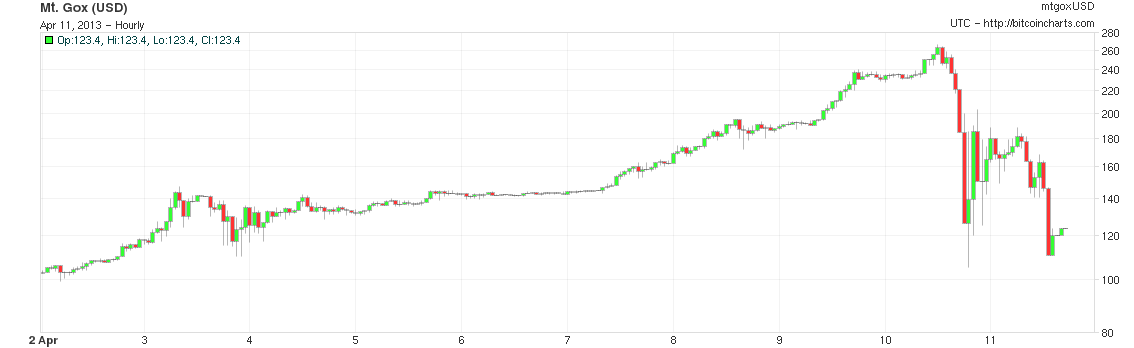
Yesterday, the value of the newfangled currency plummeted 61 percent:

Bitcoin_Chart

Timothy B. Lee points out that Bitcoin has crashed and recovered several times before. Yglesias expects this cycle to continue:

The problem is that if the price of a bitcoin is on a steady upward trajectory, then nobody’s actually going to want to spend a Bitcoin on anything. And if everyone’s hoarding their Bitcoins, then the network is actually useless. Then, since it turns out to be useless, you get a crash. The funny thing is that once the upward spiral comes to an end, then the technological virtues of the Bitcoin platform come to the fore again. If nobody wants to hoard Bitcoins, then Bitcoin-as-platform looks like an attractive alternative to elements of the payment system. But when Bitcoin starts looking attractive again, you should get a renewed hoarding cycle.

Jerry Brito argued recently that Bitcoin’s valuation doesn’t necessarily matter:

Bitcoin will work as a seamless payment system so long as you can get in and out of it quick enough to mitigate volatility. That is largely a technical consideration, but it could also depend on the market’s liquidity, which conceivably could be hurt by speculative hoarding. I haven’t given this much thought yet, but given that bitcoin can be denominated down to eight decimal places, I’m not sure it will be a big problem anytime soon.

Felix Salmon thinks Bitcoin is too volatile to work well for payments:

Currently, it can take an hour for a bitcoin transaction to clear, which means that the value of the transaction when it clears can be radically different from its value at inception. Bitcoin only works for payments if you can be reasonably sure that its value will remain reasonably steady for at least the next hour or so.

McArdle bets that governments will restrict Bitcoin’s growth:

I think that governments can make it so difficult to translate your bitcoins into the real economy that most people simply won’t bother. And the more successful that bitcoins are–the better they become established as an alternate currency–the more likely it is that rich-world governments will swoop in and make it prohibitively difficult to use bitcoins to procure real-world goods in developed countries. At that point you’ve essentially got a novelty currency like greenstamps, which can be exchanged for only a limited supply of goods, and maybe some developing-world travel.

Eric Posner calls the currency a “Ponzi scheme”:

A regular Ponzi scheme collapses when people realize that earlier investors are being paid out of the investments of later investors rather than from the returns on an underlying asset. Bitcoin will collapse when people realize that it can’t survive as a currency because of its built-in deflationary features, or because of the emergence of bytecoins, or both. A real Ponzi scheme takes fraud; bitcoin, by contrast, seems more like a collective delusion.