Coloring Our Perception

Erika Hall presents her findings on people who use “African-American” versus “black”:

[A]long with colleagues Katherine Phillips and Sarah Townsend, I conducted a series of studies to determine whether white Americans perceived African Americans more favorably than blacks. In one study, we randomly assigned white participants to associate words with either blacks or African-Americans. Specifically, they selected 10 terms out of a list of 75 (e.g. aggressive, ambitious) that they felt best described each group. The participants that evaluated blacks chose significantly more negative words than those who evaluated African-Americans. Notably, whites did not associate more negative words with “Whites” than with “Caucasians.” …

Naturally, we were interested in nailing down the “Why?” question.

Perhaps, each term evoked different individuals. For example, if White Americans were told that an African-American man was at the door, would they expect a refined gentleman who looked like former U.S. Secretary of State Colin Powell? If they were told that a black man was at the door, would they expect a more thuggish man who looked like a character from the hit crime series, the Wire? We wondered whether whites perceived blacks as lower socioeconomic status than African-Americans, and we speculated that whites’ feelings toward blacks (vs. African-Americans) could be explained by this factor.

Should concludes with the question, “How many of our youth would have been more rightfully vindicated in the justice system if they were first identified as an ‘African-American’ rather than ‘Black’ suspect?” Meanwhile, Lori L. Tharps insists on capitalizing the “b” in “black”:

Black with a capital B refers to people of the African diaspora. Lowercase black is simply a color.

Linguists, academics and activists have been making this point for years, yet the publishing industry — our major newspapers, magazines and books — resist making this simple yet fundamental change. Both Oxford and Webster’s dictionaries state that when referring to African-Americans, Black can be and often is capitalized, but the New York Times and Associated Press stylebooks continue to insist on black with a lowercase b. Ironically, The Associated Press also decrees that the proper names of “nationalities, peoples, races, tribes” should be capitalized. What are Black people, then? …

If we’ve traded Negro for Black, why was that first letter demoted back to lowercase, when the argument had already been won?

Shuttering The World’s Coal Plants Isn’t Enough

Ross Koningstein and David Fork worked on Google’s defunct RE<C project, “which aimed to develop renewable energy sources that would generate electricity more cheaply than coal-fired power plants do.” Their reflections on the failure of RE<C are worth reading in full, but here is one of their more alarming findings:

We decided to combine our energy innovation study’s best-case scenario results with [climate change expert James] Hansen’s climate model to see whether a 55 percent emission cut by 2050 would bring the world back below that 350-ppm threshold. Our calculations revealed otherwise. Even if every renewable energy technology advanced as quickly as imagined and they were all applied globally, atmospheric CO2 levels wouldn’t just remain above 350 ppm; they would continue to rise exponentially due to continued fossil fuel use.

So our best-case scenario, which was based on our most optimistic forecasts for renewable energy, would still result in severe climate change, with all its dire consequences: shifting climatic zones, freshwater shortages, eroding coasts, and ocean acidification, among others. Our reckoning showed that reversing the trend would require both radical technological advances in cheap zero-carbon energy, as well as a method of extracting CO2 from the atmosphere and sequestering the carbon.

Those calculations cast our work at Google’s RE<C program in a sobering new light. Suppose for a moment that it had achieved the most extraordinary success possible, and that we had found cheap renewable energy technologies that could gradually replace all the world’s coal plants—a situation roughly equivalent to the energy innovation study’s best-case scenario. Even if that dream had come to pass, it still wouldn’t have solved climate change. This realization was frankly shocking: Not only had RE<C failed to reach its goal of creating energy cheaper than coal, but that goal had not been ambitious enough to reverse climate change.

What they recommend going forward:

Consider Google’s approach to innovation, which is summed up in the 70-20-10 rule espoused by executive chairman Eric Schmidt. The approach suggests that 70 percent of employee time be spent working on core business tasks, 20 percent on side projects related to core business, and the final 10 percent on strange new ideas that have the potential to be truly disruptive.

Wouldn’t it be great if governments and energy companies adopted a similar approach in their technology R&D investments? The result could be energy innovation at Google speed. Adopting the 70-20-10 rubric could lead to a portfolio of projects. The bulk of R&D resources could go to existing energy technologies that industry knows how to build and profitably deploy. These technologies probably won’t save us, but they can reduce the scale of the problem that needs fixing. The next 20 percent could be dedicated to cutting-edge technologies that are on the path to economic viability. Most crucially, the final 10 percent could be dedicated to ideas that may seem crazy but might have huge impact.

Our society needs to fund scientists and engineers to propose and test new ideas, fail quickly, and share what they learn. Today, the energy innovation cycle is measured in decades, in large part because so little money is spent on critical types of R&D.

(Video: NASA shows “exactly how carbon pollution travels across the planet over the course of a year, moving away from the largest polluters and across the atmosphere.”)

More Guns ≠ Less Crime?

Ingraham flags a new study that calls the core belief of gun-rights advocates into question:

The notion [that more guns mean less crime] stems from a paper published in 1997 by economists John Lott and David Mustard, who looked at county-level crime data from 1977 to 1992 and concluded that “allowing citizens to carry concealed weapons deters violent crimes and it appears to produce no increase in accidental deaths.” Of course, the study of gun crime has advanced significantly since then (no thanks to Congress). Some researchers have gone so far as to call Lott and Mustard’s original study “completely discredited.” …

Now, Stanford law professor John Donohue and his colleagues have added another full decade to the analysis, extending it through 2010, and have concluded that the opposite of Lott and Mustard’s original conclusion is true: more guns equal more crime.

“The totality of the evidence based on educated judgments about the best statistical models suggests that right-to-carry laws are associated with substantially higher rates” of aggravated assault, robbery, rape and murder, Donohue said in an interview with the Stanford Report. The evidence suggests that right-to-carry laws are associated with an 8 percent increase in the incidence of aggravated assault, according to Donohue. He says this number is likely a floor, and that some statistical methods show an increase of 33 percent in aggravated assaults involving a firearm after the passage of right-to-carry laws.

The Word Of The Year

Oxford picked “vape”:

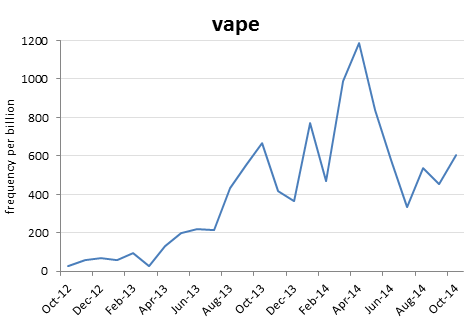
VapeVape, a verb meaning to inhale and exhale the vapor produced by an electronic cigarette or similar device, beat out everything from bae to normcore. It was coined in the late 1980s when companies like RJR Nabisco were experimenting with the first “smokeless” cigarettes. But, after years of languishing, the word is back, needed to distinguish a growing new habit from old-fashioned smoking. According to Oxford’s calculations, usage of vape, which as a noun can refer to an e-cigarette or similar device, more than doubled between 2013 and 2014.

Edwin L. Battistella mulls our love of new words:

Clippings frequently rub me the wrong way for some reason. When I am in a conversation where someone used words like cray, vacay, and bro, the usages somehow feel much too familiar, like a telemarketer addressing me by my first name. Abbreviations can be annoying too, as if the speaker assumes I am as immersed in some topic as they are and know all the shorthand. IMHO.

I’m enamored of blends though, and I smile at the recollection of the first time I came across the word hangry in a tweet from a former student. To me blends are verbal magic tricks: words sawed in half and magically rejoined. I always think of publisher Bennett Cerf’s description of Groucho Marx as someone who looks at words “upside down, backwards, from the middle out to the end, and from the end back to the middle. Next he drops them in a mental Mixmaster, and studies them some more.” Groucho would have loved the Urban Dictionary’s blend bananus, for the brown part at the end of a banana. When I finished my book on the language of public apology I toyed with using the word regretoric in the title, but wiser editorial heads prevailed. The best blends have a playful punning to them, in which the remnants of the old words encapsulate the new meaning perfectly (the worst blends are like Frankenstein’s monster, like schmeat, a finalist in 2013.). I’ll leave it to you to judge the blends in this year’s finalists: slacktivism (from slacker + activism), normcore (from normal + hardcore), budtender (from bud + bartender).

History Is Not On Hillary’s Side

Arkansas Politics

Judis concedes that Democrats will be vulnerable in 2016:

The chief obstacle that any Democratic nominee will face is public resistance to installing a president from the same party in the White House for three terms in a row. If you look at the presidents since World War II, when the same party occupied the White House for two terms in a row, that party’s candidate lost in the next election six out of seven times.

The one exception was George H.W. Bush’s 1988 victory after two terms of Ronald Reagan, but Bush, who was seventeen points behind Democratic nominee Michael Dukakis at the Republican convention, was only able to win because his campaign manager Lee Atwater ran a brilliant campaign against an extraordinarily weak opponent.

Larison agrees:

When a president has mediocre or poor approval ratings, as Obama probably will have at the end of his term, it becomes almost impossible for a candidate to find the right balance between approval and criticism. That is because it becomes much more difficult to win over alienated voters without further demoralizing one’s own core supporters. Even in cases of extreme presidential unpopularity, most candidates for the nomination don’t want to be seen as trashing or repudiating the president. Most partisans that vote in primaries remain supportive of the president at least as long as he is still in office, and so the eventual nominee has to cater to that. An added difficulty is that the presidential party’s nominee usually is very closely aligned with the administration on policy, so that it is only too easy for the other party to use the administration’s failings as a bludgeon against the nominee. That attack becomes even easier when the nominee is very closely associated with the administration or even served as a part of it.

There’s another possibility: that the economy will keep growing so as to make a dent in the lives of those passed over by the recovery so far; that the ACA will win more recruits and, with some enthusiastic backing from a Democratic nominee, could even be an asset in the next election; that a deal with Iran averts war in the Middle East; and that, once the public gets a sense of the actual alternatives to Obama – more war; more secrecy; less healthcare security – the mood might shift. I’m not predicting this, and I basically agree with John and Daniel. But the public mood is restive and fickle. It could turn yet again.

(Photo: By Bill Clark/CQ Roll Call)

What Drove Down Gas Prices?

Crude Production

Jordan Weissmann admits that, contrary to the predictions of liberals, drilling has played a role:

There had never been much of a statistical relationship between U.S. oil production and what Americans paid at the pump. But with crude prices crashing, gas down to about $3 a gallon, and the International Energy Agency declaring that we have reached “a new chapter in the history of the oil markets,” it is time to acknowledge that the left in some respects was wrong, and that drilling in North Dakota, Texas, and beyond has actually helped cut the price of gas. …

The combination of U.S. drilling and a global slowdown didn’t necessarily have to end in plummeting oil prices. Traditionally, OPEC members have cut their production in the face of global gluts in order to keep their profits high. But now, OPEC appears to be fraying. Earlier this month, Saudi Arabia shocked much of the world by cutting its crude export prices to the U.S., in what was interpreted as an attempt to protect its market share and possibly put pressure on America’s domestic drillers. Instead of trying to buoy the price of petroleum, the Saudis are now helping drive it down further in order to save their own revenue stream.

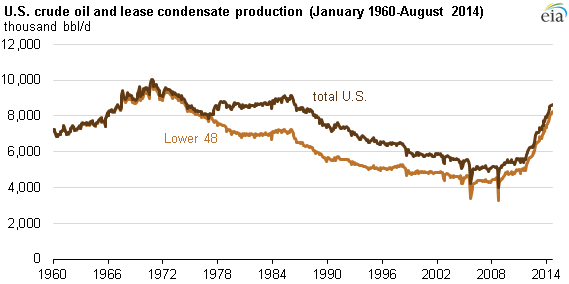
Plumer passes along word that “US is now producing more crude oil than at any point since 1986″:

Worldwide, only Russia and Saudi Arabia now pump out more crude oil, and the US is quickly closing the gap. (Sometimes you’ll see news stories saying that the US is already the largest oil producer. This is only true if your definition of “oil” includes things like natural gas liquids — which are still useful, though not exactly the same as crude oil.)

But Max Ehrenfreund finds it worrisome “that no one is buying all that oil”:

The unfortunate truth is that low prices for gasoline are a symptom of a sickly global economy. It isn’t just gas prices that are falling as consumers make do with less and businesses put off new investments in Europe, China and Japan. Metals such as copper, silver and platinum are cheap, too, and so are crops like corn, soybeans and wheat.

Earlier Dish on $3-a-gallon oil here.

A Time To Rend?

The polarizing trends of our current cultural moment are alive and well, alas, in the debate over civil marriage for gay couples. We seem incapable of compromise, of an unsatisfactory (to both sides) middle ground, of the give-and-take that makes a liberal society possible. And so we now come across a proposal for religious ministers to withdraw from any role in establishing civil marriage – for straights as well as gays. The institution is now so tainted no minister should acquiesce to it. Hence this proposed pastoral pledge, endorsed by the editor of First Things:

In our roles as Christian ministers, we, the undersigned, commit ourselves to disengaging civil and Christian marriage in the performance of our pastoral duties. We will no longer serve as agents of the state in marriage. We will no longer sign government-provided marriage certificates. We will ask couples to seek civil marriage separately from their church-related vows and blessings. We will preside only at those weddings that seek to establish a Christian marriage in accord with the principles ­articulated and lived out from the beginning of the Church’s life.

Of course, these pastors are well within their rights to do this. Maybe some more secular types will even welcome it. I find it merely sad and somewhat spiteful. Does accommodating a tiny minority in the civil rights and responsibilities of civil marriage really require all Christian ministers to withdraw from their traditional role in certifying a civil marriage? It’s just one more thread removed from our commonality.

And, then, of course, there’s the absolutism of the hard left on these matters. The idea that you cannot simply live with people who don’t want to celebrate or participate in gay marriages – but have to sue them to enforce equality – is also likely to make things worse, not better. Over-reaching to restrict religious freedom unravels us as a society – and abjures the simple virtues of getting along. Then there’s this kind of maneuver, which is an extreme outlier – but would have lots of support on the hard left if they had their druthers. Catalonia has just passed a new bill protecting gays, lesbians and transgender people from discrimination. But with a twist:

The new law includes a range of sanctions, which has been one of the most controversial points of the new legal framework. The sanctions include fines, whose amount is graded in relation to the seriousness of the offense. The parties supporting the new measure argued that without sanctions, the new law would be “a mere statement of good will”. Furthermore, another controversial aspect is that those accused of being homophobic against somebody will have to prove their innocence, instead of the victim having to prove the accused’s guilt. This positive discrimination measure is already in place for other offenses, such as domestic violence against women, in instances when it is very difficult to prove.

And this is not that far from what the Obama administration has decreed is appropriate for campuses. No wonder the defense lawyers are gearing up for conflict. What’s missing from this is balance, some accommodation for all in a society, and a fair judicial system to separate the true from the false. Raising awareness of how this stuff can happen with impunity is extremely important – just as signaling a religious opposition to civil marriage for gays is well within the bounds of fair advocacy. But finding a way not to over-reach is a trickier task. And we’re not doing so well with that right now, are we?

Some Suggestions On Gender Wars, Ctd

A reader writes:

On the subject of false allegations of rape, we often hear of the Duke Lacrosse team and Tawana Brawley.  Far less often, we hear of Jamie Leigh Jones v KBR and Charles Bortz.  That case was tried to an eleven-person federal jury in the summer of 2011.  I was Bortz’ attorney.  The jury refused to find -on evidence that was beyond ample – that Jamie Leigh Jones was raped.  She was not raped; her claims were not true and yet only one writer on the left, Stephanie Mencimer, ever came close to figuring this out.

Post-verdict, with both sides having had their day in court, Charles was as guilty in the left’s eyes as he was when Ms. Jones first made her allegations.  Neither the evidence nor the jury’s verdict mattered at all.  The mystery is why the current debate isn’t a source of terror for traditional civil liberties types.  The current left, including elements of the current administration (these federal mandates are recent arrivals), prizes outcome – their outcome – over all else, including guilt or innocence, fair trial or kabuki play.  When someone tries to explain why due process matters, the response is vilification and dismissal.  No effort is made to explain why due process does not matter or why it should be secondary or diluted or what-have-you.  Rather, the Progressive Feminist Left has spoken and further discussion other than assent is not tolerated.  And they’re winning.

Another makes many legal distinctions:

You write that arguments for a serious response to the problem of campus rape, including changes to the standard of proof, “echo[] Ezra Klein’s endorsement of expelling male students accused of rape without due process.” Emphasis mine. A quick and honest question: what is your understanding of the term “due process”?

Because the concept is not so cut and dry as you are presenting it. “Due process” does not mean “maximal procedural protections in every case.” Rather, it means that a party to a dispute should receive the procedural protection (“process”) that is “due” given the circumstances.

Civil defendants, for example, do not have the same trial rights as criminal defendants, because if she loses, the civil defendant won’t be going to jail. To borrow a term from my favorite law professor, “due process” is an “error deflection” principle. The law understands that mistakes happen. Procedural safeguards work by “deflecting” the risk of those mistakes away from the protected party.

When you talk about campus rape, then, you need to remember the stakes, and assess the due process problem accordingly. In a college disciplinary proceeding, does the accused student risk being thrown in jail? Fined? His criminal history broadcast to the world through a public trial?

No, no, and no. He’s just going to be expelled from college, to re-enroll somewhere else. His risk of error is low, relative to a criminal case. By comparison, the risk of error borne by the accuser is about the same relative to a criminal case, if not higher. Following acquittal, the victim can’t avoid a wrongly-acquitted rapist. She must go to class with him, socialize with him, and live (in most cases) within a mile of him. She’s trapped, basically. With her rapist. In her home.

When campus reformers talk about making it easier to expel accused rapists, they’re not arguing against due process. They’re just emphasizing the “due” part over the “process” part. And with good reason.

A Massacre Of Jews At Prayer, Ctd

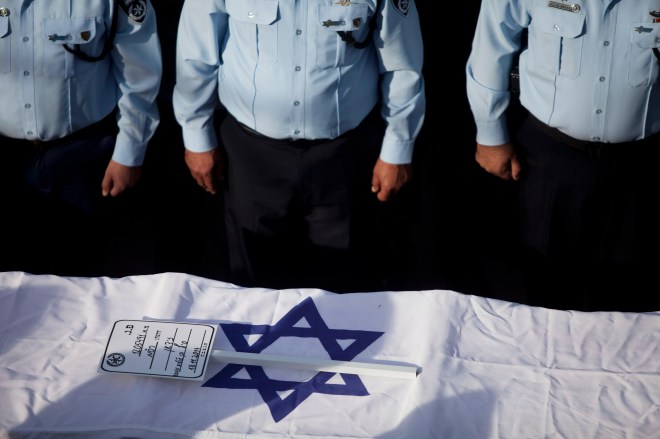
Mourners Attend The Funeral Of The Policeman Who Died In Synagogue Attack

Speaking before a Knesset committee yesterday, Israel’s Shin Bet chief Yoram Cohen pushed back on Netanyahu’s angry assertion that Mahmoud Abbas was to blame for inciting the horrific attack:

No one among the Palestinian leadership is calling for violence, Cohen said, noting that Abbas has reiterated that the path of intifada should be rejected. “ Abu Mazen [Abbas] is not interested in terror,” he explained, “and is not leading [his people] to terror. Nor is he doing so ‘under the table.’” At the same time, however, Cohen admitted that, “There are people in the Palestinian community who are liable to see Abu Mazen’s words of criticism as legitimization for taking action.”

J.J. Goldberg comments on why Cohen’s remarks are significant:

Cohen’s frontal attack on the prime minister’s stance toward Abbas is particularly shocking because the Shin Bet chief, appointed by Netanyahu in 2011, has been considered Netanyahu’s one reliable ally within the Israeli intelligence community. The heads of the Mossad and IDF military intelligence consistently take less alarmist views of Arab and Iranian intentions, repeatedly blunting the prime minister’s efforts to depict Israel’s enemies as unequivocally committed to Israel’s destruction.

Just last week Cohen was at the center of a media firestorm (as I described here) after senior Shin Bet officials appeared with his permission on a television newsmagazine to claim that the security service had warned the IDF last January of Hamas plans to launch a war in July, but the military had overlooked the warning.

Yishai Schwartz is convinced that the attack was motivated by hatred of Jews, rather than anger with Israel:

There is irony in the latest attack. The synagogue was in Har Nof, an ultra-Orthodox neighborhood in West Jerusalem. The worshippers lived in internationally recognized Israel and almost certainly never served in the army. They would never approach the Temple Mount, the holy site where recent visits by Jews have supposedly triggered the latest wave of Palestinian violence, because they believe that God’s law forbids it. In other words, these worshippers should be among the least offensive to Palestinians.

This is not to say that, for instance, last week’s murder of 26-year-old Dalia Lemkus was less obscene because it happened near a West Bank settlement. But the senselessness and brutality of the synagogue assault, and the otherworldliness of the victims, lays bare the inadequacy of rational political explanations for terror. No doubt the murderers had their grievances (and some perhaps were reasonable), but the butchery in Har Nof shows that any sense of strategy has been overwhelmed by hate. The murder of non-Zionist Torah scholars is an attack on Jews more than Israel, and explaining it requires an understanding of hatred, not of politics.

The attackers were members of the armed wing of the Popular Front for the Liberation of Palestine, a Marxist-Leninist militant group that hasn’t been heard from in a while. Ishaan Tharoor provides some background on the PFLP:

The group is considered a terrorist organization by the United States and other Western countries, but its ideology has very little in common with Hamas, whose jihad against Israel has blown hot and cold over the past two decades. Its legacy is a reminder of the older, secular nature of Palestinian militancy against Israel and Israel’s occupation of the West Bank and Gaza since the 1960s.

The PFLP was founded in 1967 by George Habash, a Palestinian Orthodox Christian animated by the pan-Arabism of then Egyptian President Gamel Abdel Nasser and the insurgent socialism that inflamed anti-colonial struggles in many parts of the world at the time. At its peak, the PFLP was one of the leading factions within the Palestinian Liberation Organization, alongside the Fateh party of the late Palestinian leader Yasser Arafat and Mahmoud Abbas, the beleaguered current president of the Palestinian Authority.

Freddie deBoer detects a double standard in the American media, wherein Palestinians are blamed collectively for such acts of violence while Israelis face no such censure for atrocities carried out by their government:

That the Israeli people are not responsible for the murderous, cruel, and illegal occupation of the Palestinian people by the Israeli government is a matter of media consensus. And, indeed, it’s true– despite the fact that Israeli government is an elected government, despite the fact that Israel’s democratic polity is in the main vociferously committed to the greatest crime of this young century, no individuals deserve to bear the blame for the sins of their government or their military. That is as clear a lesson as any the 20th century taught to us: the notion of collective blame is the first step on the staircase to genocide. And yet when it comes to the actions of two desperate madmen, there is no similar consensus, for the simple, plain, unavoidable fact that to the American media, Palestinians don’t deserve human rights because Palestinians are not human.

Jonathan Tobin, unsurprisingly, sees it differently:

[W]hile it is true that a minority of Jews would like to alter the status quo on the Temple Mount to make it place where both faiths can be freely observed (Jews currently may not pray on the Mount, a stand endorsed by Prime Minister Netanyahu), the hate and incitement that leads inevitably to the kind of bloody slaughter witnessed in a Har Nof synagogue where five Jews were murdered yesterday is not a function of a few isolated zealots or a twisted interpretation of Islam. Rather it is a product of mainstream Palestinian political culture in which religious symbols such as the imagined peril to the mosques on the Mount have been employed by generations of Palestinian leaders to whip up hatred for Jews. The purpose is not to defend the mosques or Arab claims to Jerusalem but to deny the right of Jews to life, sovereignty, or self-defense in any part of the country.

Chemi Shalev loses hope:

The Israelis who routinely ride roughshod over Palestinian sensitivities stirred up a hornet’s nest at the Temple Mount while hate-infested Palestinians massacred Orthodox Jews as they were praying: It’s unprecedented, it’s true, though we’ve seen it all before.

No, there is no moral equivalence, but there is more than enough responsibility and recklessness to pass all around. The leaders of both sides are too busy maligning each other, after all, as they resign themselves and their constituents to constant struggle and eternal strife and the incorrigible otherness of their enemies. It’s hard to imagine anyone who could inspire less confidence than Abbas and Netanyahu to lead us out of the morass, but given the mutual hatred and racism coursing through their constituents, the odds are that their successors will fare even worse.

(Photo: Israeli police officers stand next to the flag wrapped coffin of Druze Israeli police officer Zidan Sif during his funeral on November 19, 2014 in Yanuh-Jat, Israel. Sif, 30, died of his wounds on November 18, after two Palestinian cousins armed with meat cleavers and a gun stormed a Jerusalem synagogue during morning prayers, killing four rabbis. By Lior Mizrahi/Getty Images)
How Many Immigrants Will Obama Let Stay?

Dara Lind does some calculations:

Obama’s upcoming plan is being characterized, in advance, as relief for 5 million unauthorized immigrants. But based on the rumors about who’d be likely to be included in the plan, that’s not exactly accurate.

What it looks like is that, by the time Obama’s new plan goes into effect, 5 million unauthorized immigrants, in total, will be eligible to apply for protection from deportation. That includes immigrants who are already eligible for protection — even before any new plan is announced — because they qualify for the Deferred Action for Childhood Arrivals program, which the Obama administration introduced in 2012.

If the undocumented parents of American citizens are allowed to stay, Roberto Ferdman figures “we’re talking about an estimated 3.5 million immigrants who currently don’t have protection from deportation”:

There’s a separate possibility that the plan might also include relief for immigrants who arrived in the country as children and are still younger than 18 years old. Those, according to Pew, amount to another 650,000 people. If this group is also included in Obama’s executive action, that would bring the total number of people affected by his action up to 4.15 million.

But this massive number doesn’t account for the millions more indirectly affected by the reform: the families of those who would no longer be deported. Even the most conservative estimate—let’s say 2.8 million undocumented adults are paired up and each couple has one child—suggests that more than a million children will suddenly not have to worry anymore about whether their parents will be deported.