Cell phone theft in major cities has become a national criminal epidemic, like the car stereo crime wave of the 1990s. In San Francisco, about half of all robberies now involve mobile phones, and in New York there was a 40% increase in mobile thefts in 2012. One recent Harris poll of phone owners found that nearly 10% of cellular users said their phone had been stolen at one point.
The reason is simple: The black market resale value of the devices, like car radios two decades ago, is high. “Your mobile phone is probably the most expensive thing you carry around with you,” says Kevin Maheffey, co-founder of Lookout, a mobile security company. “It’s like holding $400 up to your head.”
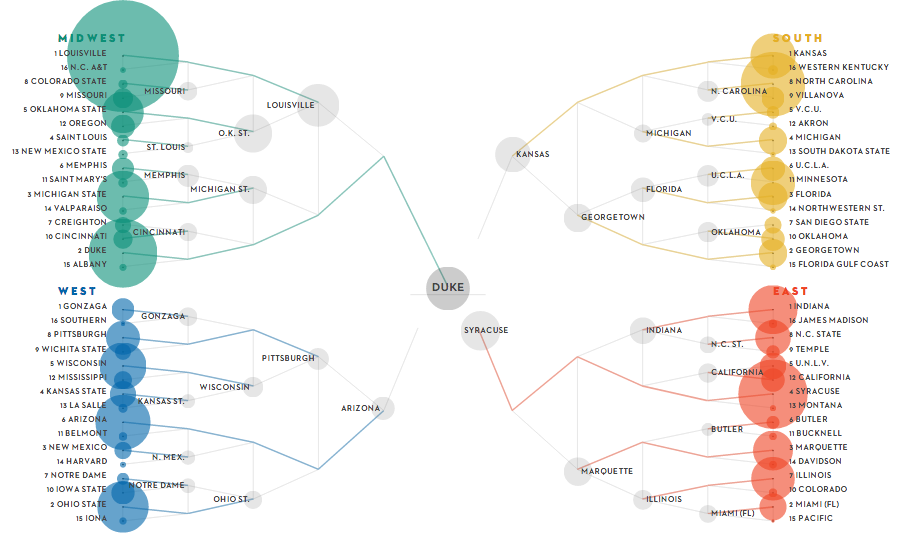
The New Yorkerdrafted a prediction “in which the biggest spender always wins” the NCAA basketball tournament:
Go here to interact with the brackets yourself. Meanwhile, a Freakonomics/Marketplace podcast crunched the ad numbers for the annual tourney:
[Kantar Media researcher Jon Swallen] tells us that two years ago, CBS and Turner may have lost money on March Madness, as they pay roughly $770 million a year for broadcast rights but took in only $728 million in TV ad revenue. But last year, Swallen says, CBS and Turner — which broadcast ever single game in the tourney — took in more than $1 billion. This makes March Madness “the most lucrative sports TV franchise in the country in terms of advertising revenue,” Swallen told us, “bigger than the Super Bowl, bigger than the entire NFL playoffs, and larger than the combined revenue that’s brought in from the Major League Baseball playoffs, plus the NBA, plus the National Hockey League.”
With that sort of windfall in mind, Dave Barri doesn’t think that giving scholarships to players is adequate compensation:
To illustrate, consider the Indiana Hoosiers this season. An examination of the player statistics reveals that Victor Oladipo produced 7.37 wins for Indiana (the Wins Produced calculation for college basketball was similar – in fact, amazingly similar — to what has been done for the NBA). We are working on the economic value of a win in college basketball, but a conservative estimate is that a win is worth at least $100,000 for a program like Indiana. Given the number of wins Oladipo produced and the conservative value of a win, Oladipo’s production was worth (i.e. his Marginal Revenue Product) about $737,000 (and again, this is a crude and conservative estimate).
A scholarship to Indiana is valued at less than $30,000. So at least nine of these players were exploited (which simply means they were paid less than their Marginal Revenue Product).
The commenters you cited in the Andrew “Weev” Auernheimer case seem to be missing the point when it comes to what Auernheimer did wrong. Ryan Tate says “the jailing of Auernheimer criminalizes the act of fetching openly available data over the web.” That data was openly available in the same way your property is openly available if you forget to lock the door to your house when you go out. You should lock your doors, and companies should make sure their websites are secure, but in neither case does (or should) the failure to act grant intruders the permission to rummage around inside.
I’m a software developer, and I’ve seen and fixed exactly the type of vulnerability Auernheimer exploited. This wasn’t something he stumbled upon; he was searching for ways to access data that he knew was confidential. What’s more, according to Tate’s description of events, the vulnerability only allowed Auernheimer to access one email address at a time. I can understand the argument that groups like Auernheimer’s are providing a public service by searching for vulnerabilities in large corporate websites, and in publicly shaming corporations when they fail. If he had contacted AT&T and the media after first discovering the vulnerability, I’d probably be supporting him right now.
But that’s not what he did.
Instead, he exploited the vulnerability to extract as many email addresses as possible, and worse, shared the tools he used to do so with unknown third parties. Only then did he notify AT&T. That’s not whistle-blowing; that’s theft and the enablement of theft. What’s more, keep in mind this was personal information he stole; there’s no claim of political activism a la Aaron Swartz.
Was his sentence overly harsh? Perhaps, but I think the US sentencing guidelines are too harsh in general. Comparing his sentence to the Steubenville rapists’ is absurd; their crime was much more serious, but they’re also juveniles and he is an adult. Given his complete lack of remorse and failure to understand what he did wrong, I’m not at all surprised the judge decided to throw the book at him.
Look, I’m sympathetic to the argument that the American justice system fails to intelligently distinguish between harmful and harmless hacking activity, both by law and in prosecutorial practice. The lack of technical knowledge on the part of judges, lawyers and juries is a real problem, and likely does result in miscarriages of justice. Arguing that that is what happened here, however, strikes me as a real stretch.
Rob Rhinehart is giving up traditional forms of food:
I don’t want to lose weight. I want to maintain it and spend less energy getting energy. I hypothesized that the body doesn’t need food itself, merely the chemicals and elements it contains. So, I resolved to embark on an experiment. What if I consumed only the raw ingredients the body uses for energy? … I haven’t eaten a bite of food in 30 days, and it’s changed my life.
He describes his non-food drink mixture, which he calls soylent:
For the fat, I just use olive oil and add fish oil. The carbs are an oligosaccharide, which is like sugar, but the molecules are longer, meaning it takes longer to metabolise and gives you a steady flow of energy for a longer period of time, rather than a sugar rush from something like fructose or table sugar. … It tastes very good. I haven’t got tired of the taste in six weeks. It’s a very “complete” sensation, more sweet than anything. Eating to me is a leisure activity, like going to the movies, but I don’t want to go to the movies three times a day.
This past month 92% of my meals were soylent. I haven’t given up food entirely, and I don’t want to. I found if I wake up early I sometimes crave a nice breakfast, I’ve gone to lunch meetings, and on the weekends of course I love eating out with friends. Eating conventional food is a fun leisure activity, but come Monday I usually have a strong craving for a tall glass of Soylent. In fact, with the money I save, I have the freedom to eat well when I do go out. I didn’t give up food, I just got rid of the bad food.
Jennifer Welsh thinks the experiment is dangerous. She points out that “Rhinehart’s claims are completely untested, have never been included in a clinical trial, and his diet isn’t being monitored by a doctor”:
His self-experiment is ludicrous and most likely dangerously unhealthy. While the diet is essentially trying to be like the medical food that is injected into a patient’s stomach when they have a feeding tube, Jay Mirtallo of Ohio State told the Washington Post that these are “very complex products, in terms of making sure you get them in a form that’s palatable but that stays in a form that’s bioavailable to the body.”
Andrew Ferguson unpacks the brief (pdf) filed by Harvey Mansfield and Leon Kass, which dismisses the idea that proponents of marriage equality can back their arguments with data:
It is the aim of Kass and Mansfield to wave the Supreme Court away from “scientific findings” that are produced by culture warriors, as the findings in the field of “gay studies” nearly always are. “The social and behavioral sciences,” they write, “have a long history of being shaped and driven by politics and ideology.” They note pointedly that two generations ago, the “scientific consensus,” as represented by the American Psychiatric Association, was that homosexuality was a “mental disorder.” The consensus was publicly reversed in 1973, and science, to paraphrase Mae West, had nothing to do with it: Both positions, before and after, were determined by political and cultural considerations.
Now, of course, the American Psychological Association, which waited until 1975 to “depathologize” homosexuality, tries to lend its shaky intellectual credibility to the cause of gay marriage in general and gay parenting in particular. In 2005, it issued a bull declaring the “no difference” finding a matter of settled science. Kass and Mansfield point to a recent paper by Loren Marks of LSU, who had the temerity (and professional death wish) to go back and actually read the 59 studies the APA cited in its decree. They were shot through with conceptual and methodological flaws: small, nonrandom “convenience” samples, a recurring lack of control groups, shifting and poorly defined outcomes, and a steady pattern of comparing apples to oranges—for example, placing the children of intact, well-to-do lesbian households up against children reared by single heterosexual parents.
The argument that the currently available social science data are not dispositive at this point seems to me inarguable. How could they be dispositive when marriage equality has only existed in one state for nine years? In reporting on the studies in my anthology, I insisted and still insist we do not have sufficient long-term data to judge the social impact of this reform.
But we do have lots of data on child-rearing and same-sex relationships, and those arguing for detrimental effects have been able to find nothing. That Mansfield and Kass cite the widely debunked Regnerus study does not change this fact. No respectable, academic studies of any kind have proven any harm to children or adults from integrating gay people into their own families. I think the co-authors are correct that the judicial decision should not rely on inconclusive social science as the basis for a ruling. But the weight of the gathering evidence is clearly on the side of it doing no harm whatever. Just ask the families of Massachusetts, with divorce rates declining as gay marriages increase in number. And just meet the kids of gay parents. They will tell you more about this than any study, however flawed.
I wonder: have Harvey and Leon ever met some children of gay couples? Or talked with them?
Sophie Quinton tracks the rise of retail walk-in clinics, which feature transparent prices and fast, inexpensive services:
Care at a retail clinic “is about 30 to 40 percent cheaper on a per-visit basis than care at a doctor’s office, and 80 percent lower, on average, than the care at an emergency department visit,” says Ateev Mehrota, policy analyst at the RAND Corporation. A flu shot given by a nurse is cheaper than one given by a doctor, even though it’s the same injection.
For store chains like CVS, Walgreens, and Target, retail clinics aren’t a big moneymaker. But they do draw in customers who might make other purchases. In the same way, hospital systems and medical groups have opened or partnered with retail clinics in order to draw new patients into their networks. “You’ve got commercial health insurance plans racing against hospitals to control the front door,” says Paul Keckley, executive director for the Deloitte Center for Health Solutions. “The front door is primary care.”
Michelle Andrews covers another medical trend, group appointments:
In recent years, a growing number of doctors have begun holding group appointments — seeing up to a dozen patients with similar medical concerns all at once. … Some of the most successful shared appointments bring together patients with the same chronic condition, such as diabetes or heart disease. For example, in a diabetes group visit, a doctor might ask everyone to remove their shoes so he can examine their feet for sores or signs of infection, among other things. A typical session lasts up to two hours. In addition to answering questions and examining patients, the doctor often leads a discussion, often assisted by a nurse.
Tom Chatfield is frustrated by the “qwerty phenomenon,” wherein, having found a keyboard “design that largely fitted our early needs, we gave up on alternatives”:
The 27 bones, over 60 muscles and tendons, and three nerves of the human hand are sensitive to minute variations in pressure, velocity, position, temperature and texture. They are effortlessly able to execute three-dimensional manoeuvres while sensing and responding to all of these. Yet, in computing terms, all this incredible bandwidth is usually funnelled into tapping on keys able to recognise only two information states – on and off. Even the most advanced touchscreen is barely able to register five fingers’ worth of contact points on its textureless, depthless surface.
He caught a glimpse of the future when he encountered a new musical instrument, the Seaboard (seen above):
For someone who has played the piano for twenty-five years, the Seaboard was an exquisitely bizarre encounter. A sleek black piano keyboard with a ribbed and rubberized surface, it looked like a silicon mould for making music-themed desserts – and felt, when I was graciously allowed to sit down and play, like massaging a giant bag of jelly sweets. Digging my fingers into the (startlingly robust) keys mixed familiarity with sudden ineptness. Onto the concept of a piano had been grafted several entirely new layers of physical interaction.
What was truly remarkable was the degree of control on offer. According to London-based manufacturers ROLI, the “soft threedimensional surface that enables unprecedented realtime, intuitive control of the fundamental characteristics of sound: pitch, volume, and timbre”.
Public approval of his handling of the economy has slipped, according to polls, and surveys now show that a roughly equal number of Americans favor Mr. Obama as favor Congressional Republicans on economic matters.
In December 2012 and January 2013, polls found that roughly half of Americans had more faith in Mr. Obama’s economic stewardship, while just over a third of respondents said they had more faith in the economic stewardship of Congressional Republicans. Since December, however, Mr. Obama’s standing has declined by roughly 10 percentage points, while Republicans in Congress have gained 4 or 5 percentage points.
(Chart: Obama’s approval rating on the economy from TPM)
In an surprise diplomatic breakthrough last week, Obama extracted a long-awaited apology from Bibi to Turkish Prime Minister Erdogan over the killing of Turkish civilians in the flotilla incident of 2010. Brent Sasely calls Obama “a magician” for negotiating the apology, while Michael Koplow thinks the mess in Syria is what finally brought the two countries back together:
[I]t was the recent introduction of Syrian chemical weapons into the equation that really changed Turkey’s calculus; now more than ever, the country needs better intelligence and allies to bring an end to the civil war or at least prevent it from spilling over. Turkey cannot afford to have chemical weapons used anywhere near its border with Syria, and the longer the fighting goes on, the greater the chances of a chemical weapons strike gone awry. Israel simply has better intelligence on regional developments than Turkey does, and Turkey can use that help to monitor Assad’s weapons stores and troop movements on both sides. In addition, whereas the United States and other NATO countries have been reluctant to support the Syrian rebels in any meaningful way, Israel has a greater incentive to make sure that the moderate Sunni groups prevail over the more radical jihadist elements of the opposition. As the situation in Syria heats up, Turkey and Israel will be thankful that they can talk to each other and coordinate.
Claire Sadar connects the thaw to the other deal Ergodan has been negotiating – peace with the PKK, the Kurdish nationalist group:
The apology from Israel is situated perfectly (perhaps purposely given the fact that [FM Ahmet] Davutoglu and the Foreign Ministry were circumvented) to maximize Erdogan’s popularity and therefore his power to orchestrate the rapprochement between the Turkish government and the PKK. Some have worried that if Erdogan appeared too eager to placate the Kurds and [their leader] Abdullah Ocalan, he risked alienating his conservative Turkish base. However, the Israeli apology is the perfect bone to throw to his supporters. If Erdogan does not take advantage of this moment to do everything he can to ensure a successful peace process between Turkey and the PKK, then he truly never was committed to peace in the first place.
After attending the sentencing hearing for Andrew “Weev” Auernheimer, convicted of accessing an AT&T database containing customer email addresses in order to expose the company’s lax security, Molly Crabapple fumes:
[T]he email addresses AT&T claimed he stole were on publicly accessible web pages. Weev’s group, Goatse Security, just had to guess the URLs. Weev and his partners compiled 114,000 addresses, sent them to Gawker, and shamed AT&T epically. Supporters argued that he had done nothing illegal—that his prosecution was the latest warning shot against anyone able to use computers to embarrass power. … The prosecutors spun the tale of a brilliant young sociopath. They quoted his Reddit AMA three times, then some drama around Encylclopedia Dramatica. They called him “highly intelligent” to justify his sentence. They led a populist diatribe against individuals with “special [computer] skills” and the power they wielded over the unskilled common man.
And the sentence?
… 41 months of prison, three years of probation, and $73,000 restitution to AT&T. He will serve more years than the Steubenville rapists.
Ryan Tate, who wrote the original post based on the info collected by Goatse Security, lets loose:
The scapegoating of Auernheimer is revolting for two reasons.
One, it lets AT&T off the hook for exposing sensitive information to public view, shifting the blame onto those who reported the slip-up, and discouraging future disclosure. Two, the jailing of Auernheimer criminalizes the act of fetching openly available data over the web. …
[F]ederal prosecutors are doing their best to punish and deter security whistleblowers, and thus to help large corporations cover up their endless bungling of customer privacy. That only increases the vulnerability of those of us who depend on those corporations. Goatse Security won’t be the last ad hoc band of hackers to stumble on a large-scale web vulnerability. But it could be the among the last to report its findings so openly, a development that’s only going to hurt the very citizens the Justice Department purports to serve.

 The Dish
