New Dish, New Media Update

Here is a snapshot of the Dish’s pay-meter at the end of last month:
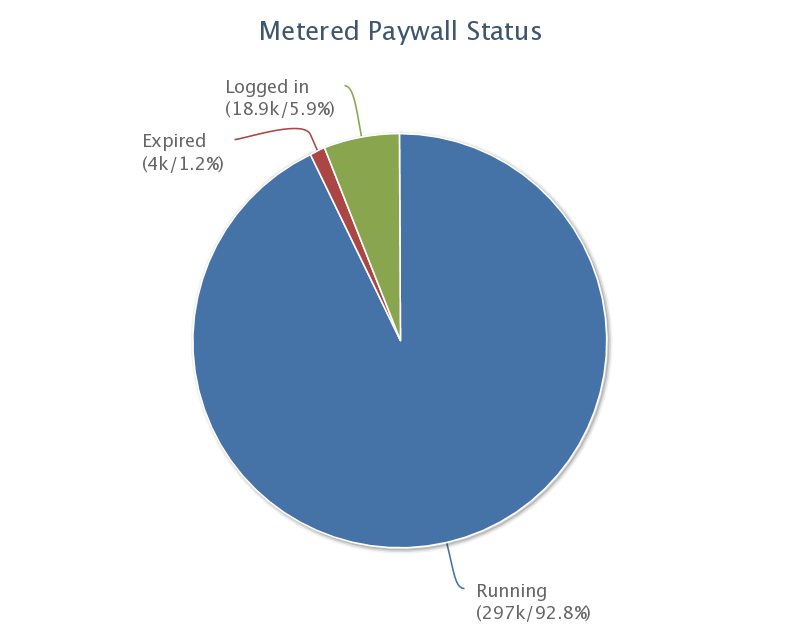
Meter Peak Pie

As you can see, in February, only four thousand readers hit more than seven read-ons and were asked to pay. That’s only 0.4% of the total monthly unique visitors and 1.2% of the readers who hit at least one read on. Here’s a breakdown of the readership that didn’t hit more than seven read-ons:

Meter Peak Bar

When we set the meter at seven read-ons per month we knew that seven might be too high, but we wanted to err on the side of generosity. The good news is that our overall traffic didn’t decline in any way from being free to all to being metered: over a million people visited last month. But what we didn’t fully account for is that a high percentage of readers consume the Dish on multiple devices (work PC, home PC, smartphone and/or tablet) and that each of these devices gets seven free read-ons, thus many readers got 14, 21 or even 28 free read-ons. As one recently wrote:

I feel tremendous loyalty to the Dish and, as soon as the new revenue model was announced, I knew that I would subscribe. I waited to do so, however. I have been involved in several start-ups and other small businesses and I am always curious to learn more about them, so I planned to wait to be prompted to subscribe to see how the mechanism worked. I continued to read the site daily using the same practices I always had. I expected to be prompted to subscribe soon after February 4. The prompt never came.

Another was more succinct:

Early subscriber, daily reader, have never hit the subscription request.  I have four devices that I tend to use depending on how my day goes, so my presence on the site is clearly under reported.

So after reading dozens of similar emails and looking over all the data with the Tinypass team, we’ve decided to lower the meter to five free read-ons and extend the reset period from 30 days to 60 days. In all other respects, the meter will remain the same.

We want for the Dish to be as accessible as possible. But, since we’ve launched, for the vast majority of readers, it’s as if the meter doesn’t exist. Given how lax the meter has been, it’s remarkable how much of the readership has subscribed. Nevertheless, in the following chart of daily sales figures since the meter launched, you can clearly see how sales flat-lined once the meter reset for most people after March 8:

Sales Since Launch

So far, we have brought in around $644K in gross revenue, which is an incredible start to our goal of $900K for the year. We are immensely grateful to all the readers who have invested in the Dish with $19.99 or more. But we are eager to begin commissioning long-form journalism and other projects like podcasting, and we can’t begin that in earnest until we have our basic operations funded.

Now to reader reax on various aspects of the whole endeavor. Yes, I took a deep breath before reading some of these.  One writes:

I know that the irritation is a deliberate part of the subscription model, but why can’t ‘Read On’ be automatic for subscribers like me?  That would be something worth paying for in itself, turning a bug into a feature.  (If you think some people enjoy the extra clicking, you can make a toggle setting for it, and learn the truth by monitoring its use.) Your recent feminism post is a good example of what I worry about – a long post that’s mostly available but with a tiny bit at the end held off for no reason than apparently to nag for subscribers.

For years the Dish has used read-ons for an editorial, non-commercial purpose: to tuck a portion of a long post behind a read-on so the front-page isn’t excessively long. The toggle feature the reader recommends probably would not be worth the time and money it would take to develop, but please keep the ideas coming. Another reader:

Hope this finds you well. I am a long-time Dish reader, probably should subscribe, but haven’t. I always talk myself out of spending more money that I don’t have. But to be honest, being a (relatively) poor 20 something living in New York City, I get excited about finding ways to get things for free.

Hence, Google Reader.  I figured out a while ago that simply subscribing to your blog via Google’s Reader service allows me to access all of the content behind the jumps, thus basically making your pay wall irrelevant. I love Reader because it brings all the blogs I love in one place for easy access. However, it is not nearly as aesthetically pleasing and enjoyable to read your blog through Reader, and I prefer to read the content on your site. However, because of the pay wall I feel like I resort to cheating and anytime I am requested on your site to become a member, I simply switch tabs and continue reading.

Not sure why I am giving up this gem – maybe out of principle or respect for you and what you are doing. I love the concept you are going for, and while it’s nice to get things for free, I feel like you should know. I waited nearly two months for you to find this error and expected it to finally get changed, but hasn’t.  I guess I am turning myself in and letting you know.

Our reader must have missed our early posts where we acknowledge the free and unfettered access offered through our RSS feed. Though intended that from the beginning, we have recently discussed whether we should try to meter the RSS or opt for RSS-specific advertizing. But that debate might be irrelevant now that Google Reader is shutting down soon. Another reader:

After reading your post today updating your readership on the State of the Dish (my phrase, not yours!), I finally broke down and subscribed. I didn’t have to. I have read the Dish for years in my Google Reader. When y’all switched over, my access didn’t even stutter. I didn’t really want to. I am 29 years old. I am a digital native. The idea of paying for online content is almost anathema to me. On top of that, like many members of my generational cohort, I am seriously underemployed at the moment.

But I subscribed anyway. Why? Because I value The Dish. Because I rely on you and your staff to collate large chunks of the Internet for me and point me in the direction of stuff that interests me. Because, like many members of my generational cohort, I hate that we are labeled “freeloaders” by many outside of our cohort. Because you asked.

So I got out my credit card and spent $20 that I don’t really have to, in order to show that I care (I hope you appreciate the extra cent!). So even though I added another $20 to my debt load, it might actually, dollar for dollar, be a better value than my $60k in student loan debt. Thanks for keeping me informed.

Another adds:

That is one of the reasons I subscribed to the Dish (besides the great quality of your blog): as long as you continue to offer full posts in your feed, I will continue to subscribe.

Another reader who helped us get some valuable perspective on the new meter:

I’m no revenue person, but I’ve conducted a lot of mail surveys over the years, and the response rates are often similar to what you’ve shown in your graphs. Based on a quick scan of your sales numbers and a general knowledge of your readership (which are similar to the groups I tend to survey in terms of education), I’d recommend you tighten that meter sooner rather than later. I think you are right to worry that subscriptions will not maintain the pace of the first month’s rate, just as the high number of “early subscribers” (people who paid as soon as they heard) and “over-subscribers” (people who paid more than $20) gave you your biggest revenue gains before the meter even began.

I don’t know how much your subscription rate will diminish over the next few months, but I’d be surprised if you managed to match half the rate of the February numbers by mid-summer without some meter tightening. I’d expect something closer to 10 or 20% of your February numbers by the end of next year. The committed have had over two months to join, so you are now working on the slugs who are still waiting to see if they can freeride. They will need a bigger push (or you’ll need to collect more from the rest of us in the future).

On a final note, I really appreciate all the transparency. It’s the only way I would have subscribed in the first place.

Many thanks for all the feedback from readers; we couldn’t do this without you.

When Will The GOP Evolve On Marriage?

Screen shot 2013-03-18 at 2.31.16 PM

As a new ABC News/WaPo poll finds a new 58 percent high for support for marriage equality, including a staggering 81 percent of those under 30, Nate Silver finds relatively low support for marriage equality among Republicans:

[O]nly 26 percent of Republicans support same-sex marriage rights as compared with 54 percent of independents and 66 percent of Democrats. Attitudes among Republican voters may shift on the issue by 2016, particularly if more respected conservatives like Mr. Portman announce their support for same-sex marriage, but it is less than clear that his position will reflect a broadly acceptable viewpoint among Republican primary and caucus voters by that time.

The fact that Indies and Dems are close on this – and that the GOP is such an outlier – is what strikes me the most. That’s dangerous electoral territory. More to the point, the public now favors SCOTUS reversing state laws and constitutional amendments. Then there’s the split between Christians and Christianists. Mainline Christians, including Catholics, back marriage equality strongly. Evangelical Christianists don’t:

Among non-evangelical white Protestants, 70 percent in this poll support gay marriage, compared with fewer than half as many of those who describe themselves as evangelicals, 31 percent. But that’s up by a nearly identical 25 and 24 points among these groups, respectively, since 2004. Support for gay marriage also is up, by 19 points, among Catholics, to 59 percent.

So Catholics now favor marriage equality by the same proportion as the country as a whole, even slightly ahead. Congrats to the American bishops who have doubtless helped our cause by attacking it with such disproportionate ferocity. Ambers eyes the evangelical resistance:

The party platform won’t be written by devotees on Jon Huntsman. The GOP cannot win the presidency without evangelicals voting heavily. There is no magic coalition for Republicans right now that does not place social conservatives at its core. That may change as the electoral cohort shifts, but we’re a few presidential cycles away from that now.

He goes on to argue that being “pro-gay and Republican won’t incur a financial penalty” because nearly “every big donor in the party either actively or tacitly supports gay rights.” But I do see this as a major problem going forward. Even Scott Walker conceded that yesterday:

GREGORY: Are younger conservatives more apt to see marriage equality as something that is, you know, what they believe, that is basic rather than as a disqualifying issue?

WALKER: I think there’s no doubt about that. But I think that’s all the more reason, when I talk about things, I talk about the economic and fiscal crises in our state and in our country, that’s what people want to resonate about. They don’t want to get focused on those issues.

But fundamentalism makes this non-negotiable; and for the next generation, that fundamentalism, in so far as it translates into discrimination against their gay peers, remains toxic. The GOP cannot easily dismount this tiger; or defang it. So they’ll stroke it and distract it.

If they can.

Diary Of A Dog Walker

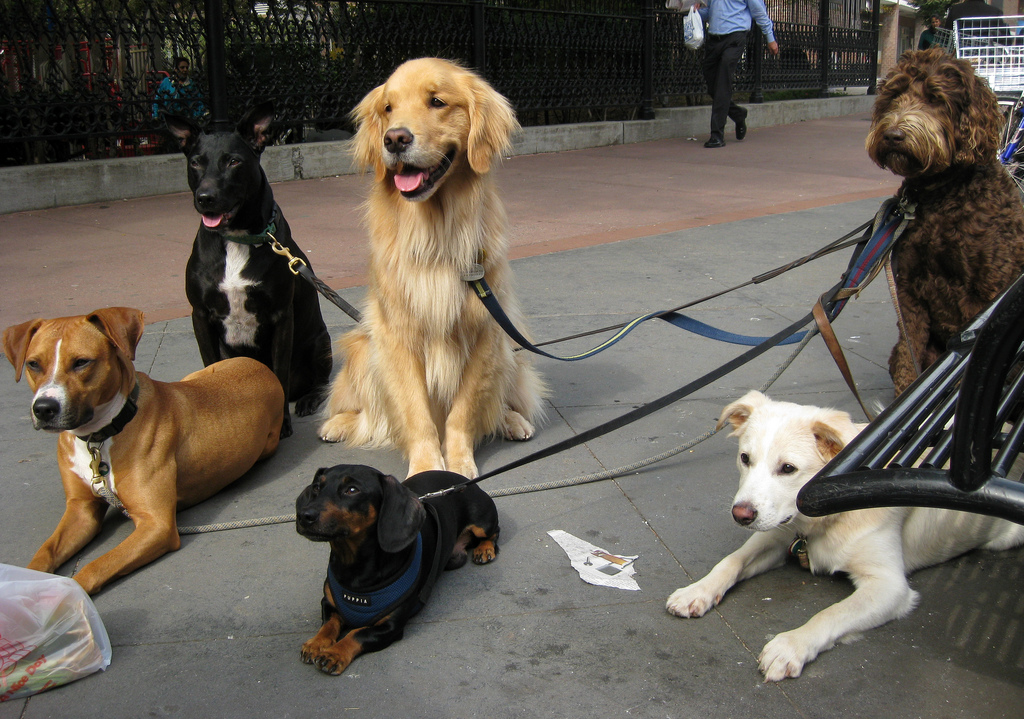
4903209928_ff87d58fd3_b

Amanda Nazario fondly recalls working as one in her twenties:

How to explain what it feels like to walk three dogs through Greenwich Village, as your job, on a beautiful spring day in the full flower of your youth? Some people are incredulous when I tell them this was my favorite job, the one I might not have minded having forever—especially when they learn about the dogs that bit me, the bounced paychecks, the “emergency” calls I got that forced me out of meals and bed. I refer them now to the stretch from Danny Boy’s back to Sam’s at noon, jogging to beat the Don’t Walk signs, cruising past stately linen-curtained windows of apartments I wished I could live in, channeling my best friend on the walkie-talkie, watching the three tails wag like metronomes. …

For dog walkers, the Village is the best neighborhood in New York.

The Upper West Side, where I worked all through grad school, isn’t bad – I remember crisp Februaries in Riverside Park, snow melting and the puddles reflecting the sky, little windows of blue glass. But the Village is better. The clients are friendlier; the architecture is more fun to look at; the buildings are closer to each other, so you can walk a lucrative route without ever having to get on the subway. If your energy is flagging, you are always near a smoothie parlor. And the people you encounter – tourists, students, doormen – are more fun to interact with; they’re enjoying the beautiful day as much as you are. Me: sweaty, messy-haired, smiling. Ethan Hawke: sweaty, messy-haired, smiling.

For more, consult the Dog-Walker Whisperer.

(Photo by Kristine Paulus)

Why Portman Matters

A far less cynical take than today’s dissenter:

It was a miracle I was with my mom Friday. She’s here in NYC visiting me for the weekend from Cleveland, when the news about Rob Portman came through. My mother had the only response an Ohio mother of a gay son could possible have: “Holy shit.” We were in such shock we had to rewind the DVR and make sure we heard it right.

My mother is a proud Ohio Democrat and phone-banked many times for the reelection of Senator Sherrod Brown this past election. We both disagree with Mr. Portman’s views on a majority of the issues – except for one (as of this morning).   Hearing those words come out of his mouth was astounding. Not because of what it meant about Portman, but because of the change it represented for Ohio.

I still remember my mother calling me the morning after election day 2004 in tears.  Not because George W. Bush had been re-elected for another term (well, maybe a little bit) but because Ohio had passed a constitutional ban on same-sex couples getting married.

It was devastating to her.  Almost like a personal rejection of her son.  She kept apologizing to me, as if it was her responsibility to reach every household in Ohio and tell them that her son was a good person. If they just got to know him they would see that he should have the same rights.  It was heartbreaking to hear this. Suddenly I felt like the parent and tried to console her by promising that things will change and that we have to keep fighting.

That’s why watching a Republican from Ohio support marriage while sitting next to my mother was so meaningful and thrilling.  Who would have thought that in less than nine years, our Ohio would have two senators (yes both!) supporting marriage quality?!

Some don’t want to celebrate this news. I understand the reservations about Portman receiving any accolades.  He shouldn’t.  This didn’t happen because of political courage. Politicians move with the polls and rarely act with courage.  I say let’s celebrate the polls!  Celebrate those who have been moving those polls steadily in our favor for decades.  Through its relentless activism, the LGBT movement created a friendly enough environment for a Republican to support marriage equality.  Not to mention a world where a senator’s son could even broach the subject of his homosexuality with his father.

That leads me to the other person who deserves accolades for today. At the age of 19, Will Portman came out to his parents.  We all know it is rarely easy. However, I think Will gets some bonus points for coming out to the dad with the anti-gay voting record who is considered presidential material by a party with anti gay rhetoric all over its platform.  Maybe his coming out was a little harder than some.

More importantly, Will’s example shows that Harvey Milk was right when he said “Gay brothers and sisters … You must come out. Come out… to your parents… I know that it is hard and will hurt them but think about how they will hurt you in the voting booth!”  Those words are especially true when your father’s voting booth is located in the United States Senate chamber.  Will has proved once again that the greatest asset the LGBT community has is that we are in everyone’s family. We just need to make sure they know it.

Francis Emerges, Ctd

Pope Francis Gives His First Angelus Blessing To The Faithful

At mass yesterday, you could feel something intangible in the air. Not to go all Peggy Noonan on you, but I sensed both hope and apprehension about the new Pope – as well as a certain distance. Under Benedict, many of us had continued with our faith as if underground, seeing little to connect to in his fastidious liturgy and tone-deafness and weak authoritarianism. Traumatized by the hierarchy’s response to the child-rape epidemic, we clung to our pews with whiter knuckles than usual, reminding ourselves that the church is not its hierarchy, but the people of God seeking the love Jesus promised and the freedom Christianity can unleash in the soul. But we would look up at times to the public leadership, wincing mostly, but still gleaning some nourishment (Deus Caritas Est, for example), before succumbing to anger at the crimes not acknowledged let alone brought to justice, at the hypocrisy and wealth and corruption, at the scandal of a creature like Maciel and a coward named Law.

But now, more heads are poking up a little, like the stubs of new tulips in the softening ground. In the last few days, we’ve found out some more about Francis, and much of it, to my mind, is reassuring. This piece by the usually judicious Thomas Reese relieved me of many worries about his time under the junta. There is no question that Francis was not a profile in courage or an aggressive dissenter in those times, but neither, I think, is it fair to see him as in any fundamental way a collaborator or betrayer of his own priests. Reese goes through the charges methodically. One worth noting:

It is said there is written evidence in the Argentine foreign ministry files that Bergoglio gave information on the Jesuits to the military. The alleged conversation took place when Bergoglio was trying to get the passport of one of the Jesuits extended. Not only did this take place after they were arrested and after they were released, it was after they were safely out of the country. Nothing he could say would endanger them, nor was he telling the government anything it did not already know. He was simply trying to convince a bureaucrat that it was a good idea to extend the passport of this man so he could stay in Germany and not have to return to Argentina.

More recently, Cardinal Bergoglio was involved in getting the Argentine bishops to ask forgiveness for not having done enough during the dirty war, as it was called in Argentina.

How hostile was this man to liberation theology? Again, this is a more complicated question than might at first appear:

What do we mean when we use a hegemonic and singular umbrella term like “liberation theology?” Are we referring to the particular texts that arose in the 1960s and 1970s from the academic and professional theologians like Gustavo Gutiérrez and Leonardo Boff? Both of whose work, by the way, varies in style, method, and outcome. Do we mean the pastoral legacy of the slain Archbishop of San Salvador, Oscar Romero? Do we mean the Jesuits and diocesan priests who took up arms in El Salvador against the will of Romero who, according to the critiques of now-Pope Francis, might also be labeled “opposed to liberation theology” in this context? What exactly do we mean?

If we mean the importation of the materialist arguments of Marxism into Catholic theology, then it seems perfectly clear to me that any Archbishop would oppose it. And should oppose it. But if we mean by it an aggressive posture always in favor of the poor, then we have simple orthodoxy, of the kind Jesus clearly taught. In that respect we have these new words from this new Pope to understand where he is coming from:

And those words came to me: the poor, the poor. Then, right away, thinking of the poor, I thought of Francis of Assisi. Then I thought of all the wars, as the votes were still being counted, till the end. Francis is also the man of peace. That is how the name came into my heart: Francis of Assisi. For me, he is the man of poverty, the man of peace, the man who loves and protects creation; these days we do not have a very good relationship with creation, do we? He is the man who gives us this spirit of peace, the poor man … How I would like a Church which is poor and for the poor!

I know I have a serious confirmation bias at work here. I desperately want reform in the church and although I remain of the conviction that this has to start with us, its ordinary members, the signals and signs of the hierarchy do convey the faith to millions – and that matters.

And so in yesterday’s Gospel, we found ourselves with Jesus and the adulteress again. The gospel passage is one of the most disarming – because it is about disarmament of the ego, openness to the other, and forgiveness. “Neither do I condemn you,” Jesus says, in an astonishing embrace of humanity in all its flaws, left finally alone with a woman facing imminent death by stoning.

His move is a lateral, not hierarchical one – the mysterious, ineffable, sudden crouch that Jesus goes into when questioned by other rabbis. He writes in the sand – words or signs we will never know. The forgiveness is overwhelming – too overwhelming for us to accept it most of the time. And so the Holy Father yesterday spoke directly to me when he called so many Catholics out for not feeling worthy of forgiveness:

Meditating on the Gospel passage (John 8: 1-11 — “Let he who is without sin cast the first stone”), Francis said, “This is Jesus’ message: mercy. On my part, I say it with humility; this is the the Lord’s strongest message: mercy. He himself said: ‘I did not come for the righteous.’ The righteous can justify themselves.… Jesus came for the sinners.”

“‘Oh, Father,’” Pope Francis continued, relating what people often say to priests, “‘if you knew my life you wouldn’t say that.’”

“Why? What have you done?”

“Oh, I’ve done bad things.”

“Good! Go to Jesus; He likes you to tell him these things. He forgets. He has the special ability to forget. He forgets them, kisses you, embraces you, and tells you only, ‘Neither do I condemn you. Go and sin no more.’ He only gives you this counsel. A month later we are the same.… We return to the Lord. The Lord never tires of forgiving us, never! We are the ones who get tired of asking forgiveness. Let us ask for the grace to never tire of asking forgiveness, because he never tires of forgiving us.”

This incomprehensibly comprehensive forgiveness is God in the Christian sense. It allows us to start anew, to see, as Saint Francis did, the forgetfulness of nature itself, its capacity for regrowth, for healing, to look into the buds on the trees in spring:

Last year is dead, they seem to say,
Begin afresh, afresh, afresh.

(Photo: People gather in St Peter’s Square ahead of the arrival of Pope Francis who will give his first Angelus Blessing to the faithful from the window of his private residence on March 17, 2013 in Vatican City, Vatican. The Vatican is preparing for the inauguration of Pope Francis on March 19, 2013 in St Peter’s Square. By Dan Kitwood/Getty Images.)

What The Hell Just Happened In Cyprus?

CYPRUS-EU-FINANCE-PARLIAMENT

Krishnadev Calamur explains the proposed details of the unorthodox EU bank-bailout bargain:

The deal reached Saturday imposes a one-time levy of 6.75 percent on all deposits under 100,000 euros and a 9.9 percent levy above that amount. The levy is expected to raise 5.8 billion euros. Cyprus’ bailout follows those for Greece, Portugal, Ireland and Spain’s banking sector, but it is the first time eurozone states and the IMF have dipped into people’s savings to pay for a bailout. The deal has met with widespread anger in Cyprus, a run on bank deposits over the weekend and fears that the public unease might spread to other at-risk EU countries such as Spain and Italy.

Thomas Pascoe finds the deal “disgraceful”:

The principle that there is no division between your private property and communal property which may be appropriated by the government whenever it sees fit is an outrageous one in any system other than Communism. The idea that a government which has chronically misspent may order the banks to close and deduct a sum of its choosing from a person’s balance before allowing it to re-open is beyond parody.

Barry Ritholtz takes a chill pill:

Would Cypriot depositors have lost more money by leaving the eurozone and suffering a currency devaluation? We think so, Ask the Venezuelan depositors who had their currency devalued more than 40 percent a couple weeks ago. Then compare to the 6-10 percent deposit tax.

Felix Salmon argues that the burden is falling on the people least able to afford it:

What we’re seeing here is the Cypriot government being forced to break one of its most important promises — the promise that if you put your money in the bank, and your deposits total less than €100,000, then they will be safe. What’s more, there’s no good reason for insured deposits to be hit in this manner: the same amount of money could be raised just by taxing the uninsured deposits at a slightly higher rate. The insured depositors are being hit, it seems, just so that the uninsured depositors can be taxed at single-digit rather than at a double-digit rate. … Someone with €8,000 of life savings in the bank can ill afford to lose an arbitrary €540, but that’s exactly what is going to happen.

Schumpeter worries about the reaction in other EU nations:

Euro-zone leaders will spin the deal as reflecting the unique circumstances surrounding Cyprus, just as they did the Greek debt restructuring last year. But if you were a depositor in a peripheral country that looked like it needed more money from the euro zone, what would your calculation be? That you would never be treated like the people in Cyprus, or that a precedent had been set which reflected the consistent demands of creditor countries for burden-sharing? The chances of big, destabilising movements of money (into cash, if not into other banks) have just shot up.

Kevin Drum has the same fear:

Is Cyprus unique? Or, more precisely, can ordinary depositors and big investors be persuaded that Cyprus is unique? Because if they can’t, then they’re going to start pulling their money out of Spanish and Greek and Italian and Portuguese banks. And that would be very, very bad. It would turn the slow-motion bank runs of the past few years into the honest-to-God, high-speed, economy-ruining kind of bank runs.

Joshua Tucker, meanwhile, focuses on the political implications:

By announcing an immediate tax on all bank deposits, every Cypriot citizen with money in the bank knows exactly how much money they have just lost. … [T]here may be an economic rationale for this form of bailout (but even that I assume will be swamped by negative side effects if the bank runs spread to other European countries), politically it seems hard to come up with something more likely to generate immediate and relevant ill will.

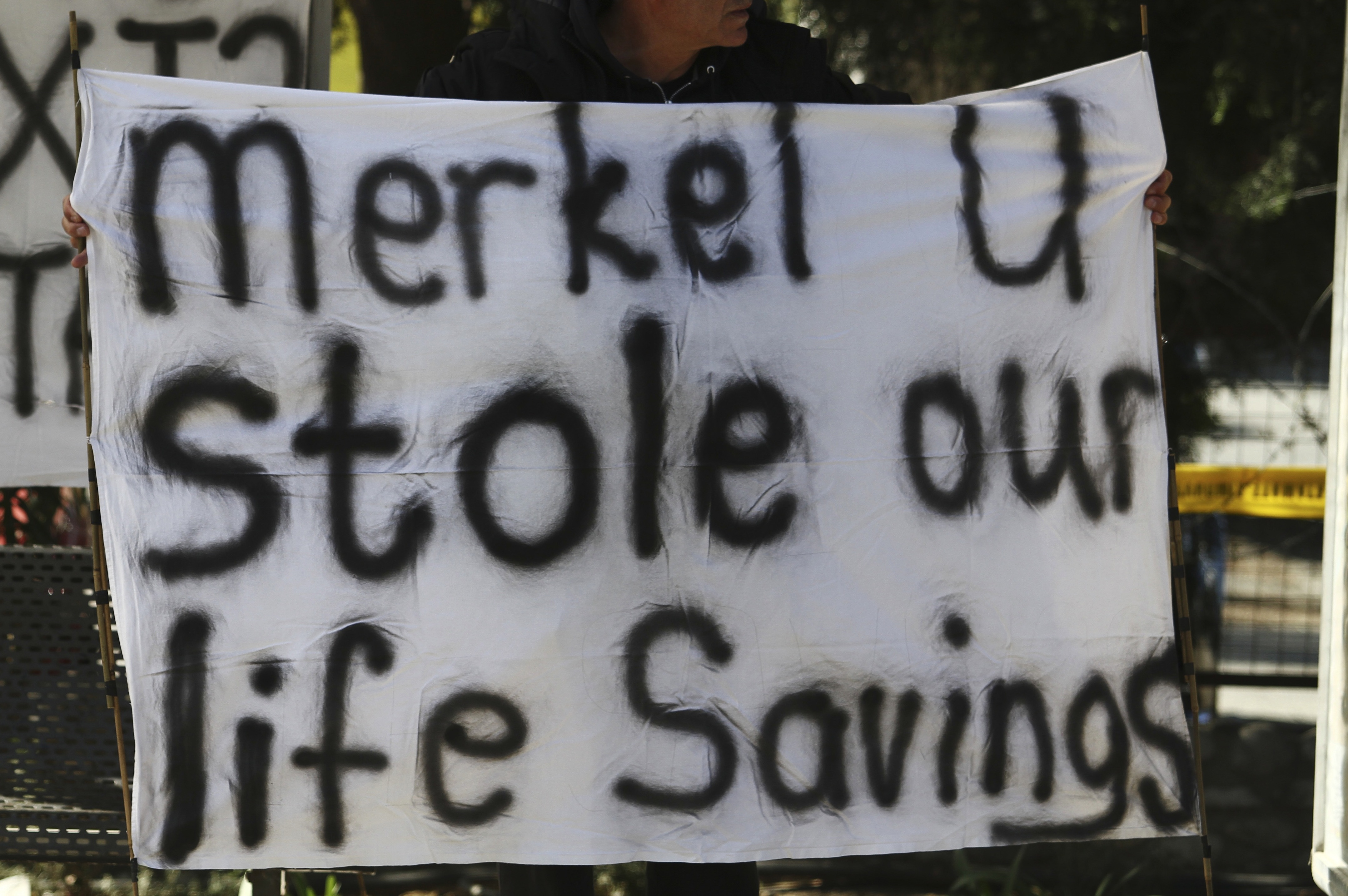
(Photo: A Cypriot man holds a banner against the EU bailout deal and German Chancellor Angela Merkel’s call for Cyprus to follow economic reforms outside the parliament building in Nicosia on March 18, 2013. Cyprus President Nicos Anastasiades was seeking the backing of MPs for the bailout deal that slaps a levy on bank savings under harsh terms that have jolted global markets and raised fears of a new eurozone debt crisis. By Yiannis Kourtoglou/AFP/Getty Images)

Side Effects May Include Plot Twists

Nick Olson’s unpacks Steven Soderbergh’s latest film, Side Effects:

Soderbergh describes his approach as, in a sense, mathematical in a recent interview with Ignatiy Vishnevetsky, and Vishnevetsky does well to identify a few recurring Soderberghian interests that, in my opinion, enable a kind of quantified space for his craft: therapeutic psychiatry, economic/market forces, and the secret plans of con-men/con-women–all of which, notably, are in play here. But these sort of contexts not only give a distinct narrative shape; they also provide the impetus for narrative conflict–a playful space for missing, manipulated, and/or generally disorienting narrative variables. That is, we can become unaware of the side effects of antidepressants, or that the reason we’re prescribed a particular pill has unseen economic implications, or that we are being conned. This allows Soderbergh the ability to deceive us, but in such a way that we’re invested in the baseline way of seeing the math add up.

Millman feels that “best thing about the film is the way in which Soderbergh builds his trap for us”:

For much of the earlier part of the film, we’re “with” Mara, and both the way it is shot and the way it is scored encourage us to believe the story we are being told, about a woman with terrible depression. It’s not just a matter of tricking us about her character – it’s also a matter of tricking us about what genre of film we’re in, which is to say, in part, what kind of moral universe we are in: a world in which intentionality and fault are fuzzy concepts because we understand too well their chemical origins, and in which medical professionals elide easily into repositories for our discarded moral sense, the people who are ultimately responsible for our actions, though they are, in reality, just human beings like ourselves.

But the shift of genre upends this world.

The Industrial Kitchen Complex

All that defense spending goes straight to our hips:

It isn’t surprising, given the superpower ambitions and imperatives of the last century, that many of the great technological kitchen leaps were the inadvertent results of research at the industries and agencies that helped us win the Second World War, not to mention our Cold War/star wars with the Soviets. (One exception is the refrigerator; the application of thermodynamic research to refrigeration also took place in Europe with, among others, Albert Einstein, who patented his own fridge in 1930. Another is the gas oven; the first safe and successfully enclosed ovens came from Britain.) NASA scientists developed the technology for freeze-dried food—like ice, smoke, and salt, a milestone in the history of preservation. And we owe the microwave oven to Percy Spencer, the engineer who helped develop the Navy’s radar system, and the Cuisinart to Carl Sontheimer, the engineer who invented a microwave direction finder for the Apollo moon mission.

Data-Driven HR

Greg Beato digests the news that “work force analytics consultants can now determine what attributes and propensities are associated with success in a given position”:

Employees who live within 10 minutes of the office may be 20 percent likelier to stay at the company at least six months than ones who live 45 minutes away or further. Employees who have a college degree may be less inclined to stick with a call-center job than those who do not. According to The Wall Street Journal, Evolv, the company assisting Xerox in its recruitment efforts, determined that the ideal candidate to staff the company’s call centers “uses one or more social networks, but not more than four.”

Beato finds “liberating, empowering aspects to this kind of data analysis”:

For example, by analyzing thousands of work histories, Evolv determined that there is “very little relationship between the number of jobs an employee has held and their current tenure,” and that “companies that screen out job hoppers and the unemployed have been needlessly limiting their candidate pool.” Even more strikingly, Evolv suggests that while many companies refuse to hire applicants who have criminal records, including some who have only been arrested, its analysis shows that “crimes committed before a person entered the workforce had no predictive value for any counterproductive workplace behaviors,” and that “people with records who stay arrest-free for four to five years are only as likely as the average person to be arrested again.”

Francis Emerges

Pope Francis Holds An Audience With Journalists And The Media

[Re-posted from yesterday]

If we leave legitimate questions about his past for a moment, can I pause to marvel at his present?

The reports of his press conference today suggest a radically new symbolism for the church. This kind of understanding of the diverse and multi-faith and multi-cultural modernity is something you would never have heard from Benedict XVI:

“Given that many of you do not belong to the Catholic Church, and others are not believers, I give this blessing from my heart, in silence, to each one of you, respecting the conscience of each one of you, but knowing that each one of you is a child of God. May God bless you.”

Respecting the conscience of each of you. That might seem to be the bleeding obvious – but it isn’t in the context of Benedict’s theological reign, which was far longer than his pontifical one. Benedict wanted to place conscience below revelation as authoritatively adjudicated by … himself. The central place of individual conscience established at the Second Council was left to wither in favor of a public, uniform religion. He seemed to me to want ultimately to restore the seamless cultural-political-religious unity of the Bavaria of his youth; and if the public square were empty, it had to be filled with religious authority. He tried. In the West, the public square moved in the opposite direction. He hunkered down, hoping for a smaller, purer church. What he got was a smaller one, but beset by scandal and internal division and a legacy of the most horrendous of crimes.

Francis seems to me to be taking the world as it is, but showing us a different way of living in it. These are first impressions, but there seems much less fear there of the modern world, much greater ease with humanity. And human beings like narratives – not opaque and ornate theologies. Jesus always spoke in simple stories and parables. And so today:

“Let me tell you a story,” [Pope Francis] said. He then recounted how during the conclave he had sat next to Cardinal Cláudio Hummes of Brazil, whom he called “a great friend.” After the voting, Cardinal Hummes “hugged me, he kissed me and he said, ‘Don’t forget the poor!’ And that word entered here,” the pope said, pointing to his heart.

“I thought of wars, while the voting continued, through all the votes,” he said as he sat on the stage in a hall inside the Vatican. “And Francis is the man of peace. And that way the name came about, came into my heart: Francis of Assisi.”

To see our two huge temptations today as war and massive inequality is, it seems to me, the Holy Spirit at work. We should remember St Francis’ pilgrimage to the Muslim authorities of his day. We should recall Saint Francis’ direct experience of the horror of war which changed his life. And then how that epiphany on the battlefield and as a prisoner of war led to Francis’ embrace of lepers as his most beloved, of a shack as the place he’d call home, and the giving away of his entire worldly goods – indeed even his own clothes – in order to be free in the spirit of Jesus’ true freedom.

Then this:

He had a couple of other thoughts for journalists, too. Reporting on the church is different from other contemporary matters, he said, because the church is essentially a spiritual organization that does “not fit into worldly categories.” “The church does not have a political nature,” he said.

We’ll see exactly what he means by that phrase in due course – he certainly involved himself in the political and social debates in his home country. But an emphasis on the centrally apolitical stance of Christianity, indeed on the fact that in core ways, Christianity is the antidote to the pursuit of power over others  … well, count me quietly elated. Again, of course, Saint Francis’ renunciation of power comes to mind. And his simplicity:

Instead of the usual formal blessing – standard practice at papal audiences – he said quietly, “God bless you,” and walked off the stage.

And didn’t get into his limo, preferring to walk on foot to his Vatican residence. In my own thoughts and prayers in this crisis of Christianity, I found myself returning to Saint Francis, as readers know. I think he is the saint the church turns to when it has truly lost its way, when it needs to be rebuilt humbly, painfully, from the current ruins.

If that is what happened in the heart of Bergoglio in the conclave, if the spirit of Francis entered his heart as a man of peace and tolerance and humility, as he says, then we have more than cause for optimism.

We have cause for real hope.

(Photo: A detail of the shoes of newly elected Pope Francis as he attends his first audience with journalists and media inside the Paul VI hall on March 16, 2013 in Vatican City, Vatican. The pope thanked the media for their coverage during the historic transition of the papacy and explained his vision of the future for the Catholic Church. By Franco Origlia/Getty Images.)