Extreme Urban Explorers

Matthew Power profiles the urban explorer movement known as Urbex, whose followers “over several years had infiltrated an astonishing array of off-limits sites above and below London and across Europe: abandoned Tube stations, uncompleted skyscrapers, World War II bomb shelters, derelict submarines, and half-built Olympic stadiums”:

They had commandeered (and accidentally derailed) an underground train of the now defunct Mail Rail, which once delivered the Royal Mail along a 23-mile circuit beneath London. They had pried open the blast doors of the Burlington bunker, a disused 35-acre subterranean Cold War-era complex that was to house the British government in the event of nuclear Armageddon. The London crew’s objective, as much as any of them could agree on one, was to rediscover, reappropriate, and reimagine the urban landscape in what is perhaps the most highly surveilled and tightly controlled city on earth.

Power tagged along with some of them to scale Notre Dame Cathedral in the middle of the night:

I passed so closely by a carved gargoyle I could see the furrows of its brow, could almost smell its breath. Atop the first roof we found ourselves in a long gallery of flying buttresses, which spanned outward like the landing struts of some alien spacecraft. Each buttress framed a fifty-foot arched stained-glass window, darkened from within, and as we climbed to the next level, I pulled myself up next to one. I spun slowly on the rope, and for a heart-stopping instant my shoulder rested gently against the glass. I was so close I could see the seams of lead that connected the thousands of pieces of colored glass, the end result of centuries of labor at the hands of nameless artisans. I felt in that moment I would rather fall than damage it.

(Photo: “Behind the Gare St. Lazare” by Dan Foy)

Cannabis Isn’t So Green, Ctd

In 2008, Katie Arnoldi volunteered for a team in charge of cleaning up emptied marijuana sites on public lands in California. On one single operation, they “pulled out 27 miles of irrigation pipes, and over 2,000 pounds of fertilizer, pesticides, rodenticides and hundreds of bags of trash.” In the first of a five-part series, she describes what she saw:

When I got into the active grow-sites, I was struck by the fact that there was absolutely nothing alive. No bugs. No animals. No snakes or lizards. Every single site was a dead zone except for the thriving, chemically drenched plants. And the thing is, all these chemicals leach into the soil. And then when the rains come they’re washed into the drainages where they pollute the waterways and kill the fish. Ultimately it all ends up in the ocean. These pot farms are permanently destroying our protected wilderness.

Even more disturbing, we are inhaling the results:

According to a 2010 HIDTA report, California supplied three-quarters of all marijuana to the US market. Most of the pot was coming directly from the huge cartel grows. People are smoking these terrible chemicals and they don’t even know it. When I worked on the Growsite Reclamation Team, I helped collect samples of the fertilizers, pesticides and rodenticides so that they could be analyzed by a lab. The results were scary. For instance, the lab determined that a quarter teaspoon of one of the Mexican pesticides, found out in the foothills of the Sierras near Sequoia, was so toxic that it in its undiluted form it could kill a 200-pound man. The growers will take a big scoop of this stuff, mix it with water, and spray their crops on a regular basis. That’s what people are smoking. Who knows what the long-term consequences will be?

Probably worse that the munchies. Previous Dish on the environmental impacts of prohibition here and here.

Corporate Feminism And The Class Divide, Ctd

Rebecca J. Rosen encourages men to angle their support for professional women in line with Lean In:

For too long, achieving equality has been seen as women’s burden. People (myself included) were disappointed by Marissa Mayer’s shirking of the feminist label, but few ever ask America’s male CEOs whether they consider themselves feminists. A recent “pop-up book club” from The Guardian asked “women of the internet, [to] gather around” to re-read Betty Friedan’s classic The Feminine Mystique. Again and again, we leave men out of the conversation about gender equality — a conversation whose success depends on their participation. …

[Sheryl Sandberg’s] book is laced with examples of men who have made a conscious effort to make their workplaces more equal, such as the case of a Goldman Sachs executive who instituted a universal “breakfast or lunch only policy” so that he could meet equally with male and female junior staff with no hint of impropriety stemming from a late-night dinner with a young woman. There’s also a Johns Hopkins medical school professor who, after watching Sandberg’s viral TED talk, got rid of hand-raising (women are less likely to keep their hands up) and just called on people randomly.

A reader sounds off at length:

Why is this a “women’s issue”?  Where are the men in all this?

I agree wholeheartedly that many women make choices that opt them out, slow them down, limit their career paths.  I’m also in the class of women Sandberg is speaking to (in terms of my social relationships and background – I went to an Ivy League college, have a graduate degree, am economically well-off, and most of my friends are similar). At age 39, I am shocked by how many of my women friends (almost all of whom are married with children) have opted out or slow tracked themselves. The very, very few who haven’t tend to be strong individualists, have a strong sense of personal identity and ambition, and are good at creating their own paths without model or example.  They just get shit done and aren’t very concerned about what other say they can or can’t do or are or aren’t supposed to do.

(Some more context on me: I’m single, childless, own a marketing agency in New York – started partly because I changed careers in my early 30s and saw that I’d either have to fight past all kinds of tired ideas of about age, career path change, etc., or just do it my own terms. And part of my reason for changing careers was about really understanding that I needed to be able to provide for myself and look for a career path that would let me have the income and flexibility to have a kid on my own.)

It’s true just getting started on this makes me realize I have plenty to say about the choices women make, but when I take a step back, I always come back to, what does this have to do with the “choices” of women?  It has just as much – if not more to do – with the conventions of and expectations for men. Culturally, men are on the other side of this “choice” dichotomy.  To use Sandberg’s language, if the convention for women is to “lean out”, then the convention for men is to “lean in”, and that has just as many – and really more – unaddressed consequences.

But where are the regular books and articles about that, particularly from male leaders?  Where are the conversations about men growing some balls and fighting for their rights to “lean out”?  Where are the men stepping up and fighting for their work/life balance?  Why are all these men letting women fight their battles?  All of the husbands of those above-mentioned women and friends (working in mainly in finance, media, tech) want more time with their families, feel stressed and overworked, hate feeling like they don’t have time with their families.  Well, why they fuck aren’t they stepping up and fighting all these battles about choice, balance, etc.?  Why is this a “women’s fight”?

The reality is all of this should be about personal choice, motivation levels, letting men and women decide within their relationships what their best working arrangements are – not letting those be driven by conventions of society (men are paid more, women sometimes get paid maternity leave, etc.) Sandberg talks about Google deciding more maternity leave was better than having women opt out and having to hire new employees.  Men don’t even have this choice. Imagine, for example, if men and women were given the same leaves?  How would that change the entire dynamic of opt-in/opt-out, lean-in/lean-out career choices, of family dynamics and relationships, for the lifetime of working and having children?

All of which is to say: the reason all of this is so tired is because it still comes back to the same thing:  Women are fighting, struggling, working for change, for something that’s better for them, for their families, for children, while men complacently sit by and sort of just wait and see how it falls out.  And, really, any men worth anything knows that working in companies where there’s gender balance across levels and roles is WAY more rewarding, so there are plenty of reasons for them to care about all of this. (I’ll reference that story on how Etsy’s work to attract female engineers actually helped them get better and more male applicants as evidence that men know working with women is good thing.)

Long email – sorry – but the feminizing of this conversation drives me insane.  It’s just the same crap with a fresh coat of paint.

Previous Dish on the debate sparked by Sandberg’s book here, here and here.

Not Supporting Our Troops Enough

Joe Klein gives low marks to the Department of Veterans Affairs:

[T]he VA hasn’t set the right priorities. A Marine who was blinded and lost two limbs last year in Helmand province goes into the same queue as a Vietnam veteran who wants increased payments because his back is deteriorating with age. First-time claims need to be handled before second-, third- and fourth-time claims; 100%-disability cases need to be handled before 20% disabilities. Somehow that isn’t happening.

On top of that, Charlie Reed and Jennifer Svan report how the Air Force, Army and Marines are “dropping tuition assistance due to sweeping federal cuts”:

The official message that the Air Force was suspending all new requests for tuition assistance effective immediately, came out “stateside time yesterday,” Davis said Tuesday. “We pushed an email out this morning from the education center,” informing airmen of the change, Davis said. By the time airmen woke up Tuesday morning in Germany, they were shut out from submitting new requests for tuition assistance through the Air Force Portal. A message on the application site says in red letters: “Air Force Military Tuition Assistance Currently Not Available.” …

Sequestration, [Air Force spokesman Capt. Nicholas Plante] said, is having “devastating effects” on readiness, mobilization and the workforce. “We have to make difficult choices to preserve those types of things.”

Girls On The Global Stage

Dreznerhas some fun translating the HBO series into a parable of international politics:

Ray is a coffee-shop manager, the oldest member of the group, and far and away the most cynical and angry character on the show. He scorns just about everything that every other character says or does, but seems unable to make much of himself. Ray is Russia personified.

In contrast, Adam — Hannah’s former beau — is China. He’s a force to be reckoned with, but it’s not entirely clear whether he’s socialized into how the rest of Brooklyn society behaves.

One could posit that Hannah’s relationship with Adam represents the promise and peril of the “responsible stakeholder” concept. On the one hand, Hannah seems to use her “soft power” to entice Adam into liking her a lot more than he originally thought — in other words, getting him to want what she wants. He begins to socialize with Hannah’s circle of friends. At the same time, Hannah is unsure just how much she wants to engage Adam, reflecting America’s ambivalence in its relationship with China. At the end of the first season, she is quite uneasy about moving in together. The result is an Adam that, much like China, is angry and frustrated at his treatment by others — which in turn leads to bellicose behavior, which in turn leads Hannah to call the cops and try to contain his behavior. The breakdown in the relationship between Hannah and Adam is yet another example of the security dilemma destroying lives.

Reality Check, Ctd

Approval

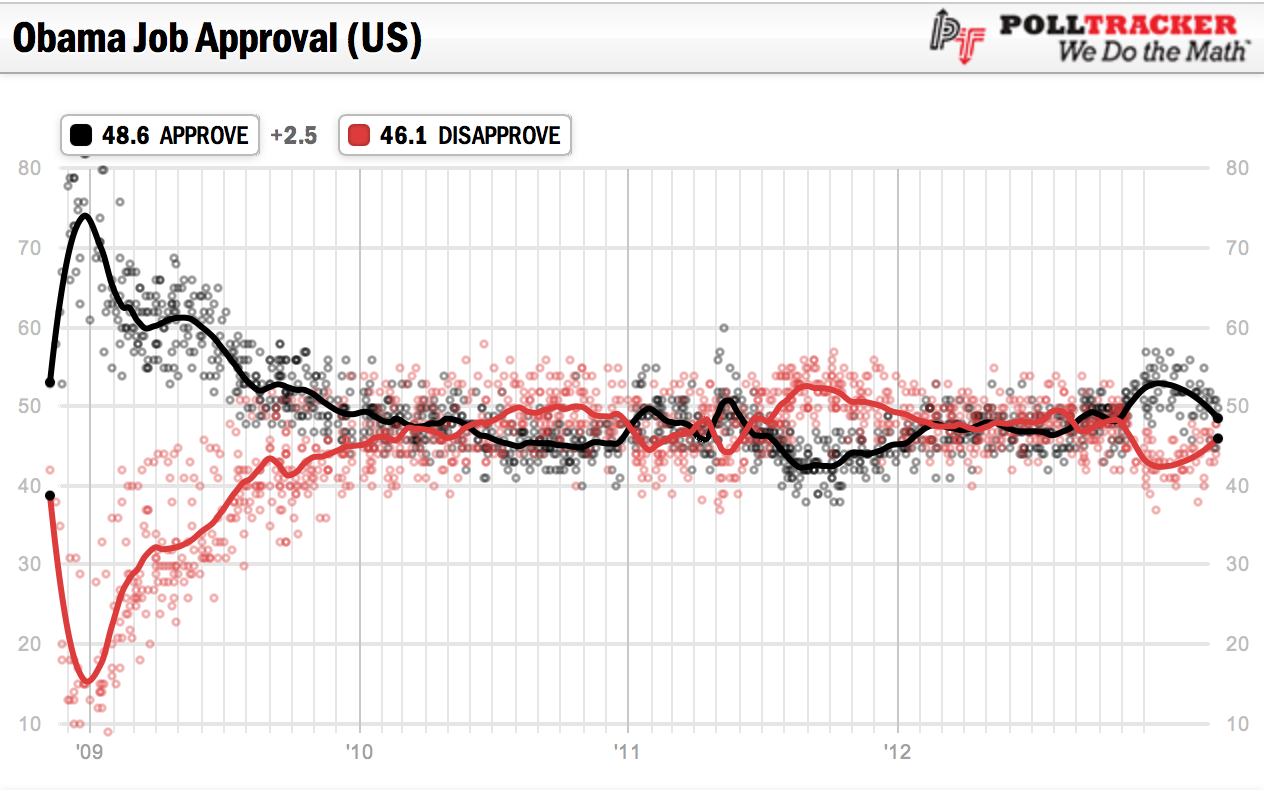
Nate Cohn is unfazed by Obama’s approval ratings slide:

The ratings’ steady decline isn’t surprising. So long as Republicans remain uniformly dissatisfied with the president, Democrats need to be all but entirely unified for Obama’s approval ratings to eclipse 50 percent. Even support from 85 percent of Democrats, still an impressive show of party unity, wouldn’t be enough to keep the rating above 50. (YouGov/Economist and Washington Post polls both show Obama down to 87 percent approval among Democrats, while McClatchy/Marist showed Obama at 82 percent.) With tepid economic growth and a never-ending stream of manufactured crises to diminish the public’s faith in Washington, Obama wasn’t likely to maintain that kind of party unity. Even without those problems, it was only a matter of time before Obama’s ratings returned to the upper forties, which is more or less where he’s been for the last three years, with only the debt ceiling crisis causing his numbers to dip further. So it’s safe to assume that what we’re witnessing is merely a modest correction rather than the beginning of a severe drop in support.

(Chart from TPM)

The Invisible Ideology of House Of Cards?

Bhaskar Sunkara, in a leftist reading of the hit series, derides its lack of ideological kick:

After Obama’s election, liberals tried to make over Washington in The West Wing’s image—post-political, free of legislative rancor, fixed to the will of a single charismatic president. But they’ve run into a roadblock, an obstructionist Congress unbound by Sorkinstyle civility. No wonder so many liberals eat up the seediness in House of Cards. Underwood is a leading member of the House of Representatives, an institution beset for decades by low approval ratings and lurid scandals. It’s not just legislative policy that is called into question by House of Cards, but the motivations of those doing the legislating. …

But easy cynicism shouldn’t be mistaken for considered political critique. House of Cards’ message is simple: Bad men and women inhabit Capitol Hill. It’s superficially progressive. Like the series’ creators, liberals have a tendency to see the structures of American political life—our Constitution, for example—as being inherently sound instruments of the popular will, rather than systems meant to protect against mob rule.

I have two episodes to go. I don’t look at this inspired miniseries as ideological. It has some clumsy compressions, some melodrama, and a main character so close to Shakespeare’s Richard III I wonder whether Kevin Spacey’s breaking the fourth wall isn’t some sly reference to Richard’s chillingly fun soliloquies to the audience. Robin Wright is like adding Lady MacBeth to Richard III.

But in general, it captures the Washington I know better than almost any movie I have seen. From the power struggle between old and new media to the wonderful humanity of Peter Russo and the subtle but pervasive influence of lobbyists and whom they represent, it takes its time to re-create reality.

My one criticism is that it is too cynical.

Washington is full of the characters you see in the series, but it is also full of people trying to make the world a little better, trying to maneuver their way through the avenues of power without accumulating too many scalps, believers and dreamers and genuinely hard-working folk doing their best. They’re a minority, of course. This is politics. But they are there – and not only among the ranks of the non-profit martyr of Claire’s charity. And there are bloggers more ethical than Zoe Barnes. But her ambition is of an Ezra Klein magnitude.

I like the fact that Underwood is a Southern Democrat. The show’s head writer explains his reasoning behind the choice:

The broader point of “House of Cards” is that anyone is fair game, no matter what side of the aisle they are on. You could easily write this story about a Republican congressman as well, but we wanted to dramatize the fact that these sort of creatures live on either side of the aisle. The things people will find objectionable about Underwood will be about deeper ethical belief systems that transcend political affiliation. If you look at Underwood and what he’s actually doing, he is not someone who binds himself to any particular ideology. His ideology is quicksand, and he would say that the only way to truly survive in Washington and to be effective is to be adaptable.

And he would be right. Which is why the GOP, if it does not mellow its ideological rigidity, is in trouble.

When The Personal Becomes Political

Allahpundit ponders Portman’s reversal on marriage equality:

I’m loath to scold the guy for his reasoning given that I agree with him and that he’s taking on a bit of political risk in doing this, but why did he need his son to come out to get him to look at this issue from the perspective of someone who’s gay? He’s been a professional legislator for years; he’s supposed to consider all sides of an issue when deciding which policy to support. That’s a surprisingly parochial approach to a national debate that’s been rolling around for a solid decade now. Makes me wonder if his feelings on the subject really did change recently or if he’s always quietly been open to gay marriage but only felt politically safe to announce it once he discovered his son’s orientation. Conservative primary voters may be less likely to hold it against him if they think it’s a decision driven by fatherly love for his son.

Chait is more blunt:

Portman ought to be able to recognize that, even if he changed his mind on gay marriage owing to personal experience, the logic stands irrespective of it: Support for gay marriage would be right even if he didn’t have a gay son. There’s little sign that any such reasoning has crossed his mind.

Drum is forgiving:

do wish conservatives could demonstrate a little empathy even for people and causes that don’t directly affect their own lives, but it’s not as if this is an exclusively conservative thing. It’s a human thing. Personal experience always touches us more deeply than facts and figures, and in the case of gay marriage we all knew this was how progress would be made. People would see gay characters on TV and shed a little bit of their discomfort. They’d learn that old friends are gay and decide they wanted to stay friends anyway. They’d learn their children are gay, and decide that they still wanted the best for them, even if that means supporting same-sex marriage.

And Yglesias asks, “if Portman can turn around on one issue once he realizes how it touches his family personally, shouldn’t he take some time to think about he might feel about other issues that don’t happen to touch him personally?”:

Senators basically never have poor kids. That’s something members of congress should think about. Especially members of congress who know personally well that realizing an issue affects their own children changes their thinking.

My thoughts here.

The Pope On The Bus

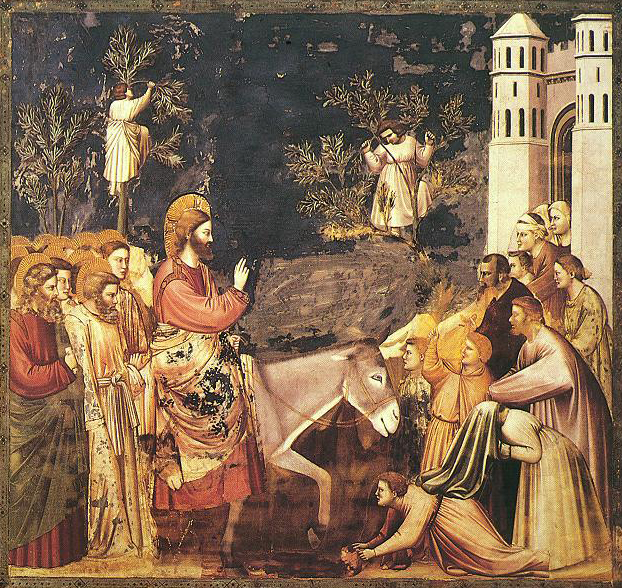
Giotto_-_Scrovegni_-_-26-_-_Entry_into_Jerusalem2

Of course that detail has resonance. The implicit rebuke to the Liberace of Popes, Benedict XVI, is somehow not disrespectful, yet obvious. Saint Francis refused to ride on a horse. It gave him, as far as he was concerned, too much haughtiness, too much power over others, too much visibility. He would walk, and if he needed a way to transport things with him, he used a donkey. For a while, Franciscans followed this stricture carefully, while eventually the norm became that Franciscans could ride on donkeys, never horses, if they really couldn’t walk. And the legend has it that on his death-bed, Francis thanked his donkey for his long service and that the donkey wept.

Jesus’ celebrated arrival in Jerusalem, when the crowds that would soon call for him to be tortured to death were throwing palm fronds at his feet, was on a donkey. Here we had the Son of God insisting on making a paradoxical entrance – on the lowliest creature. “Lowly Yet Chosen” as Pope Francis put it in his first statement. And so we hear more and more stories of his insistence on an absence of pomp, of not placing the priesthood or even the papacy on a lofty pedestal, getting on the same bus as is fellow cardinals, paying his own bills at a local hotel, telling his fellow Cardinals to wear black rather than Benedict’s fabulous scarlet near-burlesque.

For much of my time in high school, I rode the public bus every day. I went to what Americans would call a “magnet school” which was a long way, in an English sense, from my home. For close to seven years, I spent two and a half hours a day on that lumbering vehicle, wending its way with painful slowness through the darkness of the English winter or the absurd green orgasm of every spring. And I think there is something valuable about that simple public exposure, day after day, that reminder that you are not better than anyone else, that if there’s no seat available, you stand, that if an old or infirm or pregnant person gets on the bus, you offer them your seat, that the strangers you stare at have lives you will never fully know – unless a conversation happens to begin, or a stranger on the same bus every day becomes a kind of unknowable friend. I can still close my eyes and see faces I would see at various stops along the way. We were English so mere nods of recognition sufficed.

This is one reason I love Catholicism: its human and cultural catholicity.

The parishes I’m drawn toward are sprawling, diverse, different congregations. I never wanted to go to a gay mass, although I respect those who choose to. For me, it was the lack of uniformity that grabbed me. To walk to communion behind a student or a construction worker or a Latino immigrant or a pregnant mother or a gay senior or an old lady in a veil is to experience the sheer, glorious wounded mess of humanity – walking to be healed by the Body of Christ. I deeply believe this is integral to Christianity – a lack of hierarchy, an insistence that what the world elevates is not what matters, that the first shall be last, and the last first. Letting go of the notion that you are worth more or less than anyone else, accepting your physical fate as dust, and embracing humanity without borders or labels – as the Samaritan did in the parable, as Francis did with lepers, as Mychal Judge and Jorge Bergoglio did in washing the feet of people with AIDS – this is Christianity.

It wounds me to see so many young people think of it as the opposite (and not without reason). A hierarchy determined to defend its privilege and prestige even at the expense of raped children, a Pope almost disappeared in his own regalia, a stream of statements ostracizing a group of human beings – gays – and refusing even to listen to the perspective of half of humanity, women: this is what Francis inherited, and he was not free of it. But the new name gives new hope and points in a new direction.

Perhaps the answer is to get back on the bus again. And in one of her most poignant posts yet, Judith O’Reilly responded to the new Pope by doing just that:

Why did I feel I had to ride this bus this morning? Because I wanted to know why a cardinal did not ride in a leather-seated, tinted-windowed limo though the streets of Buenos Aires, but chose instead to travel among the faithful and less-than-faithful, bumping and swaying, the wheels on the bus going round and round. What did Jorge Mario Bergoglio get from those bus-rides around the city? Stories? Comfort? Warmth? An understanding what it is to work hard, to be tired, to be lonely, to have to stand when you want to sit, to know you are going home or going far away? Maybe too, I wanted to get on the bus, any bus, because we are on our own journeys and right now at least so far as faith goes, I don’t know where I am heading. Maybe, I thought, if I catch a bus like a Pope, I’ll arrive at a destination called Faith.

And maybe we will.

(Painting: Jesus’ arrival in Jerusalem, Giotto).

It Gets Better

Senator Rob Portman, prompted to rethink the issue after finding out that his son is gay, has announced that he supports marriage equality:

British Prime Minister David Cameron has said he supports allowing gay couples to marry because he is a conservative, not in spite of it. I feel the same way. We conservatives believe in personal liberty and minimal government interference in people’s lives. We also consider the family unit to be the fundamental building block of society. We should encourage people to make long-term commitments to each other and build families, so as to foster strong, stable communities and promote personal responsibility.

One way to look at it is that gay couples’ desire to marry doesn’t amount to a threat but rather a tribute to marriage, and a potential source of renewed strength for the institution.

Weigel puts this in perspective:

Up to now, a lot of the Republicans making bold strides toward gay marriage were consultants (whose corporate work would benefit from the stance) or retired pols. Portman is one of the acknowledged thought leaders of the congressional party.

Timothy Kincaid thinks Portman’s change of heart “is a bit risky”:

Ohio Republicans are a different breed from the New Hampshire strain. But I’m going to hazard a guess that this wont much hurt Portman. It might even help him.

For my part, I’m thrilled by his acknowledgment of the equal humanity and citizenship of his own son. We hear a lot about “family values” from the GOP, but we rarely see them in action as clearly as we do in Portman’s reversal. And the clarity of his essentially conservative argument for marriage equality – the same one I made two and a half decades ago – has to resonate. No conservative not in thrall to religious fundamentalism can regard this reform as somehow anti-family. It is pro-family; it is socially integrative; it heals wounds, rather than opening them; it helps create more marriages that act as a critical civil society that keeps government at bay. Now I have a husband, I have a First Responder to all the crises of life. I have less need of government help, if I have a spouse’s help first.

Some will wonder why Republicans only seem to get this question when they have a gay member of their family.

And you can indeed argue that conservatives tend to embrace social justice only when they are directly affected. I’d prefer to look at it the other way round. These Republicans, unlike some others, have actually confronted the issue face to face – and the good ones immediately become some of the strongest supporters of marriage equality. Once they see us as them, they realize the hurt and pain and cruelty of ostracizing from civil society core members of that society and full members of their own families. Ask yourself: how many out gay Republicans actually oppose marriage equality? Almost none that I know of. When a community’s entire right wing and entire left wing back a reform, when their families back it, it becomes not a matter of left and right. It’s really a matter of right and wrong.

Sometimes, reforms threaten conservatives, as they should. Conservatism, properly understood, remains an important restraint on our utopian impulses or our certainty about anything. It asks us of to consider unforeseen consequences of reform, to consider carefully the pluses and minuses, to prefer federalism to sudden, national decisions. As this process has taken place, even as religious fundamentalism has swept the GOP, those capable of adjustment, those who understand that to preserve the vitality of a social institution, you sometimes have to change it a little: they are coming around.