
Eating Like Which Caveman?

Laura Miller summarizes arguments from Marlene Zuk’s new book, Paleofantasy, which calls the “paleo diet” fad pseudoscientific:

[G]eneralizations about the typical hunter-gatherer lifestyle are spurious; it doesn’t exist. With respect to what people ate (especially how much meat), the only safe assumption was “whatever they could get,” something that to this day varies greatly depending on where they live. Recently, researchers discovered evidence that people in Europe were grinding and cooking grain (a paleo-diet bugaboo) as far back as 30,000 years ago, even if they weren’t actually cultivating it. “A strong body of evidence,” Zuk writes, “points to many changes in our genome since humans spread across the planet and developed agriculture, making it difficult at best to point to a single way of eating to which we were, and remain, best suited.”

Yglesias agrees with Zuk:

None of which is to say that adopting a paleo diet won’t “work.” Any sufficiently stringent, somewhat arbitrary set of dietary restrictions is likely to lead you to snack less and be more mindful of what you’re eating. But the paleo concept is a marketing gimmick that doesn’t have much basis.

Driving On Sunshine, Ctd

A reader writes:

With regard to solar highways, a more inclusive solar policy would be to modify building codes to require re-roofing to be done with solar-collecting roofing tiles. If the homeowner was willing to fund the full cost of the solar roofing, they would own the electricity generated by their roof. Their electric bill would be reduced by using the energy from their roof and they could sell any excess power to the utility company (as is often done today). The twist would be that if the homeowner didn’t want to pay the additional amount for solar tiles and hook up to the grid, a government subsidy could bridge the difference between a traditional roof and a solar one. In that scenario the energy created by the homeowners roof would belong to “the commons” and the homeowner would receive the usual electric bill for all the power consumed by that household.

This method would allow utilities to expand solar service in a very predictable way that allows the business to ramp up production with a real knowledge of future demand. Also, within 30 years, the entire county would be a giant solar collector.

A wonky reader responds to another recent post on solar energy:

Loving the recent focus on energy issues, attacked with the usual vigor.

The Bloomberg analyst has it exactly right: Suntech is the most recognizable, reputable Chinese brand, and the government won’t let it go down. There are certainly a number of other high-quality Chinese manufacturers, but there is a lot of substandard product coming from that country, as in other industries. Given that they’ve just effectively vanquished the U.S.-based manufacturers, it seems crazy that they’d fold now. As long as the U.S. incentive structure holds up (barely, for now) there will still be demand here, and most consumers unfortunately don’t know enough about solar brands to distinguish between the junk and the premium manufacturers. The loss of Suntech’s production share would be significant for the U.S. market.

I also doubt the warranty issues is as big a concern for companies like SolarCity and SunRun. Most of these systems are closely monitored, and they don’t fail terribly often. When they do, it’s more likely to be wiring or the inverter, rather than the panel itself. Since the large installers buy high-quality product, there’s every likelihood that most panels will perform at or above spec for their full warranty life. Many “solar guys” proudly display still-working arrays from the first solar boom in the 70’s. The industry touts a 1%/year efficiency degradation rate but it’s probably often better than that.

One thing that’s commonly misunderstood about solar panels is that once you’re beyond the level of the solar cell itself, a typical PV panel is just about the least complex form of energy generation in existence. They have no moving parts. The panel itself is encased, usually rated to withstand hail or whatever type of weather is appropriate for the region. You could crack one if you kicked it really hard (I never tried), but they’re not what I would call fragile. The only “mechanism” is a wire attached to the back which transmits the current. Some systems have microinverters attached on each panel, but those are warrantied separately, and are more likely to be U.S. manufactured.

I’m talking off the cuff here though, and while having to eat the warranty on Suntech panels might not kill a company like SolarCity right away, it’s just as easy to imagine their already-thin margins getting nibbled to death over time under those circumstances.

The long game here – and this ties into your post from the other day about fracking – is that solar is pretty close to an economic tipping point in the U.S., and it drives solar industry guys nuts when academic renewable energy guys talk about “costs need{ing] to come down”. We don’t need more research; we need more demand. The only way solar gets any cheaper anymore is for guys in harnesses and helmets learn how to do their jobs better. We don’t need another scientist at MIT setting a cell efficiency record, or another “expert” telling the politicians that they should cut demand incentives to fund research. Doubly so for the whole “the sun doesn’t shine at night” bit – how much electricity demand is there in the middle of the night? Solar produces power when it’s needed – the middle of the hottest day in the summer when everyone turns on their air conditioners at once. If energy were priced in real-time, solar would get top dollar. Instead, we have a regulatory regime that effectively guarantees that all electricity is the same price no matter how much is purchased or when.

Even with our distorted electricity market, solar has almost reached grid parity, or the point where solar electricity competes with natural gas-generated grid electricity without subsidies. As long as solar prices declining and the boom-bust incentive cycle doesn’t cause the industry to lose the manufacturing knowledge and economies of scale – again – solar could go pretty big in the next few years. Moreso if we fixed the electricity markets, not just to price pollution but price electricity supply and demand in real-time. The utilities that see this future as inevitable or desirable are the ones pushing smart meters, by the way. Trust me, these things are good for you.

Sorry for the lengthy note; these issues are so often misunderstood, so rarely discussed well. Between school and work I spent the better part of a decade trying to unpack them, before burning out late last year. I have a friend who just spent a night in jail protesting Keystone XL. After working with Congress on energy for four years, I sometimes wonder if guys like him are the only ones making a difference.

Amazing Amazon

Readers push back against the most recent Dissent of the Day:

Amazon and the ebook don’t displace independent book sellers as much as they displace the supermarket mass-market paperback.  I see the ebook as a great technology that is inevitable and Amazon may wipe out the independents.  Just like horse, carriage and stables were all part of our economy and provided jobs, the book publishing industry is a dinosaur in the world of human advancement.  We all have nostalgia for the things we loose to technology and progress, but it does not mean we are worse off in society.  Like it or not the guy who works for a independent bookstore will become the stable boy of past.

Another quotes the dissenter:

“We need traditional book publishers to sift through endless submissions, just as we need highly-literate booksellers to promote exceptional new works to the public.” Do we? The stunning success of author Hugh Howey says we don’t and his Wool is the best new sci-fi I’ve read in ages. It’s not clear to me that publishing gatekeepers will do any better than crowd-sourcing and word-of-mouth in identifying worthy authors. But really, we’re all supposed to go talk to a “highly-literate bookseller” to tell us what to read, when we can go to Goodreads or Amazon and get the opinions of dozens, hundreds, or thousands? Please.

Another:

I agree with your dissenter that print books and bookstores offer something necessary and important in the world, and I hope they survive forever. But I have to add that, from the writers side, Amazon is offering a steady income stream to hundreds (maybe thousands) of writers who never had an income stream before.

Some breakout self-publishers are even making huge amounts of money and gathering zillions of readers. Not many of them, but beyond the stories of these big successes there is an unrecognized story of writers who are finding readers and paying their bills when they were blocked before by the gatekeepers of the large publishing houses.

I wish Apple and Google and B&N and Kobo would step up and give Amazon some real competition on this front. But don’t condemn Amazon. They have created new markets as they’ve broken old ones.

Another:

I also like to support independent bookstores when I can. So I immediately looked at the three mentioned in the dissent and searched for my new mystery novel, The Killer Wore Leather. Because like many authors these days, I do most of my own marketing, and I link to Amazon and Barnes and Noble all the time. I have also started to include Powells, the well-loved Portland, Oregon store. I would love to link to more places where people could walk in and find it!

What did I find? One bookstore didn’t have it and had no way to special order it. The other two didn’t have it, but I could order it from a warehouse, adding 1-5 business days to the shipping time.

Now, consider Amazon, which had my book listed on EVERY Amazon website all over the world, even though the book is only (right now) in English. They allowed people to pre-order it, both as a paperback and as an e-book. When the e-book went live, people who pre-ordered it got it downloaded to their Kindles automatically. People who ordered the paperback got boxes in the mail within days of the release. And Amazon offers it at a discount.

I’m sorry to see brick-and-mortar stores go. I love a good bookstore, staffed by people who read, with handwritten shelf tags, personal recommendations and a quirky selection of things not found in every airport bookstore across the country. But you know what else I like, as an author whose income depends on sales? I like it when people can find my book easily, and get it quickly, and be able to go back and recommend that book on a website millions of people use every day. If I was depending on The Strand, McNally Jackson, the Community Bookstore, or, for that matter, Rizolli to help MY job? I’d have nothing. Because Rizolli also doesn’t stock my book, or even offer it as a special order.

The Argument For Not Being

Rhys Southan considers it while reviewing David Benatar’s Better Never to Have Been: The Harm of Coming into Existence:

(1)   Those who exist experience suffering, which is bad.

(2)   Those who exist experience pleasure, which is good.

(3)   The absence of suffering for the nonexistent is good, even if that good is not enjoyed by anyone.

(4)   The absence of pleasure for the nonexistent is not bad, because there is nobody for whom this absence is a deprivation.

In Benatar’s estimation, since existence includes suffering (claim 1), it loses to nonexistence’s lack thereof in claim 3. But existence and nonexistence tie in the clash over pleasure in claims 2 and 4. Benatar calls this “the Asymmetry.” The fact of suffering means there are negative aspects to existing, but since you can’t miss pleasure if there is no you to miss it, there is nothing bad about never being born. Therefore, having a child creates suffering that wouldn’t otherwise exist, and since suffering is bad and nonexistence isn’t, let’s never breed again.

How he dismantles that idea:

Utilitarians like Benatar tend to aggregate all the world’s suffering into a unitary metaphysical reservoir of concentrated, pulsating agony – like that river of psychomagnotheric slime in Ghostbusters II that exploded from the sewers as New York City got grumpier – and who wouldn’t want to pull the plug on that? But we experience life as individuals, not as a collective mind, and one advantage of this is that throughout the entire world, there is no more pain perceived at any one moment than what a single person is capable of experiencing – and most of us are pretty well equipped to handle that.

Drones By Default

Ambers contends that America’s “targeted killing policy is the best of all worst options for two reasons”:

One: The United States does not have a coherent and legitimate capture and detention policy. (Thank the CIA torture program, Abu Ghraib, Congress, and the Obama administration’s weak efforts to create one.) Two: Human intelligence collection has atrophied to the point where there are not enough people on the ground to facilitate the capture and detention of wanted targets.


This means the US over relies on technical intelligence, and on signals intelligence in particular. In Pakistan, it relies on tips from the Army and the ISI. Often, the member of al Qaeda core who’s been identified by the ISI is not, in fact, a member of al Qaeda core, but is instead a Pakistani Taliban or militant who is not sufficiently pro-Pakistan. The U.S. has gotten better at vetting these tips, but the policy generally is that it’s best not to let the sufficient be the enemy of the reliable. Yemen’s government does the same thing. The U.S. MUST rely on allied intelligence services because it cannot rely on its own. So: Bad guys exist. Can’t capture ’em. Can’t figure out who they are without help. What’s the answer? You kill them. If you oppose the policy of targeted killing of al Qaeda operatives, then you ought to support a viable detention system as well as a significant increase in our indigenous human intelligence capacity. Special operations forces and the CIA really would like to capture these guys and interrogate them, because these guys will often give up their comrades. But they can’t. So they don’t. And the president won’t take any chances in letting someone potentially dangerous slip through his grasp.

Pope Francis vs Clerical Privilege

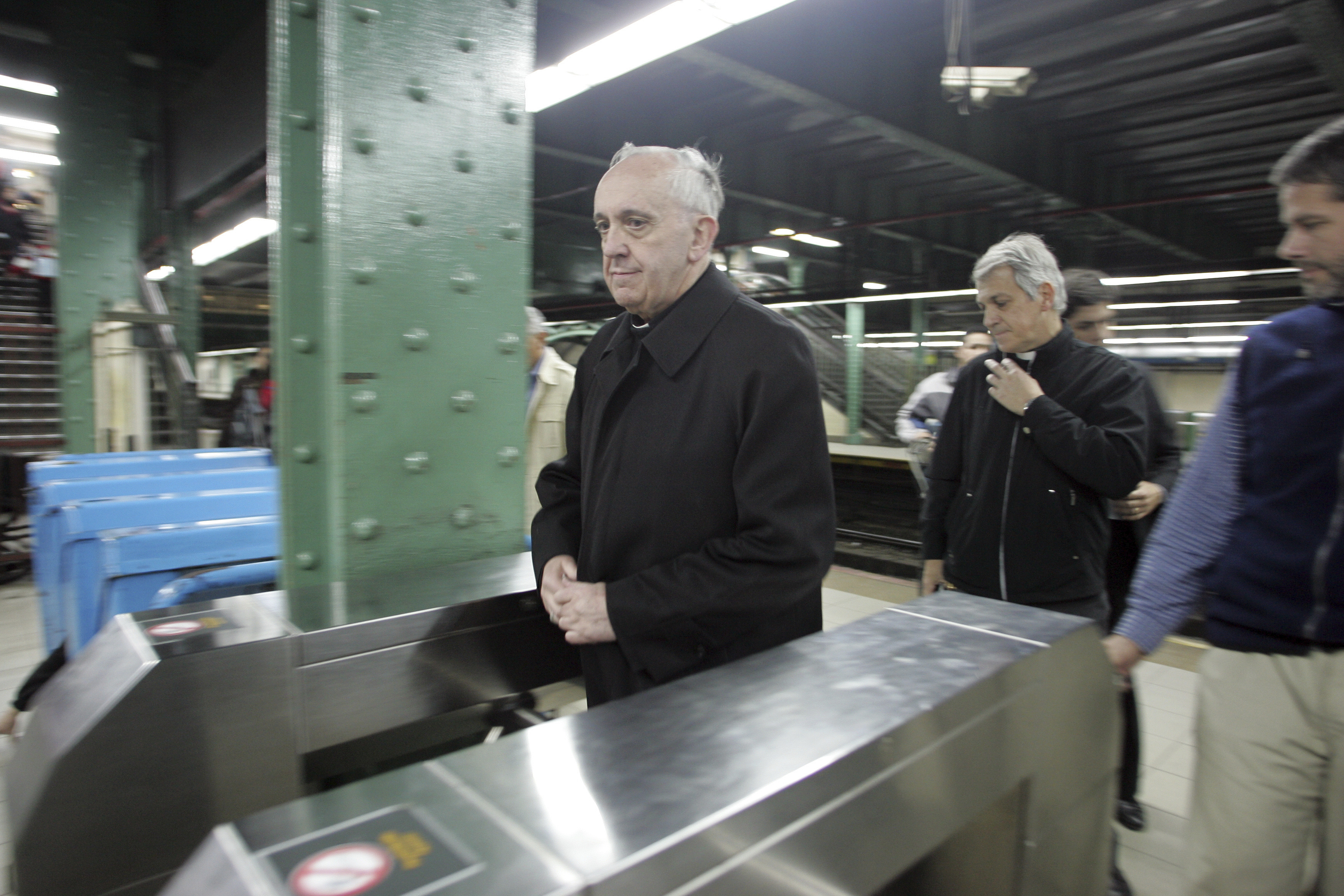
Cardinal Jorge Bergoglio Celebrates Tedeum in Buenos Aires

Garry Wills, whose new book against the priesthood has just come out, might find a strange ally in Pope Francis. In so far as the new Pope seems determined to tackle the untouchable, remote power of clericalism, he is exactly what the church needs to rid itself of abuses embedded in seeing priests as a caste apart, beholden to no-one. From an old, somewhat inspiring interview:

BERGOGLIO: Their clericalization is a problem. The priests clericalize the laity and the laity beg us to be clericalized… It really is sinful abetment. And to think that baptism alone could suffice. I’m thinking of those Christian communities in Japan that remained without priests for more than two hundred years. When the missionaries returned they found them all baptized, all validly married for the Church and all their dead had had a Catholic funeral. The faith had remained intact through the gifts of grace that had gladdened the life of a laity who had received only baptism and had also lived their apostolic mission in virtue of baptism alone. One must not be afraid of depending only on His tenderness… Do you know the biblical episode of the prophet Jonah?

Q: I don’t remember it. Tell us.

BERGOGLIO: Jonah had everything clear. He had clear ideas about God, very clear ideas about good and evil. On what God does and on what He wants, on who was faithful to the Covenant and who instead was outside the Covenant. He had the recipe for being a good prophet. God broke into his life like a torrent.

He sent him to Nineveh. Nineveh was the symbol of all the separated, the lost, of all the peripheries of humanity. Of all those who are outside, forlorn. Jonah saw that the task set on him was only to tell all those people that the arms of God were still open, that the patience of God was there and waiting, to heal them with His forgiveness and nourish them with His tenderness. Only for that had God sent him. He sent him to Nineveh, but he instead ran off in the opposite direction, toward Tarsis.

Q: Running away from a difficult mission…

BERGOGLIO: No. What he was fleeing was not so much Nineveh as the boundless love of God for those people. It was that that didn’t come into his plans. God had come once… “and I’ll see to the rest”: that’s what Jonah told himself. He wanted to do things his way, he wanted to steer it all. His stubbornness shut him in his own structures of evaluation, in his pre-ordained methods, in his righteous opinions. He had fenced his soul off with the barbed wire of those certainties that instead of giving freedom with God and opening horizons of greater service to others had finished by deafening his heart. How the isolated conscience hardens the heart! Jonah no longer knew that God leads His people with the heart of a Father.

(Photo: Argentine Cardinal Jorge Mario Bergoglio takes the Line A of the undergournd prior to the celebration of the traditional Tedeum mass at the Metropolitan Cathedral on May 25, 2008 in Buenos Aires, Argentina. By Emiliano Lasalvia/LatinContent/Getty Images.)

A Pope In Court?

It appears Francis – and not Benedict – may have to attend another court hearing to deal with a previous “crime against humanity” with respect to children under the Argentine dictatorship:

Tiempo Argentina is reporting that Bergoglio could be called to federal court to testify for the third time in a case involving crimes against humanity for his interaction with a pregnant woman named Elena de la Cuadra, and her husband, Hector Baratti, who were both kidnapped on February 23, 1977. According to Elena’s sister, Elena gave birth to a daughter who was then taken by Argentine authorities. At the time, Elena appealed to Bergoglio for help and received a letter saying that a bishop would intercede, but after a few months passed, the bishop reported that the baby had already been adopted by an important family and that the kidnapping could not be reversed. Despite the letter, Jorge Bergoglio has denied that he knew anything about kidnapped children until after the military dictatorship was overthrown.

Let me say on the record that I don’t believe that last statement. Which worries me.

The Pope For The Great Recession?

ITALY-VATICAN-POPE-CRIB FIGURINE

Partially because of his Latin American heritage, Michael Sean Winters expects Francis to be an advocate for the poor in an era of global economic disruption and turmoil:

Bergoglio and the other bishops in Latin America have been relentless in questioning and criticizing those who exercise power in ways that marginalize the poor. The criticism of capitalism is trenchant: He called the IMF’s efforts to squeeze interest payments out of a struggling Argentine economy “immoral.” Here, Bergoglio stands in continuity with Benedict whose criticism of modern capitalism never made headlines but was there for anyone who cared to look. Catholicism does not propose any specific economic or political systems, but it must always criticize whatever systems insult human dignity.

Philip Jenkins argues along the same lines:

Bergoglio is … clearly an heir to the strong tradition of social-justice activism in the Latin American church. Again, this owes much to his Argentine background. If Argentina was once regarded as a hemispheric success story in economic development, its history since the 1950s has been much grimmer, with systematic decline and repeated bouts of hyperinflation, reaching catastrophic dimensions during the crisis of 1999 to 2002. In consequence, people who regarded themselves as citizens of a prosperous near-European economy faced ruin, the annihilation of their savings, and the loss of their jobs and homes.

Naturally, having lived through such a disaster, Bergoglio has placed the church’s social mission front and center in ways that a European would regard as alarmingly radical. Even more than the last two incumbents, Francis I will speak forcefully and critically about neoliberalism and global economic exploitation.

(Photo: Crib figurines’ artist Genny Di Virgilio works on a figurine depicting Pope Francis, the day after he was elected on March 14, 2013 in Naples. By STR/AFP/Getty Images)

How Racism Was Made, Ctd

kids-race

Readers continue the debate:

I take your point that you “don’t believe the law created racism any more than it can create lust or greed or envy or hatred.” I think, though, that this depends on how you define racism. It seems that what you’re describing is less racism than prejudice.  I agree that you cannot totally erase prejudice – that unconscious separation of those “like me” from those “unlike me” – from people’s psyches.  The origins of that are surely evolutionary, and were once very valuable on the savannahs of Africa.  But racism is an institutionalized system of discrimination based on prejudice.  In short, it’s prejudice plus power.  That is something that can and should be addressed in policy. In fact, there’s no other way to address it.

Another adds, “Government policy may not be able to “end” racism, but it can definitely reduce it to levels where it may be effectively extinguished.” Another:

It fascinates me how a guy who is clearly one of the most brilliant people out there still has this strange blind spot when it comes to the use of the term “race.” Maybe it’s because “race” took on a different connotation when you grew up in England than it does in the U.S.

Group loyalty may be part of our DNA. But what you fail to understand is that how the “groups” are determined is a separate question altogether. Each of us identifies with dozens of “groups” in a lifetime. Those loyalties change, they can be invoked in countless ways, and circumstances can alter them dramatically. All TNC – along with practically every historian of “race” in America – is trying to illustrate is that the way we’ve chosen to draw up “races” (i.e. groups) in America is not a part of nature. A mere survey of racial imaginings throughout the world will illustrate, for instance, that “the one drop rule” is distinctively American.

And not also Nazi? Or South African? Another:

I suspect that you and TNC may agree more, or at least disagree less, than you realize when it comes to his assertion that racism is created by policy. The issue is, I suspect, a difference in terminology rather than TNC’s “utopianism.” Note that both your and TNC’s uses are options in the following Dictionary.com definition:

rac·ism, [rey-siz-uhm] noun

1. a belief or doctrine that inherent differences among the various human races determine cultural or individual achievement, usually involving the idea that one’s own race is superior and has the right to rule others.

2. a policy, system of government, etc., based upon or fostering such a doctrine; discrimination.

3. hatred or intolerance of another race or other races.

In short, I think you and TNC are using the term racism in different but not contradictory, and even complementary, ways. And I am not sure TNC is suggesting that eliminating existing racist institutions or correcting past ones will eliminate human prejudice (although we are witnessing how these hatreds diminish as people of younger generations gain increasing exposure to difference, which would not be possible without the dismantling of policies that keep them separate from other groups).

Another reader:

I have a very distinct memory of being a small child, probably no older than 5 or 6, and, wanting to be more grown-up, announcing to my parents that I had a “girlfriend” (who of course was just some random fellow kindergartener in my class). They were amused. The punchline, of course, is that she was black (and I am white). At the time, it literally did not register that this aspect of her appearance had any significance whatsoever. I think anyone who works with small children will say my example is typical, and race is simply not important to a child who has not been taught racism. Clearly, then, racism is learned, not innate.

Along those lines, another sends the above photo:

I agree with TNC that racism is taught. I also take your point about evolutionary urges. The attached photo tells more than my words could ever muster. My granddaughter, Lilian, the white one on the left, has spent every week of her life interacting with Adrielle, the black baby to the right. We have been told that when Lilian is at her large community daycare, she wants to play with the black toddlers as her first choice. If racism can be taught, acceptance sure as hell can be taught as well. We chose the latter.
How Long Will Francis Last?

Older Popes

Nate Silver – veering ever so slightly into self-parody between election seasons – charts the reigns of popes from the past 500 years:

[O]ne question is whether [the cardinals] saw his advanced age as a liability — or an asset. How might Francis’ age be advantageous? One reason is that, if he were to serve 5 to 10 years, that would actually be very well in line with historical precedent. Beginning with St. Peter in 33 A.D., there have been 266 popes in 1,980 years, or about one new pope every seven and a half years. Benedict XVI’s regime, which lasted for seven years and 315 days before ending in February, was also well in line with this historical average.

Charles Pierce thinks the conclave intentionally voted “for a guy with the actuarial tables lined up against him”:

[H]e’s 76-years old which means, quite honestly, that the man’s a caretaker, or that there is a real faction within the cardinal-electors arrayed against the idea of very long papacies on the order of that of John Paul II. The last pope, in a conclave that was a bigger fix than the 1919 World Series, was the obvious choice, but he also was 78 upon his election, and he reigned only eight years. It’s hard to imagine Francis I going much longer than that. It’s also hard to imagine that this wasn’t some kind of plan all along.

Benedict was also a care-taker, remember? But we’ll see. There are growing worries among some of my Catholic friends, experts and sources, I have to say. My concern is that the one critical thing the Vatican lost under Benedict XVI was moral authority. And an Archbishop at the very least acquiescent to a military junta that murdered and tortured countless liberals and leftists is not exactly the antidote. But notice also this US diplomatic cable from 2007 on him, retrieved by McClatchy:

“Many on the political left allege the church was complicit with atrocities committed by the state and believe the church has failed to account or atone for its actions,” the cable said. “The church has not yet disciplined nor defrocked Von Wernich but has sought to distance itself from the unauthorized, maverick operations of rogue priests. Nonetheless, at a time when some observers consider Roman Catholic primate Cardinal Bergoglio to be a leader of the opposition to the Kirchner administration . . . the Von Wernich case could also have the effect, some believe, of undermining the church’s (and, by extension, Cardinal Bergoglio’s) moral authority.”

In an earlier cable, dated May 10, 2007, the embassy noted that Bergoglio had actively opposed Kirchner initiatives despite having said “that the church would not get involved in politics.” “The government appears irritated at the cardinal’s apparent preference for the opposition in this electoral year,” the cable said.

An Archbishop taking on the role of leader of the political opposition on all the issues that fracture the Catholic church in the West: women’s rights, abortion, homosexuality, contraception. Here’s hoping that is not the Pope we will now get.