Google Reader, RIP

Citing declining usage, Google announced yesterday that it will shut down its Google Reader RSS service in July. Tom Watson thinks Google is pissing off the wrong crowd:

Google Reader is used and loved by a very loud – and as some would no doubt say, very influential – core user group. Any app builder would kill for this following – any social entrepreneur would walk a thousand miles for this crowd. And make no mistake, Google Reader is something of an important public accommodation, a real point of differentiation for a company whose motto is “don’t be evil.” Google was doing a public service for the news and blogger community by keeping Reader going. Understandably, the Reader shutdown [is being] received not just as the end of an era but almost as an attack on those who count on it for traffic and attention.

Drew Olanoff pins the blame on RSS’s lack of consumer appeal:

I’ve heard many smart people try to explain RSS to normal folks, such as “turning content into television stations, allowing you to subscribe only to what you want to consume.” That one didn’t work. Neither did any other explanation, because RSS as a technology is too nerdy, too behind-the-scenes and lacked general consumer appeal. Nobody ever took RSS under its wing and “mentored” it. In essence, Twitter is a big RSS reader, allowing you to “follow” the people sharing content that you’d like to consume. That simple concept of following gripped, but subscribing to feeds simply did not, at least how Google Reader and other popular readers let you do it.

Zooming out, Alex Kantrowitz argues that Reader’s demise is proof that no service on the Internet is forever:

The death of Google Reader reveals a problem of the modern Internet that many of us likely have in the back of our heads but are afraid to let surface: We are all participants in a user driven Internet, but we are still just the users, nothing more. No matter how much work we put in to optimize our online presences, our tools and our experiences, we are still at the mercy of big companies controlling the platforms we operate on. When they don’t like what’s happening, even if we do, they can make whatever call they want. And Wednesday night, Google made theirs.

Yglesias hopes that Google Reader’s death will spur innovation:

Google Reader wasn’t a viable business that Google was investing in and improving. If anything, they were making it worse in flailing efforts to integrate it into a real business strategy. But it was essentially impossible to compete with them either. They were the 800-pound gorilla in the RSS space, but like a hobbled 800-pound gorilla that wasn’t going anywhere.

Marco Arment argues along the same lines:

It may suck in the interim before great alternatives mature and become widely supported, but in the long run, trust me: this is excellent news.

Meanwhile, Whitson Gordon rounds up some alternatives for the soon-to-be Reader-less.

Our Constant Struggle With Stress

Dana Becker, who has a new book on stress, dislikes contemporary understandings of the term:

Instead of thinking about stress as something outside us, it’s now become integral to the self. So the problem of stress has become our own personal predicament to solve, and there’s no dearth of advice about how to do this: eat more kale, get some therapy, take a yoga class. The message is: change yourself, change your lifestyle, or learn to adapt to the stress. Consider what it means to accept this way of thinking about stress. If women believe that it’s our job to manage the stress of combining paid employment and family work, we’re more likely to “de-stress” by putting more bath oil in the bath and less likely to work toward changing family-unfriendly workplace policies or to agitate for universal daycare.

Alexander Nazaryan reviews Becker’s book:

[T]oday, not only has the notion of being stressed-out come to embody a whole host of issues that may have non-mental underpinnings, but we are constantly told that we can marshal what the poet John Berryman smirkingly called our “inner resources” to wage an effective battle against this invisible enemy. This is Becker’s objection to the culture of stress: Stress exists, but it’s been blown out of proportion, falsely rendered, and has spawned an entire ecosystem of pseudo-psychological empowerment, from therapy to VitaminWater that purportedly offers relaxation.

Stress is not the issue, Becker says. Life is difficult, unknowable and often harrowing, and there is no use pretending that two minutes spent in downward dog is going to change all that. One more inclined to philosophy than sociology might note that we have replaced Kierkegaard’s prevailing anxiety about existence with a far more mundane unease, one we think we can eliminate precisely because it is earthbound.

When The Internet Opens Its Wallet

Max Sidorov’s campaign to give bullied bus-monitor Karen Klein a vacation, sparked by a distressing YouTube video, raised $700,000 last year. In response, Seth Stevenson worries that the Internet is misdirecting charitable donations:

Charities have always used poignant, individual stories to play on people’s emotions and open up their wallets. But the idea was that you should donate to the charity, not to the individual sad sack with the most heart-wrenching video or the most prominent link on Reddit. Likewise, political and social causes have long used the specter of bad behavior to lobby for new laws and policies—but rarely to round up an angry mob that tracks down specific offenders. It seems we’ve decided it’s more fun (and much easier) to collaborate in making one person happy or unhappy than it is to work together to change the underlying context.

Felix Salmon counters:

[Surely] the real reason why so much money flowed to Karen Klein [was that the] people who gave her money felt really good about doing so. They weren’t trying to change the world, they were just making themselves feel good, and helping out a victim of bullying at the same time. It’s the story of most successful Kickstarter campaigns, too: the feeling-good-about-giving part is much more important than the ostensible commercial transaction.

The internet is the greatest disintermediating force the world has ever known, and it’s going to have to change the way that charities campaign — at least with respect to the ones who like to use individual stories as a way of raising collective funds. That worked much better when you couldn’t help the individual directly. Nowadays, as a charity, you either need to give people the belief that they are helping the individual (as Kiva does, for example). Otherwise, you risk being disintermediated entirely by the likes of Max Sidorov.

A New Pope: Tweet Reax

tumblr_mjm7dxa8Hf1rodz1bo1_1280

Above image from the One Tiny Hand tumblr. More tweets after the jump:

Live-Blogging Pope Francis: “Lowly Yet Chosen”

The Conclave Of Cardinals Have Elected A New Pope To Lead The World's Catholics

5.43 pm. He celebrated Rosh Hashana in 2007,

saying that he was there to examine his heart, “like a pilgrim, together with you, my elder brothers.” “Today, here in this synagogue, we are made newly aware of the fact that we are a people on a journey and we place ourselves in God’s presence,” the cardinal said. “We must look at him and let him look at us, to examine our heart in his presence and to ask ourselves if we are walking blamelessly…. Even if your sins are scarlet, they will become white as snow, he promises us; even if they are red like crimson, they will be like wool… In the end we are asked not to hide these, our errors, this meanness, this sin in its totality […] but to place them in front of God’s eyes — that Lord who forgives and is patient.

That’s what the church needs: humble solidarity with our fellow believers of all kinds, and a refusal to look away from our own iniquity.

5.37 pm. Stanley Hauerwas:

It’s remarkable that they’ve chosen a Jesuit. That’s even more remarkable than choosing a non-European. That he’s a Jesuit says so much about his commitment to the poor, and that he’s taken the name of Francis — in recollection of Saint Francis of Assisi — clearly gestures that the Roman Catholic Church not only serves the poor, the Roman Catholic Church is the church of the poor.

Now for a real battle within American Christianity: the “church of the poor” or the Prosperity Gospel?

5.28 pm. Assisi or Xavier? Many readers think Francis may be nodding to the co-founder of the Jesuits, Saint Francis Xavier, rather than of Assisi. I assumed Assisi because the former invariably has the Xavier attached (so many Catholic boys were once named Francis X. O’Sullivan or whatever), and because of the new Pope’s focus on poverty and humility. And Pope Francis, unlike Xavier, is not a globe-trotter or known for missionary work. But I may be wrong. We should find out soon enough.

5.24 pm. This Pope will give Paul Ryan heartburn:

Francis also seems to be an opponent of austerity, most notably during his time as spiritual leader of Argentina when the country defaulted on its debt in 2002 … When the debt crisis hit in 2002, the church called in strong terms for a debt restructuring to take place which privileged social programs above debt repayment. They argued that the true problems in the Argentinian economy were, in their words, “social exclusion, a growing gap between rich and poor, insecurity, corruption, social and family violence, serious deficiencies in the educational system and in public health, the negative consequences of globalization and the tyranny of the markets.”

5.20 pm. He has a background in chemistry. Hank Campbell cheers:

As I have noted before, we have had back-to-back Popes with solid support for science. It isn’t going to satisfy every militant who thinks every form of biology should be embraced (yet don’t complain at all that the Obama administration bans somatic cell nuclear transfer) but the Catholics have the oldest science institute in the world, Galileo was one of its first presidents, and this carries on a long tradition of advancement of science among Catholics.

Pope Francis is a humble man and that’s good, because 21st century science is humbling. The world is going to change pretty fast.

One merciful thing about Catholic Christianity: no denial of evolution.

5.16 pm. A reader writes:

“The Pope is the successor of the Apostle who was graced with faith, and still denied Christ, cowered in fear with the other male apostles in the upper room after Jesus’ death, and would have us still circumcising boys and eating kosher. Yet managed to serve God.”

We are all sinners, and the Gospels tell us that the first leader of the church was one of the greatest.

5.14 pm. I have a feeling this book is going to get translated pretty soon.

5.09 pm. Why American conservatism is so sick:

5.03 pm. Some more details on Bergoglio’s relationship with the dictatorship of the late 1970s and early 1980s:

One [case] examined the torture of two of his Jesuit priests — Orlando Yorio and Francisco Jalics — who were kidnapped in 1976 from the slums where they advocated liberation theology. Yorio accused Bergoglio of effectively handing them over to the death squads by declining to tell the regime that he endorsed their work. Jalics refused to discuss it after moving into seclusion in a German monastery.

Both men were freed after Bergoglio took extraordinary, behind-the-scenes action to save them — including persuading dictator Jorge Videla’s family priest to call in sick so that he could say Mass in the junta leader’s home, where he privately appealed for mercy. His intervention likely saved their lives, but Bergoglio never shared the details until Rubin interviewed him for the 2010 biography.

At the same time, there was a reluctance to testify, public silence about the regime’s horrors, and evasive answers, according to some human rights lawyers. He seems to have been much more outspoken about social ills under a free society than under the junta’s rule.

4.55 pm. As I often do, I find myself in agreement with Michael Potemra:

People who worry that, as a Jesuit, he might be too liberal, should relax: A very conservative Jesuit priest of my acquaintance, who is unhappy with the liberal direction of his order, has been telling me for weeks that he supports Bergoglio for pope. Bergoglio is a solid conservative on the hot-button social issues that agitate American laity, but that would have been true of just about any of the cardinals who might have been elected today. The story here is that he is an outsider who is the consensus choice to fix what’s wrong with the church administration, but all in a Franciscan spirit of love and humility, to wipe the face of the church so that its inner beauty can radiate. St. Francis was called to “rebuild the church” — Pope Francis will act in that spirit.

The word that is constantly repeated in assessments of him is “balance”. And his entire career in the church has been centered on overcoming and condemning social and economic inequality.

4.51 pm. More from Reuters on the Pope’s alleged complicity with the military junta’s purge of leftists:

The most well-known episode relates to the abduction of two Jesuits whom the military government secretly jailed for their work in poor neighborhoods. According to “The Silence,” a book written by journalist Horacio Verbitsky, Bergoglio withdrew his order’s protection of the two men after they refused to quit visiting the slums, which ultimately paved the way for their capture.

Verbitsky’s book is based on statements by Orlando Yorio, one of the kidnapped Jesuits, before he died of natural causes in 2000. Both of the abducted clergymen survived five months of imprisonment. “History condemns him. It shows him to be opposed to all innovation in the Church and above all, during the dictatorship, it shows he was very cozy with the military,” Fortunato Mallimacci, the former dean of social sciences at the Universidad de Buenos Aires, once said. Those who defend Bergoglio say there is no proof behind these claims and, on the contrary, they say the priest helped many dissidents escape during the military junta’s rule.

4.45 pm. Rod Dreher reprints a hagiography of Saint Francis as perhaps a sign of what this Pope intends to do with his time in office:

One day when Francis went out to meditate in the fields he was passing by the church of San Damiano which was threatening to collapse because of extreme age. Inspired by the Spirit, he went inside to pray.

Kneeling before an image of the Crucified, he was filled with great fervor and consolation as he prayed. While his tear-filled eyes were gazing at the Lord’s cross, he heard with his bodily ears a voice coming from the cross, telling him three times: ‘Francis, go and repair my house which, as you see, is falling into ruin.’

4.42 pm. One source of considerable hope is Pope Francis’ history of contempt for clericalism, one of the key factors behind the child-rape conspiracy:

“These are today’s hypocrites. Those who clericalize the Church. Those who separate the people of God from salvation.”

4.30 pm. Theocon Damian Thompson wants Francis to clean out the stables:

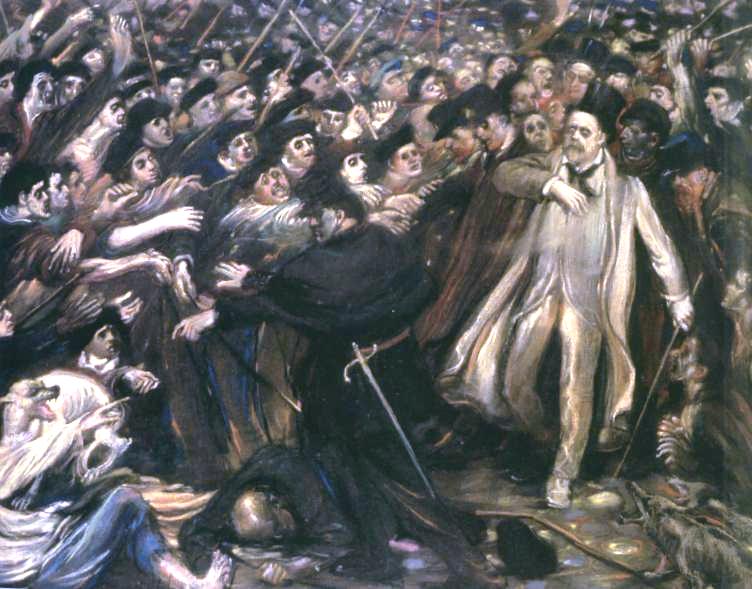
It’s a shame that Cardinal Bergoglio never had the opportunity to mingle incognito in the bars of modern Dublin, where he would have found an intensity of hatred for the Catholic Church that the Gordon rioters might have recognised. Young Irish people especially can hardly mention the Church without a curl of the lip. Older folk, meanwhile, feel miserably betrayed. It’s the same story in, say, Boston or Quebec. How telling that the siblings of Cardinal Ouellet, Prefect of the Congregation for Bishops, no longer go to Mass regularly.

I know this is a downbeat response to what, for Catholics, is a joyful and hopeful event. But savage reform to the curia is required so that Pope Francis can (should he wish) take advantage of the successful Benedictine reforms … So welcome, Holy Father, and let the sackings begin.

4.18 pm. And now the troubling parts of his background – which were aired just before the last conclave. From Hugh O’Shaughnessy of the Guardian almost two years ago:

The extent of the church’s complicity in the dark deeds [of the Argentine junta in the 1970s] was excellently set out by Horacio Verbitsky, one of Argentina’s most notable journalists, in his book El Silencio (Silence). He recounts how the Argentine navy with the connivance of Cardinal Jorge Bergoglio, now the Jesuit archbishop of Buenos Aires, hid from a visiting delegation of the Inter-American Human Rights Commission the dictatorship’s political prisoners. Bergoglio was hiding them in nothing less than his holiday home in an island called El Silencio in the River Plate. The most shaming thing for the church is that in such circumstances Bergoglio’s name was allowed to go forward in the ballot to choose the successor of John Paul II. What scandal would not have ensued if the first pope ever to be elected from the continent of America had been revealed as an accessory to murder and false imprisonment.

And the heart sinks.

4.11 pm. After Benedict’s frills and lace, we get something rather different:

When Roman Catholic Cardinal Jorge Mario Bergoglio takes the subway to work, few of his fellow commuters realize they are sharing the train with the archbishop of Buenos Aires.  The 68-year-old Jesuit eschews opulent religious garments, chauffeur-driven limousines and other perks of his position. Sometimes, he throws an old raincoat over his cassock before heading out the door. “He never dresses like a cardinal,” said Gregory James Venables, a close friend of Bergoglio’s who heads the Anglican Church in southern South America. “It’s not to be scruffy. But that’s his character. He is very, very, very humble.” …

It’s also noticeable that one of his close friends is an Anglican. He is said to be open to other faith traditions.

4.04 pm. Tweets of the hour:

4.02 pm. Quote for the hour (and perhaps suggesting why Francis’ age may not have counted against him):

One Italian writer quoted an anonymous cardinal on March 2 as saying, “Four years of Bergoglio would be enough to change things.”

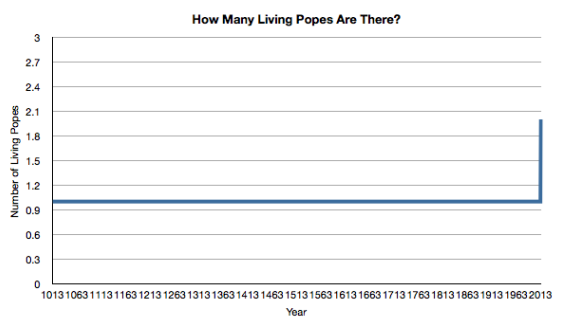
3.57 pm. Chart of the hour from Yglesias:

Screen shot 2013-03-13 at 3.57.24 PM

But he’s wrong. There’s only one actual Pope at a time. And his name is Francis.

3.55 pm. Why Argentina? Why not?

If you crunch the numbers, it’s astonishing that we have not yet had a Latin American pope. Today roughly 41% of all Catholics hail from Latin America. And half of all Catholics under age 40 are from Latin America.

3.48 pm. In 2001, he made an important gesture in washing the feet of people with AIDS – another sign of his association with Saint Francis, whose outreach to lepers began his great ministry. I may be reading too much into the name, but Bergoglio’s embrace of poverty and his seeming humility speak to me as a Christian in these dark ages for the faith. Rocco also notes how rare it is for a Jesuit to nod to a Franciscan:

By choosing the name of the founder of his community’s traditional rivals, the 266th Roman pontiff – the first from the American continent, home to more than half of the 1.2 billion-member church – has signaled two things: his desire to be a force of unity in a polarized fold, and his intent to “repair God’s house, which has fallen into ruin”… that is, to rebuild the church.

3.41 pm. Another Allen nugget:

In September 2012, he delivered a blistering attack on priests who refuse to baptize children born out of wedlock, calling it a form of “rigorous and hypocritical neo-clericalism.”

He seemed genuinely mild-mannered, gentle and humble too – judging from a few minutes of watching him wave rather tepidly to the crowd.

3.31 pm. Evem more than his predecessor’s, this Pope seems an unlikely fit for Paul Ryan-style Catholics:

Bergoglio has supported the social justice ethos of Latin American Catholicism, including a robust defense of the poor. “We live in the most unequal part of the world, which has grown the most yet reduced misery the least,” Bergoglio said during a gathering of Latin American bishops in 2007. “The unjust distribution of goods persists, creating a situation of social sin that cries out to Heaven and limits the possibilities of a fuller life for so many of our brothers.”

“Social sin”. I cannot imagine what he’d say about Ryan’s budget proposal.

3.28 pm. John Allen’s profile is here. Money quote:

“We have to avoid the spiritual sickness of a self-referential church,” Bergoglio said recently. “It’s true that when you get out into the street, as happens to every man and woman, there can be accidents. However, if the church remains closed in on itself, self-referential, it gets old. Between a church that suffers accidents in the street, and a church that’s sick because it’s self-referential, I have no doubts about preferring the former.”

3.24 pm. Here’s what he recently wrote about marriage equality in Argentina:

“Let’s not be naive, we’re not talking about a simple political battle; it is a destructive pretension against the plan of God. We are not talking about a mere bill, but rather a machination of the Father of Lies that seeks to confuse and deceive the children of God.”

So marriage equality is the work of Satan. Oh well.

3.20 pm. Perhaps a sign of why he chose the name Francis. From Wiki:

As Cardinal, Bergoglio became known for personal humility, doctrinal conservatism and a commitment to social justice. A simple lifestyle has contributed to his reputation for humility. He lives in a small apartment, rather than in the palatial bishop’s residence. He gave up his chauffeured limousine in favor of public transportation, and he reportedly cooks his own meals.

3.18 pm. Two obvious first thoughts. The first Jesuit Pope, named after arguably the greatest saint, Francis, and from Latin America. Those are big precedents. And they give me some hope.

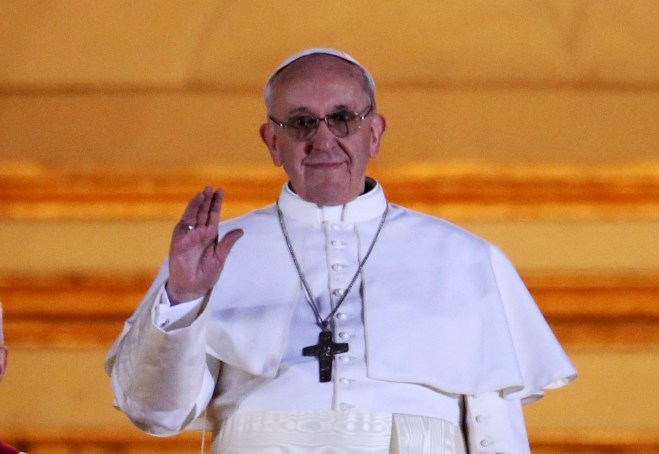
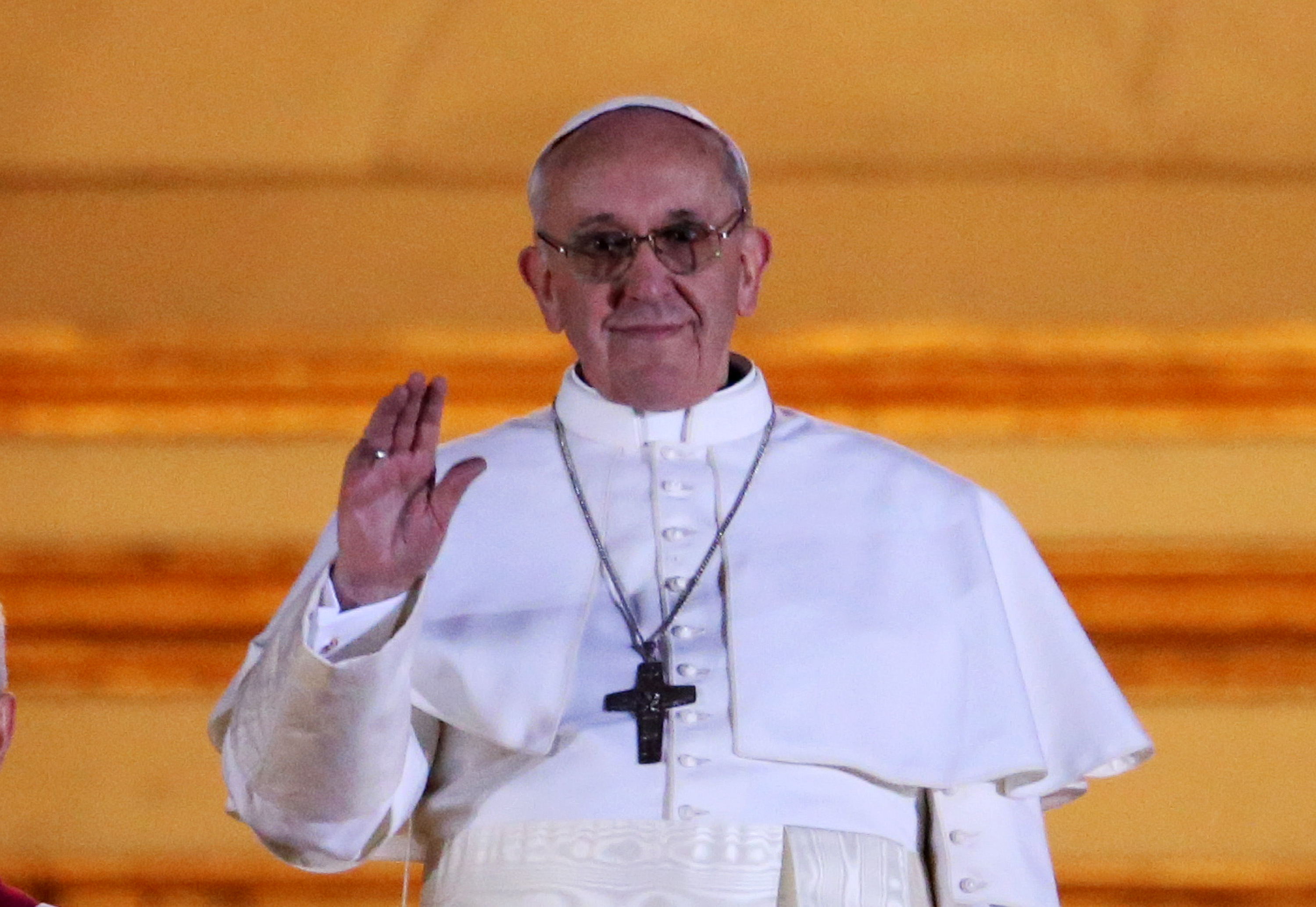
(Photo: Newly elected Pope Francis I appears on the central balcony of St Peter’s Basilica on March 13, 2013 in Vatican City, Vatican. Argentinian Cardinal Jorge Mario Bergoglio was elected as the 266th Pontiff and will lead the world’s 1.2 billion Catholics. By Peter Macdiarmid/Getty Images.)

The Falklands Vote

99.8% of the islands’ residents voted to remain British subjects. Nile Gardener struts a bit:

The [Argentine President] Kirchner regime can rage all it likes, but it has no prospect of seizing the Falklands. For as long as its inhabitants wish to remain under the protection of the Crown, Britain will defend them, and stand up to Argentina’s threats and intimidation. Argentina’s government claims the Falklands will be theirs within 20 years. This is the language of delusion, and the stuff of pure fantasy, the pathetic ranting of a failed presidency, which cares little for the prosperity of its own people, and nothing at all for the freedom and liberty of the Falkland Islanders.

Seamus Milne is unsatisfied, claiming the issue at hand isn’t the opinion of the British occupants, but Argentina’s right to the territory:

[S]urely the islanders have the right to self-determination, it’s argued, even if they’re 300 miles from Argentina and the other side of the world from Britain. They certainly have a right to have their interests and way of life protected, and to self-government. But the right of self-determination depends on who is deciding the future of what territory – and since the dispute is about whether the islands are part of Argentina or not, it’s also about who should exercise that right.

The Economist suspects Argentina sees things the same way:

No matter how overwhelming the Yes vote, it will not shift the position of the Argentine government, which claims sovereignty over the islands, which it calls Las Malvinas. “Self-determination does not apply to Las Malvinas,” the Argentine foreign minister, Héctor Timerman, told British politicians in London last month. And it is unlikely to make much difference to the views of ordinary Argentines either. A recent poll found that only 15% thought the islanders should get to decide their own future, and 59% that the islanders’ wishes were simply irrelevant to who held sovereignty over the island. Other South American governments support Argentina’s claim and its desire for bilateral negotiations, without the islanders present, to resolve the territorial dispute.

The Pope’s Ruby Slippers Explained

Massimo Gatto traces the history of the most conspicuous retired red shoes in Rome. They were once a symbol of wealth and power:

Those red shoes, for example—which the pontifex emeritus has now given up in favor of a more ordinary brown pair from Mexico—may symbolize the blood of Christian martyrs. But when red shoes were the height of fashion in Etruscan Rome, that is, five hundred years before the birth of Jesus, they designated the wearer as an aristocrat, someone who could afford leather that had been colored with the most expensive dye in the Mediterranean, Phoenician “purple”—which was actually scarlet red. (It was produced by scoring the bodies of molluscs and ranged in color from blue to red, with red the most prized shade). The leather itself came not from kangaroos, of course, but from the Chianina cattle, who came to Italy together with the Etruscans and provided the ancestral form of Florentine beefsteak.

Jews And Gays: The Bonds Of Ostracism

Zola_sortie

I’ve long seen anti-Semitism and homophobia as closely related psychologically. They are particular manifestations of group-hatred in as much as bigots of both kinds actually fear the power these groups allegedly hold, and their ability to pass for goyim or heteros. There’s almost a kind of admiration mixed in with the loathing, and often a sense that the groups conspire together in secret. Here’s what I wrote on the subject a while back:

In her book The Anatomy of Prejudices, the psychotherapist Elisabeth Young-Bruehl proposes a typology of three distinct kinds of hate: obsessive, hysterical and narcissistic. It’s not an exhaustive analysis, but it’s a beginning in any serious attempt to understand hate rather than merely declaring war on it. The obsessives, for Young-Bruehl, are those, like the Nazis or Hutus, who fantasize a threat from a minority, and obsessively try to rid themselves of it. For them, the very existence of the hated group is threatening.

They often describe their loathing in almost physical terms: they experience what Patrick Buchanan, in reference to homosexuals, once described as a “visceral recoil” from the objects of their detestation. They often describe those they hate as diseased or sick, in need of a cure. Or they talk of “cleansing” them, as the Hutus talked of the Tutsis, or call them “cockroaches,” as Yitzhak Shamir called the Palestinians. If you read material from the Family Research Council, it is clear that the group regards homosexuals as similar contaminants. A recent posting on its Web site about syphilis among gay men was headlined, “Unclean.”

The reason I bring this up is because newly declassified documents from the Dreyfus affair in fin de siecle France reveal the connections and the complexities of the two identities. Two key sources framing Dreyfus as a treasonous Jew turned out to be two high-level spies from Italy and Germany. And they were having a torrid homosexual affair. It was to cover up this affair that the dossier (much of which was forged) was not made public. So homophobic gays were closeted and protected by the state in order to provide false evidence to convict a Jew.

And the fact that the dossier was kept secret for these reasons led to speculation about Jewish conspiracies to keep its details under wraps. In fact, the French government didn’t want to “disgrace” the envoys of Italy and Germany, by revealing the affair. The phobias fed each other, in other words, with the closet – both Jewish and gay – intensifying everything.

But the best thing about Caroline Weber’s column on the subject is this passage from Proust, where he compares the overlap between being gay and being Jewish in late nineteenth century France:

“Their honor precarious, their liberty provisional, lasting only until the discovery of their crime; their position unstable … excluded even, save on the days of general misfortune when the majority rally round the victim as the Jews rallied round Dreyfus, from the society — even the sympathy — of their fellows … but also brought into company of their own kind by the ostracism to which they are subjected, the opprobrium into which they have fallen, finally having been invested, by a persecution similar to that of Israel, with the physical and moral characteristics of a race … [finding] a relief in frequenting the society of their kind … forming a freemasonry far more extensive, more effective, and less suspected than that of the lodges … all of them required to protect their own secret but sharing with others a secret which the rest of humanity does not suspect, … playing with the other race … a game that may be kept up for years until the day of the scandal when these lion-tamers are devoured; obliged until then to make a secret of their lives.”

That man could write. Although taming lions is not as good as Wilde’s “feasting with panthers.”

(Painting:  Emile Zola, besieged by angry mobs after his testimony defending his defense of Dreyfus. By Henry de Groux, 1898.)

The Murder Of A Gaza Child, Ctd

The UN report recently found, contrary to earlier reporting, that Hamas, not Israel, was responsible for a child’s death. I asked for a correction. Max Fisher, who wrote one of the pieces I objected to, follows up:

Matthias Behnke, a representative of the UN office that authored the report, has since clarified to the Associated Press that the report is indeed referring to Mishrawi’s family. Behnke explained that the report does not “unequivocally conclude” that Mishrawi was killed by a Hamas munition, but said that evidence did point toward a rocket fired by a Palestinian group. … A BBC story expresses some doubt about the UN report. The BBC’s Jon Donnison writes, “The Israeli military made no comment at the time of the incident but never denied carrying out the strike. Privately, military officials briefed journalists that they had been targeting a militant who was in the building.” Donnison adds, “The Israeli military had reported no rockets being fired out of Gaza so soon after the start of the conflict.”

Getting Better In Pro Sports, Ctd


While the NFL struggles with homophobia among players and coaches, the UFC is making surprising strides:

[Ultimate Fighting Championship] President Dana White, trumpeted as a kind of mad-genius sports executive for his mix of social-media savvy, marketing, and unapologetic quest for world sports domination … [has] been making very public strides to fight an image of homophobia, transforming a negative conversation about attitudes toward gay people in general into something of an open dialogue about gay fighters in the cage. In late 2011, White urged any gay fighter in the UFC to come out of the closet: “I’ll tell you right now, if there was a gay fighter in UFC, I wish he would come out,” White said a press conference. “I could care less if there’s a gay fighter in the UFC. There probably is and there’s probably more than one.”

And the league just put its first open lesbian in the cage:

At the end of 2012, the organization started its first women’s division at 135 pounds. The very first women’s title fight was between inaugural champion Ronda Rousey and Liz Carmouche, a former Marine who also happens to be openly gay. The fight happened on February 23, and while Carmouche ended up losing, it remained a significant moment for her and for the sport, which has grown at an even faster clip since its national TV deal with Fox began last year. It was the first time a women [sic] fought in the UFC, and the first time an openly gay fighter of either gender has fought in the UFC — not that White thinks she’ll be the last. Asked after the Rousey-Carmouche fight whether he could see a straight male fighter potentially refusing to fight a gay male fighter, White shot down the idea and promised retribution if a fighter were to ever utter outwardly homophobic biases again. “Most of the guys that are in this sport are really good people,” he replied. “I honestly don’t see a situation where that would happen, but if it did, I’d fix it.”

Earlier Dish on the progress in pro sports here and here.