The Gladwell Effect

Jessica Love complains about the lazy tendency of social-science researchers to inflate the relevance of “counterintuitive” studies for a clickable headline:

[It is] this irksome spin that makes [these studies] such fodder for the popular press. Indeed, had the researchers not spun it this way, the press (and, alas, I include bloggers like myself) might have done so for them. Why read “Social Connections Evoke a Variety of Strong Emotions” when you can read “What Makes Us Happy Can Make Us Sad“? Why click on “Intelligence No Cure-all for Cognitive Bias” when you can go to “Why Smart People Are Stupid”? …

The counterintuitive has its place. But our love affair comes at a cost. It leaves little room in the public consciousness for social scientific work that is incremental, for work that shores up and teases apart, for work that complicates, for work on the boundary conditions—those fragile social and mental habitats upon which decisions turn. In other words, it leaves little room for most of social science.

Sully And Hitch: “You Are Going To Die”

photo

The last installment of my 2006 taped late-night conversation with Christopher Hitchens can be found here, along with all the previous extracts. This new one, on re-reading, stopped me short, as you might imagine from the opener – and Hitch’s priceless response:

H: Well, look, you’re not gonna trap me into saying the Gospels are true. I don’t think they’re true at all, I don’t think there’s a word of truth in them.

A: You think it was entirely made up. He didn’t even exist.

H: I think the entire thing — the Gospel account of his life is of course an absolute fiction —

A: Absolute?

H: Well, an absolute confection. A jamming together of mutually inconsistent and weird accounts. If you now tell me, “hey, are you resting yourself on the Gospel,” I’m saying, Andrew, please don’t make my point for me. That is what Christianity, however, does depend upon. And there is one thing on which they certainly agree that makes no sense at all: moral advice such as “take no thought for the morrow.” Don’t care about clothes, or wealth, or investment, or your children, or anything for the future, why bother? This is immoral advice. Anyone who took it would be highly irresponsible at best.

A: Yes.

H: It only makes sense if you believe that there is no point in doing this, if you take the James Watt view of the national parks: why preserve anything when it’s all coming to an end? This is wickedness.

A: Well, because it will come to an end, because you are going to die.

H: [Lights cigarette.]

A: And you and I are not going to be here in 50 years’ time, neither of us. We will end.

H: Well I’m holding out for stem cells, myself.

A: [Laughs.]

H: Particularly embryonic ones, because apparently they last longer. No, no of course, no one argues more strongly than me that we’re born into a losing struggle, as is our cosmos, certainly our universe. For all we know, the heat death of the universe certainly might occur before we die!

A: Is it a more logical thing to surrender to that and accept it rather than to fight it?

H: Not as moral advice, no. To say, “in that case, what is the point in preserving a surplus from the harvest and trying to make sure that the next one will be larger,” because one has children, say, or because there are other people to be fed.

A: But Jesus, of course, did not have children, and instructed his disciples to abandon their own children and abandon their own families…

H: Immoral advice.

A: …and abandon their own wealth.

H: Does the Church do an imitation of Christ in this way?

A: No. No, they do not—it’s an impossible doctrine. It is an absolutely impossible doctrine.

H: Andrew, you’re doing my work for me.

A: No I’m not, I’m actually doing my work.

H: It’s either morally incoherent or it’s actually wicked, but as a precept of morality it’s utterly void, null.

A: Or it is truer than anything you’ve said. Or it is the only sane response to living as a mortal. Now it may be that we are, as mortals, incapable of it.

H: It’s too man-made, and it’s too obviously man-made for that to be true. And it bears, as Darwin says about our species, the lowly stamp of its origin. You can tell its man-made, as you call tell with the Qu’ran as well, as with the Torah and the Talmud. This is the work of fallible mammals, and it shows.

A: Of course.

H: Well, that’s all there is to be said about it.

A: No, that isn’t. The people who wrote down the oral history of this figure that they knew—

H: Copied down from other fragments, inserted later. Have you read Barton Ehrman’s book?

A: I haven’t read it but I know of it.

H: Well, it’s quite extraordinary, much more than I thought.

A: The Misquoting Jesus book?

H: It’s called ‘misquoting’ which is a very mild statement of its title, and I hope I don’t interrupt you but I just want to say this: the story, say, the famous story of the woman taken in adultery and the very interesting and odd behavior of Jesus on that occasion that everyone remembers in their childhood—

A: Was put in a hundred and fifty years later, yeah.

H: And it isn’t in the same kind of language that the other Gospels are in, it’s to Prof. Ehrman’s shock—and I mention him because he had become the chief spokesman of the Biblical fundamentalists, was their most skilled and most multilingual and sincere and scholarly advocate. His realization that this is at best a legend, I consider to be significant. I’m taking Bertrand Russell’s test of “evidence against interest.”

A: Well yes, in his case—although I think you’re exaggerating a little his previous stature. I mean I don’t think he would claim that he was the most important fundamentalist scholar.

H: He would be too modest for that, but he was being advanced by them as such and had been to, first to Wheaton I believe and then to the college that looks down on Wheaton as slightly too secular…

A: Namby-pamby.

H: Yes, and undoubtedly entered this vocation mastering all the relevant tongues in the hope of vindicating Biblical literacy.

A: No, his story is an absolutely riveting one, and what I find fascinating in terms of the church—and not just my Church but other churches, what we’re seeing the Episcopal Church as well—is, I think, the impact of a lot of this. And I think that part of what you see in popular culture is the sort of dreck of the Da Vinci Code, it’s a kind of ghastly … I’m not going to get into the content of it, I’m just saying purely as an anthropological, sociological phenomenon, it seems to me without the awareness that scholarship has essentially destroyed the notion of a single, inerrant text.

H: I think the difference between us may be this, then: I don’t believe scholarship is necessary for that. It’s interesting, but I’m so made—and I think I’m not the only one, but if I was I wouldn’t mind—as to be certain that there wouldn’t be an infallible text dictated by God to men. That the idea is impossible to begin with, ex hypothesi, by definition, it cannot happen, there will be no revelation, there never has been one and if there was, why wasn’t it made to everybody to judge whether it’s true or not? Why was it made to a group of Bronze Age villagers who then have to pass it on, who would be incapable of passing it on in its original form?

A: Well, it has to be made to somebody—

H: Of that we can be absolutely certain.

A: Yes.

H: So it’s not that there wasn’t a revelation, it’s that there can’t be a revelation.

A: Or the truth that would be imparted would be extraordinarily hard to translate. I mean, what Jesus speaks in are these mysterious parables that are subject to all sorts of interpretation. It’s not as if what Jesus is saying is the kind of doctrine that one would read in the catechism of the Catholic Church. I mean, if Jesus was the son of God, then it’s certain the God speaking through him spoke in paradoxical, mysterious contradictory dialogues.

H: I wouldn’t say paradoxical. Contradictory, incoherent. And very often wicked, the injunctions are very often evil. They say all other tribes must be destroyed physically and—

A: I don’t recall Jesus saying any of those things.

H: Jesus doesn’t say that—

A: Well let’s stick to Jesus, then.

H: Alright, let’s stick to Jesus, then.

A: And let’s stick to Jefferson’s Jesus. Because if Jefferson, for example, who you believe had no interest—why was he so interested? What drew Jefferson to the Gospels?

H: It was compulsory to be interested…

A: No it wasn’t, he kept this privately. Why did he privately construct his own Bible?

H: In order: if I can’t mention, I won’t dwell on the evil instructions of genocide and enslavement and rape that are mandatory in the Old Testament except to say that nowhere in the Old Testament is there any mention of Hell or punishment of the dead, the most evil doctrine of Christianity, I think of them all. It’s only until gentle Jesus, meek and mild makes his appearance, or only when, rather, he does so, that the idea of eternal torment is introduced. The Old Testament contains no warrant, at least, for that. Slavery, yes, genocide, yes, racism, yes, rape, all of that, certainly. Human sacrifice, and its equivalents. But no Hell. That has to come with the gentle, more modest New Testament. But Jefferson cuts all that out of the Bible as best he can…

A: Because why? What is his justification for that?

H: Jefferson died in I think 1826. Darwin and Lincoln were born on the same day in 1819, Jefferson is just at the point where there isn’t quite enough science to disprove the Bible or to utterly negate religion. He’s a man of enormous curiosity, he wanders, goes on expeditions and has debates with French naturalists about the topography of Virginia. “How can it be the shells, the sea shells, are so high up on the mountain?” He’s just below the summit, he can’t see over— bit like Moses—but he really wants to know.

And he knows that religion is, in its clerical form, nonsense, but he feels, can it really be all untrue? Well, it might be truer if I cut out all the things that are self-evidently untrue. Well, this is a very primitive pre-Darwinian almost pre-modern view. Because he was trying his best, he was one of the precursors. One looks at the Jefferson Bible with interest but one doesn’t learn anything from his amendment of it. Except that it can’t be the word of God.

A: When you read Jefferson’s Bible, does it say anything to you? Are the sayings of Jesus, insofar as they reflect upon the way one should be among one’s fellow human beings, do they strike you as…

H: What’s left over is just as wicked as it was to begin with, it seems to me.

A: It’s wicked to love one’s neighbor?

(Photo: taken by yours truly on the beautiful grounds of Willamette University in Salem, Oregon.)


Spot The Sponsored Content, Ctd

DevourNativeAdvertising

A reader passes along the “Examples of Native Advertising” entry on WikiExample. It’s a terrific guide to some of the tricks of the trade. The caption for the above screenshot:

Devour’s video ads are integrated with all of their curated videos and clearly marked as an “AD.” In the bottom right corner there is an ad for “Mouthopedia,” which is an entertaining video by Mcdonalds about their Bigmac. This allows the advertiser to get a similar CTR [Click-through rate] as the other spots as it is right in line to the other curated videos.

But at least it clearly says “AD”. I’d rather the word “ADVERTISEMENT”. It’s what we’re used to in understanding the difference between editorial and advertizing. Update from a reader:

I think Wiki is using an old method of Devour IDing ads. The site doesn’t even mark them anymore, so it’s even worse now. For example, a Grey Poupon ad the site is hosting as “Sponsored Video” (a small label in the same color font as the video’s description, thus barely noticeable) is not even labeled as such on the front page

A reader adds to this post about Buzzfeed using Fark to direct traffic to its ads:

I’m a long-time Farker and I’ve noticed these new Buzzfeed links, too. The existence of sponsored links isn’t new to Fark, actually. We’ve seen sponsored headlines for a few years (e.g., from Cracked). What makes these new ads really different is that there isn’t a link to comments. Fark is a comment-driven site and the lack of ability to comment on a link like this really makes it stand out, and not in a good way. When Cracked sponsors a link, there’s a risk that they’ll draw in snark if the link sucks. In a weird way, that makes me respect those links more, even though they’re just as commercially driven and, if anything, more stealthy. The lack of ability to talk about the Buzzfeed links signals, to me, a lack of confidence, and I’m sure that I’m not the only Farker who feels the same. Because of this, I don’t think that they’re doing their advertisers much of a favor with this trick.

Several more examples from readers below:

I don’t know if you saw it but at the bottom of the “sponsored content” IBM ad on The Atlantic you linked to it states that “comments for this thread are now closed”. I wanted to leave a comment expressing my displeasure with the ad. Alas, I cannot, but there are no other comments in there anyway. Were comments ever open?

I also notice the article was tweeted 37 times. I wonder how many of those twitter uses knew/did not know that this was an ad.

I wonder how many of them work for IBM or the Atlantic. Another:

Check out one of the more popular tech sites, Techmeme. It says “Sponsor Posts” but I used to click on them without realizing it until it hit me recently.

Still, the Techmeme sponsored ads are clearly not Techmeme once you get past the homepage. They have a different font, look, design and feel. Again, with enough clarity and disclosure, you can create ads that are not like, say, the Atlantic’s blatant tactics of making its ads almost indistinguishable from its editorial content. Another:

This “sponsored content” on Deadspin was written by a real writer with a byline. The word “sponsored” only appears twice on the page. And there are no comments.

But that’s Gawker. It doesn’t even pretend to be ethical about anything. Another turns the tables:

I’d like to remind you of a post of yours from a few months ago, “A Bigger, Hairier Rom-Com,” about the premiere of Bear City 2. Your disclosure is pretty weak here. “Aaron’s in it” is only sufficient for people who are regular readers who pay attention to your personal life and totally discounts readers who started reading your blog since the last time you mentioned your husband Aaron. I can miss this detail just as easily as glancing over “Sponsored by Brand X” in a by-line.

While there’s a HUGE difference between the advertorials you’ve posted here and your post, it’s not unreasonable to assume that you have a financial incentive to encourage more people to see your spouse’s movie by giving it free publicity. I’m not calling you out, and I don’t think for a second that Aaron twisted your arm or that you had some motive for the post other than “people will like this movie that I liked,” but at the end of the day, your editorial content was advertising. I’m just trying to keep you honest.

Here’s the line in the post in the first paragraph:

Full disclosure: Aaron’s in it. Provincetown is the star. Hence my review.

I don’t know why that is weak. And Aaron has received no money from the movie since it ended production.

The Nanny State’s #1 Fan

Cass Sunstein reviews Sarah Conly’s Against Autonomy:

Her starting point is that in light of the recent findings, we should be able to agree that [John Stuart] Mill was quite wrong about the competence of human beings as choosers. “We are too fat, we are too much in debt, and we save too little for the future.” With that claim in mind, Conly insists that coercion should not be ruled out of bounds. She wants to go far beyond nudges. In her view, the appropriate government response to human errors depends not on high-level abstractions about the value of choice, but on pragmatic judgments about the costs and benefits of paternalistic interventions. Even when there is only harm to self, she thinks that government may and indeed must act paternalistically so long as the benefits justify the costs.

One of his major objections:

[I]n my view, she underestimates the possibility that once all benefits and all costs are considered, we will generally be drawn to approaches that preserve freedom of choice. One reason involves the bluntness of coercive paternalism and the sheer diversity of people’s tastes and situations. Some of us care a great deal about the future, while others focus intensely on today and tomorrow. This difference may make perfect sense in light not of some bias toward the present, but of people’s different economic situations, ages, and valuations. Some people eat a lot more than others, and the reason may not be an absence of willpower or a neglect of long-term goals, but sheer enjoyment of food. Our ends are hardly limited to longevity and health; our short-term goals are a large part of what makes life worth living.

The Prohibition Markup

To illustrate it, Jochen-Martin Gutsch and Juan Moreno tracked cocaine through the illegal drug market:

Pure cocaine costs €1,300 a kilo in Putumayo [a major cultivation hub in Colombia], more than €4,000 at the Colombian border and, in nearby Jamaica, the price already approaches €6,000. The drug gets really expensive when it reaches Europe or the United States, where dealers make about €30,000 a kilo, depending on market conditions. The European drug user, who only receives cocaine in diluted (“cut”) form, doesn’t pay a fixed price. Coke is cheaper in Spain than in Germany, for example, and it’s cheaper in Berlin than in Munich. The going rate in Germany is about €100 for a gram of impure cocaine, while a kilo of pure cocaine can cost up to €400,000.

Meanwhile, The Economist checks in on waning enforcement efforts in Europe:

Spain’s approach now rivals that of the pioneering liberal Dutch. Though selling is illegal, buying is not. One result is hundreds of cannabis “social clubs”, which allow members to pool their purchases. These range from small co-operatives where new members must wait six months for new cannabis to be grown before joining, to huge semi-commercial organisations, with thousands of “members” buying cannabis. One in Barcelona even made a €1.3m ($1.74m) deal with the country town of Rasquera to grow supplies on local land, better known for its almond trees. Similar experiments are under way in France, Belgium, Italy and Germany, says Tom Blickman of the Transnational Institute, a think-tank based in Amsterdam. In much of Britain, especially its big cities, the risk of prosecution for those using small quantities of soft drugs is vanishingly low.

Rape In The Ranks

A disturbing look at a persistent problem in the military:

Research suggests that one out of every three women in the U.S. military is the victim of sexual assault, making military women twice as likely to be raped as civilians.

(Victims are disproportionately female, given that women make up less than 15 percent of the military, but men are victimized, too: More than 40 percent of vets receiving treatment for Military Sexual Trauma are men.) An anonymous DOD survey found that in 2010, an astonishing 19,000 service members were ­sexually assaulted; a mere 13.5 percent of those attacks were reported to authorities. Victims have little incentive to report, since the military’s insular justice system rarely holds perpetrators accountable. Of the sliver of sexual assaults reported last year, 92 percent never saw the inside of a courtroom but rather were dismissed or administered wrist-slap penalties like fines, reduced PX privileges or counseling – a prosecution record even outgoing Secretary of Defense Leon Panetta has called “an outrage.”

Incredibly, this ugly picture comes after two decades of very public sex scandals – Tailhook in 1991, Aberdeen in 1996, the Air Force Academy in 2003 – after each of which the DOD swore “zero tolerance,” then resisted any meaningful reform. But as survivors have begun to speak up, and legislators resolve to take action, the military finds itself facing a public relations crisis at a time when it’s not only trying to justify its $633 billion budget but also desperate to step up recruitment. Women, widely seen as a way to help stop attrition of troops – and now, for the first time, cleared to serve in combat alongside their male peers – are projected to make up one-quarter of the armed services by 2025.

Previous Dish on the issue herehere and here.

Green Shoots On The Right, Ctd

The First Day Of Spring At Kew Gardens

National Review actually comes out in favor of including GOProud and Chris Christie at CPAC this year. Money quote:

GOProud is the most conservative gay group of note (perhaps the only gay group rightly called conservative), and that conservatism extends to its circumspection about many planks of the so-called gay-rights agenda. … Conservative opinion on the intersection of homosexuality and politics is not monolithic, especially among the college-aged set that makes up the better part of CPAC attendees. And a gathering that hopes to speak for the conservative movement will be better equipped to do so if it represents the overlapping gamut of views included in it.

There is, of course, the not-so-small matter of marriage equality. GOProud, despite being a far-right splinter group who’s chummy with Ann Coulter, is still in favor of marriage equality. There are plenty of conservative and Republican gays – but almost none who oppose the conservative cause of full gay inclusion in the family. There are no gay conservatives on marriage like black conservatives on, say, affirmative action. Which is itself telling. Even Roger Ailes couldn’t find any.

Obviously, the editorial is a teensy shift away from theoconservatism. And K-Lo sits up straight and notices:

I tend to agree with Robby George, who last year expressed to me here his concern that conservatives need to keep our priorities straight. Marriage ought to be one, we need to be clear that it is not ours to redefine.

That doesn’t quite capture the tone of the piece, which was by Lopez herself:

“[GOProud] has just written “crazy social issues” out of what it means to be conservative.

That “crazy social issues” phrase comes from a comment made by its chairman, Christopher Barron, during an MSNBC appearance this fall — and it underscores the reasoning behind the boycott. At best, GOProud is indifferent to the issue of defending traditional marriage; it supports letting the states figure it out. But in practice, GOProud has proven itself to be opposed to the defense — and defenders — of marriage.

And now National Review is arguing for inclusion of a pro-marriage equality group in CPAC. One step at a time …

(Photo: Snowdrops and Daffodils emerge at Kew Gardens on March 1, 2013 in Kew, England. Today marks the first day of Spring, though the Met Office have said that temperatures are likely to be below average throughout March. By Dan Kitwood/Getty Images.)

The End Of His Road

Jack Kerouac On The Radio

Justin Nobel travels to France to explore the setting for Jack Kerouac’s second-to-last novel, Satori in Paris (1966), an autobiographical work about the Beat writer’s search for a town in Brittany that bore his family’s name. In one scene, drunkenly arriving at an airport, Kerouac realizes the next available flight is to Florida – a destination Nobel sees as an emblem of the the great writer’s decline:

Florida? That doesn’t sound like a Kerouac sort of place. But at the time he was living in a small house in Orlando with his mother. And so there it is, the mighty Kerouac traveled to France to find his roots, drank himself into a series of stupors and rushed home to read the comics. You begin feeling bad for Kerouac. The boozy womanizing thing can only go so far. Youth lets a writer flick off the world, and sometimes it even makes for exceptional writing, but you get just one On the Road. After that there are two options, stop writing and disappear, a la Rimbaud, letting your work stand as a pure but narrow tongue of fire, or progress along with your ideas. I’m not sure Kerouac ever did.

Nobel’s conclusion:

I still call On the Road the most important book I’ve ever read. It showed me that you don’t have to live the life set out for you, that you can juke and waver, making the rules up as you go along. But looking back now I see how much Kerouac actually missed in life. The spontaneous prose that moved the country may really just have resulted from his inability to think through his own thoughts. Kerouac invented a style that ensured he would never have to face his weaknesses as a writer. And in that we see an odd sort of irony: the man who lived more freely than anyone had barricaded his own mind.

Update from a reader:

I swear, every time I read someone saying that On the Road is Kerouac’s “spontaneous prose” and he never did anything else as good, I just remind myself that this is how the canon works.  People like Justin Nobel read On the Road, and don’t know enough of the details, but figure that going on their own road trip to “find” Kerouac is somehow deep.  But then they write things that show they don’t know their Kerouac from their elbow.

Nobel is surprised to find Kerouac was a raging alcoholic as late as 1966?  He was one in the 1940s.  Surprised that Kerouac seemed like “an over-the-hill frat boy”?  He was a fading frat boy, had been since getting kicked out of Columbia.  Kerouac was a goddamn scholarship football player.  He was always a frat boy, just one tortured by his own sexuality (probably at least bi, maybe very deeply closeted gay, which would explain the many failed heterosexual relationships and perhaps even the alcoholism and mother-fixation (sorry, that’s a 40’s/50’s Freudian read on gayness: but that’s what Kerouac would have been steeped in. . . )) and booze.   Kerouac’s last publication?  An essay in the Chicago Tribune in support of the Vietnam War, decrying hippies.  Yet writer after writer confuses the media image with the man, and, even worse, On the Road with his whole oeuvre.

On the Road is not his finest aesthetic achievement by a longshot.  Either The Subterraneans or Doctor Sax, both novels written after he finished “the road book” and before On the Road was edited half to death and finally released by Viking only AFTER Howl and other events made the Beats potentially marketable, are better examples of what’s truly revolutionary about his prose.

But everyone stops with On the Road, is surprised when Kerouac’s biography doesn’t live up to the myth of the media image of his life.  And laments.  Read The Subterraneans. Read Doctor Sax. Read the poetry.  That’s where Kerouac matters.

(Photo: American Beat writer Jack Kerouac (1922 – 1969) leans closer to a radio to hear himself on a broadcast, 1959. By John Cohen/Getty Images)

The Great Healthcare Scam, Ctd

ER Visits

A recent study in PLOS ONE supports Steve Brill’s alarming conclusions about healthcare prices. Lindsay Abrams summarizes:

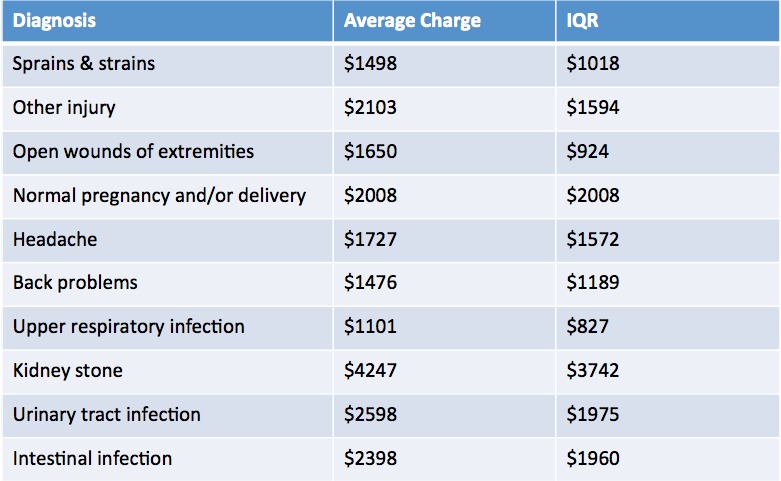
 The median ER visit costs 40 percent more than what the average American pays in monthly rent. But the discrepancy in ER charges is so great, according to the study’s authors, that patients have no way of knowing how much they can expect to be billed. The average cost of a visit to the ER for over 8,000 patients across the U.S. was $2,168. But the interquartile range (IQR), which represents the difference between the 25th and 75th percentile of charges, was $1,957 — meaning many patients were paying a lot more or a lot less than that.

An ER doc in the comments section objects:

These prices sound so arbitrary, like it’s just some crap shoot of what you’ll get depending on what the doc feels like billing that day, but there is a lot more to the system than the article would lead one to believe. Kidney stones are a prefect example. The diagnosis “kidney stone”, covers a wide spectrum of patients. The work up for a 20 year old that has a known history of stones, who comes complaining of his typical pain, and is there simply for pain relief is worlds different than a 60 yr old that has totally new onset of symptoms, yet they’d both be lumped together in this study. The 1st may get out of the ED with nothing more than a simple urine dip for blood and some pain meds, while for the later, anything less than a contrasted CT for a possible leaking abdominal aneurysm would be malpractice.

Meanwhile, Uwe E. Reinhardt proposes one way to limit healthcare pricing unfairness:

Mr. Brill once again illustrates why dubious policies such as he describes can persist. He offers a bewildering potpourri of little tweaks here and there, including huge taxes on the salaries of hospital executives and hospital profits, capping profits on lab services, changes in patent laws and, of course, the eternal stalwart, malpractice reforms. That is a scattershot response to the central problem he lays bare: the pricing of hospital services in general and to uninsured middle-class people in particular.

Here is a simpler approach. Why not make it illegal for hospitals to charge uninsured people more than X percent of what Medicare pays for a procedure? That maximum price would certainly cover the true incremental cost of serving uninsured middle-class people, with handsome contribution margins to overhead and, most probably, to profits as well.

Unnatural Law

Pivoting off posts by Rod Dreher and Alan Jacobs, Noah Millman unpacks the problem with contemporary “natural law” arguments:

The people who, today, seem to me to be making “natural law” type arguments of the sort Aristotle himself would recognize are the evolutionary psychology folks – the people who are trying (we can debate with what success) to develop a genuinely scientific genealogy of morals, to know our natures by understanding, scientifically, how they got that way. But this isn’t at all what people who call themselves supporters of a “natural law” approach to law and ethics do.

It seems to me that this is the reason that natural law arguments fail in practice. It’s not that we can’t accept that we have natures, or that those natures might be constraining in one fashion or another – outside of certain politically touchy topics, we entertain the idea that our natures constrain us, and how we can pursue (and achieve) happiness, all the time. It’s that the advocates of a natural law approach cannot explain adequately how they know what they claim to know about our natures, and expose that purported knowledge to scientific criticism of the kind that we would recognize if the question were, say, “do dogs feel pain?” And the suspicion grows, over time, that this question isn’t opened not because it cannot be opened but because it must not be opened, because it is really the conclusions that are “known” absolutely, and not the premises.

Pascal-Emmanuel Gobry takes the argument in a slightly different direction, defending the Enlightenment notion of natural rights while holding that this “is not a religious concept, and what’s more, it’s much more useful as a secular concept”:

Without appealing to God, the only way to ground the idea of universal human rights is if there is such a thing as human nature, which is shared by human beings, because they are human beings, and which includes the endowment of rights. This is the classic formulation of secular Enlightenment morality. Because human beings are beings “of a rational nature”, they have rights, the Enlightenment tells us—the key word here being nature. The insane still have human rights, the Enlightenment tells us, because even though they may not individually be rational, they share human nature, which itself is rational, and thereby endowed of rights. This seems absolutely crucial to me. No human nature, no natural law, no human rights, no secular Enlightenment morality (as we have thus far been able to understand these things).