Kinks Of The Animal Kingdom

Jason G. Goldman highlights just a few, reassuring humans that “for just about any fantasy between consenting adults that might be thought of as beyond conventional sexual practices or decency as dictated by society, you can bet that there’s a non-human species for whom that particular behaviour is commonplace”:

Take giraffes, for instance. Males, called bulls, make casual visits to various groups over time in search of a cow who might mate with him. In order to select the mating partner the bull literally finds the one that best suits his taste – by sampling their urine. Females co-operate in this “urine-testing” ritual, according to researchers David M. Pratt and Virginia H. Anderson. “When the bull nuzzles her rump, she must produce a stream of urine if he is to catch some in his mouth and savour it,” they write. If a cow is particularly attracted to a visiting bull, she may simply decide to urinate as he walks past her, no prodding required. Urolagnia, or “golden showers” as it is more commonly known, is not a human invention, it seems.

On a related note, Christopher Ryan recently delivered a not-yet released TED talk on human sexuality and its animal origins. Ben Lillie recaps:

Where did our misconceptions about sex come from? Well, Darwin, as it turns out, was a world-class Victorian prude. He was fascinated by the colorful genital swelling in bonobos, but what he didn’t know is that female chimps have sex 1-4 times an hour with up to a dozen partners.

Furthermore, Ryan notes that female chimps are sexually available for 40% of their menstrual cycles, but bonobos for 90% — almost as much as humans, who are capable of engaging in sex at any point in their cycle. That is a trait that is vanishingly rare among mammals.

For Ryan, a key question to understanding the origin of human sexuality is, “Are human beings a species that evolved in the context of sperm competition?” Are they competing against each other or with the sperm of other men as well? It doesn’t seem to be the case. For example, the average human has sex about a thousand times per birth. “If that seems high to you,” laughs Ryan, “don’t worry, it seems low to other people in the audience.” A more typical number among apes is to have sex about a dozen times per birth. Additionally, Ryan notes, humans and bonobos are among the only animals that have sex face to face. They also have external testicles. Says Ryan, ”External testicles are like having an extra fridge in the garage for beer. If you’re the kind of guy that has a beer fridge, you expect a party to happen at any moment.”

Sendak’s Sexuality

Ellen Handler Spitz believes it might help us decipher the meaning of the writer’s work, including his posthumously published My Brother’s Book:

Is it possible that the isolation and belligerence of Sendak’s characters may have been fueled by some of his own aggression toward a world that could not accept him as he was? There is Pierre from The Nutshell Library, rebellious and eaten by a lion; Max from Where the Wild Things Are, destructive, banished, and resentful; angry Mickey from In the Night Kitchen, baked in the oven; Ida’s baby sister from Outside Over There, kidnapped by goblins. In My Brother’s Book, aggression emerges when an enormous polar bear reminiscent of Sendak’s wild things both hugs and threatens Guy and begins to eat him “bite by bite.” Even the title of this latest work contains shades of latent violence: After “My Brother’s” comes the instant association “Keeper,” covertly summoning Cain and Abel. In Sendak, however, primal fraternal hostility is displaced from the relationship itself on to cosmic forces and animal savagery.

Eerily, by means of an oblique classical reference, the homoerotic theme and aggression come together in Sendak’s last work. The devouring bear transforms itself into stars and assumes the form of the constellation Ursa Major. Ursa Major, so the myth goes, was created when Jupiter (in the form of Diana) rapes a chaste nymph named Callisto. Juno, to punish her husband Jupiter, turns Callisto into a bear; taking pity, Jupiter then wrings another change, turning the bear into Ursa Major. Throughout centuries, painters have used this story to titillate, showing one “woman” making love to another woman.

A Nasty New World

800px-1622_massacre_jamestown_de_Bry

Ron Rosenbaum reviews Bernard Bailyn The Barbarous Years, which details the “little-remembered” brutality of life in the American colonies during the 17th century:

Bailyn has not painted a pretty picture. Little wonder he calls it The Barbarous Years and spares us no details of the terror, desperation, degradation and widespread torture—do you really know what being “flayed alive” means? (The skin is torn from the face and head and the prisoner is disemboweled while still alive.)

And yet somehow amid the merciless massacres were elements that gave birth to the rudiments of civilization—or in Bailyn’s evocative phrase, the fragile “integument of civility”—that would evolve 100 years later into a virtual Renaissance culture, a bustling string of self-governing, self-sufficient, defiantly expansionist colonies alive with an increasingly sophisticated and literate political and intellectual culture that would coalesce into the rationale for the birth of American independence. All the while shaping, and sometimes misshaping, the American character. It’s a grand drama in which the glimmers of enlightenment barely survive the savagery, what Yeats called “the blood-dimmed tide,” the brutal establishment of slavery, the race wars with the original inhabitants that Bailyn is not afraid to call “genocidal,” the full, horrifying details of which have virtually been erased.

Above image from the Wiki entry for the Indian Massacre of 1622:

Captain John Smith, though he had not been in Virginia since 1609 and was thus not a firsthand eyewitness, related in his History of Virginia that braves of the Powhatan Confederacy “came unarmed into our houses with deer, turkeys, fish, fruits, and other provisions to sell us”. Suddenly the Powhatan grabbed any tools or weapons available to them and killed any English settlers who were in sight, including men, women and children of all ages. Chief Opechancanough led a coordinated series of surprise attacks of the Powhatan Confederacy that killed 347 people, a quarter of the English population of Jamestown.

Update from a historian in Virginia:

I want to provide a bit more context for your readers about the so-called Indian Massacre of 1622. If, as the reviewer of Bailyn’s book suggests, the details of this period “have virtually been erased,” the image and accompanying Wikipedia information you provide doesn’t much help the effort to un-erase it.

Of course, the 1622 attack was a massacre only from the perspective of the English settlers, who had, in previous years, razed Indian towns, looted religious temples, and stolen or destroyed whole fields of maze. Many of the English military men had fought in Ireland and happily repurposed for Virginia the terror tactics developed in those wars. For instance, according to an account by George Percy, English soldiers captured an Indian chief’s wife and two children and confined them aboard ship. This was in the spring of 1610. Annoyed that their superior, Percy, might show the Indians mercy, the soldiers instead threw the children overboard and shot “owtt their Braynes in the water.” The chief’s wife was later put to the sword.

The “Powhatan Confederacy,” meanwhile, was not a voluntary alliance as the word “confederacy,” used in the Wikipedia entry, suggests. In 1608, for instance, the paramount chief Powhatan surrounded and attacked a member group, the Piankatank Indians. For all intents and purposes, he wiped them out and moved another group of Indians into their newly emptied town. According to William Strachey, Powhatan then collected the dead warriors’ scalps and hung them on a line between two trees – in full view of English visitors, Strachey among them.

The attack of 1622 killed about a quarter of Virginia’s English settlers and a report drawn up for the Virginia Company of London suggested that the “Viperous” and “wicked” Indians, rather than be Christianized and civilized, ought now to be completely destroyed: “by force, by surprize, by famine.” “Conquering them is much more easie then of civilizing them by faire meanes,” the writer concluded, “for they are a rude, barbarous, and naked people.”

And yet what’s interesting is that the deaths caused by Opechancanough‘s attack were a drop in the bucket compared to deaths caused by disease and by what some investors in the Virginia Company described as mismanagement. One such investor was Samuel Wrote. In the wake of the attack he decided to crunch some numbers. He estimated that Virginia’s population in 1619, when the company’s current leadership had taken over, was 700. Another 3,570 men, women, and children had entered Virginia in the subsequent three years, adding up to a population of 4,270. But after Opechancanough’s attacks, and the deaths of 347 colonists, only 1,240 settlers remained. What had happened, Wrote demanded, to the other 2,683?

The barbarous years, in other words, involved much more than war, scalps, and flaying. But so also was it more complicated than a conflict between—as one Virginia history textbook puts it—the “obnoxious” John Smith and Powhatan, “a ruler of great spiritual, mental, and physical strength.”

Are Doctors Overpaid? Ctd

[youtube http://www.youtube.com/watch?v=mn360trGChY]

Readers push back on Yglesias’ claim that physicians get paid too much:

I am a highly specialized physician and Obamacare supporter who is likely be considered one of those “overpaid” doctors. I think what is often missed is what hidden expenses and opportunity costs, in total, those reimbursements defray. I was in school (paying tuition) or in training (earning $20-$30K per year) for 12 years after college and collecting more than $150K in debt at a public medical school while others my age and background were moving up in their careers, earning increasingly higher wages (some made millions in the Internet bubble), increasing their retirement nest egg, buying houses, etc. I made my first paycheck from “overpaid” reimbursement at the ripe age of 33.

Another reader:

As an attending, my husband works a minimum of 55 hours a week. He gets four weeks of vacation a year. He’s often on call weekends and nights, and works several holidays a year. We crack the six-figure mark in salary. (Medical students live on about $15,000 in loans a year; residents and fellows make between $40,000 and $60,000 a year.) One quarter of our take-home pay goes to pay student loans and will for many, many years to come.

I’m not going to pretend we don’t live a comfortable life. Of course we do. We own a mortgaged 1,200 square foot house. We have insurance. We can put away for retirement and college for our kids and we own two cars. Most Americans don’t make six figures. But I’m sorry, my prematurely grey husband is not responsible for rising healthcare costs. He makes way less than several of his siblings in the business world who have less training, work fewer hours, and do, frankly, a little less for the world.

Another points to possible problems with the studies that Yglesias cites:

First: Not all physicians, or specialties, are the same.

I’m an IT manager for a big global company.  I actually earn more money than a friend of mine who is a pediatrician.  But my salary doesn’t hold a candle to other MDs in specialties like vascular surgery or anesthesiology.  Which of those doctors is “overpaid”?  Which are not?  None of these studies bother to make this distinction.  They are all lumped into the same category as “doctors” and then use average salaries, rather median salaries, across the totality of the United States.

Which leads to other big problem with these studies: beware of any study that compares the United States, as a whole, to tiny homogeneous nations like The Netherlands.  There is no way to compare the two – even “adjusting” for population size.  The US is too large and diverse to make those kinds of comparisons and studies that do so should be disregarded as invalid right from the start.

Another:

If we took Matt’s advice and cut their salaries to what looks to be the European average on his chart, they’d be making closer to $60k, once the costs of getting the job are taken into account. Given that you can get an IT job with just a couple years of training and experience and no overhead that pays $60k (or more), what idiot would bother going into medicine? The smart ones wouldn’t. Which is of course exactly what we want – stupid doctors.

And, for the record, my late father retired from medicine in 1989. He paid $24k in annual malpractice (Southern California) at that time. He recommended I not go into medicine. I’m in IT.

Wet And Naked With Strangers

Russian baths are a bit different than the 24-hour Korean spa, as Sadie Dingfelder recently learned:

I am sitting boob-deep in tepid water, sous-viding the burrito I ate for lunch a half-hour ago. Around me float a dozen women representing almost as many age and ethnic groups. An elderly Korean lady accidentally grabs my thigh while, outside of the pool, a young blonde woman towel-dries her crotch. It is a typical Friday afternoon at Spa World, the sprawling South Korean-styled bathhouse in Centreville, Va.

This unincorporated community in Fairfax County isn’t at the forefront of many international trends. But when Spa World opened in 2008, it was during the height of South Korea’s public-bath craze and just a year behind the opening of New York’s largest jimjibang, Spa Castle. Since then, Spa World has done brisk business relaxing the D.C. area’s fast-growing Asian population as well as various tightly wound constituencies, including between-assignment State Department officials, Groupon users, and expats pining for the sentos, banyas, or hammams of their youth. There’s no shortage, after all, of type-A Washingtonians hoping to shed their stress (and, clearly, their clothes).

Giving Up Gluten, Ctd

A reader writes:

Thanks for shedding light on the complexities of gluten today. As a restaurant owner, I have found this fad to be problematic in an unexpected way. I have seen requests for gluten-free items go through the roof in the last few years. When these items are ordered, often there is gluten in items that we know about but that the guest may not, so waitstaff returns to the table to alert the guest. Nine out of ten times, the reply is that “A little bit of gluten is ok.”  When this happens often enough, it reduces the importance of gluten-specific requests to your kitchen staff. The next order that comes along, they might not take the care that they should. A little bit of gluten was ok for the last 10 orders with this request, so why not this one? This puts people who have Celiac’s in great danger, even when they make the gluten-free request. People with Celiac’s typically know exactly what ingredients they cannot have and where these ingredients hide. That’s really the best way to operate, as it will make you far less likely to get something you’re not supposed to.

A reader with Celiac’s writes:

I lived with real and severe “fibromyalgia” symptoms for years while rheumatologists, allergists, internists, osteopaths, and orthopods tried to resolve my pain.

My joints hurt, I had generalized pain, depression, fog, fatigue.  Each specialist did their battery of tests and declared that whatever my problem was, it wasn’t in their purview.  All agreed it was “something auto-immune”.  One quickly prescribed an anti-depressant marketed by Eli Lilly to basically stop me from feeling the pain.  Others told me take vitamins to make up for shockingly low levels of some nutrients.  I tried yoga, exercise, tai chi, weight training …

Finally my internist – on information Darshak Sanghavi would certainly reject – said I should try eliminating wheat.  I thought I’d try it for three weeks, then go back to eating wheat to prove the theory.  But then every single symptom went away completely.  Someday, I’ll try eating a pizza, but only when I have time to lie in bed the next day.  It hasn’t happened yet, and it doesn’t even look good any more.

The same here. I was covered in hives and rashes and constantly itching and nothing worked and a few weeks later, it was all gone. I’m one of those guilty ones asking about flour, because it’s not as if I’ll suddenly have a seizure. I’ll be clearer in future. I have lost about 15 pounds, by the way – but that might have also been launching the new blog.

Replacing Medicaid With Obamacare, Ctd

In Arkansas, Democratic Governor Mike Beebe has negotiated a new breed of Medicaid expansion with HHS under which the Medicaid-eligible population will get federal money to buy private insurance in the Obamacare marketplaces. David Ramsey explains the reason for the creative arrangement:

“My main objective is to make this legislature as comfortable as I can make them,” [Beebe] said. “With a three fourths vote requirement in both houses, that’s a steep, steep burden….If the majority would prefer to go this way to get this done, I’m happy with that. If they want to go the other way, I live with that as well. The cost to the taxpayer for the first three years in the state of Arkansas is going to be the same.”

Beebe said that for some legislators, subsidizing folks to buy private insurance was preferable to directly covering people through a government program for “philosophical” reasons.

Sarah Kliff looks ahead:

The benefit of this approach seems pretty clear: The Arkansas legislature can say they’re moving Medicaid recipients into private coverage, rather than expanding a cash-strapped entitlement program. But will it sway other states on the fence? There is one possible downside they might want to consider, that this approach will likely be more expensive over time. That’s due to the fact that a private insurance plan tends to be more expensive than Medicaid. The Congressional Budget Office estimates the difference between the two, for an individual, is $3,000.

Kevin Drum thinks it might address an issue with the standard Medicaid expansion:

If you’re at 130 percent of the poverty level this year, you qualify for Medicaid. If you get a raise and go up to 140 percent next year, you no longer qualify and instead have to navigate the exchanges. If your hours are cut back and you fall to 130 percent again the year after that, it’s back to Medicaid.

How big a deal is this? That’s hard to say. But it’s not a made-up issue, and it’s possible that the Arkansas approach could legitimately be better. What’s more, I’m OK with allowing states to experiment within limits. It’s the only way to find out whether or not the exchanges really are more expensive, and whether or not the Medicaid ping-pong really is a serious problem.

Previous Dish on the Medicaid expansion here and here.

Can The South Be Trusted On Voting Rights Yet?

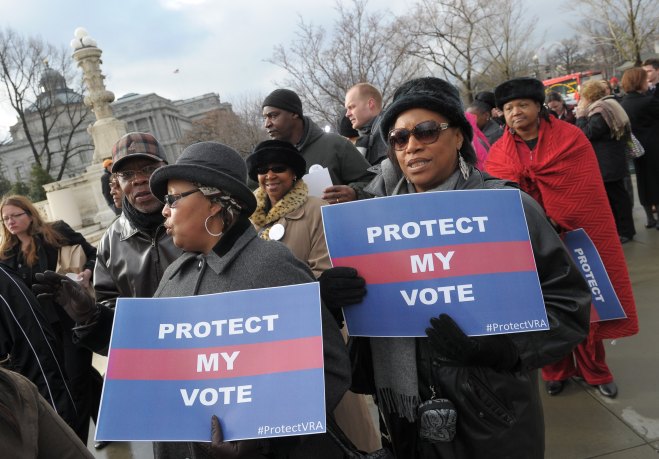
US-VOTE-RIGHTS-JUSTICE

As the Supreme Court this week heard arguments over the Voting Rights Act in Shelby County v Holder, Adam Serwer sets the scene:

Under Section 5 [of the Act], parts of the country with histories of discriminatory election practices have to ask for permission—or “preclearance,” in legal terms—from the Justice Department before making any changes to their voting rules. But [according to Bert Rein, the attorney leading the challenge to the Act,] the South, where most of the covered jurisdictions are, has changed, [and] the law, although once justified, is now unfair and unconstitutional. The five conservative justices on the Supreme Court seemed to agree. “The Marshall Plan was very good too,” argued Justice Anthony Kennedy, “but times change.” … Scalia called Section 5 the “perpetuation of a racial entitlement” that legislators would never have the courage to overturn. “In the House there are practically black districts by law now,” Scalia complained.

Scalia is an asshole, but what Kennedy is saying is not outrageous.

I have to say I am not one of those who thinks that this kind of federal oversight, essential once, must necessarily be essential for ever. And I cannot quite grasp the logic of liberals’ insistence that the bigotry of 1964 is no less a danger today. It’s obviously a much less bigoted society with respect to race than then – in part because of the very Act that liberals are rightly proud of (and that more Republicans as a proportion of their numbers voted for than Democrats). I do think there’s a day in which such supervision may not be necessary as a matter of principle and disagree with Rachel Maddow’s views expressed on last night’s Daily Show that oppression is for ever and that government control of oppression must also be for ever. Societies change. It’s crazy to take no notice of this, and wherever possible the government, in my view, should be race neutral.

But when that change has occurred seems to me to be best left to the legislature – and I thought that was the core conservative position. When last revisited, the Voting Rights Act was passed overwhelmingly. Since when were conservatives the ones asking the courts to strike down laws almost unanimously supported by the representatives of the people?

Serwer argues that SCOTUS shouldn’t even be hearing the case, because jurisdictions can in fact bail out of Section 5 provided they maintain a long-standing record of not having proposed discriminatory voting changes – something Shelby County, Alabama has not done. Jamelle Bouie’s jaw drops at the implication from Scalia and others that racism is a thing of the past. Below he responds to Roberts having asked if it was “the government’s submission that the citizens in the South are more racist than the citizens in the North?”

The answer is a qualified yes. Here is the conclusion of a 2005 study from political scientists Nicholas A. Valentino and David O. Sears:

General Social Survey and National Election Studies data from the 1970s to the present indicate that whites residing in the old Confederacy continue to display more racial antagonism and ideological conservatism than non-Southern whites. Racial conservatism has become linked more closely to presidential voting and party identification over time in the white South, while its impact has remained constant elsewhere.

But Abigail Thernstrom outlines arguments and evidence showing that black voting is vibrant in the Southern state in question:

In Alabama, the number of blacks in the state legislature is proportionate to the black population, Rein replied.  There is also very high black registration and turn-out. The point could have been put more strongly. For many years, those political participation rates have not been especially low in the Deep South. The disparity between black and white registration rates, the Chief Justice pointed out, is greatest in Massachusetts, with Mississippi, where (remarkably) the black registration rate is higher than that for whites, having the third-best rate in the country.

In addition, blacks in the covered jurisdictions have had greater success in winning public office than outside the Deep South “But think about this State that you’re representing, it’s about a quarter black, but Alabama has no black statewide elected officials,” Justice Elena Kagan argued. In reply, Rein might have pointed a finger at the Voting Rights Act.

The insistence on race-conscious districting to maximize the number of safe black legislative seats — built into the enforcement of the Voting Rights Act — is a brake on minority political aspirations.  In majority-black districts, minority candidates tend to consolidate the black vote by making the sort of overt racial appeals that are the staple of invidious identity politics. Very few have any experience building biracial coalitions; they do not acquire the skills to venture into the world of competitive politics in statewide majority-white settings. As a result, max-black districts (the ACLU’s term) seem to have worked to keep most black legislators clustered together and on the sidelines of American political life – precisely the opposite of what the statute intended.

(Photo: Activists hold a pro-voting rights placards outside of the US Supreme Court on February 27, 2013 in Washington, DC as the Court prepares to hear Shelby County vs Holder. The case centers around a key section of the 1965 Voting Rights Act which mandates federal approval for any proposed voting changes in nine states. By Mandel Ngan/AFP/Getty Images)

A Rare Bipartisan Moment

Yesterday, the House finally passed the Violence Against Women Act, which had expired in early 2012. Reauthorization of the law was delayed by the inclusion of measures related to the protection of Native American and LGBT women. Steve Benen points to the significance of the bill’s passing without support from the majority of House Republicans:

[U]nder modern Republican norms, the Speaker only considers legislation that enjoys “majority of the majority” support — if most GOP House members oppose a measure, it won’t even be considered, whether it can pass the chamber or not. The non-binding rule is great for party discipline, but lousy for democracy and governing. For Boehner’s part, the Speaker had long believed in enforcing the “Hastert Rule,” but he’s finding far more flexibility on the issue than we’re accustomed to seeing. When it was time to approve the “fiscal cliff” deal, Boehner ignored the rule to pass a bipartisan Senate plan. When he needed to pass relief aid to Hurricane Sandy victims, he bypassed the rule again. At the time, the Speaker said these were isolated incidents that wouldn’t be repeated, but here we are again — most of Boehner’s caucus opposed the Violence Against Women Act, but he brought it to the floor and passed it anyway.

To reiterate a point from several weeks ago, this may seem like inside baseball, but it’s extremely important. If Boehner, in the name of getting stuff done, is open to bringing important bills to the floor, and passing them with mostly-Democratic support, there’s an opportunity for real governing in the near future.

Amanda Marcotte puts Republicans who voted against the bill in the hot seat:

[A]ll the Republicans who voted against VAWA in the Senate were men—all the female Republican senators voted for it. Then you have the nine Republican congressmen who declared that there was no version of VAWA they would support. Rep. Tom McClintock of California justified his resistance in 2012 by calling VAWA “a feel-good measure” and objecting to how the bill supposedly hamstrings “judges who are attempting to resolve and reconcile highly volatile relationships.” It is true, as I reported at the American Prospect, that VAWA puts an emphasis on separating victims from their abusers instead of trying to patch things up, but that’s because the evidence overwhelmingly suggests that this strategy works better at keeping victims safe. Which is the point.

Alexis Levinson thinks that those who opposed the bill will probably pay a price:

Democrats have gone after Republicans in the past for not supporting the reauthorization of the bill. North Dakota Republican Rep. Rick Berg got an earful last cycle, for example, after he declined to take a position on the bill. His opponent, now-Sen. Heidi Heitkamp, held a number of campaign events on the importance of reauthorizing the bill. Berg ultimately lost [to] Heitkamp, in a state that was expected to lean Republican. Should the House Republicans who opposed the VAWA reauthorization run for Senate, they will likely face withering criticism for being part of what Democrats in 2012 repeatedly called the “war on women.”

The Long Nag, Ctd

An updated chart of readers hitting various levels of readons:

Screen Shot 2013-03-01 at 12.27.33 PM

A reader quotes me:

“…around 5,000 subscribers have yet to log in. (What’s stopping them? We don’t know…)”  I am one of those subscribers. The reason for me is that I have four different devices to read the Dish on: PC at work, PC at home, phone, and a tablet. While I click “read on” fairly frequently, no single device has reached its limit. So I don’t need to sign in. I will keep funding the Dish, as it’s ethical and I want you to succeed. But that’s the only reason I haven’t logged in.

Subscribers can bypass the meter process altogether by clicking the red button in the top-right corner of the Dish. Another subscriber:

I would submit that the cause for some fraction of that 5k is Tinypass’ desire to use a cookie, which means that browsers see a 3rd party site wanting to play with my cookies, and Safari on the iPhone has only all/none/no-3rd-party settings, and I’m not accepting all cookies – eff that. This means that I can’t click your Login button and have it do anything. So what I do is go to dashboard.tinypass.com and login there, then click the “Dish” link in Purchases and that launches me a subscribed-and-logged-in Dish window, allowing me to close the tinypass bootstrap window. Tinypass has helpful paste-in lines for whitelisting them as a valid 3rd party cookie site, but I don’t know how to convince my iPhone of that without opening the cookie floodgates.  So my workaround suffices.

The most common response from readers:

I read your blog through RSS, specifically Google Reader. I rarely if ever visit your site, and have done so recently only to check out the new design (nice work, appreciate the minimalist approach!). I’m guessing that many of the other non-login subscribers come from this group, but perhaps your site analytics could shed light on this.

My feeling is that content consumption strictly through websites will die off as people move to simpler, more customizable mechanisms such as RSS feeds and mobile devices. One of my pet peeves with website feeds is truncated posts that force you to click to a website to read the full post/story. The primary reason I’ve created the feed is to minimize website visits, and the second I’m forced to do so the less likely I will continue to consume your content at all. Serve an ad in my reader, I don’t care, as long as it doesn’t bog down the limited time I have to read the posts I want to read. That is one of the reasons I subscribed to the Dish (besides the great quality of your blog) – as long as you continue to offer full posts in your feed, I will continue to subscribe.

One other note: your “nags” are beginning to feel more like NPR pledge drives – only a nickel a day for honest independent journalism! Not that it’s a bad thing; NPR is great and we all should contribute to the financial stability of the independent media we consume if we can afford it. And hey, I can’t wait for next year’s subscription to come with a free emergency radio or brain power CD.