Will Obama’s Executive Amnesty Prove Popular?

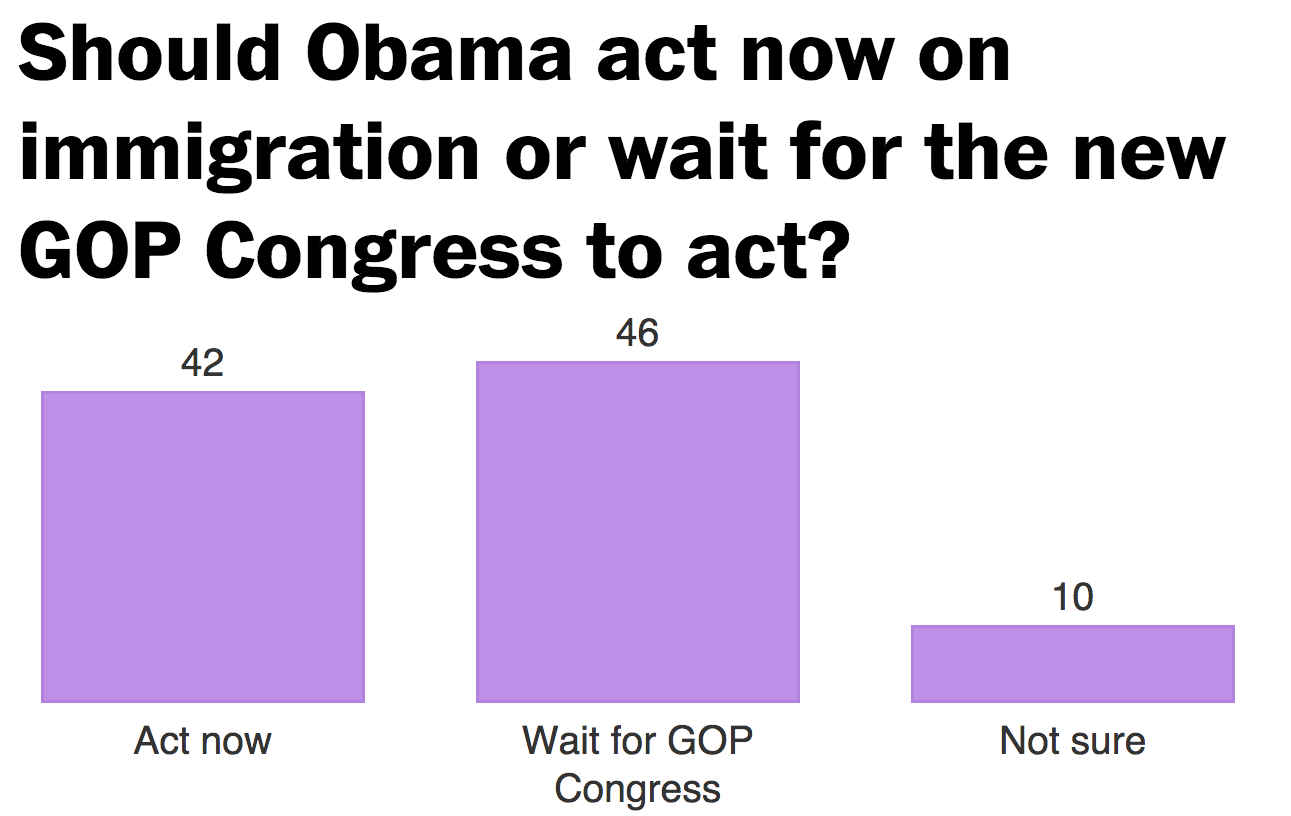
Should Obama Act

Americans are split on whether Obama should take action:

The split is somewhat counterintuitive, since a strong majority of Americans approve of what is likely to be the key element of the executive action: effectively legalizing millions of immigrants who are here illegally. As Post pollsters Peyton M. Craighill and Scott Clement pointed out over the weekend, 57 percent of those who voted on Nov. 4 favored legalization for these people, while 39 percent wanted deportation, according to exit polls. And even that split was actually narrower than most polls have shown.

But in politics, the process matters too, and many of those who otherwise support legalization also appear opposed to or hesitant about doing so without the regular checks and balances of the legislative and executive branches.

Yglesias bets that the executive action will help Democrats:

Hill staffers who believe in the political power of immigration reform point out that one of the biggest substantive drawbacks of executive action — its very tenuousness — is a political asset. What discretionary authority giveth, discretionary authority may taketh away, after all. If a Republican wins the White House in 2016, there will be no checks and balances to stop him from ordering the deportation of millions of immigrants granted relief by Obama. This dramatically heightens the stakes, not just for the immigrants themselves (who of course won’t be eligible to vote) but for their friends, family, coworkers, and employers.

Of course the higher stakes also involve higher stakes of backlash. But from the viewpoint of the party that benefits from higher turnout, the risk-reward ratio looks good.

Josh Marshall is on the same page:

If there are 5 million people who are affected by this order, the number of people who either have family ties to these individuals or affective relationships with them is much larger. I don’t know if it’s 15 million or 20 million or 40 million. But it’s a lot more than 5 million people who will feel acutely the fate of these people hanging in the balance with the 2016 election. And advocates on both sides of the immigration divide, deporters and pro-immigrant activists will press the issue throughout the 2016 cycle. The 5 million affected can’t vote and won’t be able to for years. But many family members, friends, community members and employers can.

Jennifer Rubin, on the other hand, argues that “it is essential that every Democratic senator and congressman in the new Senate take a vote (be it on the merits or on cloture of a filibuster) on the issue of executive action”:

At some point, they will need to face the voters and explain why they abdicated their responsibility and power to the executive branch. Maybe this is why Sen. Claire McCaskill (D-Mo.) declared about executive action on immigration, “I am not crazy about it,” although she blamed the GOP-controlled House for not acting on the issue. For someone who understood the voters’ intentions well enough to vote against Sen. Harry Reid (D-Nev.) as the new minority leader, surely she could see that the voters dislike unilateral action as much as they dislike the Reid era in the Senate. In any case, make each Democrat vote.

Frum selects another ripe target:

The president’s plan would be costly. The vast majority of those who would gain residency rights under the president’s reported action will be poor. Their low incomes will qualify them for means-tested social programs just as soon as their paperwork is in order. This will not be a small-dollar item. Forty-one percent of the net growth in the Medicaid population between 2011 and 2013 was made up of immigrants and their children. Legalize millions more poor immigrants, and sooner or later, programs from Medicaid to Section 8 housing vouchers to food stamps will grow proportionately. It’s not widely appreciated how much past immigration choices contribute to present-day social spending. In 1979, people living in immigrant households were 28 percent more likely to be poor than the native-born. By 1997, persons in immigrant households were 82 percent more likely to be poor than the native-born. Wittingly or not, U.S. immigration policy has hugely multiplied the number of poor people living in the United States. The president’s plan will put millions of them on the path to qualifying for welfare benefits.

Meanwhile, Bouie dubs Obama’s executive order a defeat for Republicans:

Democrats weren’t going to relent on immigration. Latinos are an important part of the Democratic coalition and key to the party’s effort to change the partisan dynamic in states like North Carolina, Georgia, Texas, and Arizona. And while Latino disappointment wasn’t determinative in this year’s elections, it’s dangerous for Democrats to delay action through 2016, both on the merits—there’s no guarantee of immigration reform in 2017—and on the politics; absent action on immigration, Latinos might just sit out the presidential election, dealing a blow to Democrats in key states like Florida, Colorado, and Nevada. (To that point, it’s no surprise that lawmakers from the latter two have urged Obama to move with executive action on immigration.)

Healthcare.gov Works – Finally

Waldman pays attention to the site’s success:

The news, an old saying goes, doesn’t cover successful airplane landings. But there’s one extremely notable successful landing happening right now, and unless you’ve gone to the inside pages of your newspaper, you might have missed it: open enrollment for the second year of the Affordable Care Act exchanges has begun, and in its first day, the federal exchange signed up 100,000 customers with only minor technical glitches.

But McArdle warns that this “open enrollment period isn’t the biggest test for Obamacare in the next 12 months”:

The biggest test will be what happens on or around April 15th.

That’s the first time all the people who didn’t buy insurance will get hit with the individual mandate penalty, and the ones who thought that it was a nominal $95 fee are in for a nasty shock. April 15th will also be the first time that people who got too much in subsidies are going to be asked to pay back some of that money.  I do not have hard figures on this, but my basic experience in personal finance and tax reporting suggests that approximately zero percent of those affected will be expecting the havoc it will wreak on their tax refund.  Brace for a wave of taxpayers angrily complaining to congressmen and their local newspapers.  The size of this pressure — and how the administration handles it — will tell us a lot about the future of this program.  As will Tax Day in 2016, when the penalties get bigger.

The View From Your Window Contest: Winner #231

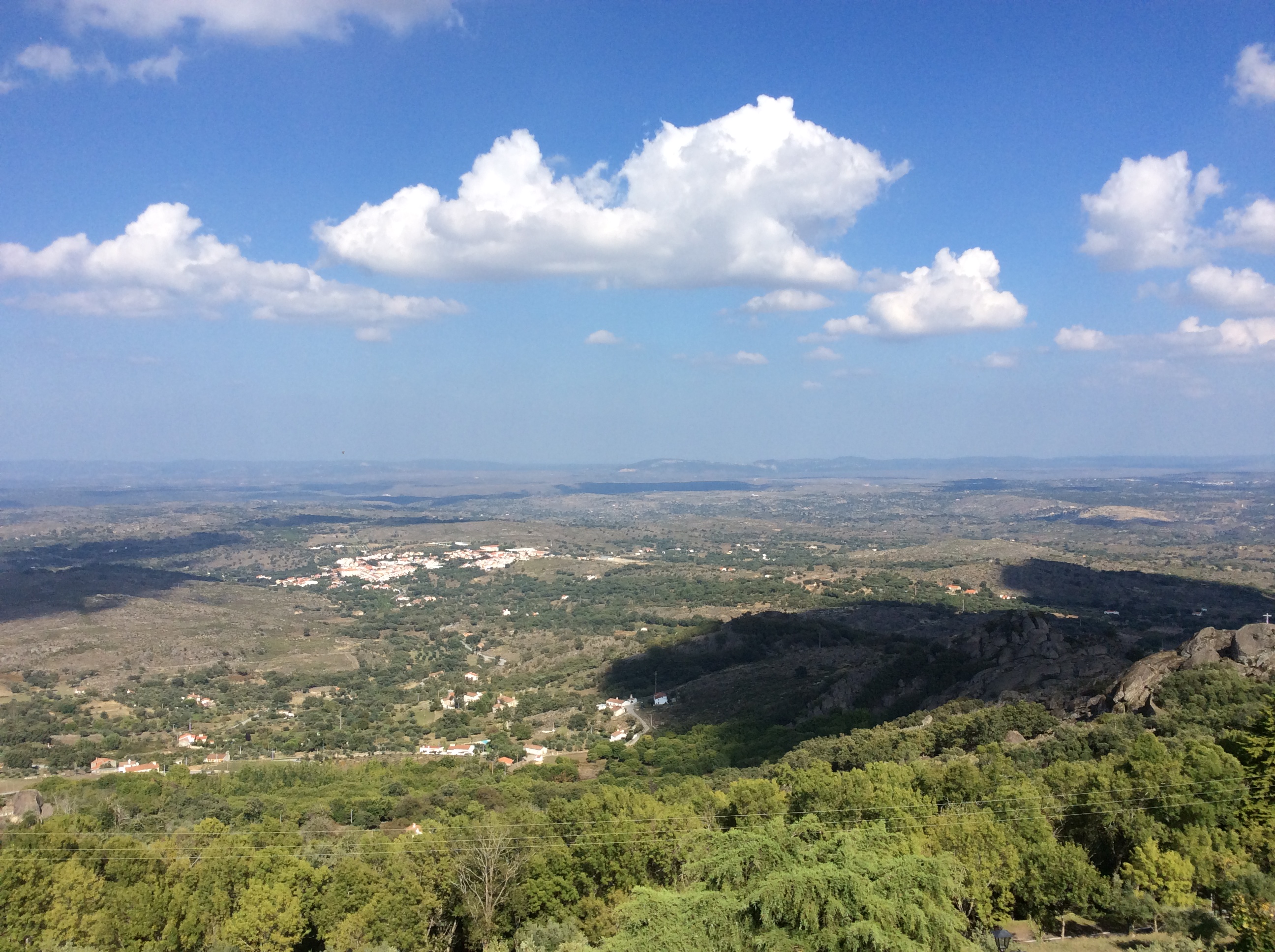
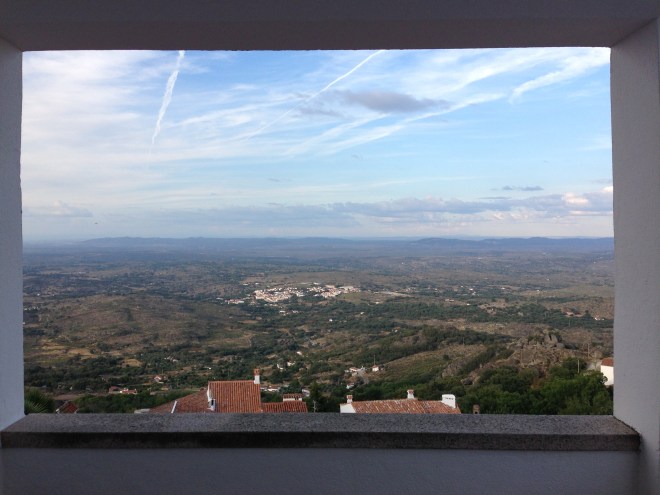
VFYW_C_231

A frustrated reader lashes out:

Jesus, could you get any more generic? Scrub brush, an outcropping with a wooden cross, telephone poles, white buildings with red-tiled roofs, a medium-sized range of hills in the background!? An image is beginning to crystallize in my mind of the typical winner of this contest. He is fat, bezitted, wears a carpel tunnel brace and cookie-crumb littered shirt. And he HAS NO LIFE!

So basically:

giphy

We love our contest players just the way they are. This one has a highdea:

Something tells me that Granada, Spain – right near the Alhambra. It could be intuition, it could just be the haze of a Saturday wake-and-bake.

Another is thinking the West Coast:

Joshua Tree National Park in Joshua Tree, CA. If that is not correct I am confident it is near there. I was at the Park two weeks ago and it certainly looks like it’s taken near the North entrance of the Park. The town in the background is Twentynine Palms.

Spinning the globe, this reader is going to need a nice red sauce:

When I first saw the contest picture, I said, “if this isn’t Italy, I’ll eat my hat.” Shortly thereafter, my dad found a white cross on some rocks just outside Palermo. Since then, I’ve found another similar cross in south Sicily. That, and the architecture, makes us 90% sure we’re in Sicily. The only other option is Tuscany, but the architecture there is softly different, and I doubt you’d return to Tuscany so soon after the Siena VFYW. Problems of terrain and building style — this window is so unique — mean we can’t find where. But I hope we’re close!

A sanguine reader adds, “Thank you for a few moments of Google touring Umbria – Cortona, Assisi, Abruzzi … it’s all good.” Most everyone correctly guessed some part of Europe this week, but this reader takes us to the right country, albeit the wrong town:

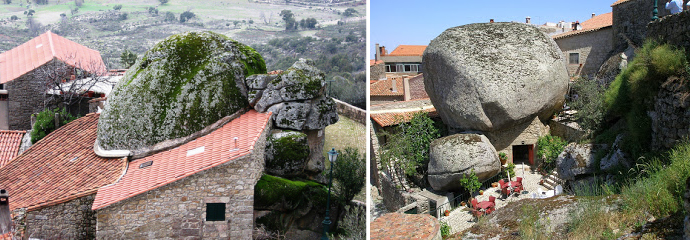
That view is from the village of Monsanto, Portugal. Beautiful place. Rocky:
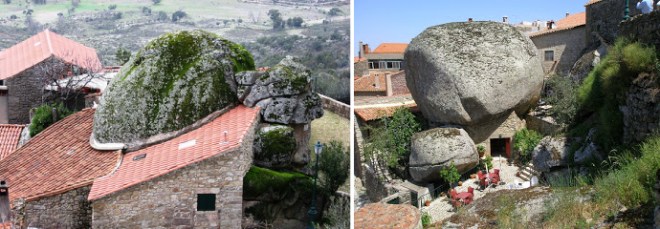
monsanto

I’m not sure exactly where the view is from, perhaps the Pousada de Monsanto, but I’m not sure if it’s the lobby, or the breakfast/dining room.  Or maybe someplace else, another hotel.

Another reader almost made the same mistake but recovered to nail the correct village and hotel:

Today’s entry comes from a window in the Pousada de Marvão hotel in b-e-a-utiful Marvão, Portugal.

I found almost no helpful hints hidden in this photo (even the seemingly helpful cross in the bottom right quadrant was useless). If the winner reveals some obvious, forehead-slap-worthy clue, I’m going to be pretty crushed. Searching things like “red tile roof valley” yields results for places far and wide: Costa Rica, Venezuela, Indonesia, all of Europe.

While trying to figure out if the palm tree in the lower left corner would yield anything interesting, I found my way to the Wikipedia entry for the European Fan Palm (Chamaerops). One of the countries this particular palm grows in is Portgual. A previous contest led me to mistakenly spend an awful lot of time in Portugal looking for red roofs. Was it about to happen again?

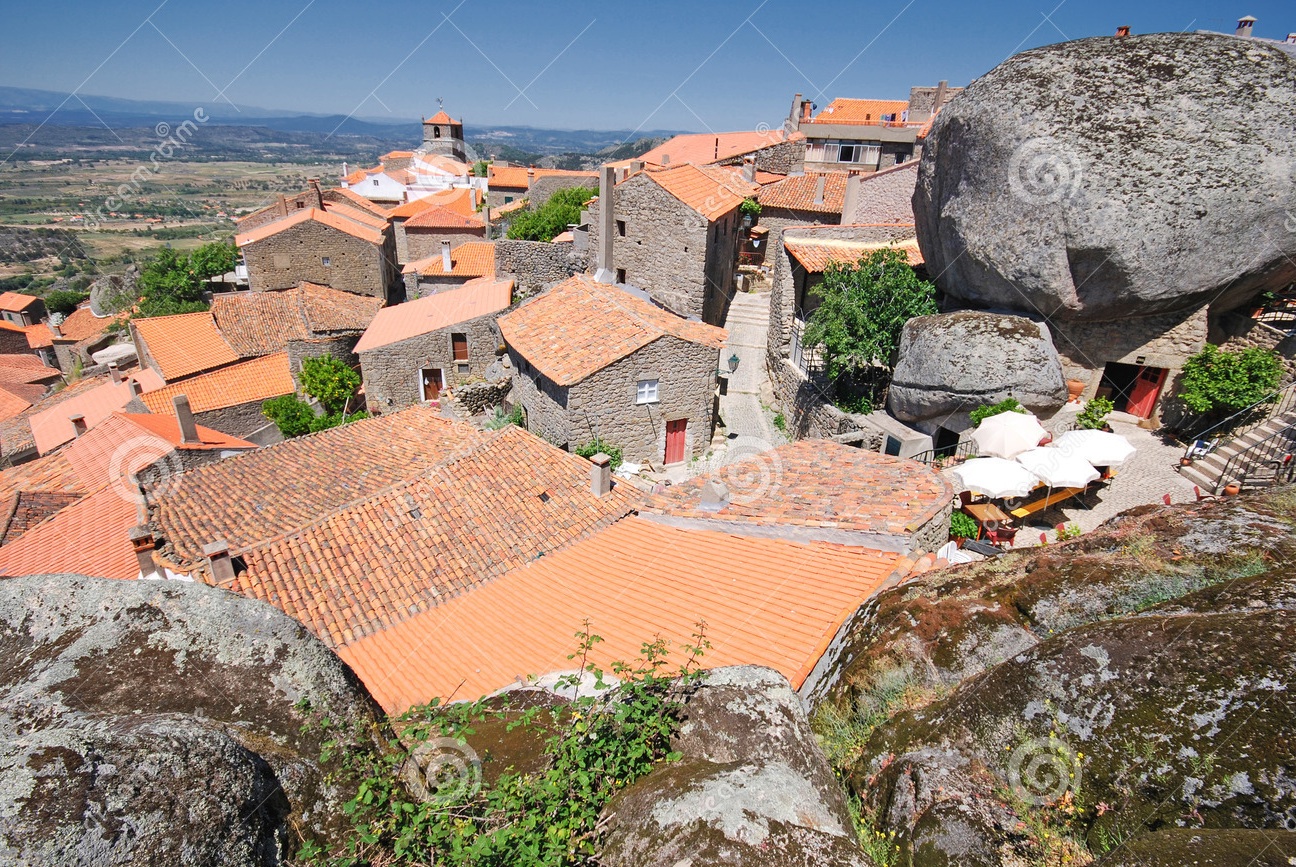
I Googled “Portugal Red Roof Village” and there it was – some place called Monsanto. The very first result features a giant boulder that seems to match the type of rocks in the lower right hand corner of our entry:

231-google-result

I fruitlessly spent the next hour surfing the various villages around Monsanto and trying to piece together the right angle for the window. Nothing worked. I started typing an entry saying that if I had to be wrong, Monsanto was the place to do it. It is seriously lovely.

Before hitting send, I took another peek at my Google Image results and it turns out another lead was sitting there right in the third row. I started poking around Marvão and it was mere minutes before I found my way to the Pousada de Marvão and this week’s view. I think this pull quote from Marvão’s Wikipedia entry says it all:

Nobel prize-winning author José Saramago wrote of the village ‘‘From Marvão one can see the entire land… It is understandable that from this place, high up in the keep at Marvão Castle, visitors may respectfully murmur, ‘How great is the world.’’

Both Monsanto and Marvão were worth making a virtual visit to and I’d love to see them in person. I’m grateful to this contest for showing me that they exist.

As always, Dishheads have been there:
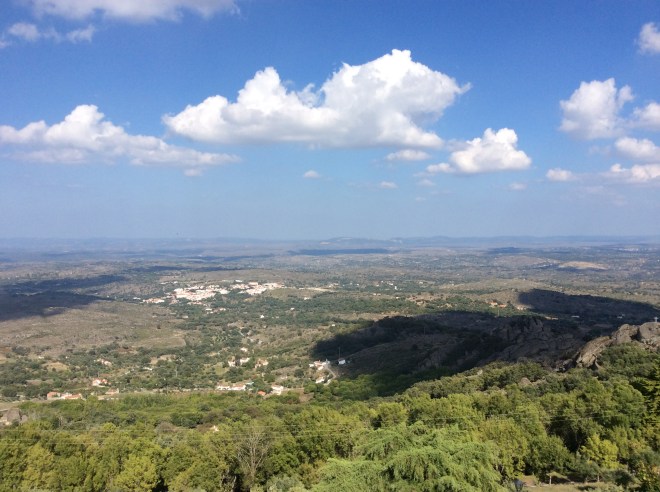
IMG_0067

Above is a photo I took a few weeks ago. You can imagine my surprise when I saw this month’s View From Your Window entry. It is taken from Marvao, Portugal, with Santo Antonio das Areias in the distance. I am guessing the photographer was staying in the Pousada de Marvao.

Another rhymes his way to the right window:

My very first guess came way too soon,
Eager elation! I shot for the moon.
Sometimes I suffer, in triangulation,
From Premature Extrapolation.

The town? Well that much I knew in a minute,
Which place, was the tough one – I just couldn’t win it.
But noticing patterns of discolored stone,
That match your sill, the Pousada is known!
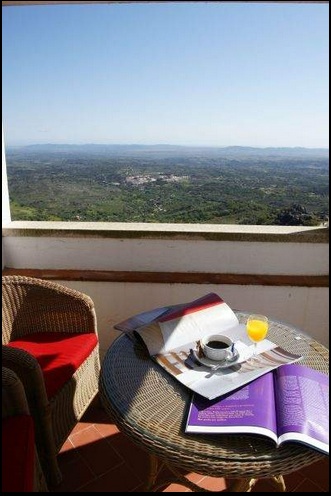
Pasted Graphic

Balcony view, the sure winning play,
The room is 210. How I know, I won’t say:

Pasted Graphic 1

Street views in Marvao? Endless rewards!
But this is, for US, all that Google affords:

Pasted Graphic 5 copy

But sad to say, that player also blundered,
For only this veteran, nailed the room number:

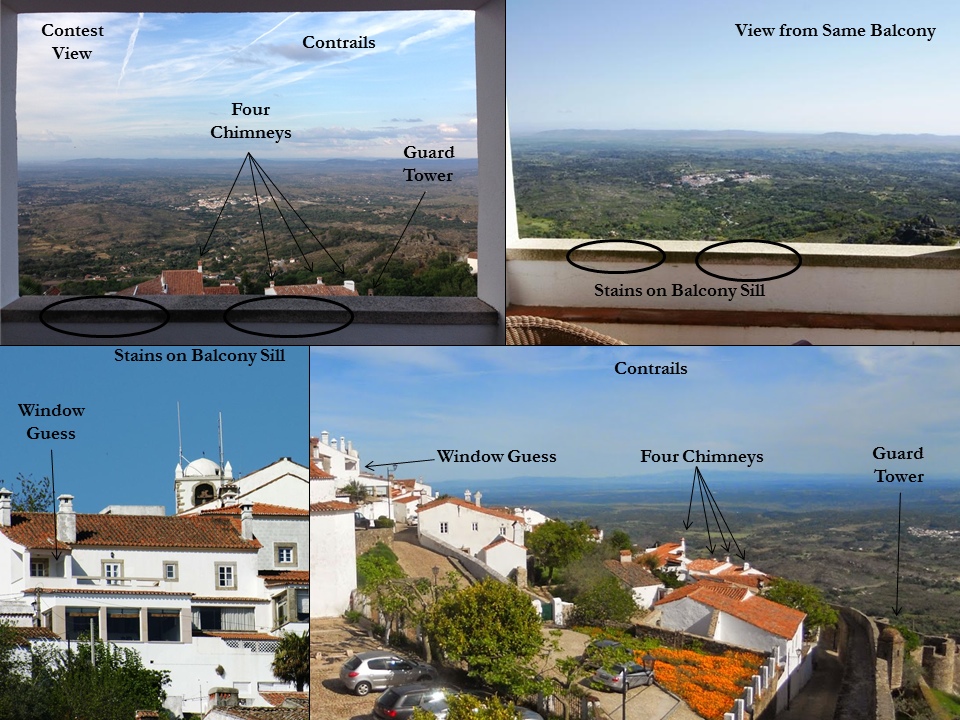
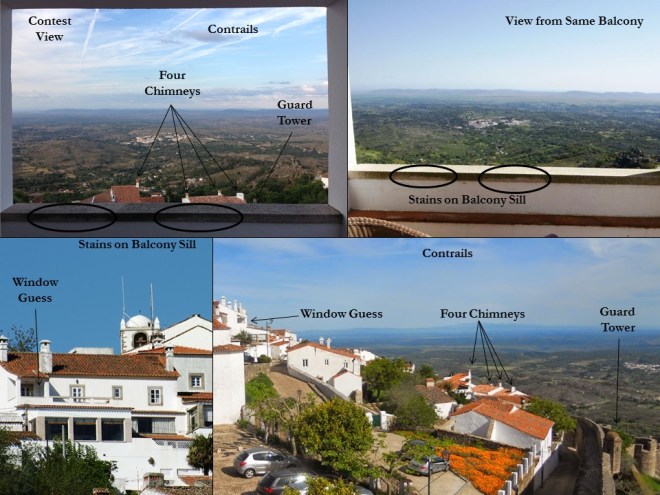
My first inclination was to search Spain given something about the landscape. I have spent a fair amount of time in Spain searching for other windows. Instead I bounced around Mediterranean countries looking for elongated, red roof tiles and eclectic chimneys similar to those in the contest view. The closest I found was the fortified town of Monsanto in Portugal. It had similar roofs, chimneys, as well as large boulders and outcrops. This prompted a search for Medieval fortified towns of Portugal on high promontories (appropriate for the soaring swifts in the contest photograph). A photograph of Marvão caught my eye because it included the distinct chimneys in the contest view. It was then obvious that the dark brown chimney to the right was, instead, a guard tower on town’s fortification walls. All other clues check out.
vfyw_Marvao2_11-15-2014

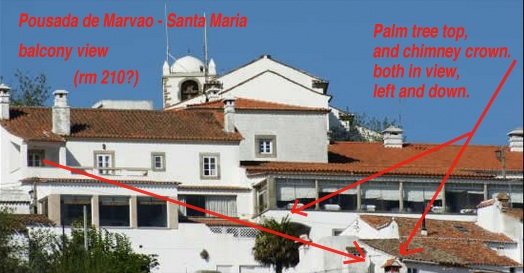
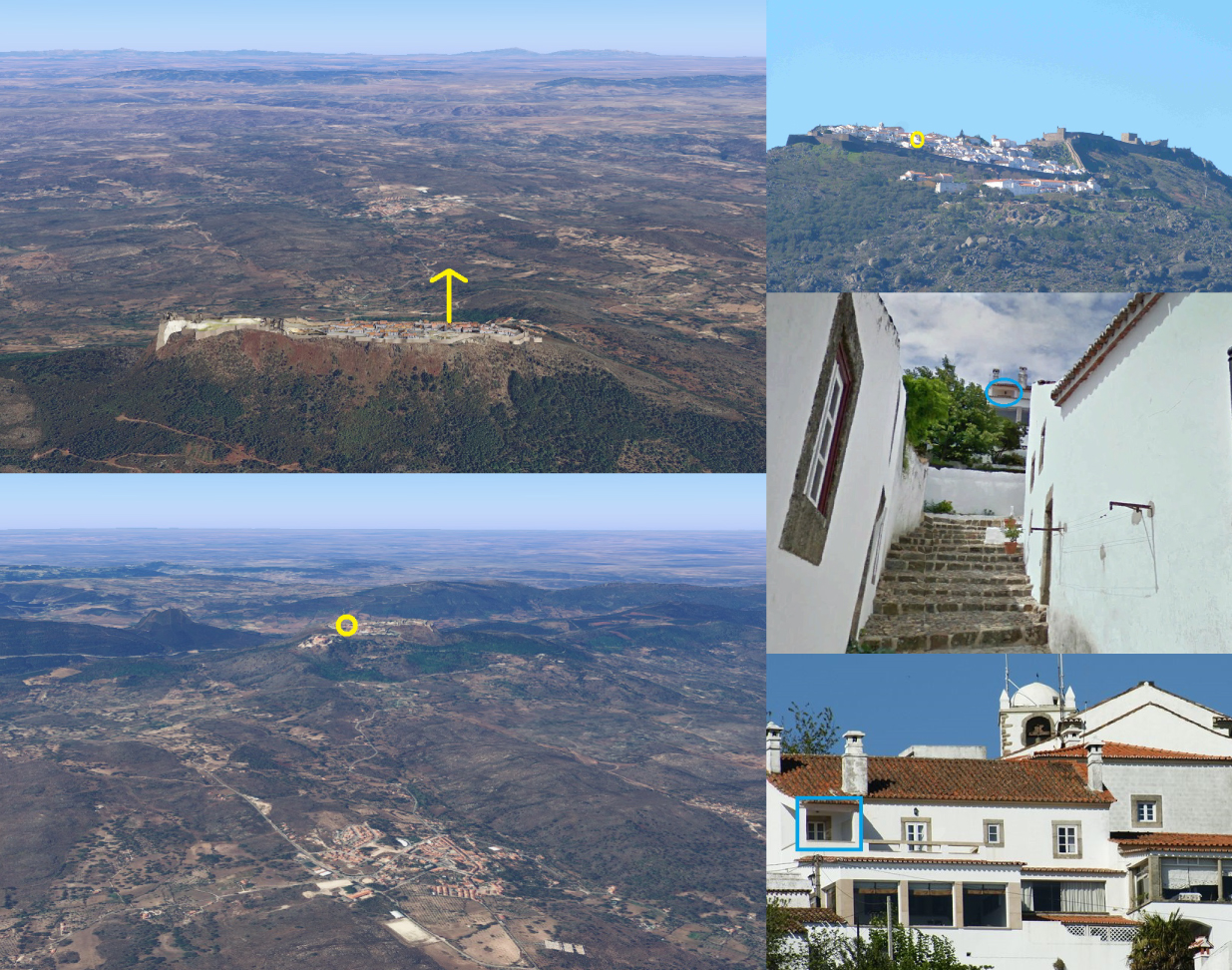
Once I found the hotel, it became clear that the contest view was from a balcony and not a window. There were no signs of glass or window framing or fixtures. Photographs from a balcony at Pousada de Marvão had much the same view and identical stains on the granite balcony sill as those barely visible in the contest photograph (see illustration). It is a fairly small balcony on the corner of one of the hotel’s cobbled-together appendages and can be seen in photographs of the hotel’s northeastern façade (see illustration). Based on guest reviews of the hotel, the room is probably #312 (said to be a small room with balcony). Room 310 is over the kitchen which is located northwest of the contest balcony with space for #311 between them. Number 311 is a double room with a terrace balcony which is also visible on the building’s façade.

Views from these fortifications are spectacular and the towns charming, but thoughts of their original purpose and use is actually quite sobering. Maybe it is all the ISIS coverage.

Another former winner looks in on Marvão:

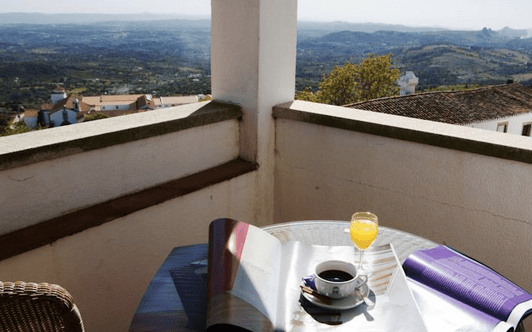
You can see the parish of Santo António das Areias below (similar, but zoomed in picture here).  And Spain is beyond those faraway hills.  The area is within the Serra de São Mamede Natural Park.  For the Room number, I’ll guess #12.
Second staged picture

Looking at the list of local events on the town’s website, I have some disappointing news to report.  We all missed the 31st annual Feast of the Chestnuts on Nov. 8 & 9 (pictures here) and the pig slaughter in the nearby village of Porto da Espada on Nov. 15.

To paraphrase Andy Zaltzman of The Bugle Podcast, this week I felt like a bad French restaurant.  “I [almost] ran out of thyme.”  But I got there in the end.  (And if you haven’t heard The Bugle, you might listen to John Oliver and Andy’s fuckeulogy to Bin Laden available here.) Thanks for the contest.

Chini had a little more trouble than usual, but it’s not because of carpal tunnel:

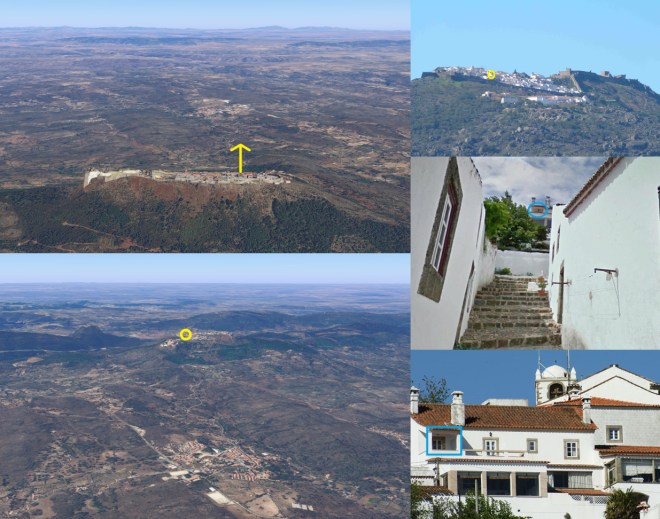
Discipline, discipline, discipline. It’s everything in this contest. Unfortunately, I started out this week with none and wound up wasting an hour or more of precious free time fruitlessly searching the Iberian plains. Then, later on Saturday, I applied my usual methods and presto! Location found in fifteen minutes. You lose focus in this game for one second …
chini-231

This week’s win goes to another veteran without a victory:

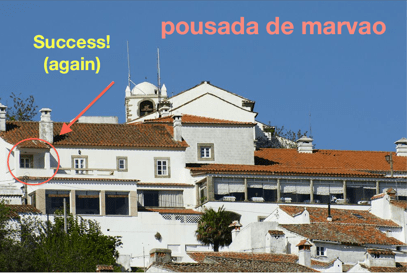
There is no view quite like that from Suite 210 of the Pousada de Marvao, looking northeast towards the hamlet of Santo Antonio das Areias,  And I should know, since I was chamber maid at that establishment for several months while working my way through hospitality school.  YES!  We can see it below, oh so clearly circled:
Screen shot 2014-11-16 at 12.31.59 AM

And I’ve got a picture of the view!  A different picture of the same exact view!

pousada-de-marvao-charming

It’s possible that I have it because I am insane and have wasted another day trying to please you!  Or perhaps I took it while cleaning.  It was such a beautiful day!  Oh, and I know I found some bridge in China, and a water tower in Mendocino, the I Street Bridge in Sacramento, some other bridge on the Oregon Coast and many more.  I am lucky that way, and have lived a varied and exemplary life.  But time to send me the book so that I can retire from such craziness and return to crosswords.

But why retire when all your future submissions can now be prefaced by “A former winner writes”? Speaking of prefaces, this week’s submission doubles as The View From Your Honeymoon:

The photo was taken from the window of room 312 at the Pousada de Marvao in Marvao, Portugal on September 12, 2014. We were there during our honeymoon (on our way from Lisbon to the Douro River valley.) Marvao is a fortified town on top of a mountain near the Spanish border. Our room had a lovely balcony, from which this picture was taken and on which we ate dinner, drank wine, and looked out at the valley below while it got dark and the lights came on.
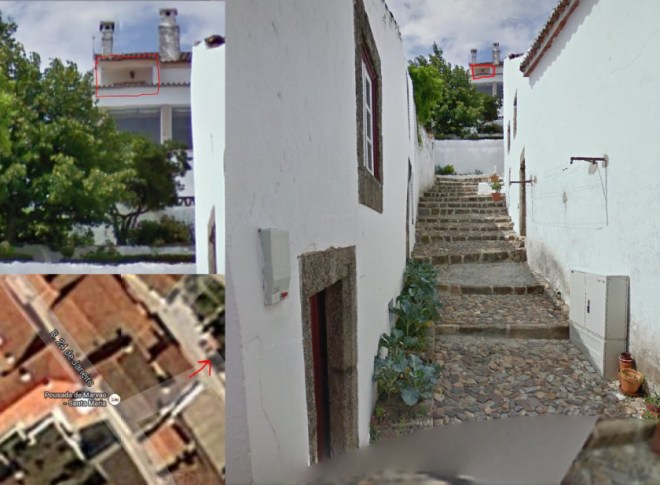
vfyw-orig

I would say the photo would be a hard one with the lack of any real distinguishing features, although I might be surprised as Marvao was named both a UNESCO Heritage Site candidate and was in the book 1000 Places to See Before You Die so people might recognize it from visiting.  The town is beautiful, and everyone there was friendly (and quite willing to deal with my extremely poor Portuguese.)  Coming from a large city, the quiet from the lack of traffic and general noise was incredibly restful.  I highly recommend visiting if you happen to be in Portugal (or western Spain – it’s right on the border); tour the castle, walk the parapet of the medieval walls, and watch the sun set from one of the high points in town.

I do have one caveat – I wouldn’t recommend it for those with a fear of height.  The drive up is winding, with some very steep cliffs very close to the edge of the road and a marked lack of guardrails.  Drive slow and drive careful, and when you arrive at the top of the mountain, have some port to relax.  (Also, on your way down, if you’re headed northwards, Google’s directions are not your friend – it sent us down what I would charitably describe as a horse trail.  Lots of fun in a rental car!)

Lastly, the View From Your Heat Map (zoom in by double-clicking an area of interest, or drag your cursor up and down the slide):

This embed is invalid


We’ll do an easier one next week. See you all on Saturday!

(Archive: Text|Gallery)
A Massacre Of Jews At Prayer

Israelis Killed In Synagogue Attack

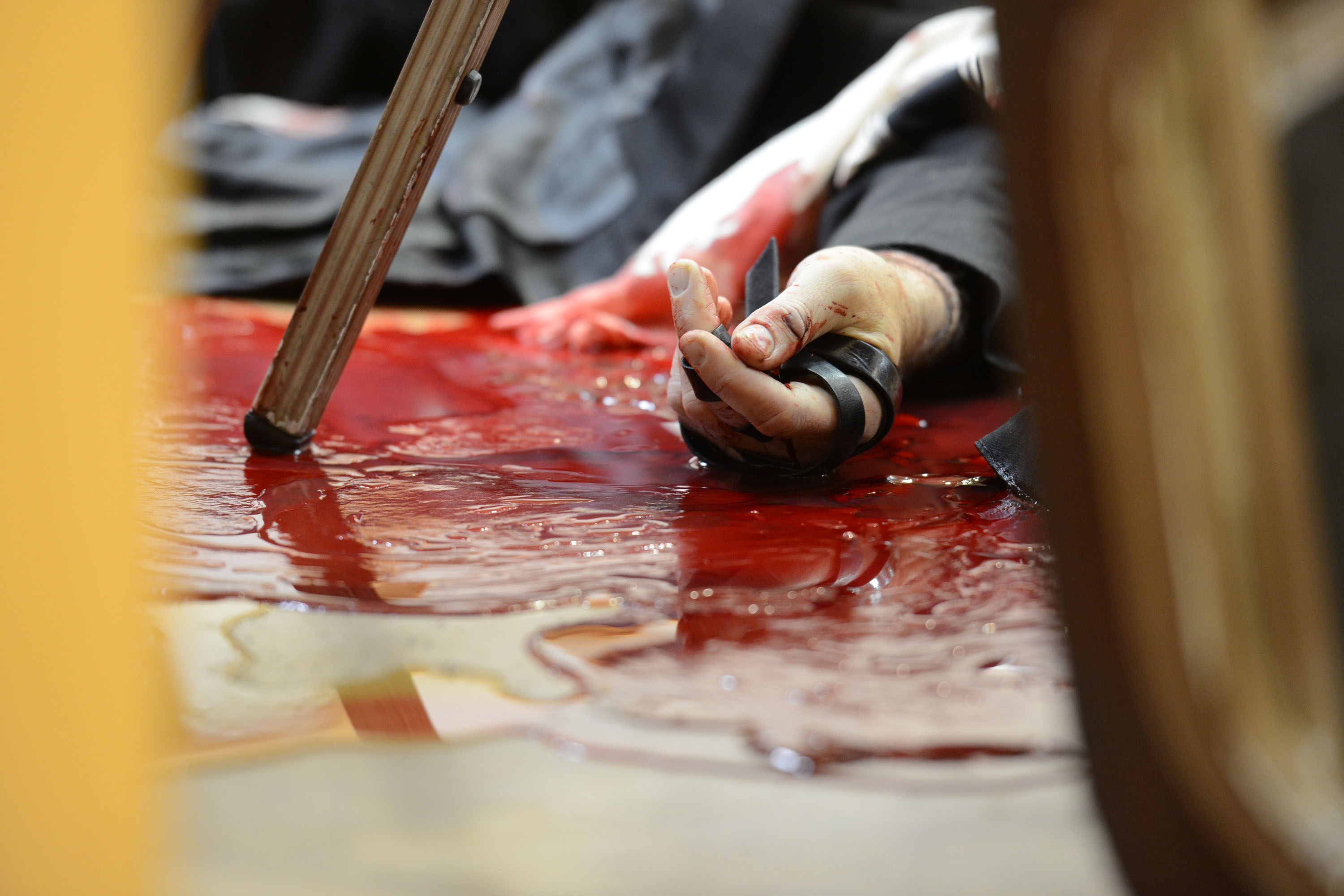
This is extremely distressing. Early this morning, two Palestinian cousins armed with meat cleavers and a gun burst into a synagogue in an ultra-Orthodox neighborhood of Jerusalem and killed four worshipers before dying in a shootout with police. The attack was the deadliest act of terrorism in the city in years and comes amid escalating tensions and violence surrounding the Temple Mount/Haram al-Sharif complex, and may also have been carried out in retaliation for recent attacks on Palestinians in the city. Hamas, which praised the murders and called for more such “revenge” attacks, is certainly spinning it that way:

Ghazi Hamad, a senior Hamas official in Gaza, said in a BBC interview that attacks like Tuesday’s should be anticipated. “Everyone expected that this would happen,” Hamad said. “Every day Jerusalem is boiling, every day there is a new crime against a Palestinian citizen. We didn’t see any effort of the Israeli government to stop the settlers from attacking the al-Aqsa mosque. They should open their eyes and see there is a revolution in Jerusalem, there is an uprising.”

Goldblog holds this up as further evidence of Hamas’s genocidal ambitions:

This is how a Hamas spokesman reacted to the massacre of Jews at prayer: “The new operation is heroic and a natural reaction to Zionist criminality against our people and our holy places. We have the full right to revenge for the blood of our martyrs in all possible means.”

Twenty years ago, shortly after the Jewish fanatic Baruch Goldstein massacred Muslims at prayer in Hebron, the then-prime minister of Israel, Yitzhak Rabin, said of the killer, “You are not part of the community of Israel. …  You are a foreign implant. You are an errant weed. Sensible Judaism spits you out.” Hamas’s endorsement of the massacre of Jews at prayer in their holy city confirms—as if we needed confirming—that its goal is the eradication of Israel and its Jews. We should pray for the day when the leaders of Gaza react to this sort of massacre in the manner of Yitzhak Rabin.

But David Horovitz also blames Abbas for fanning the flames:

[T]he centrality of religious dispute to this latest iteration of the Israeli-Palestinian conflict is now unmistakable. And at the core of this new iteration, Tuesday’s attack made murderously clear, is Muslim intolerance — of the very notion that Jews have a religious connection to the Temple Mount, and by extension to Jerusalem and to Israel. Appallingly in the last few weeks, Abbas made himself a party to this intolerance. Unlike Hamas, he does not openly call for Israel’s destruction. He may not, in his heart of hearts, even seek it. But he has allied himself to the extremists in castigating as “contamination” the Jewish desire to express the link to the site of the Biblical temples, the site that roots our historical legitimacy here.

Charles Pierce throws up his hands:

By the choice of targets, by the alleged motives in question, and by the ex post facto justification offered on behalf of the attackers, this was purely an act of religious war. By the choice of targets, by the alleged motives in question, and by the ex post facto justification of what is surely to come, the response is likely to be purely an act of conventional war, even though there will be a religious undertone to it that nobody will talk about. The response is also likely to be overwhelming. Thus, in the choice of targets, by the alleged motives in question, and by the ex post facto justifications of both sides, the violence will be speaking to the violence in a different language entirely. One cannot solve the other because one cannot understand why the other does what it does. This increasingly seems to be a problem that the modern world is unequipped to solve. The intellectual faculties needed to understand religious violence have atrophied in the west. It baffles us, a T-Rex in the Internet cafe. It baffles us and it goes on.

(Photo: This handout image supplied by the Israeli Government Press Office (GPO), shows a view of the scene of a shooting at a Synagogue where a suspected Palestinian attack took place on November 18, 2014 in Jerusalem, Israel. By Kobi Gideon / GPO via Getty Images.)

The Physical Markings Of Psychic Pain

In a review of Bessel van der Kolk’s The Body Keeps the Score, Shaoni Bhattacharya describes trauma as “one of the West’s most urgent public health issues”:

[Van der Kolk] explains how trauma and its resulting stress harms us through physiological changes to body and brain, and that those harms can persist throughout life. Excess stress can predispose us to everything from diabetes to heart disease, maybe even cancer. … The book has gut-wrenching stories: about Vietnam veterans who committed war atrocities, incest survivors, broken adults that were terrorised as children or shunted between foster homes. Van der Kolk draws on hundreds of studies to back up his claim that “the body keeps the score”.

We meet a woman who had suppressed the memory of being raped at age 8 by her father, but when she ferociously attacked a new partner for no reason, she signed up for therapy with van der Kolk. Soon after, her eyesight started to fail: an autoimmune disease was eroding her retina. In a study, his team found that female incest survivors had abnormalities in the ratios of immune cells, compared with untraumatised women, exposing them to autoimmune diseases.

In an excerpt from the book published last month, van der Kolk endorses writing as a form of therapy:

As far as I’m aware, the first systematic test of the power of language to relieve trauma was done in 1986, when James Pennebaker at the University of Texas in Austin turned his introductory psychology class into an experimental laboratory. Pennebaker started off with a healthy respect for the importance of inhibition, of keeping things to yourself, which he viewed as the glue of civilization. But he also assumed that people pay a price for trying to suppress being aware of the elephant in the room.

He began by asking each student to identify a deeply personal experience that they’d found very stressful or traumatic. He then divided the class into three groups: One would write about what was currently going on in their lives; the second would write about the details of the traumatic or stressful event; and the third would recount the facts of the experience, their feelings and emotions about it, and what impact they thought this event had had on their lives. All of the students wrote continuously for 15 minutes on four consecutive days while sitting alone in a small cubicle in the psychology building. …

The team then compared the number of visits to the student health center participants had made during the month prior to the study to the number in the month following it. The group that had written about both the facts and the emotions related to their trauma clearly benefited the most: They had a 50 percent drop in doctor visits compared with the other two groups. Writing about their deepest thoughts and feelings about traumas had improved their mood and resulted in a more optimistic attitude and better physical health.

Van der Kolk adds, “Numerous experiments have since replicated Pennekbaker’s findings. Writing experiments from around the world, with grade-school students, nursing-home residents, medical students, maximum-security prisoners, arthritis sufferers, new mothers, and rape victims, consistently show that writing about upsetting events improves physical and mental health.”

Lumbersexuals: The Triumph Of The Bears

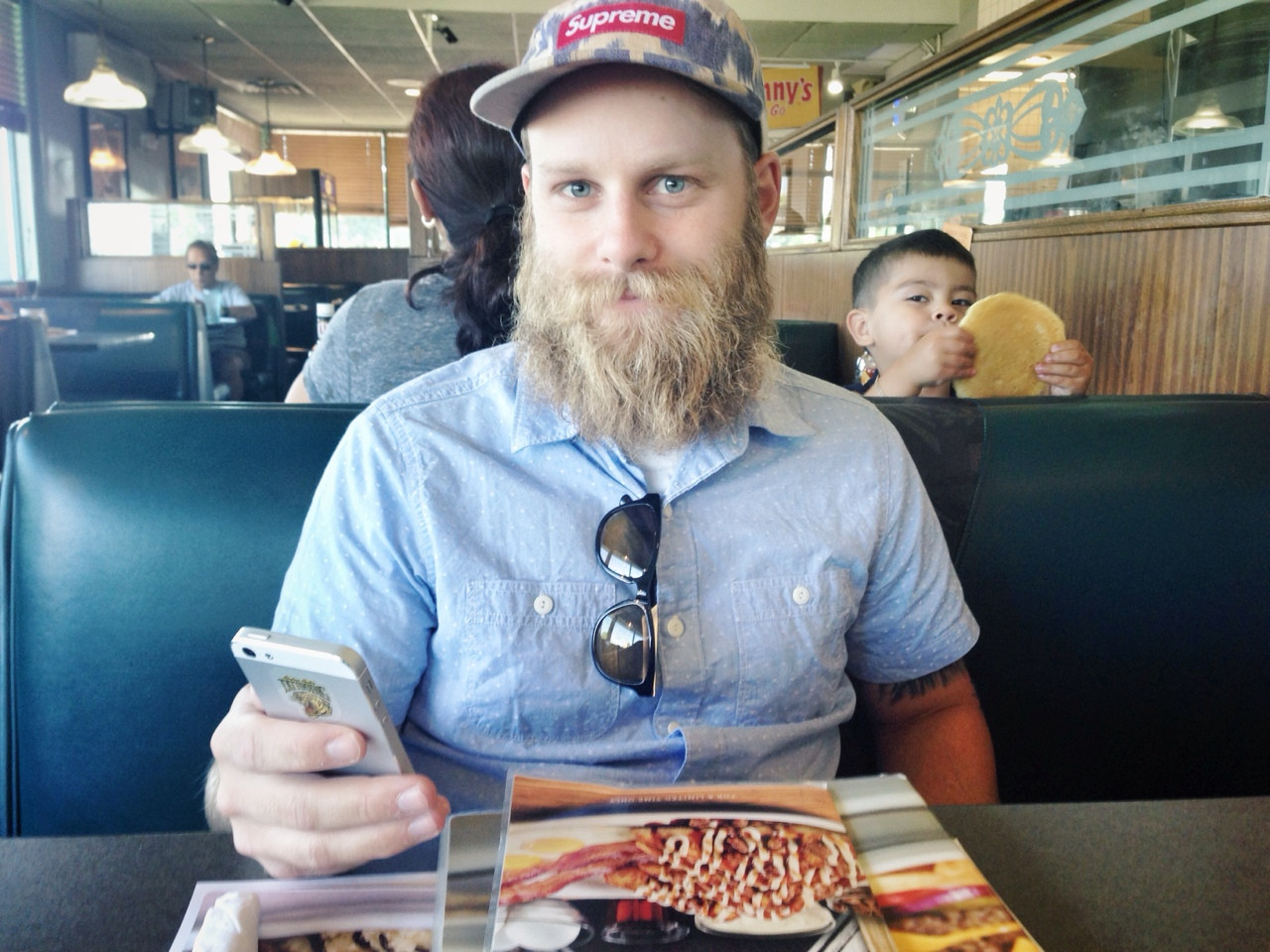
Funny kid at Dennys was looking at my beard. - Imgur

It’s now eleven years since I wrote an early piece on bear culture for Salon. But I was obviously onto something bigger than I imagined:

“Bears” almost all have facial hair — the more the better. Of all the various characteristics of Beardom, this seems to be one of the most essential. The Ur-bears have bushy beards that meander down their necks and merge with a large forest of chest and back-hair to provide a sort of all-hair body environment … Bears at their most typical look like regular, beer-drinking, unkempt men in their 30s, 40s and 50s. They have guts. They have furry backs. They don’t know what cologne is and they tend not to wear deodorant.

Bears were partly a reaction to the whole ghastly metrosexual moment when straight men, for some elusive reason, decided to shave, product and starve themselves so as to look more like women (at the behest of those Queer Eye minstrels). And exactly the same kind of hirsute transition is now – a decade later – well under way among straights.

I regard this, in the spirit of Tim Teeman, first as a huge achievement for gay male America. Not only are we more comfortable in our own unpolished masculinity, we have created a cultural space for straight men to be the same. To put it another way: gays have helped redefine masculinity for straights – and for the first time, straights have not responded by feeling in any way tainted or discomfited by the association. In the process (don’t tell anyone), the gays have craftily transformed the public space by exponentially increasing the number of men we might have a hankering or a fetish for. Win-win!

(We’ve been quietly doing this for quite a while, of course. One reason every film star in an action movie looks like Arnold Scharzenegger is that gay men adopted steroids in the 1990s and strode around town with huge pecs and tight abs and traps that could lift a tow-truck – thereby upping the ante for the now relatively-puny straights. Yes, steroids in sports – especially football – also ramped up muscle culture. But the sexual and aesthetic appreciation of it – often suppressed in public female discourse – encountered no such restraints among the gays.)

The new vibe has many parts. It seems to me driven by a little cultural balancing of the high-tech 21st Century by the mores of the low-tech 19th – whether it be local brews, carpentry or sturdy all-weather clothing. This doesn’t mean being an actual lumberjack of course, as Holly Baxter explains:

I like the poseur who sits beside me at a nauseatingly hip cafe with his cold brew, Barbour jacket and anchor tattoos – I can’t deny it. He isn’t telling me he’s anything but a freelance web designer who can grow an impressively bushy moustache. He isn’t sitting at home, crying over his laptop and wondering why he can’t just get out there and be a “real man”. Instead, he’s playing with the concept of what masculinity looks like and does. He is at the same time both aggressively attached to the traditionally masculine look and completely removed from the lifestyle that it advertises.

Attaboy! It was the same idea that caused Victorian men to adopt the beards of those returning from the Crimean war – which was the first war that, because of the severe cold, allowed British soldiers to grow beards. No one mistook the newly bearded civilians for actual war heroes of course, but it was the heroic aesthetic that had cachet – and begat a new trend that lasted decades. There’s a minor parallel to that today as well. The wars in Afghanistan and Iraq also gave us real Special Ops heroes who grew big beards to melt into the surrounding population more easily. Of course, bearded hipsters are not actual war heroes, but they sure don’t mind looking like one. And what greater fantasy of male derring-do than a bearded, horse-riding badass chasing the Taliban in the mountains of Af-Pak?

I can’t help but wonder also if this public display of raw masculinity isn’t also a reaction to the relative decline in male power in American life and culture. As girls beat boys in school, and as women increasingly beat men in college, and as women out-pace men in vast swathes of the economy, and as old patterns of allegedly sexist male culture are policed and patrolled with ever-greater assiduity, the beard and the old-school manliness of the lumbersexual become new ways to express masculinity which cannot be denigrated or dismissed as sexist. It’s a way to reclaim manliness without running afoul of the new prophets of gender justice.

And it’s a default. If many cannot concede the power of testosterone in creating male culture, they surely have to concede its power in growing a beard. Think of it as testosterone’s last permissible stand against the forces of relentless sameness. And all you have to do to display it is … nothing.

(Photo: from our Beard of the Week last June.)

A Massacre In Mexico, Ctd

Protest to Demand Justice for The 43 Missing Students

Juliana Jiménez Jaramillo follows up on the 43 Mexican students who disappeared in late September in the southwestern state of Guerrero:

Authorities believe the police delivered the students to the local drug cartel, Guerreros Unidos. The mayor of the town, José Luis Abarca, and his wife, María de los Ángeles Pineda, were later arrested and charged with ordering the police to capture the students out of fear that they would cause a disturbance. Three of the gang members confessed this week to murdering the students, burning them, and throwing the remains in plastic bags in a nearby river and garbage dump. The remains are so badly charred that local forensics investigators haven’t been able to confirm their identities. An outside commission from Argentina had to be called to perform further tests.

This is not the first, biggest, or most gruesome mass disappearance during Mexico’s past eight years of brutal drug violence. More than 106,000 have died in what government data term “executions,” “confrontations,” and “homicide-aggressions” since former President Felipe Calderon informally declared his war on drugs in 2006. But the tragedy of Ayotzinapa is different. Rarely has the collusion between local authorities and the cartels been so obvious and the consequences so dire.

The disappearances, the insidious corruption they revealed, and the Mexican authorities’ failure to locate the students’ remains despite uncovering one mass grave after another have sparked protests throughout the country, as citizens demand answers and accountability from president Enrique Peña Nieto and his government. Laura Carlsen focuses on how these protests relate to Mexico’s left-wing activist movement, with which the murdered students were associated:

While the demonstrators seek justice for the 43 students, what’s also driving them is a deep-seated anger at the Peña Nieto administration. The 16 rural teachers’ colleges embody that clash of cultures. No matter what fallout results from Ayotzinapa, the ongoing demonstrations have revealed the vast gulf between Mexico’s radical grassroots and its government. …

With public pressure rising and the protests showing no sign of abating, the Ayotzinapa case will almost certainly continue to ensnare government officials — the only question is how far up the chain. The Guerrero state governor, Angel Aguirre, was the first political leader forced to resign as a result of the crisis on Oct. 23; some are calling for the resignation of Peña Nieto and [Attorney General Jesus] Murillo. “This is the bad old Mexico, where local officials are inept, corrupt or in cahoots with organized crime; where life is cheap and justice elusive,” the Financial Times warned on Oct. 28 — a far cry from the modern, business-friendly image Peña Nieto has worked so hard to project.

José Cárdenas criticizes Peña Nieto’s “fitful approach to endemic security issues”:

What Guerrero puts into bold relief is the huge chasm between security efforts at the federal level, where security forces have been reshuffled and consolidated, and local levels, where weak and frequently corrupt state and municipal institutions have proved almost helpless against the armed capability and audacity of the large criminal groups, who have successfully infiltrated those same institutions and forces. Guerrero should be a watershed moment for Mexico, convincing Mexico City elites that the security situation is not a distraction from the economic agenda, but instead that dismantling the operations of criminal enterprises is indispensable to their nations’ stability and prosperity. Clearly, ordinary citizens are finding the levels of criminal violence unbearable and are losing patience with government strategies.

Anabel Hernández is less charitable:

Since Peña Nieto came to power, there have been grave regressions in Mexico, one of which is the abhorrence of transparency and public accountability, a move that was led by the presidential office and replicated by other governmental institutions. What else can be expected of this soiled government? In recent months, the military and the attorney general have presented false reports regarding crimes. Official information shows that in 2006 the number of criminal complaints not investigated by the federal government amounted to 24,000; in 2013, the number was 63,000. In Peña Nieto’s administration, law enforcement has become increasingly slow and pathetic.

(In Mexico City, Mexico on November 16, 2014 a protester holds a sign reading “Mexico is a grave” during a demonstration against Mexico’s government. By Miguel Tovar/LatinContent/Getty Images)

Is Another Shutdown Brewing?

Josh Marshall doesn’t rule it out:

After their big election win two weeks ago, GOP leaders in Washington pressed one key point again and again: No shutdowns. Certainly no impeachment. And more generally an end to the government by showdown and crisis which has been their order of the day since coming to power in early 2011. And yet here we are, not two weeks into the new era of unified GOP control on Capitol Hill (albeit in the majority-elect phase) and we’re already down to our first shutdown showdown. Indeed, shutdown is emerging as the ‘mainstream’ response to the President’s impending immigration executive order, with impeachment the preferred response of your moreforward-leaning GOP electeds and Fox News whips.

The upshot is clear and shouldn’t surprise us: government by crisis is built into the DNA of the current GOP. And leaders like Mitch McConnell and John Boehner, despite their efforts since just after the 2010 election, are largely powerless to control or discipline it.

Politico reports on Republican leaders’ attempts to avoid a shutdown:

The least desirable option, according to several Republicans directly involved in planning, is a series of short-term spending bills. McConnell and Boehner desperately want to avoid a rolling set of spending fights early in the year, which would undermine their campaign promises to return Congress to regular order. An endless stream of stopgap spending bills would throw Washington back into the crisis-like atmosphere that has defined the post-2010 divided government. The dynamic amounts to the first true post-election test for Republican leaders: They want to push back aggressively on the administration without going too far.

Matthew Boyle hears “a consensus emerging among Republicans on Capitol Hill: There will be no funding for Obama’s planned executive amnesty.” But he doubts this will result in a shutdown:

First off, unlike Obamacare, executive amnesty is not the law. It’s a lot easier to make a case to block funding to use Congress’ power of the purse to stop an executive amnesty, and Lee said he expects many of the Democrats who have publicly opposed Obama’s planned executive amnesty will join in the effort to stop him.

Secondly, unlike Obamacare, amnesty is not implemented yet—and an effort to block funding would prevent the expenditure of taxpayer dollars being used to carry out a future action; in this case, the printing of executive amnesty documents like work permits, ID cards, and Social Security numbers for illegal aliens.

Thirdly and most importantly, with full control of both chambers of Congress, the GOP can push through appropriations bills or a partial Continuing Resolution that funds everything except for the Department of Homeland Security—separating that out for another fight.

Sargent weighs in:

Republicans will work hard to create a narrative in which their own drastic measures were only necessary in response to Obama’s extreme lawlessness.

So let’s recall a bit of context here: Republicans had previously been planning to possibly use government funding fights — which carry with them the implicit threat of a government shutdown — to reverse Obama’s already achieved policy gains. We know this because Mitch McConnell himself usefully confirmed it on the record in August. He said the new GOP Senate majority would attach riders to spending bills, designed to get Obama to agree to roll back his policies on the environment, health care, and elsewhere, or risk a government shutdown. McConnell made the same pledge in a private Koch confab with wealthy donors.

McConnell may or may not go through with that tactic; it may well have been just bluster for the base. He appears to want to move away from it now. But it’s looking increasingly like GOP leaders may have no choice.

Lastly, should the government shut down, Chait expects it to backfire on the GOP:

Republican leaders had hoped to pass a year-long bill to keep the government open. Ultraconservative dissidents have instead proposed a short-term bill, which would allow Republicans to come back and attach conditions (weakening Obama’s authority to regulate the environment and revamp immigration enforcement) to any bill to keep the government open. A bill that prevents a shutdown for a year, argues a National Review editorial, “would surrender all leverage Republicans have with government funding.”

That a shutdown gives Republicans any actual leverage, as opposed to imagined leverage, is another right-wing fantasy. It is now fairly well-established that the sole impact of a government shutdown is to make the public hate the party that controls Congress. The gun the conservatives are holding is pointed at their own head.

The Loneliest Stars

ciber_launch_0

Alexandra Witze flags a report showing that “as many as half of all stars in the Universe lurk outside galactic boundaries”:

“There might be people living out there, out in the middle of cold dark space, that don’t have a Milky Way,” says Harvey Moseley, an astrophysicist at NASA’s Goddard Space Flight Center in Greenbelt, Maryland. The stars were probably tossed there when galaxies collided. A team led by astrophysicist Michael Zemcov, of the California Institute of Technology (Caltech) in Pasadena, reports the discovery in the 7 November issue of Science. … Stars normally reside within galaxies, but can be yanked out by gravitational forces when galaxies collide. Bock suspects that a lot of these renegade stars could have come from relatively lightweight galaxies, which can lose hold of their stars more easily than more massive galaxies. If this is true, then there is an entire population of stars that’s been sitting out there, but because they are individually so faint we can really only see them in ensemble,” says Moseley.

Nicholas St. Fleur elaborates:

As a part of their research into ancient galaxies, Zemcov and his team of scientists from the U.S., Japan, and Korea, launched a rocket equipped with a built-in telescope to take an enormous picture of space. The experiment, called Cosmic Infrared Background Experiment, or CIBER, had a field of view that was 20 times larger than the surface of the moon, according to Zemcov. It offered the team a single image of millions of galaxies. When the team analyzed the data, they observed twice as much infrared light as they expected to find. To investigate the discrepancy, the team blacked out the light coming from the star clusters and observed that a lot of light seeped from between the galaxies. “It’s like looking at a LiteBrite with all of the little pegs being galaxies with clusters of stars,” said Zemcov. “We masked the light emitted from the galaxies, or pegs, and expected to see a black screen, but actually there were small amounts of light still emitted.” The findings stumped the team at first. Not until they eliminated several other possibilities did they deduce that the light was coming from large amounts of rogue stars.

(Photo: This time-lapse photograph shows the Cosmic Infrared Background Experiment (CIBER) rocket launch, taken from NASA’s Wallops Flight Facility in Virginia in 2013. By T. Arai/University of Tokyo.)

The Best Hangover In Fiction? Ctd

The latest in the popular thread:

You kicked off your discussion with Boris Johnson nominating Kingsley Amis’ Lucky Jim. I think it’s worth pointing out that Amis had his own nomination:

Perhaps Franz Kafka’s story The Metamorphosis, which starts with the hero waking up to find he has turned into a man-sized cockroach, is the best literary treatment of all. The central image could hardly be better chosen, and there is a telling touch in the nasty way everybody goes on at the chap.

For my own part, I’d like to nominate the following passage from P.G. Wodehouse’s famous short story “Jeeves Takes Charge,” in which Bertie meets — and hires — Jeeves for the first time:

I shall always remember the morning he came.

It so happened that the night before I had been present at a rather cheery little supper, and I was feeling pretty rocky. On top of this I was trying to read a book Florence Craye had given me. She had been one of the house-party at Easeby, and two or three days before I left we had got engaged. I was due back at the end of the week, and I knew she would expect me to have finished the book by then. You see, she was particularly keen on boosting me up a bit nearer her own plane of intellect. She was a girl with a wonderful profile, but steeped to the gills in serious purpose. I can’t give you a better idea of the way things stood than by telling you that the book she’d given me to read was called “Types of Ethical Theory,” and that when I opened it at random I struck a page beginning:

— The postulate or common understanding involved in speech is certainly co-extensive, in the obligation it carries, with the social organism of which language is the instrument, and the ends of which it is an effort to subserve. 

All perfectly true, no doubt; but not the sort of thing to spring on a lad with a morning head.

I was doing my best to skim through this bright little volume when the bell rang. I crawled off the sofa and opened the door. A kind of darkish sort of respectful Johnnie stood without.

“I was sent by the agency, sir,” he said. “I was given to understand that you required a valet.”

I’d have preferred an undertaker; but I told him to stagger in, and he floated noiselessly through the doorway like a healing zephyr. That impressed me from the start. Meadowes had had flat feet and used to clump. This fellow didn’t seem to have any feet at all. He just streamed in. He had a grave, sympathetic face, as if he, too, knew what it was to sup with the lads.

“Excuse me, sir,” he said gently.

Then he seemed to flicker, and wasn’t there any longer.

I heard him moving about in the kitchen, and presently he came back with a glass on a tray.

“If you would drink this, sir,” he said, with a kind of bedside manner, rather like the royal doctor shooting the bracer into the sick prince. “It is a little preparation of my own invention. It is the Worcester Sauce that gives it its color. The raw egg makes it nutritious. The red pepper gives it its bite. Gentlemen have told me they have found it extremely invigorating after a late evening.”

I would have clutched at anything that looked like a life-line that morning. I swallowed the stuff. For a moment I felt as if somebody had touched off a bomb inside the old bean and was strolling down my throat with a lighted torch, and then everything seemed suddenly to get all right. The sun shone in through the window; birds twittered in the tree-tops; and, generally speaking, hope dawned once more.

“You’re engaged!” I said, as soon as I could say anything.

As for the reader who suggested discussing “the best word for hangover in any language,” I submit for your consideration the New Year’s essay “How to Say ‘Hangover’ in French, German, Finnish, and Many Other Languages,” written by Sam Dean for Bon Appétit magazine, in its entirety. His “world tour of misery” is hard to beat, and a treat for any logophile. There’s just one word that Dean misses: if you wake up drunk among the Tsonga people in South Africa, you might realize you’ve been rhwe: sleeping, drunk and naked, on the floor without a mat.

Several Douglas Adams fans are also weighing in. One writes, “There’s always the Pan-Galactic Gargle Blaster from Douglas Adams’ Hitchhiker’s Guide to the Galaxy series, described as ‘like having your brains smashed out by a slice of lemon, wrapped ’round a large gold brick’ and ‘the alcoholic equivalent to a mugging: expensive and bad for the head.'” Another:

I’m surprised no one has offered the opening to the great Hitchhiker’s Guide to the Galaxy. Here you go:

At eight o’clock on Thursday morning Arthur didn’t feel very good. He woke up blearily, got up, wandered blearily round his room, opened a window, saw a bulldozer, found his slippers, and stomped off to the bathroom to wash.

Toothpaste on the brush – so. Scrub.

Shaving mirror – pointing at the ceiling. He adjusted it. For a moment it reflected a second bulldozer through the bathroom window. Properly adjusted, it reflected Arthur Dent’s bristles. He shaved them off, washed, dried, and stomped off to the kitchen to find something pleasant to put in his mouth.

Kettle, plug, fridge, milk, coffee. Yawn.

The word bulldozer wandered through his mind for a moment in search of something to connect with.

The bulldozer outside the kitchen window was quite a big one.

He stared at it.

“Yellow,” he thought and stomped off back to his bedroom to get dressed.

Passing the bathroom he stopped to drink a large glass of water, and another. He began to suspect that he was hung over. Why was he hung over? Had he been drinking the night before? He supposed that he must have been. He caught a glint in the shaving mirror. “Yellow,” he thought and stomped on to the bedroom.

He stood and thought. The pub, he thought. Oh dear, the pub. He vaguely remembered being angry, angry about something that seemed important. He’d been telling people about it, telling people about it at great length, he rather suspected: his clearest visual recollection was of glazed looks on other people’s faces.

Something about a new bypass he had just found out about. It had been in the pipeline for months only no one seemed to have known about it. Ridiculous. He took a swig of water. It would sort itself out, he’d decided, no one wanted a bypass, the council didn’t have a leg to stand on. It would sort itself out. God what a terrible hangover it had earned him though. He looked at himself in the wardrobe mirror.

He stuck out his tongue. “Yellow,” he thought. The word yellow wandered through his mind in search of something to connect with.

Fifteen seconds later he was out of the house and lying in front of a big yellow bulldozer that was advancing up his garden path.

Meanwhile, a naughty-minded reader can’t help himself:

If you’re going to have a thread on hangovers, I’d think it’s only natural to extend the idea to another thread: the best orgasm in fiction. (Sorry, I don’t have my own selection to recommend, but I do look forward to what your other readers, er, come up with.)