Benedict’s Farewell

Rembrandt_Christ_in_the_Storm_on_the_Lake_of_Galilee

Am I wrong to see in this an invocation of the Second Vatican Council’s insistence that the Church is not its hierarchy but the people of God?

It’s true that I receive letters from the world’s greatest figures – from the Heads of State, religious leaders, representatives of the world of culture and so on. I also receive many letters from ordinary people who write to me simply from their heart and let me feel their affection, which is born of our being together in Christ Jesus, in the Church. These people do not write me as one might write, for example, to a prince or a great figure one does not know. They write as brothers and sisters, sons and daughters, with the sense of very affectionate family ties. Here, one can touch what the Church is – not an organization, not an association for religious or humanitarian purposes, but a living body, a community of brothers and sisters in the Body of Jesus Christ, who unites us all. To experience the Church in this way and almost be able to touch with one’s hands the power of His truth and His love, is a source of joy, in a time in which many speak of its decline.

Benedict is a brilliant writer and thinker, one of the original architects, alongside Hans Kung, of the opening of the church fearlessly to the world. And it was his assumption of power, in my view, first as Rome’s doctrinal enforcer, then as its chief investigator of the ubiquitous abuse and rape of children (which must be counted, in my view, as a success in establishing new safeguards but as a terrible failure of accountability and responsibility for the past), and then as its Pope. He pledged to re-convert Europe with a newly authoritarian papacy, a rigid doctrinal discipline, and a purer, older form of Catholicism. He did not just fail; his papacy has been a rolling disaster for the Church in the West.

He lost Ireland, for Pete’s sake, if you’ll pardon the expression. His version of Catholicism entered the public square and has been overwhelmingly refuted, rejected, and spurned by not just those outside the Western church but by so many within it. And in his inability to rise to the occasion of unthinkable evil in the child-rape conspiracy – to clean house by removing every cardinal and every bishop and every priest implicated in any way with it – he has presided over the global destruction of the church’s moral authority. By his refusal to face the fact of huge hypocrisy in the church over homosexuality – indeed to double down on the stigmatization of gay people, reversing previous gradual movement toward acceptance – he has consigned the church to what might well become an institutional tragedy.

I think he knows this and knows he has not the strength to persevere through it. This passage moved me deeply:

I have felt like St. Peter with the Apostles in the boat on the Sea of Galilee: the Lord has given us many days of sunshine and gentle breeze, days in which the catch has been abundant; [then] there have been times when the seas were rough and the wind against us, as in the whole history of the Church it has ever been – and the Lord seemed to sleep. Nevertheless, I always knew that the Lord is in the barque, that the barque of the Church is not mine, not ours, but His – and He shall not let her sink.

The Lord seemed to sleep! He’s blaming the failures of his papacy on God Almighty. But notice the metaphor: the church is a sinkable ship, when left in human hands – in his hands – taking in the water of corruption, hypocrisy, denial, rigidity and above everything else, fear.

If we do not conquer that fear, if we do not rid ourselves of these corrupt old men, and their refusal to listen or converse, if we do not allow priests to know conjugal love and fatherhood, and to bring women to full and equal membership in the church – as Jesus clearly did – then I fear the ship that is the institutional church will sink.

But because we are the church, and every act of love in Jesus’ name is the church, and every sacrifice for another is the church, the actual church can never sink. It is, in his Holiness’s words a “community of brothers and sisters in the Body of Jesus Christ.” It lives on – in the lives of so many, lay and priests and sisters and brothers alike, men and women who have been betrayed by their nominal leaders, even as they witness to Jesus every day of their lives.

This church, whoever is elected Pope, will rise again. It will rise because in a world of such potential destruction, the message of non-violence and peace is more vital than at any time in the history of humankind. It will rise because the global capitalist system, while bringing so many out of poverty, is also now creating vast inequalities and straining the planet’s eco-system with a frenzy that we have an absolute duty to slow and control again. It will rise because the supreme values of the current West – money, power, fame, materialism – are spreading everywhere. And they lead us not to some future hell but to a very present one, in which the human soul becomes a means, not an end, in which human life is regarded as disposable not sacred, in which even the more enlightened countries, such as the US, legitimize the evil of torture and pre-emptive warfare.

We are the second generation of humankind capable of destroying the entire planet with weaponry. We are the first capable of destroying its very eco-system with greed. We need the Gospels more powerfully now than ever – because the stakes have become so great and humankind’s hubris so vast and expansive.

Yes, as a Catholic, I pray for a new Pope who sees this and can speak truth to the power of the world. But as a Catholic, I also know this will change nothing unless we begin that renewal from the ground-up.

(Painting: The Storm on the Sea of Galilee by Rembrandt.)
Divorce Equality

Jesse Green examines the trials and tribulations of gay divorce:

It’s not a subject that marriage-equality groups tend to trumpet on their websites, but gay couples are at the start of a divorce boom. One reason is obvious: More couples are eligible. According to a report by UCLA’s Williams Institute, nearly 50,000 of the approximately 640,000 gay couples in the U.S. in 2011 were married. (Another 100,000 were in other kinds of legal relationships, such as domestic partnerships.) The marriage rate, in states that allowed it, was quickly rising toward that of heterosexual couples: In Massachusetts as of that year, 68 percent of gay couples were married, compared with 91 percent of heterosexual couples.

Another reason for the coming boom is that while first-wave gay marriages have proved more durable than straight ones (according to the Williams Institute, about one percent of gay marriages were dissolving each year, compared with 2 percent for different-sex couples), that’s not expected to last. Most lawyers I spoke to assume that the gap will soon vanish, once the backlog of long-term and presumably more stable gay couples have married, leaving the field to the young and impulsive.

Susan Sommer, director of constitutional litigation for Lambda Legal, outlines some of the reasons why gay divorce is so necessary on a practical level:

“First of all, you can’t enter into a new marriage, or for that matter a new civil union or domestic partnership. So you can commit bigamy and might be subject to criminal prosecution.” Such “walking bigamists,” accustomed to the more casual ending of past gay relationships, may not even realize they need a divorce. “Or let’s say you and your spouse live in Virginia but got married in New York. You split up but don’t get divorced, because you can’t. One of you steps foot in D.C. because you commute there for work. While you’re in D.C. you are married to that other person even if you haven’t spoken in years. And let’s say you’re in an accident that doesn’t allow you to make end-of-life decisions; that spouse is likely the one who has the right to make decisions for you.

“Or say you never bothered to make wills, and you die. It is that spouse who inherits your property. And if you have made a will, giving your estate to your new partner, the old one is probably entitled to the spousal election, a percentage of the estate that has to go to the spouse regardless, because the law in general says you can’t entirely disinherit your spouse.

“And here’s another: There’s something called the marital presumption. So if you are married to your same-sex spouse but have moved on without getting a divorce, and have a child using an anonymous donor with your new partner, it’s your old spouse who is the presumptive parent of that child. It’s a mess!”

Meat That Isn’t Murder

This embed is invalid


Andras Forgacs, CEO of Modern Meadow, “a company at the forefront of 3D-printed meat and leather” took questions from Redditors a few days ago. On the taste of lab-grown meat:

I’ve tasted it as have my colleagues. We’ve only been able to have small bites since we’re still working on getting the process right. I cooked some pieces in olive oil and ate some with and without salt and pepper. Not bad. The taste is good but not yet fully like meat. We have yet to get the fat content right and other elements that influence taste. This process will be iterative and involve us working closely with our consulting chefs.

Steak isn’t within the realm of possibility at the moment:

Real steak is a big stretch. It won’t be the first product since steak is very hard to make for now. Instead, the first wave of meat products to be made with this approach will likely be minced meats (burgers, sausages, etc.) and pates (goose liver pate, etc.). Also seafood is an early possibility since the texture requires may be easier to achieve than premium cuts. While I doubt anyone will make commercial quantities of premium steak within 10 years, we will eventually get there but it will be an Nth generation product.

Canine “Suicides”

John Patrick Leary recounts how newspapers reported on them:

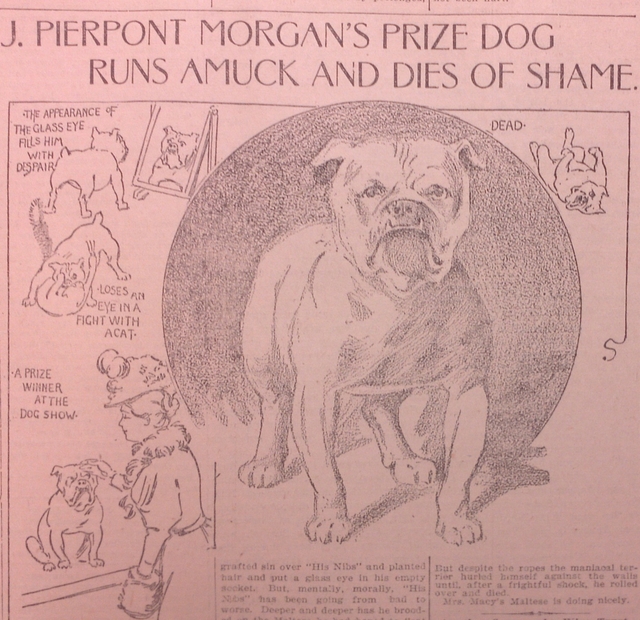
Dog suicides in 1898 were always male. The suicides were usually expressions of a fragile emotional state. Like [J.P Morgan’s prize bulldog “His Nibs”] their humiliation was provoked by a neglectful family, an unkind mob, or by abuse from boys, women, or cats. Sarah Knowles Bolton, in the 1902 book Our Devoted Friend, The Dog, devoted an entire chapter to dog suicides. For example: Rex, a prize-winning Gordon Setter, was worth $300 and drowned himself after he was kicked on the head by a private watchman. Most suicidal dogs were pure-bred, which presumably led to their emotional fragility: a $10,000 dog in Boston deliberately drowned himself, writes Bolton, after he was devastated by an insult from a thoughtless kennel-keeper.

It was the New York World who declared the end of “His Nibs” a “suicide”:

His Nibs offered the World a golden opportunity to combine animal violence and class conflict in one melodramatic package. For one, His Nibs—a mock aristocratic title given to a self-important person—was supposedly named by Morgan’s servants, who were responsible for looking after their boss’s pet. Add to this the fact that His Nibs was also a bulldog, a breed with a resolutely masculine name that manages, in its appearance, to channel both the confident aggression of male youth and the ineffectual droopiness of masculine old age. That such a dog, pampered by servants, should die at the hands of a woman’s thoroughbred cat and his own wounded vanity, was gravy—and an easy way to mock Morgan’s excesses too.

Caught In A Dragnet-22

In a 5-4 decision on Tuesday, the Supreme Court ruled in Clapper v. Amnesty International that citizens cannot sue the federal government over its secretive warrantless wiretapping program. Julian Sanchez summarizes the Court’s reasoning:

The FAA permits the government to secretly vacuum up Americans’ international communications on a massive scale, without any individualized suspicion—and at least some of that surveillance has already been determined to have violated the constitution by a secret intelligence court. Yet [the Alito-led] majority has all but guaranteed no court will be able to review the constitutionality of the law as a whole by imposing a perverse Catch-22: Even citizens at the highest risk of being wiretapped may not bring a challenge without proof they’re in the government’s vast database. The only problem is the government is never required to reveal who has been spied on.

Scott Lemieux adds:

This case is also an illustration of why the Court’s increasing barriers to granting standing undermine constitutional protections. Alito’s opinion argues that the Court’s standing doctrine “serves to prevent the judicial process from being used to usurp the powers of the political branches.” But as applied to this case the argument is nonsensical. If the Court believes that FISA violates the Fourth Amendment, it does not “usurp” the powers of the White House or Congress to so rule; the Court would be fulfilling its basic constitutional role by protecting individuals from arbitrary government action prohibited by the Fourth Amendment.

Marcy Wheeler further breaks down the ruling here. Greenwald fumes:

The supreme irony here is that when Obama supported this 2008 eavesdropping law, it sparked intense anger among his own supporters as he ran for president. To placate that anger, he vowed that, once in power, he would rein in the excesses of this law that he oh-so-reluctantly supported. He has done exactly the opposite. He just succeeded in pressuring the Congress, with heavy GOP support, to extend this eavesdroppiong law for five years without a single reform. And now his Justice Department has used the five right-wing justices to completely immunize the law from judicial review …

Cindy Cohn and Trevor Timm find a glimmer of hope:

[A]s disappointing as the Clapper decision is, the good news is the decision likely won’t adversely affect our Jewel v. NSA lawsuit, which we argued in district court in December of 2012. Indeed, the Clapper decision makes the Jewel case one of the last remaining hopes for a court ruling on the legality of the warrantless surveillance of Americans, now conducted for over a decade.

The Ninth Circuit has already ruled that the Jewel plaintiffs have standing under settled law. The court’s decision is based on solid ground because we have presented the court with evidence that dragnet warrantless surveillance has already occurred, through testimony and documents from AT&T and NSA whistleblowers. In fact, the court specifically differentiated the two cases in its Jewel opinion: “Jewel has much stronger allegations of concrete and particularized injury than did the plaintiffs in Amnesty International. Whereas they anticipated or projected future government conduct, Jewel’s complaint alleges past incidents of actual government interception of her electronic communications.”

What’s The Best Way To Free Mother Earth?

Lucy Weltner considers the legacy of the in-your-face environmentalist Edward Abbey:

Compared to the pragmatic environmentalism of many contemporary lobbying groups, Abbey’s vigilante movement doesn’t make much long term tactical sense. As opposed to presenting the government with viable, environmentally friendly alternatives to copper smelting and fracking, Abbey preaches the wholesale destruction of mining equipment. Instead of appealing to construction workers by providing safer, equally profitable jobs, Abbey’s vigilante idealists turn workers and governments against environmentalism by dynamiting bulldozers. While defending pristine wilderness against construction and degradation, Abbey (and many of his characters) accidentally set forest fires and leave chunks of burning metal strewn on the forest floor.

In fact, there is evidence to suggest that the sort of communing with nature Abbey promotes may be counterproductive to his goals.

An increasing number of studies show residents of less developed natural areas produce larger carbon footprints; the transportation of food and conveniences to off-the-grid areas exacerbates environmental devastation. Moreover, naturalists agree not only development, but also human traffic, threatens the health of pristine ecosystems. Many well-regarded ecological developers support a sustainable model of growth which confines humans to bustling urban centers, warning against too much human interference with wild lands. Perhaps we’d all be better off holed up in our solar powered homes, leaving the environment in peace.

The above photo is by Arty Guerillas, who offers this Abbey quote:

We need wilderness whether or not we ever set foot in it. We need a refuge even though we may never need to go there…. We need the possibility of escape as surely as we need hope.

The World’s Most Powerful Blogger?

Beppe Grillo Holds Final Rally Before Election In Rome

It might be the Italian comedian-turned-politician Beppe Grillo, whose anti-establishment 5-Star Movement, in an effort to permanently disrupt the Italian political system, collected nearly a quarter of all votes cast in the general election. The resulting hung parliament has sent shockwaves across Europe and rattled world markets. There was speculation that Grillo might ally with Pier Luigi Bersani’s center-left coalition to break Italy’s sudden gridlock, but as of today that seems unlikely:

Grillo, who holds the balance in parliament, slammed the door in Bersani’s face and poured insults on him and other centre-left leaders on his blog. He accused Bersani of making “indecent” proposals to his anti-establishment movement. The fiery comic and blogger called Bersani “a dead man talking,” and political stalker, saying he should have resigned after falling badly short in the election which pollsters had expected the centre-left to win.

Ian Steadman sizes up the online presence of Grillo, who writes Italy’s most-read blog:

Grillo’s blog has long hosted names of politicians convicted for charges of corruption, and in posts the satirical comedian has railed against the corruptions problems in Italian politics. In 2007, he corralled his supporters into a one-off “V-Day Celebratio” where the “V” stood for vaffanculo — “fuck off”. Other campaigns targeted certain bills or vested interests, with the culmination being the launch of the Five Star Movement (M5S) in 2009, a populist bloc whose unifying characteristic isn’t so much what it’s for as what it’s against — the status quo. Its members organise online, it has an extreme direct democracy slant, and [now M5S has become] the third-largest political bloc in the Italian parliament.

He goes on to detail the movement’s platform:

A 20-hour working week, free internet for everyone, free tablets for schoolchildren, a freeze on interest payments that could make the country default on its debt, tax cuts for working people, stricture rules to punish and prevent corruption, strong new environmental laws and increased corporate transparency. There’s even a proposal to replace PIL (Gross Domestic Product in Italian) with BIL (Gross Domestic Happiness). It’s avowedly populist…

Steadman also points out that “the fact that we may well see the world’s economy thrown out of a whack by a principled blogger taking a stand is definitely some kind of watershed moment in social media.” Regarding the makeup of the M5S’s supporters, Jamie Bartlett summarizes the results of a recent survey of nearly 2,000 of Grillo’s Facebook fans:

His supporters come from across the spectrum; they are neither clearly left nor right. They are all, however, angry about the state of democracy in Italy and Europe. Our survey showed only 2% trust parliament and only 11% trust the press. … His skill has been to channel Italians’ general frustrated apathy into a powerful political movement, spurning mainstream media to talk to them directly through Twitter and Facebook. Grillo has, by an enormous margin, the largest social media following of any politician in Europe: he has more than one million Facebook friends, and a similar number of Twitter followers – [center-left leader Pier Luigi] Bersani has about a quarter of that (as does David Cameron).

John Hooper compares Grillo’s rise to that of former PM Silvio Berlusconi:

Twice in the last two decades, outsiders have burst onto the [Italian] political scene. Both have done so by exploiting their understanding of the medium that was most relevant at the time. Berlusconi took Italy by storm in 1994 after creating a virtual monopoly of private television; Grillo has relied instead on making himself a master of digital communication.

(Photo:Beppe Grillo, leader of the Movimento 5 Stelle, Five Star Movement, speaks at Piazza San Giovanni during his last political rally before the national election on February 22, 2013 in Rome, Italy. By Laura Lezza/Getty Images)

Literary Doppelgängers

How does an author decide on a character’s name without stealing someone’s in real life? Having been contacted angrily by a person with the same name as a character in one of her books, Rebecca Makkai considers the conundrum:

This Peter’s surname was spelled exactly the same as my fictional Peter’s. In a story, I’d tone down the following for believability; but what follows is the verbatim email: “i thoought when you write a novel all people whom have that name should be notified before writing a novel for the people won;t sue you for infringe ments on said name. and also royalties there are three of us left with the name peter t______.”

So the poor guy had Googled himself, and, instead of links to his small business, up had popped some literary fiction about a gay actor in Chicago. (The story had been anthologized by this point, and unfortunately the Google algorithm had decided my imaginary Peter was a more relevant search result than the real guy.) I almost understood his logic: If I can’t open a restaurant and call it Burger King, why can I sell a story using this man’s name, a name that is also the name of his business?

Wondering if authors steal too much from real life, she is comforted by another writer’s experience:

He told me that seeking a Polish surname for a character in his novel Vestments, he’d borrowed his neighbor’s, Olchefske. After the book was published, he got an email from a woman across the city, asking where he’d gotten the name. It’s rare, it turns out, an unusual spelling. And it turned out that the woman and his neighbor were long-lost cousins. John put them in touch, and thus the two branches of the Olchefske family of St. Paul were reunited.

Okay, so we take and take and take. We mooch and we leach and betray. But only to give something back. If we’re very lucky, one reader out there will pick up a story and recognize herself. If not her soul, if not her secrets, maybe just her name. And maybe that will be enough to absolve us. If we don’t get sued first.

How Much Should A Joint Cost?

800px-Producer_of_marihuana

Christopher Matthews ponders the optimal marijuana tax:

The ultimate goal for opponents of marijuana prohibition is federal legalization. But any serious reform of federal marijuana policy will most certainly include a hefty federal excise tax as well in order to 1) help fund regulatory mechanisms; and 2) garner support from lawmakers who would not otherwise be disposed to reform. Oregon Representative Earl Blumenauer, for instance, has introduced marijuana reform legislation that would enact a 50% excise tax on production.

Proponents of legalization understand that healthy sales taxes are a great tool for furthering their cause. At a certain point, however, high taxes will encourage an illicit market. Where is the line? It’s difficult to know for sure, but if a 50% tax were enacted on the federal level, the marijuana industry in a state like Washington would face at least $1.92 in tax for every $1 of product sold. Whether this level of taxation is enough to encourage a black market is difficult to say.

He goes on to note that prices are also driven up by regulations. Along those lines, Jacob Sullum fears that Colorado will make marijuana sellers follow the 70/30 rule, which would require retailers to grow 70 percent of their product:

Amendment 64 declares that “marijuana should be regulated in a manner similar to alcohol,” which is hard to reconcile with a requirement that retailers produce 70 percent of what they sell. Jack Finlaw, co-chairman of the Amendment 64 task force, observed at Tuesday’s meeting that “if you read Amendment 64 in its entirety, this [recommedation] is going in a pretty dramatically different direction, and I think we need to be prepared to answer questions from the public about embracing a model that is the antithesis of how we regulate alcohol.” Supporters of the 70/30 rule draw an analogy to brew pubs or wineries that sell directly to consumers, but in neither of those cases is everyone who sells the product required to make it; you can still buy beer and wine from retailers who had nothing to do with producing it.

(Image: United States Special Tax Stamp — Producer of Marihuana — July, 1945. “It was probably related to the U.S. Hemp for Victory campaign, which allowed production of hemp for the U.S. WWII effort,” via Wikimedia)

No Moderates Allowed, Ctd

Krauthammer sees Christie’s exclusion from CPAC as a mistake:

[youtube http://youtu.be/cbWDQkwZucs ]

Frum is in the same ballpark:

If the Republican party contained a self-conscious modern Republican wing, with its own organizational presence equivalent to CPAC, then it would matter less that CPAC excluded the party’s most viable candidates. As is, however, CPAC remains the only such show in town – and Christie’s exclusion sounds an ominous warning about obstacles on the route back to a Republican majority.

Larison explains why Republican pundits talked up Christie in the first place:

As movement conservatives start to sour on Christie, it might be instructive to recall what it was about him that many of them liked from 2009 through last year. For the most part, it wasn’t the content of his agenda, in which most of his admirers had little interest. It was Christie’s willingness to be combative and confrontational that won their admiration. When this was all that most movement conservatives knew about him, Christie’s future in the party seemed very bright, and his name was frequently listed along with such movement conservative heroes as Rubio and Ryan.

Silver looks at why movement conservatives have fallen out of love with Christie:

Mr. Christie was in good graces of CPAC as recently as last June, when he was the headliner at a regional conference the group sponsored in Chicago. So what has changed? Is it Mr. Christie, or is it CPAC? In fact, I’m not sure that either has. Instead, what seems to have changed is the salience of different issues, as driven by major news events over the past year.

And Allahpundit wonders if Christie will move right after reelection:

[W]ith the possible exception of Rand Paul, he’ll be the most interesting Republican to watch for the next year or two. Does he tack back to the right after his reelection to try to atone with conservatives? Or does he actually inch a bit further to the center by partnering with Bloomy on guns, or “evolving” on gay marriage, or maybe pushing reform on marijuana laws to try to get the attention of younger Republicans? He’s got to pick a brand before other people pick it for him.