[Re-posted from earlier today]
Forgive me a moment to absorb this news. I was tipped off something was imminent, reading my email on a flight to Portland, Oregon. I’m speaking there tonight and attending a class there today – on marriage equality and conservatism respectively (if you’re a local Dishhead, the event is at 7.30 pm at the Smith Auditorium 900 State Street, Salem, Oregon. Tomorrow, I’m at the University of Idaho for a debate on the same topic hosted by Peter Hitchens. That’s at 7.30 pm at the University of Idaho’s Student Union Ballroom, in Moscow, Idaho).
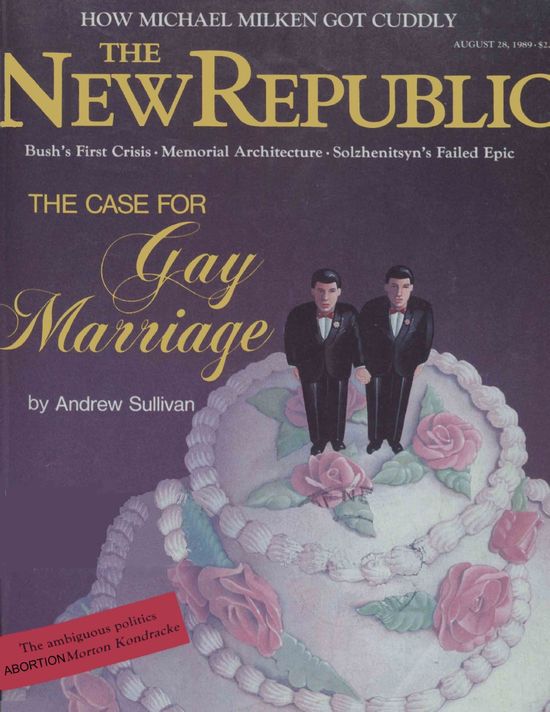
Over the years, after my 1989 conservative case for marriage equality, I must have given hundreds of these kinds of talks – in the late 1990s, it was basically all I  did. Today, I rarely show up on TV. Then I accepted any invite on marriage. And my goal was to persuade sometimes uncomfortable audiences (I’ll never forget the events at Notre Dame and Boston College on Catholicism and homosexuality) that there really was nothing radical about integrating a previously marginalized community into the options of family and commitment and mutual responsibility, and the social status those virtues rightly acquire.
In the early 1990s, I might as well have been speaking Swahili – and was assailed, attacked, picketed, demonized and smeared to the point of personal trauma by the gay left. By the early 2000s, I was demeaned, pitied, ignored, ostracized and mocked by the Republican right. They were both, in my view, misguided and panicked – because the truth is: marriage equality is both a liberal and a conservative project. It’s liberal because of its insistence on equality; it’s conservative because of its insistence on responsibility, and because the alternatives – domestic partnerships/civil unions – are actually damaging to a critical social institution, civil marriage, by providing a marriage-lite option for all.
This conservative case was buttressed by my fellow conservative writers – learned, decent, honest intellectuals like Jon Rauch and Bruce Bawer and Dale Carpenter and John Corvino and many others. We were no Democrats. Most of us loathed the Clintons for what they did to the gay community, our rights and dignity. But we became more and  more dismayed by our fellow conservatives, so many of whom did not simply remain on the fence but mounted a furious, passionate campaign against us. Bill Kristol’s response to this nascent movement was to bring legitimacy to the ex-gay movement; David Frum – back in the day – threatened to bring back enforcement of sodomy laws if we didn’t shut up. Republicans gleefully enshrined discrimination in many state constitutions – and bragged about it a little more loudly than Bill Clinton did the Defense of Marriage Act.
They decided, with Bill Clinton, on the most radical pushback to a fledgling movement imaginable: a Defense of Marriage Act that stripped our families of any rights under federal law, and, without Bill Clinton, a Federal Marriage Amendment that would single out gays as second-class citizens in the founding document of their own country for ever. And they used this hatred and fear of homosexuals quite openly as a way to win the 2004 election. It was crucial in Ohio that year. If Bush had lost it, Kerry would have been president. And Bush won it in large part by fear-mongering about gays.
For me, the FMA was the end of engagement and the beginning of war. You can read my reaction the day Bush endorsed it here. But I never stopped making the conservative case for marriage equality for the simple reason I believed in it. I never thought it would happen to me, but I knew it would have protected so many of my friends who didn’t have to just die agonizing deaths from AIDS but did so stigmatized and alone, their spouses treated often like dirt, their loves  publicly repudiated, their dignity grotesquely violated. This was, I believed, a matter of core humanity. It became for me the defining cause of my life.
A friend recalled visiting a man dying of AIDS at the time. A former massive bodybuilder, he had shrunk to 90 pounds. ‘Do I look big?” he asked, with mordant humor. In the next bed, surrounded by curtains, my friend heard someone singing a pop song quietly to himself. My friend joked: “Well not everyone here is depressed!” Then this from his dying, now skeletal friend: “Oh, that’s not him. He died this morning. That’s his partner. That was their song, apparently. The family took the body away, threw that guy out of the apartment he shared with his partner, and barred him from the funeral. He’s stayed there all day, singing their song. I guess it’s the last place he’ll ever see where his partner actually was. His face is pressed against the pillow. The nurses don’t have the heart to tell him to leave.”
You want to know why this became a life-long struggle? You have your answer. And I did this not despite being a Catholic, but because I am a Catholic. And I did this not despite being a conservative but because I am one.
This hideous cruelty in the midst of such shame demanded a Catholic and Christian response. This attack on people’s families, and their mutual responsibility (that man’s partner had cared for him for months, while his biological family kept their distance) was an attack on those institutions like civil marriage that are vital for a free society to keep its government in check. If that man’s husband hadn’t cared for him, the government would have had to. Why weren’t conservatives celebrating this man’s dedication rather than smearing him? Why could they not see in the gay community’s astonishing self-defense a Burkean model for social change from below – a dedication to saving our community independent of government that, if it happened in any other community, would have led the GOP to put those activists on the podium of the Republican Convention as exemplars of civil society at its best?
And that is what husband really means: to take care of someone. Why, I wondered, were conservatives actually doing all they could to prevent couples’ taking care of each other? Why would they barely tolerate it in a free society – but treat these responsible relationships as if they were threats to the very values they exemplified? Why would they want to discourage an emotional and domestic break against the huge force of testosterone that was and is bound to define a male-only community – and with a viral breakout helped wipe out 300,000 human beings in one generation? Why, for that matter, would they want to tear children from their lesbian mothers – or, even more sickeningly, recruit them to attack their own mothers, as NOM recently has?
It’s 24 years since I wrote that essay. But today, I see a phalanx of conservatives standing up for the equality of gay citizens. Here are some among the roster, which is now 75 and counting:
Meg Whitman, who supported Proposition 8 when she ran for California governor; Representatives Ileana Ros-Lehtinen of Florida and Richard Hanna of New York; Stephen J. Hadley, a Bush national security adviser; Carlos Gutierrez, a commerce secretary to Mr. Bush; James B. Comey, a top Bush Justice Department official; David A. Stockman, President Ronald Reagan’s first budget director; and Deborah Pryce, a former member of the House Republican leadership from Ohio who is retired from Congress.
Ken Mehlman, bete noir of the gay left for understandable reasons given his role in Rove’s gay-baiting 2004 campaign, was the key organizer. I’ve always believed that civil rights movements should be all about welcoming converts rather than hunting for enemies or heretics. And I think this is a huge achievement for Ken, morally, and politically. It is the right conservative thing to do. As the British Tory prime minister has put it:
I don’t support gay marriage in spite of being a conservative. I support gay marriage because I am a conservative.
Allahpundit is underwhelmed by the list. It does indeed lack, apart from Ros-Lehtinen and Hanna, current members of Congress. It lacks Dick Cheney, for example, a figure who holds this position but, as usual, does nothing about it – even when it directly affects his own family. It lacks Laura Bush – although she could still add her name. But, to her credit, Mary Cheney is there. So is my friend David Frum. The two strategists for the 2008 campaign, Steve Schmidt and Nicole Wallace are on it. Stephen Hadley and Israel Hernandez – two people very close to 43 – are there. Ken Duberstein, Alex Castellanos, Mike Murphy and Greg Mankiw are also on the list. These are not GOP lightweights. They are up there with Ted Olson.
The reason, to my mind, is quite simple. The Republican Party of Reagan who defended gay rights in the 1970s, of Bush 41 and even parts of Bush 43 is now emphatically and increasingly a party of the fanatical Christianist right, based in the South, and dedicated not to conservative politics but to dogma, theological and political. Some elements in the party may simply be wary of major change in a social institution – which is a perfectly legitimate worry. But as the statement notes:
Many of the signatories to this brief previously did not support civil marriage for same-sex couples; others did not hold a considered position on the issue. However, in the years since Massachusetts and other states have made civil marriage a reality for same-sex couples, amici, like many Americans, have observed the impact, assessed their core values and beliefs, and concluded that there is no legitimate, fact-based reason for denying same-sex couples the same recognition in law that is available to opposite-sex couples who wish to marry. Rather, we have concluded that the institution of marriage, its benefits and importance to society, and the support and stability it gives to children and families are promoted, not undercut, by providing access to civil marriage for same-sex couples.
So we now also have empirical data to reassure legitimate conservative concerns about damage to a vital institution. The first state with marriage equality continues to have the lowest divorce rate: 2.2 percent, compared with 2.5 percent before gays were allowed to marry. Compare that with the most anti-gay states: Alabama’s 4.4 percent – double Massachusetts – or anti-gay Virginia’s divorce rate of 3.7 percent, compared with marriage equality DC with 2.6 percent. More broadly, the divorce rate has come down in almost every state in the last decade – the very decade gays were allegedly going to destroy the Constitution. Stanley Kurtz was simply wrong. Gay marriage has entered our consciousness and reality as divorce rates have fallen. The linkage that Maggie Gallagher keeps talking about as a premise is a fantasy. If you can properly draw any conclusions from the data, the linkage works in the opposite way. Gay marriage has strengthened straight marriage – not the other way round.
Only prejudice and fundamentalist dogma now stand in the way. Whatever happens in the Supreme Court, exposing that matters. Showing that there is a debate among conservatives, as well as among people of faith, is a vital step forward.
I sometimes end optimistic posts with the Israeli saying, “Know hope.” But this is actually something a little different. It is knowing hope. And seeing it rise, finally and fitfully, above fear.
The full summary of the Amicus brief is below:
Amici are social and political conservatives, moderates, and libertarians from diverse religious, racial, regional, and philosophical backgrounds; many have served as elected or appointed federal and state office-holders. Many of the signatories to this brief previously did not support civil marriage for same-sex couples; others did not hold a considered position on the issue. However, in the years since Massachusetts and other states have made civil marriage a reality for same-sex couples, amici, like many Americans, have observed the impact, assessed their core values and beliefs, and concluded that there is no legitimate, fact-based reason for denying same-sex couples the same recognition in law that is available to opposite-sex couples who wish to marry. Rather, we have concluded that the institution of marriage, its benefits and importance to society, and the support and stability it gives to children and families are promoted, not undercut, by providing access to civil marriage for same-sex couples.
Amici do not denigrate the deeply held emotional, cultural, and religious beliefs that lead sincere people to take the opposite view (and, indeed, some amici themselves once held the opposite view). Whether same-sex couples should have access to civil marriage divides thoughtful, concerned citizens. Those who support and those who oppose civil marriage for same-sex couples hold abiding convictions about their respective positions. But a belief, no matter how strongly or sincerely held, cannot justify a legal distinction that is unsupported by a factual basis, especially where something as important as civil marriage is concerned. Amici take this position with the understanding that providing access to civil marriage for same-sex couples—which is the only issue raised in this case—poses no credible threat to religious freedom or to the institution of religious marriage. Given the robust constitutional protections for the free exercise of religion, amici do not believe that religious institutions should or will be compelled against their will to participate in a marriage between people of the same sex.
I. There Is No Legitimate, Fact-Based Justification For Different Legal Treatment Of Committed Relationships Between Same-Sex Couples
Laws that make distinctions between classes of people must have “reasonable support in fact.” New York State Club Ass’n, Inc. v. City of New York, 487 U.S. 1, 17 (1988). Amici do not believe that laws like Proposition 8 have a legitimate, fact-based justification for excluding same-sex couples from civil marriage. Over the past two decades, amici have seen each argument against same-sex marriage discredited by social science, rejected by courts, and undermined by their own experiences with committed same-sex couples, including those whose civil marriages have been given legal recognition in various States. Instead, the facts and evidence show that permitting civil marriage for same-sex couples will enhance the institution, protect children, and benefit society generally.
A. Marriage Promotes The Conservative Values Of Stability, Mutual Support, And Mutual Obligation
Amici start from the premise—recognized by this Court on at least fourteen occasions— that marriage is both a fundamental right protected by our Constitution and a venerable institution that confers countless benefits, both to those who marry and to society at large. … It is precisely because marriage is so important in producing and protecting strong and stable family structures that amici do not agree that the government can rationally promote the goal of strengthening families by denying civil marriage to same-sex couples.
B. Social Science Does Not Support Any Of The Putative Rationales For Proposition 8
Deinstitutionalization. No credible evidence supports the deinstitutionalization theory. … Petitioners fail to explain how extending civil marriage to same-sex couples will dilute or undermine the benefits of that institution for opposite-sex couples … or for society at large. It will instead do the opposite. Extending civil marriage to same-sex couples is a clear endorsement of the multiple benefits of marriage—stability, lifetime commitment, financial support during crisis and old age, etc.—and a reaffirmation of the social value of this institution.
Biology. There is also no biological justification for denying civil marriage to same-sex couples. Allowing same-sex couples to marry in no way undermines the importance of marriage for opposite-sex couples who enter into marriage to provide a stable family structure for their children.
Child Welfare. If there were persuasive evidence that same-sex marriage was detrimental to children, amici would give that evidence great weight. But there is not. Social scientists have resoundingly rejected the claim that children fare better when raised by opposite-sex parents than they would with same-sex parents.
C. While Laws Like Proposition 8 Are Consonant With Sincerely-Held Beliefs, That Does Not Sustain Their Constitutionality
Although amici firmly believe that society should proceed cautiously before adopting significant changes to beneficial institutions, we do not believe that society must remain indifferent to facts. This Court has not hesitated to reconsider a law’s outmoded justifications and, where appropriate, to deem them insufficient to survive an equal protection challenge. The bases on which the proponents of laws like Proposition 8 rely are the products of similar thinking that can no longer pass muster when the evidence as it now stands is viewed rationally, not through the lens of belief though sincerely held.
I. This Court Should Protect The Fundamental Right Of Civil Marriage By Ensuring That It Is Available To Same-Sex Couples
Choosing to marry is also a paradigmatic exercise of human liberty. Marriage is thus central to government’s goal of promoting the liberty of individuals and a free society. For those who choose to marry, legal recognition of that marriage serves as a bulwark against unwarranted government intervention into deeply personal concerns such as the way in which children will be raised and in medical decisions.
Amici recognize that a signal and admirable characteristic of our judiciary is the exercise of restraint. Nonetheless, this Court’s “deference in matters of policy cannot … become abdication of matters of law.” The right to marry indisputably falls within the narrow band of specially protected liberties that this Court ensures are protected from unwarranted curtailment.
Proposition 8 ran afoul of our constitutional order by submitting to popular referendum a fundamental right that there is no legitimate, fact-based reason to deny to same-sex couples. This case accordingly presents one of the rare but inescapable instances in which this Court must intervene to redress overreaching by the electorate.
Here are all the signatories so far:
—Ken Mehlman, Chairman, Republican National Committee, 2005-2007
—Tim Adams, Undersecretary of the Treasury for International Affairs, 2005-2007
—David D. Aufhauser, General Counsel, Department of Treasury, 2001-2003
—Cliff S. Asness, Businessman, Philanthropist, and Author
—John B. Bellinger III, Legal Adviser to the Department of State, 2005-2009
—Katie Biber, General Counsel, Romney for President, 2007-2008 and 2011-2012
—Mary Bono Mack, Member of Congress, 1998-2013
—William A. Burck, Deputy Staff Secretary, Special Counsel and Deputy Counsel to the
President, 2005-2009
—Alex Castellanos, Republican Media Advisor
—Paul Cellucci, Governor of Massachusetts, 1997-2001, and Ambassador to Canada,
2001-2005
—Mary Cheney, Director of Vice Presidential Operations, Bush-Cheney 2004
—Jim Cicconi, Assistant to the President & Deputy to the Chief of Staff, 1989-1990
—James B. Comey, United States Deputy Attorney General, 2003-2005
—R. Clarke Cooper, U.S. Alternative Representative, United Nations Security Council,
2007-2009
—Julie Cram, Deputy Assistant to the President and Director White House Office of
Public Liaison, 2007-2009
—Michele Davis, Assistant Secretary for Public Affairs and Director of Policy Planning,
Department of the Treasury, 2006-2009
—Kenneth M. Duberstein, White House Chief of Staff and Assistant to the President,
1981-1984 and 1987-1989
—Lew Eisenberg, Finance Chairman, Republican National Committee, 2002-2004
—Elizabeth Noyer Feld, Public Affairs Specialist, White House Office of Management and
Budget, 1984-1987
—David Frum, Special Assistant to the President, 2001-2002
—Richard Galen, Communications Director, Speaker’s Political Office, 1996-1997
—Mark Gerson, Chairman, Gerson Lehrman Group and Author of The Neoconservative
Vision: From the Cold War to the Culture Wars and In the Classroom: Dispatches from
an Inner-City School that Works
—Benjamin Ginsberg, General Counsel, Bush-Cheney 2000 & 2004
—Adrian Gray, Director of Strategy, Republican National Committee, 2005-2007
—Richard Grenell, Spokesman, U.S. Ambassadors to the United Nations, 2001-2008
—Patrick Guerriero, Mayor, Melrose Massachusetts and member of Massachusetts
House of Representatives, 1993-2001
—Carlos Gutierrez, Secretary of Commerce, 2005-2009
—Stephen Hadley, Assistant to the President and National Security Advisor, 2005-2009
—Richard Hanna, Member of Congress, 2011-Present
—Israel Hernandez, Assistant Secretary of Commerce for International Trade, 2005-2009
—Margaret Hoover, Advisor to the Deputy Secretary of Homeland Security, 2005-2006
—Michael Huffington, Member of Congress, 1993-1995
—Jon Huntsman, Governor of Utah, 2005-2009
—David A. Javdan, General Counsel, United States Small Business Administration, 2002-
2006
—Reuben Jeffery, Undersecretary of State for Economic, Energy, and Agricultural
Affairs, 2007-2009
—Greg Jenkins, Deputy Assistant to the President and Director of Presidential Advance,
2003-2004
—Coddy Johnson, National Field Director, Bush-Cheney 2004
—Gary Johnson, Governor of New Mexico, 1995-2003
—Robert Kabel, Special Assistant to the President for Legislative Affairs, 1982-1985
—Theodore W. Kassinger, Deputy Secretary of Commerce, 2004-2005
—Jonathan Kislak, Deputy Undersecretary of Agriculture for Small Community and Rural
Development, 1989-1991
—David Kochel, Senior Advisor to Mitt Romney’s Iowa Campaign, 2007-2008 and 2011-
2012
—James Kolbe, Member of Congress, 1985-2007
—Jeffrey Kupfer, Acting Deputy Secretary of Energy, 2008-2009
—Kathryn Lehman, Chief of Staff, House Republican Conference, 2003-2005
—Daniel Loeb, Businessman and Philanthropist
—Alex Lundry, Director of Data Science, Romney for President, 2012
—Greg Mankiw, Chairman, Council of Economic Advisers, 2003-2005
—Catherine Martin, Deputy Assistant to the President and Deputy Communications
Director for Policy & Planning, 2005-2007
—Kevin Martin, Chairman, Federal Communications Commission, 2005-2009
—David McCormick, Undersecretary of the Treasury for International Affairs, 2007-2009
—Mark McKinnon, Republican Media Advisor
—Bruce P. Mehlman, Assistant Secretary of Commerce, 2001-2003
—Connie Morella, Member of Congress, 1987-2003 and U.S. Ambassador to the
Organization for Economic Co-operation and Development, 2003-2007
—Michael E. Murphy, Republican Political Consultant
—Michael Napolitano, White House Office of Political Affairs, 2001-2003
—Ana Navarro, National Hispanic Co-Chair for Senator John McCain’s Presidential
Campaign, 2008
—Noam Neusner, Special Assistant to the President for Economic Speechwriting, 2002-
2005
—Nancy Pfotenhauer, Economist, Presidential Transition Team, 1988 and President’s
Council on Competitiveness, 1990
—J. Stanley Pottinger, Assistant U.S. Attorney General (Civil Rights Division), 1973-1977
—Michael Powell, Chairman, Federal Communications Commission, 2001-2005
—Deborah Pryce, Member of Congress, 1993-2009
—John Reagan, New Hampshire State Senator, 2012-Present
—Kelley Robertson, Chief of Staff, Republican National Committee, 2005-2007
—Ileana Ros-Lehtinen, Member of Congress, 1989-Present
—Harvey S. Rosen, Member and Chairman, Council of Economic Advisers, 2003-2005
—Lee Rudofsky, Deputy General Counsel, Romney for President, 2012
—Patrick Ruffini, eCampaign Director, Republican National Committee, 2005-2007
—Steve Schmidt, Deputy Assistant to the President and Counselor to the Vice President,
2004-2006
—Ken Spain, Communications Director, National Republican Congressional Committee,
2009-2010
—Robert Steel, Undersecretary of the Treasury for Domestic Finance, 2006-2008
—David Stockman, Director, Office of Management and Budget, 1981-1985
—Jane Swift, Governor of Massachusetts, 2001-2003
—Michael E. Toner, Chairman and Commissioner, Federal Election Commission, 2002-
2007
—Michael Turk, eCampaign Director for Bush-Cheney 2004
—Mark Wallace, U.S. Ambassador to the United Nations, Representative for UN
Management and Reform, 2006-2008
—Nicolle Wallace, Assistant to the President and White House Communications
Director, 2005-2008
—William F. Weld, Governor of Massachusetts, 1991-1997, and Assistant U.S. Attorney
General (Criminal Division), 1986-1988
—Christine Todd Whitman, Governor of New Jersey, 1994-2001, and Administrator of
the EPA, 2001-2003
—Meg Whitman, Republican Nominee for Governor of California, 2010
—Robert Wickers, Republican Political Consultant
—Dan Zwonitzer, Wyoming State Representative, 2005-present




 The Dish