The Buzzfeed Model – From The Horse’s Mouth

This embed is invalid


Here’s some real clarity on the concept of “sponsored content” or “native advertizing”. It’s from Buzzfeed’s own presentation last week at a media conference by Jeff Greenspan and Mike Lacher.  A key section is around the 3:40 moment where they explain how they take an advertizing campaign like the Mini’s – “Not Normal” – and then, instead of running a banner ad on those lines, they create a Buzzfeed page on “10 Not Normal Things That Actually Exist.” Here’s how the presenter(s) explains this:

This is an example of our editorial content … so then the thing we work on is sort of how to make branded content sort of like fit alongside this editorial content … there are no banner ads at Buzzfeed at all. We all have content that feels like editorial. We do not trick anyone into thinking this is an ad … If you go to the post, there are two places where the client’s name is listed in the by-line and in the text …

Later in the clip, we get even more honesty:

I’m sure there are brands who would love a headline to be 23 great things you can find at Ikea – not … I know lots of brands that would love their names in a headline but then that screams of an ad. So we have to explain to them that in order to get the results they want is to act like editorial content, act like you’re in the space that you’re in.

Here’s the dialogue between me, the Atlantic’s Derek Thompson and Ben Smith last week:

BEN: I could live with a new word because I think advertorial — to me what that means is like something they paid – usually a quite low quality piece of propaganda that people are tricked into reading because it looks exactly like editorial content – but I actually think though that that’s – like our trick, and the trick that the business side here is attempting to pull of is to produce great content for people … who know our ads and like [them].

ANDREW: So the content is ads – that’s what you’re saying?

BEN: I look at it as great…

ANDREW: So what distinguishes that content from your content?

BEN: Only the label, only the, only the clarity of the label

DEREK: The label makes it..

ANDREW: But you don’t have “advertisement” at the top of it

DEREK: But if they did?

ANDREW: It would help

Will they do that? It would tell us a lot.

Life And Death In The Ring

COLOMBIA-BULLFIGHTING-RAMSES

Eric Nusbaum recently attended his first bullfight in Mexico City:

I was prepared for violent death when I arrived at Plaza México, and violent death was what I got. The first bull was small and puppy-like; he hardly seemed vicious. After a series of hypnotic dodges and maneuvers that were so elegant as to not even look dangerous, El Juli failed on the initial thrust of his sword. The steel blade clanked down to the dirt. Only on the third thrust was the sword (called anestocada) successfully inserted. The matador rolled his eyes, thinking finally, and went to retrieve his hat from where he had ceremoniously placed it in the center of the ring. The bull seemed suddenly aware that not only was he doomed, but that he had been duped, publicly humiliated. He bucked briefly and desperately, then he fell for a final time. The trumpets played a funereal dirge. I have never been to war, but bullfighting as an approximation for it only makes sense to me in that both activities are draped in flags and often based on antiquated ideas.

Nusbaum wonders if, in some ways, the bull has lived a “charmed life”:

He had been bred for strength, raised for four years on a large ranch, pampered and prepared. He would die a miserable public death, and afterward he would be butchered for meat. Is this worse than the life of typical beef cow, who after six months alongside his mother is sent to a crowded feedlot to be fattened up with grain and injected with antibiotics for another six months before meeting his own inglorious death by captive bolt pistol? Obviously this is a false choice. More ethical options exist. But the hypothetical is worth considering. Which life and death would you prefer?

(Photo: Colombian bullfighter Ramses tries to kill a bull during a bullfight at La Macarena bullring on January 19, 2013 in Medellin, Antioquia deparment, Colombia. By Raul Arbodela/AFP/Getty Images.)

The GOP vs The Pentagon?

First some overdue business. On the authorship and meaning of the sequester, I think Ezra Klein basically cleaned Bob Woodward’s clock last week. Yes, the sequester appears to have been first suggested by Jack Lew, as a throwback to the 1980s, as a desperate last minute way to avoid a credit downgrade. But it was heartily endorsed 481px-Dwight_D._Eisenhower,_official_photo_portrait,_May_29,_1959by the GOP at the time as a way out of a horrible impasse and as a down-payment on triggered, automatic spending cuts. The pressure on the GOP was entirely because of possible defense cuts; the pressure on the Dems was because of automatic entitlement cuts. The goal was to make both sides so queasy they’d come up with a Grand Bargain of tax hikes, tax reform and entitlement cuts that would clear the air, end uncertainty and help us move on.

The committee failed; the elections loomed. Ezra’s right, I think, to see the elections as an endorsement of a mixed approach: raise revenues, reform taxes, and cut entitlements. Now some revenues have been raised – but only because without some modest concessions from the GOP, even more revenues would have been raised, tipping the economy into recession. But the implemented tax hikes, as the GOP has consistently and rightly argued, are nowhere near enough to tackle the debt. So we still do need real spending cuts in the medium and long run, especially in Medicare, and we do need defense cuts, to reduce a military-industrial complex now costing twice as much as it did a decade ago; and we desperately need tax reform and simplification. In that last option – tax reform and simplification – lies the least damaging way to raise essential revenues.

The GOP’s recent position, in contrast, was that all the cuts should come from the needy and entitlements, that none of them should come from defense, and that no increase in revenues is permissible at all – and that the sequester is horrible and all Obama’s fault. Perhaps sensing the total incoherence and unpopularity of this position, their response may be changing somewhat – and in a good way. More and more Republicans are prepared to see the military cut rather than raise taxes. That’s a BFD, if it pans out, a real shift in the balance of ideology within the Republican coalition. There’s a reason Bill Kristol is worried. This Kristol post is such an amazing bath in hathos I found myself reading it twice, letting the panicked, ponderous, pseudo-Churchillian prose roll joyfully around in the frontal cortex. It even has a shout out to Leo Strauss. Sit back and enjoy:

The plain is darkling. The world grows more dangerous. Yet we heedlessly slash our military preparedness. Iran hastens toward a nuclear weapon, which would pose an existential threat to Israel and signal a nuclear arms race in the Middle East. Yet the president nominates for secretary of defense a man who is patently unqualified for the position, who despises Israel, and who has a record of being exceedingly solicitous of Iran. We win in Iraq and make progress in Afghanistan, thanks to the valor and sacrifice of our troops, and the president puts these accomplishments at great risk because he chooses to pander to public war weariness rather than attend to America’s national interests.

There is more complete delusion, absurd hysteria and outright deception in that hysterical passage than in Sarah Palin’s autobiography. (We won in Iraq! Won! No WMDs found, no sectarianism overcome, tens of thousands of bodies, the collapse of America’s moral standing, and a strengthened Iran … and we won! One wonders what losing would have looked like.)

But back to the sequester. The president’s position, as I understand it, is here (hat tip: Chait).

The core fact to me, and, I suspect, many others who remain very concerned about financing the long-term debt indefinitely, is that the president has already cut $1.4 trillion in spending, while getting $600 billion in new revenues: more than 2:1, or roughly the balance of the British Tories. Going forward, if I understand this correctly, the president proposes $930 billion in new spending cuts, of which only $100 billion could come from defense. He’s also committed to cutting Medicare over the next ten years by the same amount proposed by Bowles-Simpson. If I were a Republican (and, of course, my brand of conservatism would make that currently quixotic), I’d jump at that deal.

Instead, the GOP is insisting on absolutely no new revenues, and recently insisted that all the cuts come from entitlements. I just don’t see how they win this argument, especially if they protect the Pentagon. And that may be why many of them are resigned to the sequester taking effect – and taking credit for it, including the big defense cuts. I have to say I’m fine with that. The spending reductions are not enough to fully sink the economy this year, although they will almost certainly drag us all down. I’d prefer a Grand Bargain, or a sane set of cuts (rather than the crude ones we now have), but if this is the only way we will ever be able to cut defense spending, I can live with it – especially if defense cuts implicitly get a GOP blessing. That’s a huge step forward toward some fiscal sanity on the right.

The trouble is: whichever of these positions the GOP takes will hurt them.  The president’s proposals for debt reduction are simply much more reasonable and pragmatic and doable than the GOP’s – and he has far higher favorable ratings than the Congressional Republicans. Obama’s approach is also much more popular. He just won re-election on those priorities – against a ticket that included Paul Ryan, whose cuts-only approach was front and center. A cuts-only, protect-the-wealthy approach would be hard enough even if Ryan and Romney and the Republicans had won the last election. A cuts-only, including-the-Pentagon, approach won’t be much more popular, but it also presents the possibility of a serious split in the GOP between fiscal conservatives and the spendthrift neocons.

Yeah, it’s a meep-meep. But a depressing one. The only positive aspect is that finally, the Pentagon might be reined in a little, because the GOP wouldn’t stop it. About fucking time.

(Photo: The official photograph of President Dwight Eisenhower, the best Republican president of the 20th Century, war hero and champion of keeping the Pentagon’s spending and political power under control.)

Guess Which Buzzfeed Piece Is An Ad, Ctd

A reader writes:

I think your strong aversion to the sponsored content model is due to two factors: 1) your profession 2) your generation. To someone like me (I’m 27), there isn’t much of a difference between ads and content. photoIn both categories, some are worth consuming and some aren’t. I’m just as likely to go to youtube to seek out a commercial I like as I am to search for a music video. I read that PS4 post without realizing it was an ad but when I found it was (through the Dish) I wasn’t offended and I didn’t feel duped.

Part of the reason is that I don’t see Buzzfeed as a site that operates within the confines of traditional “journalism” and I don’t think they’ve ever tried to position themselves that way. I think Ben Smith’s Buzzfeed Politics sort of exists as a separate piece of Buzzfeed and should have stricter rules for sponsored content, because while the format is slightly different, that part of the site is clearly committed to real, traditional journalism.  The main Buzzfeed site is not, and that’s where the PS4 post came out.

Most of the content is those silly scroll down photo-essays, which are a great way to waste 3 minutes. I don’t expect those posts to follow the traditional rules of journalism, because they’re not traditional journalism.

Making money on the web means we’re seeing new models evolve. The Dish is one model, the Atlantic is another and Buzzfeed is too. Buzzfeed is just really good at making content for the ADD types like me who sometimes just want to read something entertaining for 3 minutes.

Another writes:

Ten years ago, I would have been incensed that Buzzfeed would have approached the advertisement /content line the way they have, but at that time, consumers were still expecting to pay for content. Now, I’m much more open to alternative forms of revenue generation because we, the consumer, have broken the pact.

Culturally Out Of Tune

Alex Pappademas deems the Oscar category of Best Song “a travesty-generating machine“:

 Here’s the problem: Everyone in the Academy gets to vote for Best Song, but only composers and songwriters get to make nominations, so the Best Song category continues to honor traditionally composed-and-written show-tune-style pop-vocal songs throughout the ’60s and ’70s, effectively looking the other way as genres like rock, soul, funk, and disco (i.e., music by artists who aren’t in the Academy) transform the sound of American film. The 1964 Best Song Oscar goes to “Chim Chim Cher-ee” from Mary Poppins; the Beatles’ title song from A Hard Day’s Night isn’t nominated. The 1967 award goes to “Talk to the Animals” from Doctor Dolittle; Simon and Garfunkel’s “Mrs. Robinson,” written for The Graduate, isn’t nominated. The 1969 award goes to “Raindrops Keep Fallin’ on My Head”; the Byrds’ “Ballad of Easy Rider” isn’t nominated.

His proposed fix:

Instead of — or, OK, fine, in addition to — a category honoring written-to-order movie songs, we need an Oscar for Best Soundtrack, one that would recognize the use of music in films regardless of that music’s provenance. We give awards to adapted screenplays; why can’t we honor the curatorial ambition and taste behind music-saturated movies like Django and Silver Linings Playbook or even Pitch Perfect, movies in which previously released songs are arguably as crucial to the storytelling as a traditional score would be?

Life Without Redemption

In an incisive review of John Gray’s latest book, The Silence of Animals, Richard Holloway explains the essence of the political theorist’s approach to human nature:

Gray believes that humanity’s obsessive search for a cure for its own ills is its most dangerous disease. Here, he both commends and condemns the religious approach to the problem. He commends it because, unlike the optimistic humanism of the new atheists, it understands the incurable sickness of the human soul and has been rich in stories that express it. Where he departs from religion is in its myth of supernatural rescue and salvation. Realistic in its assessment of the human condition as fallen and self-obsessed, Christianity pulls a metaphysical rabbit out of the hat by promising that, while we are unable to save ourselves, there is one who will rescue us from the bondage of our own nature and deliver us into a state of eternal bliss.

The “new note” that appears in this most recent work:

To his prophetic contempt for those who destroy others in the name of their theories has been added a lyrical new theme he calls “godless mysticism”, through which he calls us to an attitude of contemplative gratitude for the only life we will ever have. He writes: “Godless mysticism cannot escape the finality of tragedy, or make beauty eternal. It does not dissolve inner conflict into the false quietude of oceanic calm. All it offers is mere being. There is no redemption from being human. But no redemption is needed.”

Relatedly, in an interview about his new book, JP O’Malley asks Gray, “Why do you dispute the notion that knowledge is a pacifying force?” Gray’s answer:

Well there is this notion in some intellectual circles that evil is a kind of error: that if you get more knowledge you won’t commit the error. People often say: if we get more knowledge for human psychology won’t that help? No. All knowledge is ambiguous in this way. The Nazis were very good at using their knowledge at mass psychology. Or if you were a Russian revolutionary like Lenin, you might use the knowledge of the causes of inflation to take control of the central bank, create hyper-inflation and bring about your revolutionary project. So knowledge can never eradicate the conflicts of the human world, or produce harmony where there are conflicting goals to start with. Because knowledge is used by human beings as a tool to achieve whatever it is they want to achieve.

The Atlantic’s New “Sponsor Content” Guidelines

Jim Fallows helpfully unpacks the two quotes I put up yesterday and argues the full chronology of them does not imply some big internal disagreement at the magazine. I’m delighted to say that the Atlantic has devised a new post-Scientology policy with regard to “native advertizing”, “sponsor content,” “enhanced communication techniques”,  or whatever newspeak is used in creating confusing advertorials, designed to look like Atlantic articles, as a way to bring in more corporate income. Here it is, in full. Below is the critical section dealing with “Sponsor Content” or, as I think I’ll call them “enhanced advertorial techniques”:

SPONSOR CONTENT GUIDELINES

The guidelines in the following section shall apply to all Sponsor Content served by or appearing in the print and digital publications of The Atlantic, including ads purchased under AAAA/IAB Standard Terms and Conditions. (These are in addition to the general guidelines for advertising content that appear above, which apply to Sponsor Content as well.)

Sponsor Content is content created by or expressly on behalf of advertisers in conjunction with The Atlantic’s marketing team (“Atlantic Marketing”). The Atlantic allows Sponsor Content in two forms: (1) Content produced by Atlantic Marketing on behalf of its advertising partners and (2) Content produced by advertisers.

As with all advertising, Sponsor Content ultimately reflects the views and choices of the advertiser—not of The Atlantic or its editors. Accordingly, The Atlantic will prominently display the following disclaimer on all Sponsor Content: ‘SPONSOR CONTENT.’ The Atlantic will additionally include the following disclaimer on all Sponsor Content: ‘This article is written by or on behalf of our Sponsor and not by The Atlantic’s editorial staff.’ The Atlantic may additionally include, in certain areas and platforms, further explanation defining Sponsor Content to Atlantic readers. In addition, The Atlantic will ensure the treatment and design of Advertising and Sponsor Content is clearly differentiated from its editorial content.

The Atlantic does not require that Sponsor Content steer clear of controversy. Indeed, we expect that Sponsor Content, like our own editorial content, will sometimes address contested issues and will be written with a distinct point of view. That said, even with the caveat that Sponsor Content reflects the views of an advertiser and not of The Atlantic or its editors, The Atlantic will refuse publication of such content that, in its own judgment, would undermine the intellectual integrity, authority, and character of our enterprise.

As with all advertising, and consistent with the foregoing General Advertising Guidelines, The Atlantic may reject or remove any Sponsor Content at any time that contains false, deceptive, potentially misleading, or illegal content; is inconsistent with or may tend to bring disparagement, harm to reputation, or other damage to The Atlantic’s brand.

The Atlantic may in its sole discretion enable readers to comment on Sponsor Content on The Atlantic’s sites. If comment functionality is enabled on Sponsor Content, the sponsor will not have any role in moderating such comments. The only moderation of such comments will be performed by Atlantic employees who implement The Atlantic’s generally applicable Terms and Conditions — which prohibit spam, obscenity, hate speech, and similar content—elsewhere on the site.

I’m going to put this document out there before commenting. I have some issues with it – but it does seem at least to recognize a real problem, whereas Buzzfeed thinks that the corrupting bugs here are exciting new features. That may be because Buzzfeed understands itself more as an entertainment site – and its journalism and reporting are relatively new. But so far as I can tell, the dubious ethics of this exercize haven’t even seemed to cross their minds. “Andrew,” as one of my Buzzfeed hosts told me, “you have a lot to learn from us.” Obviously, I do. Consider me on a learning curve. And what I learn I intend to pass on to Dish readers, so you can also get a better idea of how to distinguish journalism from corporate propaganda online.

Realizing You’ll Never Be A Novelist

Juliet Escoria describes the feeling:

I was in a heightened state of being, where I was entirely losing my shit (and by ‘shit,’ I mean ‘mind’). During this, I looked back at my novel-in-progress. I had written exactly ninety-nine pages, and this had taken me exactly six months. I looked at these pages, and realized that my book would be mediocre at best. I simply could not plant myself into my life at seventeen in a way that would enable my book to be great. I could not do this because of something I explained in my previous column, which is, to put it briefly, that my memory is shit. And while my imagination is a good one, it is only good enough to create a world that is  semi-compelling. I can no longer allow myself to create something  that is merely semi-compelling. I cannot allow myself to spend hours and years on a book that is mediocre.

Instead, she turned to writing a memoir – and began facing her fears, including mental illness:

If you want to be true to yourself, you have to be vulnerable. I’m sure you’ve all heard that you should only write about the things that scare you. If I want to be true to myself, I have to talk about exactly what it is like to be crazy, because doing this scares me more than anything else in this world. And I have to attach my own name and experiences to it, because doing so will make me that much more vulnerable. I have to open my ribcage and bleed out my heart.

I wanted to be a novelist, I really did. I wanted to do it to prove to myself that I was a hard worker, that I was a Real Writer. Some inner lit snob inside of me whispered and told me that fiction was where it’s at, in terms of ‘real art.’ That voice told me that memoir-writing is lesser than, not good enough, a genre for celebrities and former journalists. I don’t even know if what I’m working on now could be considered a memoir, but what I do know is this: That lit snob voice? She stems from the same little dark spot in my heart as my two illnesses. And that chick needs to be bled out. She needs to shut the fuck up.

Oliver Stone’s America

This embed is invalid


Sean Wilentz tears into Oliver Stone and Peter Kuznick’s The Untold History of the United States, especially its hagiographic treatment of JFK and Communist-sympathizer Henry Wallace:

With a few twists, above all its defense of the liberal anti-Communist (and Stone’s longtime personal hero) John F. Kennedy, The Untold History of the United States, both the book and the televised series, is a quirky summa of the old Progressive rhetoric, as proclaimed by Stone and Kuznick’s other hero, Henry Wallace, but presented as brand new. They fail to say that in 1952 Wallace published his article “Where I Was Wrong,” writing that he had been inadequately informed about Stalin’s crimes and

did not see…the Soviet determination to enslave the common man morally, mentally and physically for its own imperial purposes…. More and more I am convinced that Russian Communism in its total disregard of truth, in its fanaticism, its intolerance and its resolute denial of God and religion is something utterly evil.

He supported Dwight Eisenhower and, in 1960, Richard Nixon for president. Although the book by Stone and Kuznick is heavily footnoted, the sourcing, as the example of Wallace’s 1952 article suggests, recalls nothing so much as Dick Cheney’s cherry-picking of intelligence, particularly about the origins and early years of the cold war. The authors also devote many thousands of words to criticism of such destructive American policies as Ronald Reagan’s in Central America and George W. Bush’s in Iraq, but much of this will be familiar to readers of these pages, as will their objections to Barack Obama’s use of predator drones. This book is less a work of history than a skewed political document, restating and updating a view of the world that the independent radical Dwight Macdonald once likened to a fog, “caused by the warm winds of the liberal Gulf Stream coming in contact with the Soviet glacier”—but now more than twenty years after the dissolution of the Soviet empire.

Charts Of The Day

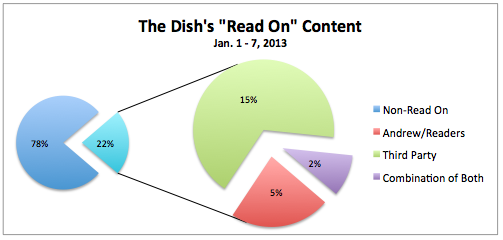
Jay Pinho has been tracking the Dish’s use of read-ons before and after we implemented the meter. A pre-meter snapshot:

before-meter

After the meter went up:

after-meter

Note that the percentage of posts that contain a read-on has stayed almost exactly the same. Pinho explains the difference:

[W]hereas 67.3% of all “Read On” sections before the meter contained mostly third-party content, now the plurality of “Read Ons” (44.0%) consist of content provided by Andrew and his readers (from analysis to letters to views from people’s windows). The proportion composed of third-party content has fallen to 40.0%, with the remaining 16.0% of all “Read On” sections comprised of material that contains both.

What this likely means is that Sullivan and his team have taken to heart the precautions of readers and commentators who noted that, to charge for content, the part that’s hidden to non-subscribers should tend to be more original — as opposed to a curation of third-party material.

Also, regarding third-party posts, almost all of their read-ons are inserted below a blogger’s link, thus publicizing his or her byline and the original piece for all Dish readers to see and visit, regardless of subscription. Pinho looks ahead:

I believe Sullivan mentioned recently that if the pace of subscribers didn’t pick up, he may “nudge” them towards paying their dues. This could happen in one of two ways. Either he could reduce the number of monthly “Read On” clicks it takes to trigger the meter (it’s currently at seven), or he could introduce more “Read On” posts as a percentage of his total posts. As an early subscriber, it doesn’t really matter to me which one he chooses. But so far at least, the content lying beyond the “Read On” button certainly seems to justify the annual fee.